AgriGames
Foodway
Growing food, building habitat, learning from the land and leaving some of the harvest free for whoever happens to pass.
AgriGames Foodway begins with a simple idea.
Not behind a fence.
Not only on a farm.
Not only for the person who owns the land.
Along the way.
When something is ripe, a person passing by can take some.
A local. A child. A worker. A stranger. A tourist.
That is the Foodway.
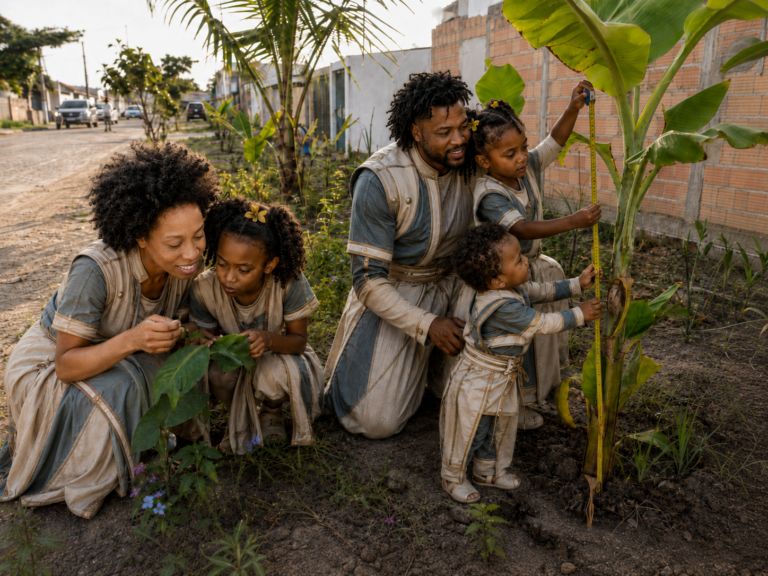
Prado Foodway 01
We are beginning with what is already growing around us.
It is not quite a farm.
It is not quite a garden.
It is a Foodway — a mixed productive place growing beside an ordinary human route.
Food Growing Freely Along the Way
The generosity is part of the design.
A ripe tomato does not always need a transaction.
A papaya does not always need a price tag.
A banana does not always need to enter a shop before it can become useful.
Leave some for the next person.
Do not damage the plant.
From Watching the Habitat to Creating Habitat
Our work in Prado began with observation.
We watched what survived in sandy ground.
We looked under mature trees and found fallen leaves, decomposing material and darker soil.
We watched pumpkin spread over exposed sand.
We watched mamona appear by itself and grow with extraordinary speed.
We watched coconut produce food.
We watched insects, flowers, roots, grasses and vines.
We started asking:
Now the Prado Observatory is entering another stage.
We no longer only ask: What insects are here?
We can ask: What should we plant so useful insects want to come?
We no longer only ask where shade exists.
We can grow shade.
We no longer only ask where the soil is covered.
We can plant living cover.
We no longer only watch birds arrive.
We can create food, flowers, shelter and living conditions that give them a reason to visit.
Life Helps Life
One of the simplest lessons coming from our Prado work is that living things do not perform only one job.
A plant can feed people while also shading soil, producing flowers, holding roots, creating biomass and giving another form of life somewhere to live.
One Species, More Than One Job
This matters especially for small producers.
A small producer does not have endless land.
Every square metre can do more.
Pumpkin
Food + flowers + ground cover + shade + biomass
Banana
Food + shade + vertical structure + leaves + biomass
Coconut
Food + long-term canopy + shade + organic material
Papaya
Food + fast vertical growth + light canopy
Tomato
Quick food + flowers + productive use of small space
Flowers
Beauty + pollinators + habitat + living signals
Temporary Pioneer Plants
Fast roots + shade + biomass + temporary protection
Ground Layers
Living cover + root occupation + less exposed soil
It is, “How many useful relationships can I build into this space?”
Cover the Ground With Life
Hot bare sand takes the full sun.
It dries quickly.
It has very little protection.
Low plants can cover the ground.
Vines can crawl.
Middle plants can make biomass and partial shade.
Fruit trees can rise above them.
Flowers can fill edges and gaps.
The same small space can begin producing:
Build the Food and Build the Habitat Together
We do not want to grow food inside a dead landscape.
We want the productive area itself to become habitat.
When we plant flowers, we can think about bees and butterflies.
When we grow fruiting plants, we can think about birds.
When leaves fall, we can think about decomposition.
When roots spread, we can think about what is happening under the ground.
Plant the shade.
Plant the flowers.
Build the ground.
Then watch who arrives.
The Foodway Is Also a Research Site
Prado Foodway 01 is not only a public food space.
It is also part of our continuing field research.
We can keep asking:
- Which plants establish fastest?
- Which plants survive the heat?
- Which plants cover exposed ground best?
- Which flowers attract useful insects?
- Which plants create the most useful biomass?
- Which species work well beside each other?
- Which compete too strongly?
- How much water do they need?
- What happens when leaves and stems return to the soil?
- How does the habitat change as we plant more deliberately?
We are already testing fresh chopped mamona leaves and non-seed stems as surface mulch around banana.
We intend to continue testing that treatment with tomatoes, grape vines, fruit trees and other edible plants.
The Foodway can therefore become both:
a place that gives food
and
a place that teaches us how to grow more of it.
Why AgriGames?
Growing food does not have to be presented only as hard agricultural work.
It can also be exploration.
A challenge.
A test.
A family activity.
A competition with yesterday’s result.
The land gives us questions.
We play by trying to answer them.
But the result is real:
Start With One Small Nucleus
Prado Foodway 01 does not need to be enormous.
That is part of the point.
Begin with one small productive place.
A household can make one.
A small producer can make one.
A community space can make one.
They do not need to look identical.
Putting Prado on the Map Through Abundance
Prado is already known for its coast, tourism and natural beauty.
There is another identity it can grow into.
Imagine a tourist walking past a ripe tomato.
A child passing a papaya.
A worker taking a banana.
A stranger finding watermelon in season.
A local resident seeing the Foodway and deciding to make another one.
That kind of abundance does not have to begin with a giant project.
It can begin with one small productive edge.
What AgriGames Foodway Brings Together
Our Prado work is bringing together many simple ideas:
Observe what survives.
Plant between useful life.
Cover exposed ground.
Let one species perform more than one job.
Return safe biomass.
Grow food and habitat together.
Attract life instead of only watching it.
Test ideas.
Film what happens.
Share what works.
And leave some of the harvest free for whoever happens to pass.
Build habitat.
Learn from the land.
Share the harvest.

 and then