Authored Water Intelligence
Water is not merely moved. Its behaviour can be authored.
Trott Bailey Family Civilization does not treat water simply as something to collect, pipe, consume and drain. Water has height, weight, temperature, pressure and movement. It can rise, fall, gather, spread, divide, cool, nourish, infiltrate, transport, replenish, erode, clean and return.
What should water be allowed or asked to do during its journey?
Authored Water Intelligence develops physical species, systems and landscape relationships around that question. Natural systems, established engineering, traditional knowledge and newly authored Trott Bailey systems may work separately or together.
An invention does not need another solution to fail in order to have value. Difference itself can be a legitimate reason to explore and invent. The standard is not whether difference was necessary, but whether the difference has been genuinely authored through anatomy, behaviour and experience rather than cosmetically applied.
Sky-Rain Organ
Official Design 01 — LockedWater goes up.
Rain comes down.
Hot people cool off.
They continue their journey.
Function
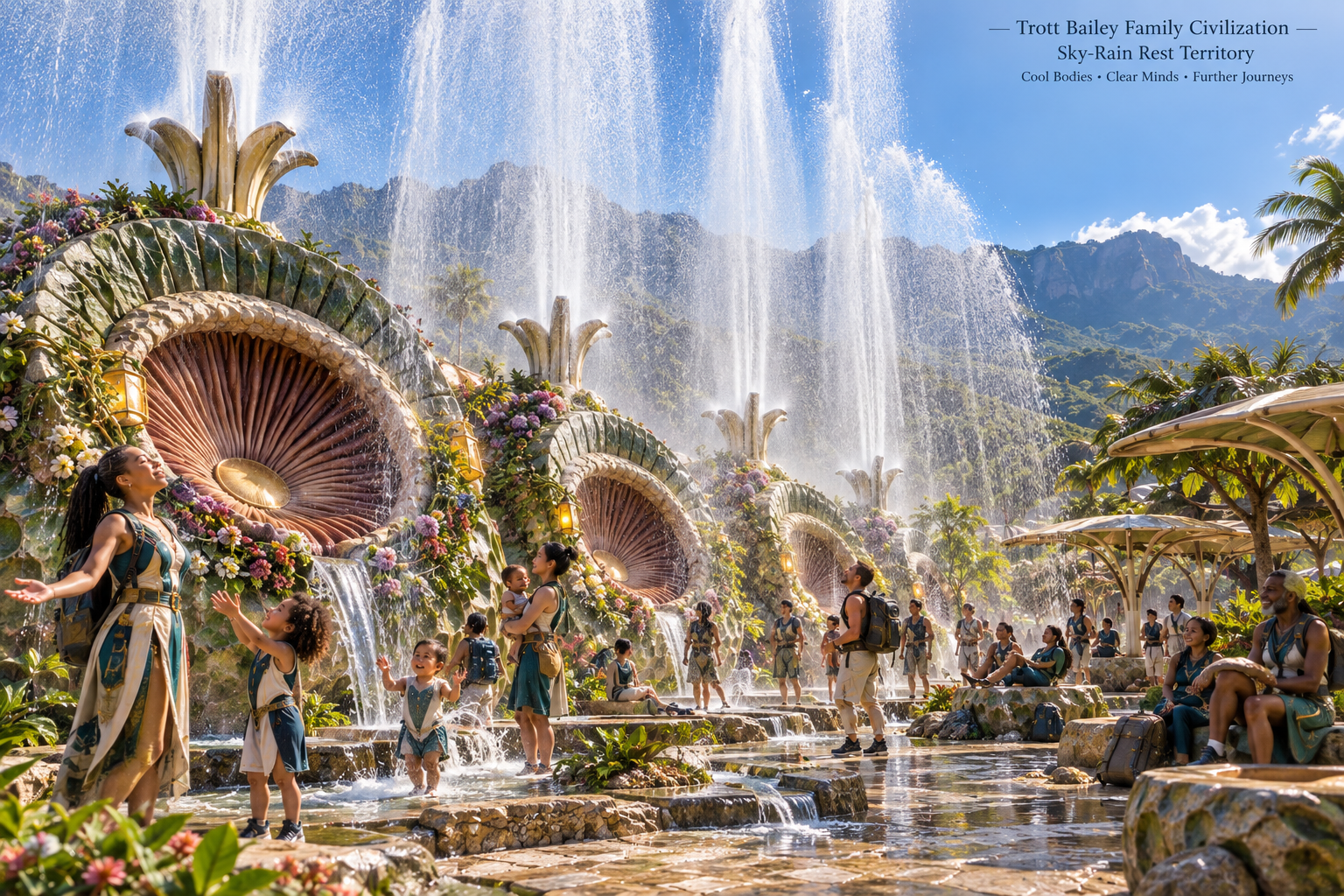
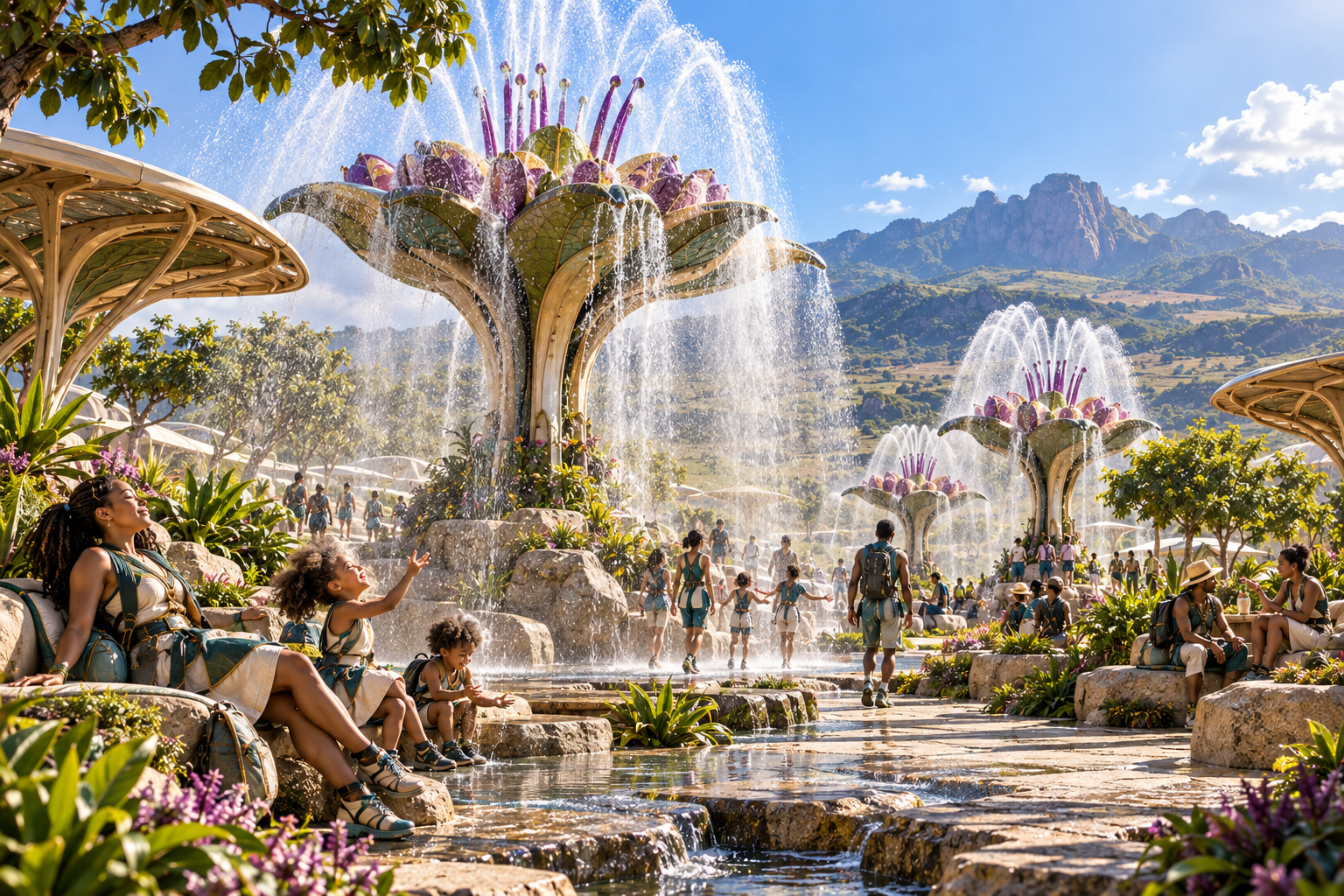
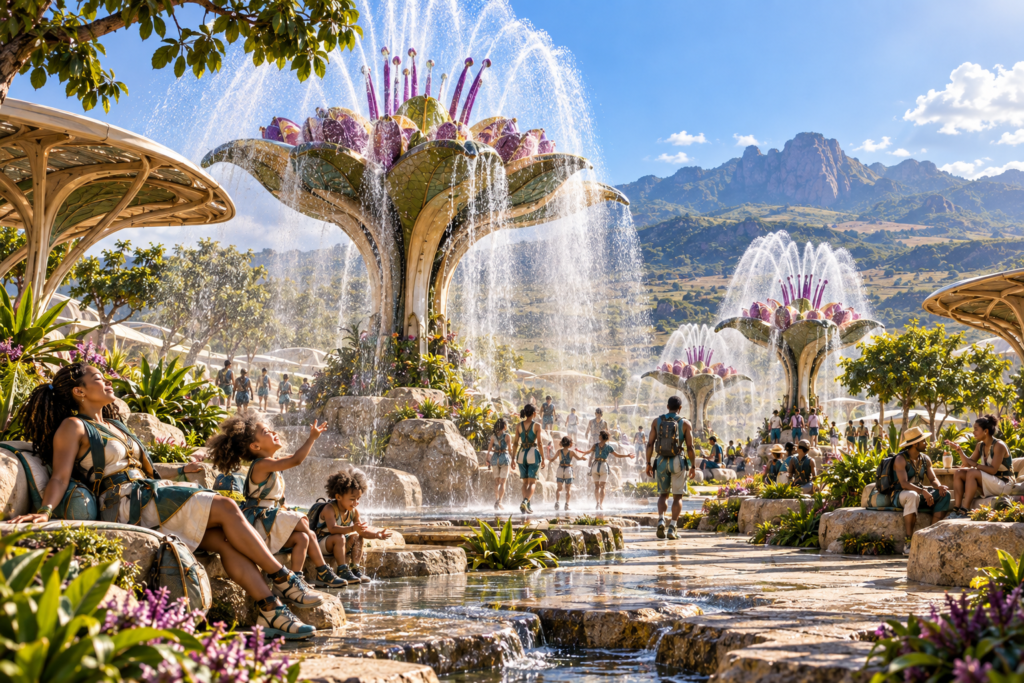
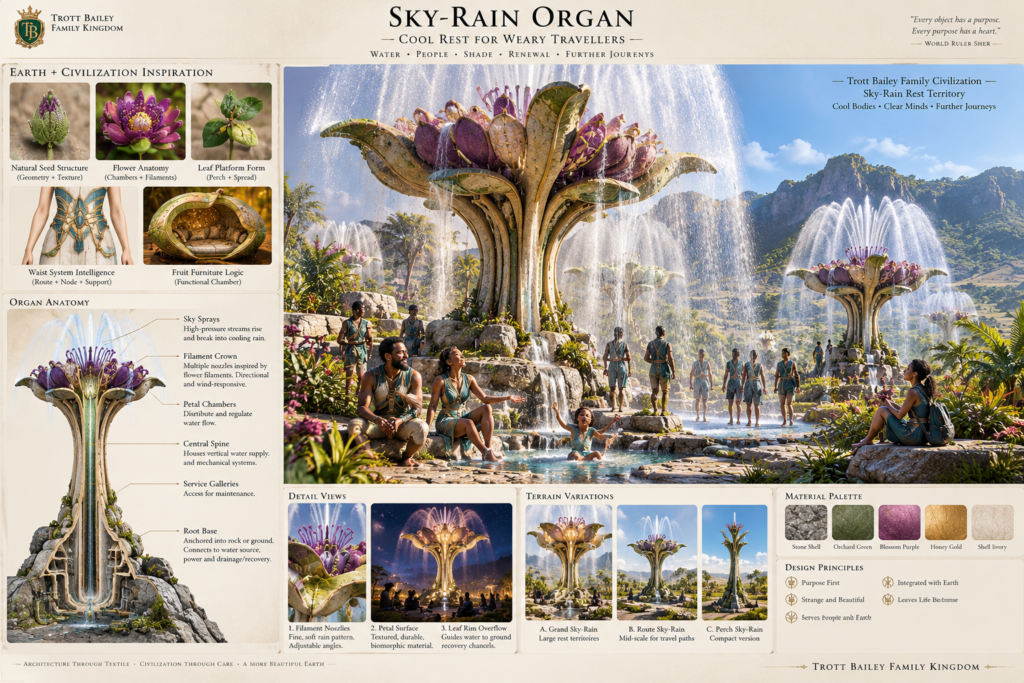
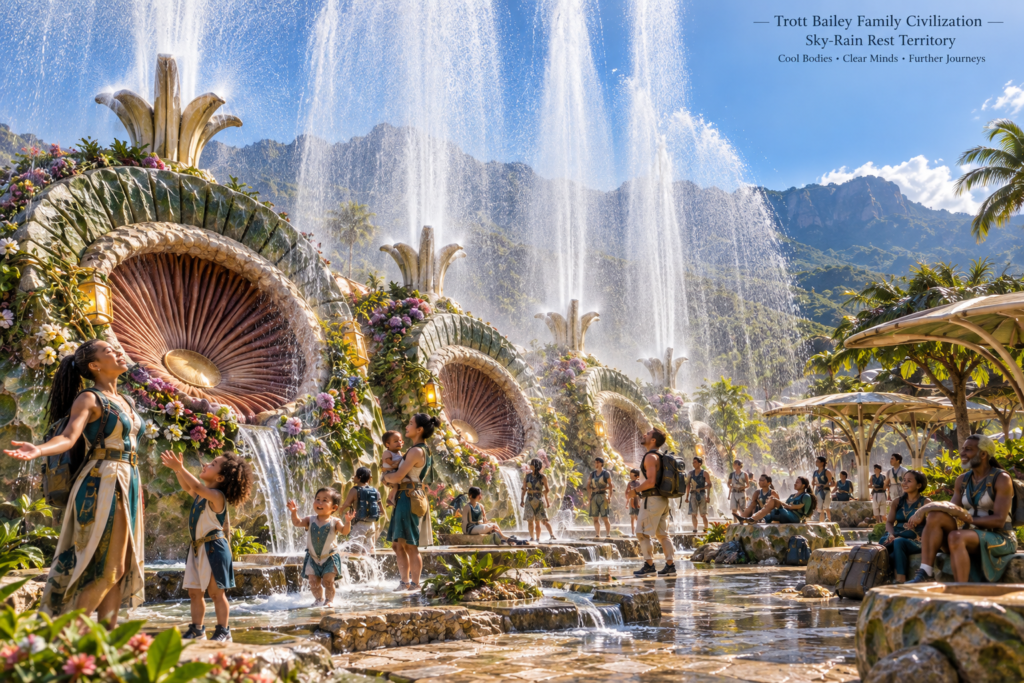
The Sky-Rain Organ creates a territory of cooling rainfall for hot and weary travellers, workers, families and other citizens moving through exposed landscapes. Clean human-contact water is driven high above the organ, separates at height, and returns over the surrounding territory as broad cooling rainfall. Its primary purpose is simple: cool hot people.
The need
Trees and mature vegetation are among the Civilization’s preferred forms of natural cooling. They provide shade while supporting habitat, soil, nourishment, beauty and the wider living landscape. But trees take time to grow. Newly recovering land, young districts, exposed routes and dry territories may not yet have enough mature canopy. Civilization should not wait years before caring for people travelling through them.
Grow the trees.
Care for people while the trees grow.
As landscapes mature, some Sky-Rain Organs may remain because they continue to be useful and loved. Others may operate less or become unnecessary. Infrastructure may gracefully surrender a job to a living system when the living system becomes able to carry it.
Water behaviour
The Sky-Rain Organ is not primarily a fountain. Water is thrown powerfully upward, well above the organ, before separating and returning as rain. A traveller may see rain falling ahead beneath an otherwise clear, hot sky. Coverage need not be circular or identical between sites; wind, weather, terrain and actual human need determine the rain territory.
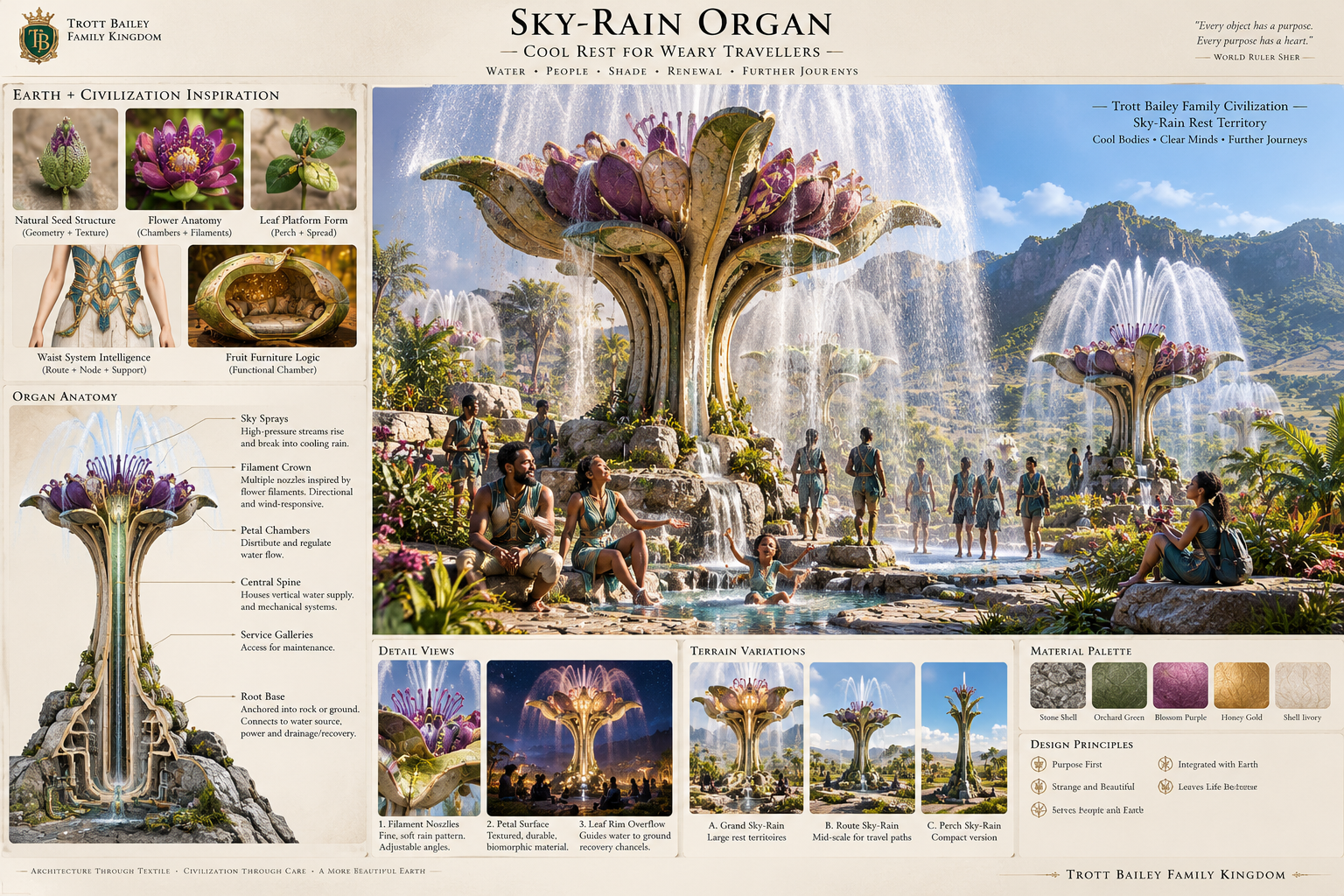
Design 01 anatomy
Sky-Rain Organ names the invention family. Design 01 names the first accepted physical answer. Future generations may author radically different Sky-Rain designs without normalizing or erasing this one.
- tall, comparatively slender supporting stem;
- disproportionately large spreading upper body;
- broad green mineral- and leaf-like projecting lobes;
- swollen purple chamber bodies;
- tall purple filament-like outlet structures;
- an unmistakable strange, perched silhouette.
Its proportion is intentional. It should not gradually become a conventional tower, sprinkler, fountain or shade canopy.
Rest territory, afterlife and lived use
Rain may fall directly onto grass, stone, earth, traveller routes and suitable resting grounds. Water reaching the ground may infiltrate, nourish vegetation or enter recovery systems. Those are downstream relationships, not extra jobs for Sky-Rain.
The invention explains itself through life: a tired traveller enters the rain; children run through it; a worker pauses; a family rests; a parent with a baby uses the gentler edge. Then people continue. Sky-Rain is care infrastructure. It can be delightful without becoming an attraction.
The traveller finds rain where the traveller needs rain.
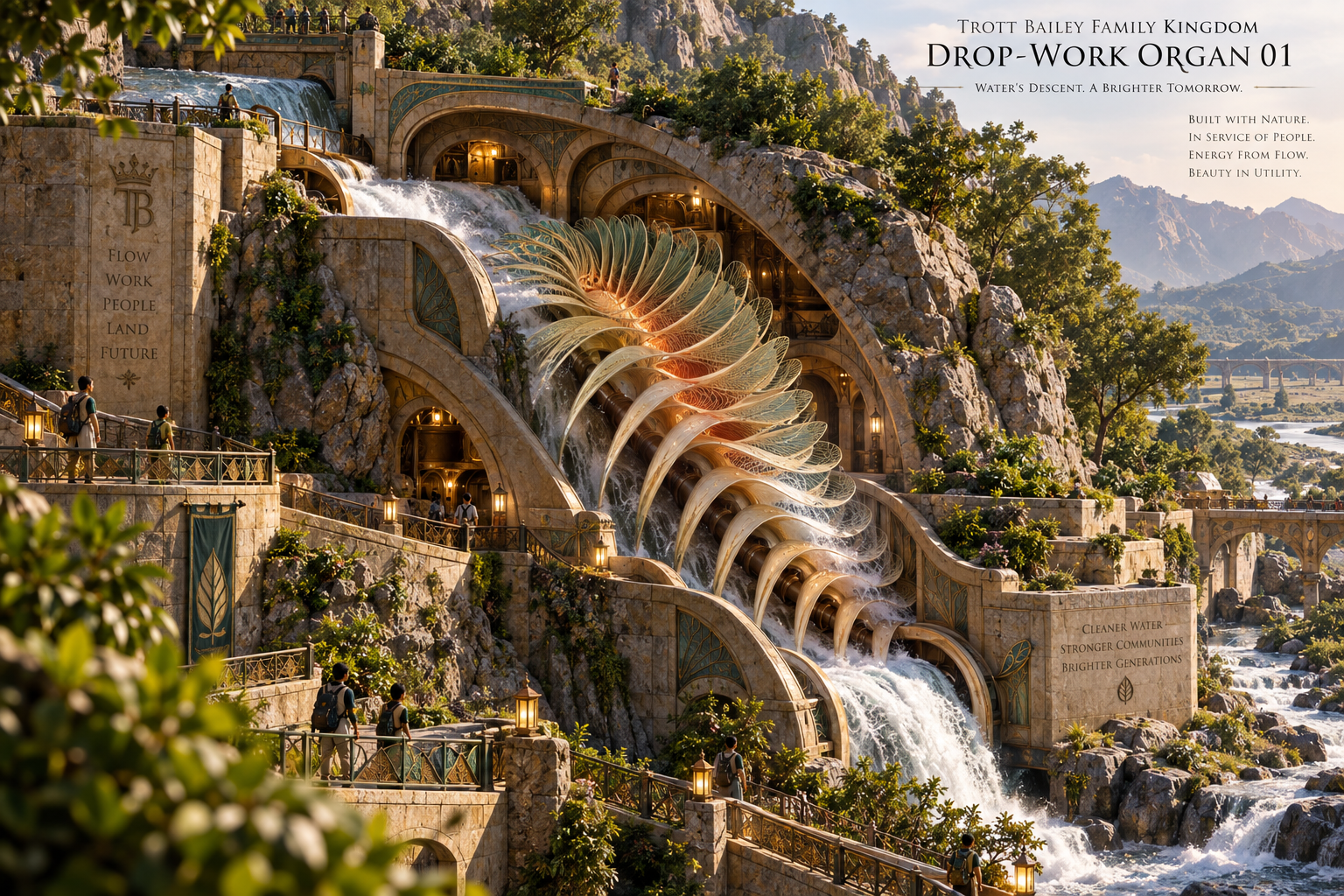
Drop-Work Organ
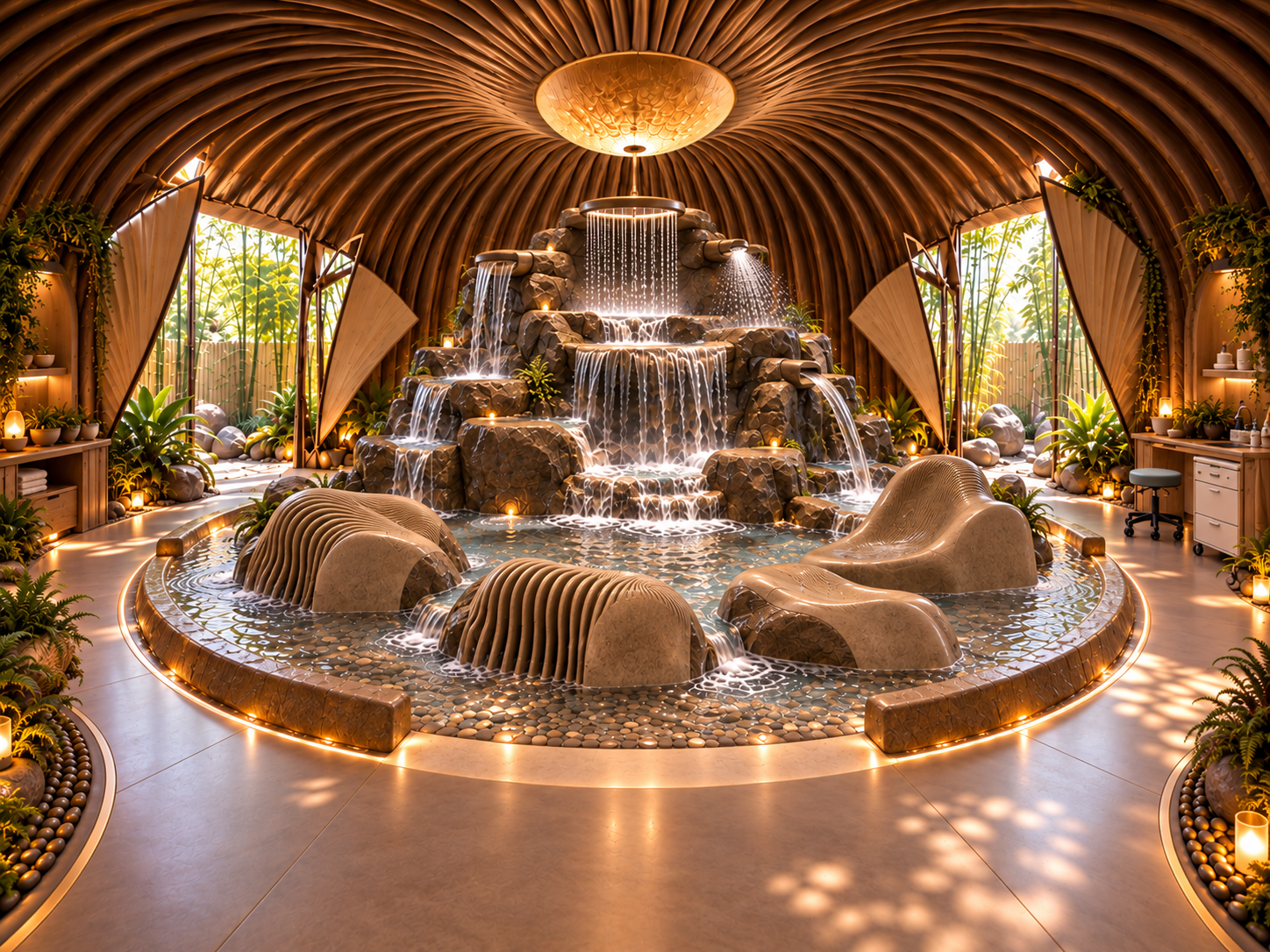
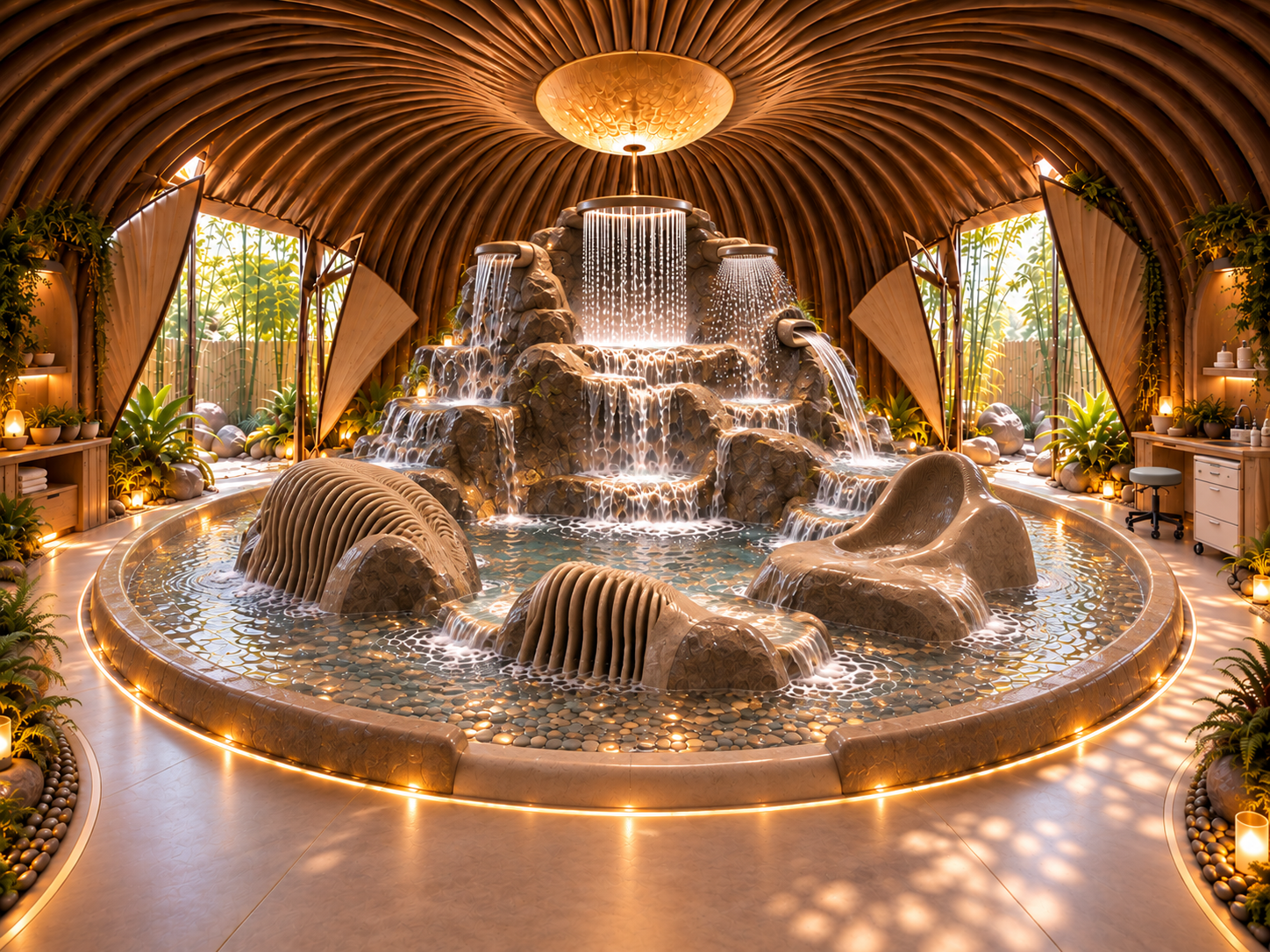
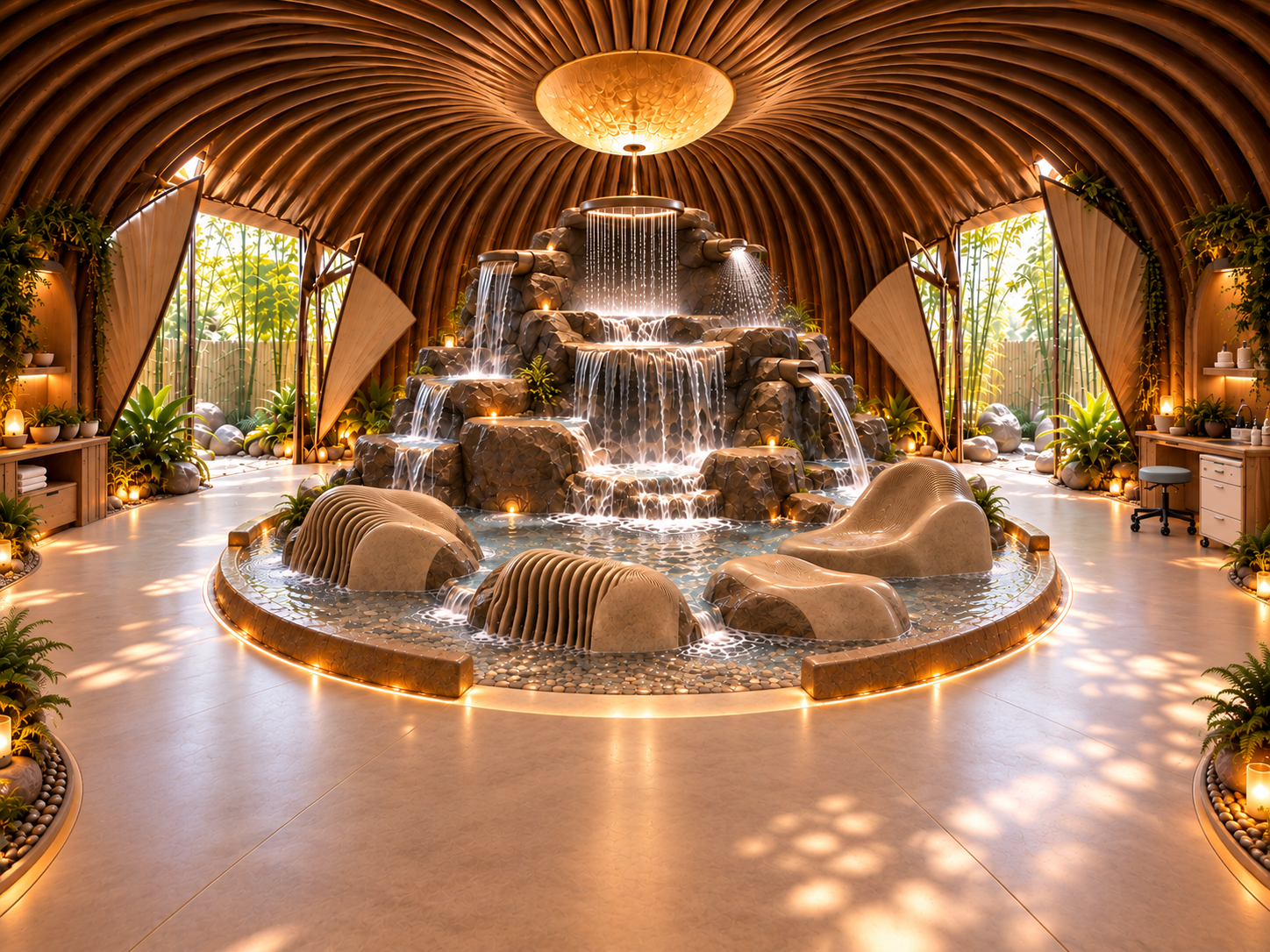
Core Function Locked · Design 01 Under RefinementHeavy water enters.
Its movement is brought under control.
Useful energy is recovered.
Controlled water leaves in deliberate directions.
The need
Powerful natural waterfalls and descending water are not automatically problems. Some should remain exactly as they are. Their existence does not create an obligation to engineer them. Where fast-descending water must already be managed before entering inhabited, cultivated, infrastructural or ecologically sensitive lower territory, the Civilization asks:
If this water already needs to be brought under greater control, what useful work can it perform during that transformation?
Water behaviour
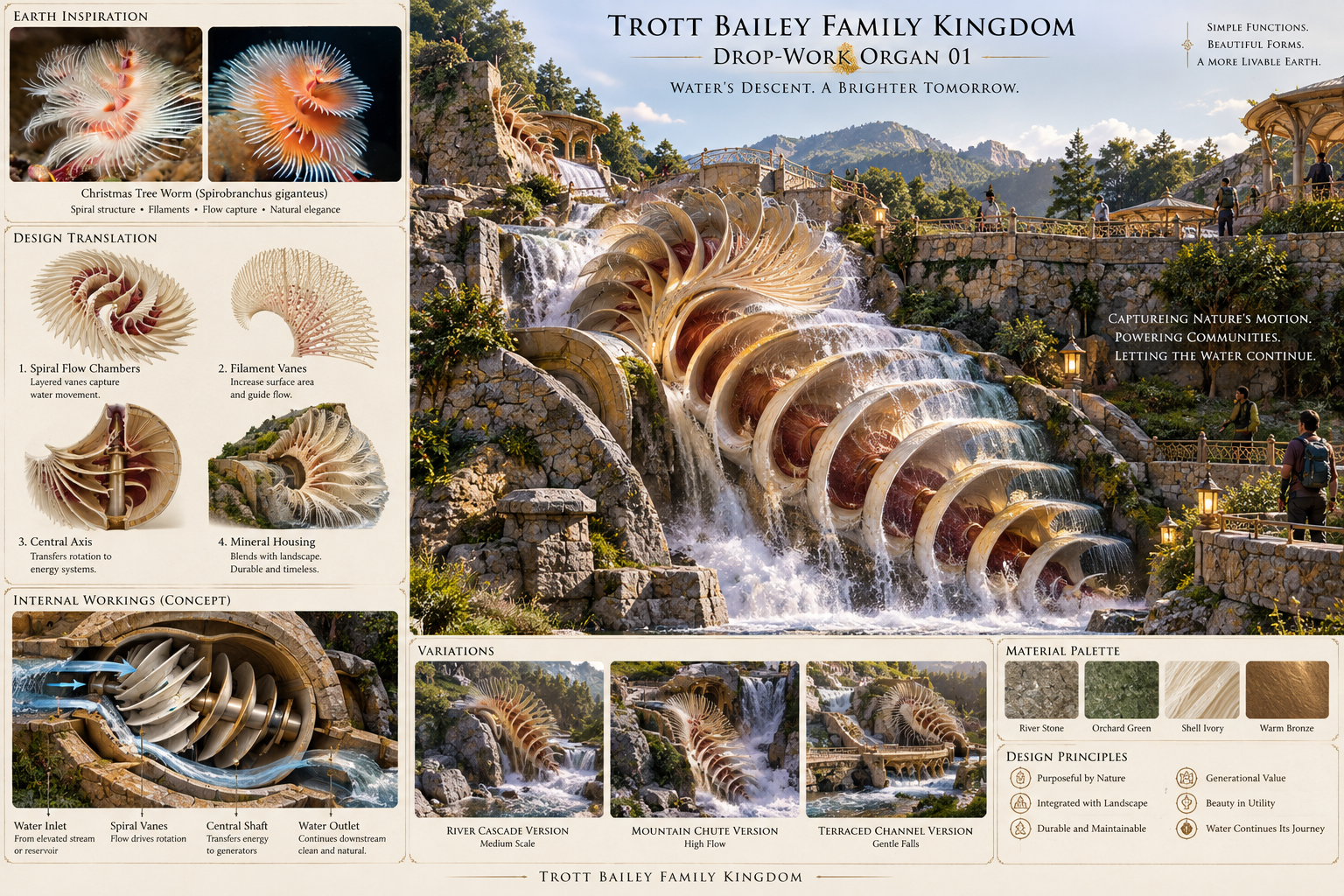
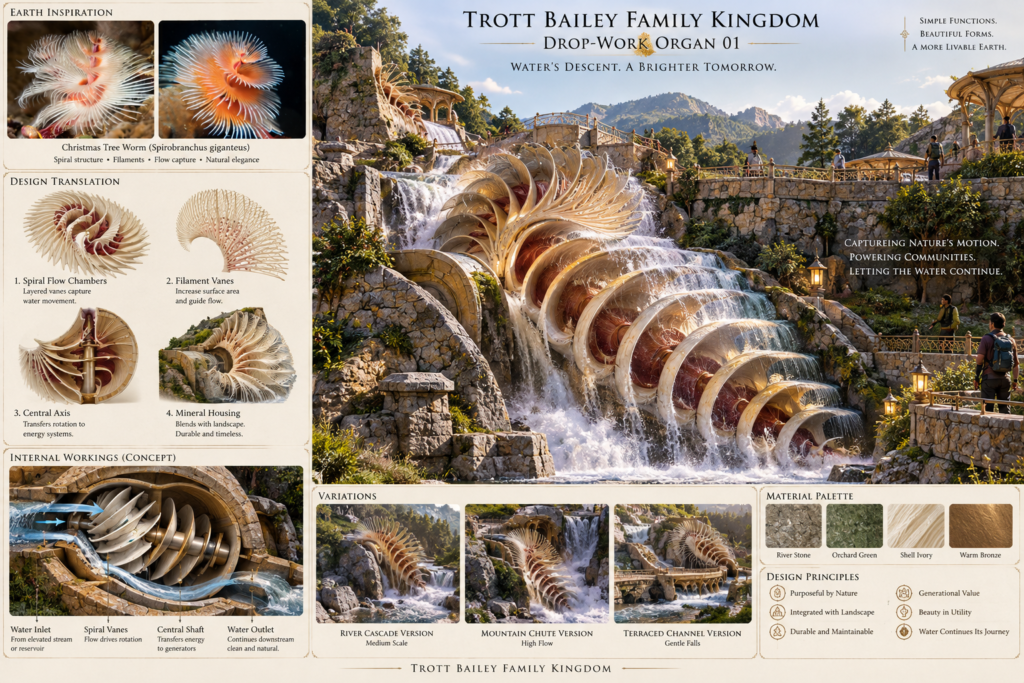
One substantial, powerful water body enters. Successive working stages intercept and redirect the flow, progressively reducing the water’s excess kinetic energy and velocity where required. Where appropriate, available hydraulic energy is recovered as useful power. Multiple calmer, deliberate water routes may then leave.
ONE powerful water body enters.
ONE embedded architectural organism works upon it.
SEVERAL controlled water bodies leave.
Energy recovery and division
Energy recovery follows from the hydraulic intervention rather than being attached as a claim afterward. Water is already descending; where terrain, flow and engineering make recovery worthwhile, part of that energy can perform useful work before the water continues.
Water needed to go downhill anyway.
The Civilization refuses to waste the fall.
Outgoing routes may later serve a continuing river, orchards, agriculture, ecological flow, storage, recharge or another water journey. Those destinations do not redefine Drop-Work. Its responsibility is to hand downstream Civilization controlled water rather than one difficult concentrated torrent.
Design 01 anatomy
The first physical branch draws anatomical intelligence partly from the Christmas-tree worm, Spirobranchus giganteus. It is not copied as decoration. Repeated spiral and radial structures, a concentrated central axis, successive layers, fine projections and transitions from dense central anatomy toward spreading outer anatomy inform hydraulic and architectural form. Upper stages may be thicker and more deeply anchored; lower stages may open toward several outgoing routes.
Embedded architecture
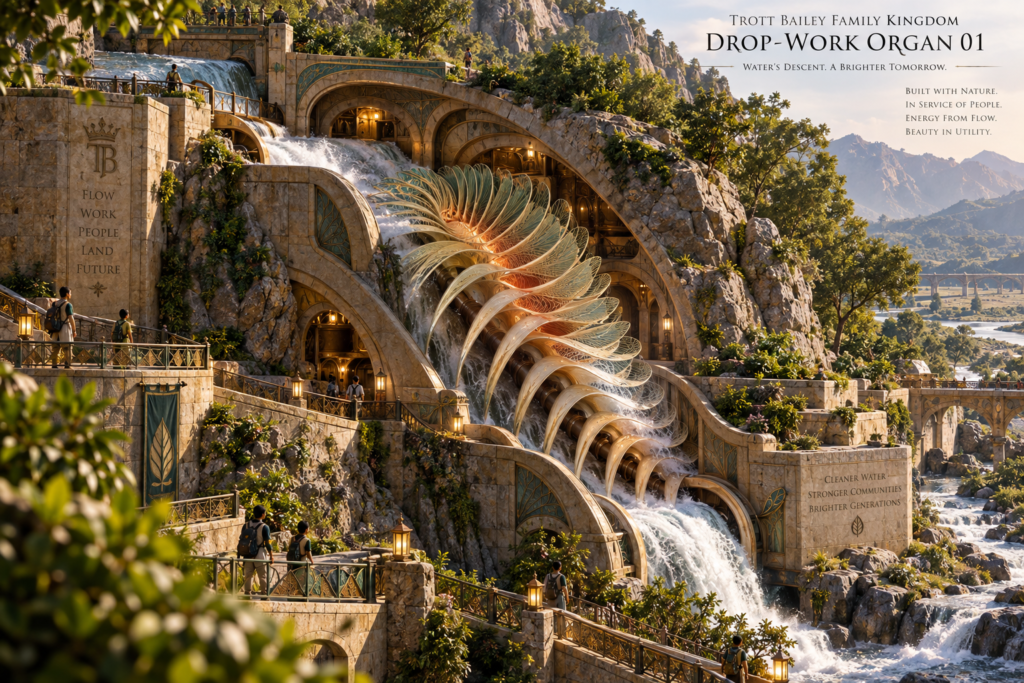
Design 01 should be neither a machine placed before a waterfall nor a sculpture placed inside one. Its relationship is terrain + architecture + machine. A working axis may penetrate rock; hydraulic chambers may occupy excavated mountain territory; protective ribs may emerge from raw stone and disappear back into it; maintenance territory can sit behind visible anatomy.
Failure behaviour
Failure and extreme conditions are part of the authored system, not an afterthought. If working chambers are unavailable, blocked, under maintenance, or receive more water than they can safely process, the design must provide a safe hydraulic condition. A terrain-integrated bypass route can allow excess water to continue without being forced through the organ. Its geometry may become genuine architectural anatomy rather than a hidden emergency appendage.
Human experience and value
The organ need not become a tourist attraction. A mountain route may simply pass near it. Travellers may hear deep hydraulic activity before seeing it. Protected openings may reveal portions of the working system to citizens, learners and apprentices, while stewards reach internal maintenance territories.
Do not interfere with powerful water merely because it is powerful.
But where intervention is necessary, ask what useful work the water can perform while being brought under control.
Two behaviours. One deeper intelligence.
Controlled water → cooling rain
Hot people cool and continue.
Powerful descent → useful energy + controlled flows
Water continues through deliberate routes.
Trott Bailey Family Civilization does not merely move water from one place to another. It authors the behaviour of water according to what life and landscape need.
Eight questions before acceptance
An organ is an encounter in the life of water, not necessarily the end of water’s usefulness.
Difference may be pursued deliberately.
No single formula is mandatory. Invention may emerge from Earth, physics, mathematics, terrain, craft, material behaviour, human experience, animal behaviour, a child’s discovery, accident, existing Trott Bailey species, or something not yet encountered.
Earth intelligence + observed behaviour + civilization need or possibility + relevant authored knowledge → new authored species.
One particularly productive branch is:
Earth anatomy × Trott Bailey anatomy × specific need or possibility → new authored species.
Earth is not merely a catalogue of attractive shapes. It can teach proportion, route, chamber, branching, repetition, suspension, compression, opening, closure, attachment, asymmetry, texture, movement and behaviour. Existing Trott Bailey work contributes accumulated authored intelligence. Neither source should imprison the result.
Difference itself can be a legitimate reason to explore and invent. Something does not need to be broken before the Civilization is permitted to imagine another possibility. The important distinction is between authored difference and cosmetic difference. A genuinely authored species may reconsider anatomy, behaviour, relationship with people and Earth, maintenance, movement, material logic and experience—even when an existing solution already works.
“What is that?”
Then, after watching it work:
“Ohhh. That’s why it is shaped like that.”
New invention does not require old knowledge to be diminished.
Future records should explain the actual need or possibility and the invention’s contribution without artificially diminishing other valid solutions.
An invention does not need another solution to fail in order to have value.
Natural systems, traditional approaches, established technologies and newly authored Civilization systems may coexist. Ask: What is needed or possible here? What already works? What remains unresolved? What else might become possible? What happens if we deliberately depart from the familiar form? Is the resulting difference real throughout the species—or merely cosmetic?
Do not decorate with water. Give water a life.
Observe the water.
Observe the Earth.
Identify the need or possibility.
Understand what already exists.
Then permit yourself to depart from it completely.
Author the form, behaviour and experience—not merely the appearance.
Give each invention the functions it needs.
Design how it behaves when conditions go wrong.
Then let the water continue its journey.