Fushi stations are freely accessible in appropriate locations throughout civilization and supports Trott Bailey Family Civilization wider dental health culture
Trott Bailey Family Civilization · Oral Health Culture
The Civilization-Wide Oral Health, Cleanliness & Dental Care Standard
“The point is not Fushi by itself, it’s everything together: the natural grass straws for flossing stuck meat out of hard to reach molars. Our dual head Fushi Level 3 cleaner brushes; one flexible ‘u’ shaped brush head with it’s compacted and dense high quality bristles, the swivel function of dental brush for better dental plaque break up without hurting the gums. Then the other inter-dental cleaning tip for cleaning between tighter teeth spaces. There are several dual tip brush combinations styles to choose from that can suit different preferences and mouths. Combine that with civilization wide access to the the FUSHI jet-like water-floss system and a culture of keeping the mouth clean, eating healthily, free access to a developed dentistry system all working together for the national health of the people.”
— World Ruler Sher
01 / Foundation
Good dental health should not depend on whether someone can afford a dentist, buy the right instruments, or remember to manage every part of oral care without support.
Our civilization must provide the conditions that make healthy mouths easier to maintain.
That includes what people eat, what children learn, how adults clean their teeth, what instruments are available after meals, and how quickly someone receives professional care when something goes wrong.
The purpose is to help people keep their natural teeth healthy, their gums comfortable, their breath clean, and their mouths free from avoidable pain and disease throughout life.
Fushi is the civilization’s coordinated response.
Our instruments are not the whole response. They are designed examples of the larger principle: the civilization should make it easy for people to do what benefits their lives.
02 / Daily life
We wash our bodies, clean our living spaces, wash our clothing, and prepare clean food. The mouth deserves consistent care too.
People eat several times each day. Food particles become trapped between teeth. Plaque builds up, and without proper cleaning, that plaque can contribute to tooth decay and gum disease.
Fushi establishes a culture in which cleaning the mouth is a familiar and convenient part of daily living.
After meals, people can remove food that has become stuck between their teeth and use appropriately designed cleaning instruments when needed.
At home, they carry out proper plaque-disrupting cleaning, including brushing and suitable cleaning between the teeth.
Children learn these routines through their parents, care providers, and practical examples in daily life.
This culture should develop naturally through teaching, convenience, and good infrastructure. It should not require humiliating people, policing their mouths, or turning cleanliness into a public performance.
The goal is healthier mouths, not the appearance of perfect teeth.
03 / Authored tools
The Fushi system recognizes that different forms of cleaning perform different jobs. One instrument does not have to do everything.
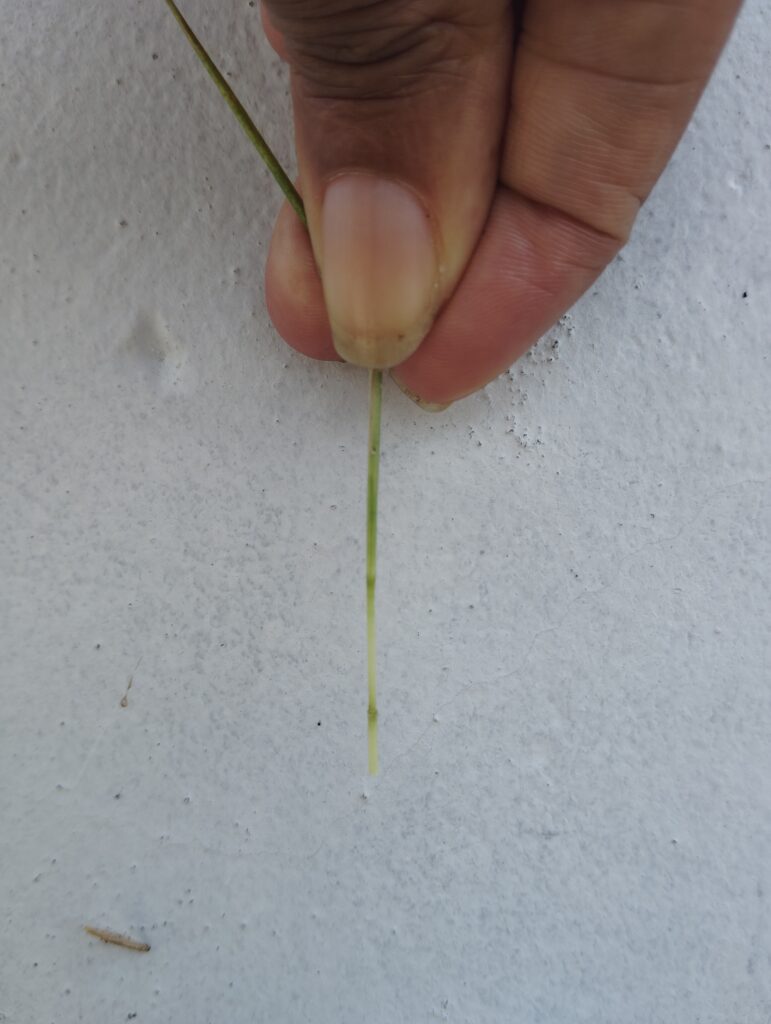
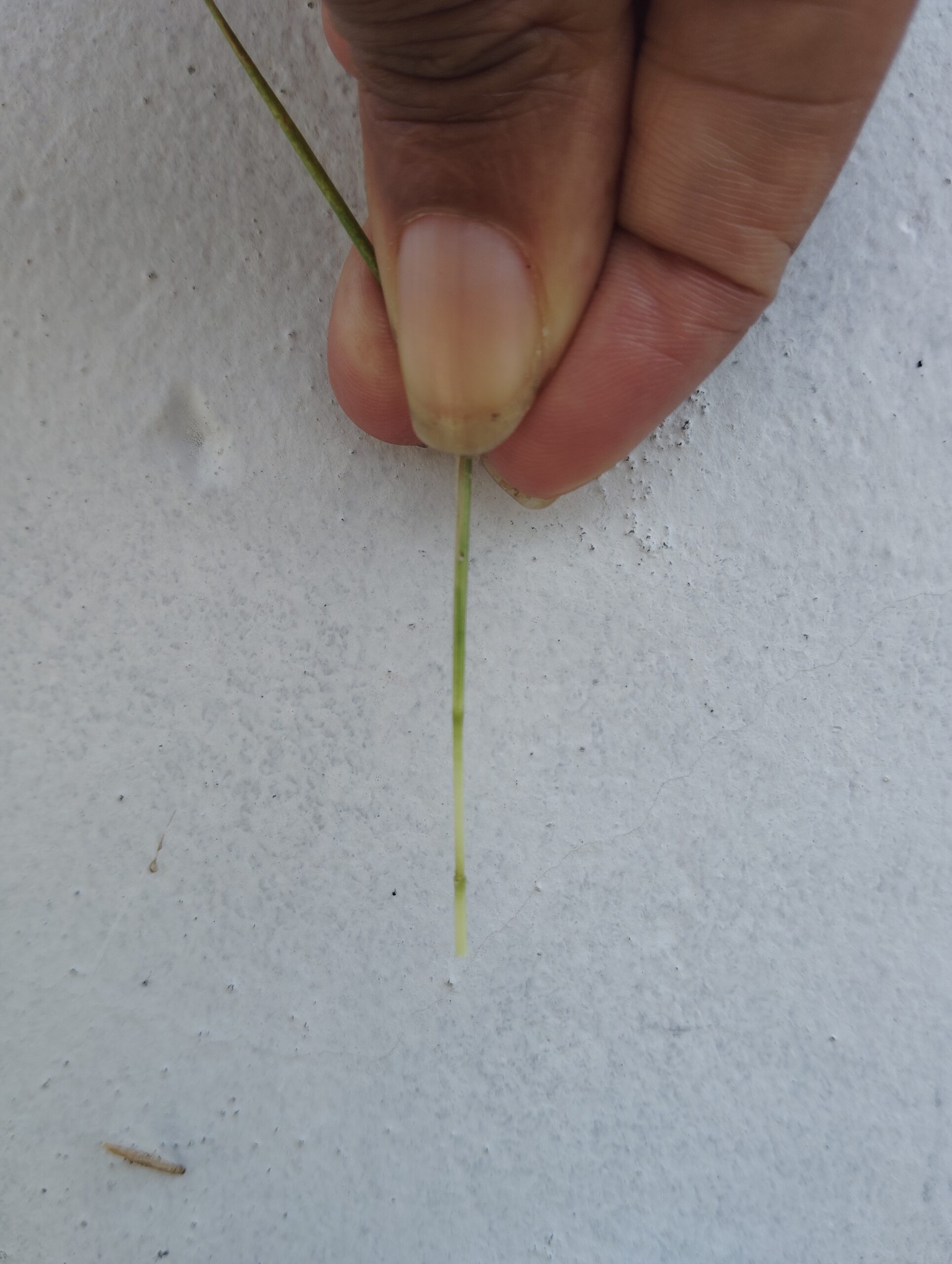
We have proposed naturally grown, biodegradable grass-straw tools for releasing pieces of food, particularly meat, trapped around the molars and in accessible spaces between teeth.
These are small, simple instruments for a common everyday problem.
They should be easy to obtain where food is served and where families spend their time.
Suitable plants, surface quality, flexibility, dimensions, hygiene, and splinter resistance must be established before approval for oral use.
They must not damage gum tissue or be forced into tight contacts between teeth.
Natural food-release tools are not a replacement for proper plaque removal or dental floss where floss is needed.
Their purpose is straightforward: help people remove troublesome food conveniently without turning a small problem into a lengthy task.
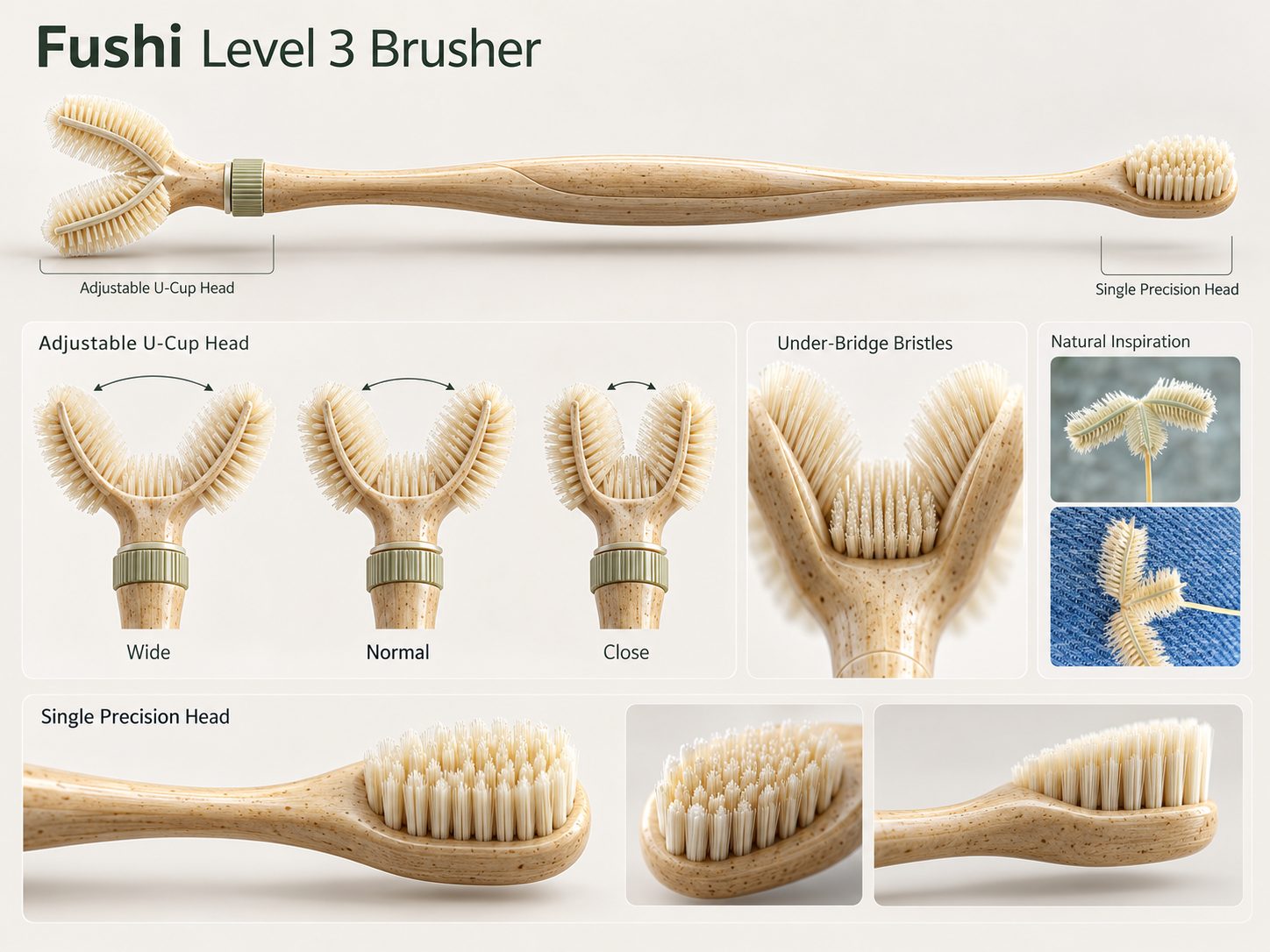
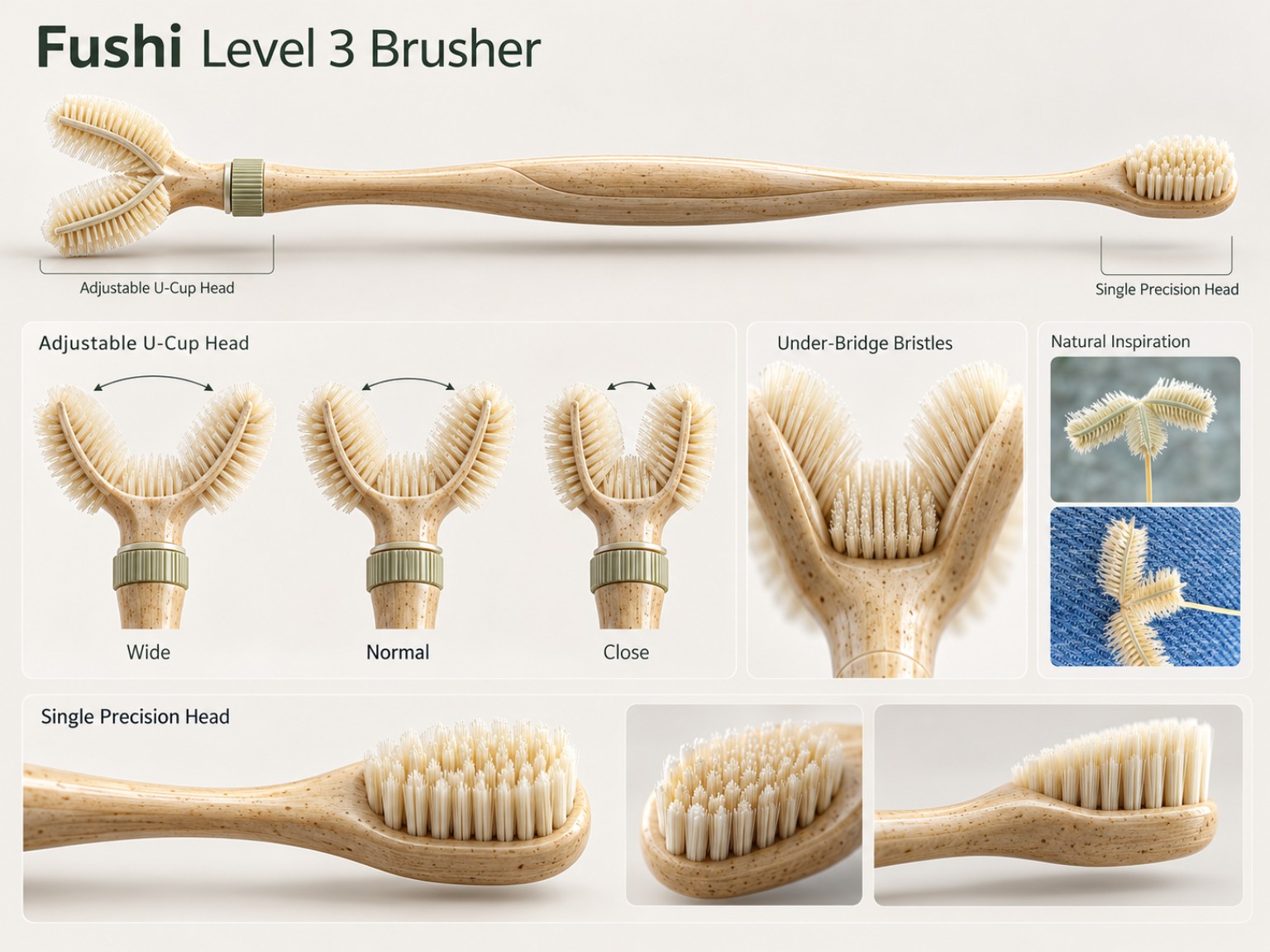
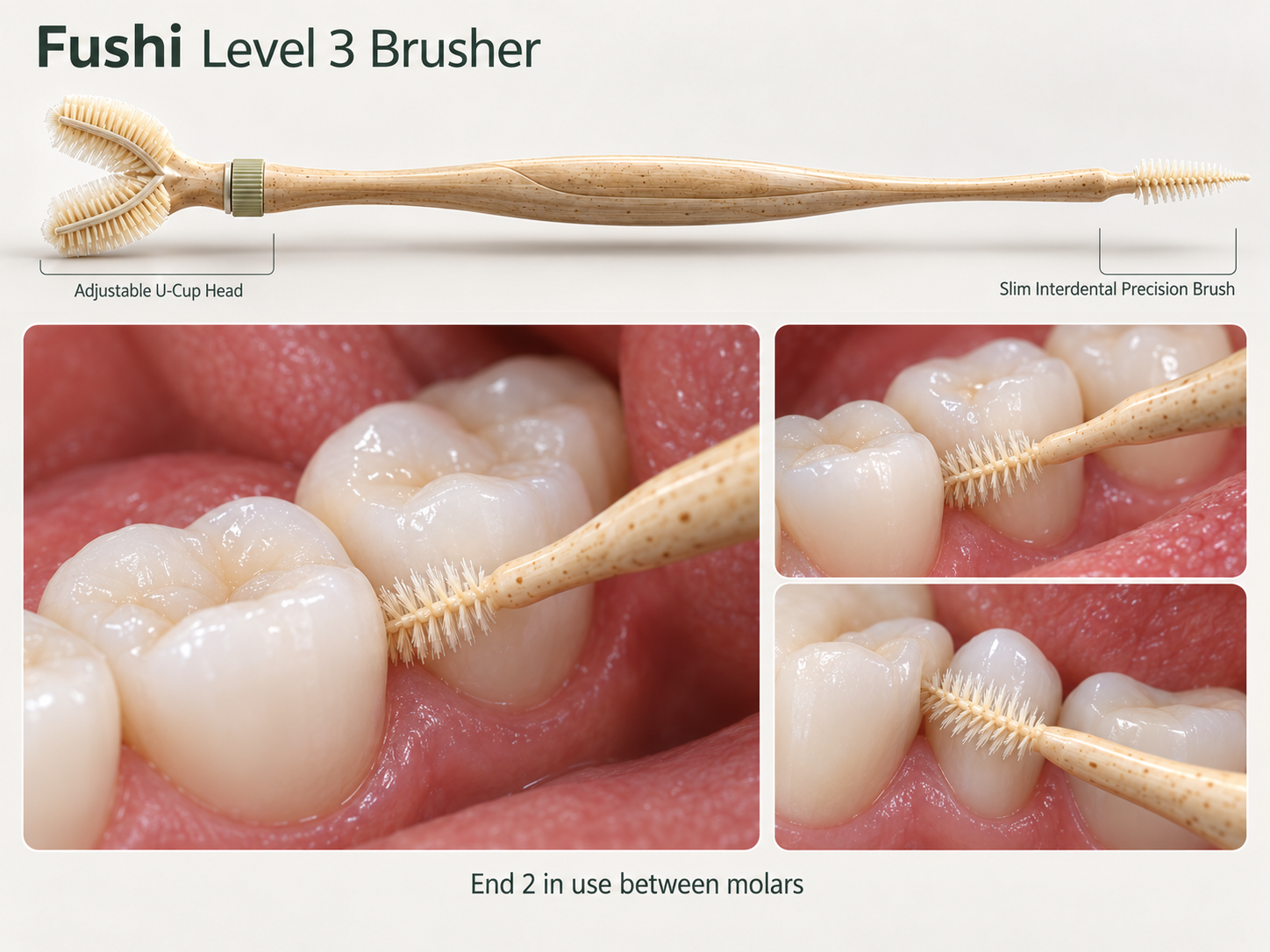
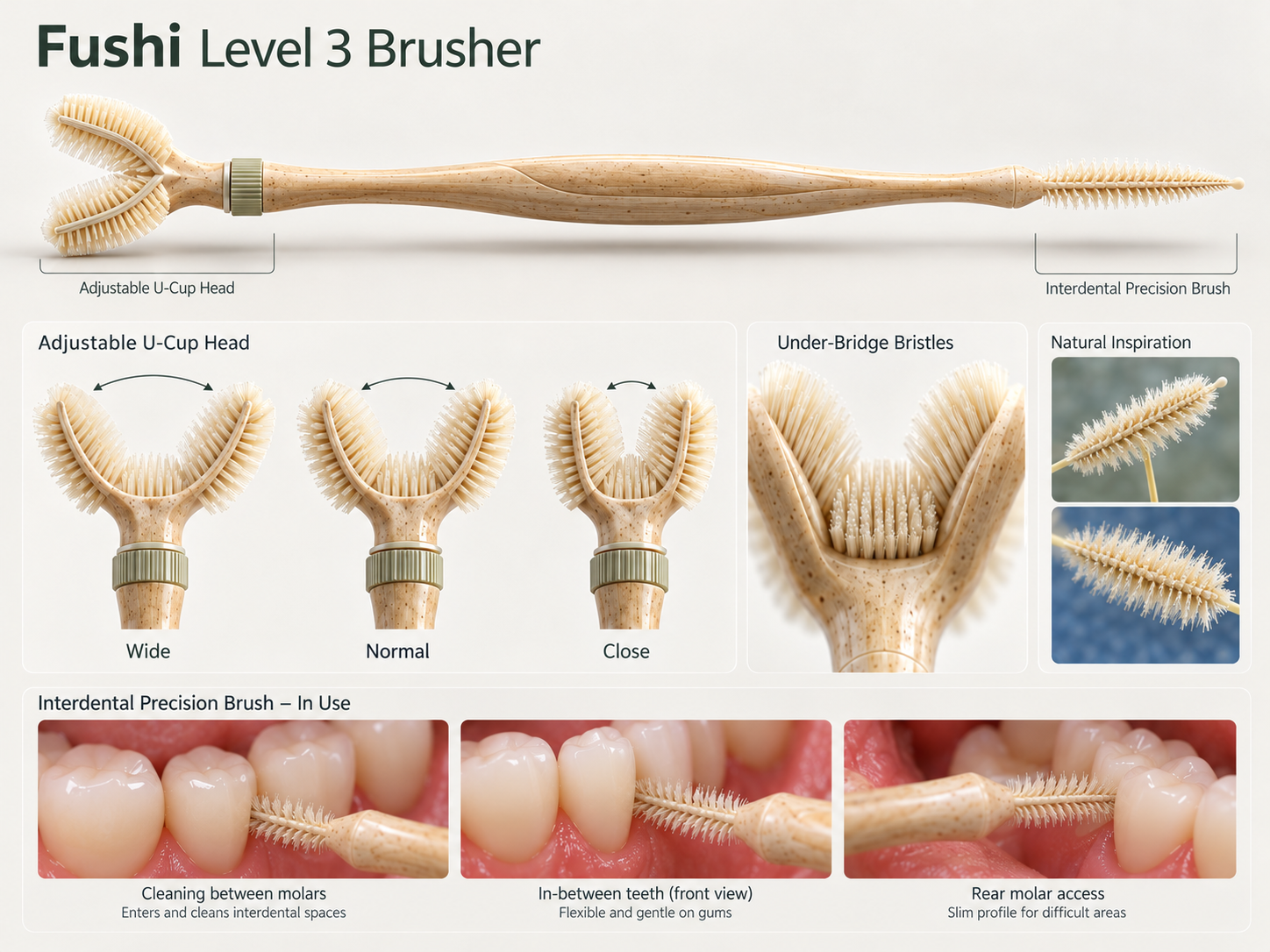
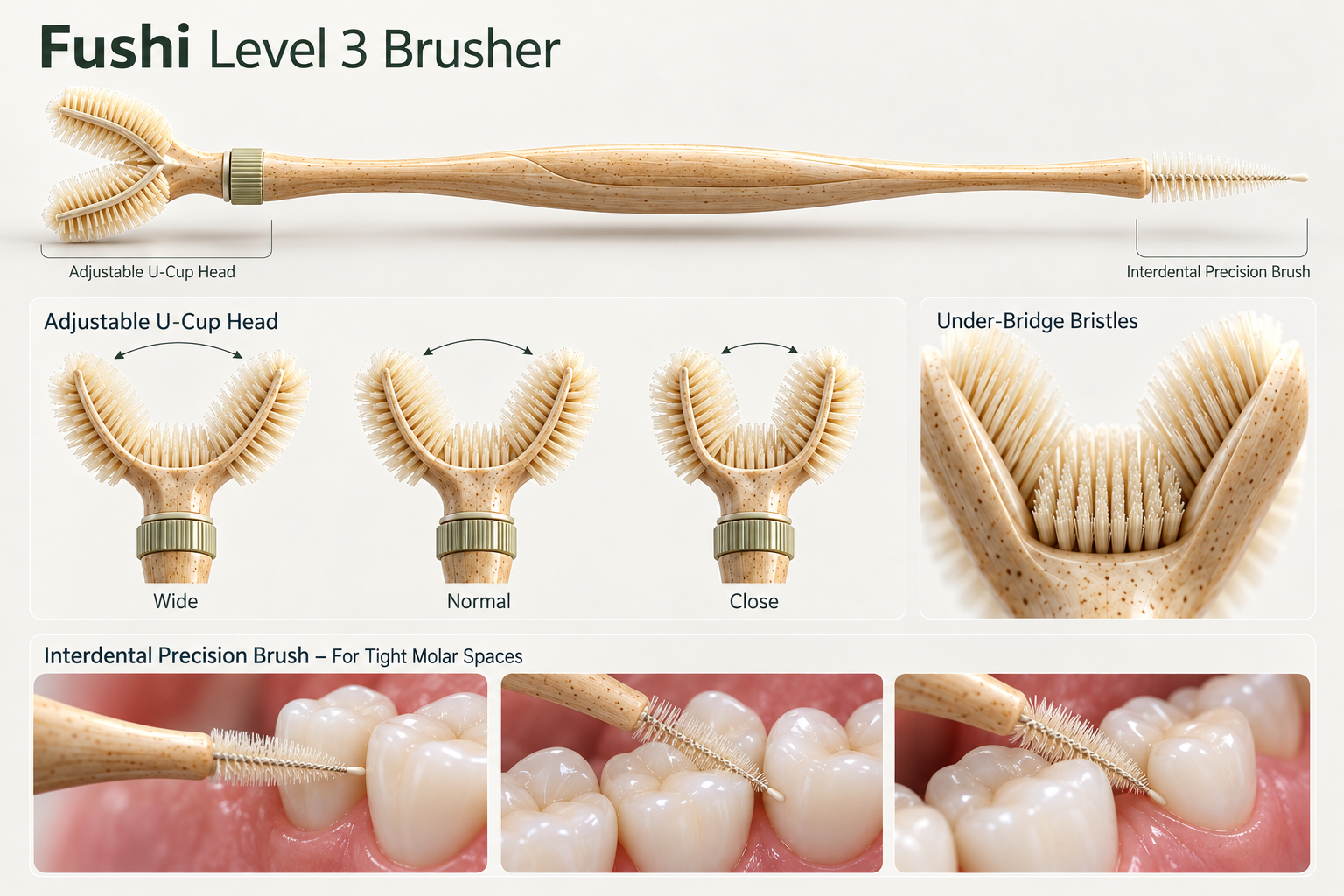
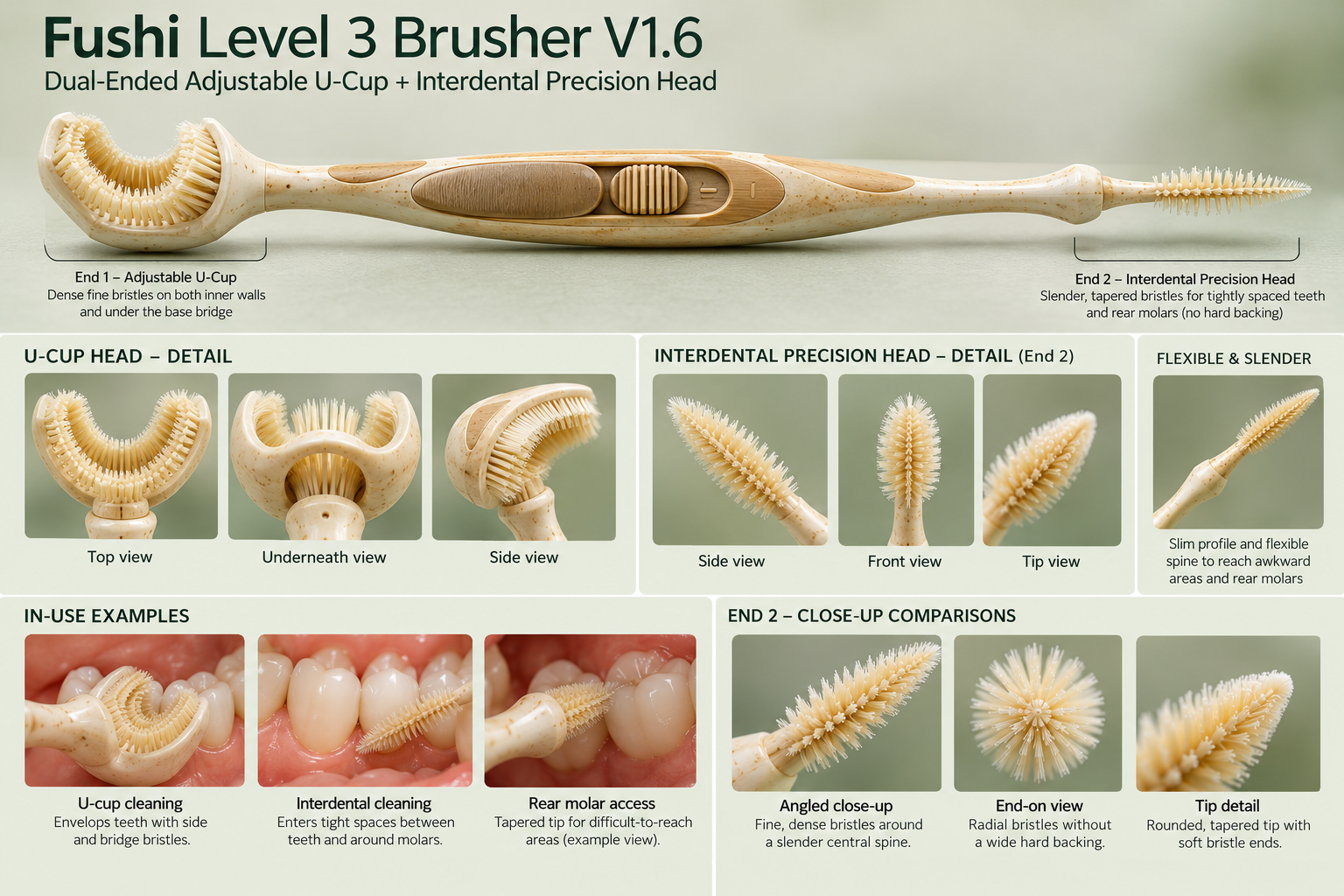
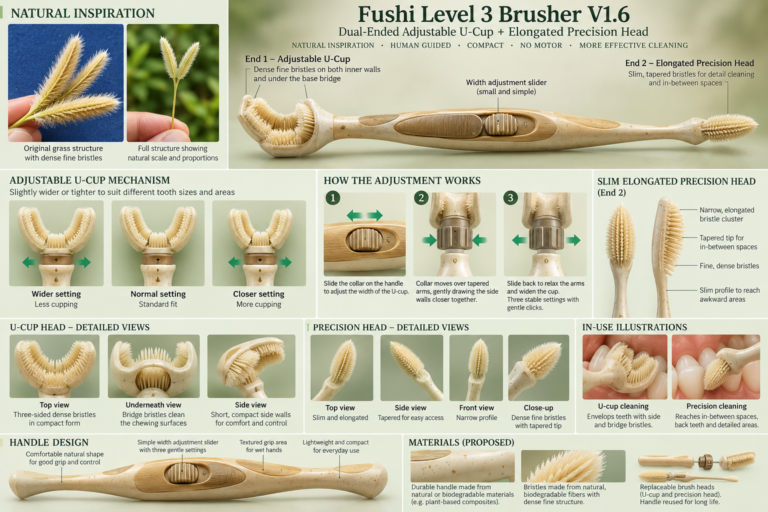
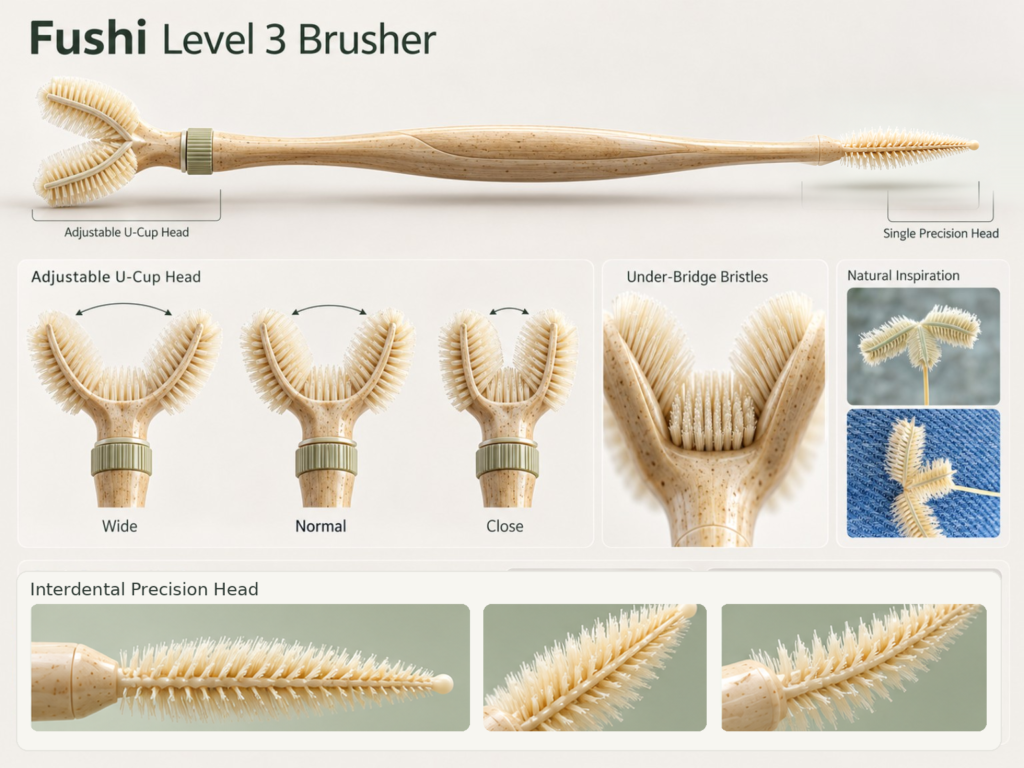
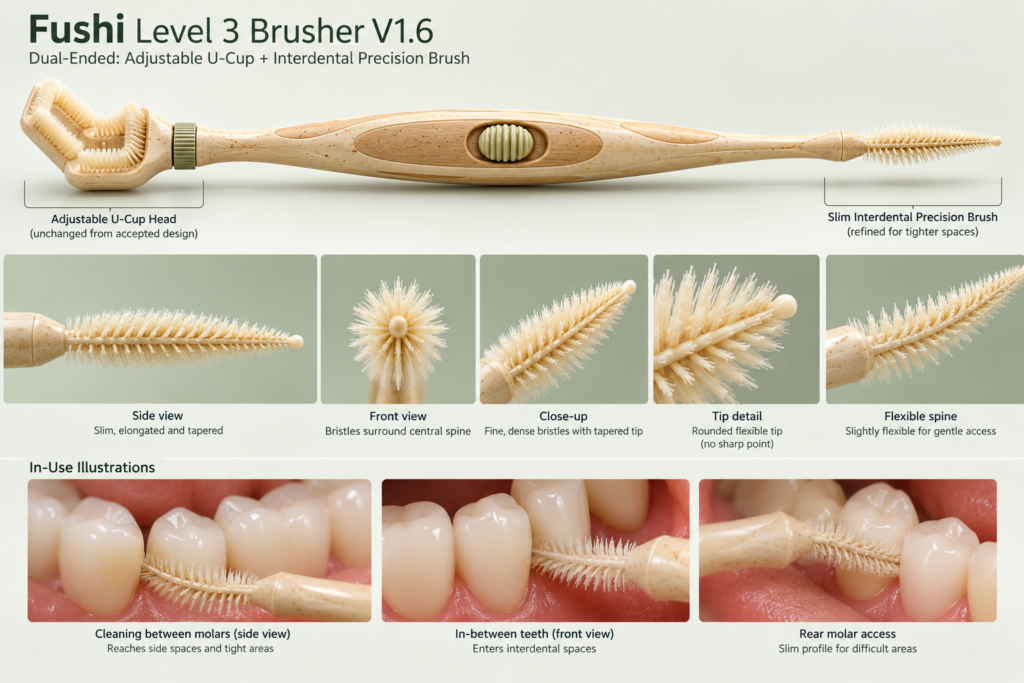
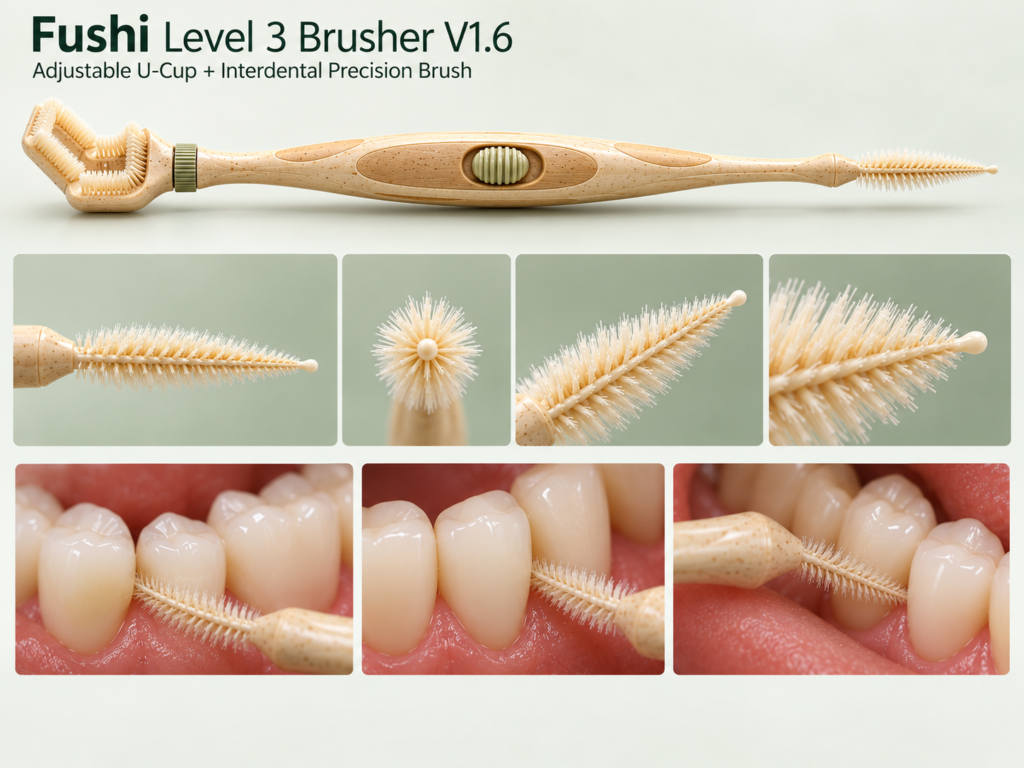
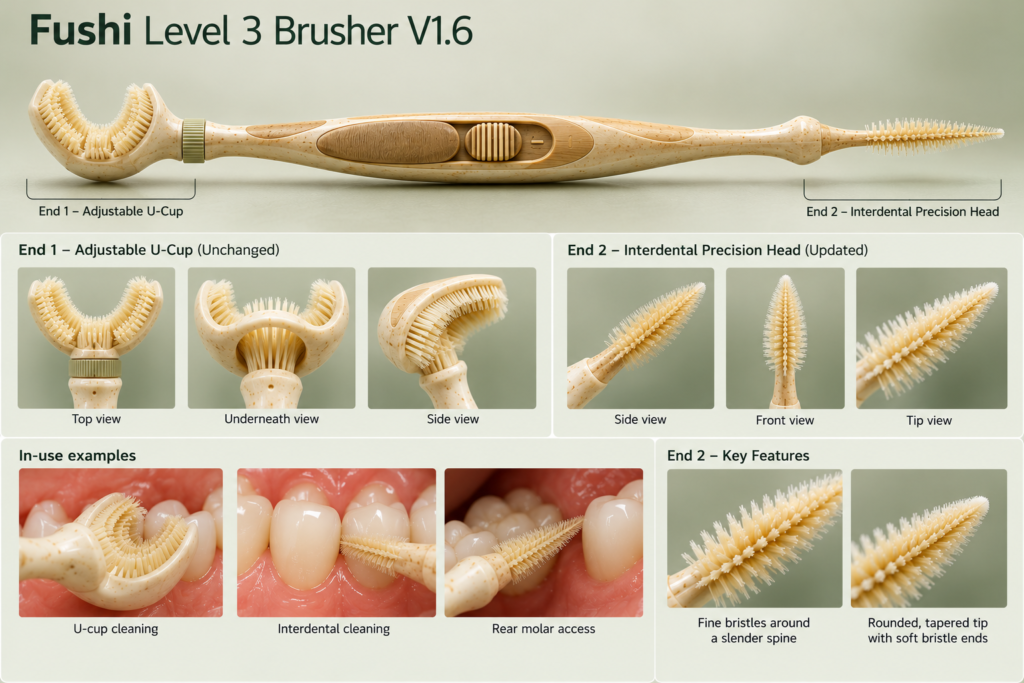
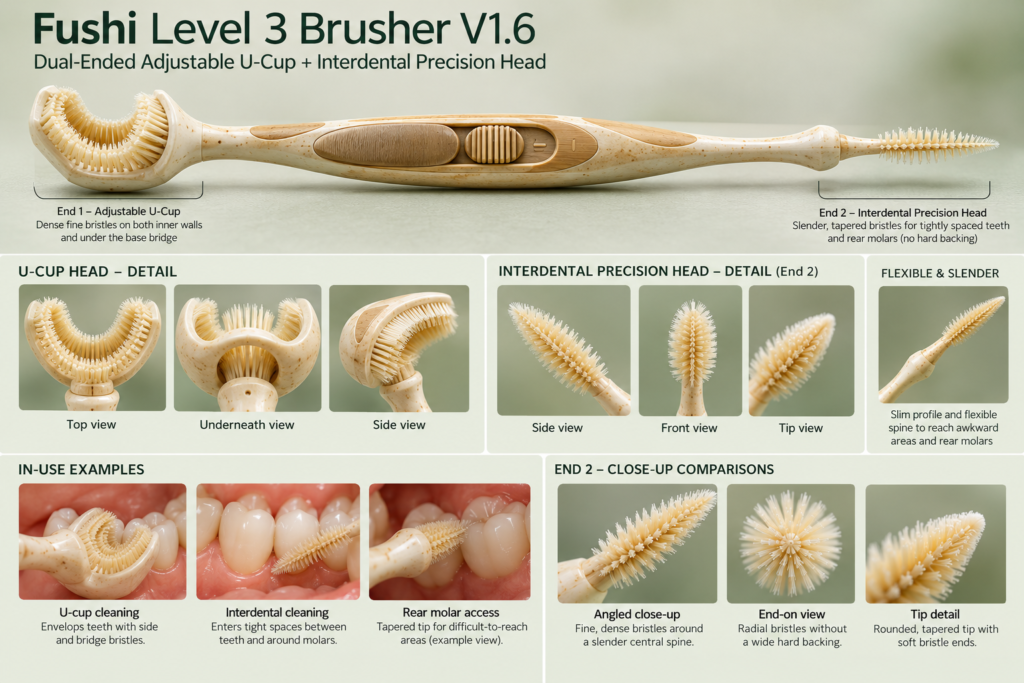
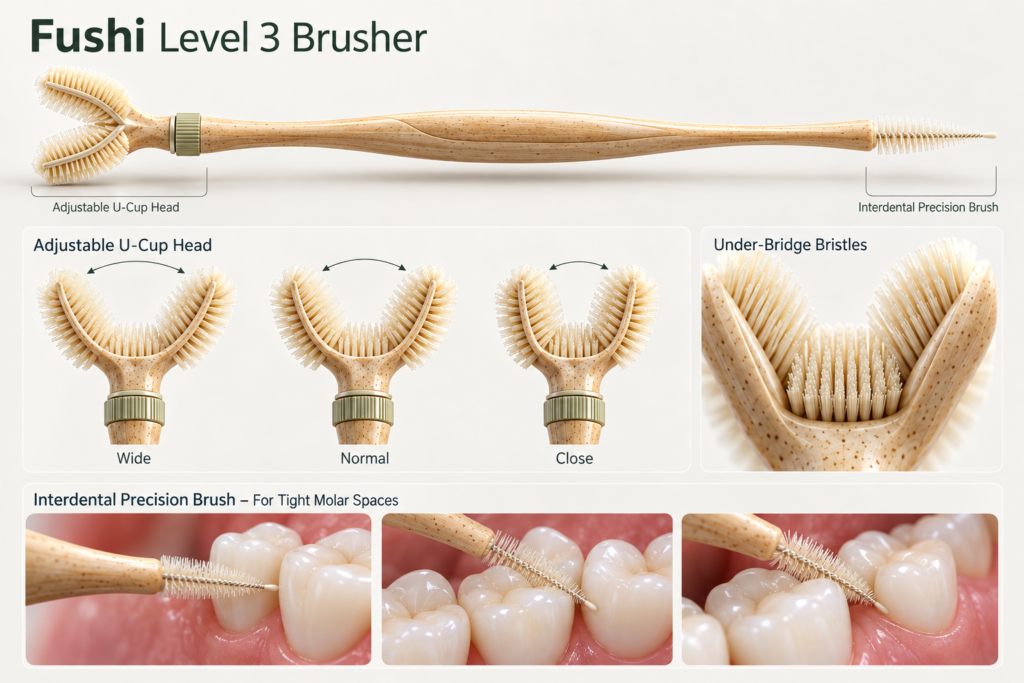
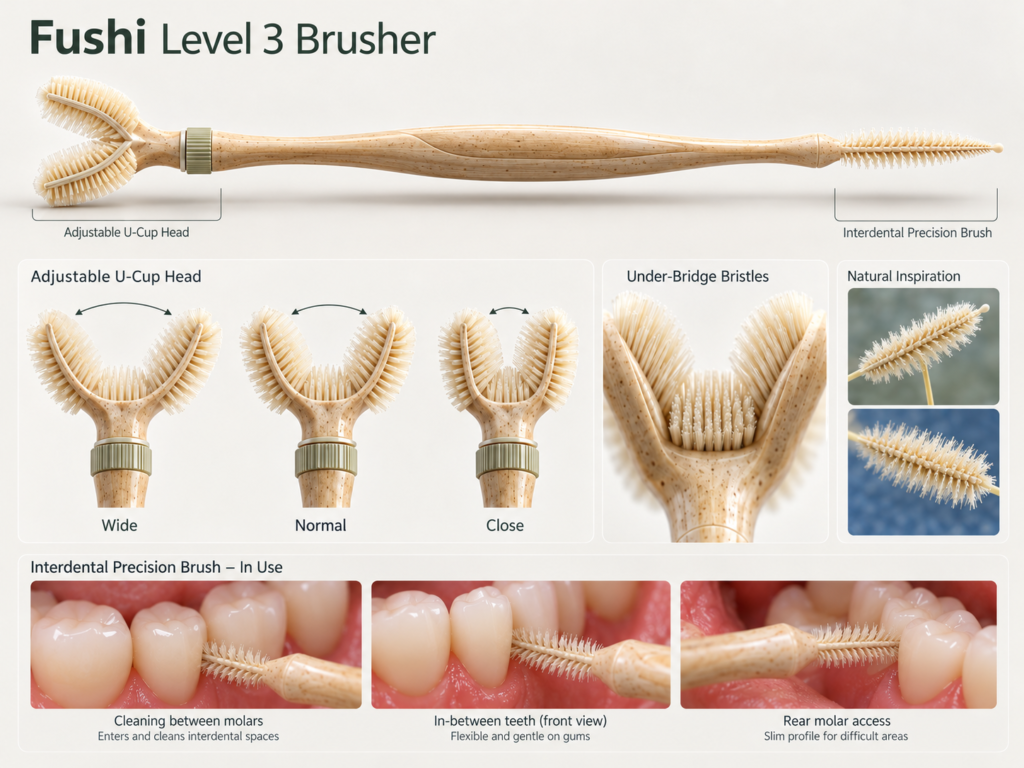
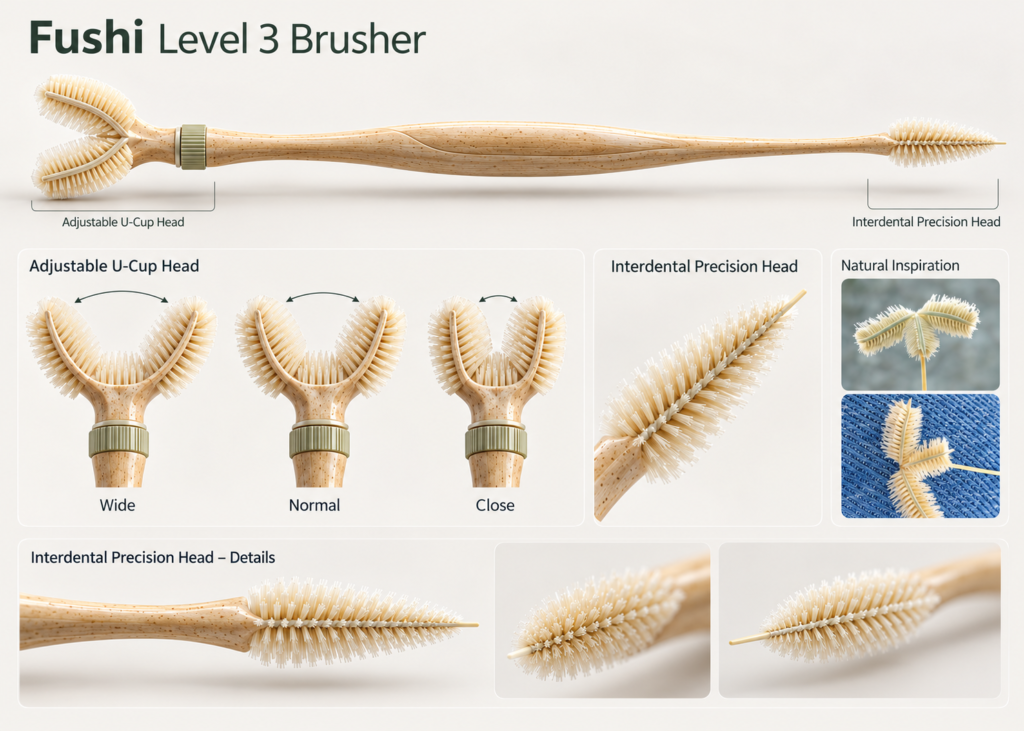
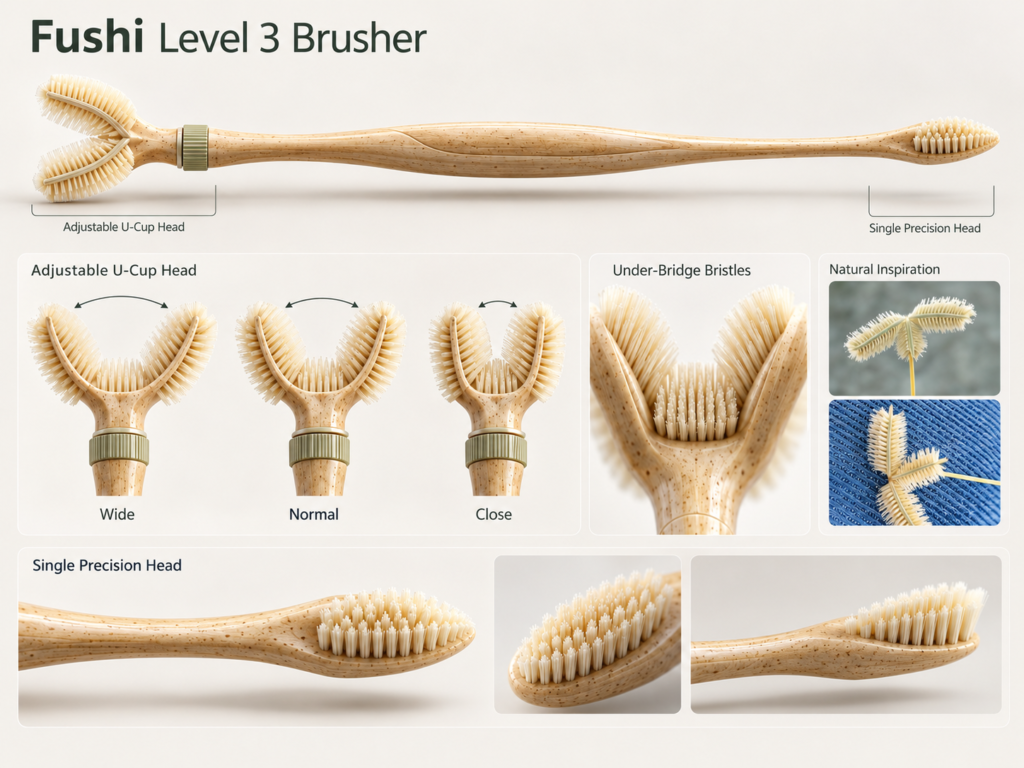
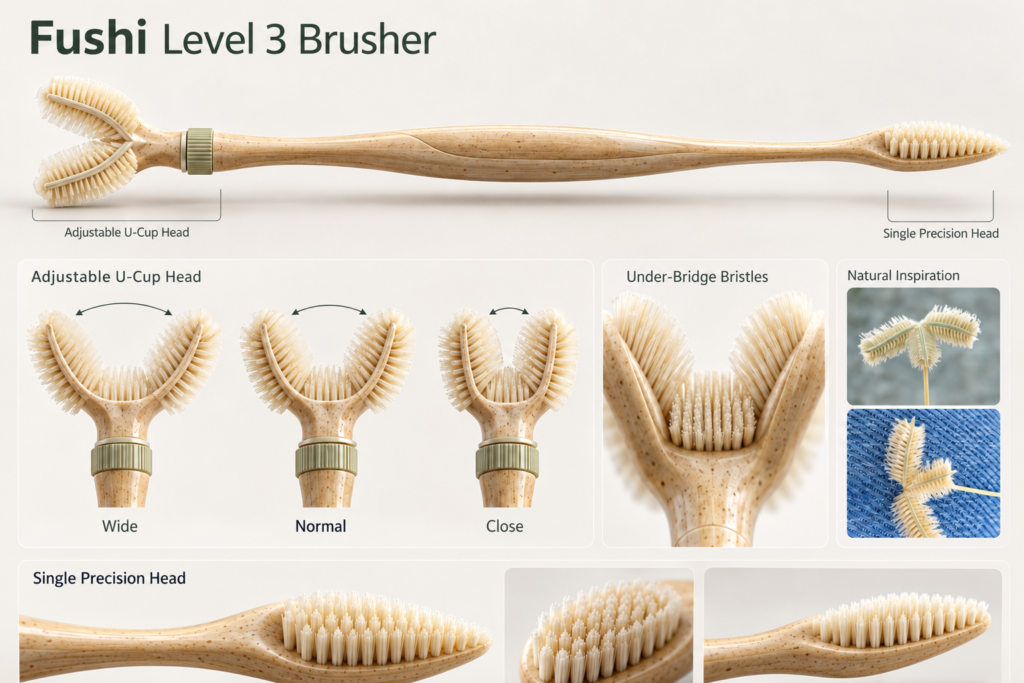
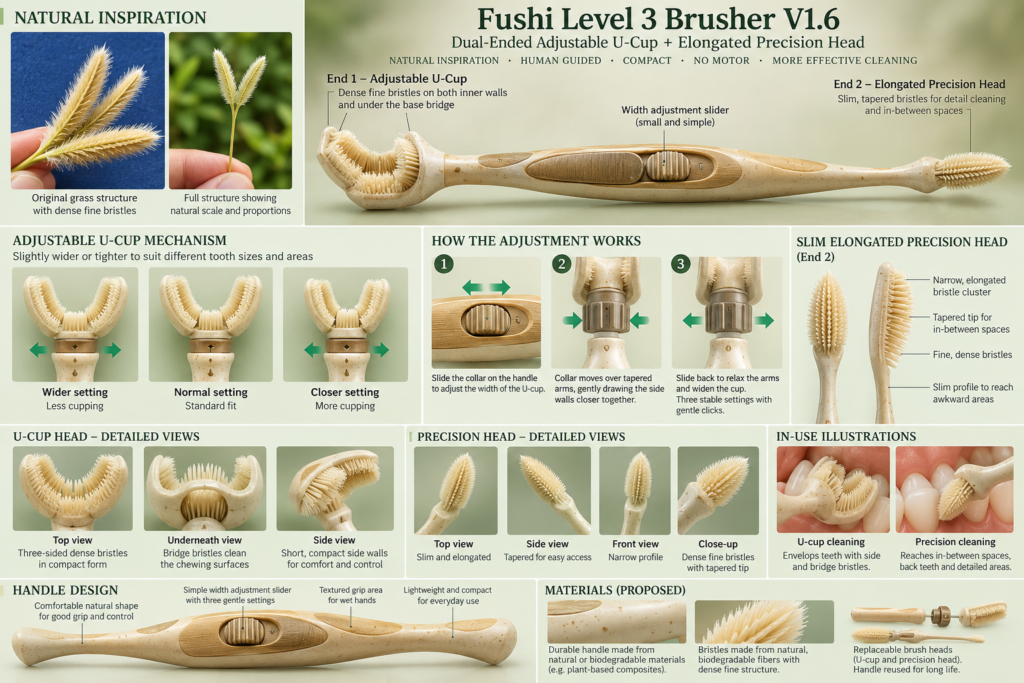
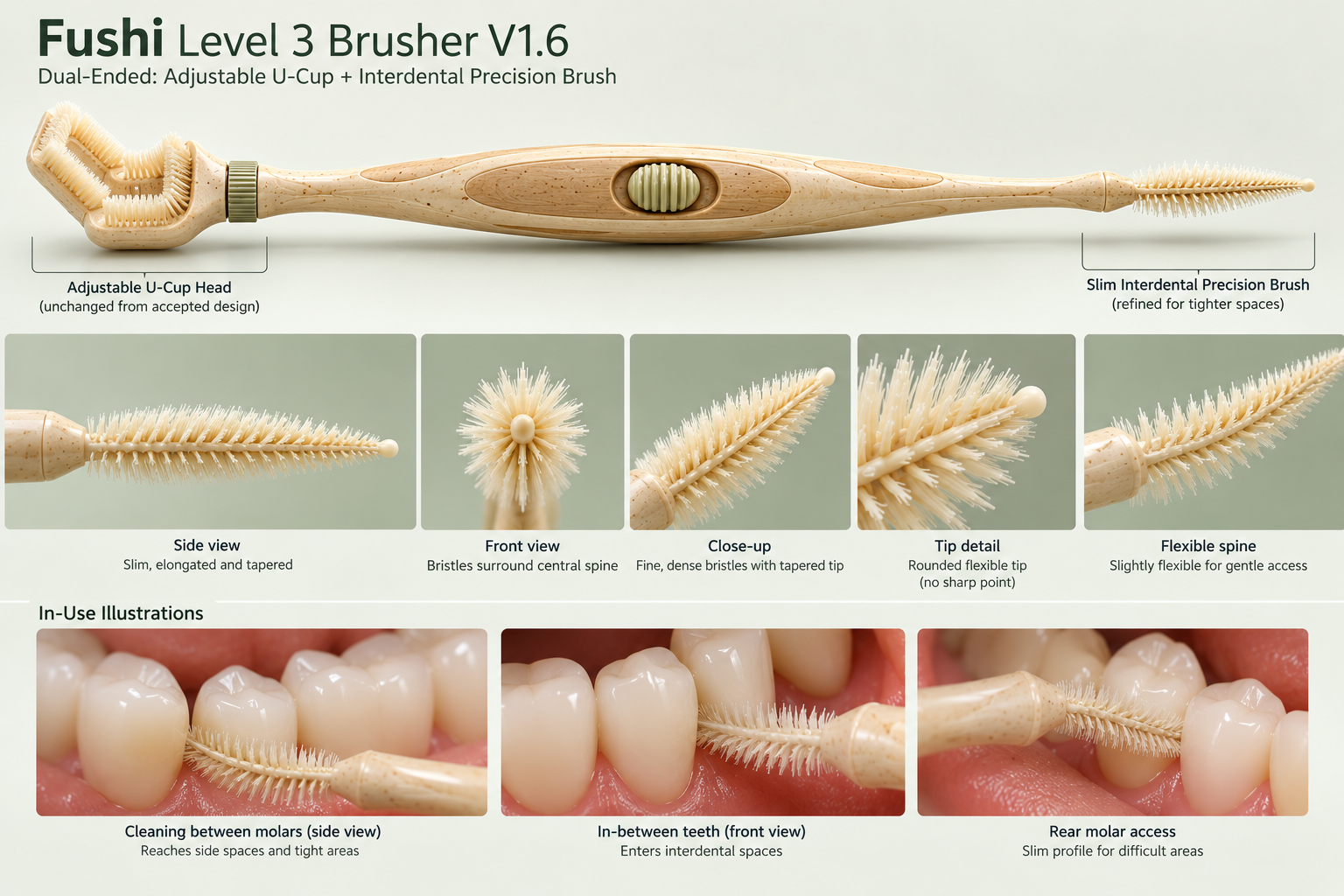
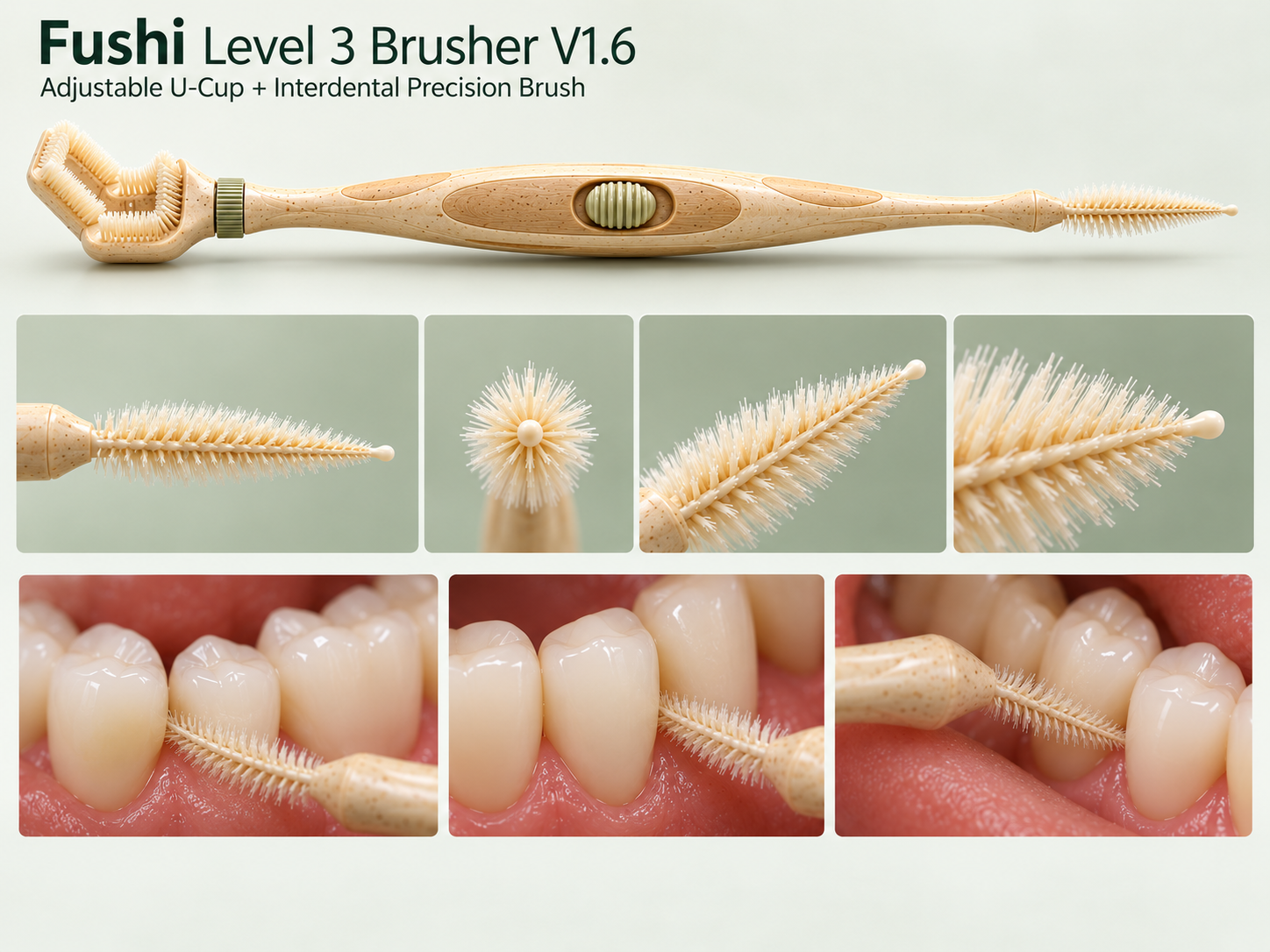
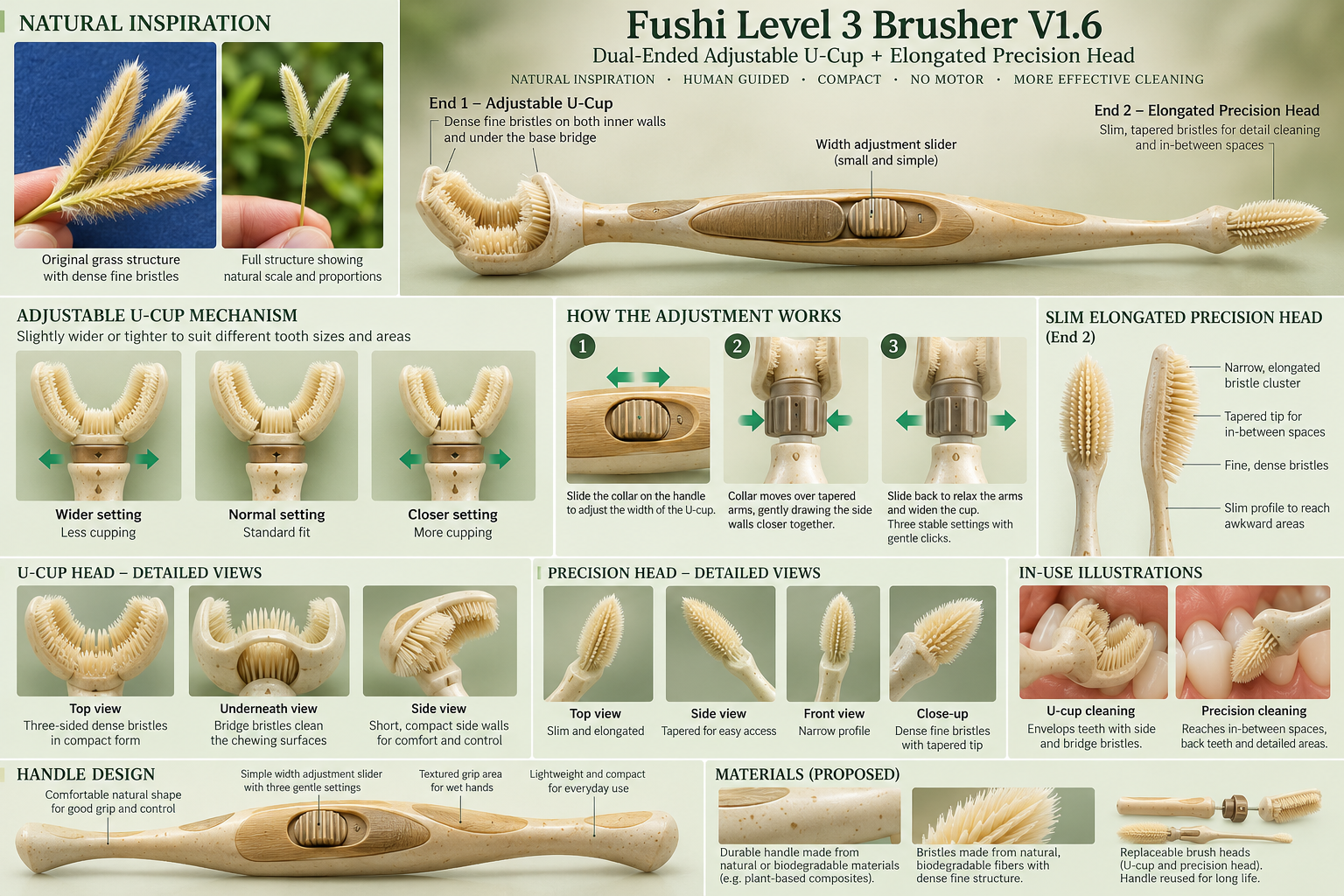
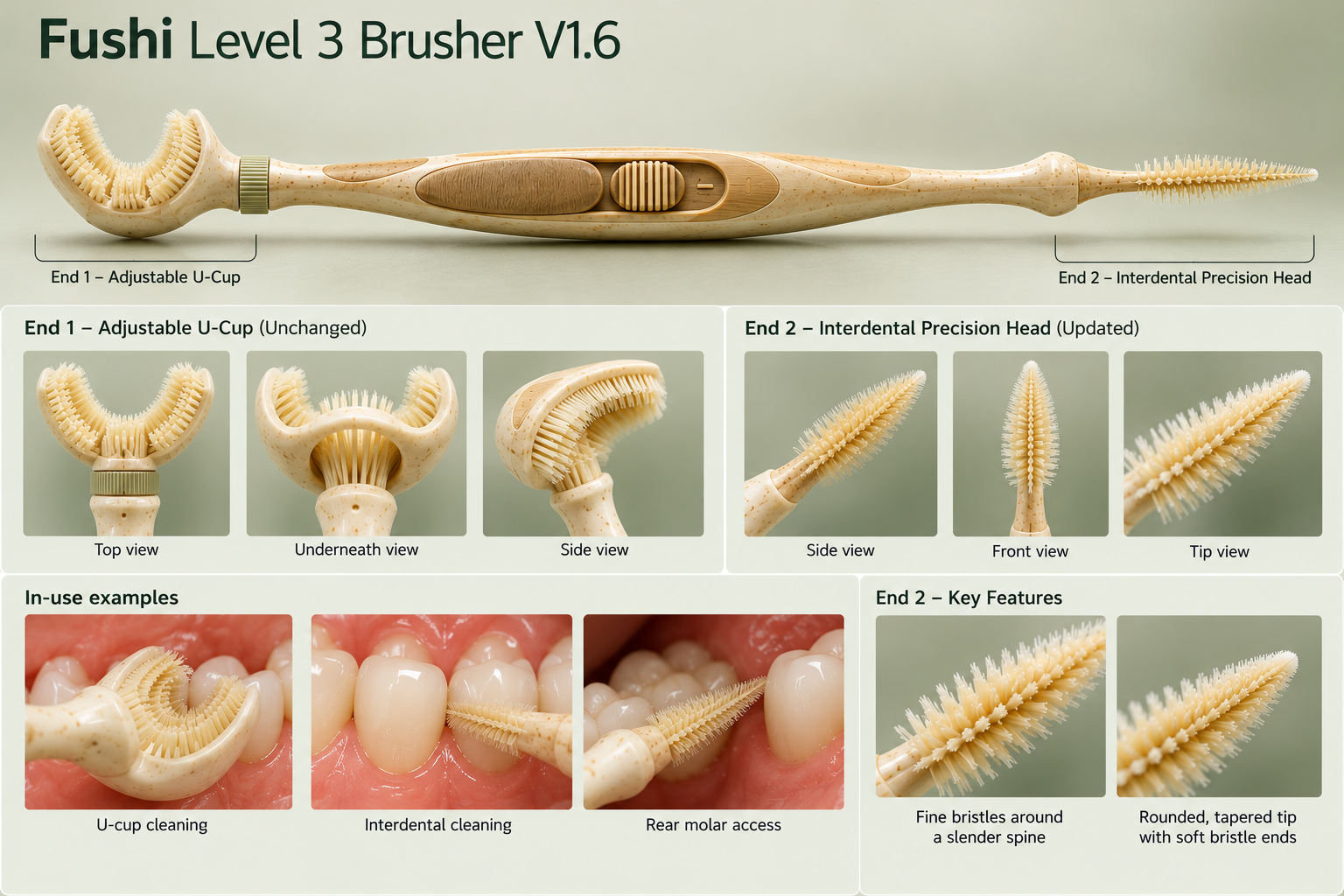
Our accepted Level 3 instrument is a manually operated, dual-ended dental brusher.
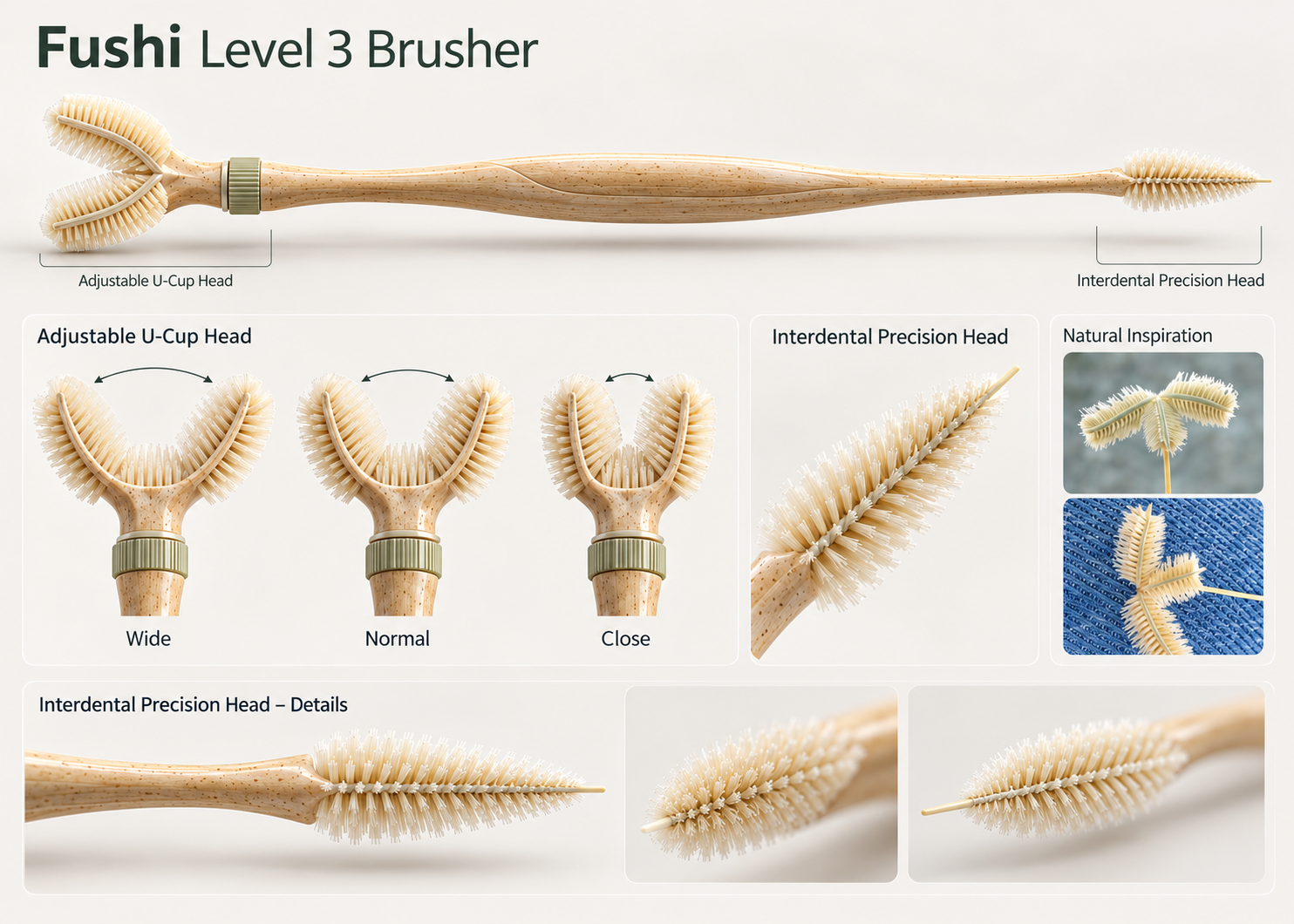
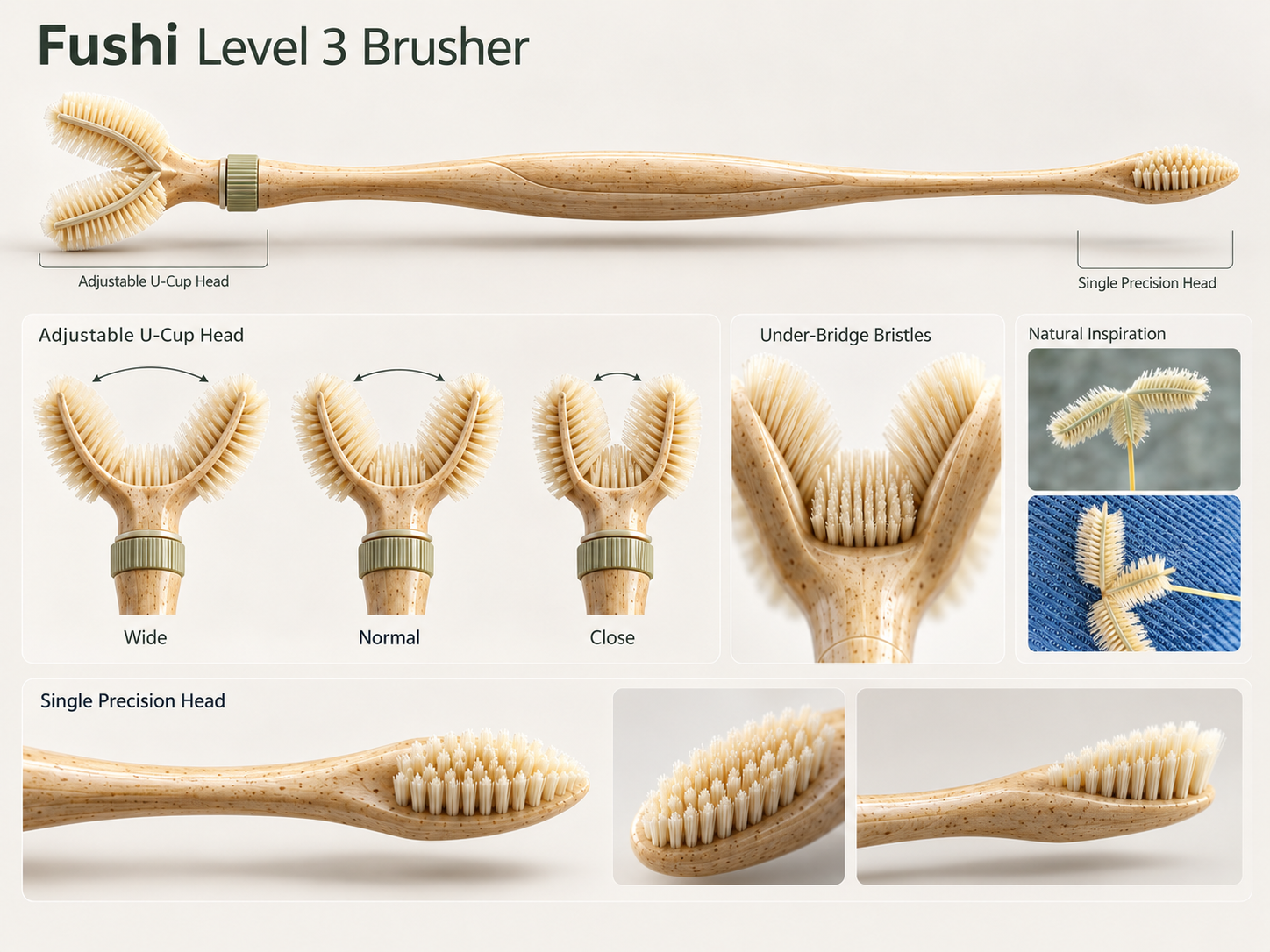
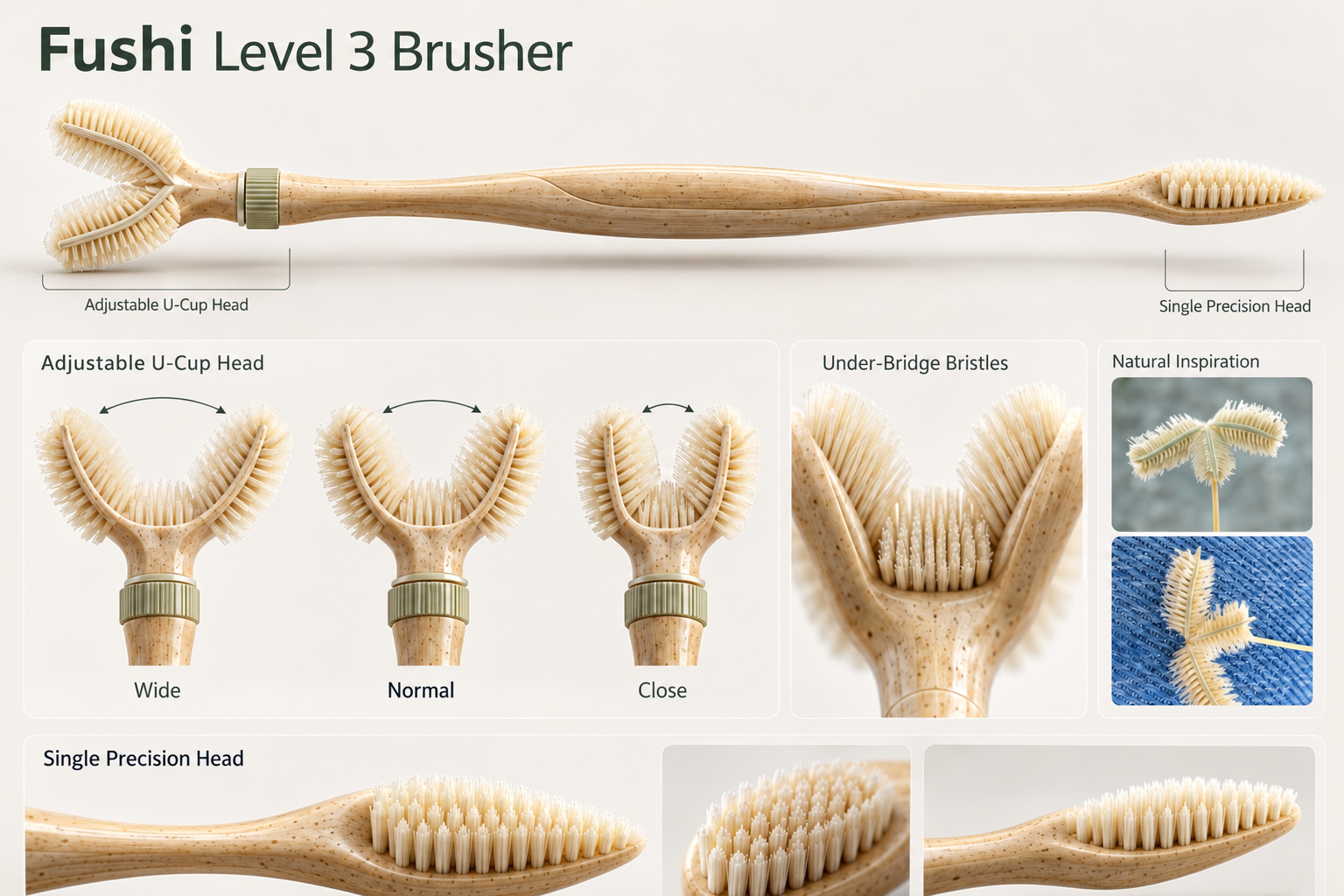
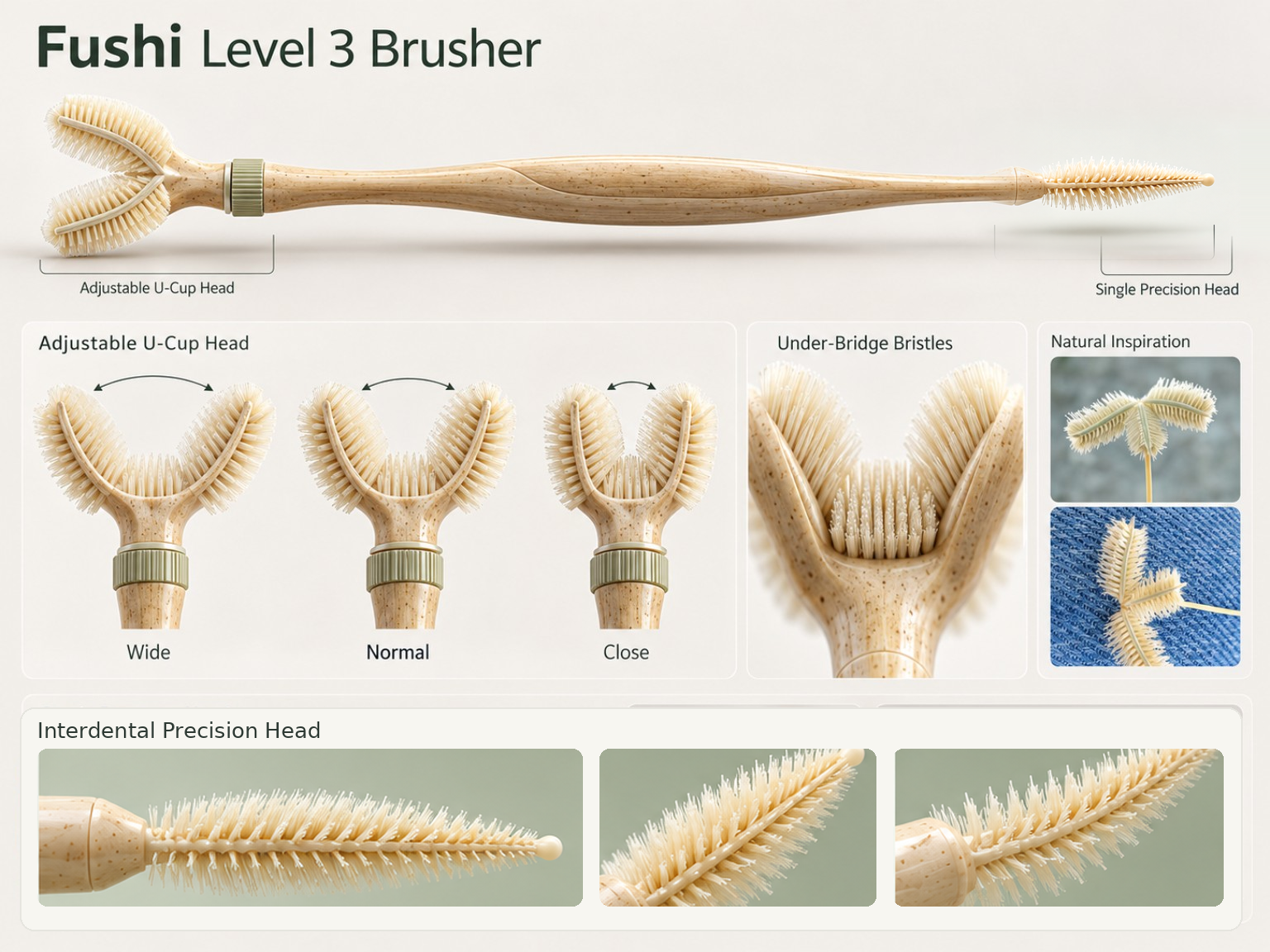
Its first end is an adjustable U-shaped bristle structure that cups the tooth, with bristles along both sides and beneath its connecting bridge.
Its second end is a slender, tapered precision brusher with fine radial bristles, designed for appropriate accessible spaces around teeth.
The instrument is intended to make thorough plaque disruption comfortable and practical without a motor or bulky machinery.
Brushing remains an essential everyday practice.
Our authored brusher must eventually demonstrate effective cleaning of tooth surfaces and gumlines without causing injury. Its materials, bristle density, flexibility, and cleaning performance require physical and clinical validation.
Proven brushing practices, including the appropriate use of fluoride toothpaste, remain part of Fushi while new instrument performance is established.
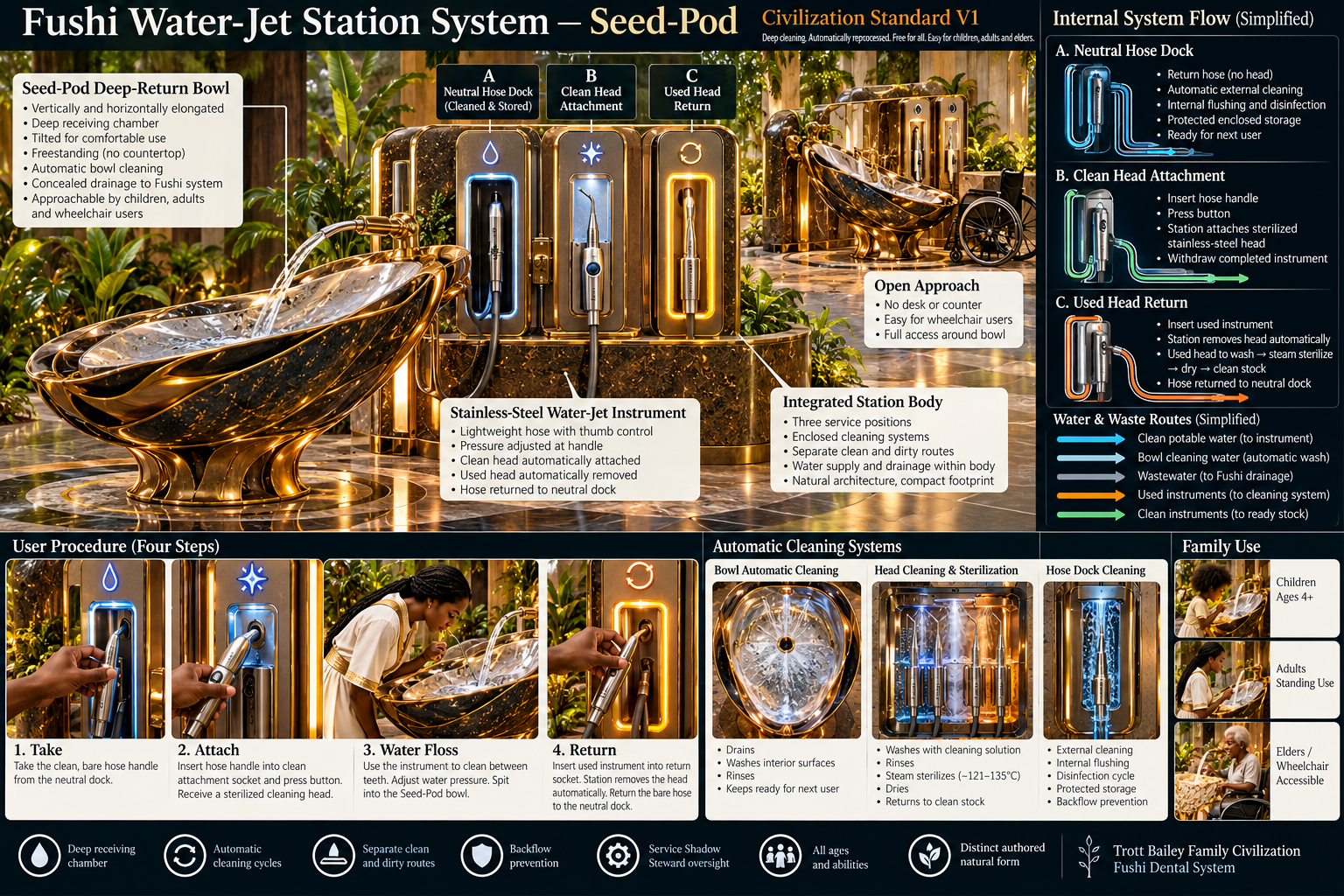
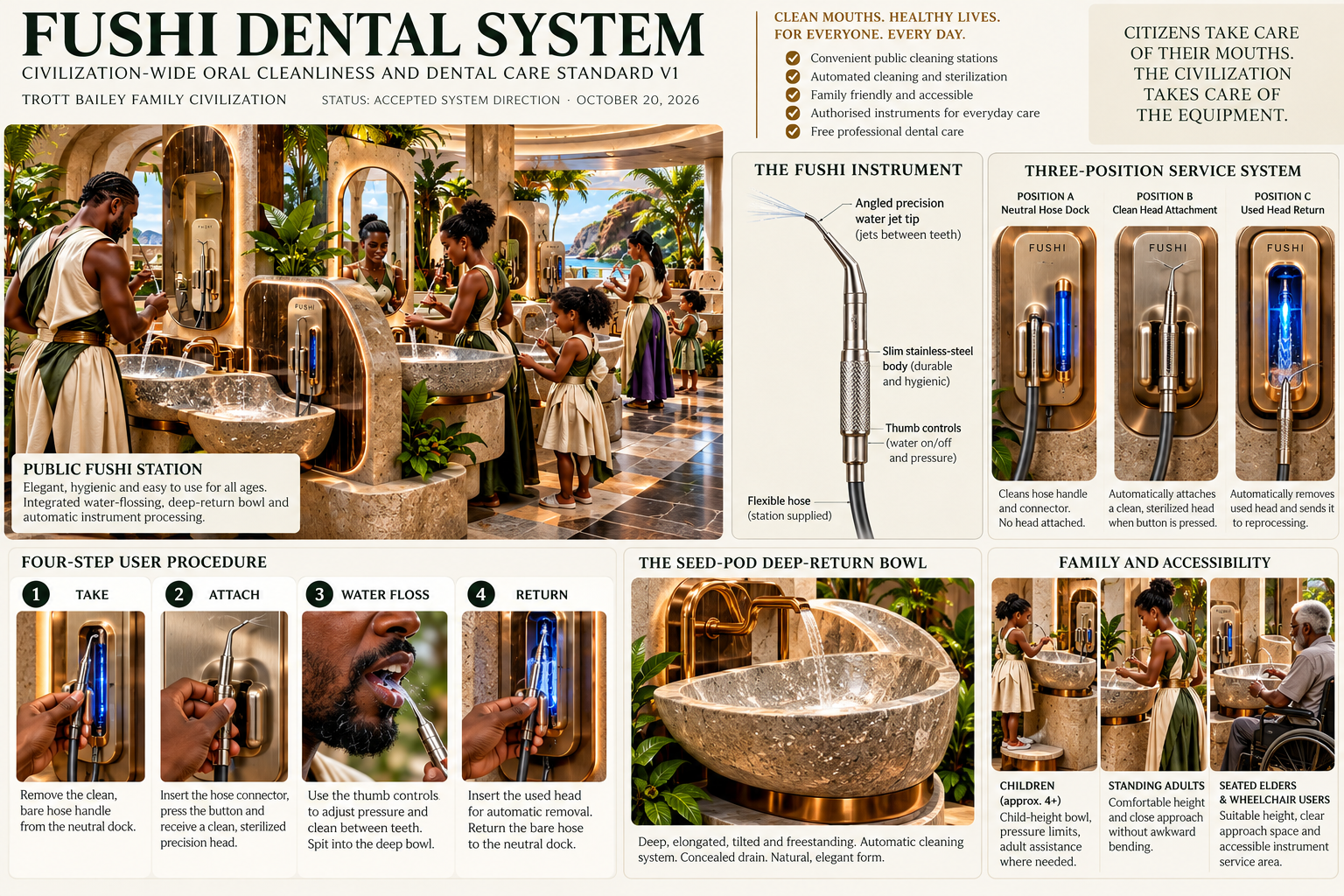
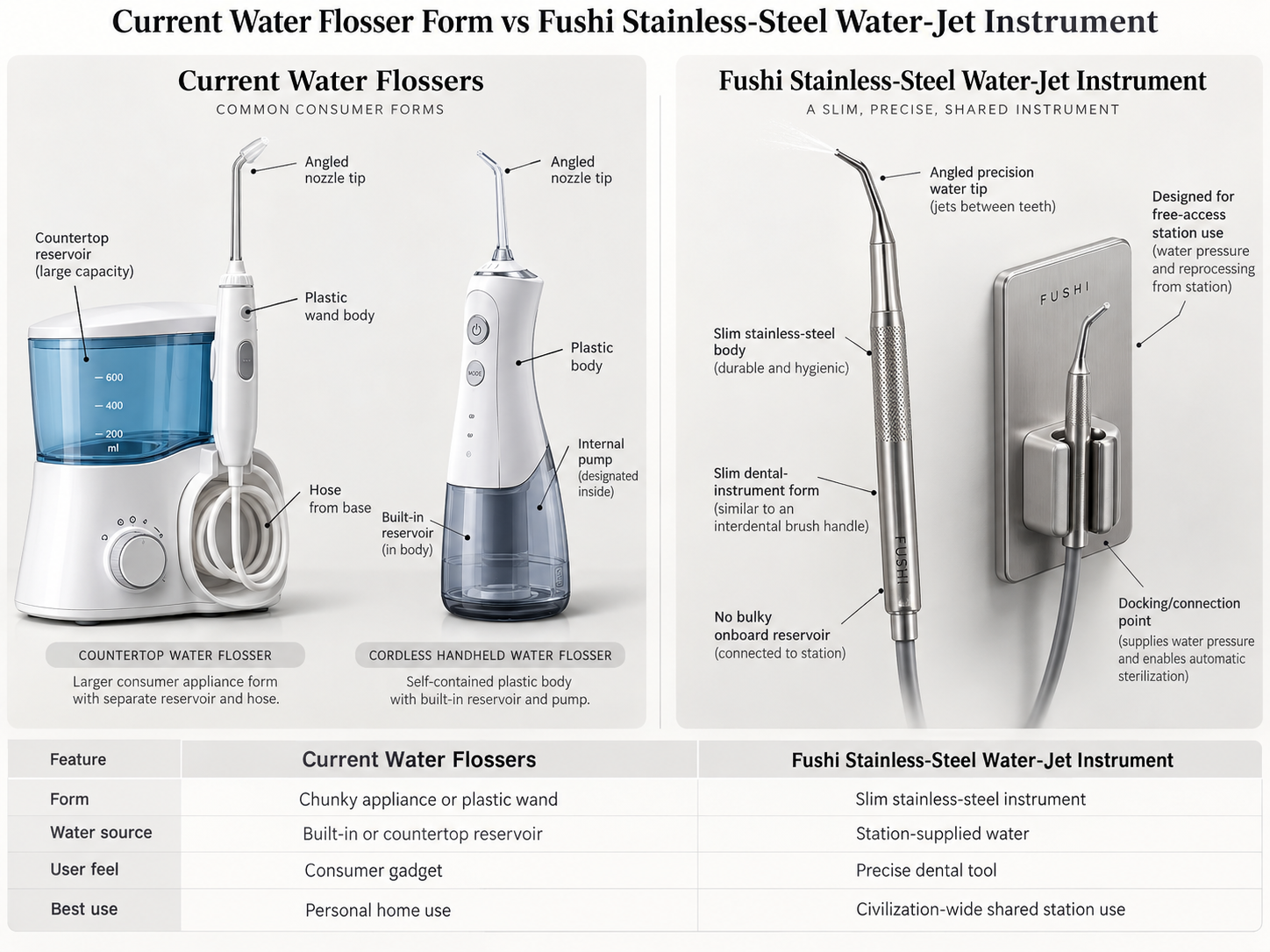
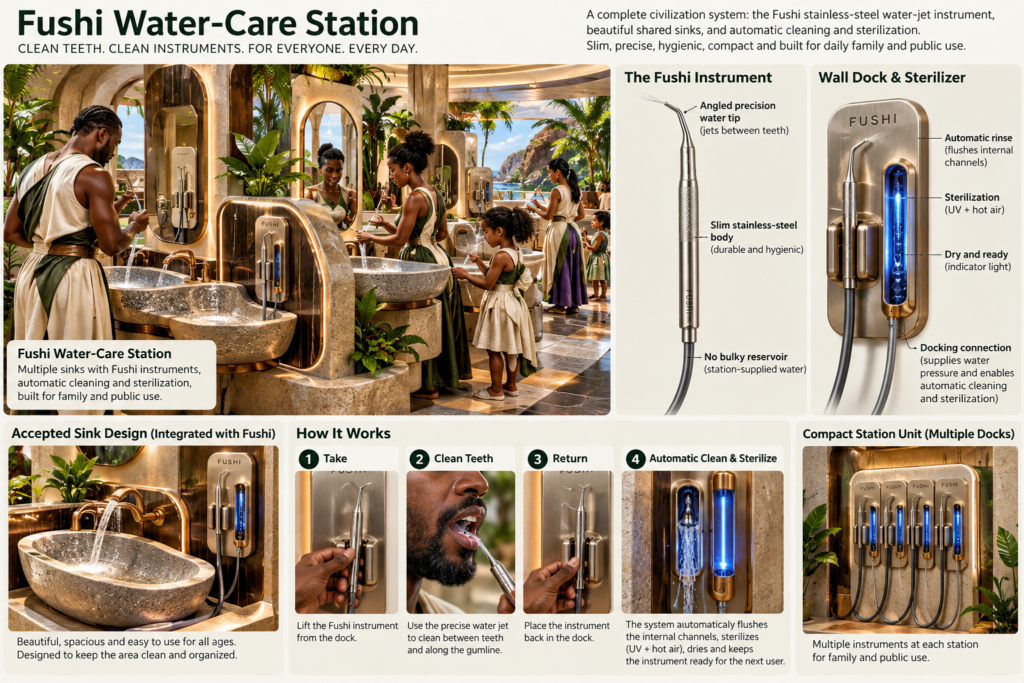
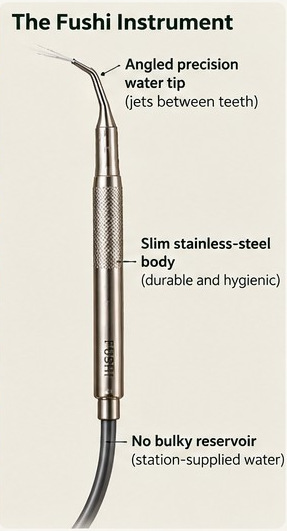
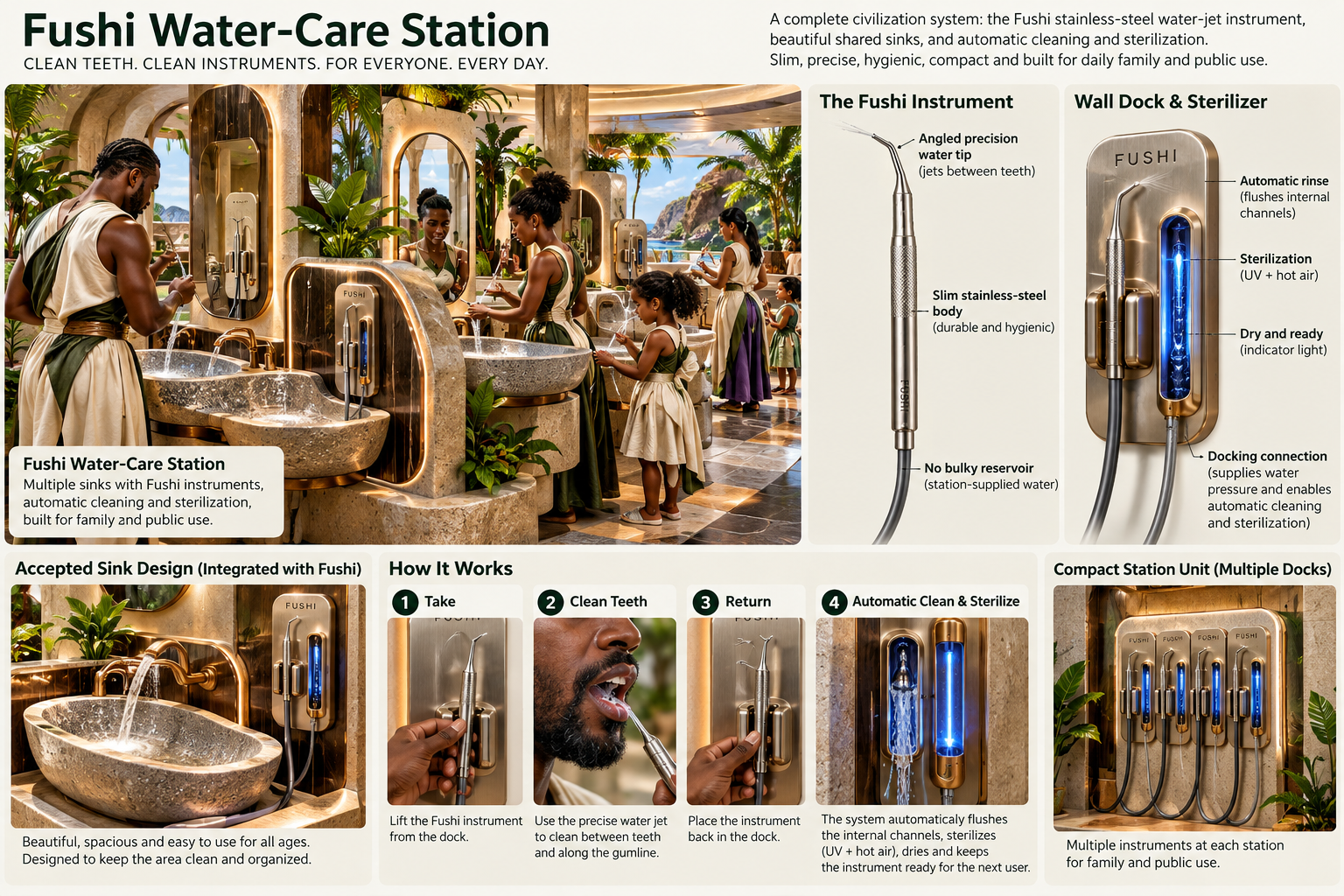
Our public Fushi stations provide a narrow, directed stream of water through a slim stainless-steel precision instrument.
The jet is intended to help remove loose debris and clean difficult spaces around teeth and gums.
The individual takes a clean bare hose from its dock, receives an automatically attached clean precision head, uses the instrument, returns the used head for automatic removal, and places the bare hose back into its cleaning dock.
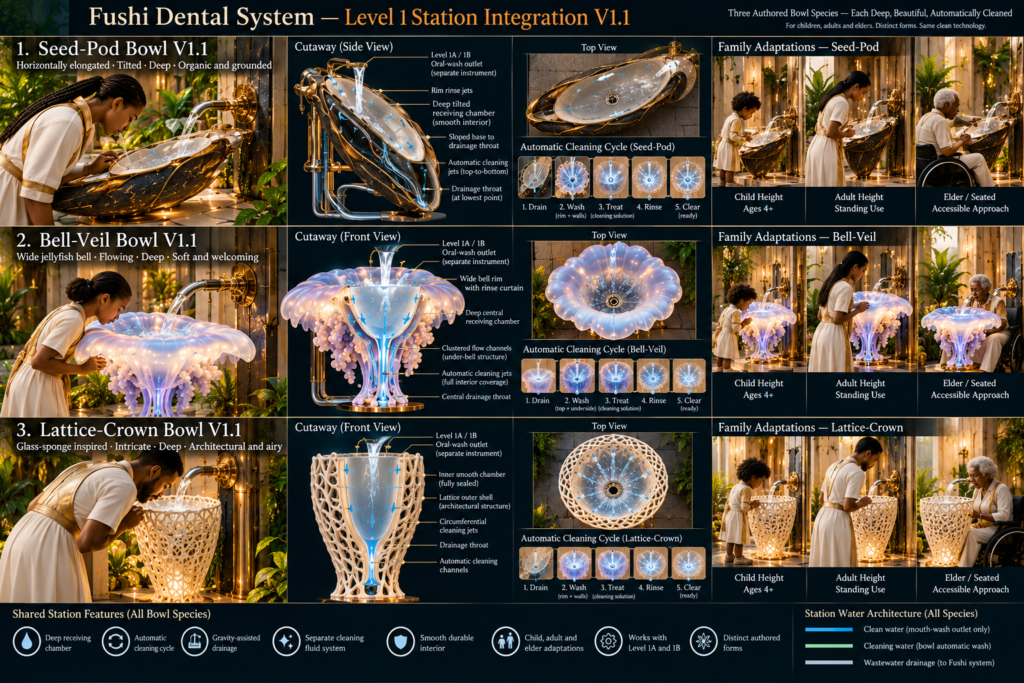
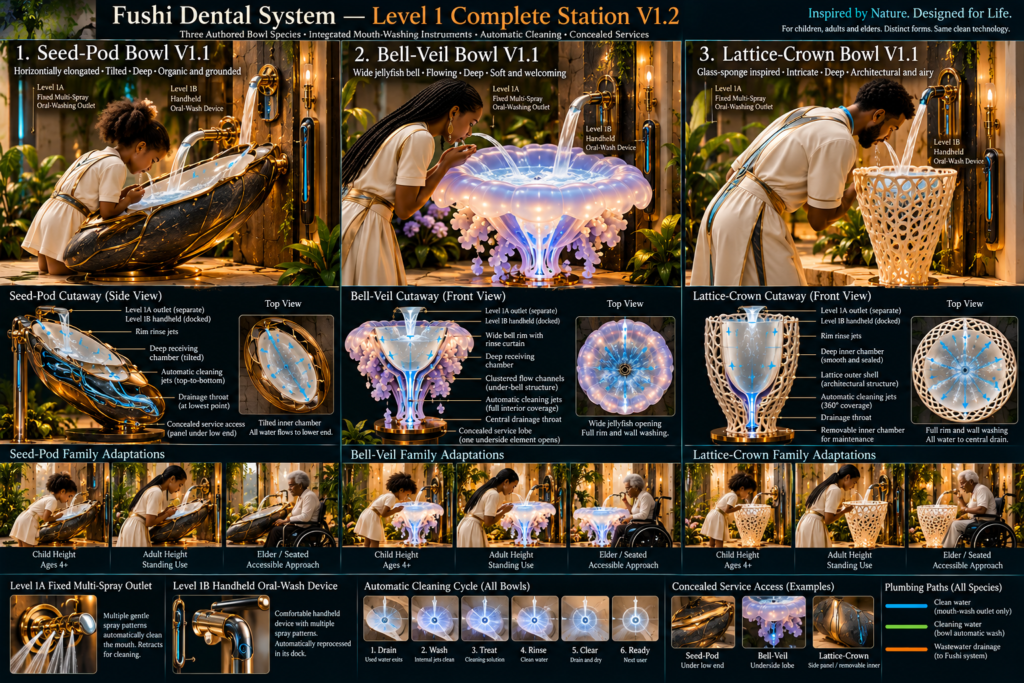
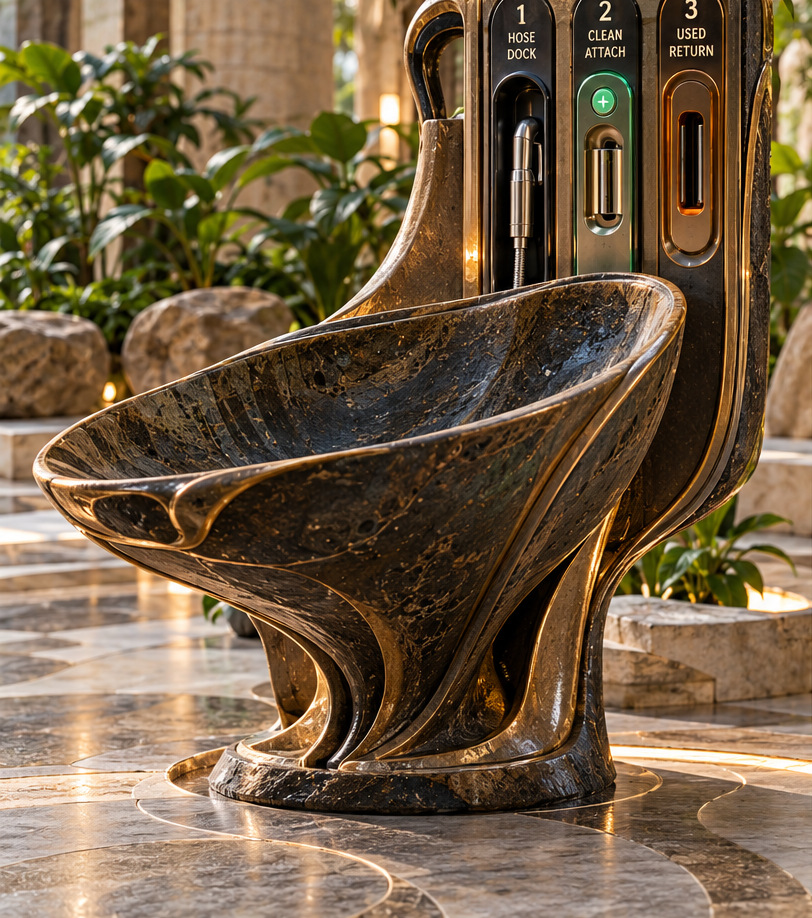
The Seed-Pod Deep-Return Bowl receives expelled water and cleans itself automatically.
Each station includes a properly positioned mirror so the person can see their teeth. Stations should be sheltered enough for comfortable personal use while remaining convenient and accessible.
The instrument’s pressure, flow pattern, head design, and cleaning effectiveness must be established through testing.
Water flossing is an additional cleaning method. It does not eliminate the need for brushing, suitable interdental cleaning, or professional dental care.
Fushi does not reject existing instruments merely because we have authored new ones.
Dental floss, appropriately sized interdental brushes, fluoride products, specialized cleaning aids, and professionally recommended instruments remain available where they provide a genuine benefit.
Our system should select and improve tools based on how well they serve the mouth, not on whether every device originated within our civilization.
04 / Nourishment
We cannot seriously discuss oral health while ignoring what citizens eat and drink.
The civilization’s food system should support healthy teeth, healthy gums, and healthy bodies together.
Frequent exposure to free sugars contributes to tooth decay. A diet rich in nutritious foods, adequate water, and fewer repeated sugary snacks and drinks helps protect oral health.
Healthy foods should be freely accessible, enjoyable, varied, and well prepared.
The civilization should not make nutritious food difficult to obtain while allowing the easiest available options to be those that repeatedly harm teeth.
Nor should dental care become a way to compensate for an unhealthy food environment.
Prevention begins before the cleaning instrument reaches the mouth.
05 / Family learning
Fushi begins in family life.
Parents and care providers learn how to look after children’s mouths from infancy through the arrival of their first teeth, the development of permanent teeth, and adolescence.
Children should learn:
- Why teeth and gums need cleaning.
- How to brush thoroughly without injuring themselves.
- How to remove trapped food appropriately.
- How to clean between teeth when required.
- How food and drink choices affect dental health.
- How to recognize pain, bleeding, injury, or other changes that need attention.
- How to receive dental treatment without unnecessary fear.
Young children need assistance with brushing and other cleaning activities until they have sufficient skill and coordination.
The child’s instruments, fluoride amounts, water-jet pressure, and supervision must be suitable for their development and established clinical guidance.
Fushi stations may include child-height Seed-Pods and future stable step-up adaptations. These are practical accommodations, not substitutes for adult help when that help is needed.
A mother or father teaching a child to care for their teeth should be an ordinary family moment, just like teaching bathing, dressing, and food preparation.
Children should reach adulthood with good knowledge, useful habits, and access to the dental care necessary to preserve their teeth.
06 / Professional care
No amount of daily cleaning eliminates every dental problem.
Teeth can decay, break, grow incorrectly, or become damaged through injury. Gums can develop disease. People can require specialist treatment despite making serious efforts to care for themselves.
The civilization must therefore maintain a capable, accessible professional dental system.
That includes:
Preventive dentistry: Examinations, professional cleaning, fluoride protection where appropriate, risk assessment, and early detection.
Restorative dentistry: Repairing damaged and decayed teeth, including suitable fillings, crowns, and other clinically necessary treatment.
Gum care: Preventing, identifying, and treating periodontal disease.
Children’s dentistry: Developmental monitoring, prevention, necessary treatment, and support for parents.
Emergency dental care: Prompt help for severe pain, infection, bleeding, broken teeth, and dental injuries.
Specialist care: Orthodontics, endodontics, oral surgery, prosthodontics, and other appropriate services.
Care across the lifespan: Support for pregnant mothers, people with disabilities, older citizens, and anyone whose circumstances make oral care more difficult.
Professional treatment must be available according to clinical need, not financial ability.
The civilization provides trained dental professionals, properly maintained facilities, safe instruments, sterilization, supplies, and continuing education.
No family should have to delay necessary care because money stands between their child and a dentist.
07 / Public provision
Our infrastructure should follow where people actually live their lives.
Fushi facilities and appropriate cleaning supplies belong within:
- Family compounds and shared living grounds.
- Food preparation, serving, and dining locations.
- Children’s learning and care grounds.
- Contribution and service areas.
- Care-Ports and travel facilities.
- Family recreation and public gathering spaces.
- Professional dental and wider healthcare facilities.
Not every location needs an elaborate water-jet station.
Some locations may need simple food-release supplies and access to clean water. Others may benefit from compact individual Fushi stations or multi-person installations.
The amount and type of equipment should follow actual use, accessibility, sanitation needs, and service capacity.
Family compounds may have multi-height Seed-Pod arrangements, while individual adult stations remain a distinct accepted design.
Children, shorter adults, wheelchair users, and people with limited mobility must be considered in station placement and design.
Civilization-wide access does not mean blindly placing expensive machinery everywhere. It means ensuring that useful care is conveniently available wherever it is genuinely needed.
08 / Sanitation
A public dental-cleaning system must not become a source of contamination.
Our accepted Fushi station separates clean and used precision heads. Used heads undergo appropriate washing, validated steam sterilization, drying, and protected storage.
The hose and connector are cleaned, internally treated, and protected in the neutral dock through procedures validated for those components.
Waterlines require suitable microbial control and backflow protection.
Seed-Pod bowls have automatic receiving-surface cleaning, with wastewater routed separately from clean water.
Service Shadow Stewards oversee equipment performance, sanitation records, water-quality checks, faults, servicing, and repairs.
Citizens should be able to use the station without personally managing its technical cleaning process.
The civilization takes responsibility for maintaining the equipment it provides.
09 / Ease of living
A good system should reduce the work required from people.
We should not create an elaborate ritual that leaves families spending large amounts of time managing dental instruments.
Fushi needs a clear distinction between a quick task and a thorough cleaning routine.
After eating: Remove trapped food where necessary. Use convenient cleaning facilities when useful.
During daily home care: Brush properly, disrupt plaque, and clean between teeth using the suitable tools and guidance.
When dental care is needed: Receive prompt professional attention without financial barriers.
Throughout life: Eat healthily, maintain good habits, and receive preventive support.
Not every citizen needs to use every instrument after every meal.
What matters is that the tools, knowledge, food, and professional services are available, and that the culture encourages effective care rather than needless work.
10 / Outcomes
Our civilization should judge Fushi by the oral health it produces, not by the number of stations installed or instruments manufactured.
We should measure whether citizens experience:
- Fewer new cavities.
- Less gum bleeding and inflammation.
- Less dental pain.
- Fewer preventable infections and extractions.
- More natural teeth retained through adulthood and old age.
- Better access to treatment and shorter delays.
- Better daily cleaning habits.
- Less family time lost to avoidable dental problems.
We should also measure the resources required to produce those results, including professional time, equipment upkeep, water, energy, materials, and cleaning effort.
The different Fushi components have different levels of scientific evidence.
Established preventive dental care, fluoride use, appropriate plaque removal, and reducing harmful sugar exposure have substantial evidence behind them.
Our newly authored brush, natural food-release straws, and particular precision water-jet system still need their safety and performance demonstrated.
The strength of the whole system does not excuse poor performance from an individual component.
We should build, test, improve, and expand based on the benefits actually delivered.
11 / Responsibility
Parents have a responsibility to teach their children. Adults have a responsibility to care for their own mouths as they are able.
But responsibility does not stop with the individual.
If a person has no convenient instruments, limited access to nutritious food, and cannot obtain dental treatment, telling them to brush more is not a complete solution.
The civilization is responsible for supplying the conditions that make healthy living practical.
We develop the tools.
We provide the food.
We teach useful knowledge.
We maintain the facilities.
We train and support the professionals.
We provide the care.
Citizens use these opportunities to care for themselves and one another.
This is how individual responsibility and civilization responsibility work together.
12 / The intended life
Imagine children growing up with healthy food, proper dental instruments, and parents who can easily teach them to care for their teeth.
Imagine adults who can remove trapped food after eating without searching for supplies, use properly maintained instruments, and obtain treatment before a small dental problem becomes a painful one.
Imagine older citizens who still have comfortable, functioning natural teeth because prevention and treatment were available throughout their lives.
That is the purpose of Fushi.
The Seed-Pod, the precision stainless-steel water jet, our authored plaque brusher, and natural food-release straws are expressions of this larger work.
They are tools within a civilization that takes oral health seriously.
We are not simply inventing a better place to spit or a more beautiful instrument for cleaning teeth. We are developing the conditions in which clean mouths, healthy gums, comfortable teeth, and good dental care become ordinary throughout life.



Trott Bailey Family Civilization
FUSHI
Civilization-Wide Oral Cleanliness and Dental Care Standard V1
01 / Foundation
Purpose
Fushi Dental System exists to make clean teeth and mouths an easy, comfortable part of everyday civilization life.
Children and adults should have convenient, free access to proper oral-cleaning instruments wherever they eat, travel, contribute, and spend their days.
The civilization provides the instruments, water, cleaning stations, automated reprocessing, maintenance, and professional dental care.
Citizens take care of their mouths. The civilization takes care of the equipment.
02 / Public Infrastructure
The Public Fushi Water-Flossing Station
Each station brings three working systems together:
- A stainless-steel precision water-flossing instrument, supplied with water and pressure by the station.
- A Deep-Return Bowl, receiving expelled water and cleaning itself automatically.
- An enclosed instrument-processing system, which prepares reusable heads and hose assemblies for the next user.
The equipment is integrated into one compact architectural body.
No used or unused Fushi cleaning heads remain exposed when the station is idle.
03 / Instrument Architecture
Three-Position Instrument Service System
The station has three clearly separated positions.
Position A / Neutral
Neutral Hose Dock
The flexible hose and its handheld connector rest here without a cleaning head attached.
The dock encloses the hose handle, cleans its exposed surfaces and connector, runs the required internal flushing and disinfection process, and protects the assembly between users.
Position B / Clean
Clean Precision Head Attachment
The user places the bare hose connector into a protected coupling socket and presses a button.
The station automatically attaches a clean, sterilized stainless-steel precision water-flossing head from protected ready stock.
The user withdraws the assembled instrument.
No manual attachment or handling of the sterile cleaning tip is required.
Position C / Used
Used Precision Head Return
After use, the assembled instrument is inserted into a separate return socket.
The mechanism grips and detaches the used precision head, taking it into the dirty-instrument processing system.
The user withdraws the bare hose connector and returns it to its neutral dock.
The user never opens the sterilization chamber or handles the used cleaning head separately.
04 / Everyday Operation
The Four-Step User Procedure
Take
Remove the clean, bare hose handle from its protected neutral dock.
Attach
Present the hose connector to the clean attachment socket. Press the button and receive a securely attached, sterilized precision head.
Water Floss
Use the handheld thumb controls to turn water on and off and adjust its pressure within an appropriate range.
Direct the fine water jet between teeth, around molars, and wherever cleaning is needed.
Spit into the deep Fushi receiving bowl.
Return
Insert the used cleaning head into the return socket for automatic removal.
Return the bare hose handle to its neutral dock.
The station takes over.
05 / Automatic Sanitation
Automated Instrument Reprocessing
Stainless-Steel Precision Heads
Used heads follow a controlled reprocessing route:
- Internal and external washing
- Appropriate detergent treatment and rinsing
- Validated steam sterilization
- Drying and inspection
- Protected return to ready stock
Multiple heads remain in circulation so one person does not have to wait while another instrument is processed.
Water-Supply Hose and Connector
The neutral dock performs the required cleaning of the returned handle and connector, internal flushing, disinfection, and protected storage.
Waterline treatment and anti-retraction/backflow protection prevent contamination from entering the clean supply.
The hose does not need to share the stainless-steel head’s steam-autoclave process. Its cleaning and disinfection procedures must be validated for its own materials and internal passages.
The reprocessing system must verify successful completion before releasing equipment for reuse.
06 / Authored Architecture
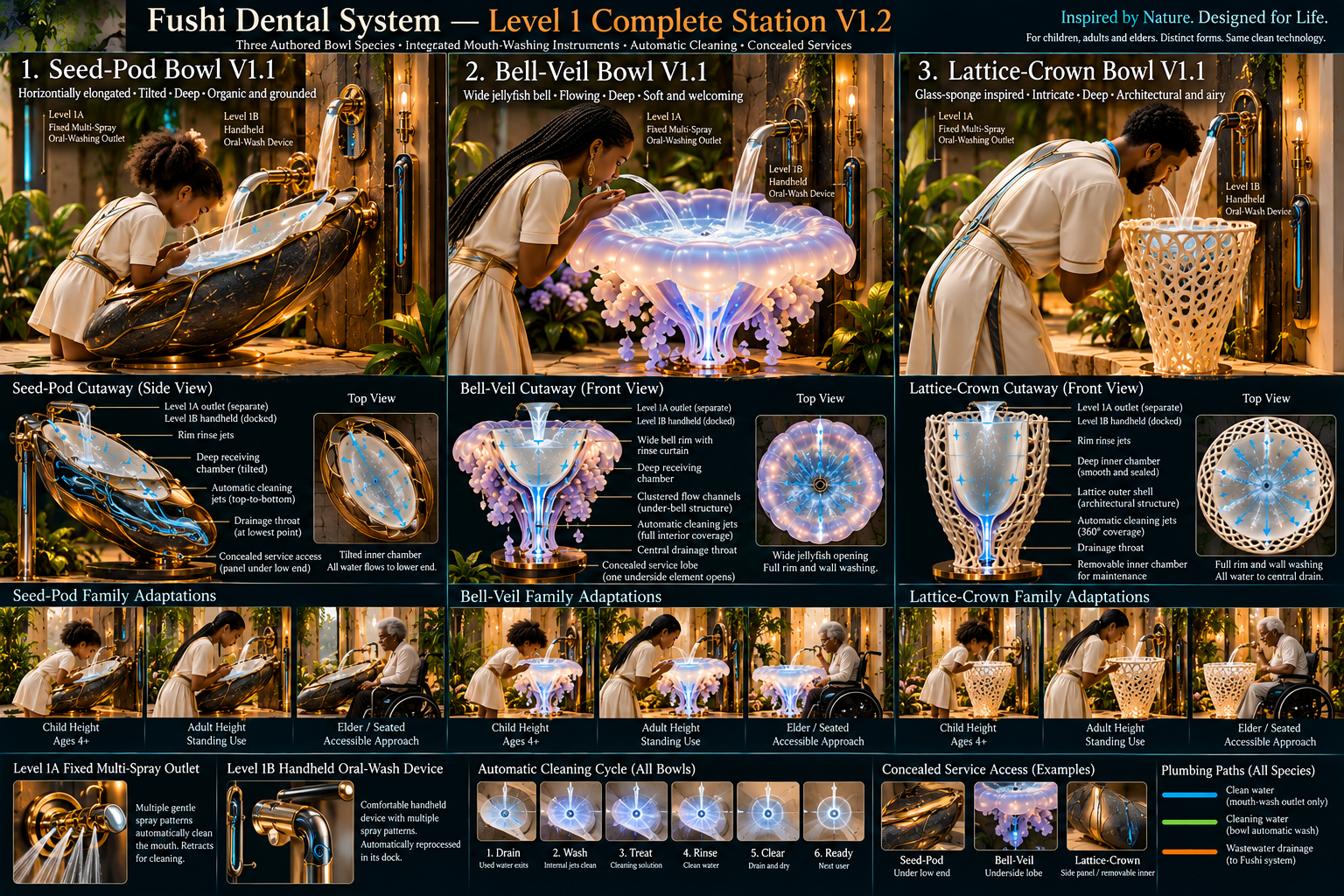
The Seed-Pod Deep-Return Bowl
The accepted Seed-Pod form is:
- Deep, vertically and horizontally elongated
- Tilted toward the person using it
- Freestanding and structurally grounded
- Approachable without a desk or countertop blocking the body
- Supported by an integrated, elegant structural base
The user can lean comfortably over its receiving chamber to spit.
The bowl’s interior directs water toward a concealed low-point drain. Its automatic washing system cleans the receiving surfaces after use.
Wastewater passes through hidden plumbing, separate from the water supplied to the mouth.
The Seed-Pod retains its distinctive natural character, including its elongated shell, sculptural body, and rich material treatment.
The Seed-Pod must never become an ordinary countertop washbasin.
07 / Inclusive Design
Family and Accessibility Adaptations
Fushi stations are developed for:
Children aged approximately four and above: Appropriately sized and positioned receiving bowls, water-pressure limits, and adult assistance where needed.
Standing adults: Comfortable bowl height and close approach without awkward bending.
Seated elders and wheelchair users: Suitable receiving height, clear approach space, and an accessible instrument service area.
The same Fushi operating system serves all three arrangements, with appropriate changes in height, reach, and physical support.
08 / Human Stewardship
Service Shadow Steward Oversight
Automation carries out routine cleaning and preparation. Human stewardship remains responsible for confirming that the system works.
Service Shadow Stewards perform daily operating checks, examine equipment condition and processing records, confirm clean and dirty route separation, oversee water-quality monitoring, and remove faulty instruments.
They arrange scheduled testing, maintenance, servicing, replacement, and repairs.
Automated processing and human supervision work together.
09 / Civilization Access
Civilization-Wide Provision
Fushi stations are freely accessible in appropriate locations throughout civilization, including:
- Family compounds and shared family grounds
- Food-serving and eating places
- Schools and children’s facilities
- Care-Ports and travel facilities
- Contribution grounds
- Public rest areas and gathering places
The purpose is to make after-meal mouth cleaning convenient enough that it becomes an ordinary practice among citizens.
10 / Complementary Care
Other Fushi Care Levels
Biodegradable Grass-Straw Food Release
Naturally grown grass stems remain a proposed biodegradable option for quickly dislodging obvious trapped food before water flossing, subject to botanical identification, material safety and suitability testing.
Fushi Level 3 — Home Brusher
The accepted visual design is a dual-ended, manually operated brusher inspired by the original three-pronged grass structure.
End 1 has an adjustable U-cup with dense bristles along both interior sidewalls and beneath its connecting bridge.
End 2 is a slim, tapered interdental precision brusher with fine radial bristles and no hard conventional toothbrush backing.
The brusher is intended for twice-daily plaque disruption. Natural and biodegradable materials remain the development goal.
Fushi Professional Dental Care
Professional examinations, preventive cleaning, dental treatment, and tooth repair remain available whenever needed.
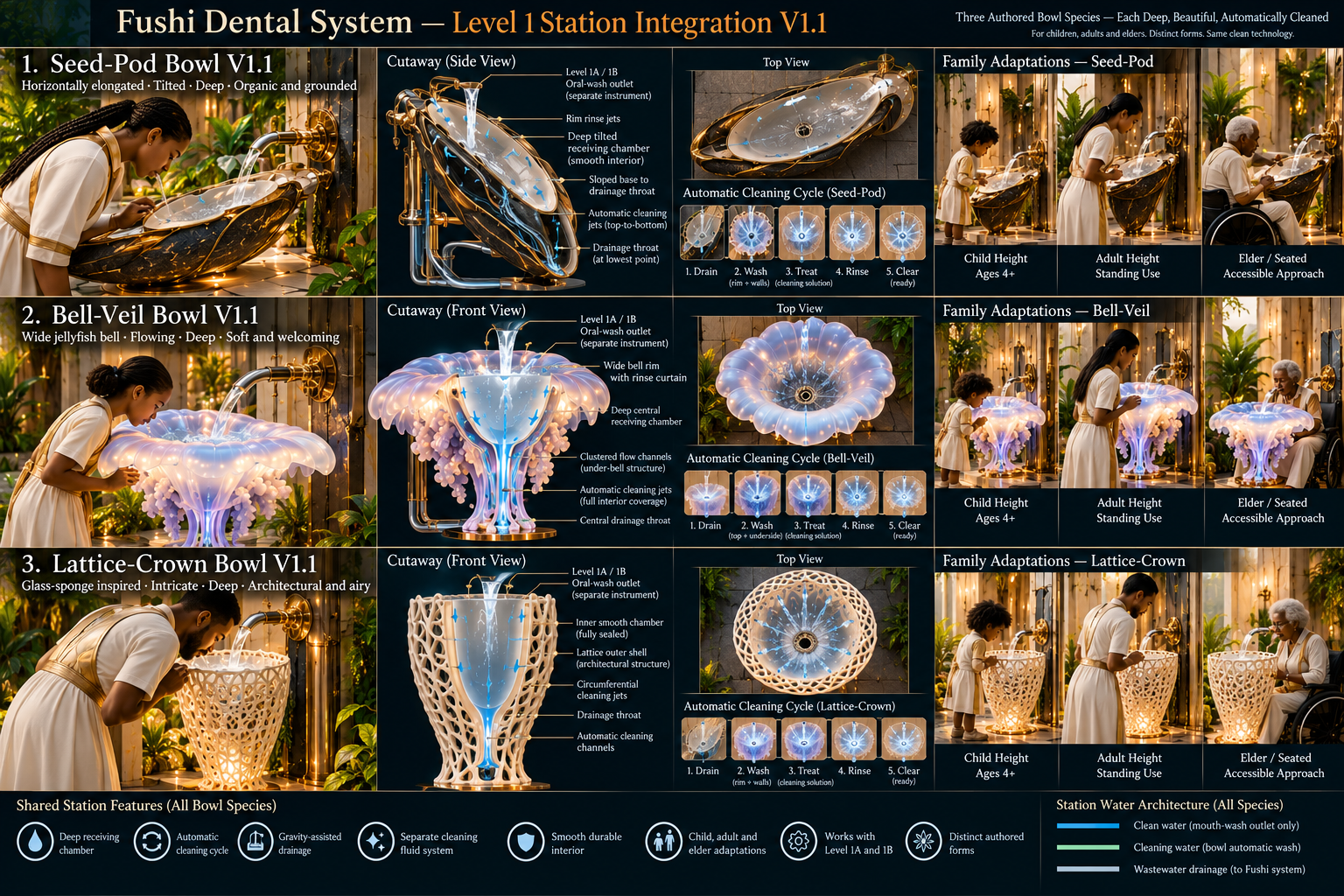
11 / Bowl Architecture Family
Accepted Bowl Species
Three Deep-Return Bowl species are retained within Fushi:
Seed-Pod: Deep, elongated, tilted, grounded.
Bell-Veil: Wide jellyfish-inspired form with a deep receiving chamber.
Lattice-Crown: Glass-sponge-inspired lattice surrounding a smooth, sealed receiving chamber.
The present station development concentrates on Seed-Pod. Bell-Veil and Lattice-Crown can be integrated into the same service system later.
12 / Engineering Integrity
Engineering Status
The system’s operation, user flow, service arrangement, and architectural direction are accepted.
Physical engineering must still demonstrate:
- Reliable automatic attachment and detachment
- Appropriate water pressure and backflow prevention
- Effective internal and external cleaning
- Validated sterilization of reusable precision heads
- Reliable hose treatment and protected storage
- Accessible bowl heights and comfortable use
- Mechanical durability and serviceability
No sterilization or cleaning performance is considered proven merely because it appears in a design illustration.
Central Operating Principle
Clean equipment available when needed. Used equipment taken back automatically. The civilization handles the cleaning, upkeep, and readiness.
Fushi makes oral cleanliness easy to practice throughout everyday life.