Trott Bailey Family Civilization · Canonical Development Record
Animal Nourishment System
A civilization-scale system for animal life, husbandry, fishing, working animals, slaughter, butchery, preservation, nourishment, biological return and the movement of food from source to family.
Trott Bailey Family Civilization treats animal nourishment as one continuous responsibility. The animal’s life, landscape, food, health, movement, breeding, work, death, butchery and eventual use are not separate moral or technical departments.
The system begins with suitable animal life and ends only when nourishment, materials and biological resources have entered their proper routes. The governing pattern is simple: good life, skilled stewardship, short movement, calm death, complete use and intelligent return.
Animal Nourishment System V0.2
The master framework joining animal life, husbandry, fishing, slaughter, food preparation and biological return.
When the Civilization receives nourishment from an animal, responsibility begins before the food reaches the plate and continues through the animal’s living conditions, care, death, food use and biological return.
Species Living Standard
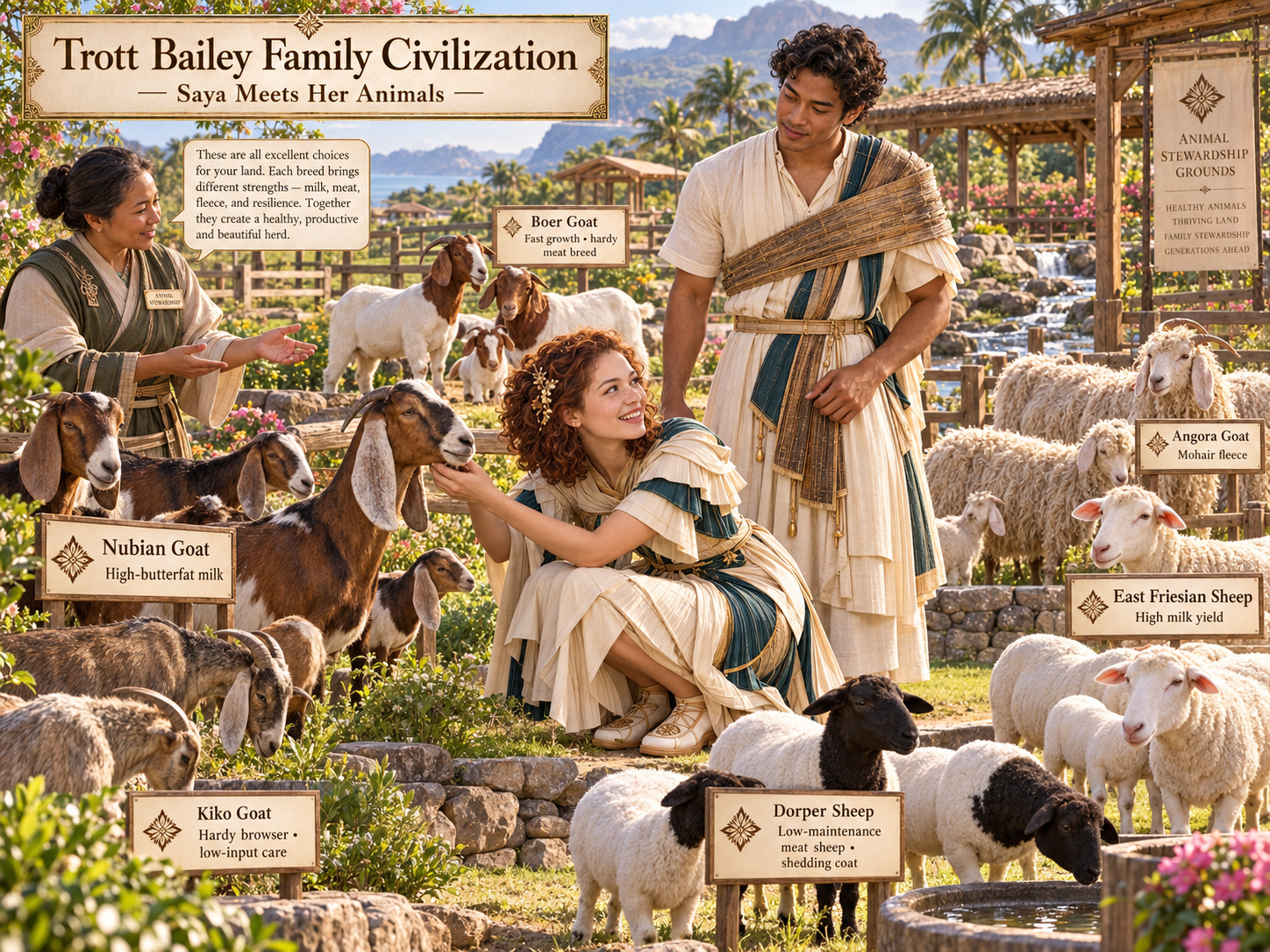
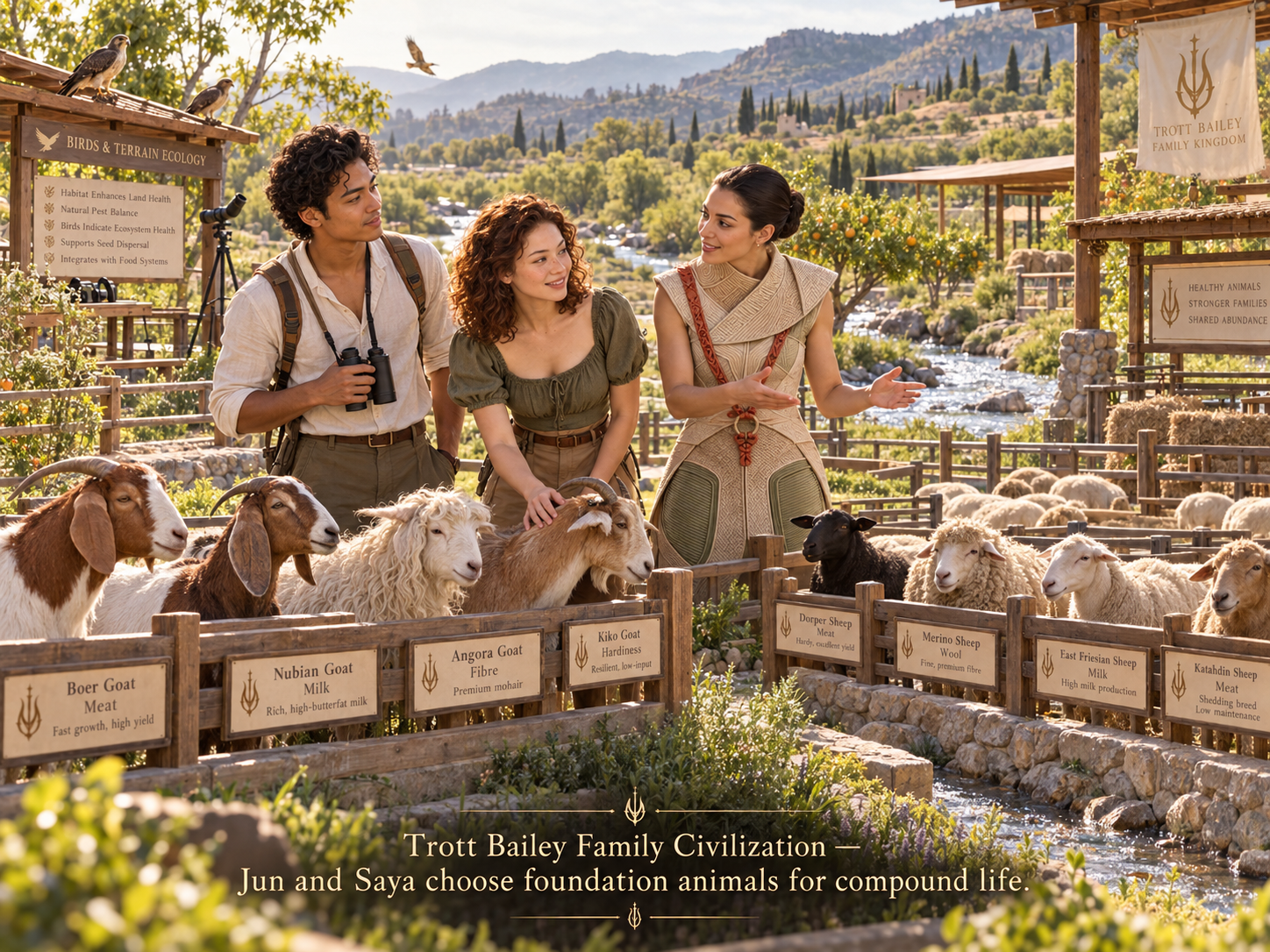
AcceptedEach species receives land, shelter, social life, food, water and movement designed around its actual biology rather than one generic livestock model.
Living Capacity Before Animal Numbers
AcceptedLand, water, forage, climate, health capacity and real nourishment needs determine animal numbers before breeding expands.
Nourishment Availability Follows Living Reality
AcceptedFood availability follows seasons, breeding, ecology and actual abundance rather than forcing every animal food to remain continuously available.
No Surplus Killing Standard
AcceptedAnimals are not killed merely to keep counters full, buildings busy or inventory constant.
Living Landscapes Before Livestock Pens
The animal’s primary living environment is designed as food, movement, shelter, rest and discovery together.
Animal Forage Orchard Range V0.4
Accepted Working Direction
Purpose
Large terraced living-and-feeding landscapes for goats and pigs.
Core Anatomy
Broad multi-acre terraces; Mulberry Browse Groves; Berry Browse Grounds;
Hanging Browse Corridors; Grass & Herb Meadows; Climb-and-Browse Groves;
stacked stone and log climbing grounds; Shared Goat-Pig Orchards;
Pig Rooting Grounds; Pig Cooling Hollows; Supplement Grounds;
Rest Terraces; Recovery Terraces and Evening Home Routes.
Rationale
These are not human orchards that animals are being prevented from damaging.
They are planted specifically for the animals to browse, eat, root through and live within.
Distinctive Idea
The Orchard Is the Feed System.
Large Terraced Living Grounds
AcceptedTerraces are broad land shelves rather than small agricultural steps. Different terraces can emphasize browse, orchard life, climbing, rooting, resting, recovery or water handling.
Hanging Browse Corridors
AcceptedGuided routes carry hanging edible vines and browse at different heights so movement itself passes through food.
Goat Evening Home Barn V0.1
Accepted Working DirectionGoats return through a trained Evening Home Call to a large airy communal night barn with broad entrances, dry sleeping grounds, raised resting levels, water and observation areas.
Pig Night Home V0.1
Accepted Working DirectionPigs return to separate dry, ventilated night bodies with social sleeping groups, while mud remains a deliberate daytime landscape feature.
Cattle Living Range V0.1
Accepted Working DirectionBroad Grazing Terraces, Grass & Legume Fields, Shade Belts, Rest Groves, distributed water, Herd Paths, recovery sectors, Fresh Milk Orchards, Calf Grounds, Bull Grounds and storm refuge.
Poultry Living Landscape V0.1
Accepted Working DirectionPoultry Forage Orchards, Insect & Scratch Grounds, Dust Courts, shelter islands, perch trees, Nesting Galleries, Roost Houses, Mother Hen Grounds, Duck Wetland Orchards and Goose Grazing Meadows.
Day Range, Night Home
Accepted PrincipleThe landscape is the animal’s main daily home. Night buildings provide safety, rest, weather protection and observation without becoming permanent confinement.
Young Animal Development Grounds
Working DirectionYoung animals move gradually from mother-and-newborn protection into exploration, social learning and finally the wider adult landscape.
Animal Health & Breeding Stewardship V0.1
Health Comes to the Animal
Accepted PrincipleRoutine examination and treatment happen near the normal living landscape wherever practical.
Animal Care Core
Working DirectionSource-linked examination, treatment, weighing, clean-water, birth-support and short-stay health infrastructure.
Recovery Near the Herd
Accepted PrincipleNon-contagious recovering animals remain socially close to their herd or flock where appropriate. True infectious isolation remains physically separate.
Observation Before Crisis
Accepted PrincipleChanges in movement, appetite, social behaviour, posture and appearance are treated as useful early health information.
Breeding Follows Living Capacity
Accepted PrincipleAnimal populations grow only after the land, forage, water, steward network and difficult-season reserves can support them well.
Whole-Life Breeding Standard
Accepted PrincipleBreeding considers health, movement, climate fitness, fertility, temperament, longevity, mothering ability and useful production rather than maximum output alone.
Animal Identity & Living Record
Working DirectionRecords follow the real management need: individual animals where useful, flocks or cohorts where individual tracking adds little.
Source Feedback Loop
Accepted PrincipleHealth observations, slaughter findings and carcass information travel back into husbandry, breeding, forage and land improvement.
Working Cattle & Carriage Stewardship V0.1
Male Cattle as Working Animals
Accepted DirectionMale cattle are not treated mainly as surplus animals for early meat use. A significant portion can be intentionally developed as working cattle for farm labour, hauling, carts and carriages.
Breeding bulls remain a distinct group. Working males may include trained oxen, with population planning accounting for both breeding and labour requirements.
Work From a Good Life
Accepted PrincipleA working animal first has a normal cattle life: grazing, shade, herd contact, rest, water and ordinary movement.
Work Without Wearing Out the Animal
Accepted PrincipleLoad, route, heat, harness, work period, hoof condition and recovery are managed for a long useful life rather than maximum extraction.
Team Continuity
Working PrincipleWorking cattle that develop an effective team relationship remain paired where practical.
Design the Load Before Blaming the Animal
Accepted IdeaCarriage balance, bearings, wheels, route grade and harness design are examined before assuming an animal is unwilling or weak.
Animal Forage Abundance & Reserve System V0.1
Grow the Reserve Before the Shortage
Working PrincipleDifficult-season nourishment is prepared during periods of abundance.
Living Feed Before Stored Feed
Working PrincipleThe landscape remains the normal food system. Stored forage is the resilience layer.
Mulberry Reserve Route
Working DirectionMulberry Browse Groves provide direct browse, fresh cut browse and preserved forage during periods of strong growth.
Hard-Season Capacity Standard
Working PrincipleLong-term animal numbers must consider what can be supported during difficult periods, not merely the most abundant month of the year.
Animals Are Forage Researchers Too
Working IdeaAnimal selection and avoidance give useful evidence about palatability and future planting, alongside nutritional measurement.
The Reserve Must Move
Working PrincipleStored forage is rotated through use and replenishment rather than becoming forgotten inventory.
Farm-Linked Butchery Network V0.1
Butchery geography follows the source animal system.
Slaughter and butchery are organized close to farms and Animal Living Grounds, rather than around the largest possible processing facility.
Animal Living Ground → very short calm movement → Calm Slaughter House → Butchery House → Whole-Animal Use → fresh / preservation / material routes.
Source-Proximity Butchery Standard
AcceptedLand animals move only a short distance from their living grounds before slaughter and butchery.
Move Food, Not Animals
Accepted PrincipleWhen distance must be covered, processed nourishment and materials move outward instead of subjecting live animals to unnecessary transport.
Calm Slaughter & Butchery House V0.1
Accepted Working DirectionLiving Arrival Grounds, species-specific calm routes, health check, quiet dispatch, one-way carcass transition, clean butchery and Whole-Animal Use.
Calm Life, Calm Death, Complete Use
Accepted PrincipleGood husbandry continues through final handling, humane dispatch and intelligent use of the animal after death.
Butchery Stewardship & Apprenticeship
Working DirectionButchery Learner → Apprentice → Species-Qualified Butchery Steward → Senior Butchery Steward.
Know the Whole Animal
Accepted PrincipleQualified butchers understand the complete animal rather than only fashionable cuts.
Skill Before the Knife
Accepted PrincipleIndependent cutting follows demonstrated anatomy, tool, food-safety and judgement competence.
Cut for Use
Accepted PrincipleCarcass breakdown responds to how the food will actually be cooked, preserved or used.
Whole-Animal Allocation Board
Working DirectionFood, organs, bones, fat, skin, hide and other useful parts receive intended destinations while the animal is still being processed.
Edible-First Route
Working PrincipleSafe human nourishment is considered before useful materials, biological conversion and disposal.
Cold Spine
Working DirectionTemperature control links source-linked chilling, butchery, dispatch and food movement where required.
Pause Authority
Working PrincipleA properly trained steward may stop immediate processing when a credible safety, welfare or contamination concern appears.
The Animal Determines the Butchery
Cattle Butchery Node V0.1
Working DirectionHeavy mechanical handling, large-section allocation, hide route, bone and broth route, fat separation and whole-muscle use.
Distinctive idea: Cut to the Life of the Animal.
Goat & Sheep Butchery Node V0.1
Working DirectionSmaller source-linked houses retaining strong whole, bone-in and Same-Day Source possibilities.
Distinctive idea: Small Animal, Whole Possibilities.
Pig Butchery Node V0.1
Working DirectionStrong routes for fresh meat, fat, skin, head, organs, bones, mince and preservation.
Distinctive idea: Separate Value Early.
Poultry Processing Node V0.1
Working DirectionVery short source movement, rapid clean processing, Whole-Bird Allocation, organ routes, bones, feet and feather routes.
Distinctive idea: Whole Bird Before Parts.
Meat Preservation Stewardship + Farm-Linked Food Web
Fresh First, Preserve Deliberately
Working PrincipleFresh use remains the first route where sensible. Preservation begins with a real purpose.
Preserve for Purpose
Working PrinciplePreservation serves taste, season, mobility, resilience or genuine abundance, not careless overproduction.
Time Is an Ingredient
Working PrincipleWhen time transforms food, duration and conditions become part of what must be stewarded.
Farm-Linked Food Web V0.1
Working DirectionSource-linked butchery nodes send fresh cuts, organs, broth materials, preserved food and useful materials outward through several short routes.
Same-Day Source Route
Working PrincipleWhere safe and practical, suitable animal food moves from source-linked butchery into cooking on the same day.
Allocate Before Accumulating
Working PrincipleLikely destinations are known before meat, organs and materials become anonymous inventory.
Demand Travels Backward, Food Travels Forward
Working PrincipleInformation about need reaches the source before cutting while fresh nourishment moves outward afterward.
Storage Is a Buffer, Not a Destination
Working PrincipleCold storage protects food and absorbs timing differences without becoming a hiding place for overproduction.
Animal Biological Return & Bedding Cycle V0.1
Land → animal → manure / bedding → managed biological return → land → forage → animal.
Return Across the Landscape
Working PrincipleNormal animal movement distributes nutrients while stewards watch for over-concentration.
Bedding Is Part of the Nutrient Route
Working PrincipleBedding serves animal comfort first and is chosen with its later biological-return route in mind.
Return Nutrients Where the Land Needs Them
Working PrincipleSoil condition, plant need and water protection determine application rather than convenience.
No Nutrient Dumping
Working StandardUseful biological material becomes pollution when concentrated beyond the land’s ability to use it.
Health Before Return
Working PrincipleMaterial from health-isolation or disease-risk areas follows controlled handling before land return.
Biological Return Stays Close to Source
Working PrincipleNutrients normally return to the source farm and surrounding land before long-distance movement is considered.
Calm Movement Infrastructure
Guide, Don’t Chase
Working PrincipleFamiliar routes, trained calls and calm group movement replace routine chasing and rough handling.
Necessary-Only Live Transport
Working StandardAnimals travel longer distances only for genuine life needs such as specialist care, breeding relocation or emergency evacuation.
Water Is Distributed, Not Centralized
Working PrincipleLarge living ranges contain several reliable drinking points rather than one crowded central source.
Shade Is Infrastructure
Working PrincipleShade trees, groves, orchard canopy and shelters are part of the basic land plan.
New Animals Enter Slowly
Working PrincipleIntroduction Grounds support health observation and gradual social integration.
Emergency Routes Exist Before the Emergency
Working PrincipleFire, flood, storm and disease response uses routes and holding grounds already understood by animals and stewards.
The Range Must Recover Too
Working PrincipleAnimal freedom includes large-scale rotation and temporary closure so browse, soil and ground cover can recover.
Protect the Herd Without Emptying the Landscape
Working PrinciplePredator protection begins with night housing, route design, guardian systems and intelligent coexistence rather than indiscriminate wildlife removal.
Fresh Animal Food Routes
Fresh Milk Route V0.1
Working DirectionHealthy animal → calm milking → clean handling → rapid cooling or direct validated use → family food route / Sabennerie.
Egg Freshness Route V0.1
Working DirectionNest → collection → condition check → clean handling → immediate food route.
Fresh Animal Foods Move Short and Fast
Working PrincipleMilk, eggs and other highly perishable animal foods should not travel farther or wait longer than necessary.
Many Uses, One Living Animal
Working PrincipleAnimals may contribute work, milk, eggs, fibre, fertility, land management and biological return across a life rather than being valued only for meat.
Productive Life Is Not the Whole Life
Working PrincipleDeclining production does not automatically make a healthy older animal disposable.
Sea Ring Living Grounds & Live-Fish Movement
Sea Ring Living Grounds V0.1
Accepted Working DirectionLarge floating ring/net living grounds with Nursery Rings, Growing Rings, Grand Sea Rings, Recovery Rings and Transfer Rings.
Species Swimming Standard
Working PrincipleStocking and ring design must allow appropriate swimming, schooling, depth use and normal behaviour.
Alive Until the Necessary Transition
Accepted PrincipleSuitable fish remain alive through growing, transfer and regional movement, with dispatch close to actual nourishment.
Move Fish as Little as Necessary
Accepted PrincipleLive movement is available but unnecessary handling and repeated transfer are avoided.
Live Fish Carrier
Accepted ConceptMonitored water chambers maintain fish alive during regional movement.
Live Fish Transfer Chamber
Accepted Authored ConceptFish swim into a water-filled chamber, travel while remaining immersed, then swim out at the destination.
Water-to-Water Transfer
Accepted PrincipleFish move between ring, vessel, chamber and basin through connected water wherever practical.
Wild Fishing Stewardship & Apprenticeship System V0.1
Skill Before Independence
Accepted PrincipleIndependent fishing responsibility follows demonstrated judgement, safety and practical skill rather than time served.
Apprenticeship Path
AcceptedShore & Water Learner → Fishing Apprentice → Independent Wild Fishing Steward → Senior Wild Fishing Steward.
Fishing Ground Knowledge
Accepted Authored IdeaDeep local fisher knowledge is treated as real operational evidence alongside ecological measurement.
Wild Water Knowledge Archive
AcceptedOral knowledge, maps, seasonal notes, unusual events and long experience are deliberately preserved.
Wild Fishing Vessel & Working Day V0.1
Accepted Working DirectionNavigation & Water Reading Body, Apprentice Observation Station, Gear Working Deck, Catch Decision Point, Wet Release Route and monitored Live-Water Chambers.
Release Is a Designed Route
Accepted PrincipleVessel architecture makes rapid return-to-water easy for unwanted or accidental catch.
Need Sets the Harvest
Accepted PrincipleFishing stops when nourishment need is met, live capacity is comfortable, conditions change or stewardship says enough has been taken.
Wild Fishing Ground Stewardship
Accepted Working DirectionNursery First, Rest Waters, spawning protection, bycatch observation, Fishing Ground Councils and a Living Fishing Calendar.
Live Water to Fresh Food
Sea Ring / Wild Water → Live Transfer → Live Fish Carrier → Kultan Live Receiving Grounds → Rest Waters / Health Pools → Live Nourishment Basins → Quiet Dispatch → Zero-Clean Processing → Sabennerie.
Kultan Live Fish Receiving Grounds V0.1
Accepted Working DirectionArrival Basins, Rest Waters, Health Separation Pools and Live Nourishment Basins receive fish while they remain alive.
Live-Fish Water Loop
AcceptedLiving-fish water remains separate from blood, gutting and food-processing water.
Kultan Live Fish Nourishment Transition V0.1
Accepted Working DirectionSelected fish move through a submerged Selection Waterway into Quiet Dispatch only when nourishment actually requires them.
Whole Fish Before Waste
Accepted PrincipleFlesh, heads, collars, skin, bones, organs and other suitable parts are considered for food and useful routes before waste.
Kultan Fish Sabenneries
Accepted Signature DirectionFish Sabenneries sit close to live receiving, dispatch and Zero-Clean processing so fish consumption can remain exceptionally fresh.
Kultan Fresh-Fish Signature
AcceptedKultan becomes known for clear water, skilled fishing, live-fish systems, whole-fish food culture and fish that was swimming very recently.
Wokumbakia Food News
Tell the Civilization what food is becoming available before it piles up in storage.
Wokumbakia — The News of Abundance
Established Civilization SystemWokumbakia is the Civilization-wide public information system that makes useful abundance, capacity, discovery, recovery and possibility visible.
Wokumbakia Food News is its food-abundance branch.
Fresh-Cut Pre-Booking
Accepted New FunctionFamilies, Sabenneries and food houses can see expected fresh animal-food availability and pre-book whole cuts or specific parts before final butchery.
Food Timing
Accepted FunctionWokumbakia can report processing tomorrow, fresh today, live fish arriving this morning, preserved food becoming ready, seasonal milk abundance and other food rhythms.
Whole-Animal Coordination
Accepted FunctionLess familiar but useful parts remain visible so organs, bones, fats and other foods can find real destinations.
Not a Marketplace
Accepted DistinctionWokumbakia does not create artificial demand, dynamic pricing or commercial sales pressure. It reports real abundance and allows citizens to organize around it.
Skill, Apprenticeship & Restoration
Specialization Without a Servant Class
Standing TBFC LogicDeep technical skill is respected without trapping one group in endless dirty, repetitive or exhausting work.
Intense Seasons Earn Recovery
Working PrincipleBirthing seasons, long fishing days, disease response and heavy processing periods are followed by lighter contribution or restoration periods.
Apprentices Are There to Become Skilled
Accepted PrincipleApprenticeship is teaching and increasing responsibility, not a source of cheap labour.
Farm Intelligence Cycle V0.1
Information moves continuously between land, animal, steward, butcher, food system and the next round of husbandry.
Distinctive TBFC Ideas to Preserve
These are distinctive names and combinations developed within this Animal Nourishment System. The claim is not that every underlying agricultural or husbandry technique is globally unprecedented. The authorship lies in the system logic, combinations, names and civilization structure.
Decision Log
Goat and pig husbandry moved away from generic pasture toward large terraced orchards planted specifically for the animals to eat.
Goats return from large ranges by trained call and converging routes into airy communal night barns.
Centralized long-distance slaughter was rejected. Butchery remains linked closely to source farms.
Male cattle gained a major positive role as labour and carriage animals rather than being treated mainly as surplus males.
Fish transport shifted from cold-chain-first to live-water-first where practical.
A movable water-filled transfer chamber was added to reduce repeated capture and air exposure.
Wild fishing became a deep-skilled intergenerational profession rather than casual rotational work.
Fresh fish food places close to Kultan live-water infrastructure became a signature district feature.
Wokumbakia Food News gained a pre-booking and advance abundance role so butchers can cut toward real use.
One master record. Deeper records only when the work demands them.
New Animal Nourishment developments should first enter this Master Record in compact form. Separate branch records should be created only when architecture, engineering, detailed protocols, training systems or publication work become large enough to justify them.
When an accepted decision changes, the existing entry should be corrected and one short Decision Log note should preserve what changed and why.