Clothing / Textile Civilization Department Constitutional Layer
A governing record on clothing as protection, dignity, movement, beauty, authorship, climate intelligence, family identity, textile stewardship, repair, inheritance, and everyday delight.
1. The Human Reality
Human beings have bodies that are exposed to weather, friction, work, dirt, injury, changing temperatures, changing life stages, social life, and the eyes of other people.
Clothing exists because the body needs protection, modesty, comfort, movement, practical support, climate response, and sometimes specialized protection for particular work.
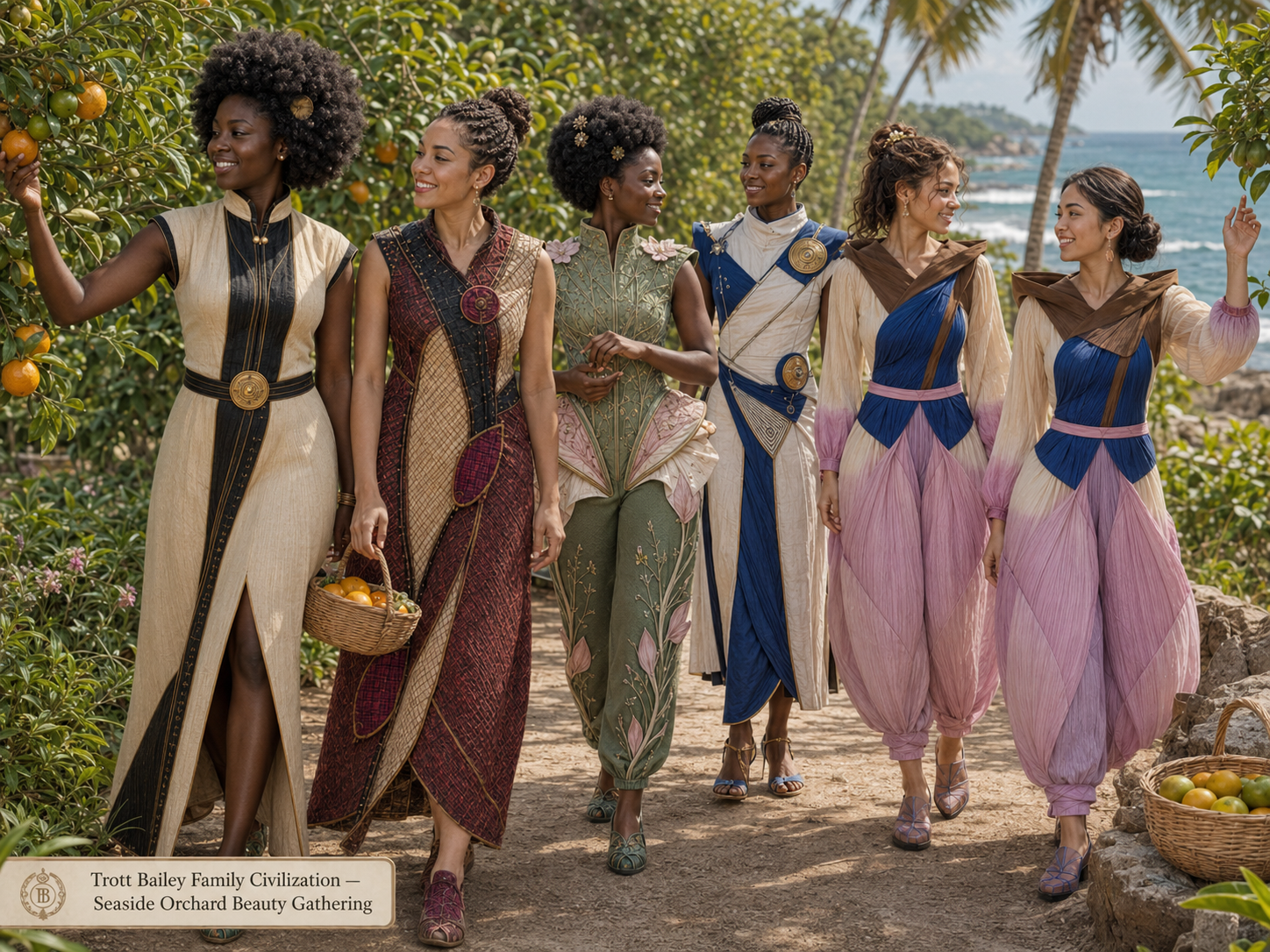
Clothing also exists because human beings enjoy beauty, attraction, self-expression, family identity, celebration, and the pleasure of being well dressed.
2. Constitutional Purpose
The Clothing / Textile Civilization Department exists to clothe human beings in ways that protect the body, preserve modesty and dignity, support movement and work, respond intelligently to climate and changing bodies, reduce care burden, express individual and family authorship, and bring beauty and delight into everyday life.
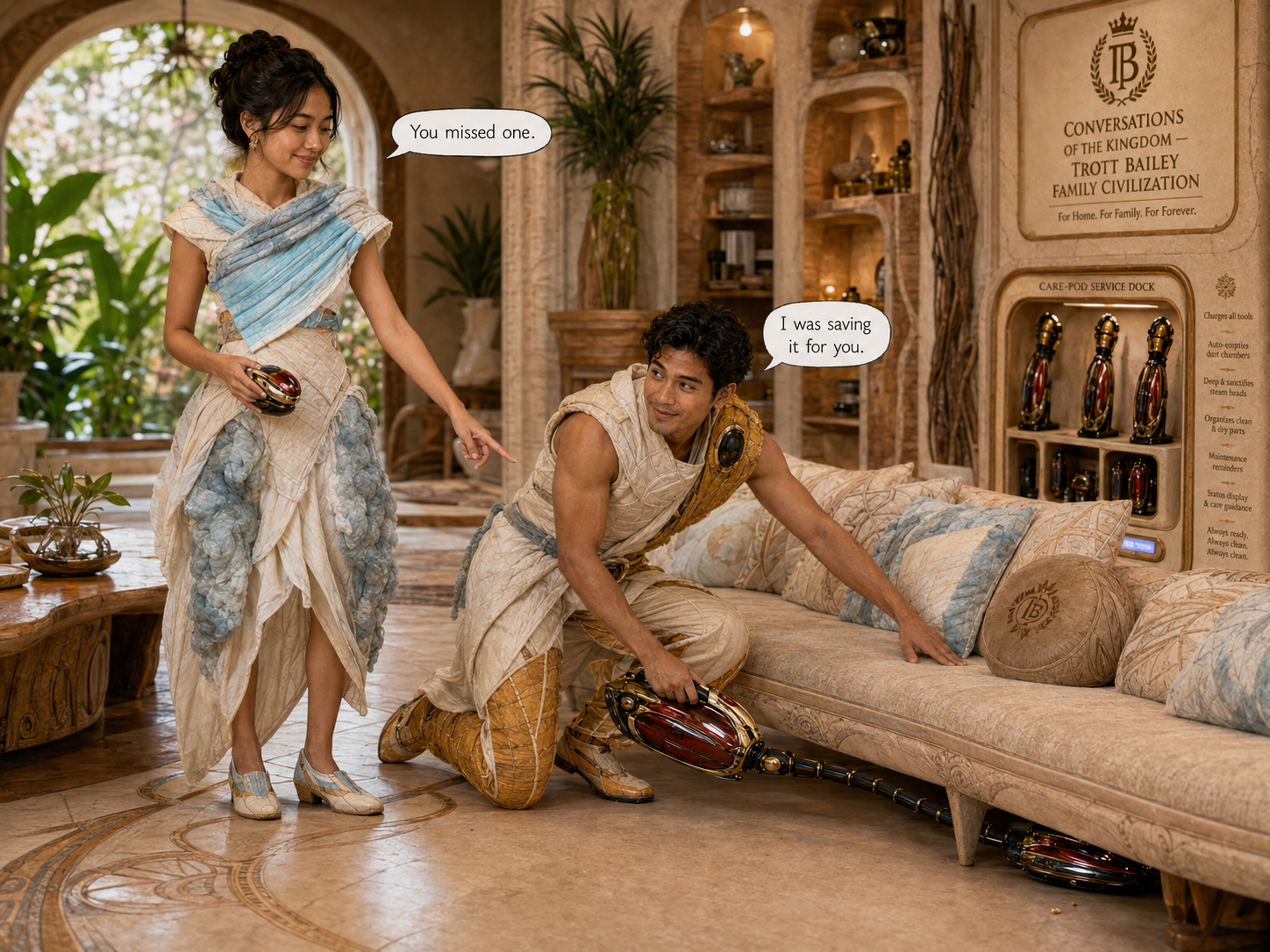
Its responsibility does not end when a garment is created. It also includes the complete garment rhythm of wearing, cleaning, drying, inspecting, repairing, adapting, storing, inheriting, and returning garments to useful life.
3. A Garment Is The Body’s Portable Life System
Architecture supports the body through space. Clothing supports the body while the person moves through space.
A garment should therefore begin by asking: What is this person about to do, experience, withstand, express, or become?
4. Protection Must Increase Capability
Clothing must protect without unnecessarily imprisoning the body.
A garment may protect from sun, heat, cold, rain, insects, sharp materials, dirt, fire, wetness, or dangerous work conditions. But protection that prevents useful movement has failed part of its purpose.
Clothing should be tested against real movement: walking, running, kneeling, sitting, climbing, lifting, carrying children, working, dancing, swimming where appropriate, and resting.
Protection should increase capability, not unnecessarily reduce it.
5. Modesty And Dignity
Modesty is a real clothing function. Shared public life requires thoughtful bodily covering and secure garment behavior.
Trott Bailey modesty must not become ugliness, shapelessness, discomfort, fear of the body, or suppression of beauty.
The garment may still be fitted, youthful, sculptural, expressive, elegant, attractive, and unusual while preserving reliable coverage and dignity.
The established Dignity Core remains part of this department.
6. Clothing Must Follow Changing Bodies
The human body does not remain fixed.
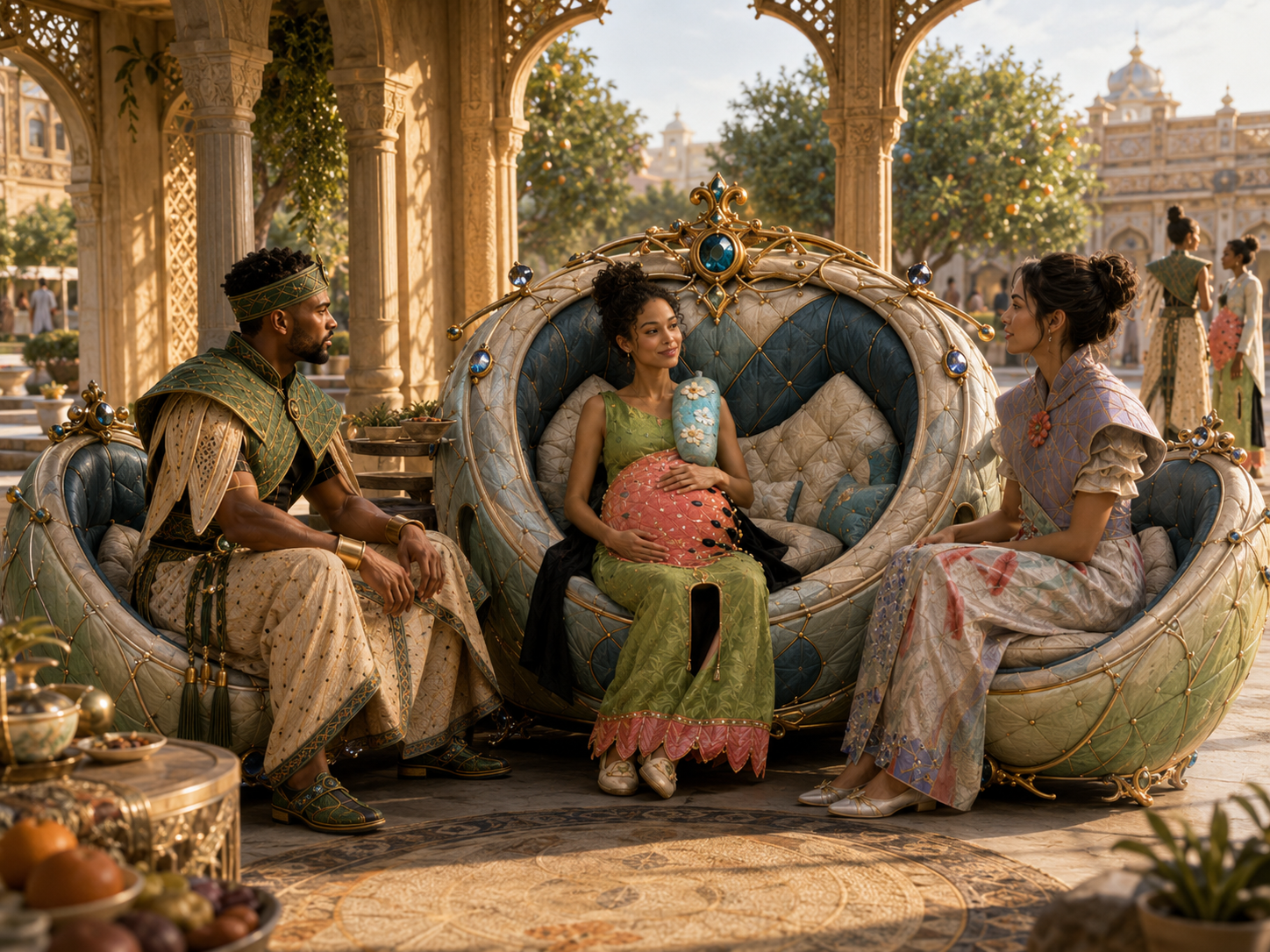
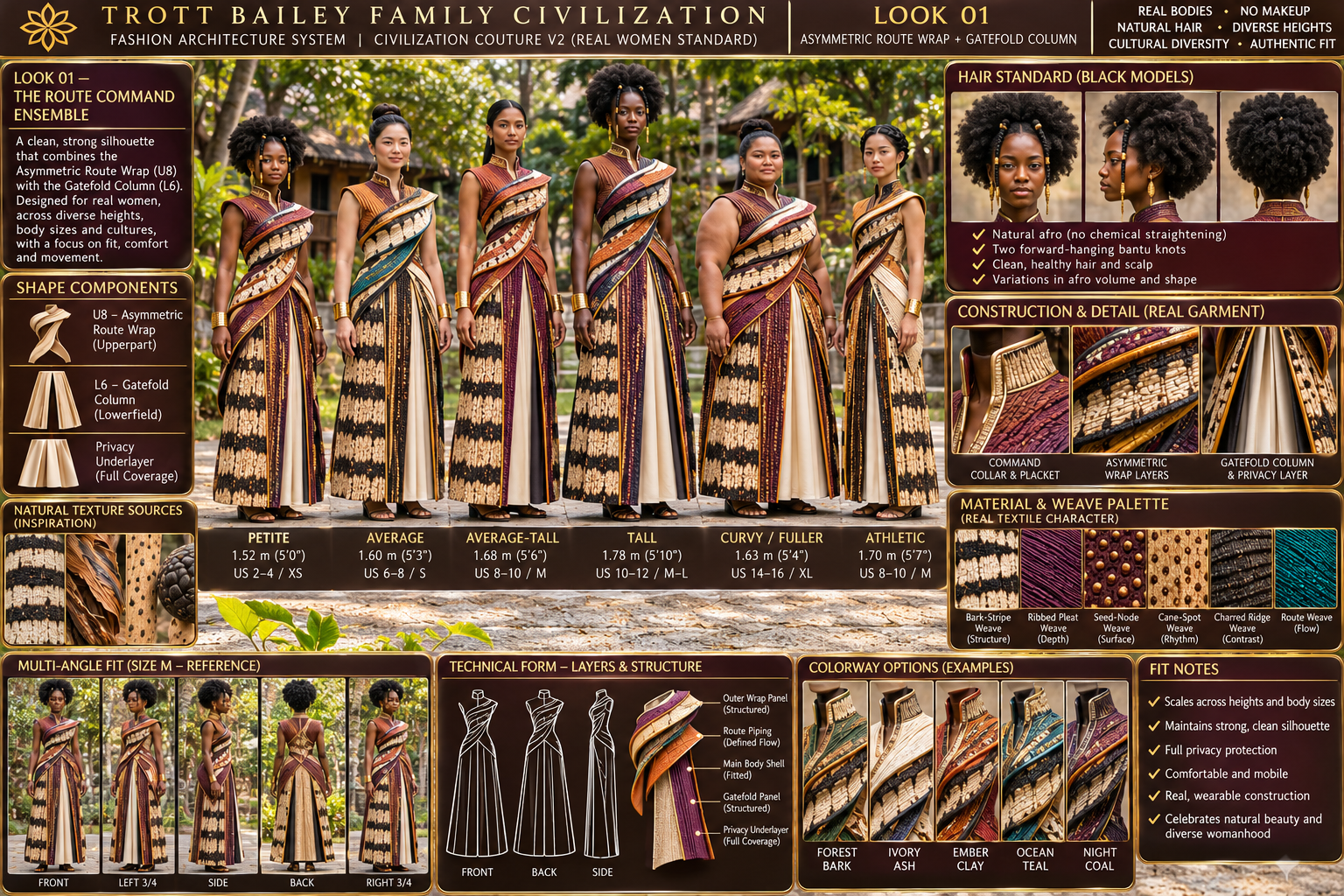
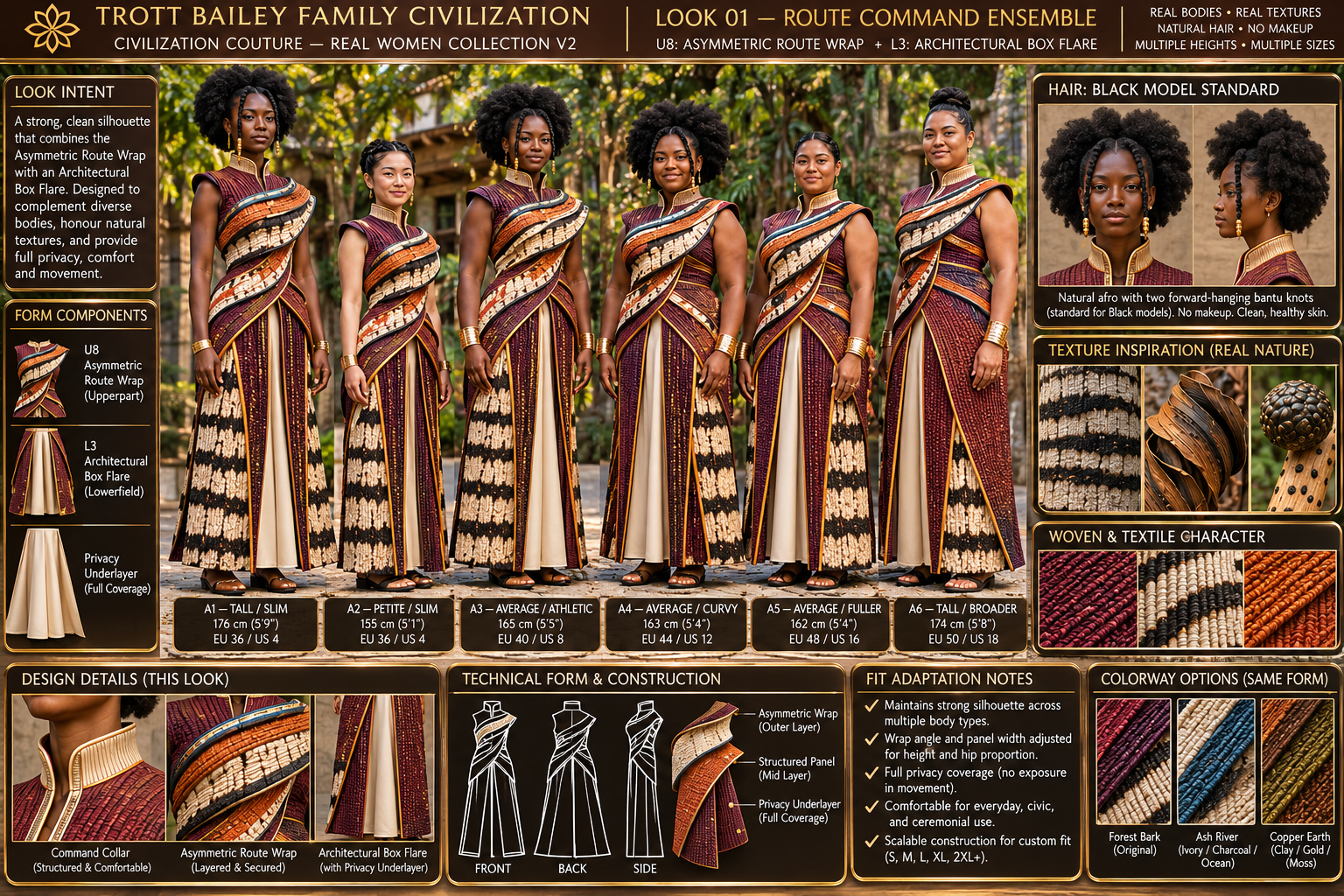
Childhood, adolescence, pregnancy, nursing, postpartum recovery, muscular development, weight change, aging, injury, and disability may all change what a body needs from clothing.
Good garment systems may therefore include:
Expansion
Routes, panels, folds, or memory regions that allow controlled growth and body change.
Adjustment
Docking points, waist locks, shoulder routes, and closures that alter fit without destroying garment form.
Pregnancy & Nursing
Support, expansion, access, airflow, comfort, and dignified adaptation.
Mobility Support
Easy dressing, accessible openings, seated-wear logic, and accommodation of mobility aids where needed.
Child Growth
Growth allowance and adjustable systems where practical so useful garments do not become obsolete immediately.
Clothing should accommodate the body rather than punish the body for changing.
7. The Complete Garment Rhythm
Clothing does not merely move from wardrobe to body. It passes through a repeated care cycle.
Garment care is therefore part of garment design, not an unrelated household problem.
8. Core Clothing Life Systems
Climate Response System
Heat, cold, sun, wind, rain, humidity, sweat, ventilation, membranes, thermal chambers, gills, and removable climate protection.
Movement & Capability System
Articulated shoulders, hips, knees, lowerfields, movement releases, footwear, and garment structures that follow real human motion.
Dignity & Modesty System
Secure coverage, authored neckline logic, movement without accidental exposure, nursing support, pregnancy adaptation, and public-life appropriateness.
Protective Work System
Role-specific protection for agriculture, medicine, machinery, food preparation, wet work, heat, sharp materials, and messy foods.
Changing-Body Adaptation System
Expansion, docking, growth allowance, pregnancy release, easy-dress systems, and adaptive support.
Garment Care & Return System
Stain stabilization, washing, drying, reshaping, inspection, repair, restoration, storage, and return to wear.
9. Climate Intelligence Belongs In The Garment
Climate response should not be treated only as layering more cloth onto the body.
Garments may use airflow gills, membranes, routed openings, thin insulation, thermal chambers, woven image, embedded fibers, removable shields, moisture-routing systems, and changing textile states.
Climate intelligence belongs in the garment itself.
In cold climates, warmth should not automatically mean bulk. In hot climates, modesty should not automatically mean overheating.
10. Beauty Is A Real Function
Clothing changes how people experience themselves and one another.
Beautiful clothing can bring confidence, attraction, joy, play, celebration, freshness, family pride, and delight into ordinary life.
Beauty should not be reserved for elites, celebrities, weddings, ceremonial days, or people doing the least practical work.
Beauty belongs in ordinary life.
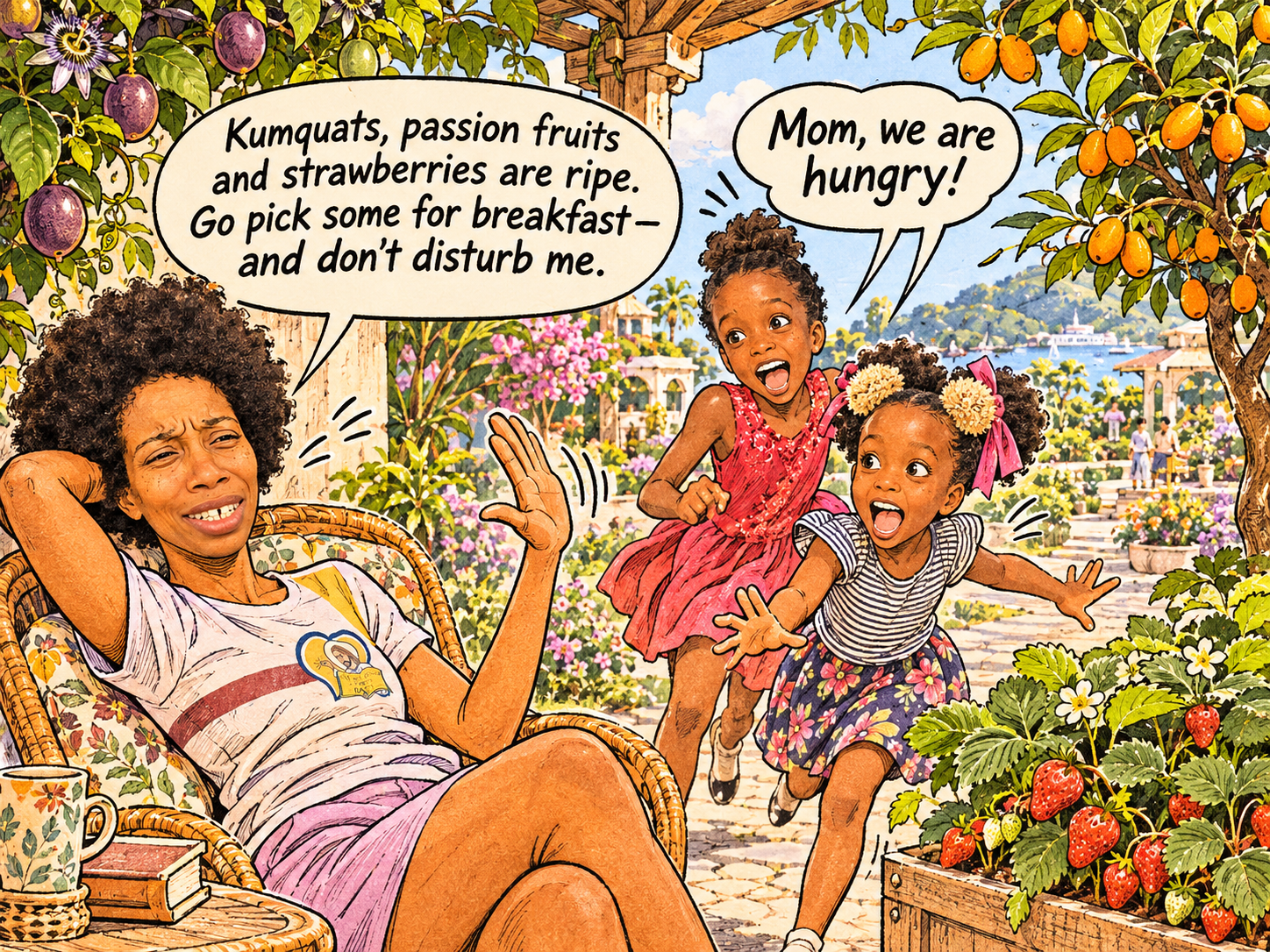
A mother going to breakfast may be beautifully dressed. A teenager entering AgriGames may be beautifully dressed. A grandfather caring for fruit trees may be beautifully dressed. A sanitation steward may be beautifully dressed while remaining properly protected.
11. Beauty Must Survive Ordinary Life
Extraordinary appearance does not excuse unusable clothing.
A garment should remain workable when the wearer sits, eats, bends, carries a child, enters transportation, works, encounters wind, uses a Baliza, sweats, or walks long distances.
Ceremonial garments may demand greater attention than ordinary public-life garments, but needless physical suffering should not be confused with elegance.
12. Refined And Strange
Trott Bailey fashion should not become merely tasteful. Taste without authorship eventually becomes another civilization of attractive but familiar clothes.
The established direction remains:
Approximately 50% refined and 50% strange.
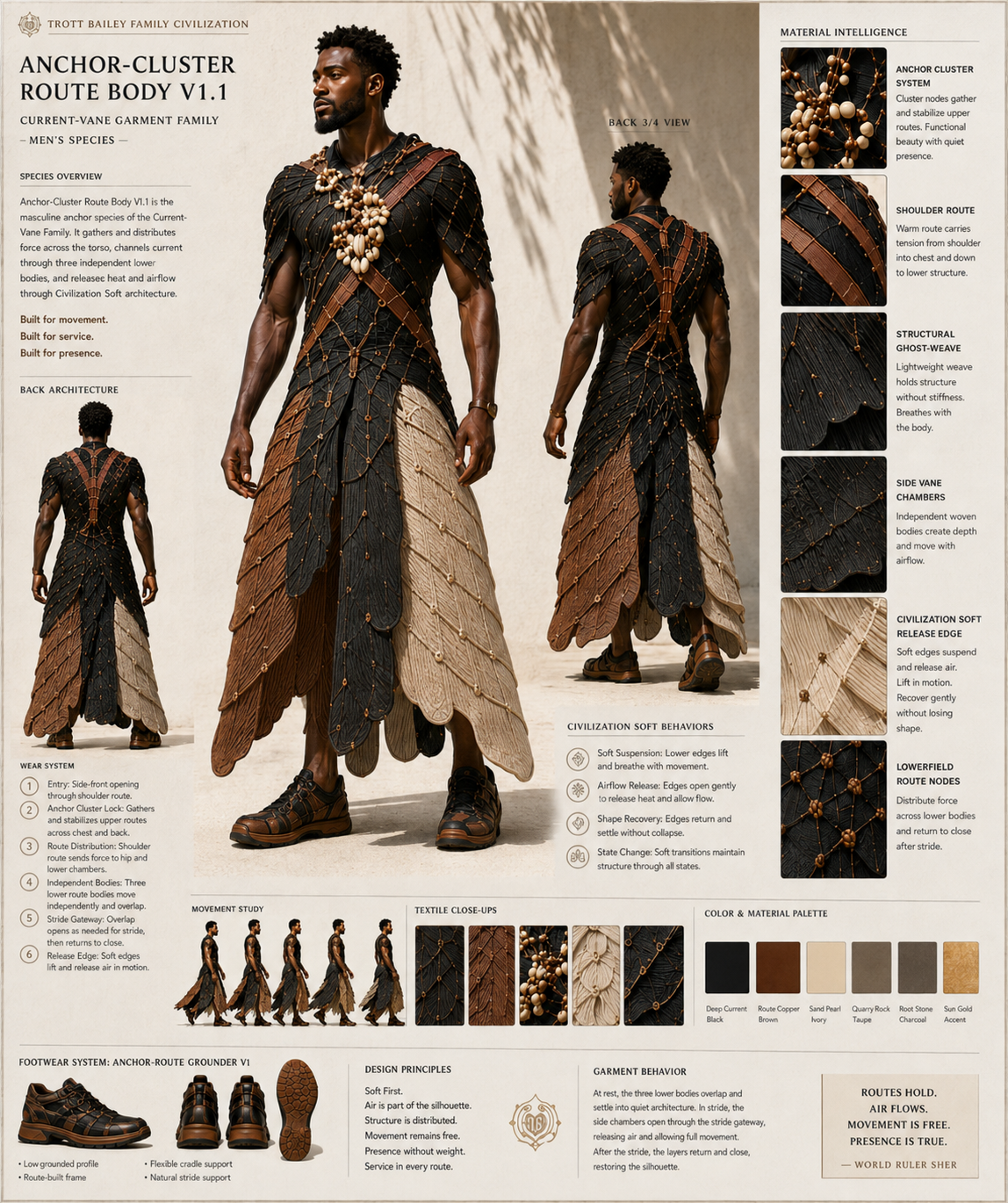
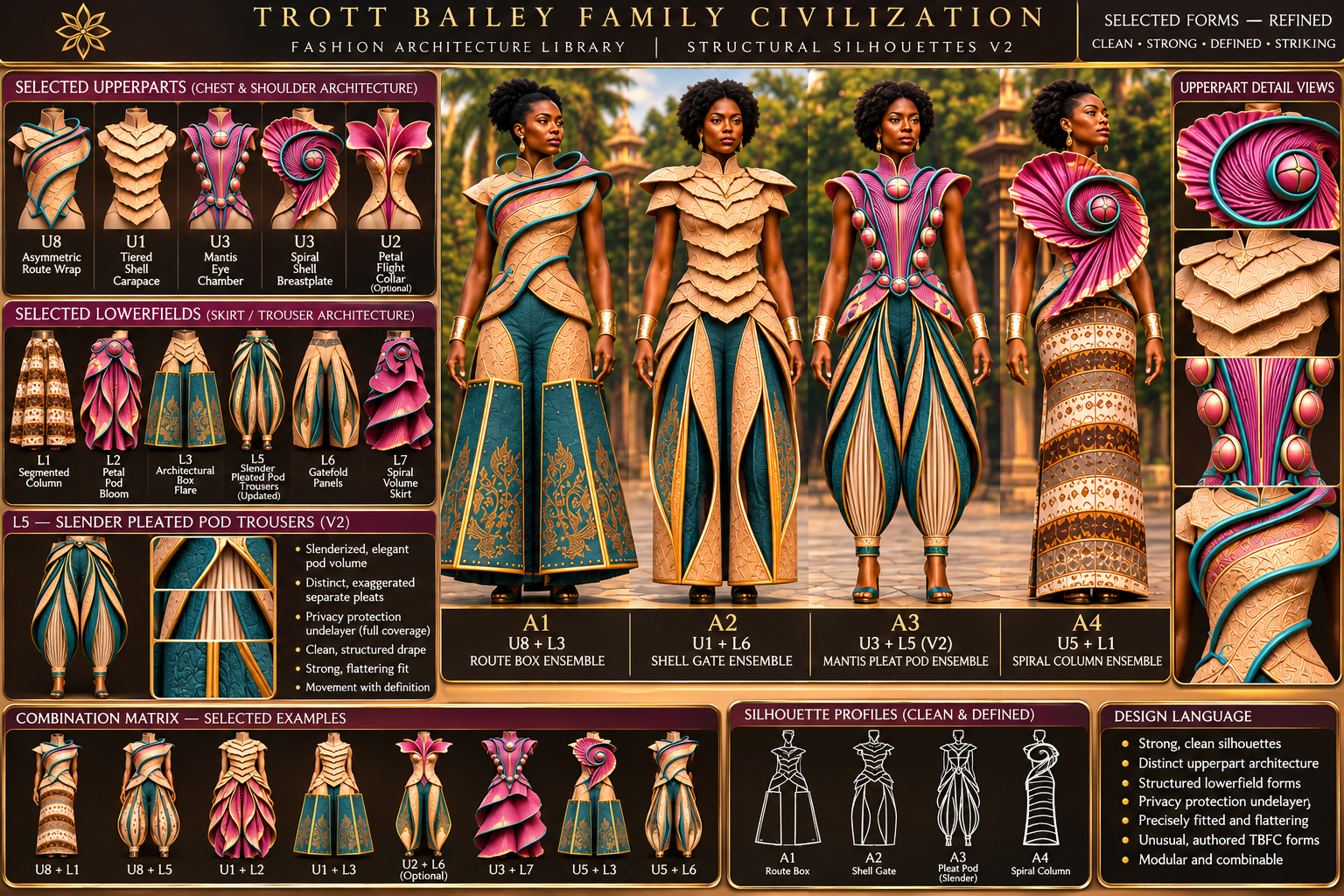
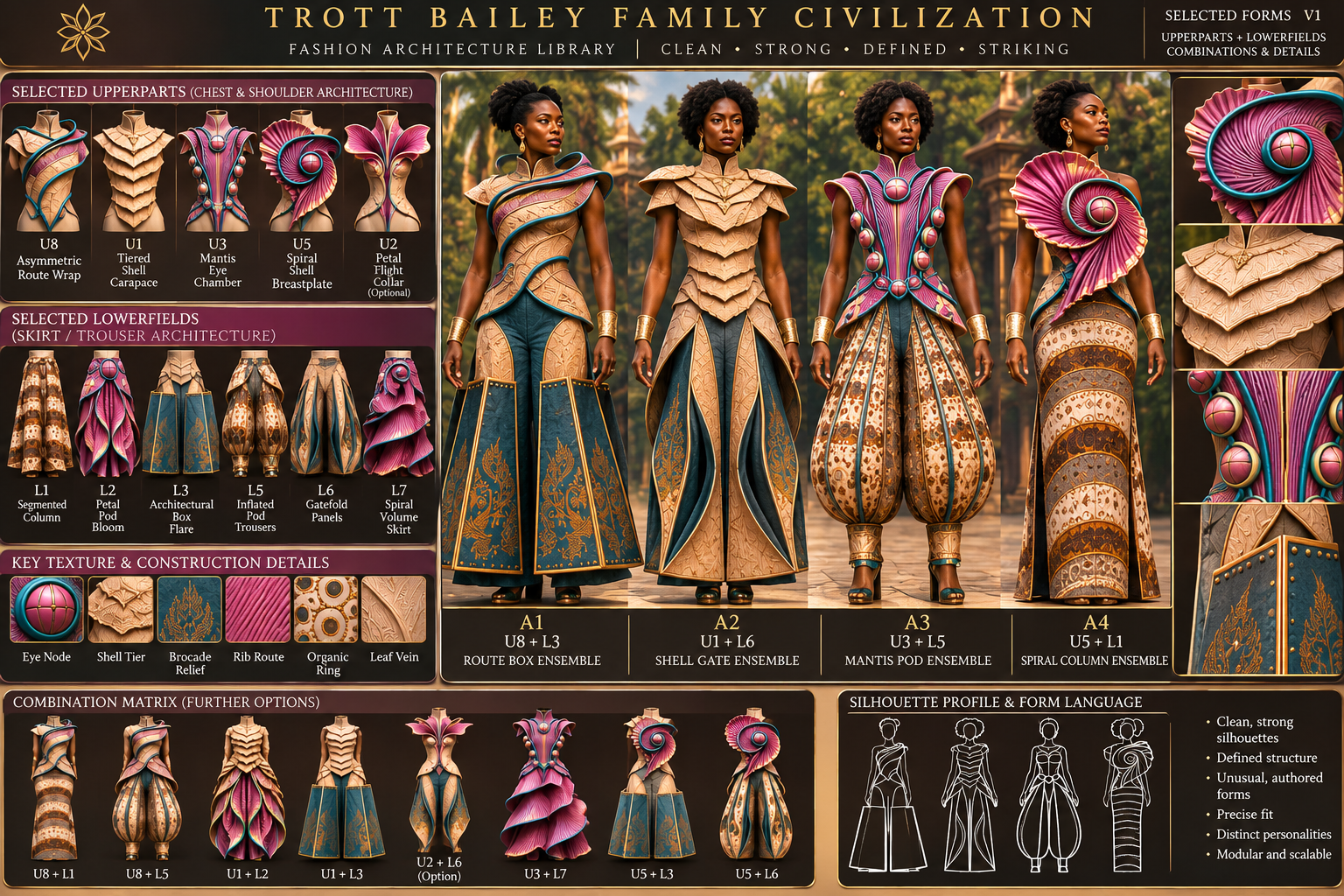
Strangeness may appear through unusual lowerfields, shoulder organisms, routed textile relief, gills, chambers, asymmetry, sculptural footwear, textile state changes, unfamiliar closures, and new garment species.
But strangeness should remain structurally intelligible.
Major volume must have a readable architectural cause such as pleating, suspension, airflow, chambering, folding, docking, routing, textile memory, or another defined garment mechanism.
13. Garments Have Anatomy
Trott Bailey garments should not be conventional silhouettes with decoration placed on top.
They should possess recognizable anatomy:
Throat
Authored neckline and neck protection logic.
Shoulder
Load, movement, docking, airflow, or sculptural architecture.
Heart / Chest Field
Structural, symbolic, protective, or routed textile focus.
Spine
Rear support, closure, routing, memory, or garment organization.
Waist Lock
Fit, docking, compression, release, or lowerfield control.
Movement Release
Pleats, gills, folds, route openings, or articulated panels.
Lowerfield
The authored lower-half garment architecture rather than a default skirt or trouser assumption.
Footwear Interface
Where garment and shoe species meet structurally and visually.
The viewer should be able to ask why a garment organ exists and usually receive a real answer.
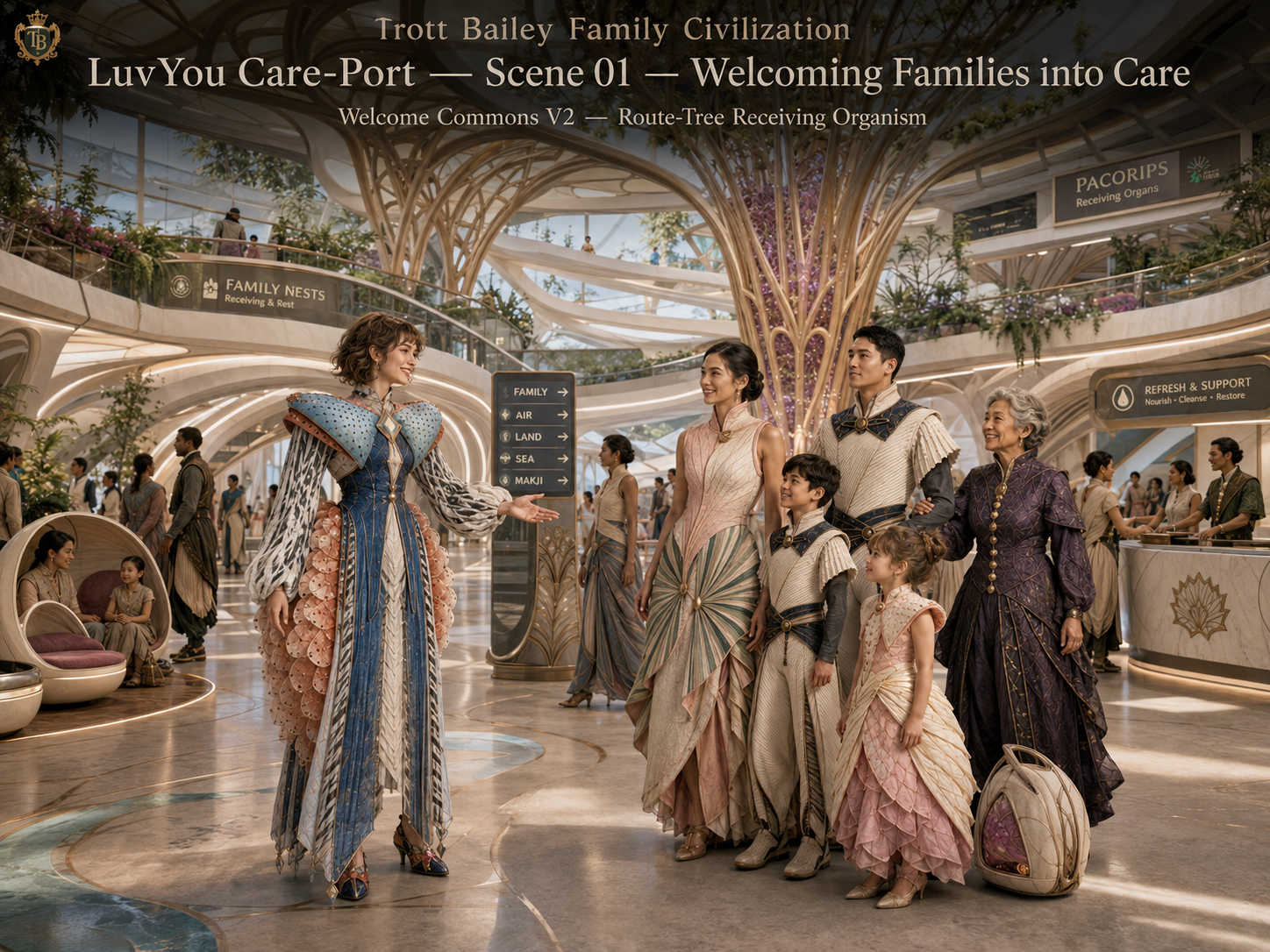
14. Family Coherence Without Uniformity
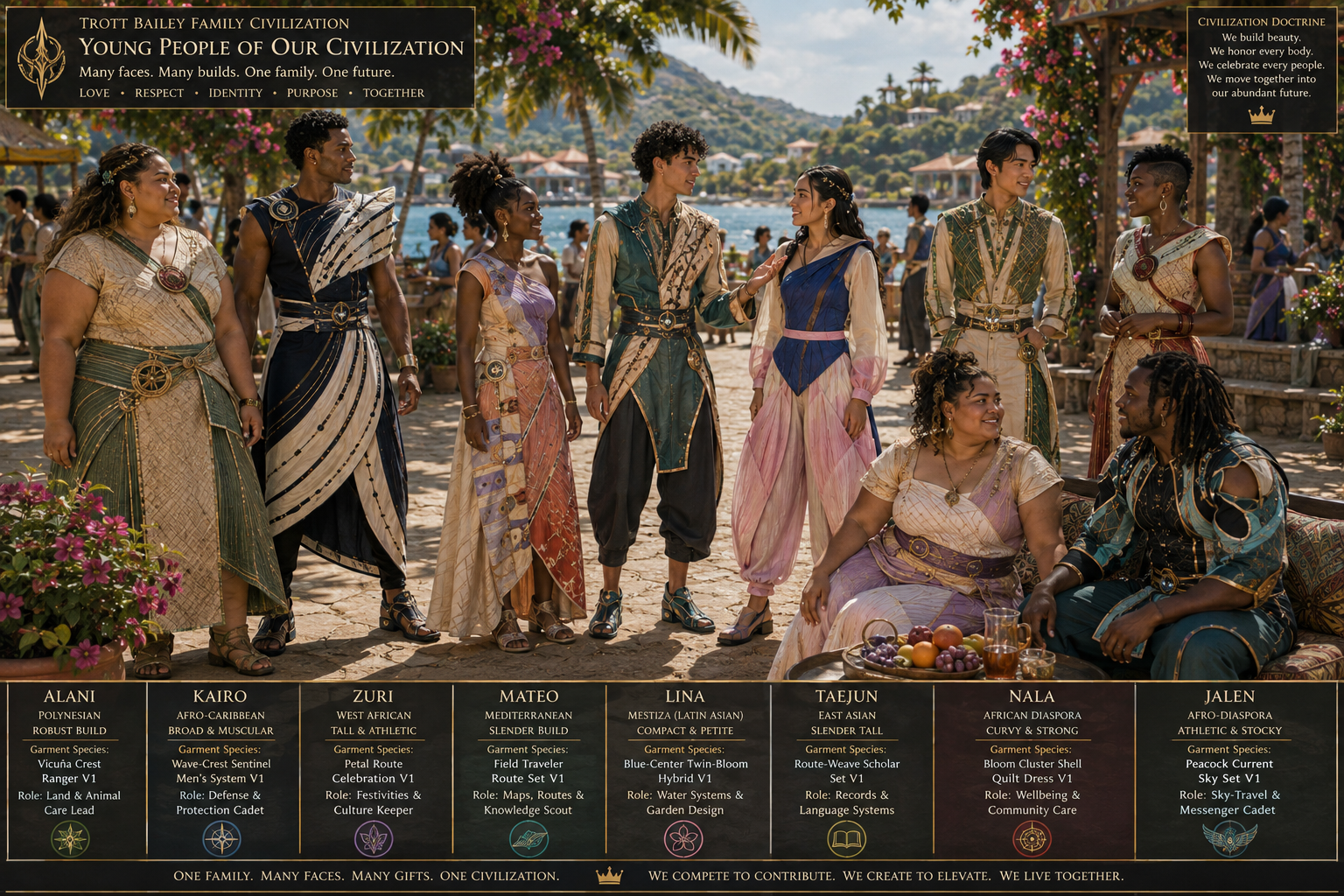
Families may develop recognizable visual languages without becoming identical.
Family connection may appear through:
- related route geometry;
- shared textile intelligence;
- coordinated but non-uniform color;
- related docking logic;
- family motifs;
- connected footwear species;
- inherited garment organs.
Family coherence should strengthen individuality, not erase it.
15. Individual Authorship
Citizens should not merely consume finished fashion. They should progressively learn enough textile intelligence to participate in their own appearance.
A citizen may choose a garment species, alter color routes, select textile families, commission variations, change neckline architecture, choose lowerfield behavior, work with Design Translation Houses, and eventually create entirely new species.
16. Clothing Can Carry Family Memory
Some garments become meaningful because of what happened while people wore them.
Wedding garments, first AgriGames clothing, family ceremony garments, a grandfather’s orchard garment, a garment worn during a major Kingdom opening, or a beloved child garment may deserve preservation.
Preservation may include:
- the complete garment;
- a textile panel;
- a clasp or node;
- a route section;
- a woven image;
- a documented pattern;
- a reconstructed descendant garment.
But sentiment should not create endless clutter. Preservation must remain intentional.
17. Repair Is Another Chapter Of Authorship
Repair should not be treated as evidence of poverty or failure.
A repaired garment may reveal stewardship, history, adaptation, skill, affection, and continued usefulness.
Repairs may become visually authored: a new route, contrasting textile chamber, expanded child-growth field, replaced gill, new docking node, or restored ceremonial surface.
Repair may become another chapter of authorship.
18. Textile Stewardship Infrastructure
Clothing stewardship should exist at several levels.
Existing Trott Bailey implementations include:
- Mini Fabric Rescue Kits;
- stain stabilization;
- district Fabric Nodes;
- stain-specific treatment bays;
- Garment Transit River;
- Wash → Reset → Air-Dry;
- repair and restore routes;
- delicate and ceremonial care;
- Family Wardrobe Consultation and Assignment;
- Family Wardrobe Fitting and Release;
- Design Translation Houses.
19. Sophistication Must Not Create Household Drudgery
Advanced clothing cannot be considered successful if its maintenance creates hours of invisible domestic labor.
The civilization should therefore expand care capability as garment sophistication increases.
Increasing garment sophistication should be accompanied by increasing care capability.
Better garments should be supported by better washing, drying, stain handling, reshaping, repair, routing, storage, and specialized stewardship.
20. Environmental Honesty
A money-free civilization can still waste fibers, land, dye materials, water, energy, machinery, and human skill.
Removing price does not remove physical reality.
Textile abundance must therefore remain accountable to:
- durability;
- repairability;
- safe chemistry;
- water use;
- fiber regeneration;
- material recovery;
- local suitability;
- biodegradability where appropriate;
- long-term resource availability.
21. Footwear Is Part Of Clothing Civilization
Footwear cannot remain an afterthought.
Feet encounter heat, wetness, rough ground, mud, long walking, climbing, standing, work, ceremony, childhood growth, and changing climates.
Trott Bailey footwear species therefore require their own logic of:
- grip;
- drainage;
- flexibility;
- cushioning;
- protection;
- repair;
- growth adaptation;
- garment docking;
- climate response.
A civilization with extraordinary garments and ordinary shoes remains unfinished.
22. Inheritance Must Preserve Intelligence
The greatest textile inheritance is not warehouses full of old clothing.
Future generations should inherit:
- garment species records;
- textile recipes;
- pattern logic;
- construction methods;
- climate data;
- repair methods;
- failed experiments;
- successful inventions;
- family garment histories;
- design principles.
Preserve the intelligence, not merely the object.
23. Dynamic Layer
Future generations must remain free to invent new garment species, textiles, footwear, silhouettes, climate systems, modesty solutions, care infrastructure, and forms of beauty.
They should not be forced to dress like the founders of the civilization.
The constitutional inheritance preserves the reasoning discipline: reality, movement, dignity, protection, beauty, authorship, stewardship, and care.
The visible result may change dramatically across generations.
Anti-Drift Rule
Do not reduce this department to fashion trends, runway imagery, luxury branding, uniforms, costume, decoration, or generic couture.
Do not allow Trott Bailey fashion to drift into anonymous bulbous volume, generic robes, generic futuristic clothing, copied cultural dress, or unfamiliar silhouettes with no structural reason.
The constitutional layer is body reality, climate intelligence, movement, dignity, modesty, beauty, garment anatomy, authorship, family coherence, repair, care, stewardship, and continual invention.
24. Constitutional Stress Test
Any future garment species should be tested by asking:
Body Reality
What actual human reality does this garment answer?
Movement
Can the wearer live, work, bend, sit, carry, and move naturally?
Protection
Does it meaningfully respond to climate, environment, work, or bodily need?
Dignity
Does it preserve modesty and comfort without erasing beauty?
Beauty
Does it bring delight without sacrificing ordinary usability?
Authorship
Does it feel like a real Trott Bailey species rather than generic fashion?
Structural Cause
Are volume, folds, gills, chambers, routes, and strange elements visibly caused by garment architecture?
Care Rhythm
Can it be cleaned, dried, repaired, reset, stored, and returned to life without unreasonable burden?
Changing Bodies
Does it adapt where life stage, pregnancy, growth, injury, disability, or climate require adaptation?
Stewardship
Does it use matter responsibly and allow repair, recovery, or inheritance where useful?
Future Freedom
Does the principle allow descendants to surpass the current design rather than trapping them in founder-era clothing?