Jungishi · Hydraulic Language Library Development Archive
21 October 2026
Jungishi · The Authored System
Jungishi: Water, Salt, and Life
How Trott Bailey Family Civilization is developing a complete seawater-to-potable-water and marine-material system.
Jungishi is the Trott Bailey system being authored to take abundant seawater, produce proven drinking water, and recover useful salts and minerals. We are not designing a machine that takes the water and leaves the rest as somebody else’s environmental problem. We are designing the full life of the material, from the moment it enters to the last substance that must be handled.
Potable water should come from the most inexhaustible sources, for example, the sea, large lakes and rivers.
World Ruler Sher — Direction that established the potable-source doctrine
1. How Jungishi began
Our family water development first established an important separation. The Family Cistern Body V1.2 holds non-potable reserve for gardens, washing, cooling, household relief and emergency support. It is not the normal source for drinking or cooking water. We gave drinking water its own system because a storage vessel and a verified potable-water supply have different duties.
We then looked to large, reliable sources: the sea, major lakes and rivers. We also documented other possible sources, including protected aquifers, artesian systems, brackish groundwater, springs, atmospheric water and advanced water reuse. The sea became the first coastal development direction. During the early visual studies, that branch carried the working title Sea-to-Life. The system is now called Jungishi.
The name covers much more than salt removal. Jungishi includes protected intake, preparation of seawater, selective separation, mineral correction, testing, sealed potable reserves, safe delivery, useful mineral recovery, energy and maintenance, and responsible management of everything left over.
2. Two useful outputs, not one useful output and one discarded problem
Proven drinking water
Seawater enters through protected intake and pretreatment, passes through validated separation and post-treatment, and is tested before entering sealed clean storage. Water reaching a family, kitchen, child drinking point or clinic must have passed the required potable-water proof.
Recoverable salt and marine minerals
Separated concentrate goes to dedicated material-recovery organs. Its salts and minerals are identified, separated and prepared for uses they can safely serve. Material that cannot yet be used remains under control.
Salt does not disappear when water is desalinated. Conventional desalination divides seawater into a lower-salinity stream and a more concentrated stream. Jungishi takes both streams seriously. We can develop additional separation stages instead of assuming that the second stream exists only to be returned to the sea.
Potable water remains physically separate from non-potable cistern water. We also preserve a strict distinction between raw seawater, prepared feed, permeate awaiting completion, approved drinking water, concentrate, and service or cleaning waste.
The cistern relieves the household. Jungishi protects drinking water and recovers useful marine material.
Trott Bailey Design Principle
3. Nature is a source of engineering intelligence
Mangroves regulate salt entering their tissues through protective root barriers and selective transport. Research has already demonstrated mangrove-inspired membranes and synthetic mangrove concepts. That does not mean living mangroves deliver a ready-made river of drinking water. It means their biology can help us ask better questions about barriers, flow, charge, ion exclusion and material structure.
The marine-life references collected for Jungishi also matter. A purple lobed animal, a frilled jellyfish, a cream-and-charcoal striped creature, spotted fins and irregular coral-pink bodies gave us very different silhouettes, surface rhythms and color combinations. We use those references as design intelligence, not proof that the animals desalinate water.
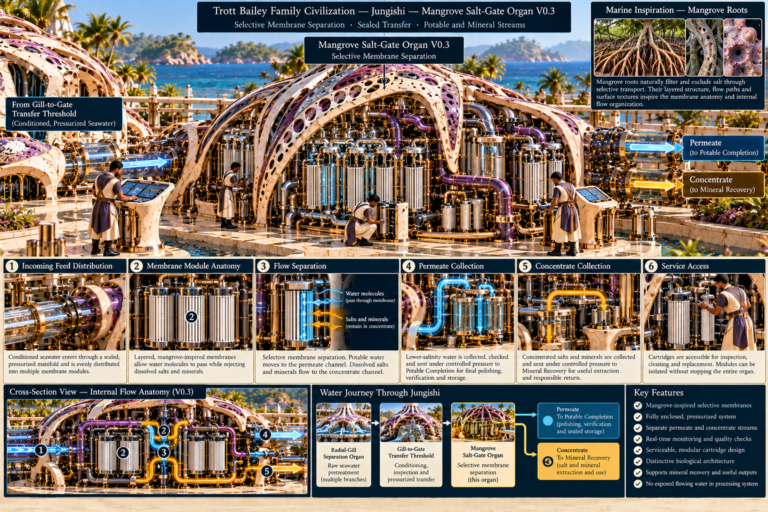
The jellyfish-inspired Radial-Gill spreads incoming seawater through repeated treatment branches. The mangrove-inspired Salt-Gate investigates selective membrane separation. The connection between them is the Gill-to-Gate Transfer Threshold, where the prepared feed is checked and controlled before entering the enclosed membrane system.
4. The organs developed so far
| Organ or System | Development Position |
|---|---|
| Marine Intake Organ V0.1 | Visual development reference: protected seawater reception, screened intake and coastal service access. |
| Radial-Gill Separation Organ V0.1–V0.2 | Cinematic and sectional studies, followed by functional definition of radial distribution and pretreatment. |
| Gill-to-Gate Transfer Threshold V0.2 | Strong corrected visual design; process connection and independent water routes identified. Not declared construction-ready. |
| Mangrove Salt-Gate Organ V0.3 | User-approved visual development. Sealed membrane body with separate water and concentrate outlets. |
| Potable Completion + Clean Reserve | Visual development: final treatment, testing, sealed transparent storage and safe family delivery. |
| Salt and Mineral Recovery Organ V0.1 | Early visual concept; separation anatomy remains the next major detailed development. |
The approval of the Salt-Gate’s visual body does not certify its experimental membranes. A built potable-water line must still use treatments whose performance has been validated, with independent monitoring and a separate research path for unproven materials.
5. The architecture must be authored, not recolored copies
Jungishi uses durable construction and real service intelligence. The marine references control much more than silhouette: they can contribute lavender and plum body surfaces, pearl-white frills, charcoal banding, sandy peach, rust-colored markings, vivid blue spots and textured rose-pink forms. There is no rule that everything must be teal. Nor should every organ become another cream-and-gold pavilion.
Different machinery may need mineral ceramics, pressure-rated metals, selective membranes, sealed glass, weather-resistant stone, protective coatings, replaceable cartridges and safely accessible work platforms. Each species should receive an appropriate material recipe, with a distinct identity and a clear reason for its components.
Water does not have to pour out of the machinery to make the scene beautiful. Jungishi’s processing water remains contained in sealed conduits and chambers. The surrounding sea is visible; transparent inspection walls can reveal protected water inside. The clean potable reserve may itself have sealed transparent structural walls, with trees forming a Living Shade Ring around the building without damaging foundations or service lines.
Scenes carry a simple civilization label. The records explain the engineering. There is no need to cover every cinematic image in arrows.
6. What is established, and what is still being developed
We have established Jungishi’s purpose, system identity, biological inspiration, two-output doctrine, component responsibilities and a set of accepted visual directions. We have not built or commissioned a Jungishi desalination plant. We have not demonstrated that a newly invented Mangrove Salt-Gate membrane can independently produce regulation-compliant drinking water at scale.
The next work is practical: study the intake and feed conditions; test membrane materials; measure pressure, flow, salt rejection and fouling; design the mineral-recovery sequence; and develop safe post-treatment, clean storage, distribution, environmental safeguards and maintenance. Keep experimental lines isolated from family drinking water until they pass the necessary proof.
Publish the design record as development. We do not need to pretend the machine is finished to document what has been authored. Equally, we should not call an illustration an engineering test.
Jungishi is being developed to produce safe potable water, recover useful marine materials, and protect the living environment throughout the process.
Trott Bailey Jungishi Parent Direction
Research and standards used
These sources support the scientific background and implementation boundaries. They do not certify Jungishi as a finished treatment plant.
Jungishi · Hydraulic Language Library Development Archive
21 October 2026
Jungishi · Process and Organ Development
Jungishi: Water Separation Anatomy V0.3
From the Radial-Gill to the Gill-to-Gate Threshold and the Mangrove Salt-Gate: a physically accountable separation journey.
We have three different jobs to perform: prepare the seawater, transfer it under controlled conditions, and separate water from dissolved salts. The organs must be connected, but they must not be confused with one another. That is the basis of Jungishi’s working separation anatomy.
The Radial-Gill prepares the seawater. The Gill-to-Gate Threshold examines and transfers it. The Mangrove Salt-Gate separates the streams. The completion system proves the drinking water; the recovery system receives the minerals.
Jungishi Functional Law
1. One correct water journey
Potable completion route
Post-treatment, stabilization or mineral correction, disinfection when required, proof testing, sealed clean reserve and protected drinking-water delivery.
Mineral recovery route
Concentrate collection, further separation and recovery of useful constituents, residue characterization, containment and verified environmental management.
These routes separate at the Salt-Gate. Mineral recovery is not downstream of potable completion. And permeate is not labelled drinking water merely because it has passed a membrane.
2. Radial-Gill: prepare and distribute
The Radial-Gill takes its form language from the wide bell and densely folded organs of the jellyfish references. Its central receiving crown and radial branches are useful ways to arrange repeated filtration elements in a serviceable body.
Inside the organ, screened seawater is divided among parallel flow branches. Those branches may house particle removal, microfiltration or ultrafiltration elements. Collected sediment and wash residues move through their own controlled service paths. Conditioned feed then reunites for the next stage.
- Receiving Crown: Protected inlet and initial flow distribution.
- Radial Branches: Balanced flow to parallel filtration modules.
- Removable Gill Cartridges: Treatment elements accessible for cleaning or replacement.
- Collection Manifold: Receives prepared seawater without exposing it to people or open basins.
- Service Petals: Isolated access to parts, not an excuse to open a live pressurized chamber.
The folds alone do not remove dissolved salts. That work belongs to selective membranes and the appropriate driving mechanism.
3. Gill-to-Gate: inspect, regulate, transfer
Once seawater has been prepared, it enters the Gill-to-Gate Transfer Threshold V0.2. Its shell has already been developed visually in spotted plum, lavender, cream and dark banded forms drawn from the marine references.
Its function is specific. It receives prepared feed, checks quality, balances the incoming flow, supplies final feed protection if necessary, and establishes the pressure or other driving conditions required by the chosen downstream membrane process.
| Body | Responsibility |
|---|---|
| Receiving Crown | Collect prepared seawater from the Radial-Gill branches. |
| Flow-Balancing Ring | Prevent unequal distribution among incoming paths. |
| Quality Eye | Monitor suitable feed indicators: turbidity, temperature, salinity/conductivity, flow, pressure and additional membrane-specific conditions. |
| Feed Protection Pocket | Provide any final conditioning or filtration required before sensitive membranes. |
| Pressure Transition Body | Contain pumps, pressure regulation, protective isolation and associated equipment. |
| Salt-Gate Throat | Carry conditioned feed in a sealed, engineered connection. |
| Retreat Route | Divert feed that fails the requirements; do not send it onward. |
| Service Petal | Permit access to isolated and depressurized components. |
We must not use the same route identity for unsuitable feed that needs retreatment and concentrate that is already being sent to mineral recovery. They are different substances, at different stages, with different handling requirements.
4. Mangrove Salt-Gate: actual selective separation
Mangroves survive in saline environments in part by controlling salt uptake. Root barriers and selective transport are established biological principles. Scientific studies have also built membranes inspired by these mechanisms. The research is useful; it does not automatically make our drafted organ a certified potable treatment system.
The approved Mangrove Salt-Gate Organ V0.3 provides the visual body: enclosed, layered modules with service access, separate product routes and a recognizable marine-derived surface pattern. Its technical anatomy must now be tested and improved.
Prepared seawater enters an enclosed selective membrane module. A suitable driving force carries some water across the selective barrier. That stream is collected as permeate. Rejected salts remain in a separate, more concentrated stream. Both routes stay enclosed.
For a conventional seawater reverse-osmosis pathway, this means pressure-rated membrane housings and controls. An experimental mangrove-inspired pathway may use different membranes or driving forces, but it must still prove salt rejection, throughput, safety and long-term reliability.
5. Two routes leave. They never rejoin by accident.
Permeate toward potable completion
The water leaving a selective membrane may still need stabilization, mineral balancing, final disinfection, monitoring and safe storage. A Clean Potable Reserve can use fully sealed transparent structural walls. Trees can provide shade and reduce solar exposure, provided the planting, heat management and clean-water protection are properly engineered.
No ordinary Family Cistern Body is fed into this potable route. The cistern remains non-potable by default.
Concentrate toward material recovery
Concentrate contains more than ordinary table salt. The recovery organ must identify and classify its substances before they are prepared for use. Cleaning solutions and other service wastes must not be casually mixed into material streams intended for food or other sensitive applications.
Where pressurized concentrate energy can be recovered, Jungishi should investigate that physical benefit as part of its energy system.
6. Closed hydraulic processing is now the default
This corrects a repeated weakness in earlier images. We kept generating cascading water because the prompts said “flowing radial bowls,” “visible water,” and “transparent channels” without firmly specifying containment. That is not the standard for Jungishi treatment machinery.
- Seawater inside the treatment and transfer organs travels through sealed passages, manifolds and process chambers.
- Pressure-rated equipment remains enclosed throughout operation.
- Water may be seen through sealed inspection glazing or instruments, not through exposed process waterfalls.
- Technicians work on dry, protected service platforms.
- Membrane modules are isolated, drained and depressurized before opening.
- Raw seawater outside the facility is naturally exposed; the water inside the production line is controlled.
What must be tested next
Feed quality, membrane compatibility, salt rejection, permeate flow, applied pressure, energy, fouling, cleaning, seal integrity, corrosion, material safety, concentrate composition and system response when a sensor fails. The operating membrane path and experimental material-development path should be isolated until each has passed its appropriate verification.
The following is the precise development boundary: we have an authored functional design and approved visual studies; we do not yet have an experimentally validated Jungishi-built membrane system.
Visible water where visibility serves inspection. Enclosed water where treatment requires containment. No decorative waterfall in place of an actual separation process.
Jungishi Closed-Processing Standard
Research and standards used
These sources support the scientific background and implementation boundaries. They do not certify Jungishi as a finished treatment plant.
Jungishi · Hydraulic Language LibraryDevelopment Archive
21 October 2026
Jungishi · Materials and environmental stewardship
Jungishi: Salt and Mineral Recovery
Use what is useful. Develop safer recovery. Do not destroy the living environment through careless return.

Salt separated from seawater is not automatically waste. Jungishi is being authored to use what is useful and govern what remains. We do not judge this work by its sale price or whether recovering a mineral would be profitable. We judge it by the useful material produced, the physical resources required and the environment protected.
There is no concern about money and economics. It’s simply: use what is useful, and don’t destroy the environment through unmonitored or careless return systems.
World Ruler Sher — mineral-recovery direction, lightly corrected for grammar
1. Recovery belongs inside the original design
There is no reason to design a water-making organ as though the second half of its work is somebody else’s problem. Desalination moves salts and other dissolved substances into a more concentrated stream. If we can recover useful substances from that stream, we should build the means to do so as part of Jungishi.
That does not mean claiming every mineral has already been separated or that every remaining drop can be recovered. It means we investigate those possibilities deliberately. We do not automatically abandon a useful material merely because existing industry treats it as waste.
The world of pretreatments and chemicals is still young. There is nothing stopping us from finding ways to desalinate safely and safely use the leftover salt in many ways.
World Ruler Sher — research direction, lightly corrected for grammar
This statement guides the research program. It is not a claim that every proposed method already works. We are free to investigate new methods, and we must still prove them.
2. Seawater is a mixture, not a bag of table salt
Jungishi concentrate may contain sodium chloride, magnesium, calcium, potassium, sulfates and other dissolved constituents. Depending on the intake and treatment, it may also contain contaminants or treatment residues. Separating those materials into useful products requires actual processes and standards.
Salt crystals recovered from a machine are not automatically suitable for food. Magnesium-rich solids are not automatically an approved agricultural treatment. Animal, medical, kitchen, textile and chemical uses all have different safety requirements.
The useful fraction
Recover, purify, assign
Identify the substance, separate it from others, establish its purity, test it and send it to an appropriate use.
The remaining fraction
Contain, investigate, govern
Measure what remains; investigate further recovery; contain or treat residues; permit environmental return only with evidence that the receiving environment is protected.
The early image of mineral recovery is a visual exploration, not proof of clean crystallization or material classification. The next working body must show how separate minerals are actually produced, sampled and safely collected.
3. The Salt and Mineral Recovery Organ V0.1
The research starts with a clean material ledger: what enters, what separates, what is usable and what remains. The organ should be modular so one separation step can change without redesigning Jungishi’s entire potable-water line.
Alongside that route, all secondary liquids, cleaning residues, process solids and rejected fractions must be recorded and managed. They do not disappear because the intended product has been collected.
Methods to investigate
- Staged evaporation or crystallization, including solar assistance where the climate and materials permit.
- Selective precipitation and controlled separation of individual mineral fractions.
- Membrane or electrochemical methods for certain ions and dissolved substances.
- Additional water recovery from concentrate where appropriate.
- Physical and chemical methods that reduce harmful treatment residues rather than hiding them.
- Purity testing, classification and storage arrangements suitable for each material.
Each method must be measured for physical demands: water output, energy, heat, equipment and material use, recovery rate, durability, maintenance, and the quality of what is produced. These are engineering facts, not financial gatekeeping.
4. What the recovered material can serve
| Recovered material | Potential civilization uses | Proof required |
|---|---|---|
| Sodium chloride | Food preservation, certain textile processes, salt-based chemical manufacture, selected water-treatment operations. | Correct purity and grade for each use; food contact demands food-grade verification. |
| Magnesium compounds | Industrial chemistry, selected material production and properly specified nutrient applications. | Composition, contaminants, stability and use-specific suitability. |
| Calcium compounds | Water-stabilization processes, specialty materials and selected manufacturing pathways. | Actual compound identification and conformity to intended application. |
| Potassium salts | Appropriate fertilizer and industrial applications. | Purity, dose and environmental suitability. |
| Other mineral fractions | Further research into chemical and material production. | Separate extraction, hazard characterization, occupational and environmental controls. |
This is a research inventory, not a promise that all materials can be recovered in useful grades from every Jungishi site.
5. Do not pretend the return garden solves everything
Our early cinematic scenes made brine-return gardens look beautiful. Beauty does not prove safe discharge. A shallow garden, a reed bed, or a series of basins cannot simply be assumed to remove dissolved salts. Dilution is not proof that the sea, soil and organisms will be protected.
The environmental return process must begin with knowledge of the remaining material. Identify its salt concentration, temperature, additives, contaminants and expected volume. Model and monitor what happens to the receiving water and living organisms. If it cannot safely be returned, it stays in containment or further treatment until an acceptable handling route is established.
- Keep concentrate, retreatment feed, potable water, and cleaning waste physically separate.
- Record composition and quantity before deciding whether reuse, recovery, containment or environmental return is suitable.
- Monitor receiving waters, sediments and living systems where return is approved.
- Keep collection and service routes accessible so leaks or contamination can be found.
- Investigate better separation and recovery technology as it becomes possible; do not make today’s disposal habits a permanent design law.
What is useful shall be recovered and put to use. What cannot yet be used shall be responsibly managed. Nothing shall be carelessly returned to the environment simply because it is easier to discard.
Jungishi Salt and Mineral Recovery Law V1
6. Our next research work
We will develop the Salt and Mineral Recovery Organ as carefully as the Radial-Gill and Mangrove Salt-Gate. It needs its own separated material paths, proper containment, usable service bays, testing stations and clear operator tasks.
The biological references remain part of the authorship. A folded jellyfish crown can influence flow distribution; striped marine envelopes can influence cartridge layers; spotted, lobed and frilled organisms can contribute form, material rhythm and color. These are different species, not one repeated palette of teal and gold.
We should begin by characterizing representative seawater concentrate, choosing the first material to recover, drawing its realistic separation sequence, and then generating the cinematic scene. Work through the useful fractions one at a time. Keep the unknowns visible until research resolves them.
Record status: Jungishi mineral recovery is an established design doctrine with early visual studies. The detailed recovery machine, materials tests, environmental validation and any product-quality certification remain development work.
This is what Jungishi is for: freshwater for families, useful minerals for civilization, and no careless damage passed back to the environment.
Research and standards used
These sources support the scientific background and implementation boundaries. They do not certify Jungishi as a finished treatment plant.
- U.S. Bureau of Reclamation — crystallization research in concentrate streams
- World Health Organization — Safe drinking-water from desalination (2011)
- World Health Organization — Guidelines for Drinking-water Quality (2026 edition)
- Brazil — Portaria GM/MS nº 888/2021: drinking-water quality and surveillance