LuvYou Carrier Nest Ring Record V1
1. Record Purpose
This record defines the LuvYou Carrier Nest Ring as the perimeter movement architecture that receives numbered Passion Carona groups and releases them into the LuvYou Carrier System without allowing carrier traffic to invade the central Welcome Commons.
The Carrier Nest Ring is the missing structural boundary between family grouping and internal Care-Port movement. It protects the Welcome Commons from becoming a mixed field of pods, kiosks, food nodes, people, and vehicles.
This is a Trott Bailey Family Civilization system-design record. It preserves the authored carrier release logic, perimeter law, nest types, movement sequence, visual direction, and rejection conditions. It is not final engineering certification, traffic simulation, code approval, evacuation clearance, or construction documentation.
2. Core Definition
A LuvYou Carrier Nest is a protected docking and family-receiving mouth at the perimeter of the Welcome Commons. It receives a called Passion Carona group, allows that group to board the correct LuvYou Carrier, and releases the carrier into a one-way internal movement ring.
The Carrier Nest Ring is the full perimeter system of these nests. It organizes domestic, international, assisted, cross-mode, same-level, and upper-level carrier movement without disrupting the central family field.
The LuvYou Carrier Nest Ring is the perimeter release architecture that receives Passion Carona groups from the Welcome Commons and sends them into the LuvYou Carrier System through protected one-way carrier movement.
3. Why the Ring Is Necessary
Carrier Intrusion
If carriers enter the central Welcome Commons, they compete with families, kiosks, pod fields, Sabennerie nodes, and children.
Perimeter Release
The central commons remains family-first while carriers dock at the protected outer edge.
Clean Movement
Pod groups move outward by lit route, board at the nest, and carriers depart forward without conflict.
4. Placement Inside the Welcome Commons
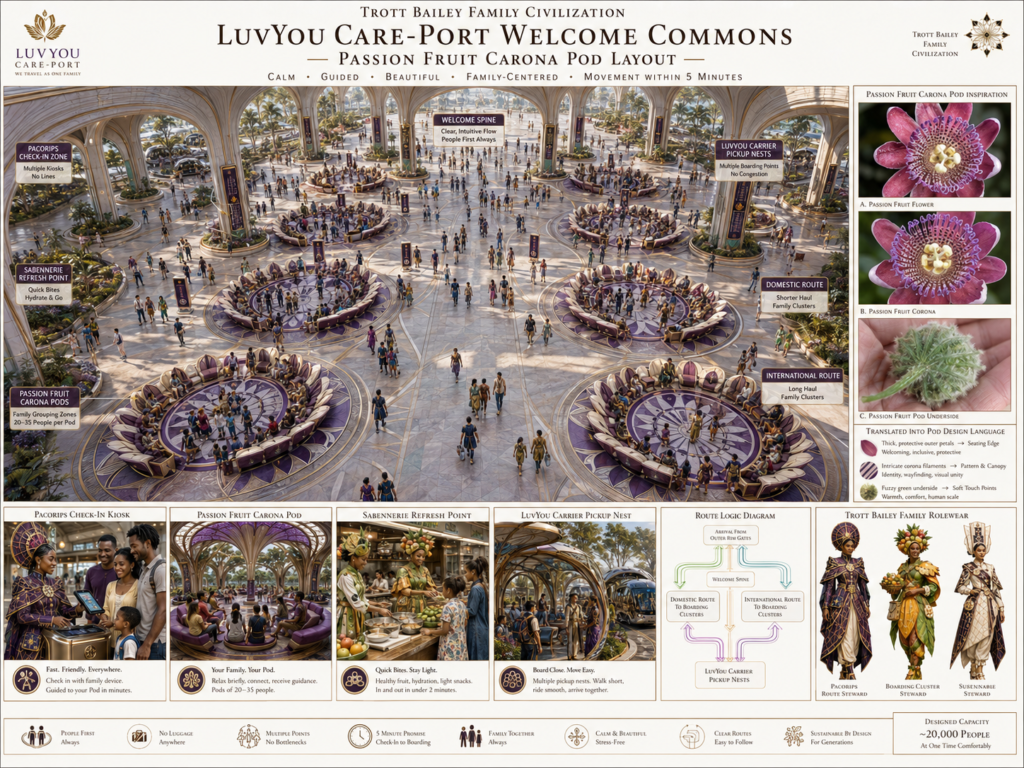
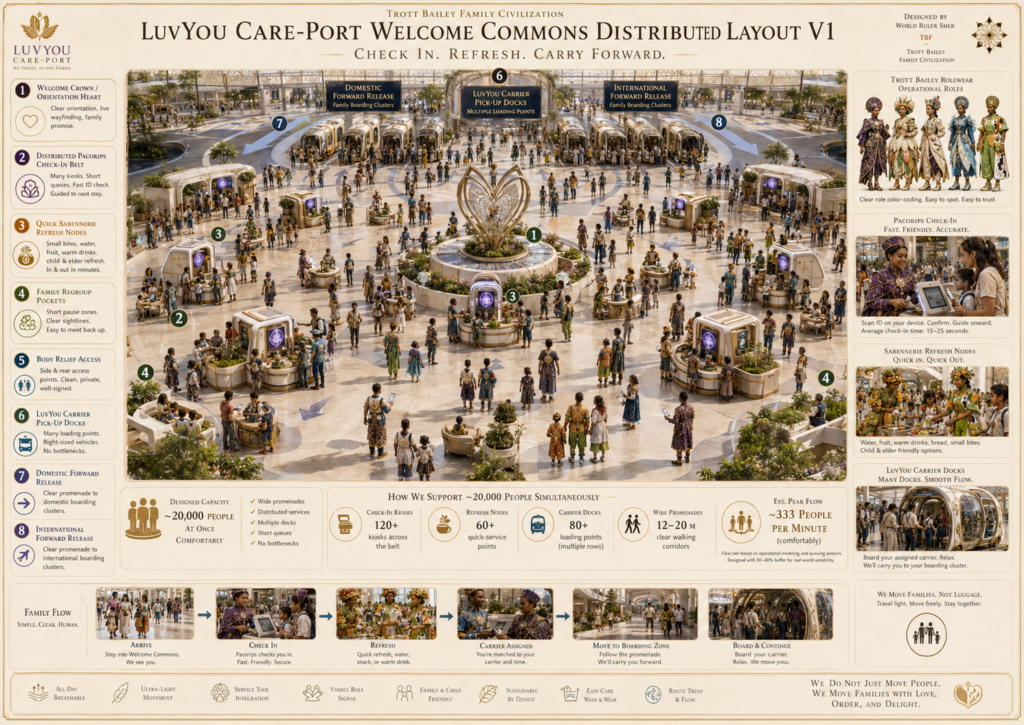
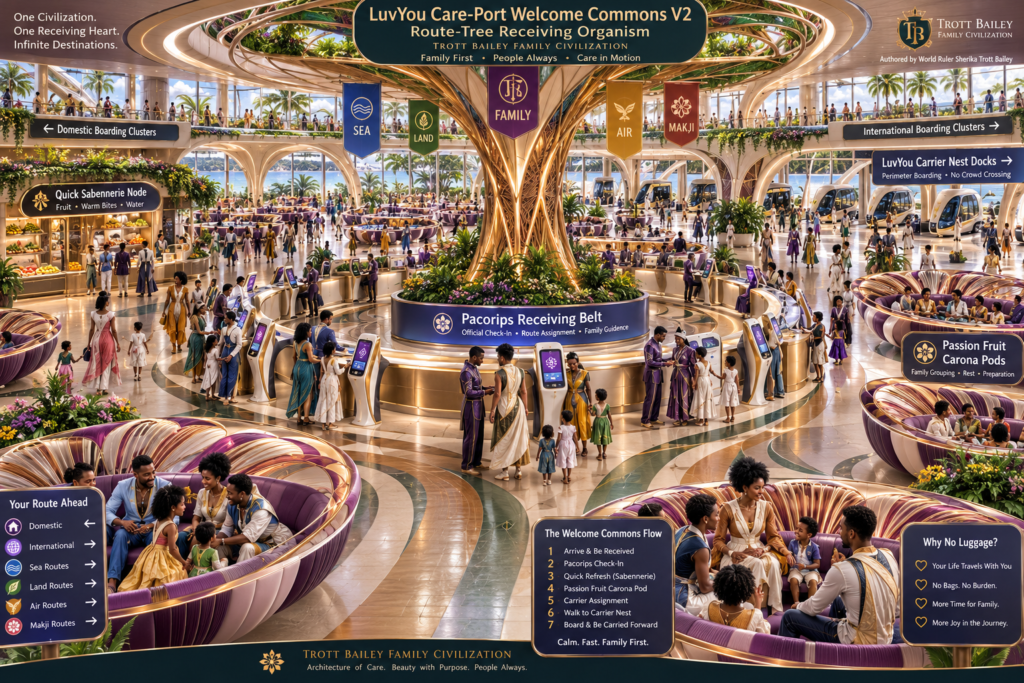
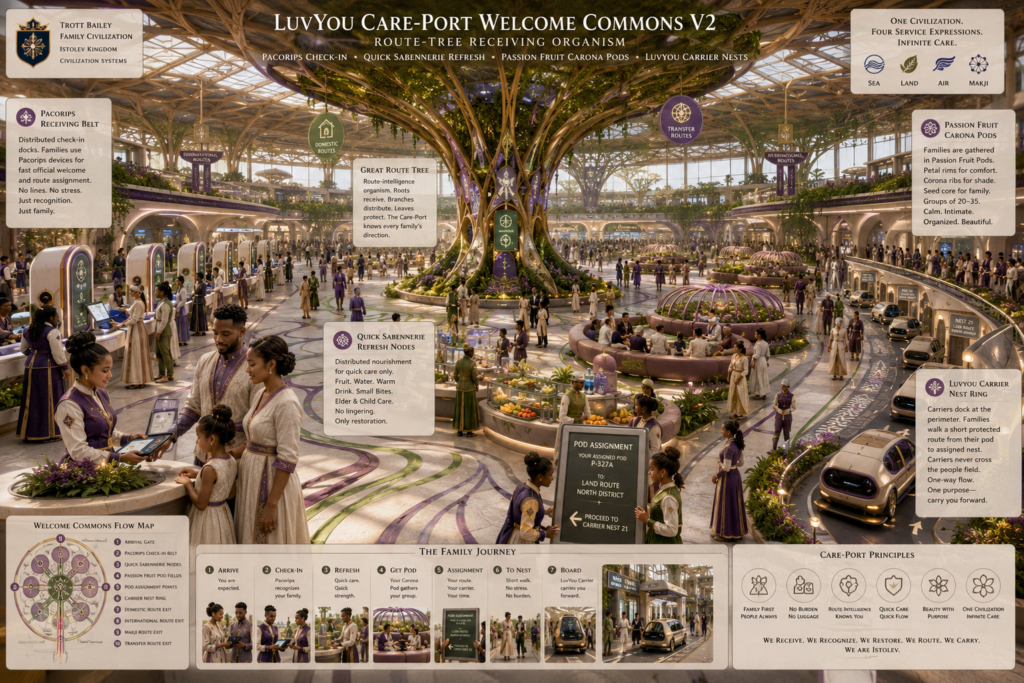
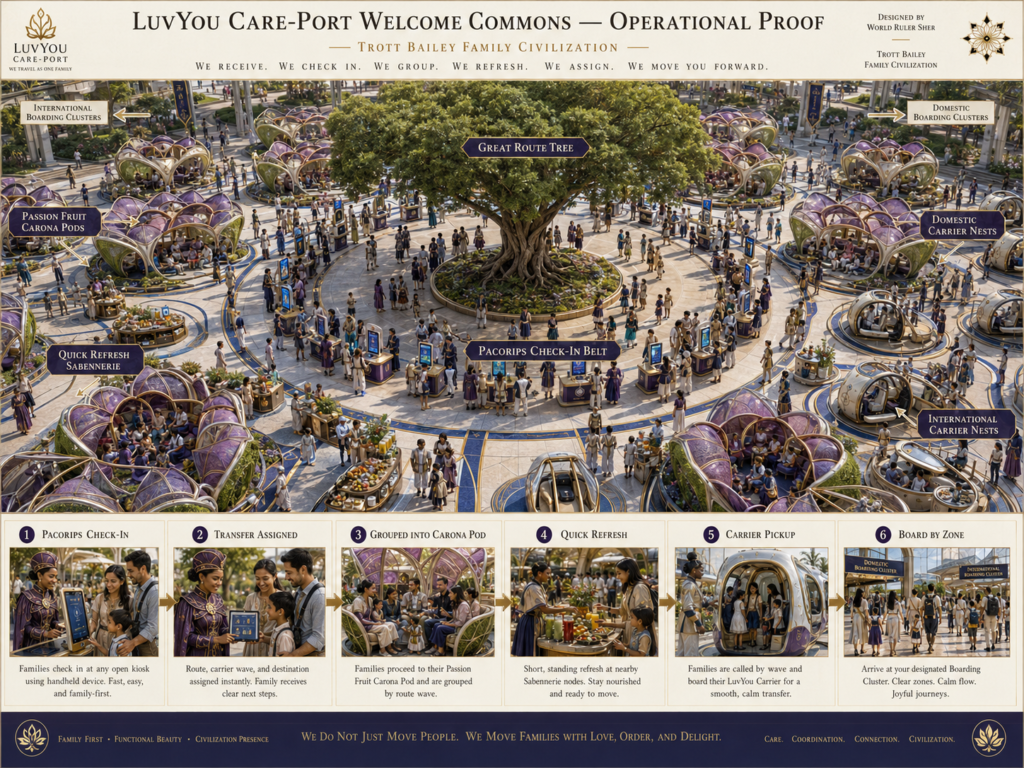
The Carrier Nest Ring sits around the perimeter of the Welcome Commons, outside the central family field. It should be close enough for families to reach easily from their called Passion Carona Pod, but separate enough that carrier movement never crosses dense people zones.
Great Route Tree, Pacorips kiosks, quick Sabennerie, Body Relief access, and Passion Carona Pods.
Lit route lines guide called pod groups outward toward assigned nests.
Carrier Nests receive groups through protected family boarding mouths.
One-way carrier circulation moves vehicles away from the commons.
Carriers dock at the perimeter. Families gather in the center. The lit route connects them without letting carrier movement invade the family field.
5. Carrier Nest Anatomy
A Carrier Nest is not a bus stop, shuttle bay, airport cart station, or parking curb. It is a protected release mouth where a family group transitions from walking guidance into carried movement.
- Nest Mouth: the protected opening where the pod group arrives from the lit route.
- Family Landing Pad: the calm standing area where the group gathers before boarding.
- Carrier Dock: the precise place where the LuvYou Carrier aligns with the nest.
- Boarding Lip: the safe threshold between family floor and carrier body.
- Pacorips Nest Marker: the number, symbol, color, or route sign that matches the pod assignment.
- Steward Post: the human support point for elders, babies, accessibility, route questions, and final calm.
- Forward Exit Throat: the one-way path that allows the carrier to leave without reversing.
Every Carrier Nest must show arrival, gathering, boarding, docking, and forward exit. A nest is not complete if the carrier has no clean way to leave.
6. One-Way Carrier Movement
The Carrier Nest Ring must use a one-way carrier circulation logic. Carriers arrive, dock, receive the group, depart forward, and merge into the internal route system.
Carrier Approaches
The carrier arrives from the behind-perimeter circulation ring.
Carrier Docks
The carrier aligns with the assigned Carrier Nest without crossing the central family field.
Pod Group Boards
The called Passion Carona group enters through the safe boarding lip.
Carrier Departs Forward
The carrier exits through the forward throat and joins the internal movement network.
No LuvYou Carrier may reverse out, face incoming carriers, weave through families, or become trapped by kiosks, pods, Sabennerie nodes, booths, or people.
7. Carrier Nest Types
Domestic Carrier Nest
Moves families toward domestic Boarding Clusters and domestic Movement Thresholds.
International Carrier Nest
Moves families toward international route systems, international Boarding Clusters, and required onward processing.
Assisted Carrier Nest
Supports elders, disabled travelers, pregnant mothers, sleeping babies, medical support, and calmer movement needs.
Cross-Mode Relief Nest
Corrects wrong-side movement, missed routing, disruptions, transfers, and mercy cases without blaming the family.
Upper-Level Carrier Nest
Receives groups lifted by Passion Carona Lift Pods and sends them through upper carrier circulation.
Service + Safety Nest
Allows protected access for stewards, safety response, cleaning reset, urgent care, and service mobility without disturbing central family flow.
Carrier Nest types may differ by route and care need, but all must preserve the same core behavior: receive the pod group, board safely, depart forward, and protect the family field.
8. Connection to Passion Carona Pods
The Carrier Nest Ring is not separate from Passion Carona. It is the release partner of Passion Carona. Every called pod must have a clear outward route to an assigned Carrier Nest.
Pod Number Assigned
Pacorips assigns the family to a numbered Passion Carona Pod.
Pod Group Called
The pod marker glows and Pacorips confirms the group is ready to move.
Lit Route Opens
The floor route lights outward from the pod to the assigned Carrier Nest.
Nest Receives
The Carrier Nest receives the family group at the perimeter and prepares boarding.
A Passion Carona Pod is incomplete unless its outward release line connects clearly to a Carrier Nest.
9. Upper-Level Carrier Ring
The Carrier Nest Ring may operate on more than one level. Outer Passion Carona Lift Pods can receive a group and lift it to an upper carrier floor where additional nests and carriers operate.
This lets the Welcome Commons increase capacity without allowing the central floor to become crowded or invaded by carriers. Upper-level carrier movement must still preserve the same one-way logic.
Upper-level Carrier Nests must behave like true perimeter release organs, not hidden elevators, random balconies, or confusing mezzanine transfers.
10. Family Experience
The family should not experience the Carrier Nest Ring as a transit problem. It should feel like the Care-Port has already prepared the next carrying body for them.
- Child: “Our pod light is leading us to the carrier.”
- Parent: “We know where to go and we are staying together.”
- Elder: “The carrier is close, protected, and calm.”
- Mother: “The children are visible, the group is contained, and the next step is clear.”
- Father: “The family does not have to cross a giant building alone.”
- Steward: “The group is manageable and the carrier can depart without conflict.”
11. No Luggage Burden Across the Ring
The Carrier Nest Ring must preserve the No Luggage Burden Law. Carriers are not old-world baggage shuttles. They are family-carrying movement bodies.
- No rolling suitcases.
- No luggage carts.
- No baggage piles at Carrier Nests.
- No trunk-unloading behavior.
- No airport baggage processing.
- No families dragging household burden through the Carrier Ring.
The Care-Port moves families, not baggage burden.
12. Visual Direction
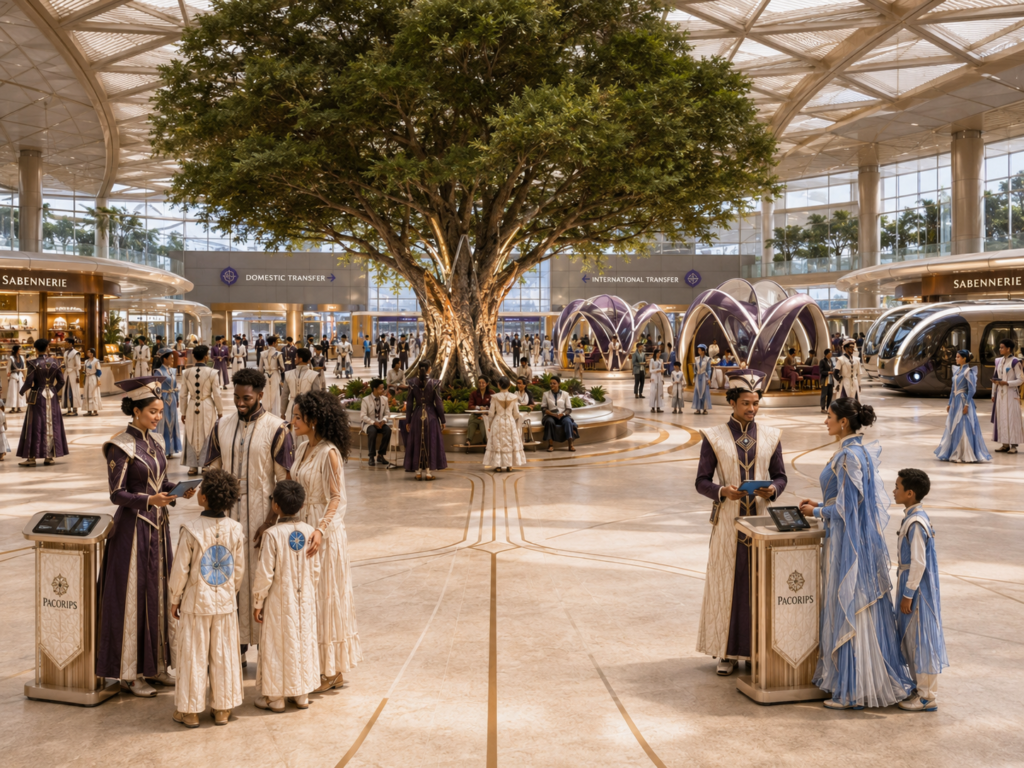
Future Carrier Nest Ring visuals must make the perimeter logic unmistakable. The image should show families in the central Welcome Commons, Passion Carona Pods in the grouping field, lit routes moving outward, and carriers docked at the perimeter instead of inside the central people zone.
Required visual traits
- Central family field clearly separate from carrier movement.
- Passion Carona Pods visible inside the Welcome Commons.
- Lit routes running from pods to perimeter Carrier Nests.
- Carrier Nests arranged around the outer edge.
- Carriers docked at protected mouths, not scattered in people space.
- One-way carrier exit visible behind the perimeter.
- Pacorips markers matching pod and nest assignments.
- Assisted / mercy nests visibly dignified, not punitive.
- No luggage burden.
- Real, buildable, operational architecture, not fantasy or generic transit.
Visual Prompt Direction for Future Proofs
A real, spacious LuvYou Welcome Commons inside Trott Bailey Family Civilization showing the Carrier Nest Ring. The center contains families, Pacorips kiosks, quick Sabennerie nodes, and numbered Passion Carona Pods. Glowing floor route lines lead outward from called pods to protected perimeter Carrier Nests. LuvYou Carriers dock at the outer edge only, aligned with boarding mouths, then depart forward into a one-way behind-perimeter circulation ring. The central commons remains people-first, warm, clear, and luggage-free. The scene is operational, premium, buildable, care-first, not an airport shuttle station, not a bus terminal, not a mall, not a fantasy palace.
13. Rejection Conditions
Reject any Carrier Nest Ring design, prompt, drawing, or article that shows:
- Carriers driving through the central Welcome Commons.
- Carriers weaving around Passion Carona Pods.
- Carriers trapped by kiosks, booths, Sabennerie nodes, or crowds.
- Two-way carrier conflict without a clear one-way ring.
- Carrier docks with no forward exit throat.
- Families forced to cross active carrier lanes.
- Carrier Nests that look like bus stops, airport shuttle stops, taxi bays, or parking curbs.
- Upper-level nests that feel like random balconies or ordinary elevators.
- Assisted nests that feel like punishment, medical segregation, or shame.
- Route District complexity exposed as passenger burden.
- Luggage carts, rolling suitcases, baggage piles, or old-world baggage culture.
- Generic airport, bus station, train station, ferry terminal, parking tram, mall, resort, or sci-fi terminal imagery.
14. What This Record Preserves
- The Carrier Nest Ring as perimeter release architecture.
- The law that the center belongs to families and the perimeter belongs to carriers.
- Carrier Nests as protected docking and family-receiving mouths.
- One-way carrier movement: approach, dock, receive group, depart forward.
- Domestic, international, assisted, cross-mode, upper-level, and service/safety nest types.
- The relationship between Passion Carona Pods and Carrier Nests.
- Upper-level carrier ring logic through Passion Carona Lift Pods.
- No Luggage Burden across the ring.
- Rejection of bus stop, airport shuttle, parking curb, and generic transit drift.
- The need for a future visual proof focused specifically on Carrier Nest Ring architecture.
15. Governing Statement and Next Development Agenda
This record locks the Carrier Nest Ring. The next development should define the actual LuvYou Carrier Vehicle Species: the body that receives families at these nests and carries them toward the Boarding Clusters.
Carrier Nest Ring Diagram
Show center family field, Passion Carona pods, lit routes, perimeter nests, and one-way carrier circulation.
Carrier Dock Close-Up
Show one nest mouth, boarding lip, steward post, carrier alignment, and forward exit throat.
Assisted Carrier Nest Proof
Show elder, baby, mobility, and mercy movement as dignified, not separated or punished.
LuvYou Carrier Vehicle Species Record
Define the actual family-carrying vehicle body that serves the Nest Ring.