Trott Bailey Family Kingdom · Worker Dignity Infrastructure
Service Shadow Support Spine
No worker should carry dangerous work home on their body.
Every civilization has work that keeps life clean, safe, repaired, supplied, and functioning. Some workers clean drains. Some reset bathrooms. Some handle waste. Some wash public vessels. Some repair service routes. Some clean after festivals. Some handle wet towels, grease, food overflow, dirty uniforms, damaged tools, protective gear, canals, public rinse stations, and heavy-use family spaces.
In many places, this work is treated as invisible. People enjoy the clean beach, clean bathroom, working drain, prepared food court, washed towels, repaired street, and safe public route, but rarely think about the worker who made it possible.
Trott Bailey Family Kingdom refuses to build beauty on invisible exhaustion.
That is why the kingdom needs the Service Shadow Support Spine.
What Is Service Shadow?
Service Shadow is the support layer that keeps the visible kingdom functioning. It includes the workers, routes, rooms, tools, vehicles, cleaning systems, repair systems, reset stations, supply flows, and monitoring that make public beauty and family comfort possible.
The name does not mean these workers are shameful or hidden because they are unimportant. It means they work behind, beneath, beside, and around public life so that families, children, elders, visitors, workers, and hosts can move through the kingdom safely and comfortably.
Service Shadow is not ugly back-of-house. It is the kingdom’s support nervous system.
The Problem With Invisible Work
In the old world, many service workers are expected to do difficult work with weak support. They may clean dangerous drains without proper recovery rooms. They may handle dirty bathrooms without good degearing. They may return home in contaminated clothing. They may eat poorly between shifts, lack proper rest, or carry pain, smell, stress, and risk back to their families.
The public sees the finished cleanliness but not the worker’s body afterward. This is a serious civilization failure.
If a society needs workers to touch what others avoid, then that society must protect those workers more carefully, not less.
What the Support Spine Does
The Service Shadow Support Spine is the full system that supports workers before, during, and after difficult service work. It does not only give workers tools. It gives them a route of protection.
- proper uniforms and protective gear
- tool preparation and tool return
- safe transport to and from work zones
- degearing rooms after dirty or dangerous work
- body wash, rinse, and recovery rooms
- protective gear cleaning and drying systems
- food, hydration, and rest support
- medical and safety checks where needed
- Pacorips alerts, route records, and risk monitoring
- clean return of tools, garments, and work materials
This means Service Shadow work is not treated as one task. It is treated as a whole human route.
Before the Work: Preparation
A worker should not enter a high-risk task casually. Before drain cleaning, bathroom reset, waste handling, canal-edge repair, public-event cleanup, wet-room maintenance, or vessel servicing, the worker needs proper preparation.
Preparation may include job briefing, route assignment, risk review, tool selection, protective gear fitting, hydration, body readiness, partner/team confirmation, Pacorips alerts, and clear instructions for what to do if conditions are worse than expected.
This prevents workers from being sent blindly into dangerous or degrading situations.
The worker should enter the task with protection, knowledge, and a clean route back.
During the Work: Tools, Routes, and Team Support
Service Shadow work must be equipped properly. A worker cleaning a drain should not be given the same support as a person sweeping a dry floor. A worker handling grease should not be treated the same as a worker moving clean linens. A worker entering a wet public bathroom after heavy use should have different tools from a worker restocking a quiet family pavilion.
The Support Spine helps match the task to the right equipment, protective layer, vehicle, storage pod, tool carrier, cleaning method, and return route.
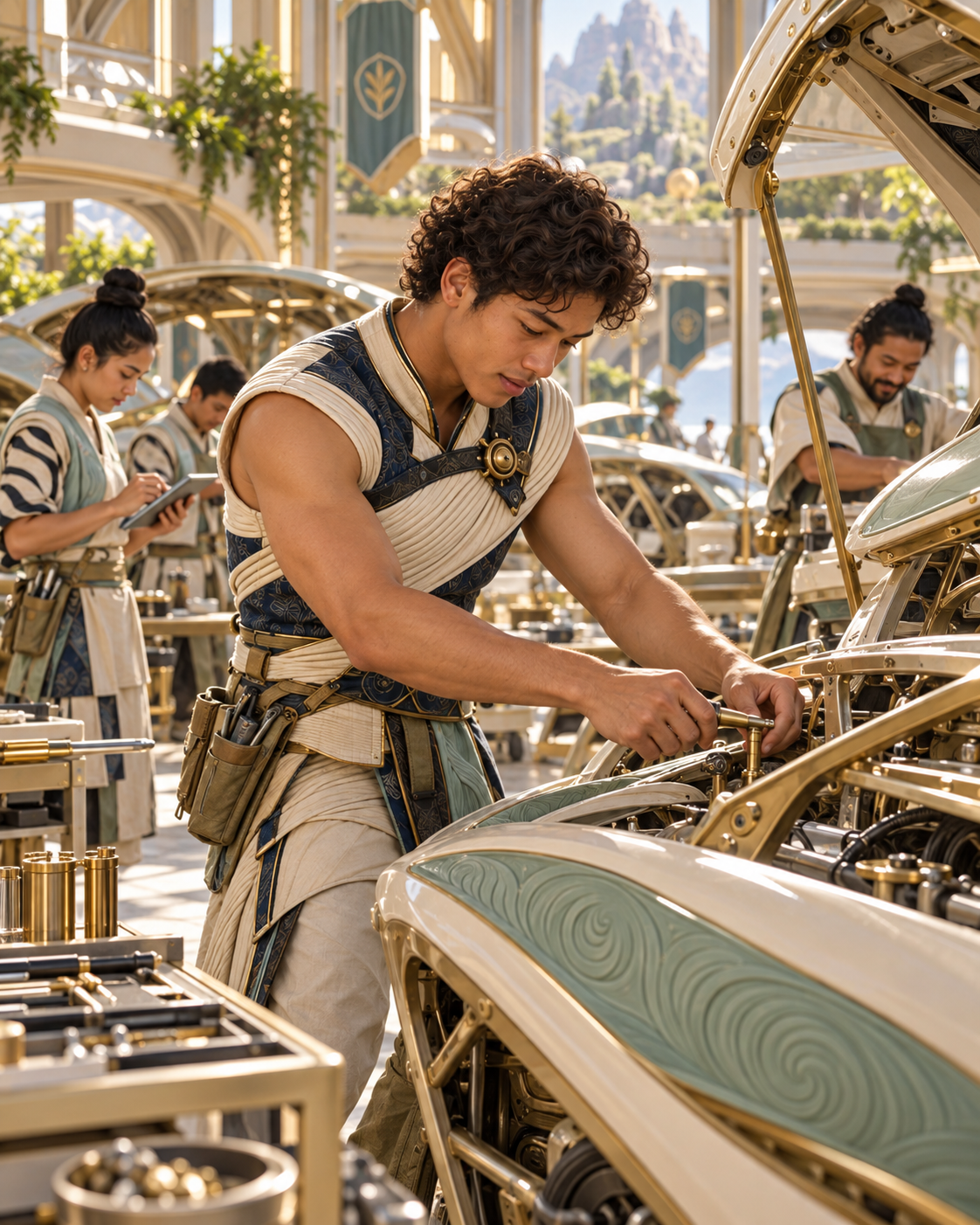
This can include Husk-Pod Assist Craft, tool carts, protective garment stations, mobile rinse support, drain inspection equipment, glove return, towel return, dry-storage modules, and Service Shadow access paths that do not collide with family movement.
After the Work: Degearing Must Be Designed
Degearing is one of the most important parts of Service Shadow dignity. After difficult work, a worker should not simply peel off dirty gear beside a storage shelf, walk through a public hallway, throw contaminated items into a corner, or go home carrying smell, residue, chemicals, sewage, grease, dampness, or risk.
A proper degearing room gives the worker a safe sequence: dirty entry, tool drop, outer layer removal, glove and boot control, garment separation, body rinse, protective gear cleaning, personal wash, dry clothing, rest, and exit into the clean side.
Degearing is not a closet. Degearing is the bridge between dangerous work and safe human return.
The Body Recovery Layer
Some service work affects the body deeply. Heat, smell, dampness, chemicals, repeated bending, heavy lifting, protective gear, long walking, public pressure, and unpleasant materials can drain a worker.
The Service Shadow Support Spine must include body recovery: showers, warm rinse, cooling, hand and foot care, clean clothing, hydration, nourishing food, rest benches, quiet rooms, first-aid checks, and recovery time between difficult tasks.
This is not pampering. It is prevention. Workers who are cared for can work more safely, last longer, recover better, and return to their families with dignity.
A kingdom that protects families must also protect the workers who protect family life.
Gear Cleaning and Tool Return
Protective gear should not become a second contamination problem. Boots, gloves, suits, masks, aprons, helmets, tool handles, hoses, drain equipment, carts, and containers all need proper return.
A strong Service Shadow system includes gear wash, drying, inspection, repair, storage, replacement, and Pacorips tracking. If a glove fails repeatedly, the system should notice. If a boot seal is weak, the system should flag it. If a tool returns damaged, it should not quietly be handed to the next worker.
Tool return is part of worker protection.
Transport Support
Service Shadow teams need transport that respects their work. Some tasks require quick response. Some require heavy tools. Some require wet-item return. Some require workers to move from one public area to another without crossing through family gathering spaces in dirty gear.
Support vehicles and service routes may include Husk-Pod Assist Craft, clean-return carts, towel and Doon return carriers, drain-support pods, public bathroom reset vehicles, Makji-service support, fishing dock service carts, and canal-edge repair carriers.
Transport is not only about moving workers faster. It is about keeping clean routes and dirty routes from confusing each other.
Food, Hydration, and Rest
A Service Shadow worker should not be expected to clean the hard parts of civilization while being underfed, dehydrated, or treated like an afterthought.
The Support Spine can connect workers to warm meals, hydration points, shaded rest pockets, quiet recovery porches, shift handoff pavilions, and short reset rooms between work cycles.
In Trott Bailey Family Kingdom, worker support is not separate from the Sabennerie and public-comfort systems. Those who serve the kingdom should also be served by the kingdom.
Pacorips and Service Shadow
Pacorips plays an important support role in Service Shadow, but it must never become a harsh ranking machine or a tool for punishing workers.
Pacorips can help record risk zones, schedule safer routes, alert teams to overflow, track gear condition, detect repeated maintenance failures, flag unsafe drain conditions, support shift handoffs, identify worker recovery needs, and connect service teams to the right tools and support rooms.
The purpose is not to watch workers with suspicion. The purpose is to help the kingdom remember what workers should not have to remember alone.
Pacorips should protect the worker from being forgotten by the system.
Service Shadow in Family and Public Life
The Service Shadow Support Spine touches many parts of Trott Bailey Family Kingdom. It supports Baby Worlds, Sabenneries, public bathrooms, Makji groves, Krubaro stations, Keslev orchards, Honey World, Balushu Release Commons, fishing docks, drain systems, food-vendor clean-return courts, beach promenades, canal-edge repair streets, and family compound support.
In every place where the public experiences comfort, there must be a support layer that keeps comfort real. Otherwise beauty becomes temporary and workers are forced to absorb the cost.
Public life without Service Shadow becomes chaos pretending to be beauty.
Shift Handoffs and Human Limits
Service Shadow work must respect human limits. A worker should not be pushed through endless dirty tasks without proper rotation, rest, food, and handoff. Shift handoff pavilions allow teams to pass information, tools, route notes, warnings, and unfinished tasks without confusion.
In a strong civilization, the next worker does not walk blindly into what the last worker survived. Knowledge transfers. Tools return. Gear resets. Bodies recover. The system learns.
Beauty Belongs Here Too
Service Shadow support spaces must not look like forgotten utility rooms. The kingdom’s support architecture can still be beautiful: shell-ivory walls, washable mineral floors, ashcoal grounding where heavy use occurs, carved drainage, bronze or soft-gold route seams, warm lighting, clear thresholds, tool niches, fresh-air openings, shaded porches, and dignified worker entrances.
Beauty in these spaces is not vanity. It tells the worker: your work matters enough to be housed properly.
A worker should not have to enter ugly rooms to keep beautiful places alive.
What Service Shadow Must Avoid
Service Shadow must never drift into hidden exploitation with nicer words. It must avoid dirty back corridors, shame-based worker entrances, poor protective gear, weak washing stations, chaotic tool storage, unsafe drain work, overlong shifts, ignored injuries, careless chemical handling, and workers being sent home unclean.
It must also avoid turning Pacorips into a punishment system. Monitoring must serve care, safety, routing, maintenance, and support. It must not become humiliation, surveillance pressure, or competition between workers.
Service Shadow is not where the kingdom hides people. It is where the kingdom proves whether its beauty is honest.
The Promise of the Service Shadow Support Spine
The Service Shadow Support Spine promises that the workers who clean, repair, reset, carry, return, wash, inspect, and maintain the kingdom will not be treated as disposable hands behind the curtain.
It says that difficult work needs preparation. Dirty work needs degearing. Wet work needs drying. Dangerous work needs recovery. Heavy work needs transport. Repeated work needs tools. Public comfort needs worker dignity.
The kingdom is not truly clean if the worker goes home carrying the dirt.
That is why Service Shadow Support matters. It is not only operational infrastructure. It is moral infrastructure. It is the kingdom admitting that beauty, cleanliness, safety, and comfort must never be purchased with invisible human damage.
The hardest work deserves the strongest support.