




The Caterport: A New Travel-Care Body for Free Human Movement
This record defines the first logical system of the Trott Bailey Family Civilization Caterport: a full transport-care organism designed for free travel, family movement, sea preference, Pacorips guidance, no luggage burden, calm mass flow, and repeatable civilization-scale travel.
1. The Starting Problem
In the old world, travel is shaped by money, stress, time pressure, luggage burden, crowded terminals, ticket systems, and transportation designed around vehicles instead of families.
Families are often forced to ask:
Trott Bailey Family Civilization begins from a different premise:
When travel is free, the old price barrier disappears. Movement expands. Families travel more often, for more reasons, across more distances, using more modes.
Therefore, Trott Bailey travel cannot be designed like a normal airport, train station, bus terminal, cruise terminal, or seaport. It requires a new civilization body.
2. Core Definition: What Is a Caterport?
Caterport Definition
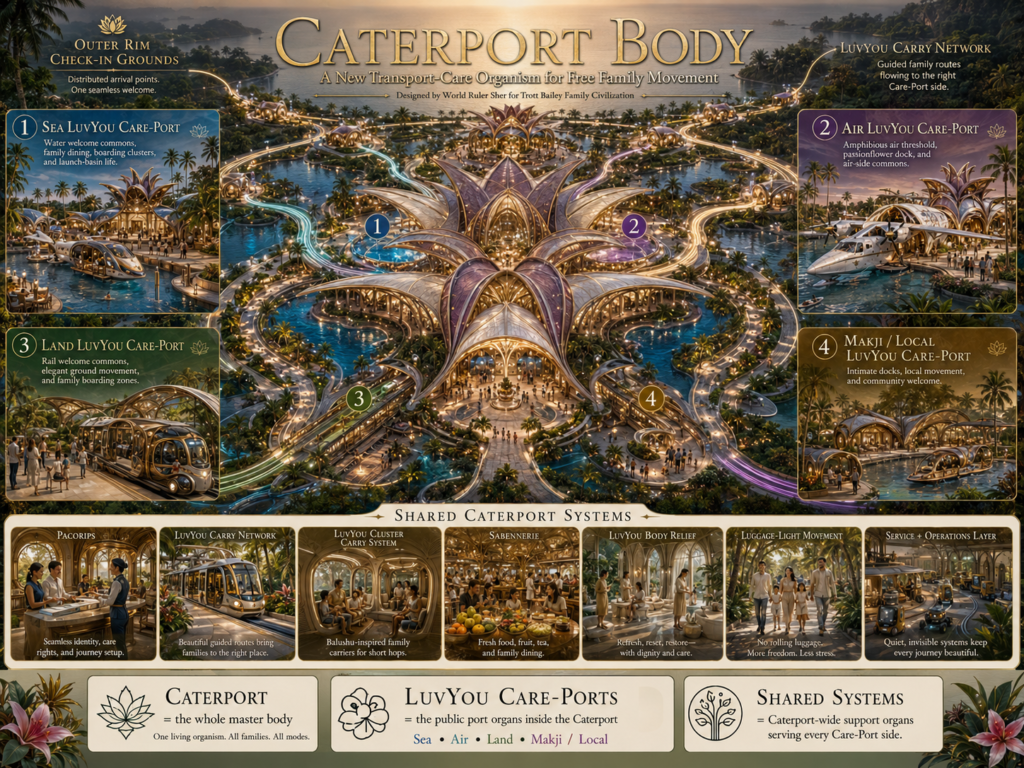
A Caterport is the full Trott Bailey transport-care infrastructure body that organizes free movement across Air, Water/Sea, Land, and Makji/local travel while caring for families through the entire journey.
A Caterport is not an airport with nicer decoration. It is not a seaport with gardens. It is not a train station with better seating. It is not a bus terminal with softer colors.
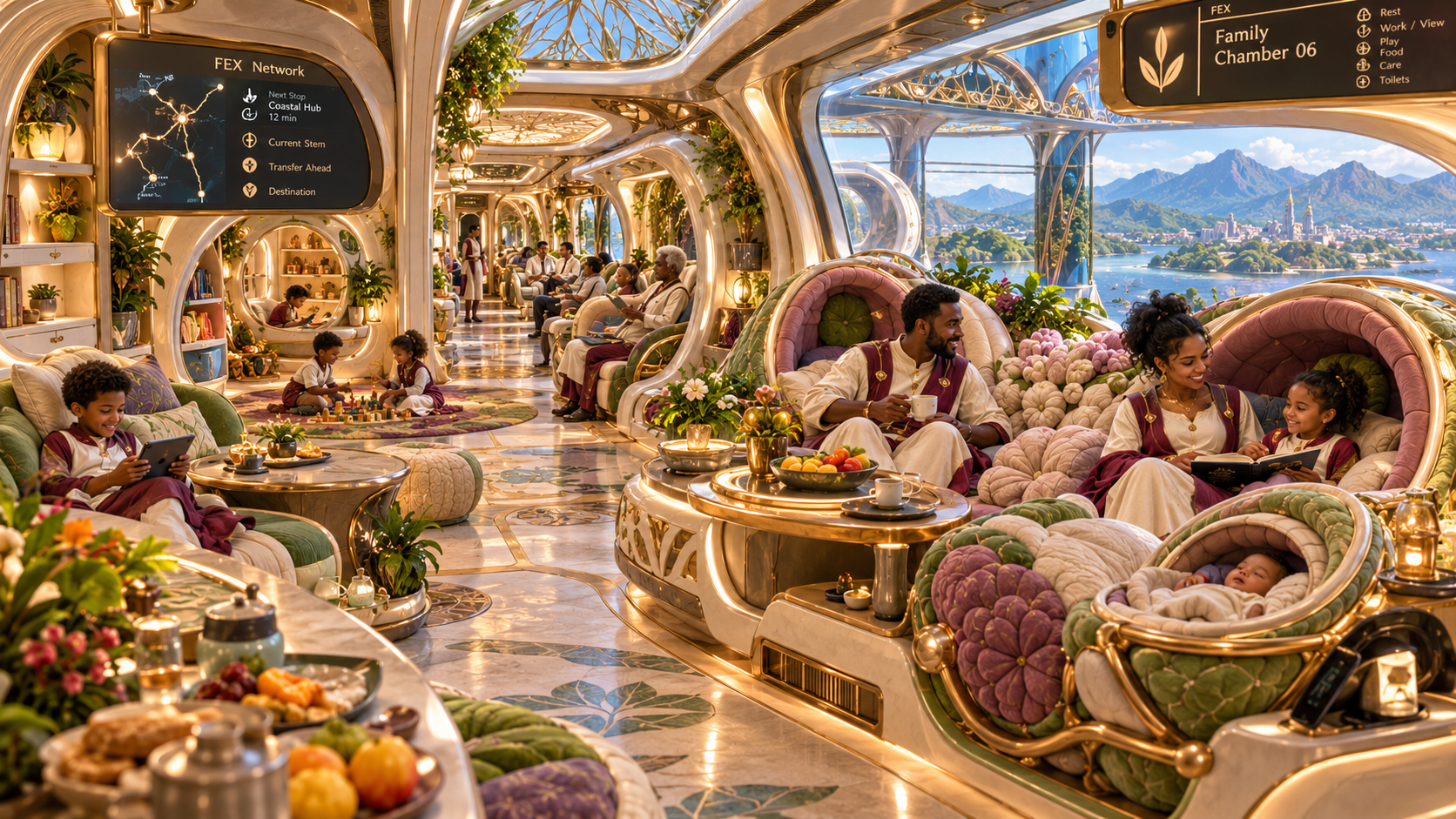
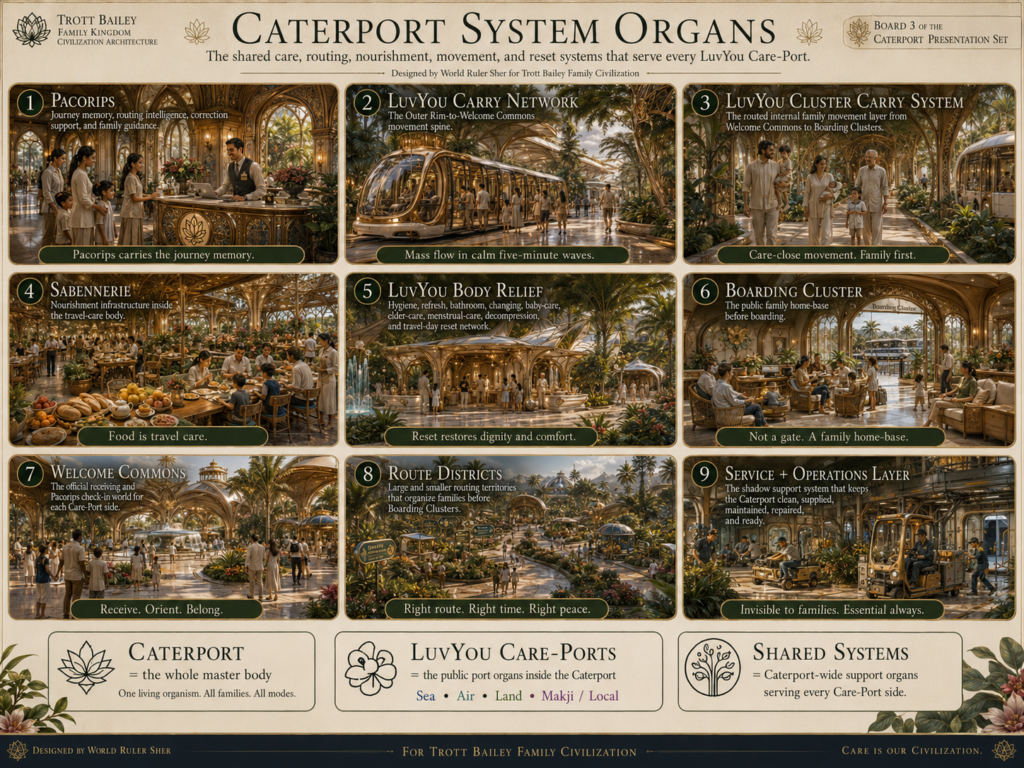
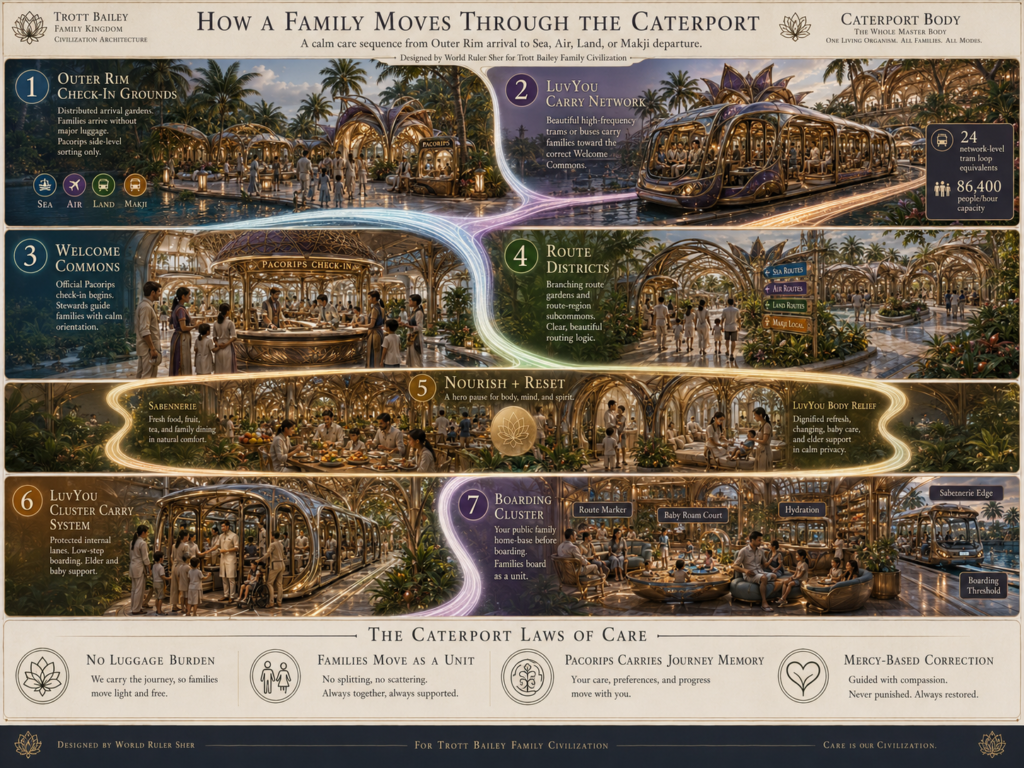
It is a travel-care organism. It organizes family arrival, side-level sorting, Pacorips guidance, luggage-light movement, Welcome Commons, route districts, nourishment, body relief, baby and elder care, internal movement, Boarding Clusters, movement thresholds, and calm departure across multiple travel modes.
3. The Three Terms Must Stay Distinct
Caterport
The full transport-care infrastructure body. It includes all major travel sides, service systems, routing systems, care systems, movement systems, and operational support layers.
LuvYou Care-Port (Air, Sea, Land, Makji)
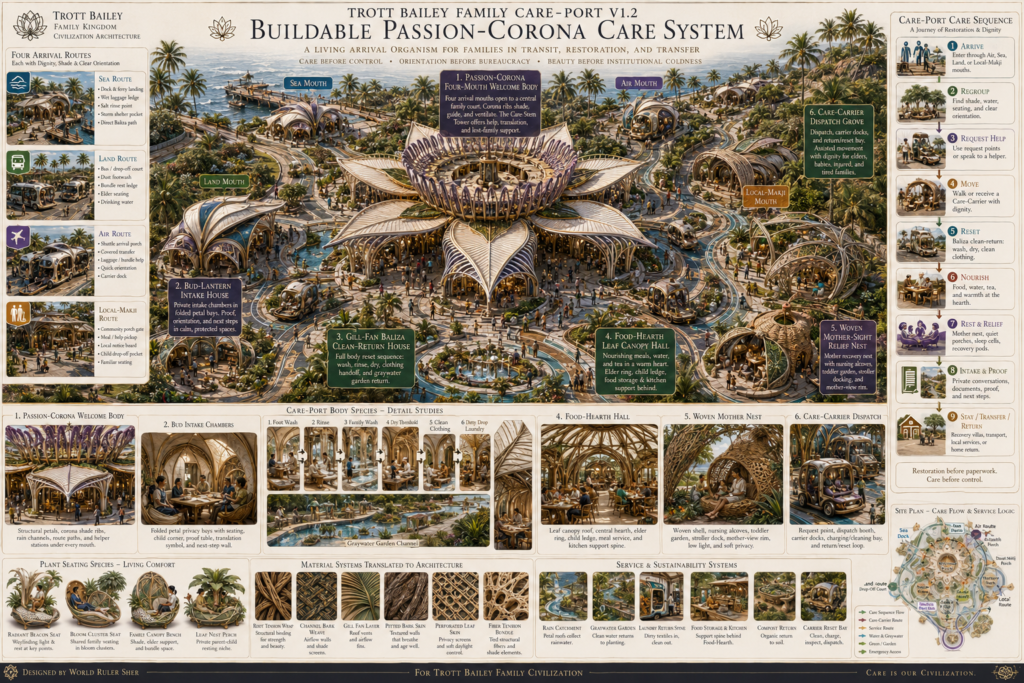
The public-facing care-first port expression inside the Caterport. This is where families are received, fed, guided, relieved, rested, routed, supported, and boarded under care.
LuvYou CaterPorts Network
The larger civilization travel network created by replicating many full Caterports.
4. Master Caterport Hierarchy
The Caterport is not one giant terminal. It is organized through a layered body system:
Full travel-care infrastructure body
Air, Water/Sea, Land, Makji/local
Official receiving and Pacorips check-in zone
Large travel sorting districts
Smaller branch sorting commons
Family home-base before boarding
Final calm boarding edge into Sea, Air, Land, or Makji movement
5. The Free Travel Expansion Law
Free travel does not simply mean more people will fly. It means more people will move. Travel expands across the entire civilization.
Families may travel for family visits, learning, rest, festivals, marriage ceremonies, health, service work, sea exploration, urgent timing, regional movement, intercontinental movement, and local movement.
Therefore, the Caterport must strengthen every travel side. It must not create one overloaded Air,Land or Sea LuvYou Care-Port organ. All LuvYou Care-Ports together must create a full travel Caterport civilization.
The Care Principles That Make the Caterport Work
The Caterport’s capacity numbers only make sense because the system removes old-world friction. The travel body is not designed around passengers fighting through stress. It is designed around families being received, guided, fed, relieved, moved, corrected, and boarded under care.
1. No Luggage Burden Law
This law is one of the reasons the Outer Rim and Carry Tram numbers become realistic. Old-world terminals are slowed by rolling suitcases, carts, baggage queues, turnstiles, confused passengers, overloaded parents, elders struggling with bags, and children trapped in luggage chaos.
Families may carry small personal items, baby needs, comfort items, or Pacorips tokens, but the household burden is handled by the system.
2. Families Move as a Unit
The Caterport does not scatter the family through separate queues, separate anxieties, and separate burdens. The family is treated as a living travel group.
This affects the entire system: Pacorips check-in, tram boarding, Cluster Carry assignment, Sabennerie nourishment, LuvYou Body Relief access, Boarding Cluster placement, and final boarding waves.
3. Pacorips Journey Memory Law
Pacorips is not merely a kiosk. It is the journey intelligence layer. It remembers the family’s movement path, route assignment, timing, needs, corrections, and care conditions.
Pacorips balances:
4. Missed Departure and Wrong-Side Mercy Law
If a family reaches the wrong side, misses a tram, needs a different route, faces weather disruption, or becomes confused, the system does not punish them. Pacorips-supported human stewards intervene.
Fast redirect shuttles and internal correction carriers exist for this purpose. They are not the normal mass movement layer. They are the mercy and correction layer.
5. Food as Travel Care: Sabennerie Law
Sabenneries are the Caterport’s nourishment layer. They are not old-world airport restaurants designed around retail extraction. They are part of the travel-care system.
Families should be fed, hydrated, steadied, and restored throughout the journey. Food care belongs near Welcome Commons, Route Districts, Boarding Clusters, Baby Roam Courts, and waiting/resting edges.
6. LuvYou Body Relief Definition
LuvYou Body Relief is not simply “bathrooms.” It is body-care infrastructure. It acknowledges that travel creates real body needs: children need changing, elders need calm relief, mothers need privacy, families need refresh, and travelers need clean reset before boarding.
Balushu is its own system. Baliza is its own room-body bathing system. LuvYou Body Relief is the Caterport’s public body-care and travel-day reset network.
7. Why These Principles Matter Before the Numbers
The Caterport can move large numbers because it removes old-world obstacles before they become crowd problems. No luggage burden, family-unit movement, Pacorips journey memory, Sabennerie nourishment, LuvYou Body Relief, and mercy-based correction all reduce panic and increase flow.
The system is not fast because it rushes people. It is fast because it is organized around care.
Sea Preference, Air Care, and the First Model Caterport Capacity
1. Sea Travel Preference Law
In Trott Bailey Family Civilization, sea travel is not treated as second-class slow travel. Because travel is free and families are no longer forced to rush, sea travel becomes one of the preferred ways to move.
Sea LuvYou Care-Port Side
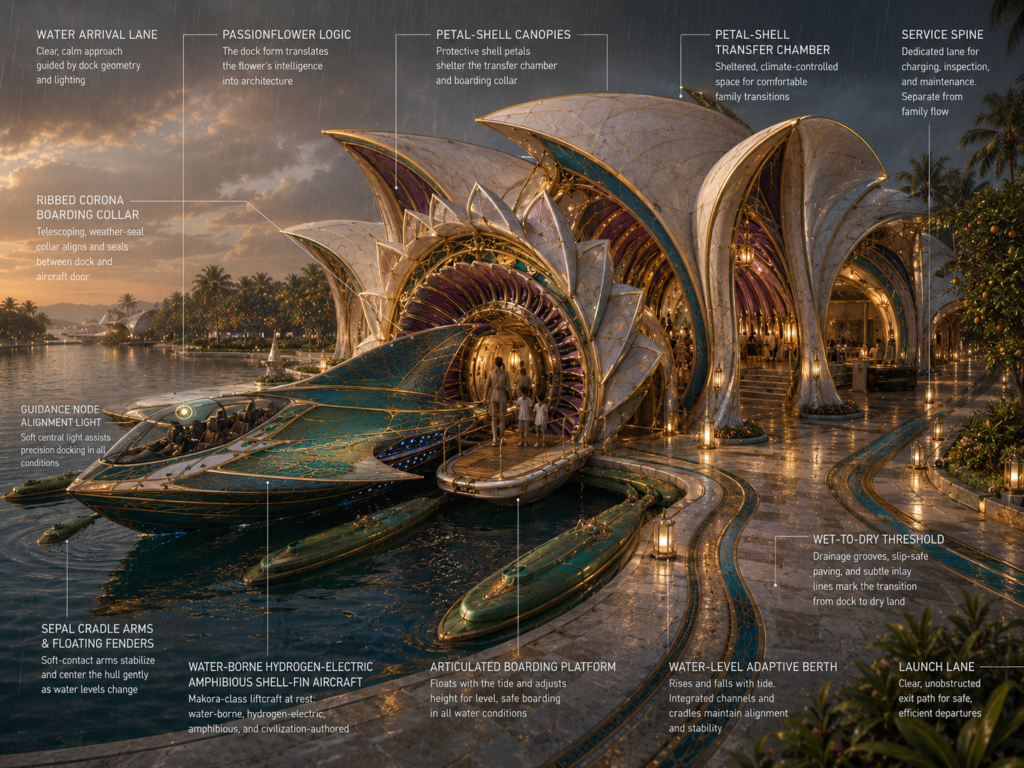
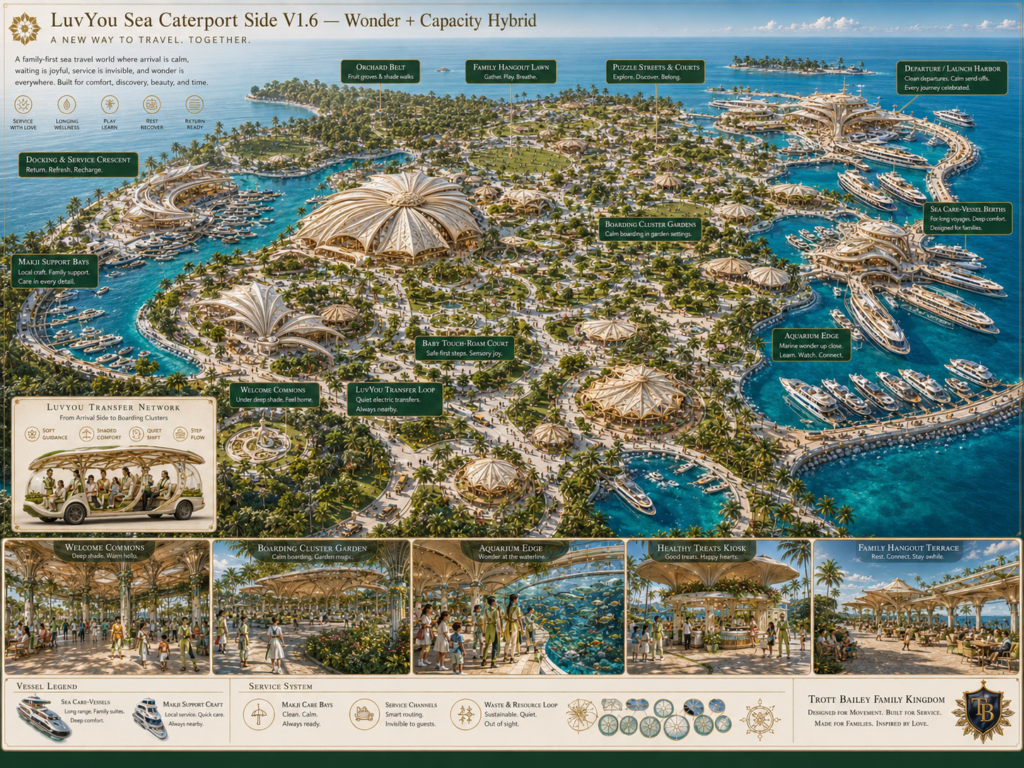
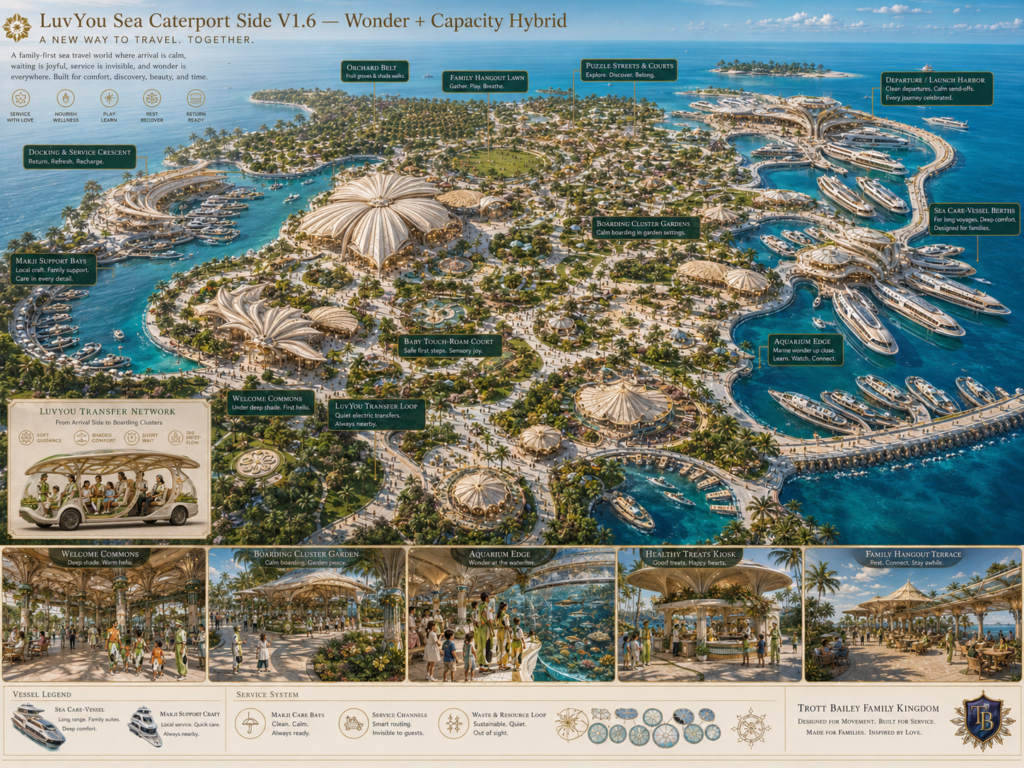
The Sea LuvYou Care-Port Side is not an old-world seaport, cruise terminal, ferry dock, or cargo harbor. It is a sea-travel civilization district where families can arrive, linger, eat, play, rest, discover, transfer, board, and launch into sea movement with beauty, space, care, and time.
The sea journey becomes part of life itself. It becomes water-world discovery, family time, nourishment, rest, learning, and civilization travel at human rhythm.
2. Air Care Option Law
Sea is preferred, but it is not forced. Some families need speed. Some families do not enjoy long travel. Some families want the journey completed quickly and calmly.
This means the Caterport must not starve the Air Side. Air remains serious, capable, and cared-for, while Water/Sea becomes the largest preferred travel body.
3. First Model Caterport Capacity Lock
The first model Caterport should be strong enough to respond to free travel expansion. It should not be a small symbolic prototype. It should be a serious, repeatable travel-care body.
Planning note: In this record, “people per year” and “people per day” refer to traveler movements through the Caterport, not necessarily unique human beings. One person may create more than one movement if they depart, arrive, connect, return, or travel again.
This is not emergency crush capacity. This is the designed maximum comfortable operating body.
4. Working Mode Share V1
The first model Caterport uses a working mode share that keeps Water/Sea as the largest preferred body, while still giving Land, Air, and Makji serious capacity.
| Mode | Working Share | Reason |
|---|---|---|
| Water / Sea | 50% | Preferred family exploration, rest, beauty, and heavy intercontinental movement |
| Land | 25% | Strong regional, intercity, ground, and rail movement |
| Air | 20% | Speed, urgency, preference, distance, and families who do not want long travel |
| Makji / Local | 5% | Local, intimate, district, lagoon, and short-range movement |
This is a working planning split, not an eternal law. Pacorips may rebalance by route, season, family preference, urgency, weather, health, destination readiness, and capacity.
5. Daily Mode Numbers
| Mode | At 160M/year | At 200M/year |
|---|---|---|
| Water / Sea | 219,178 traveler movements/day | 273,973 traveler movements/day |
| Land | 109,589 traveler movements/day | 136,986 traveler movements/day |
| Air | 87,671 traveler movements/day | 109,589 traveler movements/day |
| Makji / Local | 21,918 traveler movements/day | 27,397 traveler movements/day |
6. Sea Vessel Logic
At the comfortable maximum of 200 million traveler movements/year, Water/Sea carries about 274,000 traveler movements/day.
If one Sea Care-Vessel carries about 2,000 people, then:
274,000 ÷ 2,000 = about 137 full vessel departures/day.
With partial loading, route variety, comfort spacing, weather reserve, and schedule spread, the Caterport should plan around:
Launching up to about 160 Sea Care-Vessels per day from one major Caterport does not crowd the global seas. The true design challenge is local water organization: arrival basins, launch basins, timed lanes, holding waters, service separation, weather delay absorption, and safe route release.
7. Air Flight Logic
At the comfortable maximum of 200 million traveler movements/year, Air carries about 110,000 traveler movements/day.
If one aircraft averages 250 people, then:
110,000 ÷ 250 = about 440 flights/day.
With route variety, reserve, and schedule spacing, the Caterport should plan around:
This keeps air strong without making the whole Caterport airport-dominated.
Outer Rim Check-In Grounds and Carry Tram Flow Logic
1. Outer Rim Responsibility Boundary
Families do not begin by entering one giant airport-style terminal. They begin at approved Outer Rim Check-In Grounds.
The Outer Rim performs only side-level sorting:
Detailed route sorting does not happen at the Outer Rim. It begins later at the correct Welcome Commons.
2. The 66,000 People Per Hour Clarification
At the 200 million/year comfortable maximum, the Caterport moves about 548,000 traveler movements/day. For peak planning, use 10% of daily movement, then add 20% comfort reserve.
548,000 traveler movements/day × 10% = about 54,800 traveler movements/hour
54,800 × 1.2 reserve = about 66,000 traveler movements/hour
The movement happens in calm waves across multiple Outer Rim Check-In Grounds and dedicated Carry Tram directions.
3. Twelve Outer Rim Check-In Grounds
The first model Caterport should not have one giant entrance. It should distribute arrival through:
This divides the 66,000 traveler movements/hour peak flow across 12 grounds:
66,000 ÷ 12 = 5,500 traveler movements/hour per Outer Rim Check-In Ground.
4. Carry Tram Capacity Law
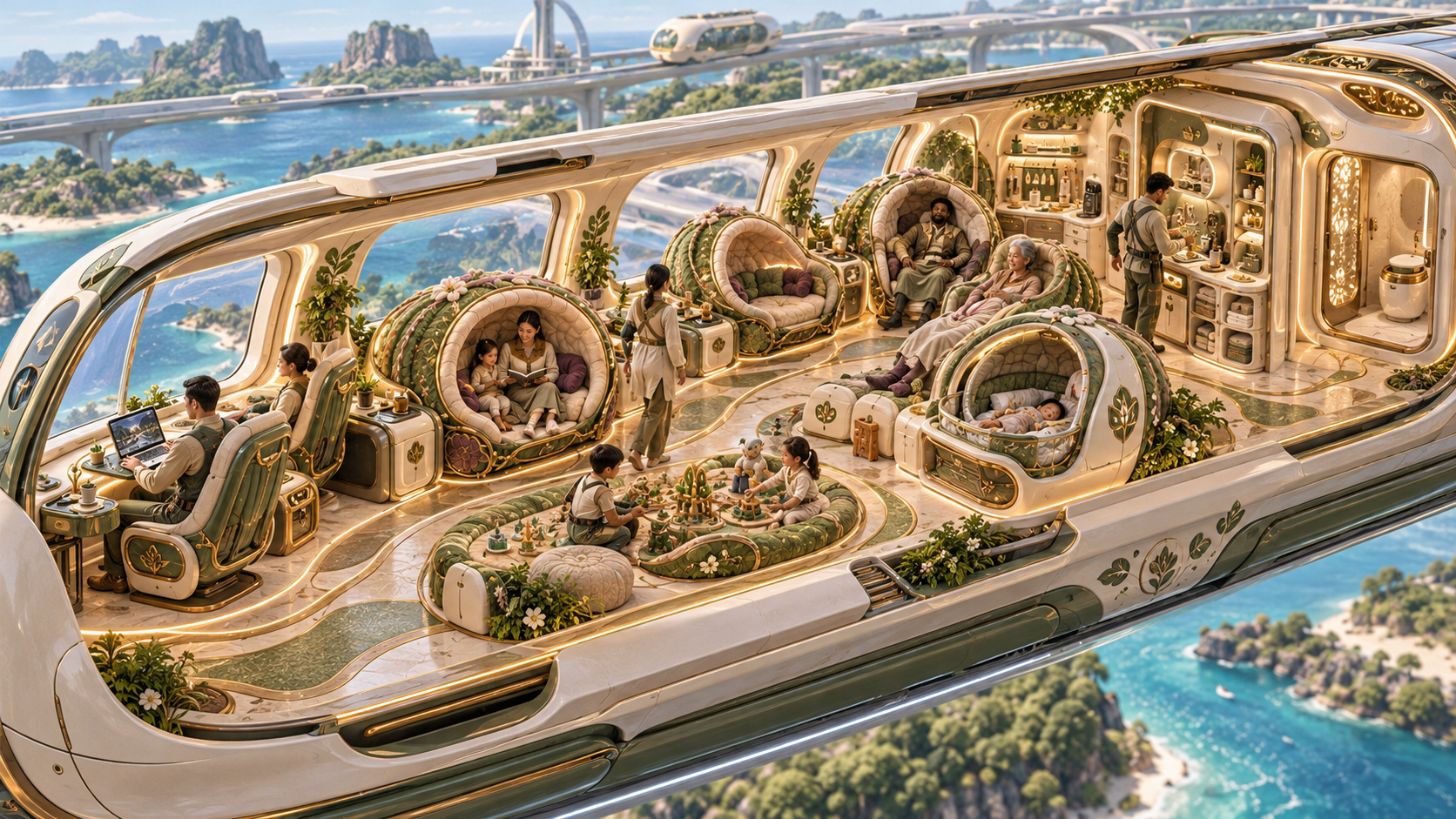
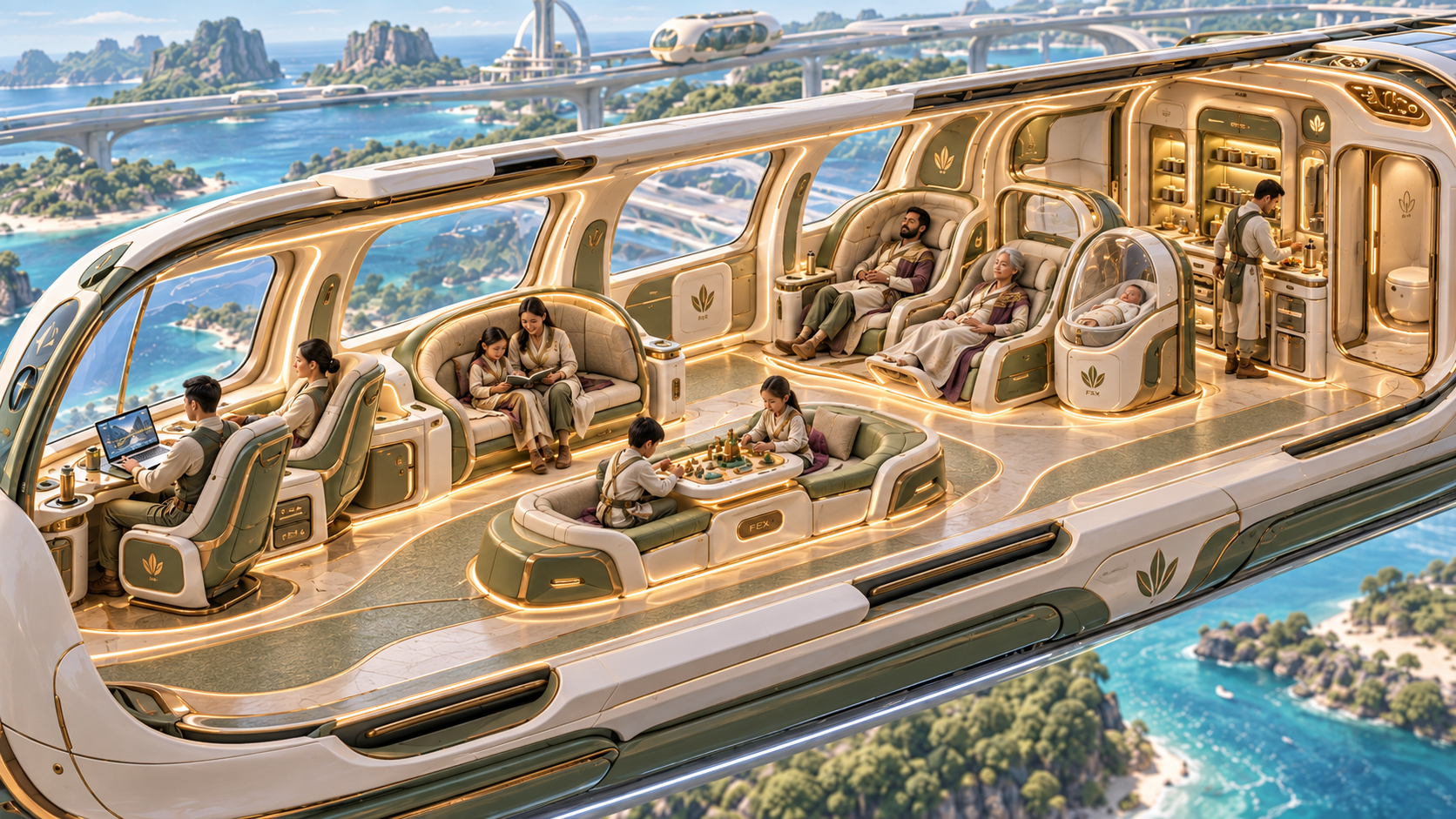
Each Carry Tram loop is planned as:
One loop is useful, but not enough for a full major Outer Rim ground. Two loop equivalents give:
3,600 × 2 = 7,200 people/hour.
5. Full Outer Rim Carry Tram Capacity
With 12 Outer Rim Check-In Grounds and 2 loop equivalents per ground:
12 grounds × 2 loops = 24 Carry Tram loop equivalents.
24 loops × 3,600 people/hour = 86,400 people/hour.
This means the tram system runs at about 76% of full scheduled capacity during the peak estimate, leaving room for comfort and irregular demand.
6. Network-Level Loop Equivalent Clarification
Important layout note: The 24 Carry Tram loops are network-level loop equivalents. They are not a final track blueprint and do not necessarily mean four separate direct tram lines at every single Outer Rim ground.
Each Outer Rim ground receives side-level Pacorips sorting and access to the correct Carry direction. The detailed physical track layout may later use dedicated Sea loops, paired-ground corridors, shared Land/Air trunks, side-specific tram spines, transfer spines, or other site-specific track arrangements.
The invention record locks the logical capacity system. The final rail geometry belongs to a later Caterport site and engineering record.
7. Five-Minute Wave Logic
Across the full Outer Rim:
24 loops × 300 people = 7,200 people can move every five minutes.
Peak demand requires:
66,000 ÷ 12 five-minute waves = 5,500 people every five minutes.
Per Outer Rim ground:
2 loops × 300 people = 600 people every five minutes.
The ground’s peak need is about 458 people every five minutes.
The system therefore moves families in organized five-minute waves, not one giant crowd.
8. Dedicated Carry Tram Allocation by Mode
Because Water/Sea carries the largest share, it receives the largest dedicated Carry Tram body.
| Mode | Dedicated Tram-Loop Equivalents | Capacity/Hour | Active Tramsets |
|---|---|---|---|
| Water / Sea | 12 loops | 43,200/hr | 108–120 |
| Land | 6 loops | 21,600/hr | 54–60 |
| Air | 5 loops | 18,000/hr | 45–50 |
| Makji / Local | 1 loop | 3,600/hr | 9–10 |
| Total | 24 loops | 86,400/hr | 216–240 |
9. Physical Tram Fleet Calculation
The loop assumption is:
To maintain 5-minute service:
45 ÷ 5 = 9 physical tramsets per loop.
24 loops × 9 = 216 active tramsets.
If 5 minutes of Outer Rim boarding time is included, the loop becomes 50 minutes:
50 ÷ 5 = 10 physical tramsets per loop.
24 loops × 10 = 240 active tramsets.
Welcome Commons, Cluster Carry, Boarding Clusters, and the Locked First Model System
1. Welcome Commons Receiving Law
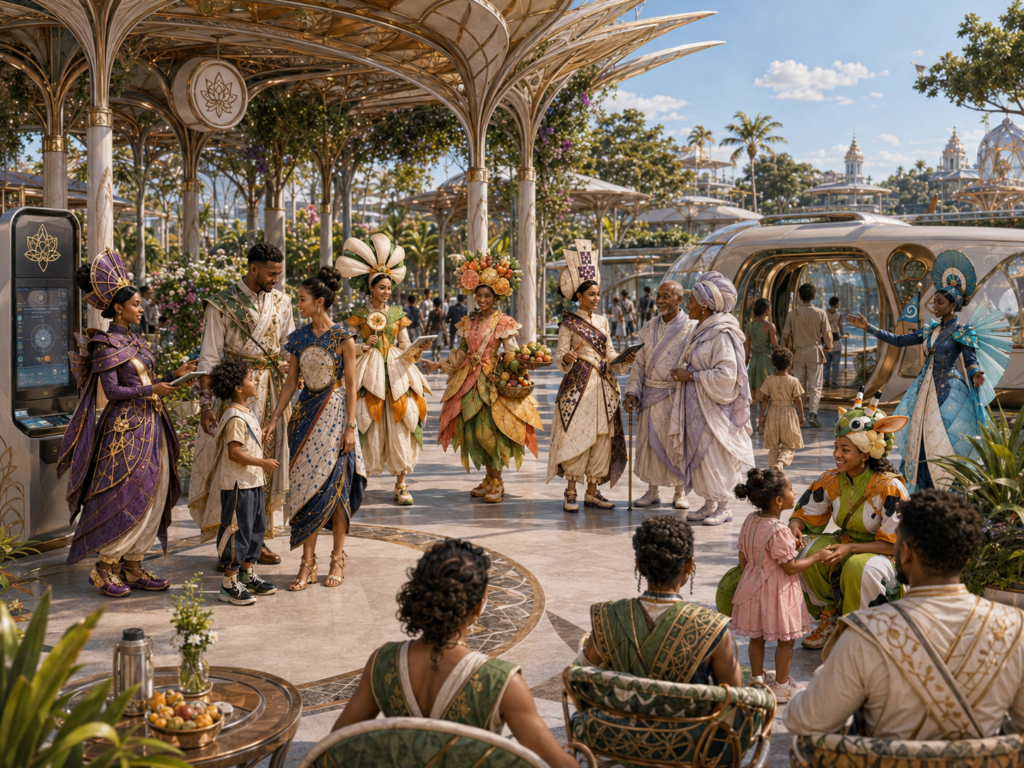
The Carry Tram system can move large numbers quickly. Therefore, the Welcome Commons must be designed to receive tram waves without crowd crush.
2. From Mass Flow to Routed Family Movement
Once Carry Trams handle the heavy Outer Rim-to-Welcome Commons flow, buses do not need to be the main intake system. Their role becomes more precise.
Outer Rim → Welcome Commons
Primary mover: Carry Trams.
Welcome Commons → Boarding Cluster
Primary mover: LuvYou Cluster Carry System.
3. LuvYou Cluster Carry System
Its job is to carry officially checked-in families from the Welcome Commons to their assigned Boarding Cluster or Boarding Cluster district.
The Cluster Carry System is inspired by Balushu’s dignified family movement intelligence, but it is not Balushu itself. Balushu remains its own system.
4. Boarding Cluster Definition
The Boarding Cluster is not a gate. It is not a waiting room. It is the family’s public home-base before boarding.
5. Full Movement Sequence
6. Locked Breakthrough Summary
First Model Caterport Scale: 160 million traveler movements/year comfortable operating body, 200 million traveler movements/year comfortable maximum.
Replication Law: Build one complete working Caterport body first. Then replicate many Caterports into the larger LuvYou CaterPorts network.
Mode Share V1: 50% Water/Sea, 25% Land, 20% Air, 5% Makji/Local.
Outer Rim System: 12 Outer Rim Check-In Grounds, 24 network-level Carry Tram loop equivalents, 86,400 people/hour Carry Tram capacity.
Physical Tram Fleet: 216–240 active Carry Tramsets, or roughly 250–290 total including reserve.
Sea Dedicated Tram Body: 12 of the 24 tram-loop equivalents, moving up to 43,200 people/hour toward the Sea Welcome Commons.
Cluster Carry Role: Carry Trams move mass flow; LuvYou Cluster Carry carriers move routed family groups from Welcome Commons to Boarding Clusters.