Trott Bailey Family Civilization
There Is No Mastermind: Civilization Has Mostly Been Inherited, Not Authored
Written by the most beautiful woman, World Ruler Sherika Trott Bailey, who is the most beautiful in all her stages, ages and glory.We inherited knowledge, but we also inherited assumptions about how a human life is supposed to work. Those assumptions are not laws of nature.
Look at the way life is organized today and it is easy to assume somebody must have designed it this way.
Somebody must have decided that billions of people would spend most of adulthood continually earning access to food, shelter, transportation and security.
Somebody must have designed a system where machines save labor, yet workers fear those same machines because losing required labor can mean losing income.
Somebody must have planned a world where enormous productive capacity can sit beside the familiar sentences:
But there is no mastermind.
There is no single group of men who sat down and authored the whole arrangement.
What we are looking at is largely accumulation.
People inherited systems.
They changed pieces.
Protected pieces.
Profited from pieces.
Patched pieces when they broke.
Passed those patches to the next generation.
Eventually, entire populations were born inside arrangements so old and familiar that they began to feel like reality itself.
But we inherited two very different things.
We inherited knowledge.
And we inherited assumptions.
We inherited mathematics, engineering, agriculture, medicine, sanitation, machinery and centuries of accumulated human learning.
But we also inherited assumptions about what a human life is supposed to look like.
And those assumptions deserve to be named.
The Assumptions We Organize Our Lives Around
We inherited the assumption that adulthood means continually earning in order to maintain access to basic survival.
That you work today so you can eat today.
Work next month so you can live next month.
Work next year so you can continue living next year.
Repeat for decades.
Then, when your body is older and much of your strongest adult life has passed, call the period when you finally stop retirement.
We inherited the assumption that food, shelter, transportation, healthcare and security should remain conditional on continued earning.
That housing can reasonably require decades of financial obligation.
That a machine reducing the amount of human labor needed is progress, while the human whose labor is no longer needed should be terrified.
That a government can have workers, machinery, land, knowledge and need, yet still be unable to act because the budget has run out.
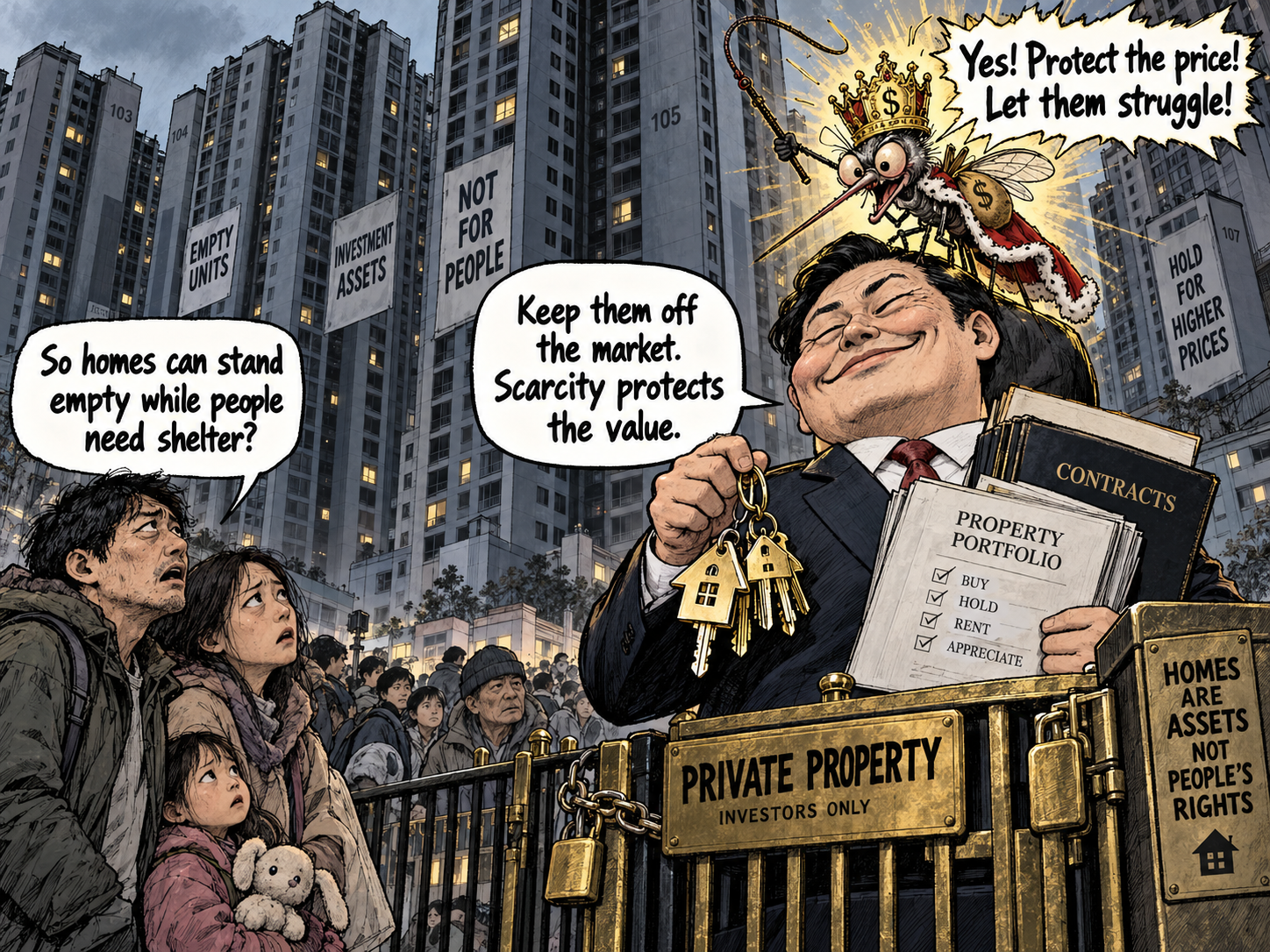
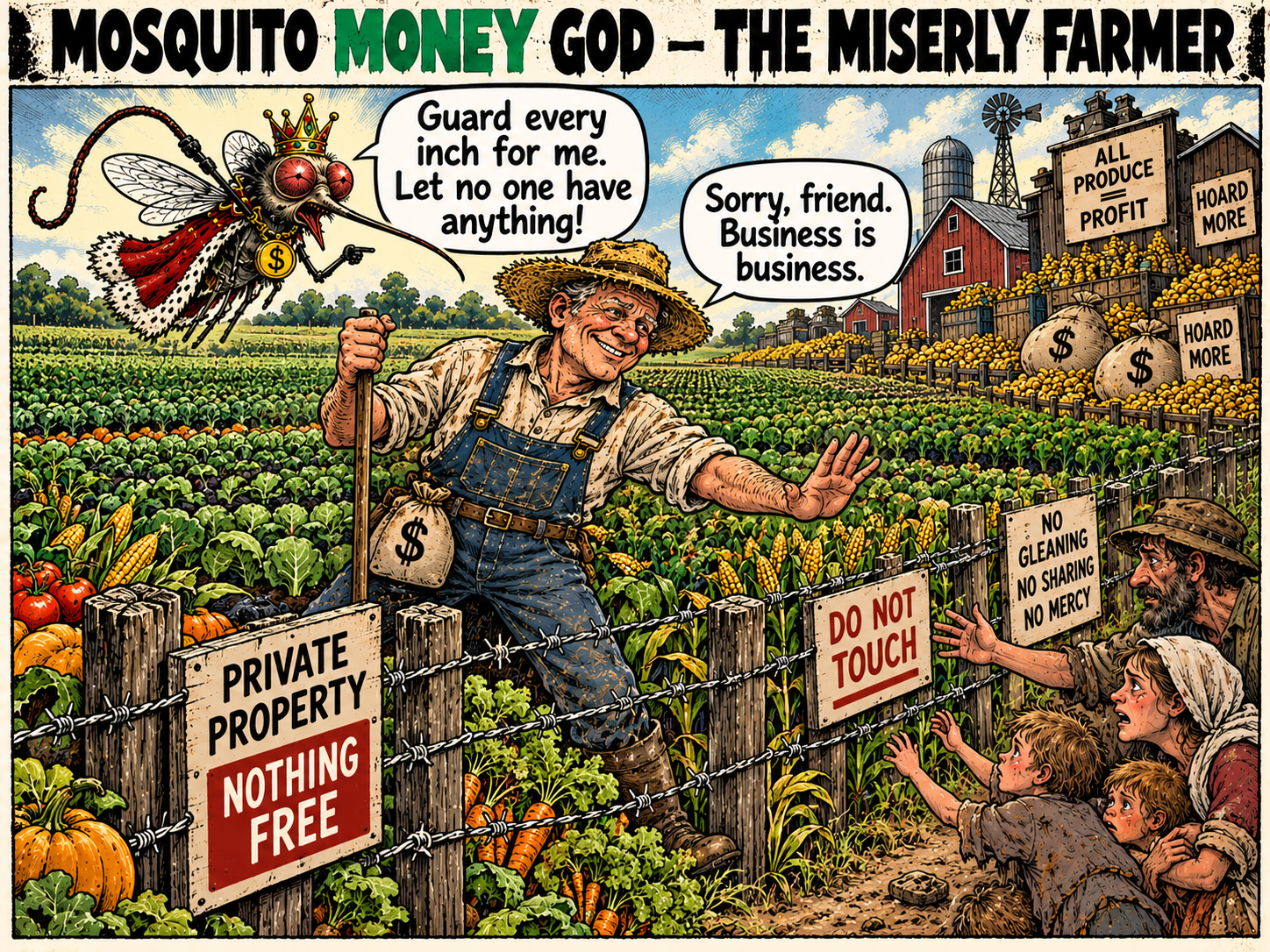
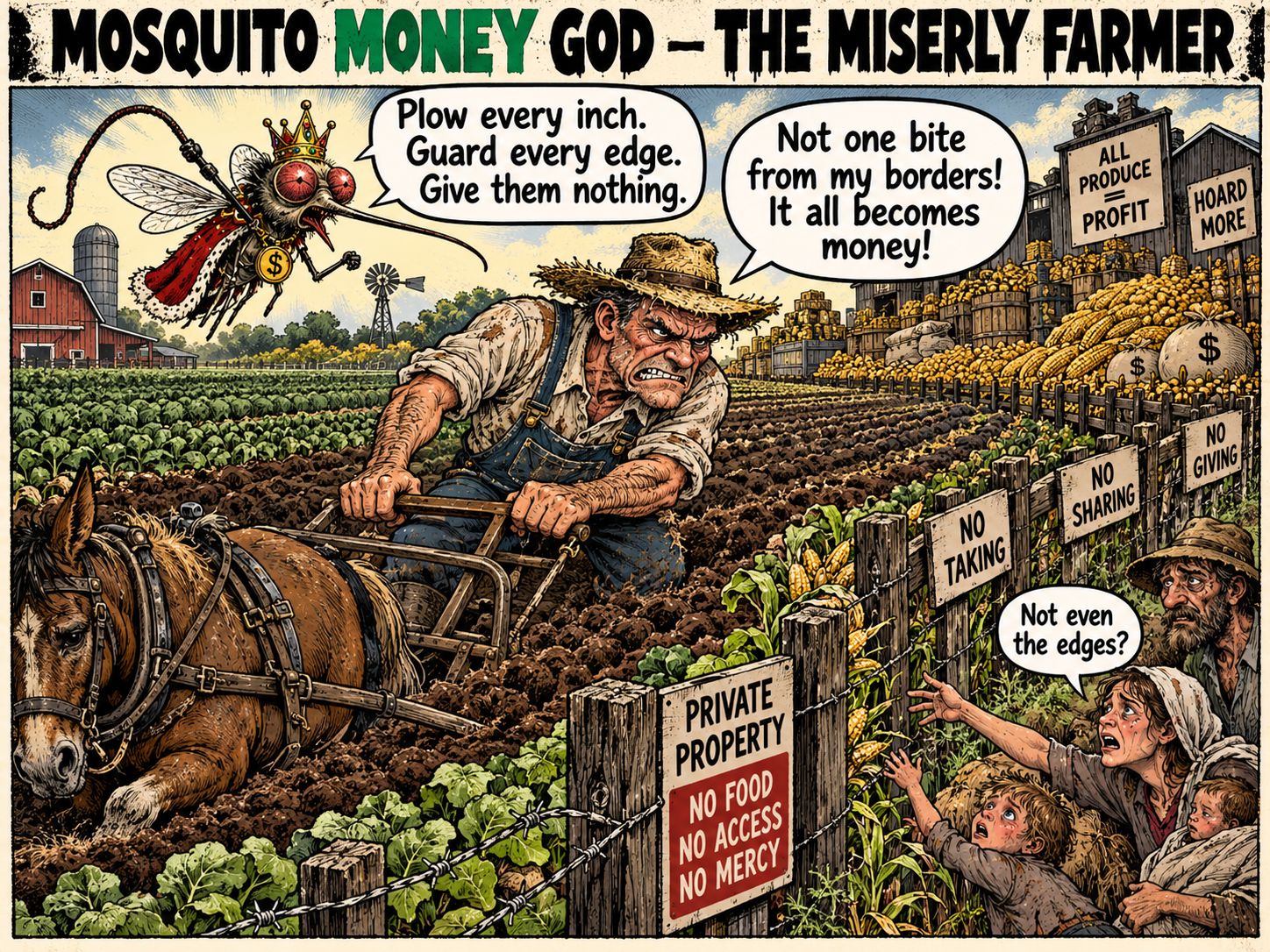
That enormous productive abundance can exist while access to that abundance remains blocked by purchasing power.
That a person can stand beside food, land, empty rooms, machines and willing people and still be told:
You do not have access.
They are people-made arrangements.
People made them.
People inherited them.
People kept operating them.
And people can change them.
A mortgage is not gravity.
A budget is not rainfall.
A wage system is not a biological requirement.
Perpetual earning is not the natural destination of an advanced human civilization.
Familiarity is not inevitability.
And nature itself gives us another rhythm.
A living rhythm
Work
then
Establish
then
Reap
then
Maintain
then
Rest
then
Renew
The inherited survival-linked rhythm
Work
then
Pay
then
Work
then
Pay
then
Work
then
Pay
until
Old age
The argument is not that human beings should stop working.
We will always build, grow, repair, invent, teach, cook, raise children, care for one another, learn, organize and contribute.
The question is why a civilization with increasingly powerful tools should treat perpetual survival-linked earning as the natural shape of adult life.
How did we arrive here?
We Kept Improving the Method
Older civilizations often organized power very directly.
Land mattered.
Water mattered.
Food mattered.
Labor mattered.
Minerals mattered.
Trade routes mattered.
And when another people possessed something desirable, one common answer was to take control of them.
Territories were conquered.
Tribute was demanded.
Populations were enslaved.
Resources were taken.
Power often meant being able to dominate the people around you.
Then human beings became better engineers.
Better roads.
Better ships.
Better weapons.
Better navigation.
Better administration.
Better banking.
Better communication.
Now the same appetite for territory, labor, resources and power could travel farther.
A ruler no longer had to dominate only the neighboring valley.
States could reach across seas.
Empires could administer distant territories.
Old ambitions acquired better machinery.
Then industrialization changed the method again.
Huge populations could increasingly be organized through factories, corporations, governments, wages, contracts, property, credit, debt, employment and markets.
People became workers.
Employees.
Consumers.
Borrowers.
Tenants.
Taxpayers.
Customers.
This is not the same as historical slavery.
But the scale of human organization became extraordinary.
That is not the same question as:
Humanity became progressively better at organizing larger numbers of people and greater quantities of resources without first stopping to author what the final human experience was supposed to be.
Then the System Became Bigger Than Its Makers
This is where people become mystified.
Modern life is so interconnected that it can look as though someone must be controlling the entire machine.
But a system does not require one author to become enormous.
A bank protects the bank.
A company protects its profits.
A politician protects a position.
A government protects continuity.
An investor protects returns.
A worker protects a job.
A family protects its income.
Nobody has to intend the whole outcome.
Everyone is steering their section.
One institution responds to another.
One crisis creates a reform.
The reform creates another problem.
Someone patches that.
The patch becomes normal.
The next generation inherits it.
Fragmented self-interest, inherited institutions, fear, profit-seeking, political survival and repeated patchwork can produce civilization-scale dysfunction without civilization-scale authorship.
Accumulation can look like design.
It is not the same thing.
The Contradiction We Barely Notice
This is where the inherited arrangement becomes almost absurd.
A government says:
A department says:
An institution says:
And most of us stop there.
We hear the sentence as though nature itself has spoken.
But look again.
The land is still there.
The workers are still there.
The machines are still there.
The knowledge is still there.
The seeds still grow.
Rain still falls.
Trees still produce fruit.
Rivers still move.
The sun still gives energy.
Stone is still stone.
Wood is still wood.
Human hands are still capable of building.
People still know how to repair, plant, cook, teach, transport, design and organize.
Nothing in physical reality necessarily disappeared when the budget ran out.
What disappeared was permission inside a people-made arrangement.
That is the contradiction.
We can stand inside abundance and experience shortage because the accounting layer says stop.
We can possess the material, the skill and the need, yet behave as though the action itself has become impossible.
The strange part is not only that the system works this way.
The strange part is how deeply we believe it.
We rarely even pause to ask:
Is the food missing?
Is the land missing?
Are the builders missing?
Are the tools missing?
Are the seeds missing?
Is the knowledge missing?
Or is the missing thing simply financial authorization?
These are not the same condition.
A failed harvest is physical scarcity.
A dry reservoir is physical scarcity.
A missing machine is physical scarcity.
A shortage of trained surgeons is physical scarcity.
But:
is not physical scarcity.
is not physical scarcity.
is not physical scarcity.
Those are statements about an arrangement humans created for coordinating access.
Yet we have lived under that arrangement for so long that its boundaries can feel as real as mountains.
They are not.
A bank balance does not stop a seed from germinating.
An empty account does not erase timber, land, machines, skill or human willingness.
The world remains physically capable even when the accounting system says no.
That is why the distinction matters:
And once that becomes obvious, another question follows.
Money Became the Gatekeeper
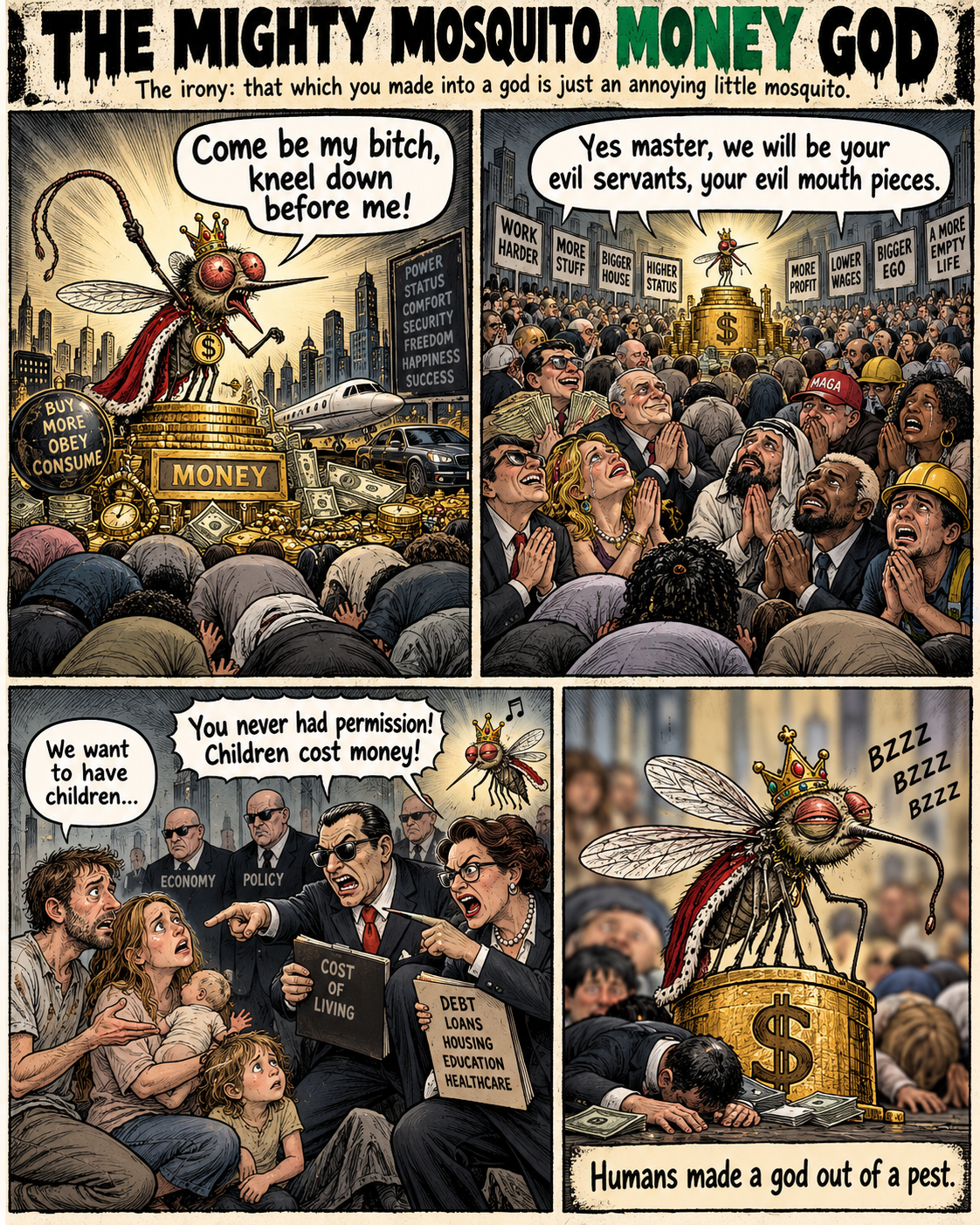
My position on money is direct.
Money became something families must continually earn.
Governments must continually budget.
Institutions must continually account for.
Businesses must continually chase.
And people must continually obtain before they can access the conditions of living.
The coordination tool became the obstruction.
The record became the permission.
The account became the gate.
That arrangement does not need another patch.
It needs to be discarded.
But the governing law is not about banning every system that has numbers, rewards or recognition.
The law is about what a system is allowed to control.
Anything that would put a barrier between a human family or individual and their human rights to eat, sleep, be sheltered, have their bodies respected, have privacy and adequate space, experience peace, companionship, beauty and delight will not be used as a tool for coordinating life.
That does not mean every system of recognition, reward or participation disappears.
In the Trott Bailey Family Kingdom, for example, we use Abundance Points.
Abundance Points do not decide whether a person gets food.
They do not decide whether a family gets shelter.
They do not decide whether someone deserves privacy, bodily dignity, rest, care or access to the basic conditions of living.
They are used for incentive.
For reward.
For recognition.
For delight.
For encouraging participation.
That is completely different from using a system to stand at the gate of human life and say:
That gate will not exist.
If Not Money, What Coordinates?
Vision.
Before budgets, before software and before modern financial systems, people have always coordinated around something more fundamental: a shared vision of what they are trying to accomplish.
When a family knows what it is building, people can organize around it.
When a community knows what it needs to establish, people can organize around it.
When a civilization knows the kind of life it intends to produce, it can determine what resources exist, what capabilities are available, what work is required and where effort should go.
And our era has tools previous civilizations did not have.
- Global communication
- Digital translation
- Cell phones
- Fast travel
- Machinery
- Software
- Shared information systems
- Planetary data
- Artificial intelligence
These tools can reduce the friction of coordinating people, resources, knowledge and work across enormous distances.
They support coordination.
But they are not the vision.
The tools help carry it out.
Money does not need to stand between the two.
Our Tools Matured Faster Than Our Civilization
This is where the youth of our civilization becomes obvious.
We taught machines to reduce human labor.
Then created a society where reduced labor can threaten human livelihood.
We developed enormous productive capacity.
Then maintained systems capable of blocking access to what has already been produced.
We built global communication before developing global authorship.
We became exceptionally good at answering:
And far less deliberate about asking:
Humanity repeatedly increased the scale of coordination without equally increasing the quality of the civilization being coordinated.
Our engineering matured faster than our arrangements for living.
But something has now changed.
For the First Time, We Can Actually Author
For most of human history, civilization-scale authorship would have been extraordinarily difficult.
People could not easily speak across languages.
Knowledge moved slowly.
Travel could take months.
Records were scattered.
Maps were incomplete.
Most people had little ability to examine how distant societies organized their lives.
Today, a person speaking Portuguese can communicate with someone speaking Korean almost instantly.
People on different continents can inspect the same plans.
Study the same information.
Translate ideas.
Compare infrastructure.
Share engineering knowledge.
Examine water, agriculture, transportation, energy and resources at enormous scale.
Artificial intelligence can help people translate, analyze, organize and develop ideas across bodies of information that no single human could comfortably hold.
For the first time, humanity is acquiring tools capable of supporting civilization-scale authorship.
That gives us the practical ability to ask a question previous generations could scarcely answer from the ground up:
Inherit Knowledge, But Do Not Inherit Assumptions
Starting fresh does not mean throwing away what humanity learned.
- Keep mathematics.
- Keep medicine.
- Keep engineering.
- Keep agriculture.
- Keep sanitation.
- Keep computing.
- Keep transportation.
- Keep materials science.
- Keep every useful discovery.
But inherited knowledge and inherited arrangements are not the same thing.
A mortgage is not mathematics.
A budget is not rainfall.
Wage dependence is not biology.
Purchasing power is not gravity.
We can inherit the knowledge of how to build a house without inheriting the assumption that access to shelter must be organized through decades of payment.
We can inherit advanced agriculture without inheriting the assumption that access to food must depend on money.
We can inherit labor-saving machinery without inheriting the assumption that humans must continually create more paid work to justify their existence.
We can keep everything humanity learned about reality while discarding arrangements humanity placed around reality.
The Next Stage
So begin somewhere else.
Begin with human life.
What should childhood feel like?
What should family life feel like?
What should useful contribution look like?
How much compulsory labor should remain when machines can perform more of it?
What should food abundance accomplish?
What should shelter accomplish?
What should health systems accomplish?
What should learning accomplish?
What should transportation accomplish?
What should human time be for?
What should rest look like when it has not been postponed until old age?
What should privacy, peace, companionship, beauty and delight look like when they are treated as parts of human existence rather than luxuries available after enough money has been accumulated?
Answer those questions first.
Then engineer the systems backward from the life we intend to produce.
For thousands of years, civilization mostly accumulated.
People conquered.
Engineered.
Expanded.
Industrialized.
Financialized.
Patched.
Inherited.
And carried forward arrangements that became so familiar they began to look like natural law.
They are not natural law.
They are people-made arrangements.
And people can change them.
We now have global communication.
Translation.
Machines.
Software.
Shared knowledge.
Planetary information.
Artificial intelligence.
And the ability to coordinate at a scale no previous civilization possessed.
The next civilization does not have to simply happen.
It can be authored.