Duplication model
Sdup(N) = N · BEvery repeated upload adds another binary copy. The more sites that need the same file, the more storage and inode pressure the network absorbs.
Media debt is what happens when a WordPress network keeps growing, but every subsite still treats images, videos, audio files, metadata, and featured media like isolated islands.
At first, duplicate uploads look harmless. One image here. One copy there. A video uploaded again because another subsite needs it. But across a real network, those small repetitions become storage waste, inode pressure, metadata fragmentation, search confusion, and slower editorial work.
Media debt is the hidden cost of unmanaged media growth inside a WordPress ecosystem.
It is not just “too many files.” It is the accumulated burden of duplicated assets, inconsistent metadata, missing alt text, broken discovery, repeated uploads, isolated libraries, messy galleries, and front-end presentation problems that get worse as a network grows.
Plain-language definition: media debt is what you owe later because your media system was allowed to grow without shared access, governance, indexing, and presentation discipline.
In a basic duplication pattern, the same media file may be uploaded separately to multiple subsites. If one canonical file has binary size B and the network has N subsites, duplicated storage grows with the number of sites.
Every repeated upload adds another binary copy. The more sites that need the same file, the more storage and inode pressure the network absorbs.
A canonical asset can be reused through lightweight references and metadata overhead. Storage savings depend on configuration, thumbnails, derivative policy, and actual reuse patterns.
Careful technical claim: Big King Media should not be described as making all WordPress storage magically O(1). The accurate claim is that shared canonical assets can avoid repeated binary duplication by shifting reuse toward indexed discovery and lightweight reference overhead.
Media debt usually does not announce itself as one big failure. It appears as many small operational frustrations that become normal until the network feels slow, messy, and expensive to manage.
Repeated images, videos, audio files, thumbnails, and derivatives can consume avoidable disk space and inode capacity.
One copy has a good title. Another has no alt text. Another has a camera filename. Search and accessibility suffer.
Instead of searching one shared media layer, users jump between subsites or re-upload because it feels faster.
Visibility, folders, deletion, hidden media, and source control become difficult when each site behaves alone.
Without indexing and shared browsing, the network may technically have the asset but practically lose it.
Galleries, lightboxes, uploads, audio players, folders, and SEO tools get stacked separately instead of operating together.
Sync tools can be useful, but many sync workflows still preserve the underlying duplication model. The file appears in more places, but the network may still carry repeated storage, repeated metadata, and repeated management burden.
| Approach | What it solves | What it can leave behind | Better direction |
|---|---|---|---|
| Manual re-upload | Quick local use on one subsite. | Duplicate storage, inconsistent metadata, weak discovery. | Use shared discovery and reuse before uploading again. |
| Sync / clone | Makes files available in multiple libraries. | Can preserve file duplication and metadata drift. | Use an indexed shared-media layer where practical. |
| External DAM | Central enterprise asset management. | Can be costly or disconnected from native WordPress workflows. | Keep media operations WordPress-native when possible. |
| Media operating layer | Connects access, indexing, governance, presentation, and automation. | Requires disciplined setup and clear network policy. | Treat media as infrastructure, not scattered attachments. |
Big King Media attacks media debt from several sides at once. It does not only make media easier to see. It helps media become easier to discover, reuse, organize, describe, publish, and govern.
These live Big King Media assets show the practical systems that move the plugin from shared library into full media operating layer.

Reduces editor hunting by bringing network media discovery into one workflow.

Creates a stronger discovery foundation for large multisite media archives.
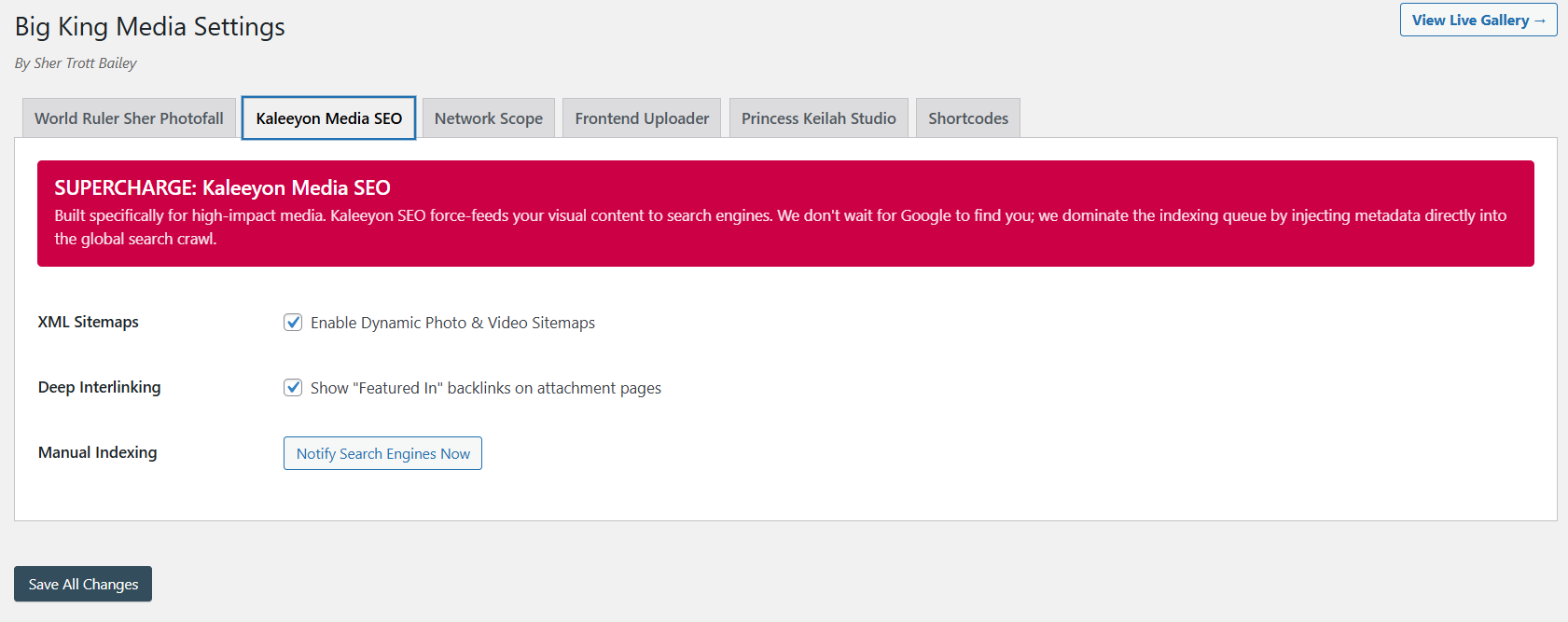
Helps fight metadata debt through alt text, visibility, and media discovery workflows.
Small sites can survive messy media for a while. Larger networks cannot. The more sites, editors, contributors, galleries, audio files, videos, and public-facing media experiences you manage, the more costly media debt becomes.
Shared lesson media, events, departments, student projects, and archive material need cleaner reuse.
Sermons, images, announcements, events, and media archives should not be trapped in separate site silos.
Editors need fast access to approved images, videos, featured media, and cross-network story assets.
Multi-site client environments benefit from reusable brand assets, templates, media controls, and governance.
Audio, cover art, video clips, playlists, and visual sequences need a connected media workflow.
Historical media needs discoverability, metadata, accessibility, galleries, and long-term organization.
Big King Media helps WordPress networks move from scattered media libraries toward a shared media operating layer: indexed, reusable, governed, searchable, accessible, and ready for front-end publishing.
These answers support long-tail search queries and help visitors understand the real problem before they choose a solution.
Media debt is the hidden cost of unmanaged media growth in WordPress. It includes duplicated files, scattered metadata, missing alt text, hard-to-find assets, inconsistent galleries, and repeated editorial work.
WordPress Multisite can run many sites from one installation, but media often remains isolated by subsite. As the network grows, repeated uploads and fragmented metadata become more expensive and harder to manage.
Syncing can help make media appear in multiple places, but it can still preserve duplication and metadata drift. A shared media operating layer focuses on discovery, indexing, reuse, governance, and publishing rather than only copying files.
No plugin can honestly promise that every kind of storage growth disappears. Big King Media helps reduce unnecessary duplication for shared media workflows by improving indexed discovery, reuse, governance, and media presentation. Actual savings depend on configuration and usage patterns.
Multisite operators, schools, churches, agencies, editorial networks, creator platforms, and media-heavy archives should address media debt early because the problem gets harder as more sites, users, and assets are added.
6

 and then