

NoDumBumbs: Learning to Cooperate through Caring for a Home and to Grow Food
Learning to Care for a Home and Grow Food
Household care, cooperation, soil fertility and food growing through lifelong capability development.
A plate can be washed and the sink still left dirty. A room can be swept while crumbs remain beneath the furniture and between the cushions. A child may put away one thing while leaving everything else scattered about.
These are ordinary things children need to learn, and sometimes even adults have not developed the habit of doing them thoroughly.
We want our children to know how to care for themselves, maintain a home properly, work cooperatively with other people and recognise when something needs attention.
We also want them to know how to grow food. How to examine a piece of ground, gather the materials available around them, prepare fertile soil, plant, maintain their crops and understand what is happening as the plants develop.
Fallen leaves, grass cuttings and suitable kitchen scraps can become useful materials for growing food. A child who understands how these things decompose can begin learning how to improve a piece of ground and keep it productive.
These are two practical branches we are developing through NoDumbDumbs, the lifelong capability development system of Trott Bailey Family Civilization.
We want children to have proper equipment, experienced people to learn from, pleasant surroundings and enough time to practise until they genuinely understand what they are doing.
Home Training Begins with Parents
Home training forms character, and the early years are when children especially need their parents. They need generous time together before branching out more fully from their homes into the wider civilization.
This doesn’t mean children never leave home or go anywhere. It’s no rigid system. Children can travel, visit other families, play with neighbouring children, explore and enjoy the many opportunities available throughout the civilization.
But these early years are where family unity, mutual understanding, love and growth have such an important influence on childhood. Learning from parents is particularly important.
Children observe how their parents speak, how they treat one another, how they care for their home, how they manage difficulties, how they show affection and how they conduct themselves among other people.
Parents also come to understand their children. They learn their different personalities, interests, habits, difficulties and ways of communicating. This understanding grows through the ordinary experiences of family life.
Before age seven, our main attention is on reading, mathematics, basic writing, playing, creativity and home training.
Children learn cleanliness, discipline, respect for parents and elders, and gradually how to care for their own belongings and surroundings.
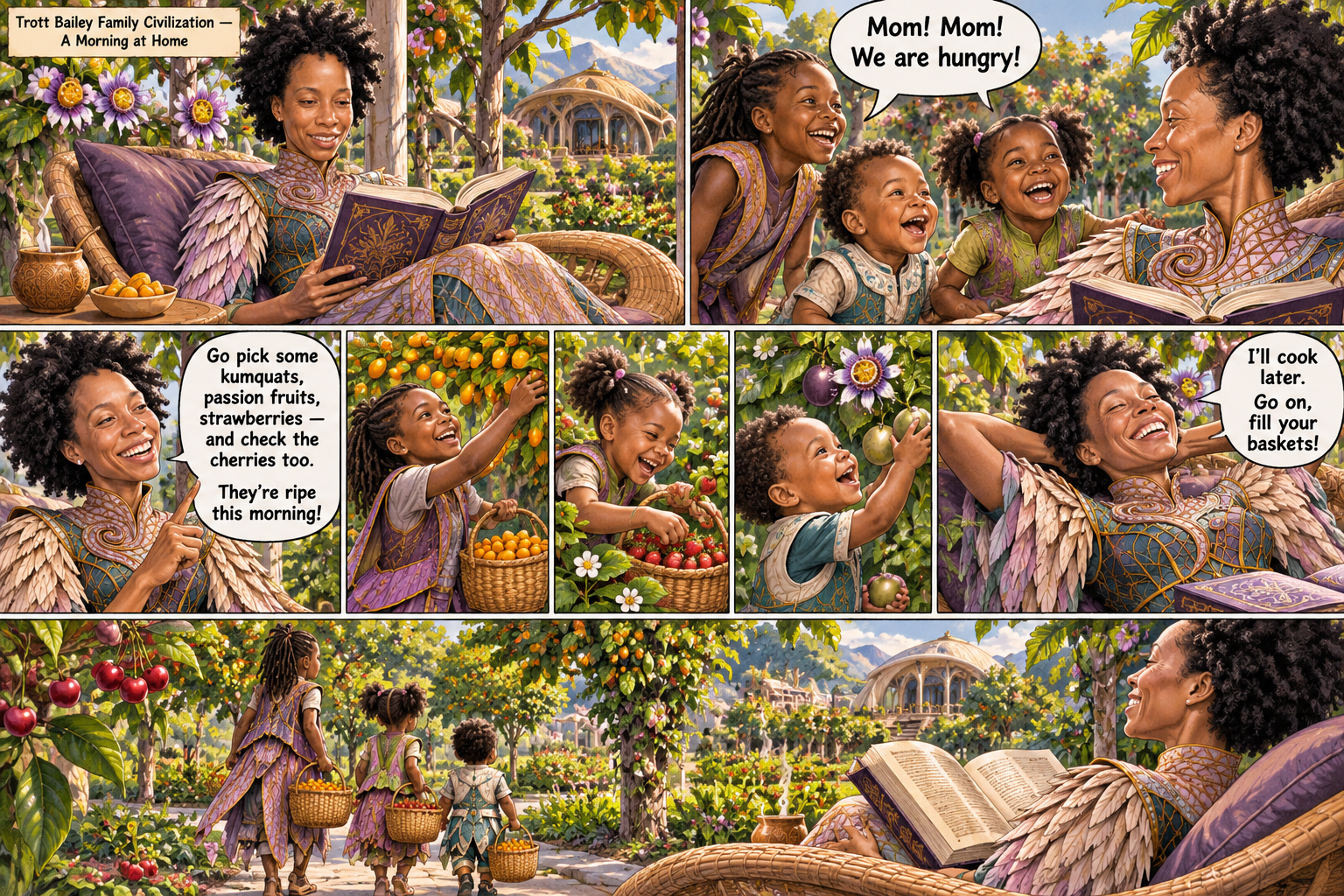
A younger child may begin by putting away toys, returning shoes to their proper place, helping to wipe a table or carrying something to the kitchen.
As children grow, they can undertake more complicated responsibilities. They continue learning these habits within the family while participating more widely in civilization life.
NoDumbDumbs builds on this foundation, giving children further opportunities to practise their abilities, cooperate with others and become capable of maintaining their surroundings.
The NoDumbDumbs Household Training House
For this branch of learning, the classroom is literally a house.
It contains a proper kitchen, dining room, living room, washing facilities, furnishings, storage areas, cleaning equipment and the ordinary things found in a functioning home.
Children learn how to care for a home by actually doing the work.
Each class contains no more than twelve children, with experienced adult instructors and teenage apprentices assisting them.
The children can be organised into pairs and small working groups. Each child has sufficient space and equipment to practise, while the instructors observe and help them understand what needs improving.
We want a comfortable, attractive house with actual Trott Bailey furnishings and household systems. The children should enjoy being there while learning the responsibilities involved in maintaining such a place.
Washing Dishes and Resetting the Sink
Let us begin with washing dishes.
A child should know what to do with a plate after eating. Food remains are removed appropriately, the plate is washed and rinsed, then dried or placed where it can drain. Afterwards, it is returned to its proper location.
But the work does not finish with washing the plate.
The sink may contain food particles, water and cleaning materials. These must also be attended to. The sink is cleaned, the surrounding surfaces wiped, the equipment returned and the washing area left ready for the next person.
Our household training uses the Kultan Clean-to-Dry Rinse Body, an authored system which organises the movement of objects through receiving, sorting, washing, rinsing, draining, drying and returning.
The children learn how the system works and why things belong in particular places.
Some practise washing. Others learn to dry and return dishes. A teenage apprentice can help them understand how to restore the entire washing area to good order.
They return to the work until they can perform it properly without needing every movement explained to them.
Sweeping, Vacuuming and Caring for Furnishings
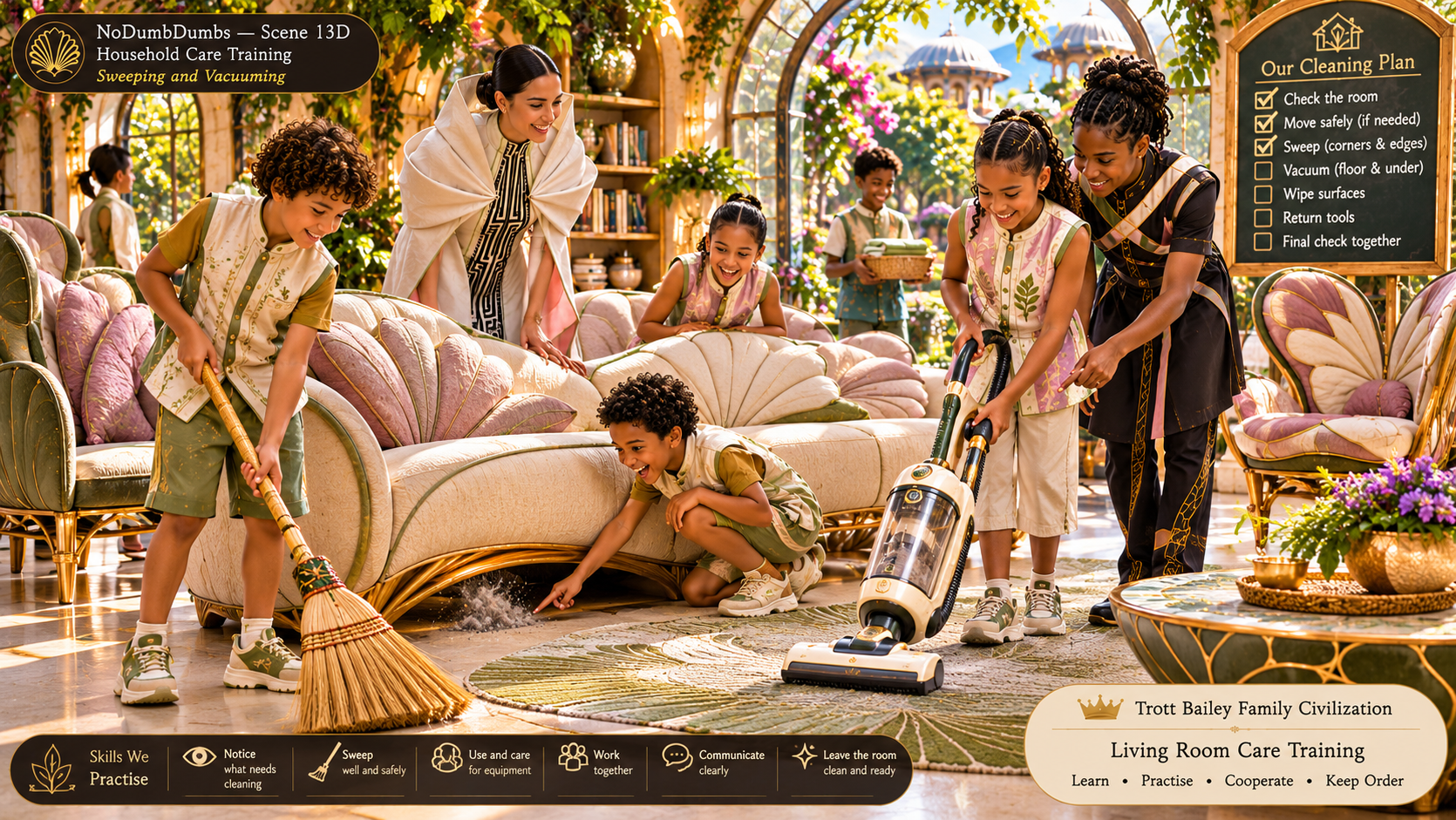
Sweeping a room requires more understanding than simply moving a broom across the floor.
Children learn to clean along the edges of furniture, reach into corners, gather debris and examine the room to see whether anything has been missed.
They also learn to use a vacuum cleaner, recognise which attachments are suitable for different surfaces and return the equipment in good condition.
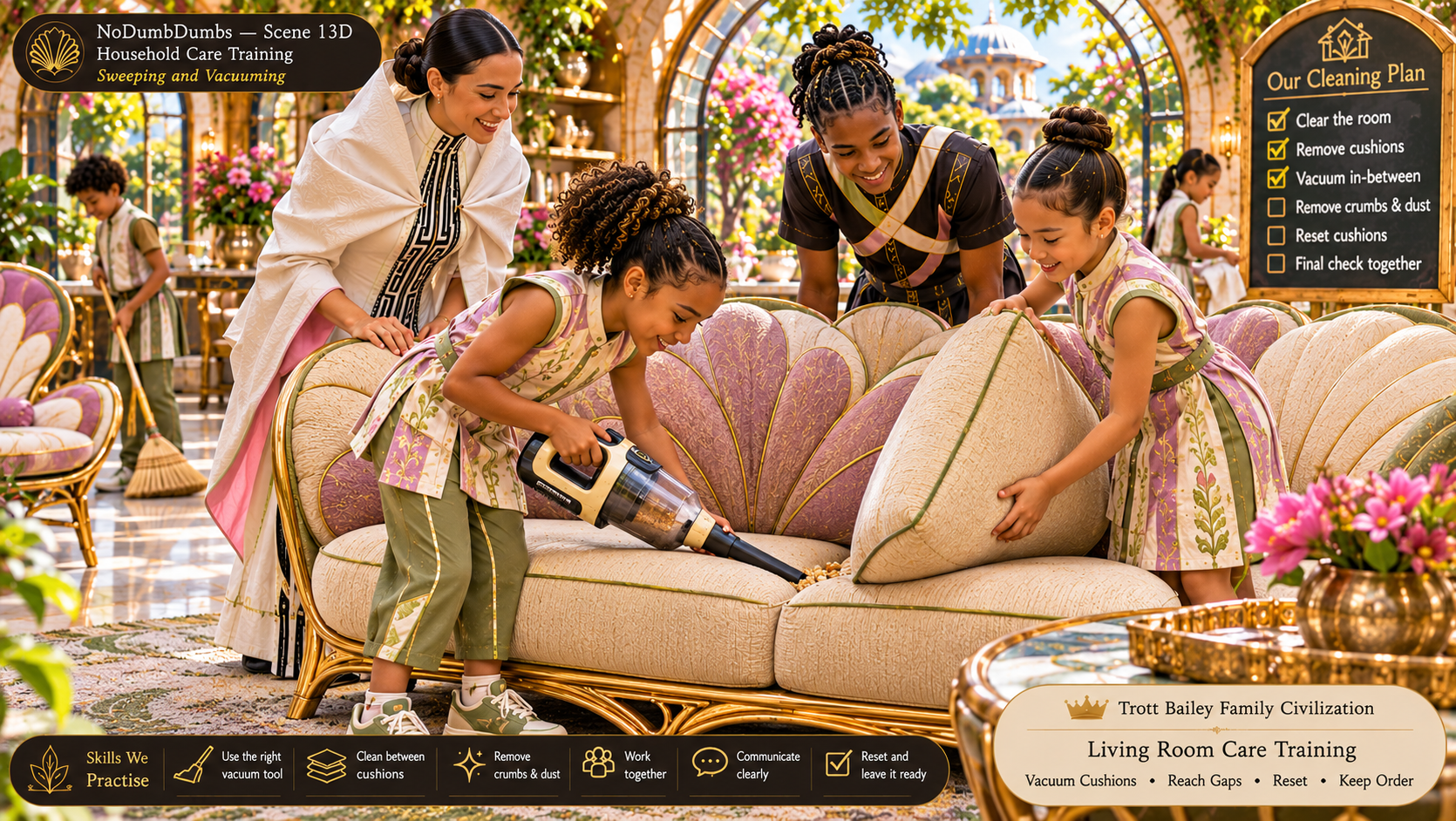
One of our developed learning scenes shows children cleaning between the cushions of a Family Bloom Sofa.
A child uses a small handheld vacuum, carefully guiding its narrow nozzle into the spaces between the cushions.
Another child lifts a removable cushion so that crumbs and other debris can be reached. A teenage apprentice assists while the instructor observes.
Once the work is finished, the cushions are returned to their proper positions, the vacuum is cared for and the room is inspected.
The children are learning to notice what needs cleaning, select suitable equipment, handle furnishings carefully and complete the work.
Cooperation and Good Communication
Maintaining a home also requires people to cooperate with one another.
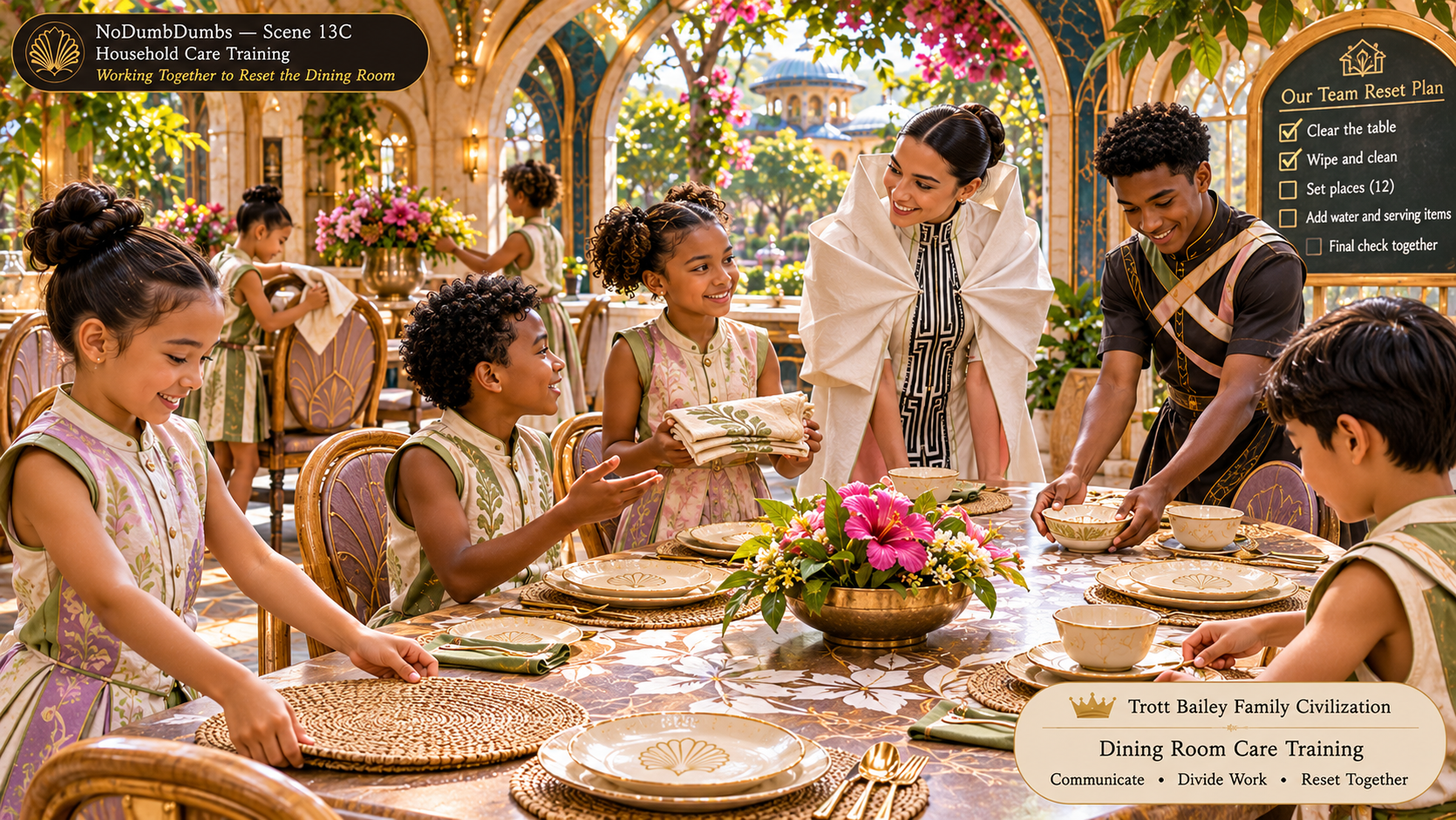
In the dining room, perhaps three children are responsible for clearing, cleaning and resetting the table.
One begins collecting the vessels. Another prepares the cleaning materials, while the third returns chairs and other objects to their places.
They need to communicate.
Who is doing what? Has the table been cleared? Does somebody need assistance? Is the surface ready to be wiped? Have the dishes been returned?
Children practise asking questions, listening to one another, agreeing on responsibilities, giving useful explanations and making corrections without unnecessary quarrelling.
We deliberately teach good communication alongside practical household work.
A home is shared by people with different needs, interests and responsibilities. Learning how to work together contributes to a more pleasant and orderly household.
Finishing and Inspecting the Work
After the children have cleaned the dining room or living room, they examine the completed work.
Is the floor properly cleaned? Are the furnishings returned? Is anything still dirty? Are the tools clean and back in their places?
They make whatever corrections are needed. Then the room is ready for family life again.
There is considerable pleasure in sitting down in a clean, pretty, orderly room, knowing how to take care of it and leave it that way for others.
Learning to Prepare Fertile Ground
The second branch of our training takes the children outdoors.
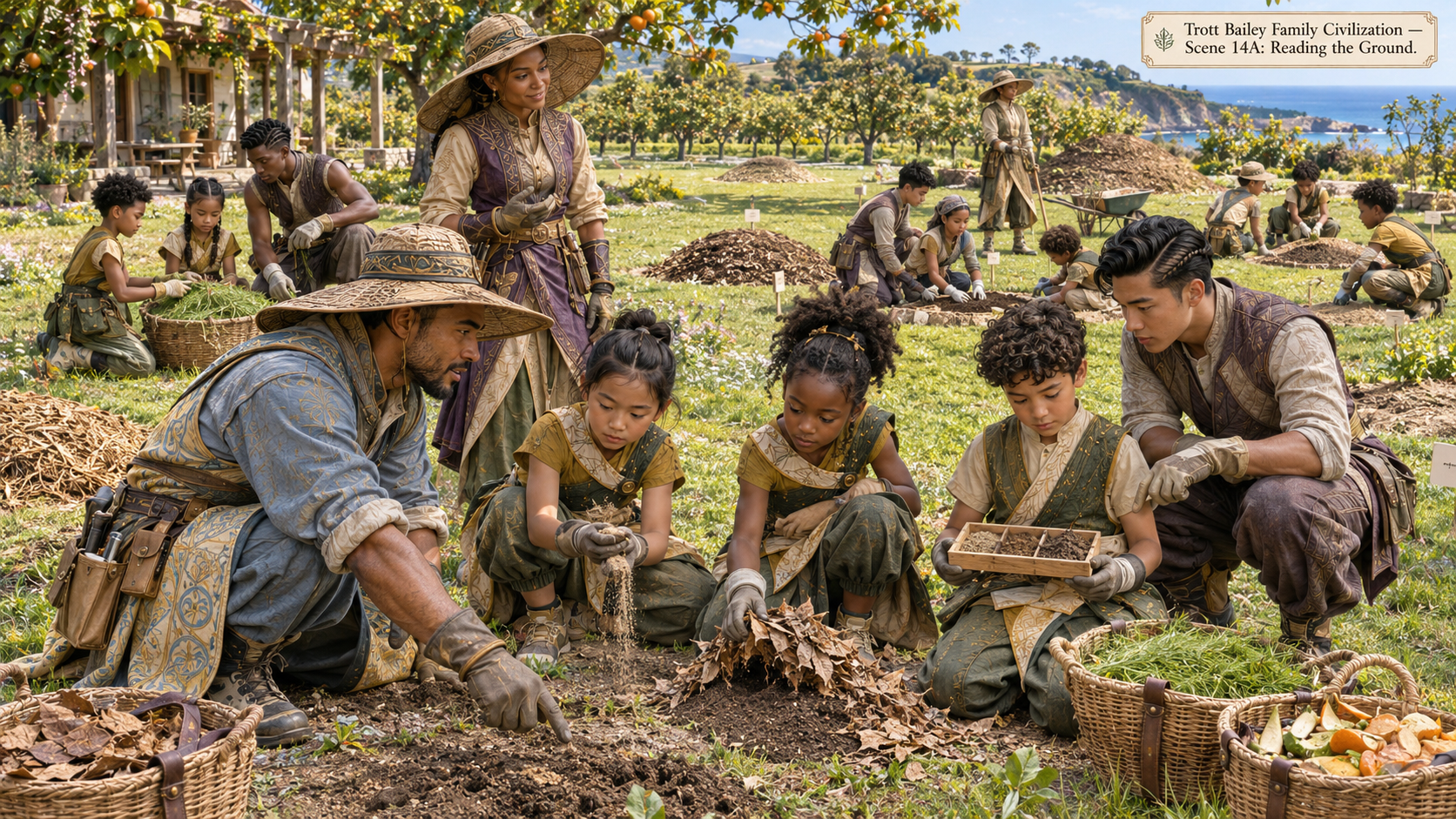
We want them to know how to prepare ground for growing food, improve soil fertility and make good use of the organic materials available in their surroundings.
One of the methods we have been developing is the preparation of small fertile islands.
These are deliberately improved planting areas within a larger piece of ground, useful for investigating how different soil compositions affect plant growth.
A child might begin with sandy ground, soil with little organic matter or a place where plants have previously struggled.
Before adding anything, we want the child to examine the ground and consider what might be useful.
Our Experience Growing Food in Sandy Ground
Our family has been experimenting with growing food in Prado, Bahia, including along a stretch of sandy ground where we have established different growing areas.
Among the things we have worked with are fallen organic matter, decomposing coconut wood, kitchen returns, mulch and charred wood.
We have tried preparing small planting areas with different materials and observing how the plants respond.
These experiences have raised further questions about how organic materials decompose, how sandy ground retains water and nutrients, and how preparing a small fertile area may affect the plants growing there.
We have not conducted controlled comparisons of every composition, so we should be careful about claiming which materials caused particular results.
But the work has given us practical questions worth investigating further. We want children to have opportunities to make these investigations themselves, using real ground, real growing materials and actual plants.
Learning to Read the Ground
The first field lesson begins with observation.
Children examine exposed soil, ground beneath trees, places covered by grass and areas where fallen leaves have been decomposing.
They feel differences in texture, observe moisture, examine roots and look for evidence of organisms living in the soil.
Beneath established vegetation, fallen leaves, roots and other organic materials may have been contributing to the soil for many years.
The children can compare this ground with nearby exposed areas.
They also observe what happens when water is applied. Does it drain quickly? Does it remain near the surface? Does the soil become compacted?
These observations help them begin to understand what sort of preparation may be required before planting.
Composting Leaves, Grass and Kitchen Returns
There are many materials around a family compound that can become useful in preparing fertile soil.
Fallen leaves and grass cuttings are good examples.
Dry leaves are generally carbon-rich, while fresh grass cuttings contain more nitrogen and moisture.
When combined in suitable proportions, kept moist and provided with enough air, these materials can decompose into compost.
Children can gather suitable materials, prepare them, make compost mixtures and observe how they change over time.
They learn what happens when the mixture is too wet, too dry or too compacted.
They examine finished compost and compare its texture, smell and appearance with the fresh materials from which it was made.
Decomposition takes time. A compost mixture cannot be declared finished simply because a lesson period has ended.
We want children to return regularly, observe the process and understand when the material has become suitable for use.
Kitchen Scraps Returning to Soil
Kitchen scraps provide another source of organic material.
Suitable fruit and vegetable remains can be composted or, under appropriate conditions, buried in prepared trenches to decompose beneath the soil.
The children learn which materials are suitable, how they should be separated and why different returns require different treatment.
They might examine a newly prepared burial area and another that has already been allowed time to decompose.
They can observe what remains of the original material and how the surrounding soil has changed.
Simple field-burial experiments should use suitable plant-based scraps and be properly covered and managed. Meat, oily food remains and other problematic materials are not part of these introductory exercises.
Manure and other materials requiring particular treatment are handled through experienced Soil-Crown arrangements, with properly finished amendments used where appropriate.
Different Districts Have Different Materials
The children should learn to make use of whatever suitable resources are available in their own surroundings.
A coastal district may have large amounts of coconut husks, decomposing coconut wood, fallen leaves and other plant matter.
A district with animal husbandry may have safely composted manure and used bedding materials.
Another district may have rice straw, sugarcane bagasse, maize stalks, banana leaves, coffee grounds, pruning residues or suitable wood chips.
These materials have different properties. Some decompose relatively quickly. Others contribute longer-lasting organic matter.
Some are useful primarily as surface mulch, while others require composting or other preparation before being mixed into growing soil.
Learning to Be Resourceful
Learning to use what is available locally also trains children to be resourceful. We want them to use their eyes to spot solutions given their local constraints, and as much as possible not to fold or throw up their hands with the excuse that there is nothing around to use.
A child may not have the same materials available as another child in a different district. One may have plenty of fallen leaves and grass cuttings, while another has coconut husks, banana stems, crop residues or suitable animal manure.
They should learn to examine what they have, understand its properties and consider how it might be used.
If one material is unavailable, what else might serve the purpose? Does it require different preparation? Can several available materials be combined? Is there someone nearby who understands how to use them?
We want children to develop the habit of looking around before deciding that they cannot do something.
Consider a child preparing a fertile island where there is no ready supply of finished compost.
Perhaps there are fallen leaves collecting beneath the trees. There may be grass cuttings from a nearby lawn, suitable vegetable scraps from a kitchen or green prunings from the garden.
The child can begin investigating whether these materials could be processed into compost, which combinations may be suitable and how long they might take to become usable.
If there is no suitable compost immediately available, the child can still learn to protect existing soil with appropriate mulch, grow suitable cover plants or prepare a composting area for future use.
Of course, some materials are unsuitable or require particular treatment. Resourcefulness includes recognising when something should not be used.
A useful material in one situation may cause problems in another. Fresh woody residues, untreated manure and strongly alkaline amendments cannot simply be added without understanding their effects.
The children learn to ask questions, consult experienced practitioners, try sensible approaches, observe the results and improve their methods.
This habit is useful far beyond food growing.
The same judgement applies to building, repairing, cooking, making equipment, maintaining a household and solving ordinary problems throughout life.
We want children to become familiar with the resources around them and increasingly capable of finding practical ways forward when circumstances are difficult.
Six Fertile Islands for Comparison
We can begin with six small planting islands, using different compositions of soil and organic materials.
These are starting points for investigation rather than fixed recipes that must be used everywhere.
| Fertile Island | Materials | What to Investigate |
|---|---|---|
| 1. Compost Island | Native soil, mature compost and surface mulch. | General growth, moisture and soil condition. |
| 2. Leaf Island | Native soil, finished leaf compost and a covering of dry leaves. | Moisture retention, texture and surface protection. |
| 3. Kitchen Return Island | Ground previously prepared with suitable buried vegetable scraps, allowed to decompose. | Decomposition and subsequent plant growth. |
| 4. Coconut Island | Native soil, finished compost and properly processed coconut fibre or decomposed woody material. | Moisture, drainage and root development. |
| 5. Animal Fertility Island | Native soil and safely finished manure compost. | Nutrient response and plant growth. |
| 6. Living Cover Island | Soil improved through growing suitable cover plants and returning cut foliage as mulch. | Ground cover, organic returns and soil condition over time. |
We can also maintain an area of unamended ground for comparison.
If the children grow the same crop under similar light and watering conditions, they can begin observing how the prepared areas perform.
They may record germination, leaf condition, plant height, soil moisture, root development and harvests.
One island may produce better growth than another. That result should lead to examination, further measurements and perhaps another experiment.
We should teach children to distinguish what they have actually measured from what they suspect may have caused the result.
Returning to the Ground Over Time
The fertile islands require continuing care.
The children water where necessary, renew mulch, examine the plants, observe soil conditions and make adjustments.
Some plants flourish. Others struggle. There may be seeds that fail to germinate or planting areas that require further improvement.
This is part of learning to grow food.
A child who returns to the same growing area over several months begins to recognise changes that would be missed during a single visit.
Over time, they can become familiar with differences between seasons, plant varieties, soil compositions, watering arrangements and other growing conditions.
Some children may develop a particularly strong interest in soil organisms, composting, irrigation, plant propagation or horticultural research.
We want them to have opportunities to continue developing those interests, including working alongside experienced growers and Soil-Crown practitioners.
How We Organise NoDumbDumbs Training
Both branches belong to our wider NoDumbDumbs capability development system.
For household care, children gather in a properly furnished training house. For soil preparation and food growing, they gather in outdoor learning grounds containing actual soil, plants, equipment and growing materials.
We organise groups of up to twelve children, assisted by experienced adult practitioners and teenage apprentices.
A person with years of horticultural experience may teach soil preparation. Another with considerable household experience can teach cleaning, organisation and home maintenance.
Teenagers can demonstrate abilities they have already developed, assist younger children and gain experience in guiding others.
District Learning and Wider Travel
Children from neighbouring family compounds can gather within their district for extended periods of learning.
They can also travel into the wider civilization to learn from practitioners in other districts.
A group interested in food growing may visit an experienced farming compound, orchard or soil restoration ground.
Practitioners can also travel to the children’s districts to teach local groups.
Both arrangements can operate together.
Parents may freely travel with their children and participate in the learning. They may even discover new interests of their own.
Travel, food, accommodation and the necessities of life are provided free by Trott Bailey Family Civilization.
Families therefore have the opportunity to spend meaningful time developing capabilities together, without the expense of remaining away from home.
Pacorips Coordinates and Remembers
Pacorips serves as the civilization’s common system for coordination, memory and recording.
Practitioners can register the capabilities they are willing to teach.
Families and districts can discover learning opportunities, equipment, facilities and experienced people.
Pacorips can help coordinate visiting instructors, travelling learners, materials, accommodation and continuing activities.
It can also preserve useful records of children’s projects, such as the composition of their fertile islands and the results they observed.
All ordinary ways of organising things remain available. People can speak directly, make plans with neighbours, invite friends and arrange activities among themselves.
Pacorips helps the wider civilization know what is available and maintain continuity across districts.
Abundance, Order, Thoroughness and Delight
We are developing a civilization with an abundance of time, equipment, materials, learning spaces and experienced people willing to share their capabilities.
We want these provisions to make thorough learning possible.
Children should have time to practise household care until they can actually maintain a home.
They should have time to prepare soil, grow plants, observe the results and improve their methods over successive seasons.
The learning environments themselves should be beautiful, spacious and properly equipped.
Our training house has comfortable furnishings and working equipment suited to the children using it.
Our outdoor learning grounds have broad lawns, orchard trees, shaded places to rest, proper tool storage, water and washing facilities.
Children can work together, talk, laugh, take an intermission, eat something enjoyable and return to their activities.
Order and thoroughness help us maintain the places and carry out the work well.
We want the children to be comfortable, cheerful and capable, without making learning rigid or cold.
We are a civilization that likes to live in beauty, order and delight while still remaining brave and capable.
Why Do We Teach These Things?
First, to support our own individual lives, then to lend our capabilities to the flourishing of our own families, and then to give freely to the rest of the people in Trott Bailey Family Civilization.
A person who knows how to care for a home can maintain their own surroundings and contribute to the care of their family’s home.
A person who knows how to grow food can cultivate a family growing area, develop greater productive capability and share what they produce and what they have learned.
A capable young person may help younger children learn to clean properly, prepare fertile ground, maintain a garden or undertake another practical activity.
An experienced practitioner can offer years of knowledge to families and learners throughout the civilization.
These capabilities serve us throughout life. They can be developed, improved and shared as our interests and responsibilities change.
We share our capabilities freely and generously, and we receive back freely and generously in return.
Trott Bailey Family Civilization
NoDumbDumbs · Lifelong Capability Development