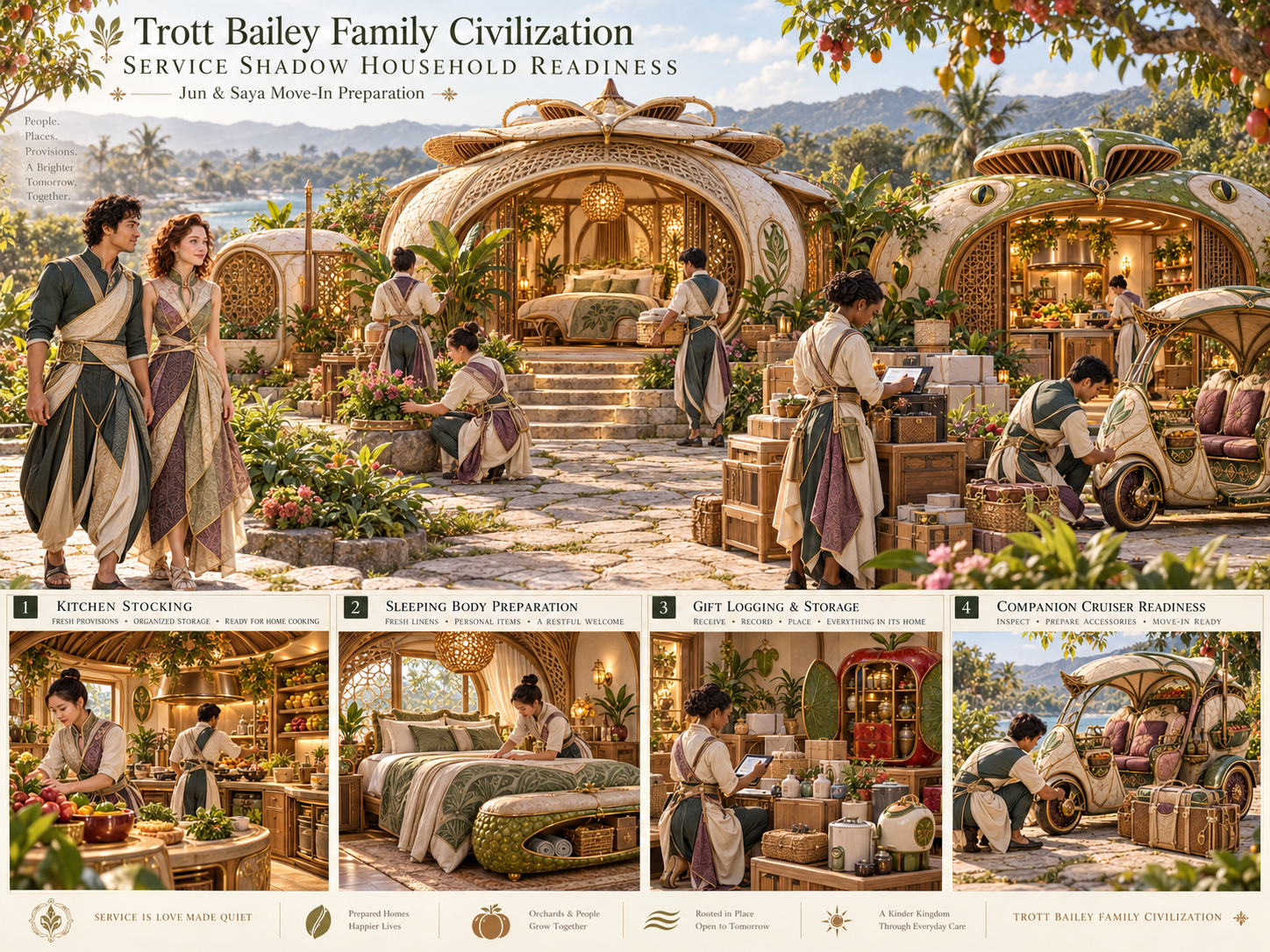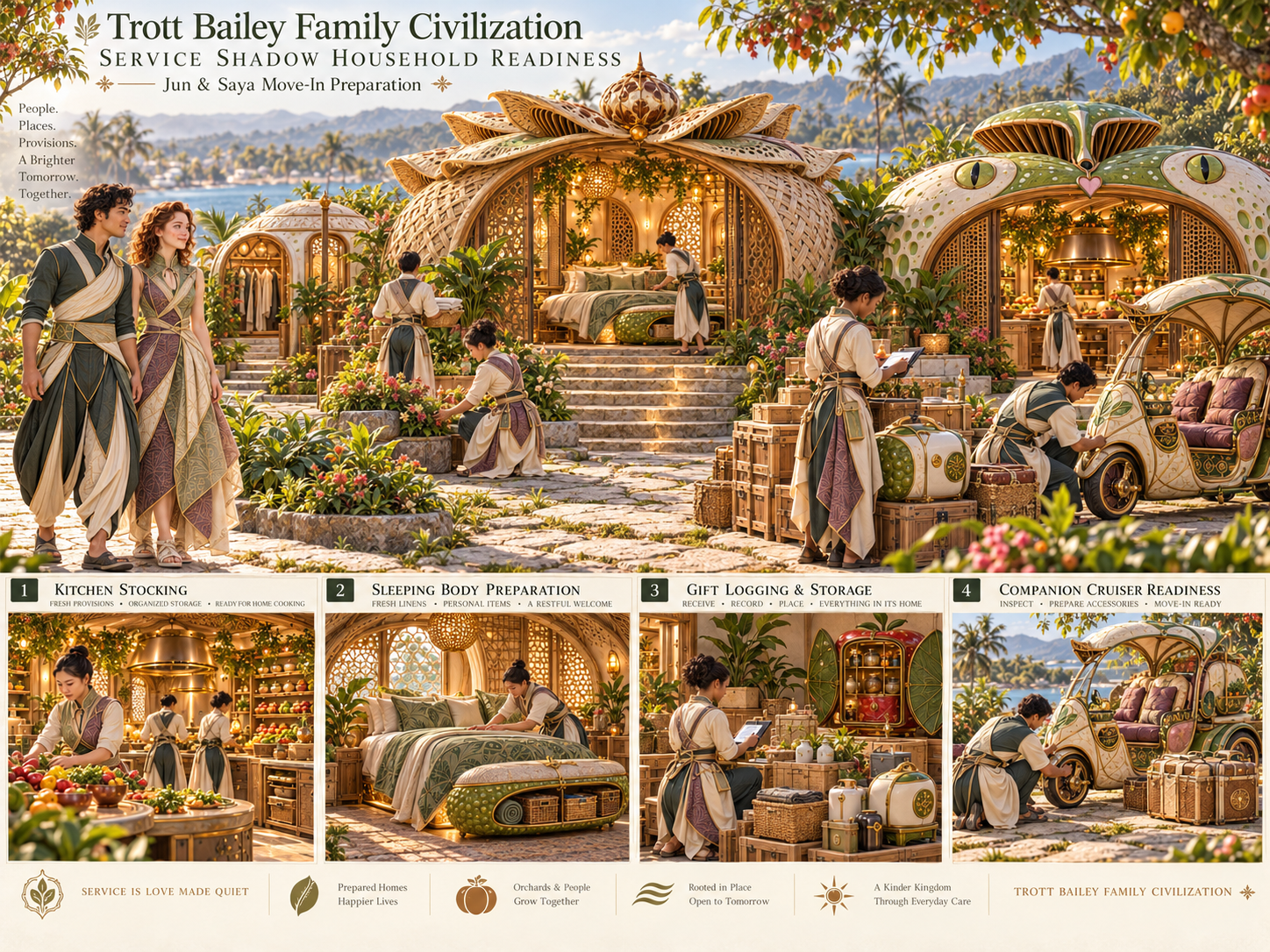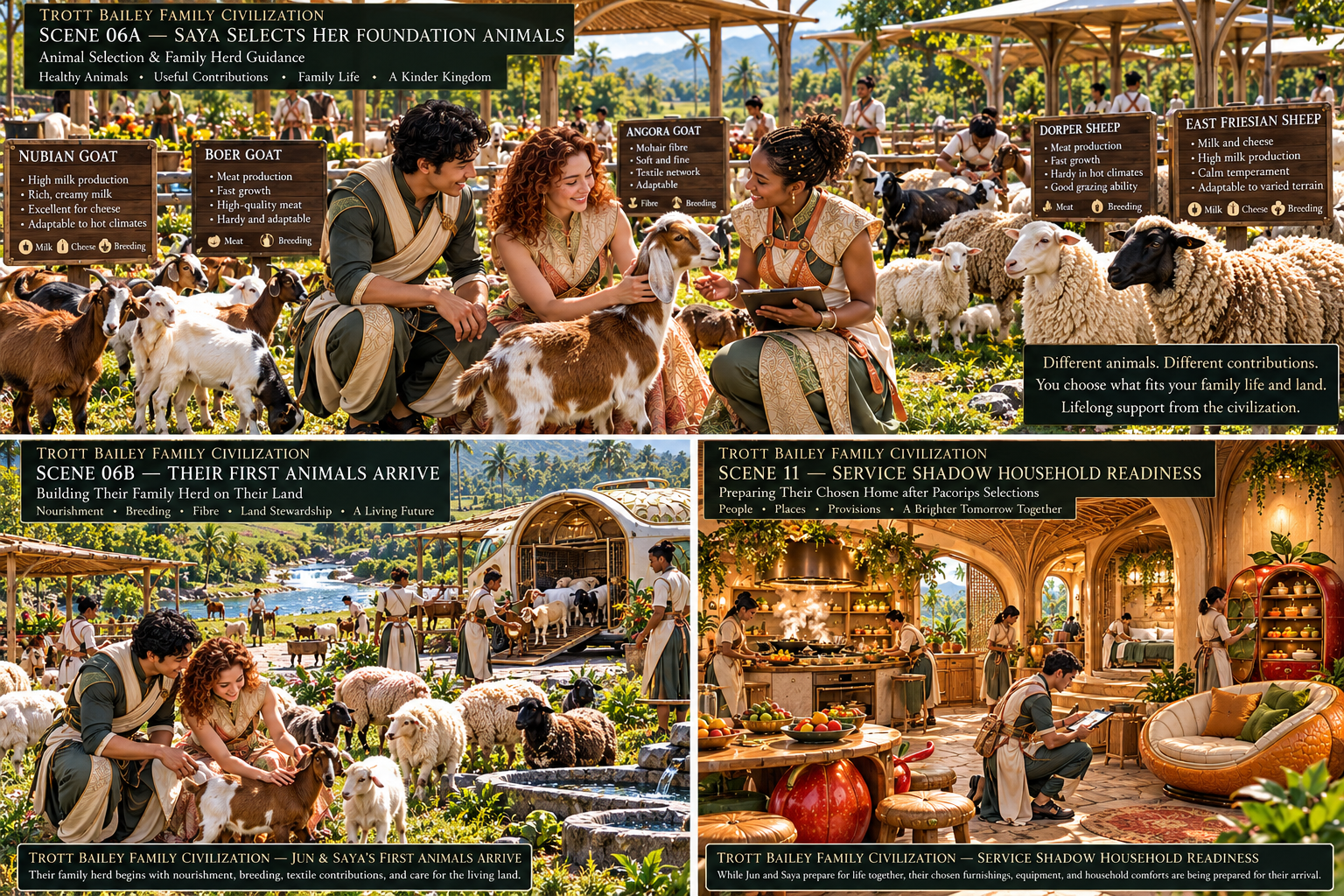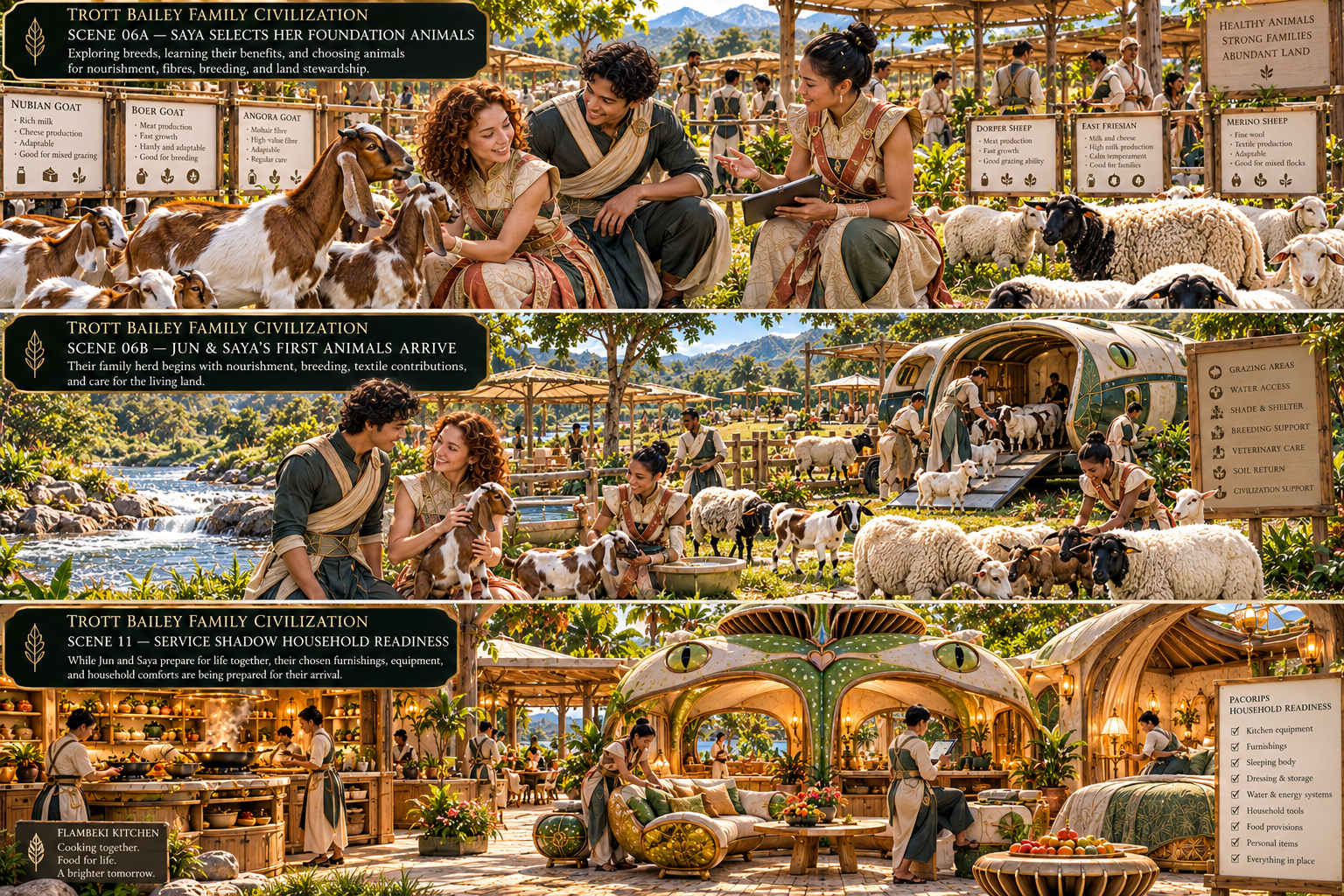
Balushu is where the kingdom gathers and every person still has form
Many Expressions, One Kingdom: Why Balushu Crowds Do Not Dress Alike
One of the quickest ways to weaken a civilization scene is to dress everyone the same.
When every person in a public world wears the same cream outfit, the same loose robe, the same linen resort clothing, the same sandals, or the same safe background costume, the world stops feeling alive.
It becomes a crowd.
Not a people.
Balushu cannot look like that.
Balushu is the Trott Bailey Family Kingdom’s public-life world. It is where families gather, walk, eat, rest, watch, celebrate, learn, and move through beauty together. It is a place of public abundance, not public sameness.
That means the people of Balushu must look like a living civilization.
Many expressions, one kingdom.
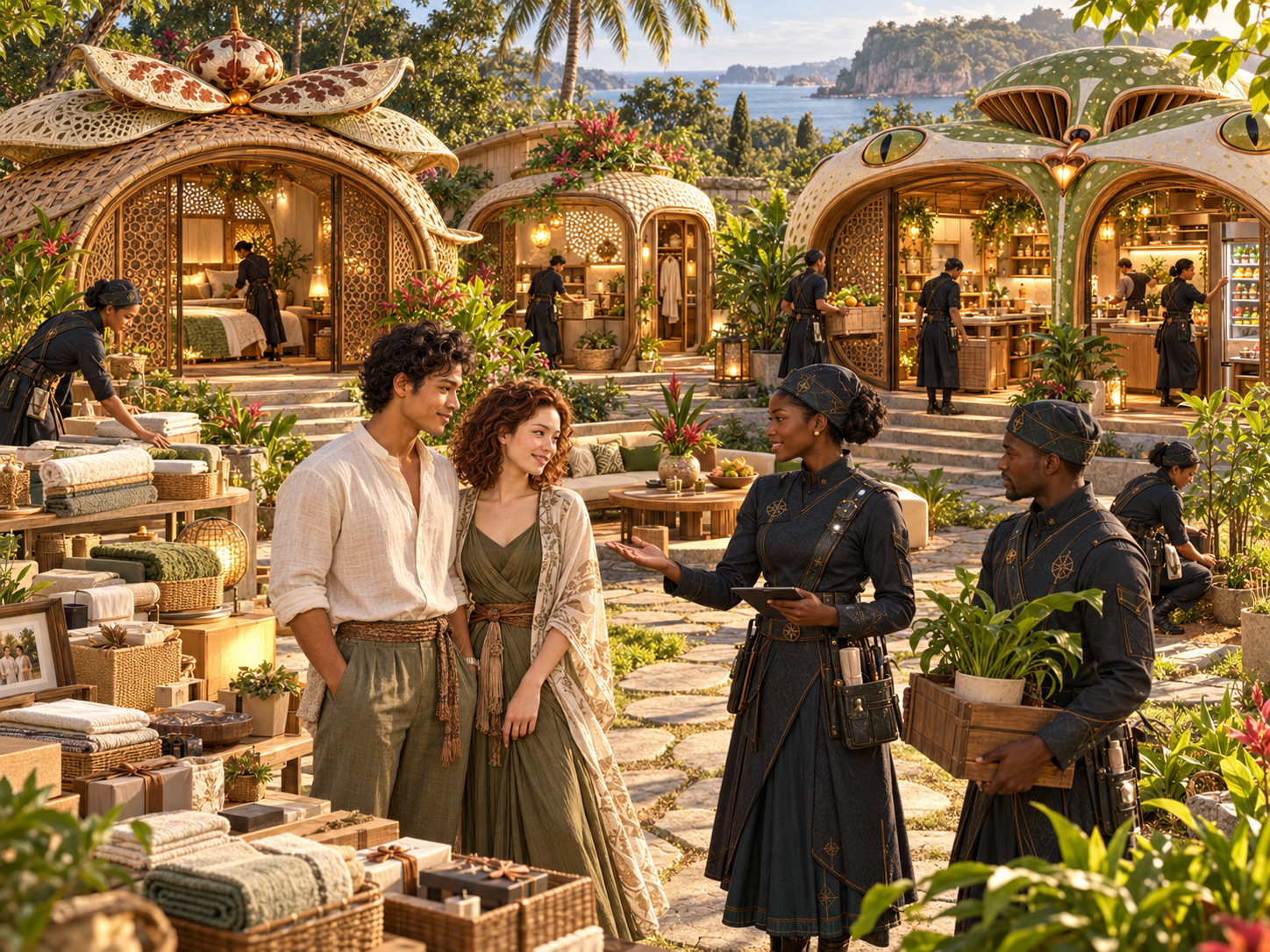
This is now one of the most important visual rules for Balushu. The crowd must show many races, many ages, many body types, many family roles, many kinds of presence, and many branches of Trott Bailey fashion. Everyone belongs to the same kingdom, but everyone does not disappear into one uniform.
Uniform sameness is not unity.
True unity can hold difference without losing identity.
A Civilization Wardrobe, Not a Uniform Crowd
Balushu crowds must show a civilization wardrobe.
A civilization wardrobe is not random clothing. It is also not a single costume repeated on every person. It is a shared design language with many branches.
The people may wear different silhouettes, colors, materials, and role-based forms, but the viewer should still feel that they belong to one authored world.
That is the balance.
If everyone looks too different, the world becomes visually random.
If everyone looks too similar, the world becomes lifeless.
Balushu needs the middle strength: variety with authorship, difference with rhythm, individuality with civilization identity.
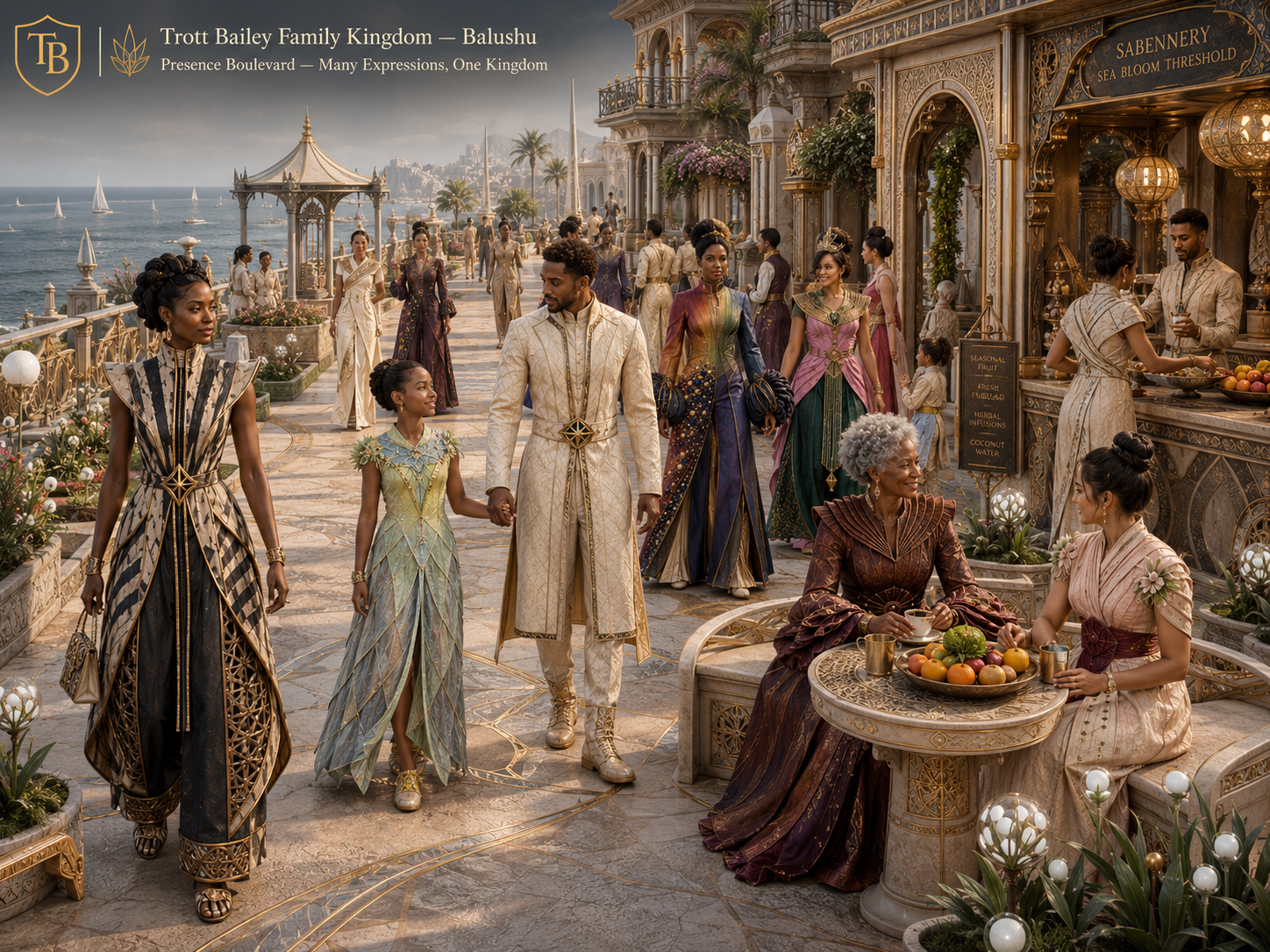
A woman may wear a Variegated Shell Route look with strong black, bone, bronze, and lattice chamber intelligence. Another may wear a Crown Bloom Route with warm authority and pleated collar structure. Another may wear Bloom Core Petal Wrap in softer hosting colors. A child may wear an Aether Bloom Shard variant. An elder may wear a softer Crown Bloom or Mineral Wrap form. A man may wear a routed column coat or shell-route tunic. A steward may wear a Shubaka function variant.
They are not dressed alike.
But they are not disconnected.
They are all speaking Trott Bailey.
Why Generic Crowd Clothing Fails
Generic crowd clothing makes a kingdom feel borrowed.
If the people look like resort guests, the place becomes a resort.
If the people look like tourists, the place becomes a tourist promenade.
If the people look like fantasy extras, the place becomes fantasy scenery.
If the people look like cafeteria workers, the Sabennery becomes a cafeteria.
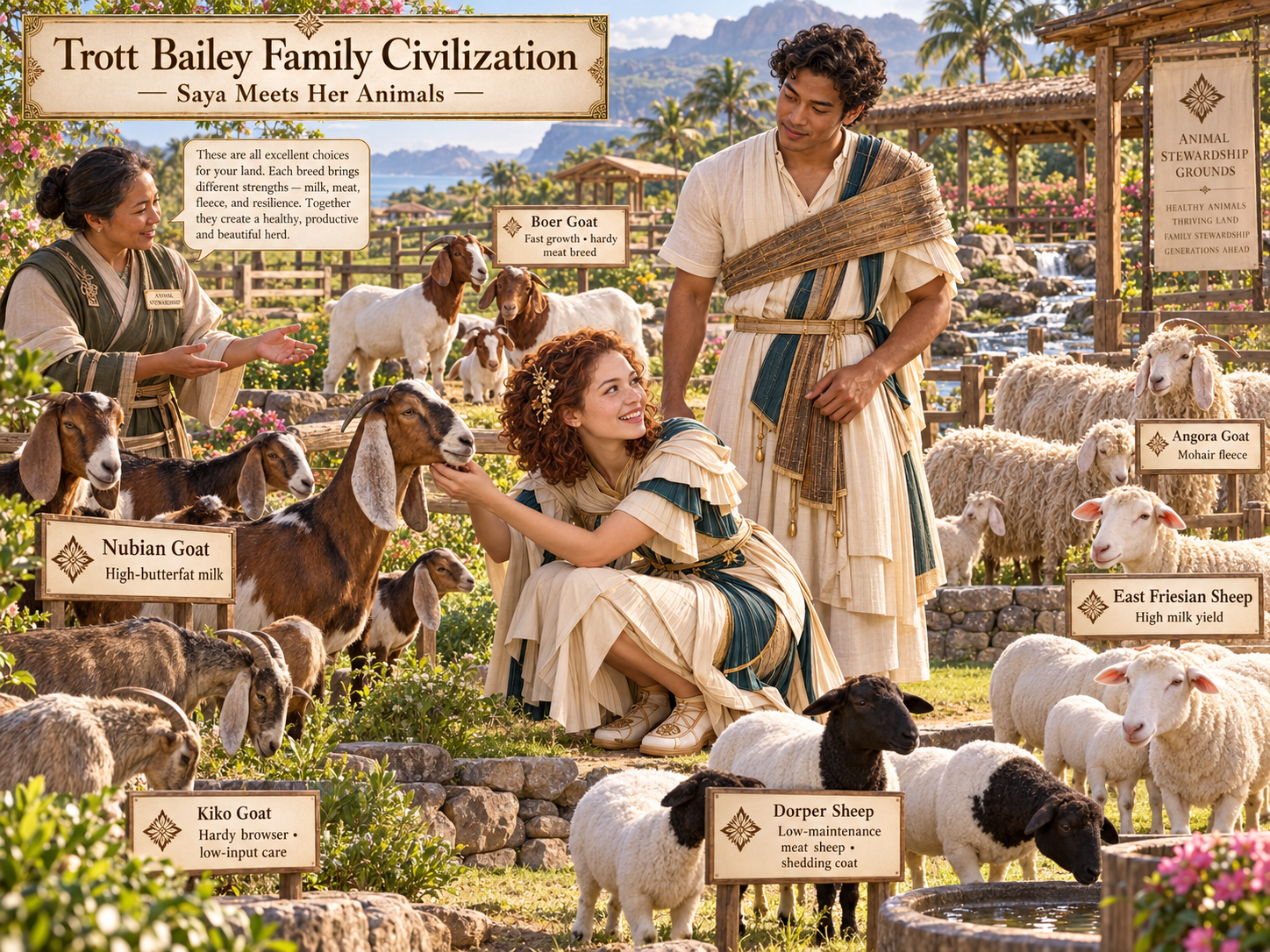
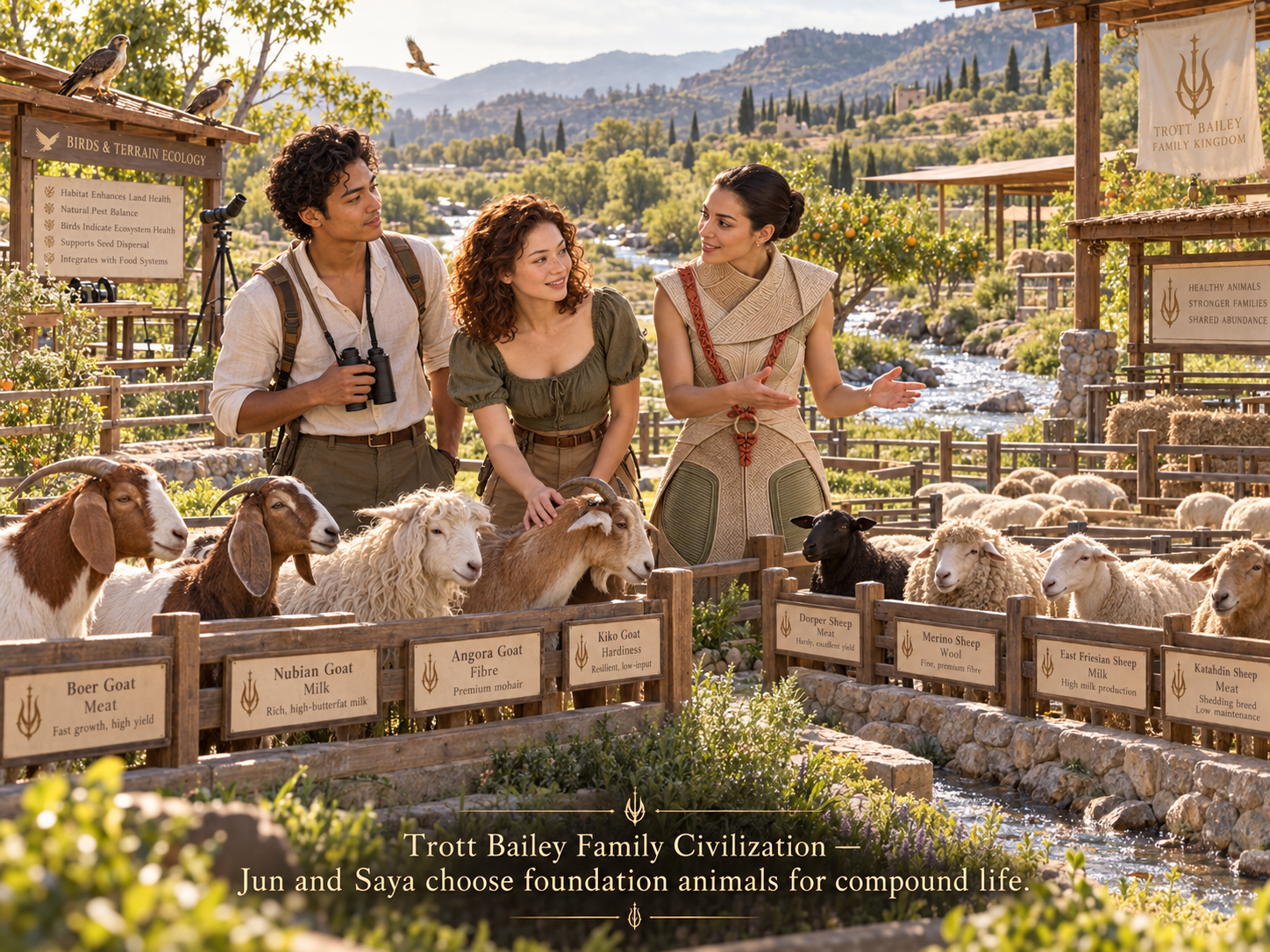
If the people look like safari guides, the Animal Realm becomes a safari attraction.
Fashion changes the meaning of the world around it.
A building may be beautiful, a path may be well designed, and a pavilion may have the correct roof language, but if the people inside the scene are dressed generically, the civilization identity weakens.
Balushu must not be filled with plain linen resort clothing, mall fashion, sneakers, generic sandals, fantasy robes, safari uniforms, hotel-worker outfits, restaurant uniforms, or random ethnic-costume drift.
Those choices pull the world away from the Trott Bailey Family Kingdom.
Balushu needs clothing that proves this civilization has its own materials, its own construction logic, its own beauty standards, its own movement intelligence, and its own understanding of public dignity.
Fashion as Public Architecture
In Balushu, clothing is not decoration.
Fashion is public architecture worn on the body.
The same intelligence that shapes a railing, a porch, a pavilion, a threshold, or a roof also shapes the clothing. Route seams, lattice chambers, crown nodes, shell wraps, bloom collars, mineral panels, pleated fans, and structured waist systems are not random embellishments.
They are civilization signals.
They show direction.
They show role.
They show dignity.
They show movement.
They show authorship.
A person walking through Balushu should not look like they were dressed after the world was designed. Their clothing should feel born from the same civilization that made the paving, railings, Sabenneries, Release Commons, pavilions, animal thresholds, and water comfort systems.
That is why Trott Bailey fashion must enter the scenes directly.
The kingdom is not only built around people.
It is also worn by people.
World Ruler and Authority Presence
Some people in Balushu carry strong authority presence.
This does not mean they dominate the scene. It means their clothing carries command, clarity, and authored weight.
The Variegated Shell Route is one of the strongest examples. Its stripe puncture logic, dark mineral grounding, lattice chambers, vertical command, and shell-route structure make the wearer feel like a moving emblem of the kingdom.
Mineral Wrap Chamber Route carries a different authority. It is quieter, more archival, more bone-mineral, more wrapped, more chambered. It feels like protection, memory, and archive intelligence.
Prism Command Column brings a sharper civic signal. Its spectrum routing, closed-neck command architecture, placket intelligence, side field, and strong panel-trouser release give it a public ceremonial force.
Crown Bloom Route carries warmth and command together. Its pleated crown collar, bloom waist, bark skin panels, and grounded footwear make authority feel human, elder-capable, and socially present.
Off-Axis Pleat Column adds a softer but still precise form of command: asymmetrical mantle architecture, routed seam intelligence, pleat release, and disciplined coverage.
These branches should appear in Balushu scenes as public presence, ceremonial hosting, civic authority, elder dignity, and world-ruler-level authorship.
They remind the viewer that Balushu is not casual leisure.
It is civilization in public motion.
Public Hosting and Everyday Elegance
Not every person in Balushu needs to carry high command.
Public life also needs warmth.
Bloom Core Petal Wrap, Sun-Woven Civic Column, Festival Hosting Look, and related hosting branches help soften the crowd without weakening the kingdom identity.
These looks carry petal wrap logic, sun-node intelligence, routed waist systems, fan collars, soft hosting colors, structured bodices, and practical movement. They allow people to sit, serve, walk, greet, rest, host, and participate.
They are not resort dresses. They are not party costumes. They are not generic ceremonial outfits.
They are public-life garments.
A mother sitting at a Sabennery table, a woman walking along a Presence Boulevard, a host greeting families near a Release Commons, or a creator presenting work at an Ordered Artisan Creation Display can all wear these softer public hosting branches.
Balushu needs this warmth.
A kingdom cannot be made only of command silhouettes.
It also needs welcome.
Children Must Look Kingdom-Authored Too
Children in Balushu should not look like they were dropped into the scene from modern casual life.
They should not default to T-shirts, sneakers, mall dresses, random shorts, or generic play clothes. They also should not be trapped in stiff ceremonial clothing that prevents movement.
Children need authored freedom.
Aether Bloom Shard Route is a strong direction for youth and child delight. Its light shard panels, leaf memory shell language, electric yellow-green and mineral blue-grey tones, routed seams, and soft movement logic give children a way to look playful, bright, and kingdom-made.
Child clothing in Balushu should allow walking, sitting, watching, learning, eating, playing, washing, exploring, and resting. It should be beautiful, but not fragile. It should be playful, but not childish in a cheap way.
Children are not background decorations in Balushu.
They are part of the public body.
Their clothing should carry the kingdom too.
Men’s Fashion Must Not Collapse Into Suits
Men in Balushu must not drift into suits, hotel uniforms, butler clothing, office jackets, or plain tunics.
The Trott Bailey Family Kingdom needs men’s public-life clothing with equal authorship: routed column coats, shell-route tunics, structured panel trousers, mineral-wrap layers, strong chest architecture, grounded kingdom footwear, and practical warm-climate movement.
A man walking with his children through Balushu should look like he belongs to the same civilization as the women and children around him. His clothing should not be weaker, plainer, or borrowed from modern formalwear.
Men’s clothing can be calm, but it cannot be generic. It can be practical, but it cannot be ordinary. It can be dignified, but it cannot become a business suit.
Balushu needs fathers, husbands, sons, elders, stewards, presenters, guides, and helpers who look kingdom-authored.
Elders Must Carry Dignity and Comfort
Balushu is not designed only for the young and energetic.
It must hold elders with dignity.
Elder clothing should not make age disappear. It should not treat comfort as an excuse for visual weakness. It should not make older people look like background figures in plain soft clothing.
Softer Crown Bloom variants, Mineral Wrap forms, structured but comfortable routed layers, gentle footwear, breathable fabrics, and dignified seated silhouettes are important for elder presence.
An elder sitting under a Curl-Tip porch, drinking tea near a Sabennery, watching a Release Commons, or overlooking an Animal Realm should look like a respected bearer of the kingdom’s memory.
Comfort and authority can exist together.
That is the elder rule for Balushu fashion.
Stewards and Helpers Need Function Without Generic Uniforms
Balushu has many support roles.
There are Sabennery Flow Stewards, Public Beauty Stewards, Krubaro Wall Stewards, Release Commons reset teams, elder and baby assistance helpers, animal realm guides, Sea-Edge Clean Water Stewards, Child Wonder reset helpers, Service Learning Guides, and Shadow Weave workers.
But these people should not look like staff from a hotel, restaurant, mall, hospital, theme park, zoo, or airport.
They need Shubaka function variants.
Their clothing should show routed vests, breathable field-civic panels, subtle emerald or bronze route seams, protected footwear, tool loops, clean vessel access, Pacorips-linked role nodes, and movement-ready construction.
A steward’s outfit should say: “I can help you, I can move, I can serve, I can reset, I can guide, and I still belong to the beauty of this kingdom.”
Function must not erase authorship.
That is the steward rule.
Race, Body, Age, and Role Diversity Are Not Extras
Balushu must show the kingdom’s people as a real human body.
Different races should be visible. Different skin tones should be visible. Different ages should be visible. Different body types should be visible. Children, elders, couples, parents, stewards, creators, presenters, animal guides, and visitors should all appear.
This is not a checklist.
It is civilization truth.
A public-life world that claims to serve families must actually show families. Not one idealized body. Not one age group. Not one fashion branch. Not one race. Not one type of beauty.
Balushu’s public body should be broad enough to feel real.
The kingdom is unified by authorship, not sameness. It is held together by shared design language, shared abundance, shared routes, shared care, shared beauty, and shared dignity.
That is why the phrase matters:
Many expressions, one kingdom.
Fashion Helps Explain the System
Good Balushu fashion does more than make the scene beautiful.
It helps explain how the world works.
A Sabennery steward’s clothing can show food-flow function.
An animal guide’s clothing can show field-civic care.
A public host’s clothing can show warmth and welcome.
A Release Commons presenter’s clothing can show ceremony and signal.
A child’s clothing can show play, movement, and invention.
An elder’s clothing can show comfort and memory.
A world-ruler-level garment can show authority and authorship.
In this way, fashion becomes part of wayfinding. It helps the eye understand who is doing what, where care is available, where ceremony is happening, where rest is possible, and where public life is being supported.
Fashion is not separate from Balushu’s operating system.
Fashion is one of the ways the operating system becomes visible.
The Rule for Future Balushu Scenes
Every future Balushu image must remember this correction.
Do not dress the crowd as one cream-colored mass.
Do not default to resort linen.
Do not use safari uniforms for animal realms.
Do not use waiter clothing for Sabenneries.
Do not use generic robes for public ceremony.
Do not use sneakers and sandals as the default footwear language.
Do not let men collapse into suits.
Do not make elders visually disappear.
Do not make children look modern and disconnected from the kingdom.
Instead, show a living civilization.
Use Variegated Shell Route.
Use Mineral Wrap Chamber Route.
Use Crown Bloom Route.
Use Prism Command Column.
Use Off-Axis Pleat Column.
Use Bloom Core Petal Wrap.
Use Sun-Woven Civic Column.
Use Festival Hosting Look.
Use Aether Bloom Shard Route.
Use men’s routed column clothing.
Use Shubaka steward variants.
Use elder comfort-authority branches.
Use child movement variants.
Let the scene breathe with difference.
Let the people prove the kingdom is alive.
One Kingdom Does Not Mean One Look
Balushu is strongest when the public world feels full of individual presence.
A woman in Variegated Shell Route may stand near a child in Aether Bloom Shard clothing. A father in a routed column coat may walk beside them. An elder in Crown Bloom may sit nearby with fruit and tea. A Sabennery steward may move behind them in a Shubaka function variant. A public host may wear Bloom Core Petal Wrap. A presenter may pass through in Prism Command.
Different people.
Different roles.
Different silhouettes.
One kingdom.
That is how Balushu should feel: not uniformed, not random, not generic, not costume-like, but authored and alive.
Public life becomes more powerful when people are allowed to carry their own presence inside shared beauty.
That is the point.
Balushu is not a place where people disappear into the crowd.
Balushu is where the kingdom gathers and every person still has form.
Many expressions, one kingdom.



 and then