
Trott Bailey Civilization Fashion Papers:1






We Are Not Designing Fashion. We Are Designing Civilization Clothing.
Trott Bailey clothing is not about chasing trends, copying luxury fashion, or dressing people like fantasy royalty. It is about building the clothing language of a new civilization.
Fashion is usually about style. Civilization clothing is about life.
A dress can be beautiful. A shoe can be beautiful. A jacket can be beautiful. But a civilization needs more than beautiful pieces. It needs clothing that helps people move, work, gather, rest, host, care for children, honor elders, appear in public, travel, and celebrate.
That is why Trott Bailey fashion does not begin with the question, “What is trendy?” It begins with a deeper question:
This changes everything. It means the clothing cannot just be copied from old systems. It must have its own grammar: its own shapes, closures, shoes, weaves, family translations, rolewear, movement rules, and public-life logic.
What makes civilization clothing different?
It has purpose.
It knows who wears it, where they wear it, and what the clothing helps them do.
It has systems.
It is not one random outfit. It connects to shoes, fabric, movement, family, and role.
It has memory.
Each design belongs to a bigger culture, not just a single fashion moment.
If a woman is hosting in Balushu, her clothing should not feel like a red-carpet gown. If a man is representing Kultan, he should not look like he borrowed a fantasy prince robe. If a child is wearing a family outfit, the child should not look like a tiny adult.
Civilization clothing respects the life of the person inside it.
The Trott Bailey rule: 50% refined, 50% strange.
Trott Bailey fashion must be refined. It must look intentional, beautiful, wearable, structured, and finished. But refinement alone is not enough.
If a design becomes too tasteful, too polite, and too familiar, it starts to look like ordinary luxury fashion. That is not enough for a new civilization.
But strange alone is not enough either. If a garment is strange but cannot move, sit, breathe, walk, support the body, or belong to a real public life, then it becomes costume.
This is why the Trott Bailey standard is:
Refined enough to be real. Strange enough to be remembered.
Every design needs a Civilization Shock Element.
A Civilization Shock Element is the part of the outfit that ordinary fashion would probably avoid. It is the strange idea that makes the design feel like it came from another way of living.
But the shock element is not random weirdness. It must have a reason.
- It may help the garment move.
- It may reveal the person’s role.
- It may show the district identity.
- It may connect the clothing to family life.
- It may turn textile structure into visible beauty.
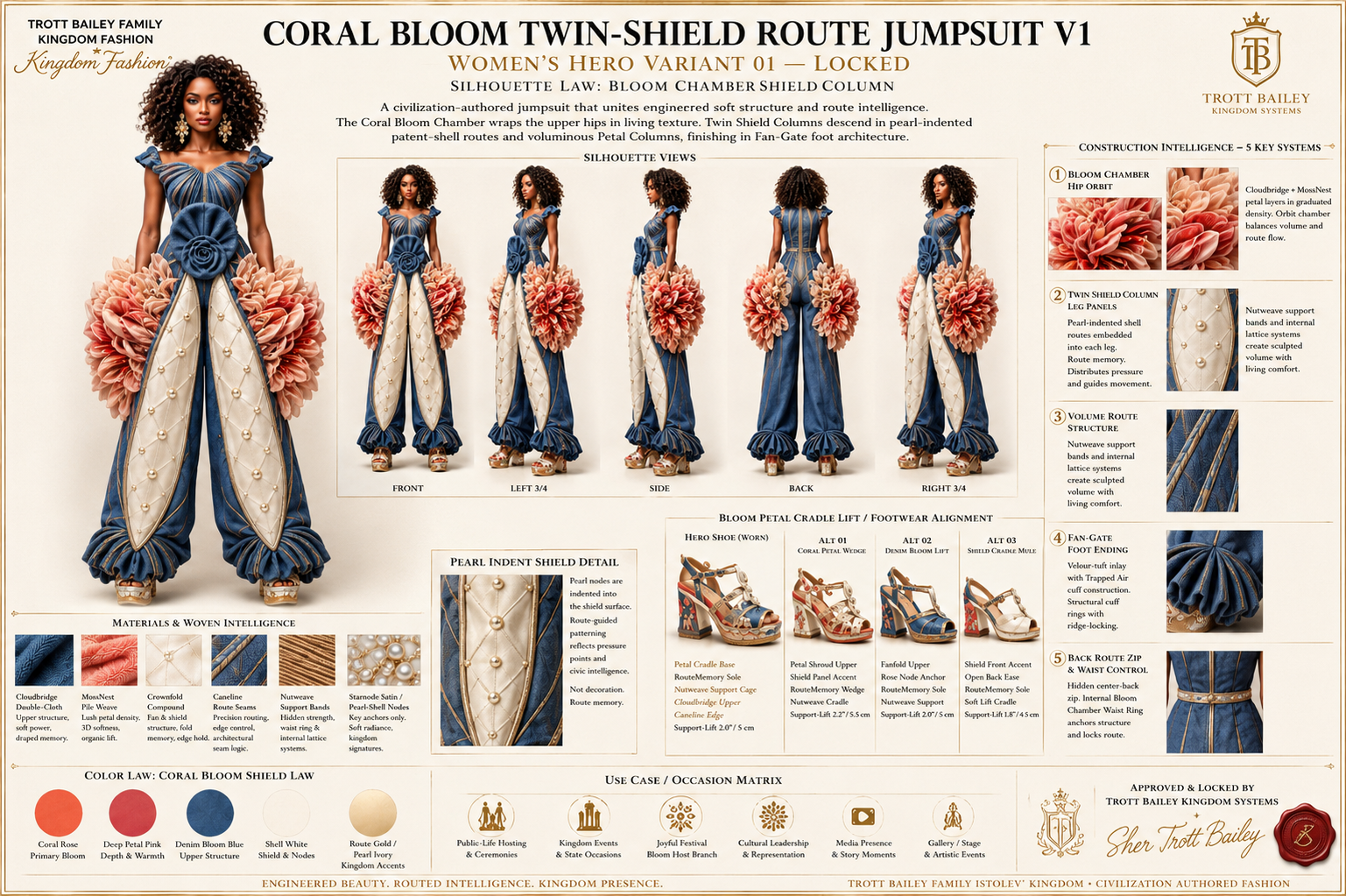
Example: In the Coral Bloom Twin-Shield Route Jumpsuit, the shock element is not just “flowers.” It is the idea of a bloom orbit around the hips, twin shield panels embedded into the legs, and fan-gate endings at the feet. The strange part becomes a real lower-body system.
Example: In the Ladybug Bloom Cradle Shoe, the shock element is the ladybug becoming a footwear node. But it is not copied the same way for everyone. Women, men, girls, boys, babies, and elders receive different translations. That is civilization thinking.
We do not accept weak lower halves.
In ordinary fashion, the lower half often defaults to a skirt, pants, gown, or trousers. Trott Bailey fashion treats the lower half as one of the most important parts of the garment.
Why? Because the lower half controls how a person walks, sits, turns, carries a child, climbs steps, greets others, works, rests, and appears in public.
That is why we develop lower-half systems instead of default shapes.
| Lower-Half System | What it means in simple words |
|---|---|
| Bisan Wrap Column | A men’s lower-half alternative that is not ordinary pants, robe, or skirt. It gives grounded movement and authority. |
| Route Pleat Column | Everyday women’s lower-half system combining wide-trouser movement, skirt-like dignity, and architectural pleats. |
| Split-Gateway Trousers | Wide trousers with engineered openings that reveal inner textile flashes during movement. |
| Tri-Route Tail Cascade | A lower garment built from three hanging route columns that move separately but belong together. |
| Feather-Current Lower Field | A flowing lower system with pleats, air channels, and route tails designed for movement. |
This is why Trott Bailey clothing does not feel like a dress with decoration added. The lower half itself becomes invention.
Shoes are not accessories. They are the final fold of the garment.
In many fashion systems, shoes are chosen at the end. A dress gets a heel. A suit gets a boot. A child gets a smaller shoe. That is not enough.
In Trott Bailey fashion, footwear completes the silhouette. It must belong to the garment’s body law.
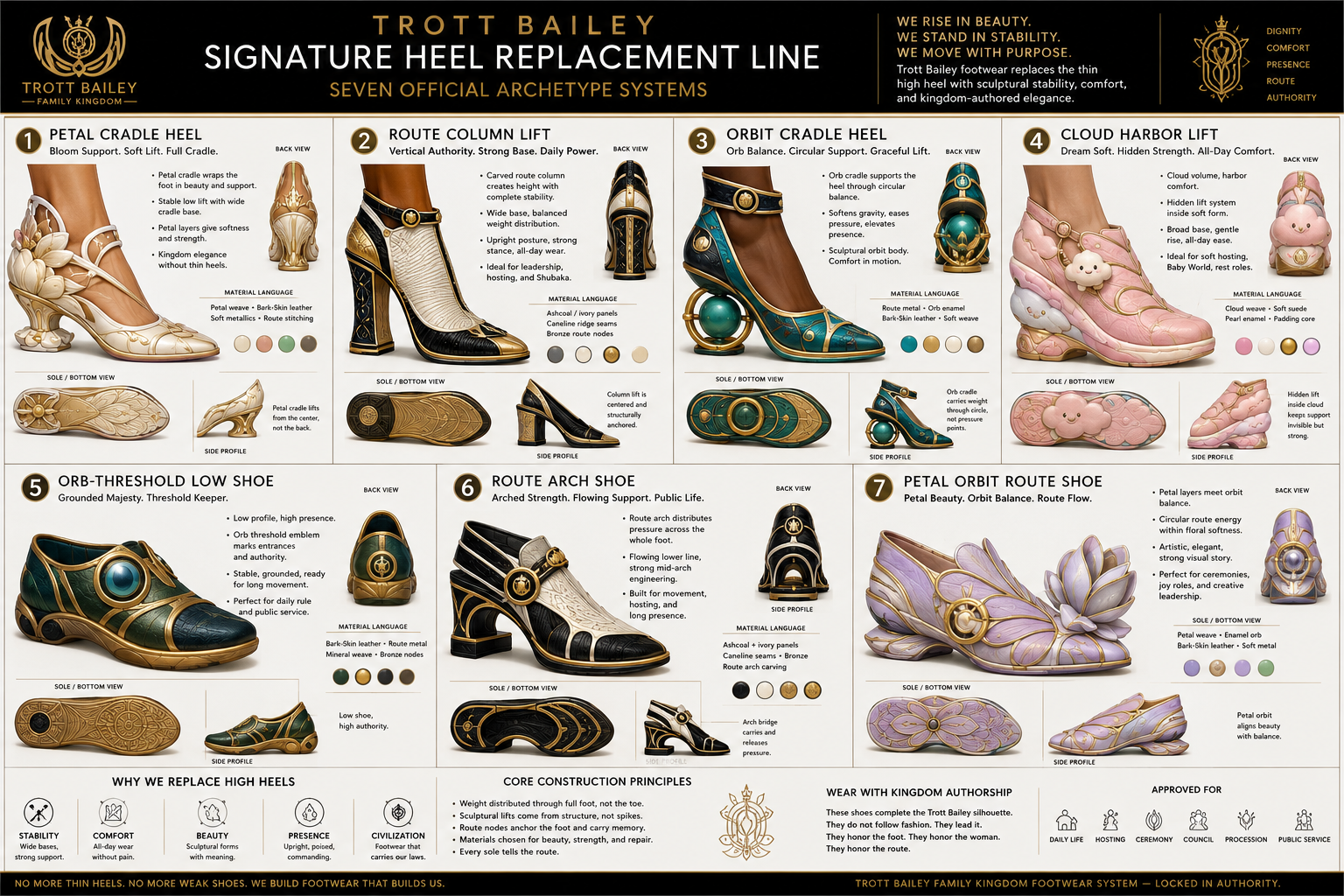
This is why Trott Bailey developed support-lift footwear instead of defaulting to painful high heels. The shoe can still be beautiful, sculptural, elegant, and lifted, but it must also support the body.
- Petal Cradle Heel: floral lift with cradle support.
- Route Column Lift: vertical authority without thin-heel pain.
- Orbit Cradle Heel: ceremonial orbit structure with stable lift.
- Bisan Ground Route Anchor: grounded men’s route shoe with strong stance.
- Ladybug Bloom Cradle Shoe: a strange botanical footwear branch where beetle-bloom pods become functional nodes.
A Trott Bailey shoe must never feel like a store shoe with decoration glued on. It must look like the garment continued all the way into the foot.
Fabric is not surface. Fabric is behavior.
In ordinary fashion, fabric is often described by how it looks: silk, denim, satin, chiffon, velvet. In Trott Bailey fashion, we ask a different question:
Does it hold structure? Does it breathe? Does it create volume? Does it remember folds? Does it support the waist? Does it form route seams? Does it carry raised motifs?
| Trott Bailey Textile | What it does |
|---|---|
| Sculpted Nib-Engineered Jacquard | Holds firm shape with a soft-touch exterior, using raised nibs to map birds, vines, shells, or nature intelligence into the weave. |
| Cloudbridge Double-Cloth | Creates soft structured volume without looking stiff or flat. |
| Caneline Route Seams | Raised seam channels that guide movement, edge control, and garment routes. |
| Nutweave | Flexible support bands, lattice, straps, and movement-friendly structure. |
| MossNest Pile Weave | Dense plush texture for bloom mass, comfort, and tactile depth. |
| Ashcoal Mineral Weave | Dark command textile with mineral depth instead of ordinary black fabric. |
This is one of the strongest parts of the Trott Bailey fashion system. The cloth is not just a covering. The cloth is engineering.
Children are not mini-adults.
When Trott Bailey designs a family branch, the goal is not to put the same outfit on the husband, wife, daughter, and son. That would be easy, but it would be wrong.
A family shares design DNA, but each person lives differently.
| Family Member | Translation Rule |
|---|---|
| Husband | Grounded, masculine, route-authoritative. Not a softened copy of the wife. |
| Wife | Root or hero expression. Strongest refinement, but not generic queen gown. |
| Daughter | Child-valid, safe, movement-ready, beautiful without becoming a tiny adult. |
| Son | Active, secure, playful, public-life ready, not a tiny formal man. |
This matters because children need to run, sit, bend, learn, play, be held, and move. A child’s clothing should honor childhood, not erase it.
Rolewear honors the people who carry civilization.
Trott Bailey fashion is not only for heroes, ceremonies, or beautiful appearances. It is also for the people who carry the civilization every day.
That includes:
- food stewards
- water-route guides
- public-life hosts
- Service Shadow workers
- Sabennery staff
- travel and shipping helpers
- district stewards
- children’s movement guides
- family support roles
In an old system, useful clothing is often made ugly, cheap, or invisible. In Trott Bailey civilization, usefulness deserves beauty.
We test clothing in life, not only on boards.
A fashion board can look beautiful, but that is not enough. Trott Bailey fashion must be able to live.
That means we test designs by asking:
- Can the person walk in it?
- Can they sit?
- Can they carry a child?
- Can the child run?
- Can the husband move without looking like he is wearing a robe costume?
- Can the shoes support the body?
- Does the garment still look authored from the side and back?
- Does it belong in a real district scene?
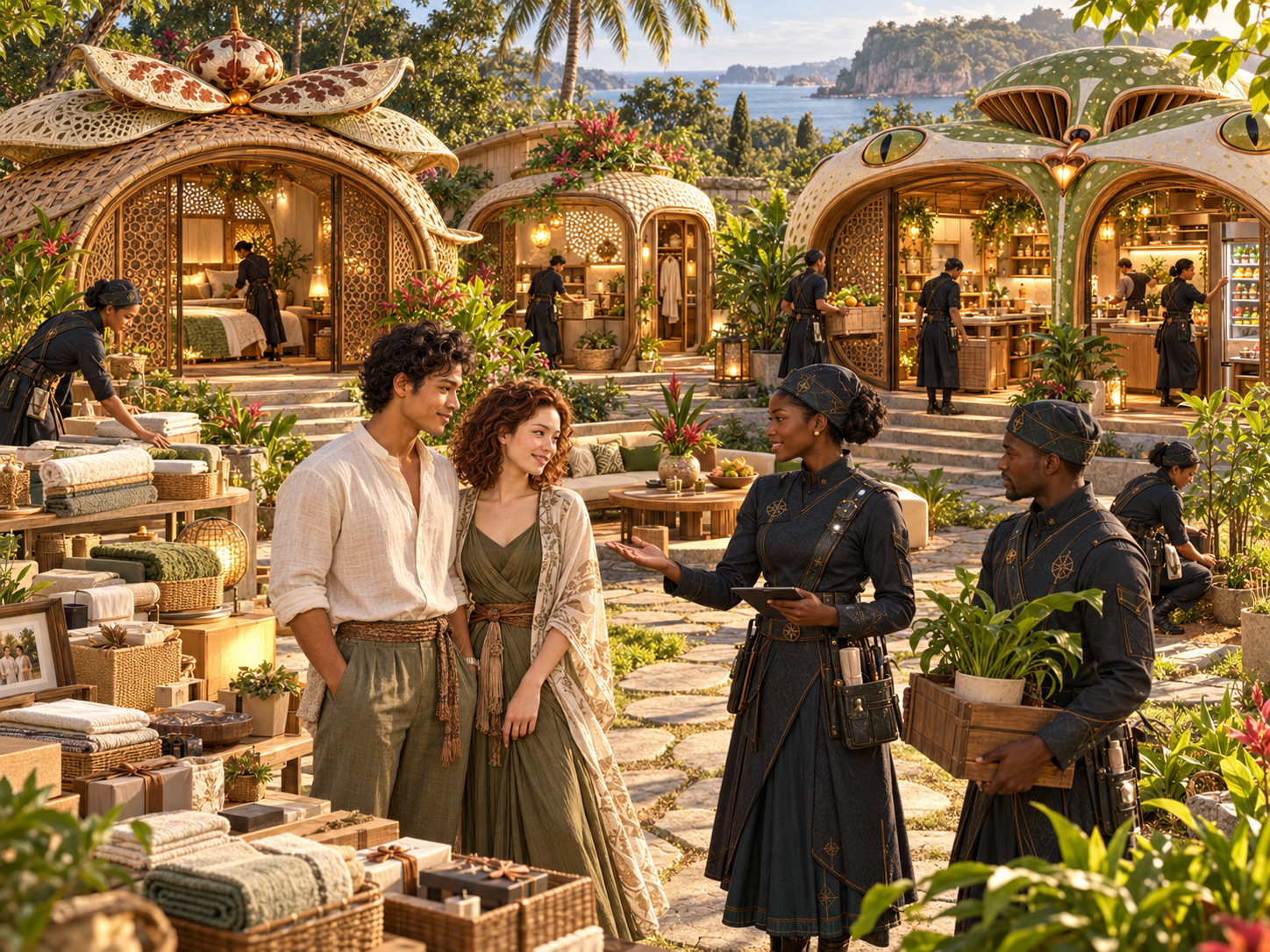
This is why we place outfits into settings like Balushu Release Commons, Kultan Water-Route Receiving Court, Sabennery gardens,
The clothing must look beautiful in stillness, but it must also survive life.
Examples of civilization clothing already developed
Coral Bloom Twin-Shield Route Jumpsuit
A women’s jumpsuit with twin shield legs, pearl indent logic, bloom orbit, and fan-gate foot endings.
Aqua Fracture Bisan Route
A men’s branch for Young Kultan, using diagonal fracture wrap, Bisan lower-half, and grounded route footwear.
Aqua Vein Shell Route
A women’s Kultan counterpart branch with shell-gill collar, facet shell plates, pearl route field, and feather-current lower half.
Route Pleat Column Collection
Everyday women’s lower-half systems that are not simple pants, skirts, or gowns.
Ladybug Bloom Cradle Shoe
A footwear family where the ladybug is not copied across roles, but translated into bloom nodes, jewel inlays, glow nodes, and comfort forms.
Sculpted Nib-Engineered Jacquard
A master textile system where raised woven nibs carry structure, motif, movement, and authority.
This is why lock discipline matters.
A Trott Bailey design is not locked just because it looks beautiful. It is locked only when the design has passed through the full civilization test.
That means the garment has to prove its silhouette, neckline, material behavior, lower-half law, shoe system, role, movement, family translation, and anti-drift rules. If one of those systems fails, the design is not ready.
This is why some designs are rejected even after a beautiful generation. A shoe may be too generic. A child outfit may be too adult. A man’s look may drift into a fantasy robe. A woman’s dress may become too safe. A family board may become a king-and-queen portrait.
The lock system protects the identity of the civilization. It keeps the clothes from sliding back into old-world fashion habits.
Simple examples a child can understand
A normal shoe
You put it on after the outfit is finished.
A Trott Bailey shoe
It looks like the outfit continued all the way down to the foot.
A normal family outfit
Everyone wears the same thing in different sizes.
A Trott Bailey family outfit
Everyone shares the same design family, but each person gets clothing for their own life.
A normal fabric
It is chosen because it looks nice.
A Trott Bailey textile
It holds shape, supports movement, carries route lines, and builds the garment.
The big idea
Trott Bailey fashion is not just about making clothes that look unusual. It is about designing clothing that carries the life of the kingdom.
A civilization needs clothing for babies, children, mothers, fathers, elders, helpers, stewards, hosts, builders, travelers, families, leaders, and people walking through ordinary public life.
Every one of those lives deserves beauty. Every one of those lives deserves support. Every one of those lives deserves clothing that is not borrowed from a tired old system.
The final point is simple.
We are not designing fashion as decoration. We are designing clothing as part of civilization.
That means the shoe matters. The lower half matters. The neckline matters. The fabric matters. The child version matters. The husband version matters. The worker version matters. The way a person walks, sits, serves, greets, carries, hosts, and belongs — all of it matters.
Trott Bailey fashion is not trying to look different just to be different. It looks different because the civilization underneath it is different.



 and then