Trott Bailey Family Abundance Theory
GDP Is Obsolete. Money Is Obsolete. We Measure Growth by How Much Life Multiplies.
We believe Earth needs a better way to measure whether civilization is actually getting better. More money moving is not enough. More products being sold is not enough. More transactions are not enough. Growth should tell us whether people are carrying less burden, whether families are stronger, whether animals and rare species are multiplying, whether nutritious foods are returning, whether soil and water are becoming healthier, whether invention is being unlocked, and whether abundance is becoming easier for everyone to reach.
We Have Been Measuring the Cash Register Instead of the Household
Imagine a family owns a little restaurant. At the end of the month, the cash register says more money passed through than ever before. Everybody celebrates. Then you walk into the kitchen and discover the stove is broken, the children have barely seen their parents, half the food is being thrown away, the water bill has doubled, everybody is tired, and the garden behind the building is dying. Would you still say the family is doing wonderfully because the cash register number went up?
That is how the Trott Bailey Family increasingly sees the way the world talks about growth. GDP tells us something useful about production and transactions, but humanity has allowed that useful number to sit in the chair of a much bigger question. We look at the cash register and call it civilization. We look at how much was sold and call it development. We look at spending and call it progress, even when some of that spending exists because something went wrong in the first place.
If a river is polluted, money may be spent cleaning it. If more people become sick, more money may move through healthcare. If families have less time to cook, they may buy more convenience. If homes are badly designed, people may buy more machines and services to keep managing the burden. All of that can create economic activity. But the Trott Bailey question is much simpler: did life actually improve?
We are not saying production no longer matters. Of course it matters. A civilization should know how much food it has, how much water it can move, how many homes it can build, how much energy it can produce, and whether its transport systems are strong. We are saying that production is a tool. It is not the final answer. A civilization should be judged by what that capacity does for life.
Money Can Tell Us a Price. It Cannot Tell Us the Full Value.
We all know this from ordinary life. Buy a new car and drive it away from the dealership. Its resale value can fall almost immediately, yet the car did not suddenly forget how to drive. Buy a television, take it home, use it for a week, and its resale price drops. The picture may still be perfect. A new phone arrives on the market and yesterday’s phone becomes “old,” even though it still calls, photographs, calculates, maps, records and connects.
Money is measuring one thing. Life is measuring another. That becomes even clearer when we look at a mango tree. What is the tree worth? Is it the price of its timber? The price of this year’s mangoes? What about its shade? The birds living in it? The insects feeding there? The cooler soil beneath it? The roots holding soil together? The leaves returning organic matter? The children learning to climb? The seed inside one fruit that can become another tree?
A market can give the mango a price. It cannot finish the story of the mango.
She teaches five children how to cook a traditional dish that nobody in the family wrote down. No invoice appears. No GDP line announces that cultural memory has been saved. Yet something valuable just crossed a generation. If those children teach their children, the value has multiplied again without anybody selling it.
This is why the Trott Bailey Family Civilization begins with capability and contribution before price. We want to know what something does for life, what it protects, what it teaches, what it can multiply, and what future capability comes from it. Money may still be able to describe a price in the old economy. It is simply too small to be the ruler of value.
We Started With Friction. Then We Realized Friction Was Only the Diagnosis.
The Friction Economy Theory came from watching how much human life disappears on the way to ordinary needs. A family wants food, but first there may be work, transport, wages, shopping, payment, carrying and repeated planning. A parent wants to spend time with a child, but the day is chopped into work, bills, passwords, school messages, transport, appointments, forms and household cleanup. Somebody wants to publish one photograph, but the same file gets downloaded, duplicated, renamed, uploaded, captioned and reorganized several times because the systems do not speak properly to one another.
We called those unnecessary burdens friction. The work that reality actually requires is different. A banana still has to grow. Water still has to move. A machine still has to be maintained. A child still needs care. Those are not failures. The failure is when civilization wraps necessary life inside layer after layer of avoidable burden.
The Friction Economy helped us see the burden. But eventually we realized a civilization cannot be built around staring forever at what is wrong. A doctor may diagnose an illness, but diagnosis is not the same as health. If all we do is become better at naming friction, we are still standing in the problem.
So our thinking moved.
Friction asks, what burden should disappear? Abundance asks, what should multiply once the burden is gone?
That is the movement from Friction Theory toward an Abundance Theory of Civilization.
If a parent gets two hours back every day, we do not want to stop at “two hours saved.” What happens with those hours? More sleep? More time with children? A garden? Learning? Rest? Music? A new idea? Care for an elder? That is where the real growth begins. Removing friction is useful because it creates room for abundance.
Abundance Theory Starts With a Different Question
Scarcity-centered thinking asks, “There are only ten. Who gets them?” Abundance thinking does not pretend the ten are actually one hundred. It simply refuses to stop thinking after the allocation problem. It asks, “Why are there only ten, and what can civilization do so there are more next time?”
Imagine one hundred children and ten ripe mangoes. The ten mangoes cannot feed one hundred children today. We need a fair way to share what exists. That is the allocation problem. But the civilization problem is bigger. How many mango trees do we have? Can we plant fifty more? Can different varieties fruit at different times? Can we preserve some of the harvest? Can guava, papaya, banana, jackfruit and other fruits carry nourishment during the months when mango is low?
The ten mangoes describe today’s shortage. They do not have to describe next year’s design.
This matters because many things in life are not fixed piles. A seed can become a plant that produces hundreds of seeds. A banana plant produces suckers. Knowledge can move from one mind to twenty minds without leaving the first mind empty. Software can be copied. A skill can be taught. A machine can multiply what a human body can do. Healthy soil can support more roots, fungi, insects and crops than damaged soil.
Of course everything does not multiply at the same speed. A software copy is almost instant. A papaya takes time. A house takes materials and skilled hands. A surgeon takes many years of training. An aircraft is harder to multiply than a recipe. Abundance Theory does not erase these differences. It asks civilization to understand them properly.
Growth Should Mean More Life, Not Just More Stuff
This is where our own measurement of growth begins. We do not want one giant number pretending to tell the whole story. We want a Civilization Development Scorecard that looks at the actual condition of life. Think of it like a family looking at a child. You would never decide whether the child is doing well by measuring only height. You would look at health, learning, sleep, confidence, relationships, movement, curiosity and many other things. Civilization deserves the same common sense.
A civilization can have fewer financial transactions and still be growing beautifully. If families spend less time commuting, people may buy less fuel. GDP may notice less activity. But if millions of hours return to human beings, something enormous has grown. The old scoreboard may call it a reduction. We call it recovered life.
Human Burden Lifted Should Count as Real Growth
Suppose a mother spends ninety minutes every day getting to work and ninety minutes coming home. Then a better system reduces the total journey by two hours. In the old economy, less fuel may be sold, fewer tickets purchased, fewer convenience foods bought on the way, and perhaps less childcare purchased for the extra hours she is away. Several transactions can shrink.
But two hours of her life returned every day.
She may eat dinner with her children. She may sleep more. She may grow something. She may sit with her husband. She may study. She may do absolutely nothing for twenty minutes, which is also allowed in a sane civilization. A system that gives people back life should not be treated as economically disappointing because it reduced spending.
Fewer machines are sold. Fewer repairs may be needed. Fewer discarded machines enter waste streams. Conventional economic activity could be lower than a world where everyone replaces the machine every three years. But which world used its intelligence better? The one that kept selling replacements, or the one that stopped manufacturing the same burden over and over?
This is what we mean by Human Capacity Recovered. We want to count how much unnecessary human burden disappeared, while also making sure it was not simply pushed onto someone else. If one family’s convenience requires another person to work twelve miserable hours, the friction did not disappear. It changed address.
Rare Foods Returning to the Human Palate Should Count as Growth
Money has quietly shaped what much of the world eats. A food does not only need to be nutritious. To win inside a large commercial system it often needs to store well, travel well, look predictable, ripen conveniently, survive handling, fit machines and sell at a worthwhile margin. Foods that do not behave nicely for commerce can slowly disappear from ordinary diets even when they are excellent foods.
Imagine a small regional fruit that is delicious, highly nutritious and perfectly suited to a local ecology, but it bruises easily and lasts only a few days after harvest. The supermarket may dislike it. The industrial distributor may dislike it. The spreadsheet may dislike it. But the human body, local soil, insects, birds and culture may all love it.
Why should the spreadsheet win?
Under our measurement of growth, bringing that food back matters. We want to know how many useful fruits, leaves, beans, roots, herbs, seeds and traditional foods return to cultivation. We want a richer human palate, not a narrower diet wearing thousands of different packages.
This connects directly to our Foodway work. If food grows through landscapes where people actually live and move, then nutritious foods do not all need to prove themselves first as profitable supermarket products. A food can deserve a place because it feeds people, supports habitat, adds diversity, survives the climate, teaches children something useful or strengthens a seasonal food system.
Animals Multiplying Should Count as Growth
We also want civilization to stop treating nonhuman life as background scenery. If a threatened bird population doubles, something valuable happened. If frogs return to a water system, something happened. If pollinators increase, fish recover, wildlife corridors work and rare species begin reproducing again, the Earth has become more capable.
Today we often talk about protecting a species from extinction as though keeping the last few alive is the finish line. It is necessary, but it is a very low ambition. Imagine raising children and saying success means they did not die. Of course survival matters, but we want them healthy, curious, strong and flourishing.
We should think about species in the same way.
The movement should be from declining, to stable, to recovering, to multiplying. We want more places where animals have enough habitat, food, clean water and safety to reproduce. Abundance Theory is not only about abundance for humans. It is about the ability of life itself to multiply.
Climate Growth Should Measure What Physically Improved
Climate discussions can also become trapped inside money. We hear how many billions were invested, how large a climate market became, how much financing was committed or how many credits changed hands. Those numbers may help track activity, but the atmosphere does not read financial reports. A wetland does not know what a bond is. Soil does not care how expensive a project was.
Earth records the physical result.
Did emissions fall? Did the soil hold more carbon? Did urban heat fall? Did water become easier to retain? Did wetlands recover? Did forests become biologically richer? Did buildings need less energy? Did transportation stop moving people unnecessarily? Did materials stay useful for longer? Did agriculture make the ground more alive rather than simply extracting another season from it?
Roof A costs ten times more and requires endless specialized maintenance. Roof B uses a smarter design, lasts longer and keeps the building cooler with less energy. The more expensive roof does not become the better civilization result merely because more money moved through the project.
We want the scoreboard to notice the burden that disappeared and the ecological capability that increased.
Waste Disappearing Should Count as Growth
The old economy can make one badly designed object look very busy. Material is extracted. The product is manufactured. It is packaged. It is transported. It is sold. It breaks. A replacement is bought. The old one is collected as waste. It is transported again. A landfill or processing facility handles it. Perhaps pollution later requires another cleanup. The same object has created economic activity again and again.
An abundance civilization asks something embarrassing: how much of that activity should never have been necessary?
A product that lasts longer can mean fewer sales and better civilization. A reusable container can mean less packaging production and better civilization. A repairable machine can mean fewer replacements and better civilization. Food that gets eaten, preserved, shared, fed appropriately to animals or returned intelligently to soil is better than food that becomes a disposal problem.
This is part of why our Krubaro work matters. We are interested in what happens after use. Civilization should not be brilliant at producing things and stupid about what happens to them twenty minutes later.
Abundance Must Be Visible or It Can Still Be Wasted
Imagine three villages. One has too many pumpkins. One has too many people who want pumpkins. The third has an excellent way to preserve pumpkin for months. If none of them knows what the others have, civilization behaves as though all three problems are separate.
This is why we developed Wokumbakia, the News of Abundance. We want civilization-level information that tells people not only what went wrong, but what is becoming plentiful, healthy, useful and available. Where are mangoes producing heavily? Where is water recovering? Where are seedlings ready? Which food is entering season? Where did someone discover a better growing method? Where are particular skills gathering? Where is accommodation available? Where should families travel to experience something extraordinary?
This is economic information, but it is not price information.
Imagine the headline:
Pumpkins are abundant here.
Come eat. Come cook. Come preserve. Come collect seed. Come learn why this place produced so well. Bring children. Bring recipes. Bring ideas. Move some pumpkins elsewhere. Leave with knowledge that helps another place grow more next year.
A conventional market may mainly translate abundance into lower prices. Wokumbakia can translate abundance into participation, learning, movement and multiplication.
Abundance Must Be Reachable
Now imagine Wokumbakia reports that a Foodway 700 kilometers away has entered an extraordinary fruit season. You see the photos. Your children would love it. There are foods there they have never tasted. There are growers teaching propagation. There is room for families to come.
In the present economy, the next conversation often becomes a wallet conversation. How much are the tickets? Can we afford a hotel? What about food? Local transport? Can we take all the children? Suddenly abundance exists, but it may as well be on another planet.
This is why LuvYou Care-Ports belong inside Abundance Theory. Travel is not just about getting from one point to another. Free movement allows civilization to connect people to places where capability already exists.
Physical distance remains. A family still has to travel 700 kilometers. But monetary distance does not have to remain. The same principle helps scientists, growers, engineers, artists, builders and teachers meet each other. Sometimes the exact two people who could solve a problem never meet because the plane ticket, room and time away from paid work make the meeting impossible.
A Money-Free Civilization Still Requires Work
This is where people often misunderstand us. Money-free does not mean effort-free. Bananas do not jump out of the ground because money disappeared. Aircraft do not maintain themselves. Water systems still require engineering. Clothes still need people who understand textiles. Children still need adults. Software still needs developers.
We are not trying to remove human contribution. We are trying to remove money as the compulsory gate sitting between contribution and life.
In the current arrangement, a farmer may grow food, sell the food for money, then use the money to buy clothing from someone else. The clothing maker sells clothing, receives money, then uses that money to buy food. A programmer sells software to buy housing. A builder sells building work to buy transport.
Everybody is contributing something civilization needs, but their contributions first have to pass through money before returning to them as access.
Our Shubaka model asks whether civilization can organize the contributions directly.
The farmer contributes food. The engineer contributes engineering. The programmer contributes software. The builder contributes structures. The garment maker contributes clothing. The mechanic contributes maintenance. The teacher contributes knowledge. The civilization combines the capabilities and provides them back.
We consider this money-free model Earth’s best path forward because it aims directly at the thing money was always supposed to help us organize: human contribution, resources and access. Instead of endlessly improving the token in the middle, we are asking whether civilization can become capable enough to connect contribution and provision directly.
Big King Media Shows What This Looks Like in the Digital World
Big King Media grew from a practical family problem. We had years of photographs, videos, audio, articles and media records. At around one hundred thousand files across our WordPress network, little inefficiencies were no longer little. Searching, duplicating, metadata, source identity and media organization became serious burdens.
Kimroy built Big King Media because we needed the capability ourselves. Then came the question many software projects face: now that the capability exists, how much of it should be locked behind paid plans?
We chose another direction. We made serious capability available Sovereignly Free. The development work is real. Testing is real. Servers are real. Maintenance is real. The work did not become imaginary because we removed the charge to the next person.
Software is an easy place to understand abundance because one person using a software capability does not consume the capability for the next person. When a useful digital system already exists, deliberately creating artificial scarcity around copies can be a commercial choice rather than a physical necessity.
Abundance Theory asks why civilization should copy artificial scarcity when the thing itself naturally wants to multiply.
Foodway Tests the Harder Question
Food is harder than software. If I send you a copy of software, I still have mine. If I give you my papaya and you eat it, that fruit is gone. So food forces our theory to deal with land, water, seasons, labor, regeneration and physical limits.
This is exactly why our AgriGames Foodway work in Prado matters. We began testing what happens when food grows through the routes people already use instead of remaining separated from ordinary life behind a farm fence and a payment counter. Bananas, pumpkins, papayas, watermelons and other useful plants can become part of the living path.
The old route might be work, earn, travel, select, pay, carry, prepare, eat. The Foodway route can sometimes become grow, encounter, harvest, eat. Production remains. Several access burdens disappear.
Foodway also teaches us that abundance is not one crop planted until everybody is sick of looking at it. Real abundance needs diversity. Different foods fruit at different times. Different roots explore different soil layers. Some plants protect others. Some provide mulch. Some attract insects. Some feed people quickly while slower trees establish.
This is why the Trott Bailey Family Civilization concentrates on multiplication rather than simply stockpiling. A mountain of pumpkins rotting in one place is not abundance. A living food system capable of feeding, reproducing, teaching and spreading is much closer to abundance.
We Should Measure the Inventions Humanity Almost Lost
There is another kind of scarcity that bothers us deeply. Somewhere in the world, somebody may already have the idea for something important. Maybe it is a better water tool, a different machine, a new textile method, a medical device, a food preservation idea or something nobody has thought to classify yet.
The person has the idea. They may even have the skill. What they do not have is the money for parts.
So nothing happens.
The idea never becomes a prototype. The prototype never becomes evidence. The evidence never becomes an invention. Humanity never discovers what it almost had.
We would think that was ridiculous in a garden. Yet talented human beings are constantly told, in effect, that an idea may grow only after it first produces the money needed to test whether it can grow.
Our growth measurement should ask how many experiments became possible because people gained access to tools, laboratories, computing, materials, travel and collaborators. We should measure inventions unlocked, not only inventions sold.
The New Scoreboard Is Not One Number
We do not want to throw away GDP and replace it with another giant number that becomes the new god. Civilization is too complicated for that. We want a scorecard, more like a doctor looking at several signs of health than a shopkeeper looking at one total at the bottom of a receipt.
We want to know whether human burdens are falling, whether mental and bodily health are improving, whether families are gaining time, whether children are developing, whether water is strengthening, whether soils are building life, whether rare foods are returning, whether threatened species are multiplying, whether waste is disappearing, whether knowledge spreads, whether talented people find one another, whether invention becomes easier, whether travel opens possibilities, and whether more needs can be met without money.
We also want to know something very simple: how much of a person’s day truly belongs to that person again?
That question may tell us more about civilization than a thousand charts showing the value of transactions.
From a Scarcity Civilization to an Abundance Civilization
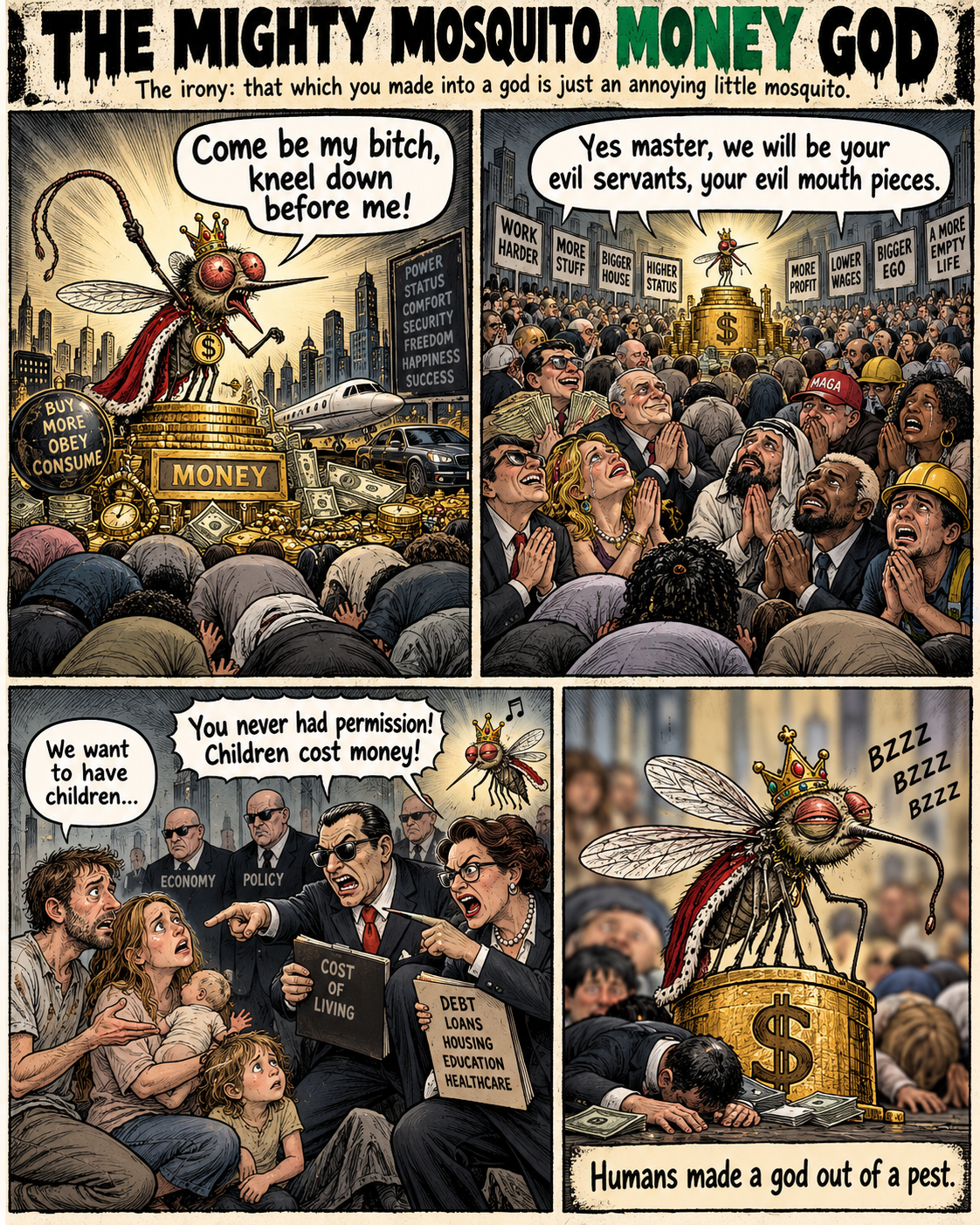
The old economy trained us to ask a predictable set of questions. Who owns it? What does it cost? Who can afford it? What can we charge? What is the return? How scarce is it? These questions are so familiar that they can feel like laws of nature, but they are not. They are questions created by a particular way of organizing life.
Our civilization asks another set.
Can it multiply? Can it regenerate? Can it be shared? Can the design make more of it possible? Can abundance be reported? Can people reach it? Can knowledge spread from it? Can waste from one process become capability for another? Can children learn from it? Can another species benefit? Can the next generation inherit more useful capacity than we did?
This does not make scarcity disappear. It changes our posture toward scarcity. Instead of building civilization around the permanent assumption that people must compete for a small pile, we build civilization to expand the pile where expansion is possible, regenerate the source where regeneration is possible, share without depletion where sharing is possible, and protect carefully what truly cannot be multiplied.
How Much More Life Became Possible?
Money was a human invention. GDP was a human measurement. Neither fell from the sky. Neither was written into the soil. They were tools created because human beings needed ways to coordinate exchange and understand production. Tools are useful until better tools become possible.
We believe humanity is now capable of asking much richer questions. We can measure the hours returned to families, nutritious foods returning to landscapes, rare animals multiplying, water recovering, soils becoming alive, waste disappearing, collaborations forming, inventions being attempted, children developing and abundance becoming reachable.
That is why the Trott Bailey Family Civilization is moving beyond the Friction Economy diagnosis and deeper into Abundance Theory. Friction showed us where human life was being lost. Abundance tells us what civilization should do with the life we recover.
Our money-free civilization is built around the belief that human contribution should strengthen civilization directly and civilization should return that combined capability freely to people. We believe this is Earth’s best path forward because it puts the objective where it should have been all along: not money, not transactions, not artificial scarcity, but the multiplication of useful life.
We do not want a civilization proud because more money moved this year. We want one proud because children had more time with their families, more foods grew, more species recovered, more water became healthy, more soil came alive, more ideas became prototypes, more talented people found one another, and fewer human beings spent their lives fighting systems that should have been helping them.
We ask a better question:
How much more life became possible?



 and then