

Krubaro Empowers the Family
Trott Bailey Family Civilization
Krubaro: A Plastic-Free Civilization Where Families Handle Their Own Waste and the World Stays Clean
Why should a family finish a wonderful meal and be left with a mountain of garbage to deal with?
Food scraps, packaging, dirty dishes, overflowing bins, unpleasant smells, and then the business of sorting everything, bagging it, dragging it somewhere, and waiting for somebody to take it away.
What an awful amount of work to create for ourselves!
In the Trott Bailey Family Civilization, we have designed Krubaro, a waste-processing and clean-return system that begins at the family compound and extends throughout the Civilization.
At the compound level, Krubaro combines three foundational machines: a mulcher, a biodigester, and an incinerator. Beyond the household, we have designed public return walls, contained processing facilities, automated material transfers, and routes for returning useful organic matter to productive agriculture.
Together with our plastic-free material standard, these systems are intended to prevent unnecessary garbage, handle what remains, and keep our surroundings clean, beautiful, and productive.
Krubaro Is a Civilization-Wide Clean-Return System
Our Governing Principles
In other words:
At the household / compound level
families can separate and return materials properly.
At the public / neighborhood level
Krubaro walls, return points, and touchpoints make clean return easy and child-safe.
At the service / shadow level
contained handling, cartridge transfer, hidden service routes, and steward systems move materials without burdening the public.
At the treatment level
materials are directed to the right process:
- mulching
- biodigesting
- incineration
- washing / drying / reuse
- compost routing to Keslev
At the civilization level
waste becomes renewal:
- soil
- fertilizer
- energy
- clean reusable vessels
- clean public environments
Our infrastructure provides different levels of handling according to the quantity and nature of the materials.
The family compound has its own processing equipment. Public Krubaro facilities serve neighbourhoods and shared spaces. FliB receives larger district loads, while Yoks handles exceptional materials requiring specialist equipment and controls.
Three Machines at the Family Compound
Imagine finishing lunch with the family.
There are banana peels, leftover porridge, corn husks, used serving dishes, and perhaps some branches collected from the garden earlier that morning.
They do not all belong in the same garbage bag.
The Mulcher
The mulcher handles suitable fibrous and woody materials, reducing them into smaller pieces that can be used as ground cover or prepared for composting and other approved routes.
The Biodigester
The biodigester processes suitable organic materials through biological activity. It can produce biogas and nutrient-rich outputs that undergo appropriate treatment before being put to productive use.
The Incinerator
The incinerator is reserved for designated materials requiring controlled thermal treatment. Its design must provide proper containment, emissions control, filtration, ash handling, and protection from heat and fire.
We certainly don’t need to burn every banana peel!
Used dishes and vessels follow their own washing, drying, and clean-return routes. Materials unsuitable for the compound’s equipment move to the appropriate district or specialist facility.
In our family-compound designs, Krubaro’s machinery belongs along the service perimeter, accessible from the working areas but separated from bedrooms, children’s play spaces, and private family environments.
Convenient receiving points allow families to make ordinary returns without directly operating dangerous equipment.
Children can learn to participate through suitable, child-safe activities.
The family handles the simple part. The machinery handles the processing.
And I particularly like the independence this gives families. Much of their ordinary waste can be treated within their own compound rather than accumulating in bags while everyone waits for a garbage truck.
Public Krubaro: Cleanliness Built Into Beautiful Places
Now look at our Balushu designs.
Families are enjoying meals beneath flowering trees. Children are walking through gardens. There are Sabenneries, shaded paths, gathering places, and beautiful environments for people to enjoy themselves.
And integrated into these surroundings are the public Krubaro return walls.
Our designs provide distinct receiving points for food scraps, reusable vessels, suitable organic materials, and other returns. Some include child-height openings, separate food-stick and liquid-return routes, and visible system-status indicators.
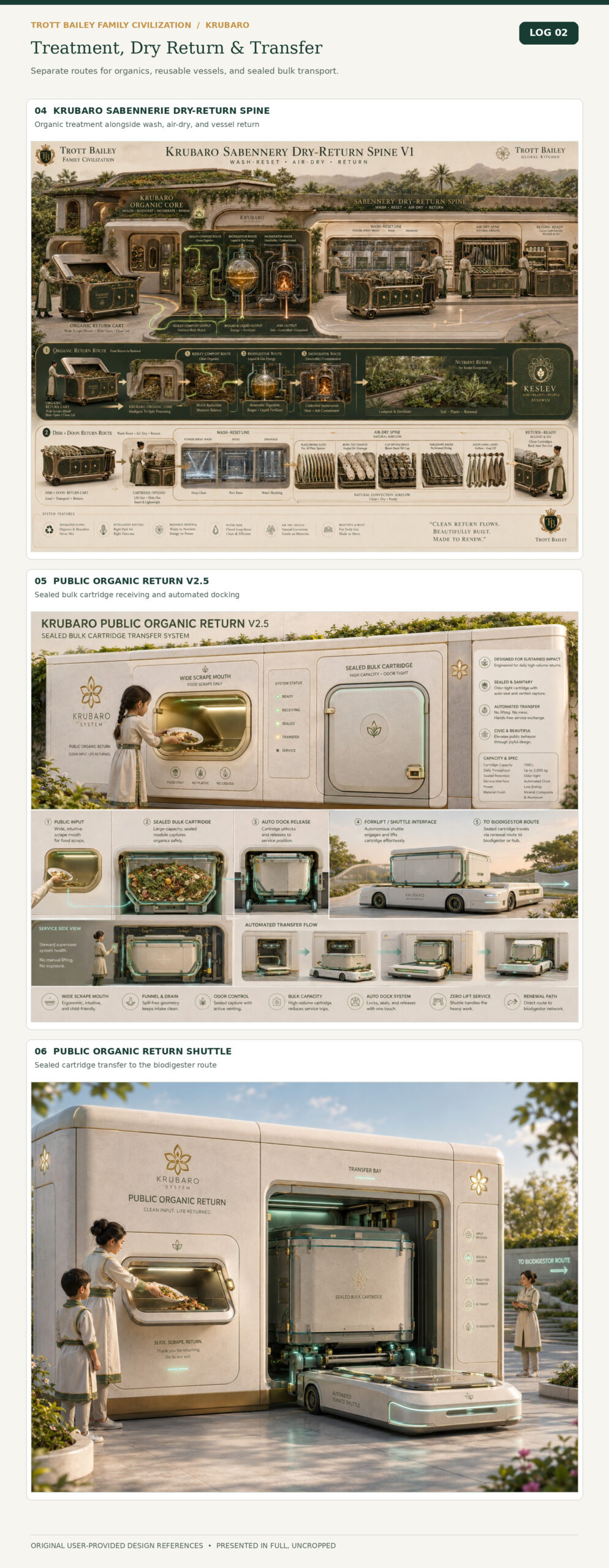
The Balushu Public Krubaro Wall also illustrates how mulching, biodigesting, controlled incineration, filtration, and clean outputs can be accommodated within a larger contained facility.
The public sees an attractive, convenient return system. Behind it are the equipment and service arrangements needed to keep everything functioning.
Our Sabennerie Dry-Return Spine takes care of another familiar activity: returning used dishes.
Plates, cups, and utensils follow a route through washing, rinsing, air-drying, inspection, and preparation for reuse. Doon garments and other washable materials follow their appropriate care routes.
Imagine enjoying a wonderful meal, returning your dishes, and continuing through a beautiful garden while the cleaning and preparation systems do their work.
The same public environment can remain attractive, comfortable, and clean throughout the day.
Sealed Returns, Service Routes, and Keslev
Our larger public Krubaro designs include something particularly useful: sealed bulk cartridges.
In Public Organic Return V2.5, suitable food scraps enter through a wide receiving opening. Behind it is a sealed cartridge designed to hold larger quantities of organic material.
When the cartridge is ready for servicing, an automated transfer arrangement can release it to a shuttle for movement to the next processing facility.
Nobody needs to drag open containers of rotting food through a beautiful public courtyard.
And stewards should not have to spend their days lifting heavy containers when machinery can perform that work.
This is where the different routes of our Clean Return Infrastructure become important.
Used materials move along contained return paths. Service Shadow supports cleaning, stocking, maintenance, and other activities that keep the public environment functioning.
Our larger designs separate these operations so that clean supplies do not mix with used materials.
The system can also monitor cartridge fullness, equipment condition, and maintenance requirements, with Pacorips helping coordinate attention when it is needed.
Now consider what happens to the organic matter.
Some is processed locally. Larger quantities can travel to district treatment facilities or the composting and agricultural systems of Keslev.
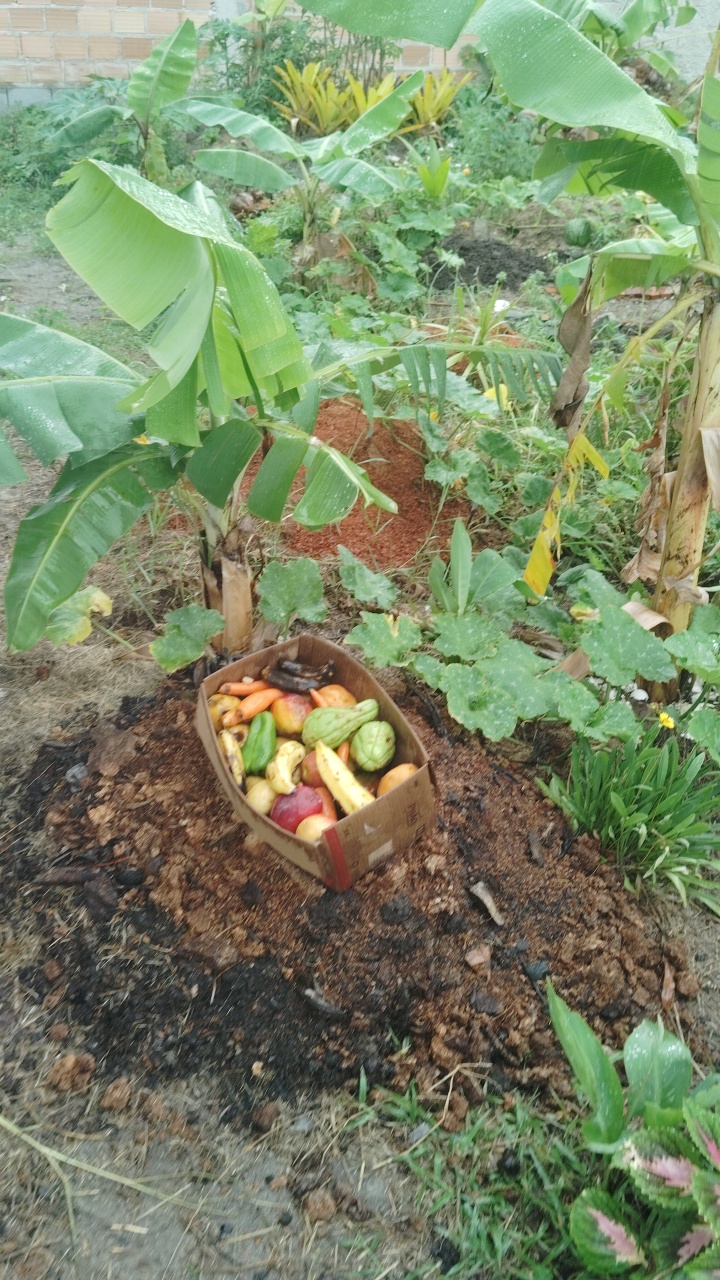
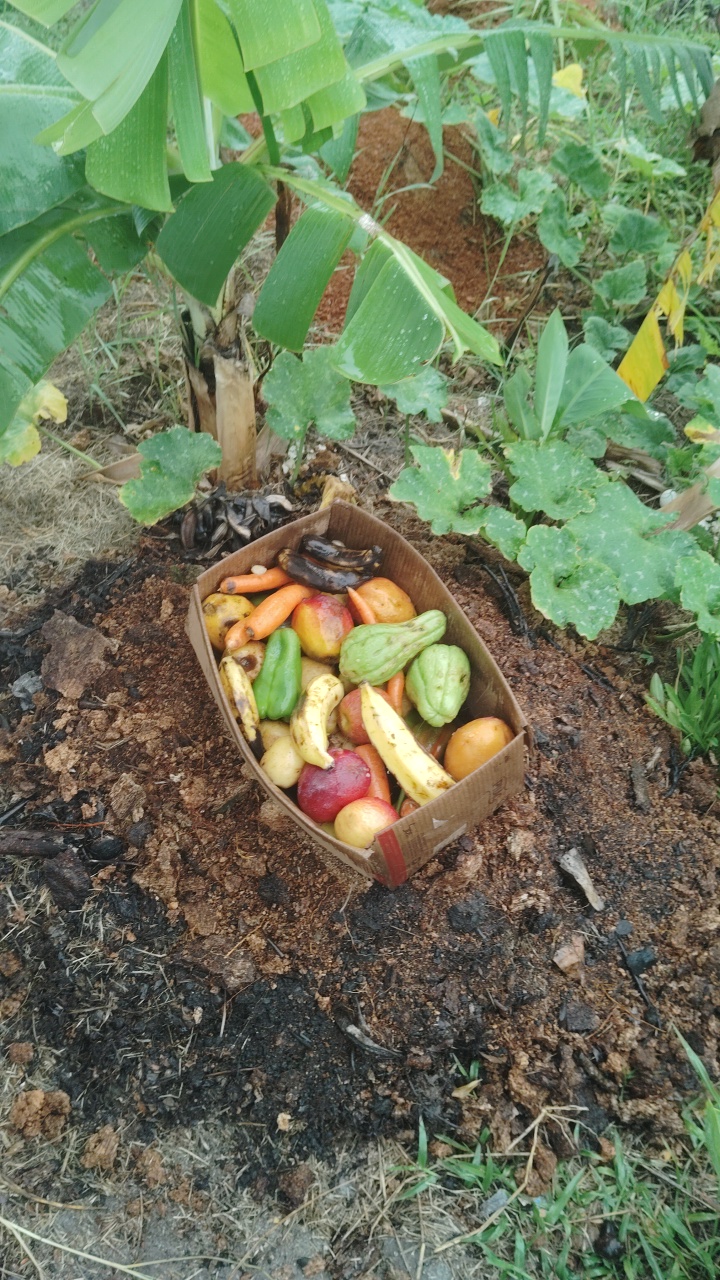
An orchard produces fruit. The fruit is harvested, prepared, and enjoyed. Suitable organic remains are returned and processed. Properly treated organic outputs can contribute to soil fertility and further cultivation.
Our designs connect waste handling with productive farming instead of treating organic matter as something that simply needs to disappear.
A Plastic-Free Civilization Prevents the Garbage Before It Arrives
Now, why manufacture so much disposable garbage in the first place?
Why wrap everything in plastic, only to spend enormous amounts of effort collecting, sorting, transporting, recycling, burning, or burying it?
The Trott Bailey Family Civilization’s plastic-free material standard addresses this problem when products are first designed.
We can use suitable glass, ceramics, metals, timber, natural fibres, woven materials, and other materials selected for their usefulness, durability, repairability, and return routes.
Imagine a food system where fruit can be harvested directly from productive landscapes, meals are prepared in Sabenneries, and people eat using beautiful, reusable dishes.
Those dishes are cleaned and returned to service.
What mountains of disposable plates, wrappers, containers, and bags would we avoid creating?
And what an enormous amount of unnecessary garbage handling would disappear with them?
Our published Krubaro work raises another important issue.
We do not want to establish a permanent recycling industry that depends upon the continued production of plastic garbage.
Existing plastics may need specialist handling, but the long-term material system should be designed around better choices.
A durable vessel that can be cleaned and reused many times has a different life from a disposable wrapper made to be thrown away minutes after opening.
And when an item eventually needs repair, replacement, or processing, its next destination should already have been considered.
Different materials need different treatments. Biodegradable materials are not all suitable for the same equipment, and substances requiring specialist handling must have their proper routes.
This is the purpose of designing the system from the beginning.
Families Help Keep the Civilization Clean
I want families to have the means to care for their own environments properly.
A child can learn where suitable food remains belong. A parent can return used vessels without spending the afternoon washing an enormous pile of public dishes. Family members can take care of ordinary household returns with equipment designed to make the work convenient.
This is also part of our Home Training and NoDumbDumbs capability development.
Children grow up learning to care for their surroundings, recognize useful materials, and understand what happens to things after they have finished using them.
Meanwhile, the wider Krubaro network provides the processing, movement, and specialised treatment that families should not have to perform themselves.
Our Krubaro designs remain at different stages of development, from authored compound standards to detailed public equipment and automated-transfer concepts. Their operational performance will need to be established through engineering, testing, and deployment.
The objective is already clear.
We want clean compounds, beautiful Sabenneries, productive landscapes, pleasant waterways, and public spaces where families can enjoy themselves without garbage accumulating around them.
There are plenty of other wonderful things for people to be doing.
Growing food. Building. Inventing. Swimming. Playing with their children. Enjoying their homes and surroundings.
We can make cleanliness an ordinary part of how the Civilization works.
Cleanliness Built Into Civilization
Krubaro, Clean Return Infrastructure, and our plastic-free material standard are designed to keep materials moving through the proper routes while families enjoy the life around them.
Clean input. Quiet transformation. Life returned.