
Kezidek Young Family Housing: Why a Home Is Not a Sealed Box
Kezidek Young Family Housing: Why a Home Is Not a Sealed Box
A young family’s home should not be a sealed box where the hardest years of care are hidden away from the rest of civilization.
In many places, housing is treated as a private container. A family is placed inside a house or apartment and expected to manage baby care, feeding, washing, sleep disruption, stroller storage, toddler movement, postpartum recovery, grandparent help, sibling needs, food mess, laundry, and exhaustion mostly on their own.
The outside world may say family is important, but the housing design often says something different.
It says: handle it inside.
Kezidek District rejects that.
In the Trott Bailey Family Kingdom, housing for young families is not designed as isolated private boxes. It is designed as part of a living support ecosystem.
In Kezidek District, a young family’s home is not a sealed box. It is the center of a soft, beautiful, Trott Bailey support circle.
Why Young-Family Housing Needs Its Own System
Young-family life has specific needs.
A baby may wake at night. A toddler may need safe outdoor movement. A parent may need warm food without cooking. A nursing mother may need quiet. A father may need stroller access and a place to sit with a baby. A grandparent may want to help without living directly inside the household. A postpartum family may need extra warmth, privacy, food delivery, washing, and calm.
Ordinary housing does not usually organize around those realities.
It may provide rooms, walls, doors, and a kitchen, but not a full early-life support environment.
Kezidek housing asks different questions:
- Can a tired parent reach warm food easily?
- Can a stroller move without struggle?
- Can a toddler play safely near home?
- Can grandparents help without being strained?
- Can postpartum recovery happen without isolation?
- Can washing and reset happen close to daily life?
- Can babies access soft outdoor spaces without a major outing?
- Can helpers support families respectfully?
- Can the home connect to Baby Worlds, not just bedrooms?
Young-family housing must be designed from the rhythm of early life, not from generic residential planning.
The Kezidek Housing Promise
Kezidek’s housing promise is simple:
Home should be close to food, rest, washing, soft ground, Baby Worlds, helper support, stroller routes, and family dignity.
This does not mean the family loses privacy.
It means privacy is protected inside a wider circle of help.
The house remains the family’s own space, but the land around the house is designed to reduce the pressure on the household.
A young family should not need to pack for a full expedition just to reach a baby-safe lawn, warm porridge, a handwash station, grandparent seating, or a quiet stroller path.
Those things should be woven into the district.
Compound Logic, Not Western All-in-One Housing
The Trott Bailey Family Kingdom does not follow the Western all-in-one house model as its default.
Kingdom homes follow compound-style logic.
Sleeping quarters, bathrooms, kitchens, food spaces, gardens, play spaces, wash systems, and outdoor life do not have to be forced into one sealed structure.
In Kezidek, this matters even more.
Young-family life needs outdoor breathing space. It needs shaded movement. It needs porches, courtyards, soft lawns, stroller loops, washing stations, and warm food access. It needs useful gardens, flowers, herbs, medicinal plants, baby-safe landscapes, and resting places.
So Kezidek homes should be designed as family compounds inside soft support clusters.
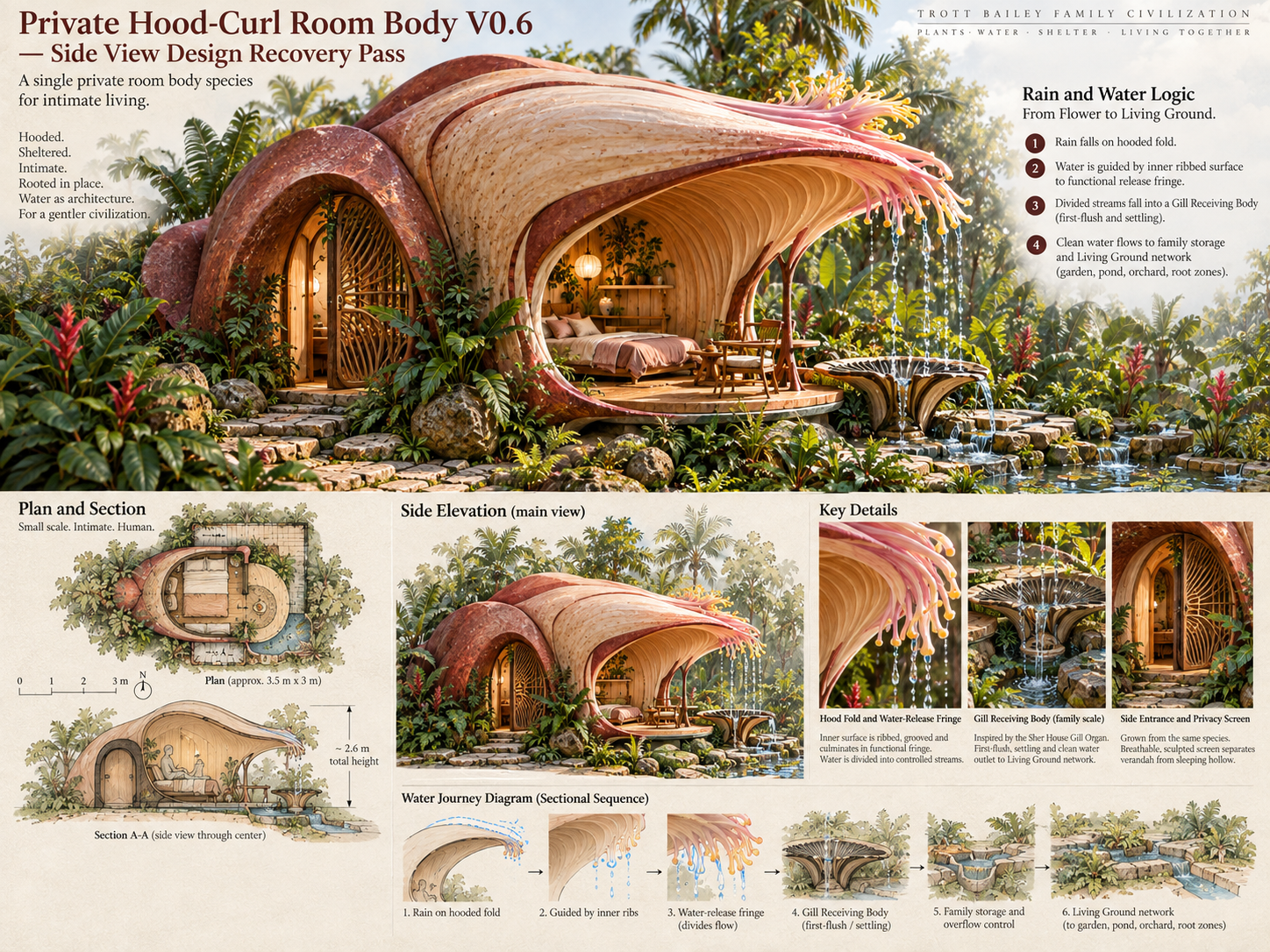
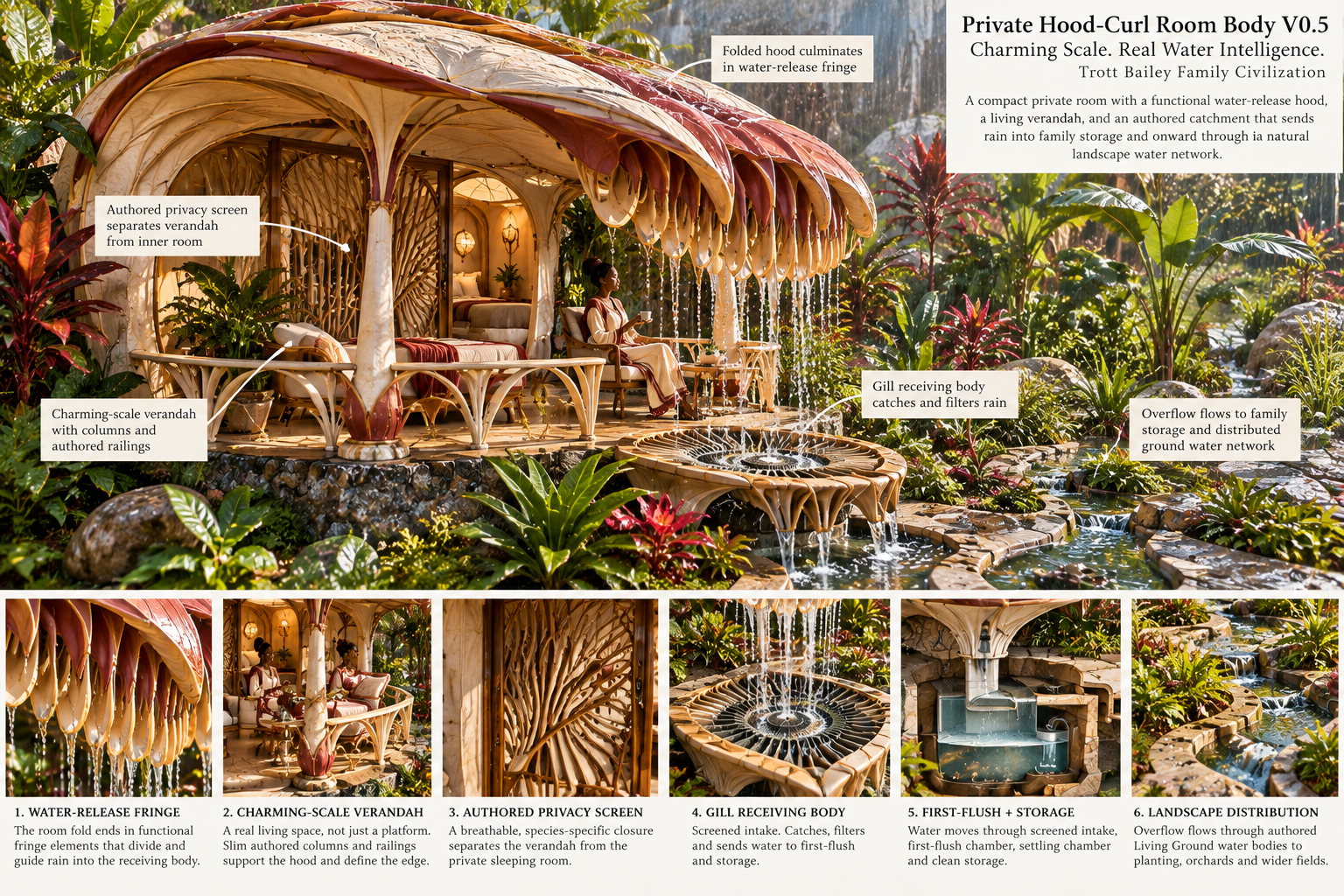
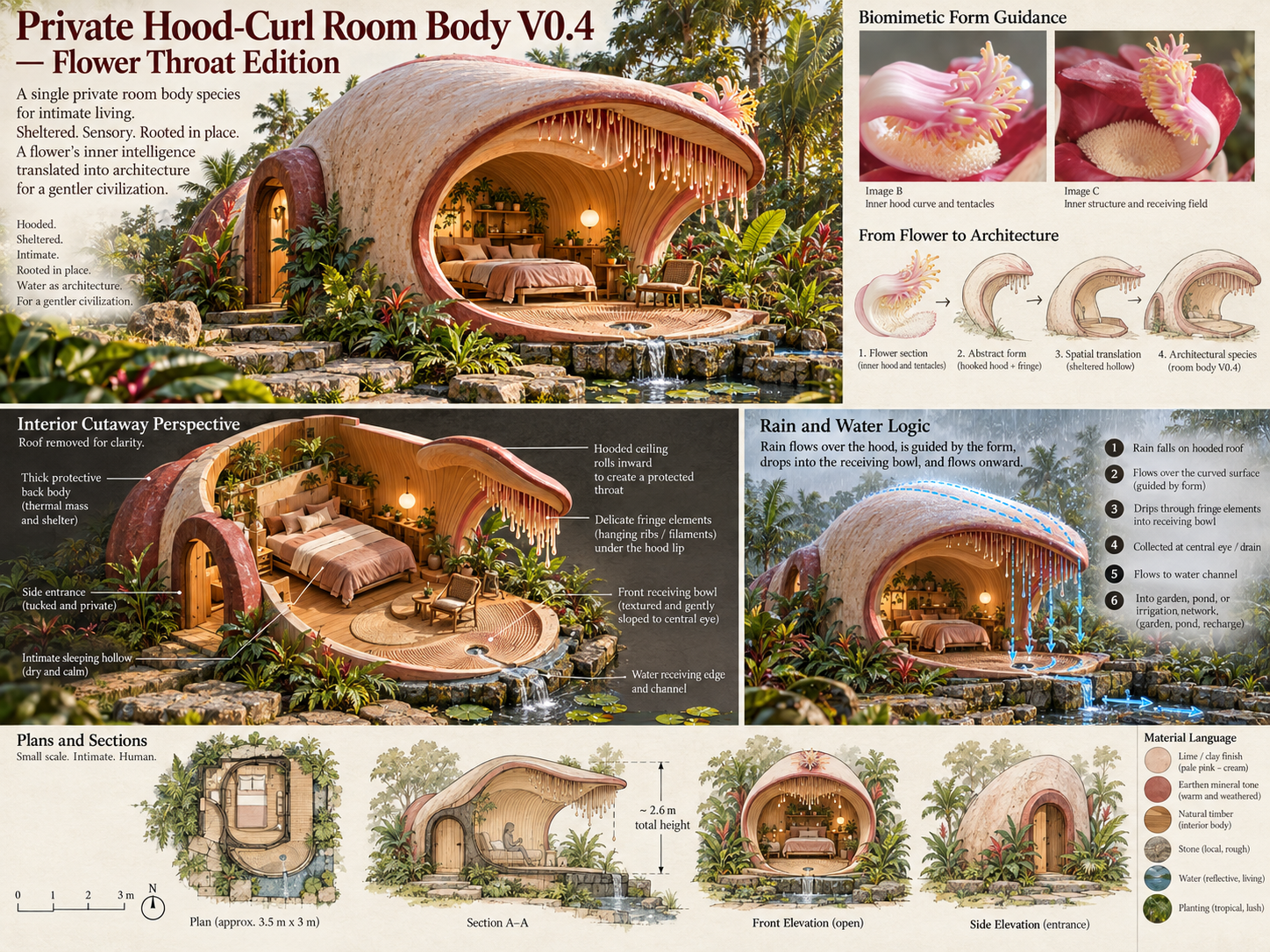
A home may include sleeping buildings, shaded family verandahs, small wash porches, baby-safe courtyards, stroller parking niches, garden rooms, parent rest edges, and nearby public support systems.
The house is not everything.
The house sits inside a family-life field.
Young Family Nests
The main housing type in Kezidek is the Young Family Nest.
A Young Family Nest is a home cluster designed for families with babies and toddlers.
It is not a cute cottage. It is not a suburban house. It is not an apartment block with a playground nearby.
It is a baby-stage home environment shaped around daily care.
A Young Family Nest should include:
- separate sleeping quarters;
- shaded verandahs;
- small baby-safe courtyard space;
- stroller storage and stroller route access;
- a nearby Warm Bowl Porch;
- nearby wash/reset support;
- soft ground for crawling or toddler movement;
- parent seating with sightlines;
- garden edges for herbs, flowers, and soft food plants;
- helper threshold access without invading the home;
- night-light path connection.
The Young Family Nest is meant to make daily family life easier before the family reaches exhaustion.
Baby World Edge Houses
Some families need to live very close to Baby World support.
That is where Baby World Edge Houses become important.
These homes sit near neighborhood Baby Worlds or small Baby World pockets. They are ideal for families who benefit from frequent access to soft crawl lawns, toddler wobble paths, parent rest porches, sibling zones, warm wash stations, and helper support.
A Baby World Edge House should not feel exposed or public. It should have private family thresholds, garden buffers, soft railings, and clear boundaries.
The goal is closeness without loss of dignity.
A parent should be able to step from home toward a Baby World pocket without feeling like the home has become part of the public space.
The transition should be soft:
private nest → shaded porch → family garden → stroller route → Baby World edge.
This allows support to feel nearby without crowding the family.
Postpartum Recovery Houses
Kezidek also needs Postpartum Recovery Houses.
These homes or small housing clusters are designed for families needing extra calm after birth.
They should be quieter than active toddler zones but still close to support.
A Postpartum Recovery House should connect to:
- Nursing Garden Rooms;
- Warm Nest care houses;
- Postpartum Warm Care Rooms;
- warm food delivery routes;
- quiet walking loops;
- parent rest porches;
- grandparent-adjacent support;
- helper access when requested;
- soft night-light paths.
Postpartum housing should not feel medical, luxury-spa, or isolated.
It should feel protected, warm, gentle, and family-centered.
The mother is recovering. The baby is adjusting. The family is reorganizing. The space should support that transition without turning recovery into spectacle or confinement.
Postpartum recovery deserves calm, warmth, food, privacy, help, and beautiful ordinary life.
Grandparent-Adjacent Units
In many families, grandparents are essential to early-life support.
But helping does not always mean grandparents should be forced into the same living space, or placed far away where helping becomes difficult.
Kezidek solves this through Grandparent-Adjacent Units.
These are homes or rest units placed close enough for grandparents to help with babies and toddlers, but separate enough to protect privacy, rest, and dignity.
Grandparent-adjacent housing should include:
- easy walking paths to young-family homes;
- shaded seating near Baby World pockets;
- warm food access;
- low-strain routes;
- rest gardens;
- nearby wash support;
- safe evening lighting;
- places to sit while still participating in family life.
This housing type respects elders as part of the family care circle without overusing them.
It says: you are near, you are valued, and you are allowed to rest.
Multi-Family Support Clusters
Some Kezidek housing should be organized as Multi-Family Support Clusters.
These are small groups of related or compatible families living around shared early-life support spaces.
They may include shared stroller courts, soft lawns, toddler paths, warm bowl access, wash porches, parent seating, grandparent seating, and small garden rooms.
The goal is not to erase family privacy.
The goal is to reduce isolation.
Young families often need other young families nearby. Parents can share knowledge. Toddlers can see other children. Siblings can play. Grandparents can sit together. Helpers can support a cluster efficiently.
A good Multi-Family Support Cluster feels like a living village pocket, not a crowded housing block.
There should be space between homes, soft lawns, gardens, shaded porches, and clear routes.
Closeness should not become compression.
Kezidek housing should give families community without crowding them.
Temporary Young-Family Transition Homes
Some families arrive in the kingdom while already carrying the pressures of early-life care.
They may have babies, toddlers, pregnancy needs, postpartum needs, exhausted parents, elderly relatives, or children who need immediate stability.
For these families, Kezidek can provide Temporary Young-Family Transition Homes.
These homes are especially important at the Sherika-to-Kezidek interface, because Sherika Regional District handles arrival, intake, Pacorips onboarding, orientation, and first welcome.
A young family should not be processed through intake and then left to figure out early-life support alone.
Temporary Young-Family Transition Homes should be close to:
- strong helper support;
- warm food;
- Baby World access;
- orientation support;
- Pacorips intake follow-up;
- wash and reset stations;
- family basket points;
- quiet rest gardens;
- stroller-safe routes.
The purpose is to help the family stabilize before moving deeper into long-term district life.
A newly arrived young family should meet the kingdom as support, not confusion.
Housing Around a Baby World Pocket
A strong Kezidek housing cluster should often form around a small Baby World pocket.
This does not mean every home faces a loud play area. It means the cluster has a soft early-life center that families can reach easily.
The center may include:
- a baby crawl lawn;
- a toddler wobble path;
- a parent rest porch;
- grandparent seating;
- a sibling soft zone;
- a warm wash station;
- a small edible wonder ring;
- a helper point;
- a shaded stroller loop.
Homes should sit around this support pocket with enough space for privacy, gardens, verandahs, and quiet movement.
The center supports family life without swallowing it.
The housing cluster should feel open, green, breathable, and calm.
Kezidek must avoid packing houses too close together. Young families need closeness to support, but they also need space to breathe.
Warm Bowl Porches Near Housing
Warm food must be close to Kezidek housing.
This does not mean every home needs its own full kitchen building directly beside it. It means the housing cluster must connect naturally to warm food support.
A Warm Bowl Porch near housing allows families to receive porridge, soup, broth, soft bowls, parent teas, toddler bowls, and postpartum recovery foods without traveling far.
This matters most during the tired hours:
- early morning;
- after naps;
- after water play;
- during postpartum recovery;
- when a toddler is hungry suddenly;
- when a parent is carrying a sleeping baby;
- during evening stroller walks;
- at night when the household needs quiet support.
Warm Bowl Porches should feel like family thresholds, not cafeteria counters.
They should be shaded, calm, stroller-accessible, clean, and beautiful.
A tired parent should not have to cross the district to receive a warm bowl.
Stroller Routes as Housing Infrastructure
In Kezidek, stroller routes are not minor paths.
They are housing infrastructure.
A young-family home is only as usable as the routes around it. If the paths are narrow, broken, steep, crowded, poorly lit, or hard to navigate, the family becomes trapped or burdened.
Kezidek stroller routes should be:
- wide;
- smooth;
- shaded;
- beautiful;
- well-drained;
- safe at night;
- connected to warm food;
- connected to wash support;
- connected to Baby Worlds;
- connected to shallow rivers, lawns, and gardens;
- separated from heavy service movement;
- rested with benches, porches, and quiet coves.
A stroller route is a promise that the family can move through the district without fighting the ground.
If a stroller cannot move with ease, the housing system has not truly supported young families.
Soft Outdoor Rooms
Kezidek housing needs outdoor rooms.
Not every family moment belongs inside. Babies need fresh air. Toddlers need movement. Parents need daylight. Grandparents need shaded seats. Siblings need nearby play. Families need spaces where the day can unfold without every action becoming an indoor task.
Soft outdoor rooms may include:
- small family lawns;
- flower edges;
- shaded verandahs;
- baby blanket areas;
- quiet sitting coves;
- tree shade pockets;
- herb gardens;
- soft water edges where appropriate;
- low railings;
- night-light dots;
- parent rest ledges;
- toddler-safe paths.
These outdoor rooms should not feel like decorative landscaping.
They are usable family rooms without walls.
They make early-life care less trapped and more breathable.
Helper Thresholds
Kezidek housing must allow help without making families feel watched or invaded.
This is where helper thresholds matter.
A helper threshold is a designed point where helpers can bring food, towels, Doon supplies, family baskets, information, or support without crossing too deeply into private family space.
It may include:
- a shaded drop-off niche;
- a family basket shelf;
- a clean/used Doon exchange point;
- a warm bowl receiving ledge;
- a Pacorips message node;
- a small covered seat for brief conversation;
- a privacy-respecting boundary.
The helper threshold protects both sides.
The family receives support.
The helper has a clear place to serve.
Privacy stays intact.
Kezidek help should be easy to receive without making the home feel invaded.
Robot Support Without Replacing Family Life
Kezidek housing may use Mr. and Mrs. Rasta Robot for support tasks, but the role of robots must remain clear.
Robots may help with repetition:
- bringing towels;
- returning used Doon items;
- delivering sealed warm bowls;
- moving clean cloths;
- collecting compost;
- restocking small support stations;
- guiding families to open warm food or wash stations.
But robots do not become parents, elders, helpers, or emotional caregivers.
They should not hover at the home. They should not intrude into quiet family moments. They should not discipline children. They should not make the housing cluster feel automated or cold.
The locked rule remains:
Humans carry warmth. Robots carry repetition. Pacorips carries information. Field visits carry truth. Parents carry authority.
In housing, that means the robot may bring the bowl, but the human helper notices whether the family is overwhelmed.
Architecture of Kezidek Housing
Kezidek housing must clearly belong to the Trott Bailey Family Kingdom.
It should not look like generic eco-villas, tropical resort cottages, suburban homes, apartment blocks, daycare housing, fantasy huts, or ordinary family resorts.
The architecture must use the locked Trott Bailey language while remaining soft enough for early-life care.
Good architecture directions include:
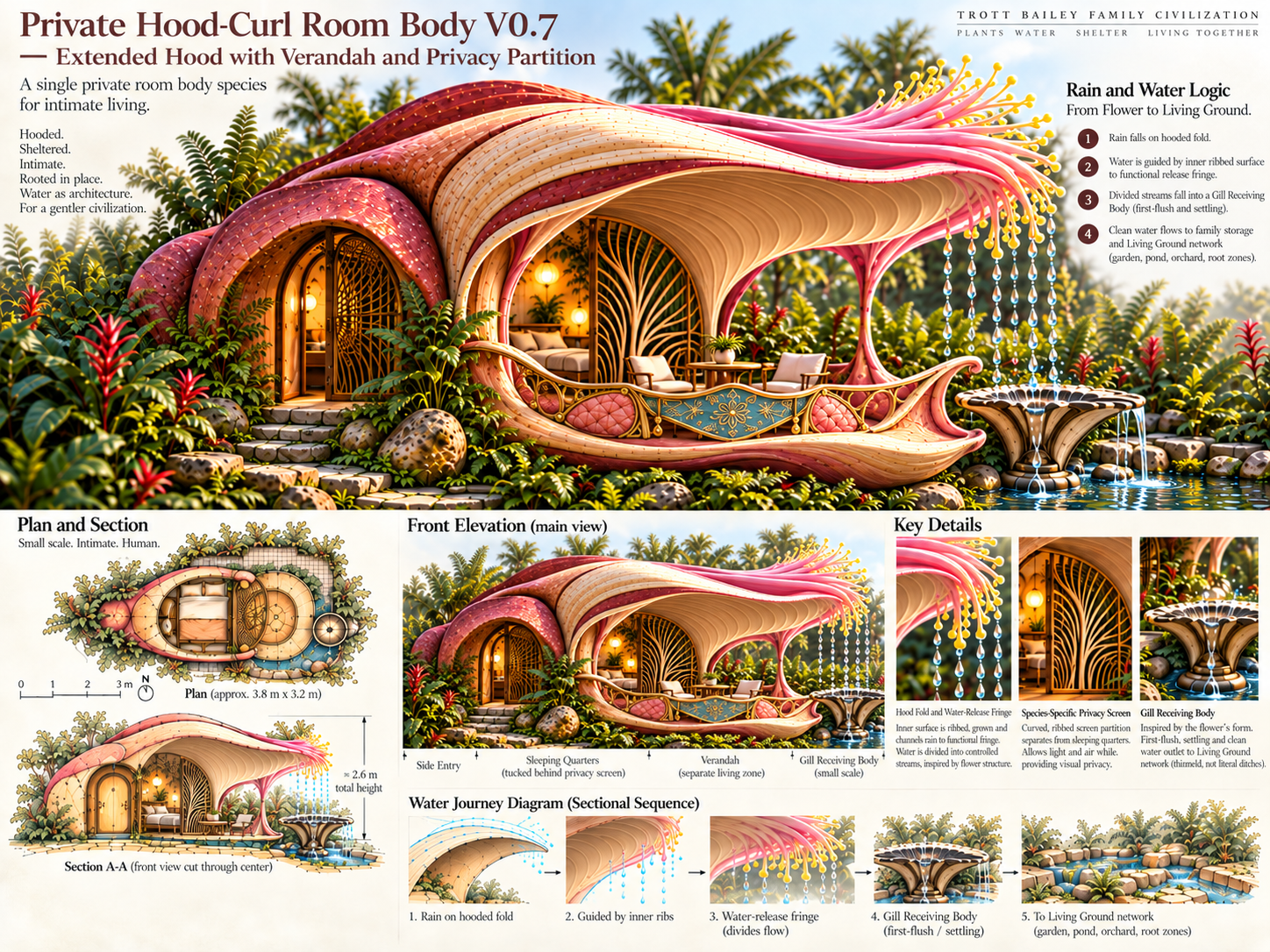
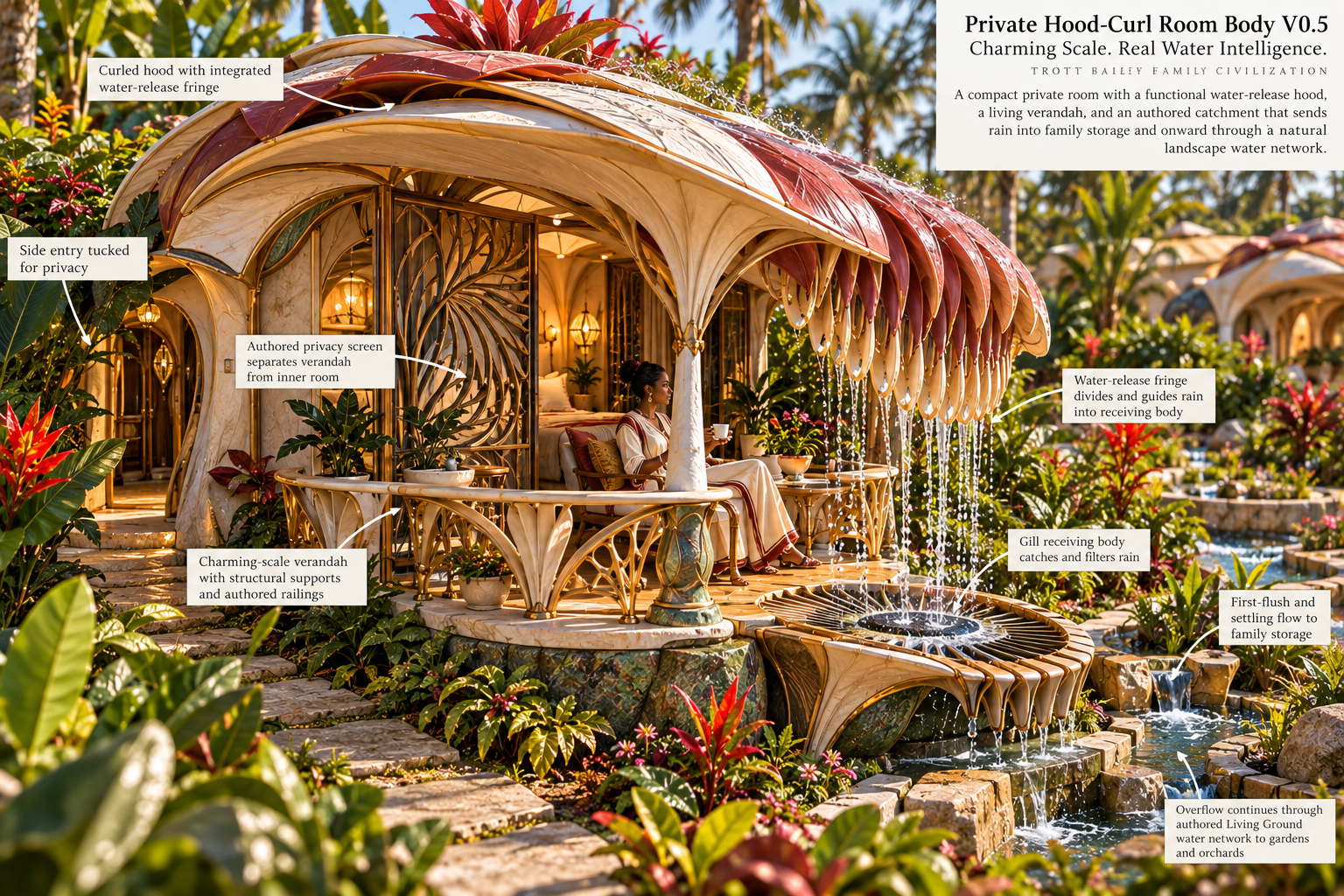
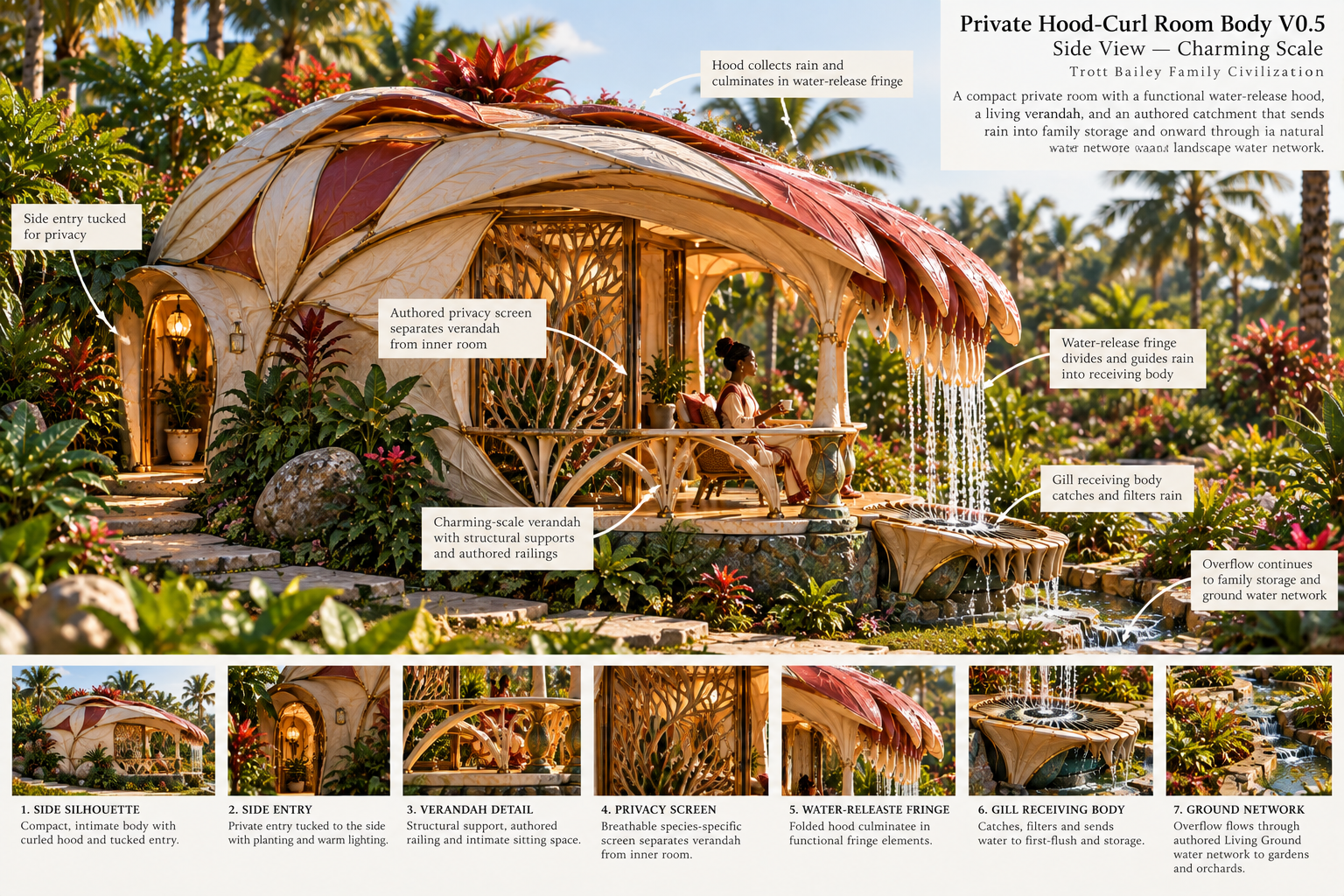
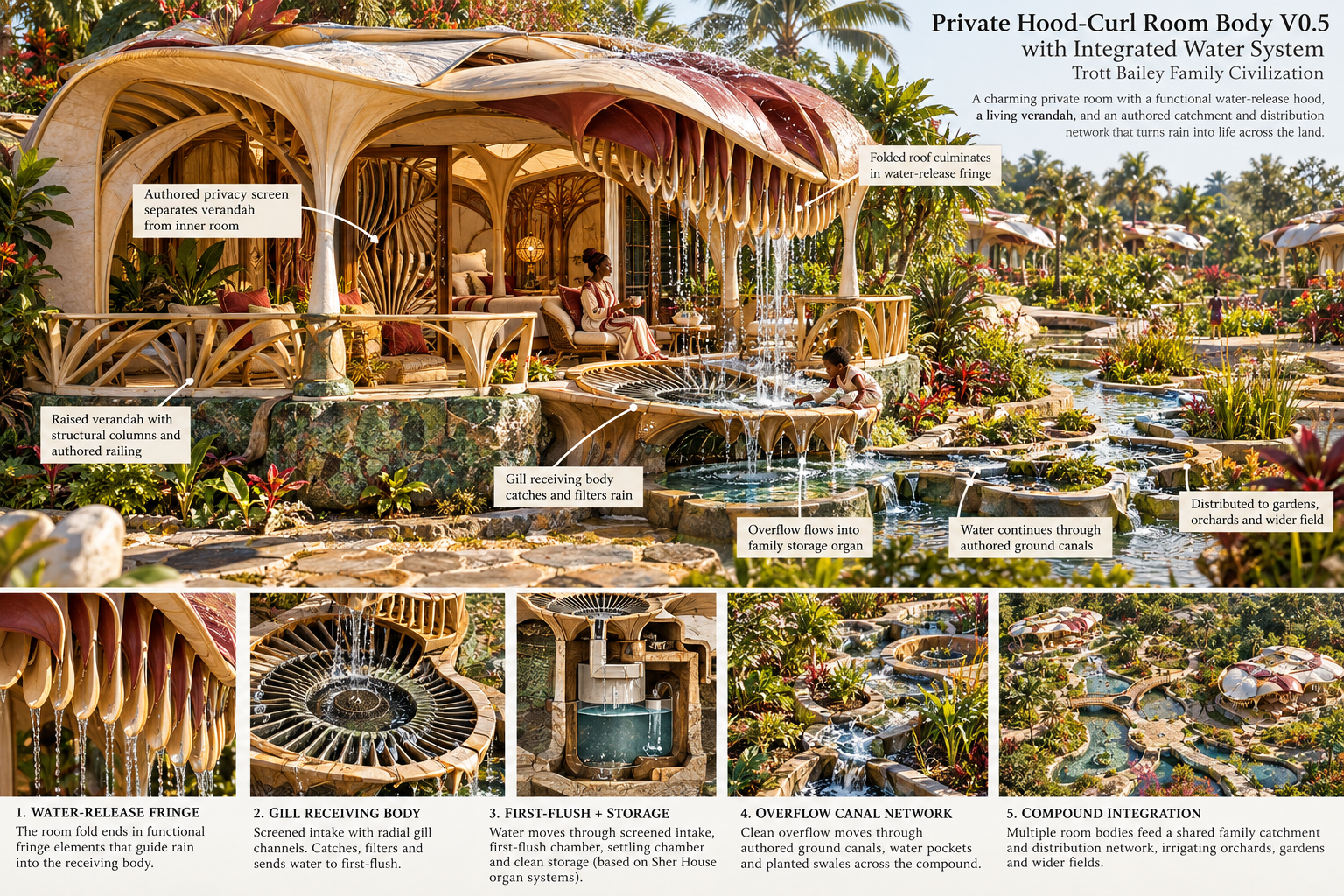
- Young Family Verandah Cluster Body;
- Cloud-Nest Civic Body for larger support houses;
- Warm Bowl Hearth Body near food porches;
- Soft Water-Cradle Body near water-care spaces;
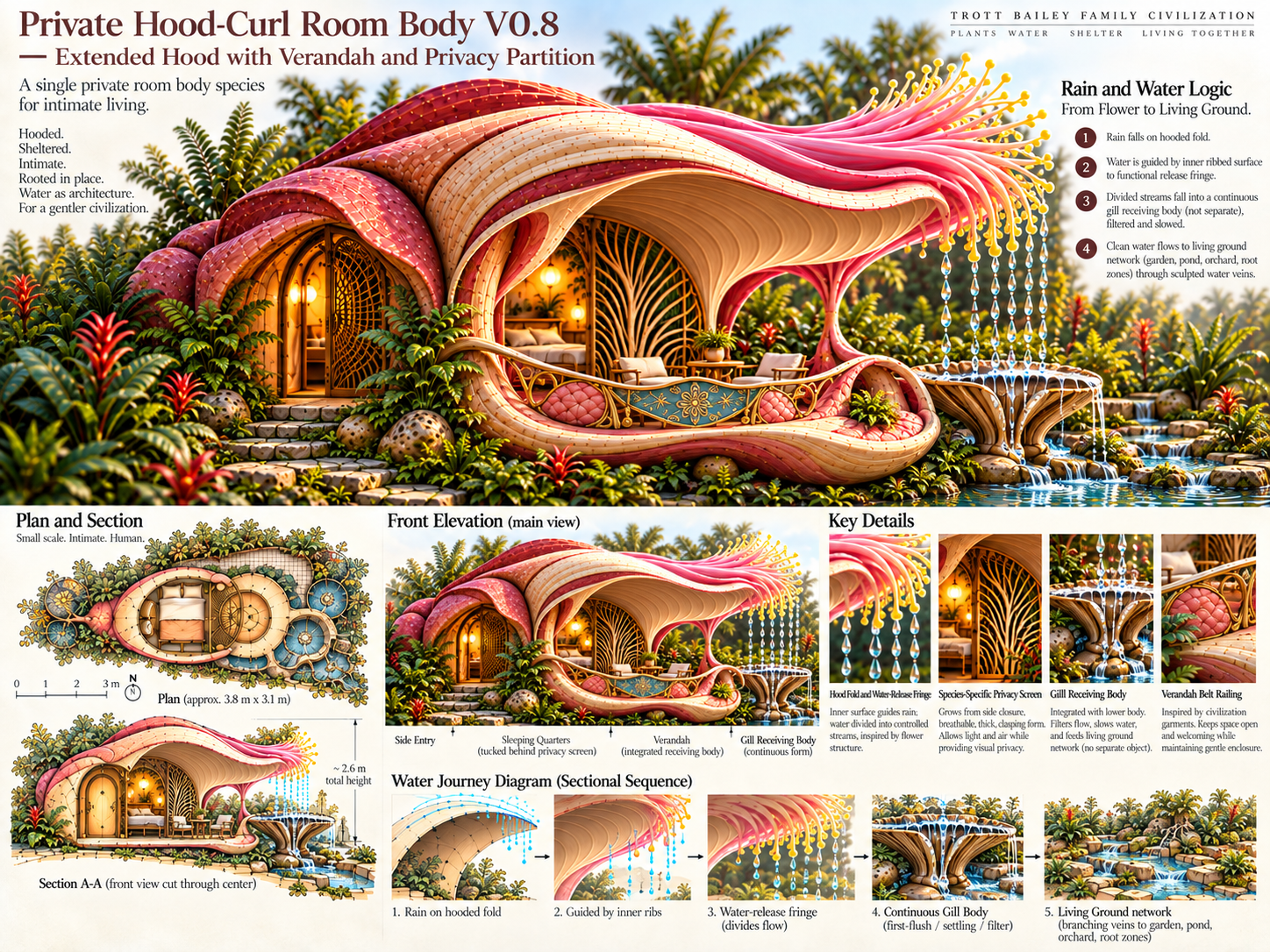
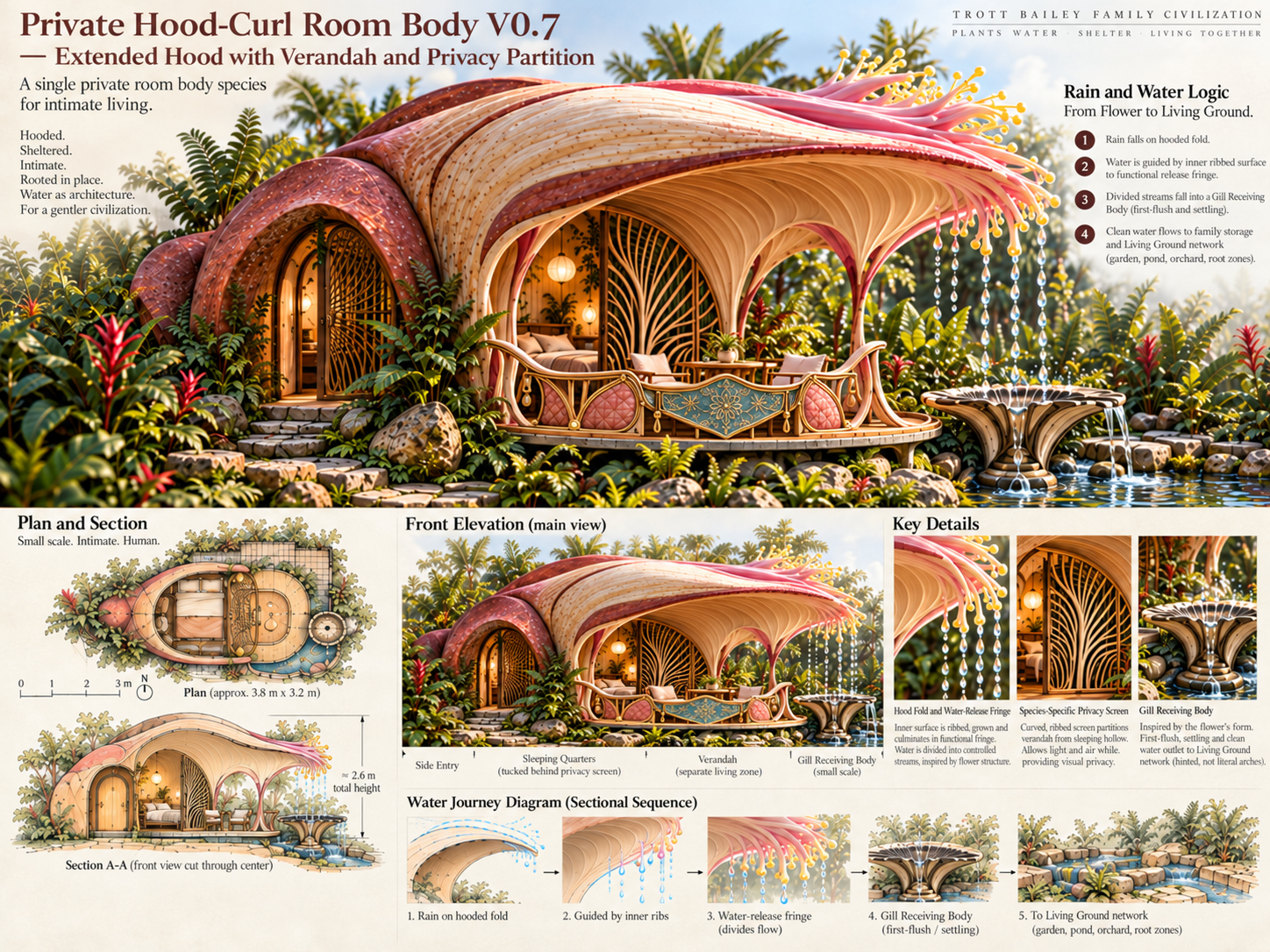
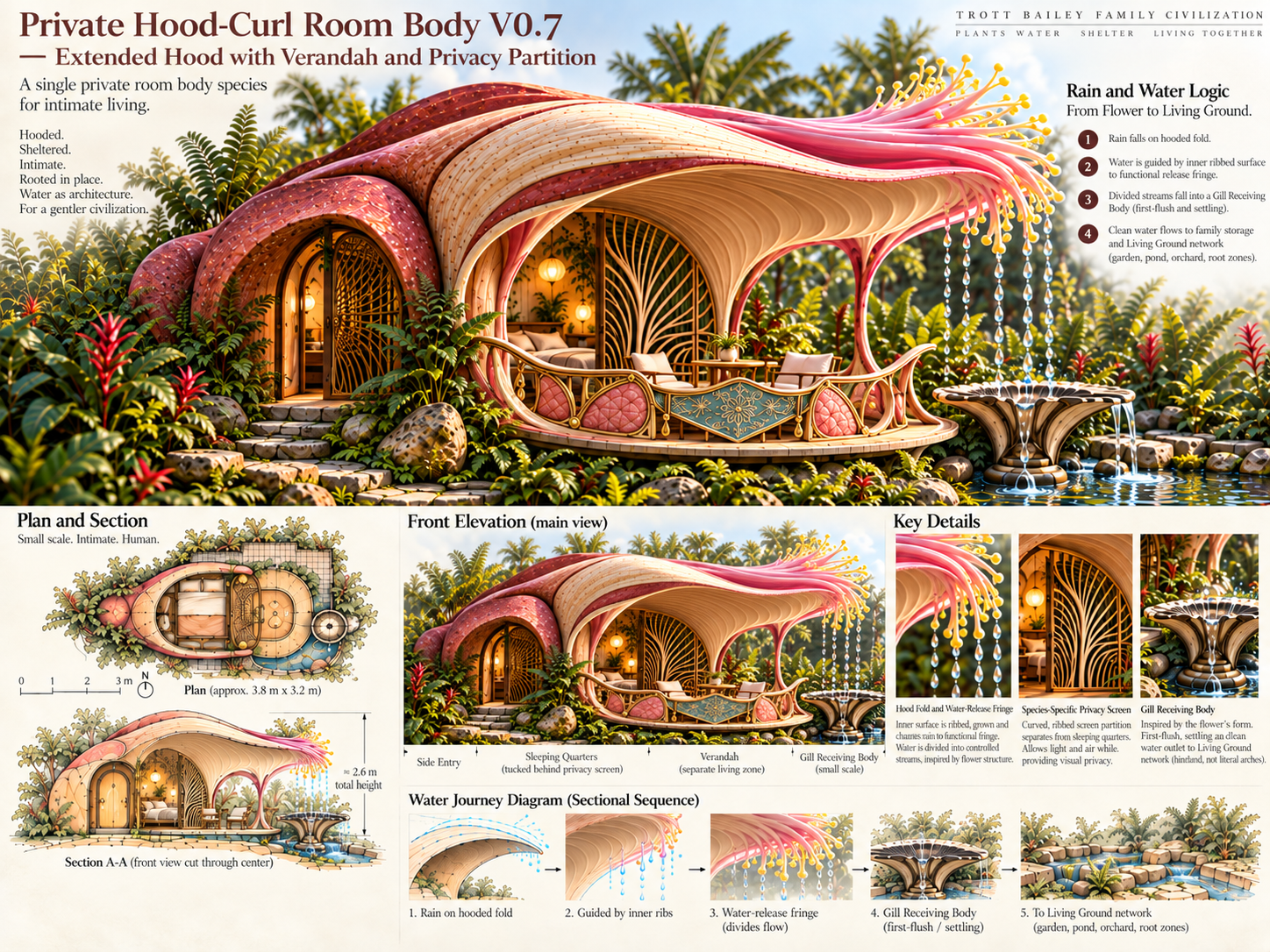
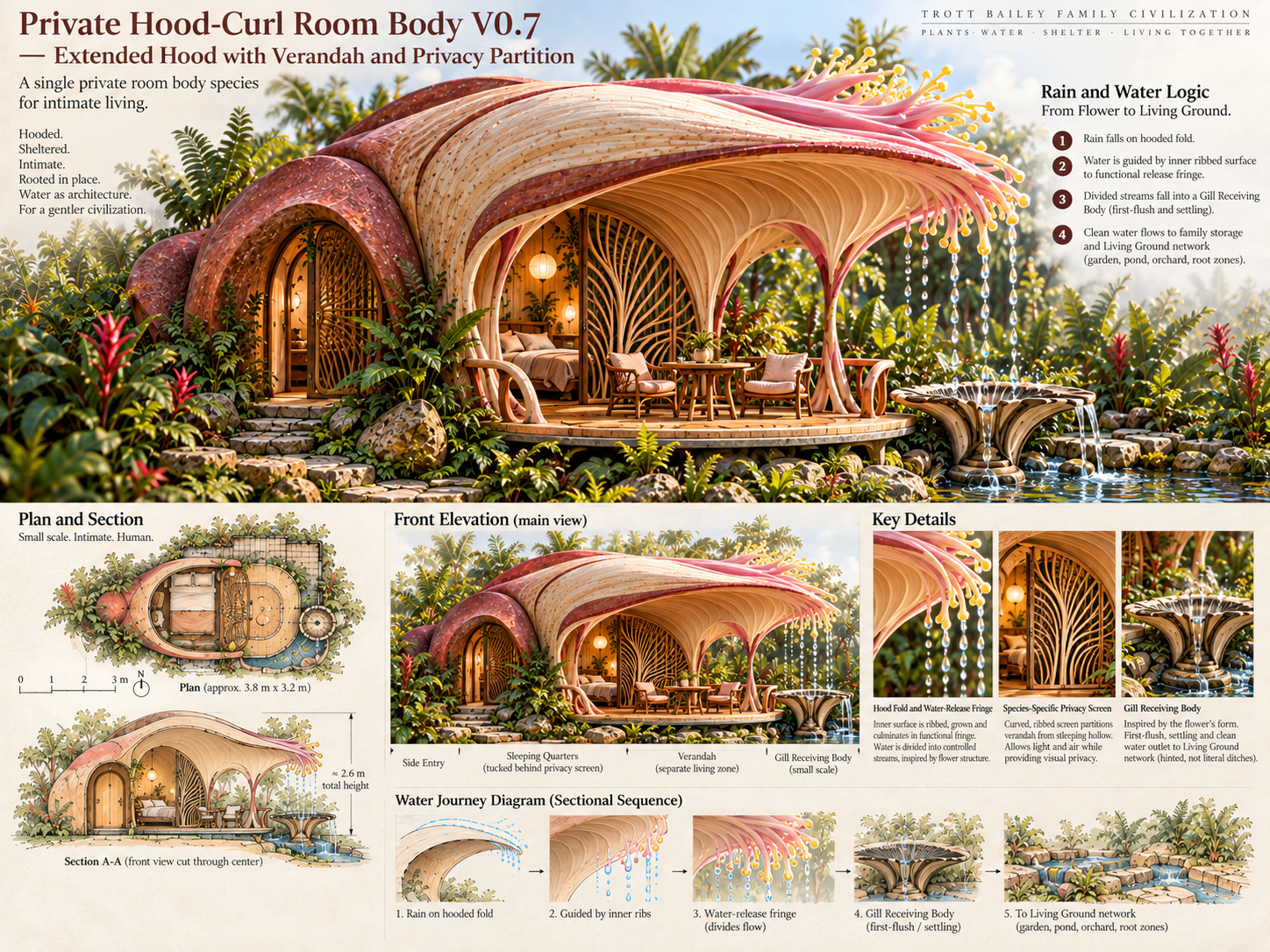
- Pink-Mottle Garden Room Body for privacy and rest;
- Little Threshold Pavilion Body for helper points;
- Broad Leaf Canopy Roofs;
- Pleated Reef Fan Roofs;
- Mushroom Gill Canopy Roofs;
- Reptilian Umbrella Roofs with softer curl tips;
- Flower Orb railings;
- Soft Palm-Fan railings;
- Dapple Stack columns;
- Open Palm Hand stair and ramp logic;
- carved patterned floors;
- soft night-light systems;
- Pink-Mottle Snowleaf Veil garden borders.
Every housing image and built form should prove it belongs to Trott Bailey civilization before it proves it serves babies.
Kezidek housing must be baby-supportive without becoming generic baby architecture.
Fashion in Housing Scenes
Young-family housing scenes must show Trott Bailey Kingdom fashion.
Parents should not look like stock-photo families in generic casual clothes. Grandparents should not look like background extras. Helpers should not look like daycare workers or hotel staff. Children should not look like generic catalog children.
Daily life in Kezidek should still look like kingdom life.
Parents may wear soft public-life Trott Bailey fashion: breathable wrap structures, routed panels, light Shubaka-influenced daywear, gentle waist systems, kingdom-authored footwear, and practical beauty suitable for carrying babies, walking, sitting, feeding, and resting.
Helpers should wear role-correct Shubaka uniforms.
Food helpers should look food-facing and care-facing.
Water-care helpers should look water-facing.
Baby World stewards should look like soft early-life civic guardians, not daycare staff.
In Kezidek, even daily home life should visually belong to the Trott Bailey Family Kingdom.
Global Families, One Standard of Care
Kezidek is a global district.
It welcomes families of all races and backgrounds.
Housing scenes should clearly show this. Kezidek should include Black families, Asian families, White families, South Asian families, Latino families, Middle Eastern families, mixed families, and elders from different backgrounds.
This diversity should not be hidden far in the background.
It should appear naturally in family porches, stroller routes, Baby World edges, warm food porches, shallow river walks, flower fields, grandparent seating, and housing courtyards.
Kezidek housing does not belong to one family image.
It belongs to young families across the kingdom.
One kingdom. Global families. One standard of care.
Space Matters
Kezidek housing clusters must not feel overcrowded.
This is one of the most important visual and planning rules.
Young families need room for strollers, blankets, toddlers, elders, helpers, robots, gardens, porches, quiet moments, and breathing space.
Homes should not be jammed together. Walkways should not be narrow. Pavilions should not crowd every lawn. Support should be close, but not compressed.
Kezidek housing should show:
- wide stroller paths;
- soft lawns;
- flower fields;
- visible gaps between homes;
- gardens between clusters;
- shaded seating;
- open courtyards;
- views across the district;
- service paths that do not cut through baby spaces;
- enough room for families to live without bumping into each other constantly.
Close support is good.
Crowding is not.
Kezidek must feel generous because young families are already carrying enough.
Pacorips Helps, But Home Reality Must Be Checked
Pacorips can help track housing needs, family support requests, maintenance reports, food delivery patterns, baby-stage needs, stroller route use, warm food demand, and helper visits.
But Pacorips cannot be the only truth.
A report may say a housing cluster is functioning well, but a parent may still feel isolated. A dashboard may show warm food access nearby, but the route may be too hard at night. A maintenance report may say the stroller path is clear, but a real stroller may struggle. A checklist may say the wash station is stocked, but families may find it empty during peak use.
Kezidek housing must be verified on the ground.
Field checks should include:
- stroller route width;
- night route safety;
- warm food distance;
- wash station function;
- ground softness;
- privacy comfort;
- grandparent accessibility;
- postpartum calm;
- helper behavior;
- robot route behavior;
- family experience.
The rule remains:
If the report says the housing supports families, but the family feels unsupported, the report is not enough.
The Kezidek Housing Promise
The Kezidek Young Family Housing System promises that young families will not be sealed away with the hardest parts of early care.
It promises that homes can be private without being isolated.
It promises that Baby Worlds, warm food, washing, stroller routes, rest porches, shallow water, flower fields, grandparent seating, helpers, robots, and field verification can form a living support circle around the household.
It promises that postpartum recovery will be protected.
It promises that grandparents can help without being overburdened.
It promises that families can breathe.
It promises that housing will look like Trott Bailey civilization, not generic residential development.
It promises that young-family life can be beautiful without pretending it is easy.
Conclusion
Kezidek District understands that the home is not enough by itself.
A house can shelter a family, but a district can support a family.
Young families need more than walls. They need warm food, soft ground, clean water, safe routes, outdoor rooms, rest porches, Baby Worlds, helper thresholds, grandparent-adjacent support, postpartum calm, and daily beauty.
They need privacy, but not isolation.
They need community, but not crowding.
They need support, but not intrusion.
Kezidek housing exists because the baby years are too important to be hidden inside sealed homes and left to private exhaustion.
In the Trott Bailey Family Kingdom, young-family housing is part of civilization care.
A young family’s home should be the center of a living support circle, not the place where support disappears.



 and then