




Observations of Sao Paulo City vs Prado Bahia, Both in Brasil


Two Brazils — Field Notes
Opening Principle
Human needs do not change.
Children still need movement, space to explore, things to touch, and environments they can safely engage with without constant correction.
Adults still need comfort, ease of movement, and daily environments that don’t constantly produce small friction.
What changes is not the need itself.
What changes is whether the environment is built around those needs, or whether it only functions around them in a loose, unplanned way.
This is what I’m looking at when I move between places.
Not culture as abstraction. Not development narratives. But whether daily life actually fits human behaviour in practice.
Prado — Daily Structure
I live in Prado, Bahia. It is small enough that most things are within walking distance: supermarket, feira, basic services, town centre.
But life does not concentrate into one centre. It spreads out into smaller zones.
From around 9am to 2pm, the house becomes hot and humid. It still functions, but it is not where life comfortably happens.
So life moves outward: – trees – river edges – shaded walking routes
Shade becomes more important than indoor space during the day.
Housing — Prado
The house does not regulate heat well. Ventilation is limited. Air movement is weak.
It functions as: – shelter – storage – night space
Not as a full daytime living environment.
Outside becomes the practical living space.
Childhood — Prado
Children are everywhere but not concentrated into shared environments.
They play in: – front yards – roads – near their own homes
Fences separate spaces, so even nearby children are visually close but structurally separated.
There is a park near the river, but it is limited by heat and lack of shade.
Ground-Level Reality — Prado
Daily attention is shaped by small environmental conditions: – garbage exposure before collection – mosquitoes (constant presence) – objects on the ground – informal outdoor setups (bikes, tools, loose items)
With a small child, this becomes continuous supervision rather than occasional caution.
Food System — Prado
There are two systems:
A nearby supermarket for convenience (meat, basics, hygiene products).
And the feira for better food quality and pricing.
The feira is about 1 hour 30 minutes round trip, so better food requires time and planning.
São Paulo — Structure
In São Paulo, the city is not uniform. It shifts depending on where you are.
There are highly structured zones: – malls – business districts – upscale neighbourhoods – parks like Ibirapuera – corridors like Avenida Paulista
These areas are controlled, maintained, and visually organised.
Outside these zones, conditions change quickly: – homelessness in certain central areas – litter and uneven sidewalks in some districts – block-to-block variation in maintenance and feel
The city operates as layers rather than a single consistent surface.
Culture and Visibility — São Paulo
São Paulo concentrates cultural visibility due to scale.Its cultural identity though seems largely invested in this modern push for LGBTQ. You would never guess that São Paulo had over three hundred years of history and culture…everything is LGBTQ this , LGBTQ that ……blah blah blah
You see: – LGBTQ+ spaces and public expression – large events like Pride – nightlife scenes – more visibly individual urban lifestyles
This is present, but unevenly distributed across the city.
Core Contrast
Prado is consistent across space.
São Paulo is variable across space.
Prado is evenly simple.
São Paulo is unevenly structured.
Closing
Both places function, but neither feels fully resolved around everyday human needs.
Prado struggles more with basic infrastructure fit: heat, housing comfort, waste containment, and environmental friction at ground level.
São Paulo operates with stronger systems, but uneven spatial experience creates sharp differences from zone to zone.
Different scale. Same underlying question: whether daily human life was actually the starting point of design.
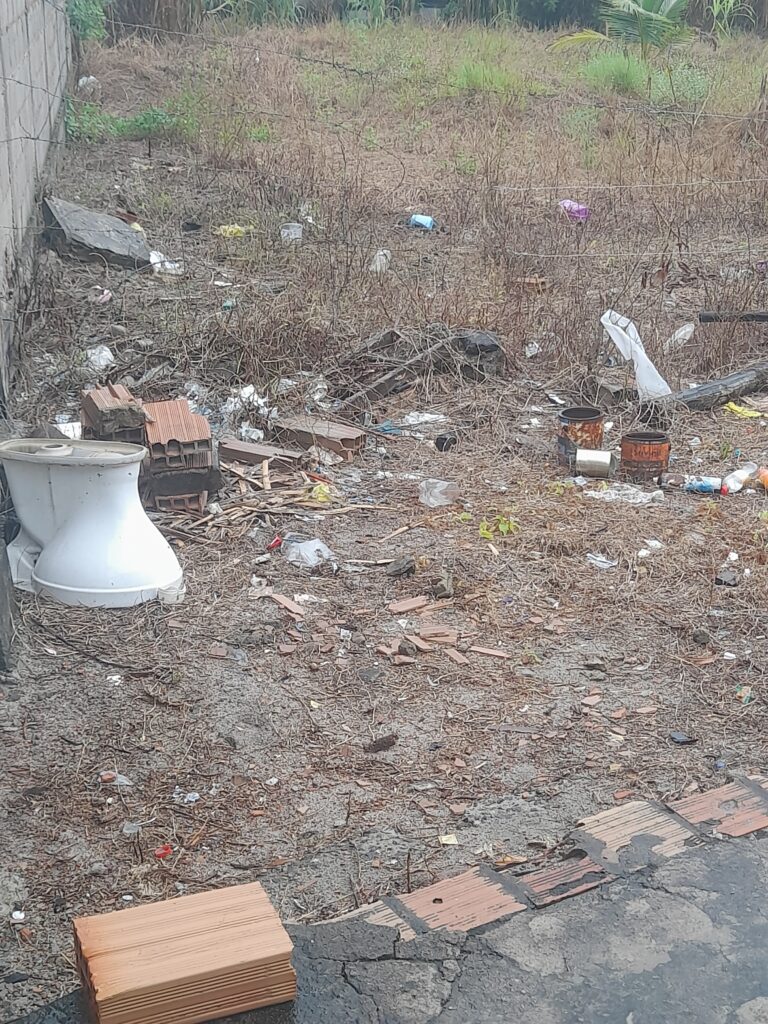
construction waste is one of the major contributors to garbage and the uglying of the community in Prado Bahia.
Conclusion: The planning was reactive, not purposeful or caring much about daily human life; As long as the basics are met: housing exists ( no care about whether it’s comfortable or not) and transport exists to bring the people to work, then everything else is luxurious additions. This is earth for you, a hot mess. Though I must say I have good wifi access here.
However while I’m currently living in this hot mess, Big King and I have taken the time to plant lots of pumpkins and watermelons in our backyard. 🤠



 and then






































