



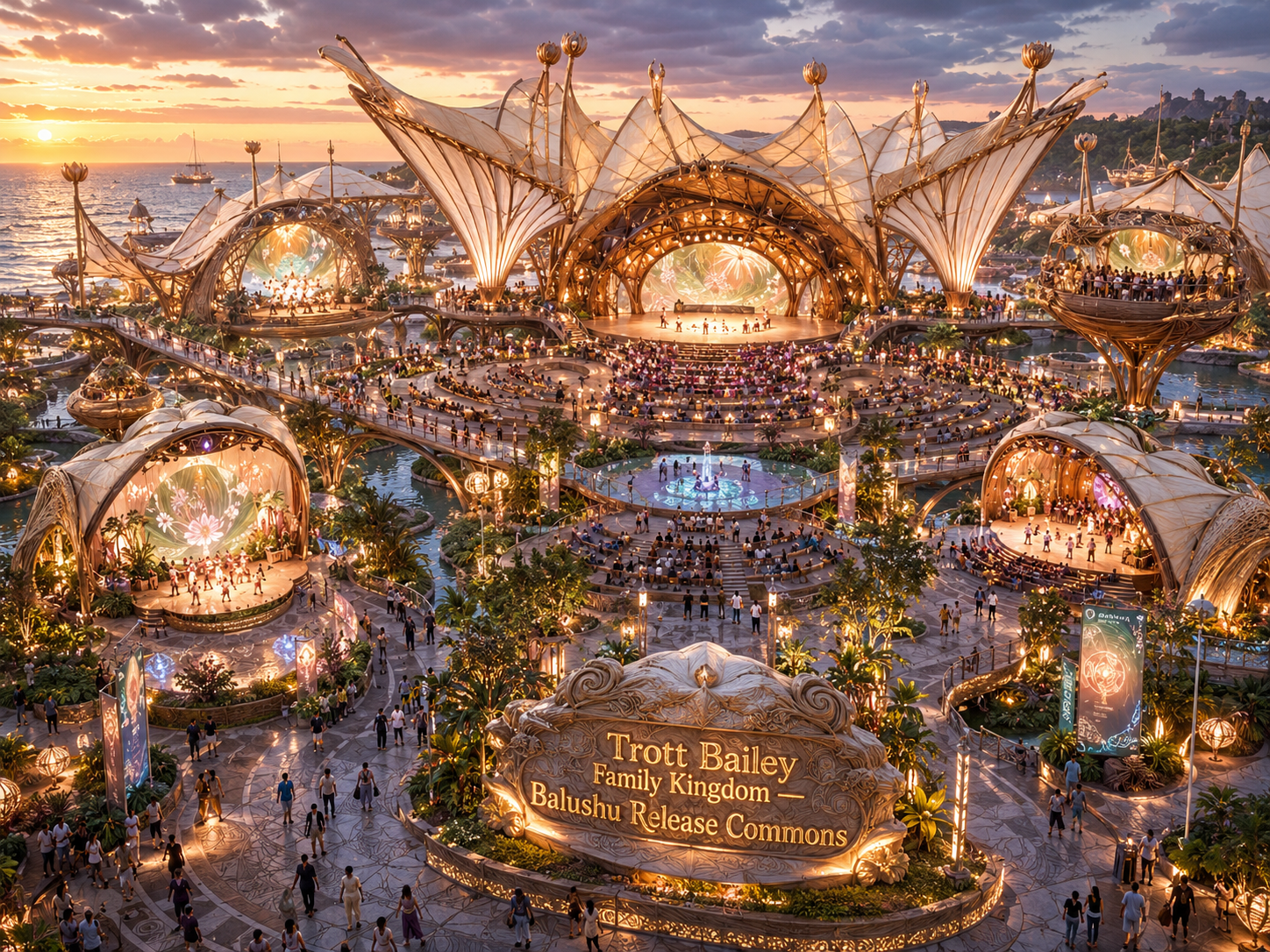
Release Commons V2: The Balushu Multi-Stage Bloom Network
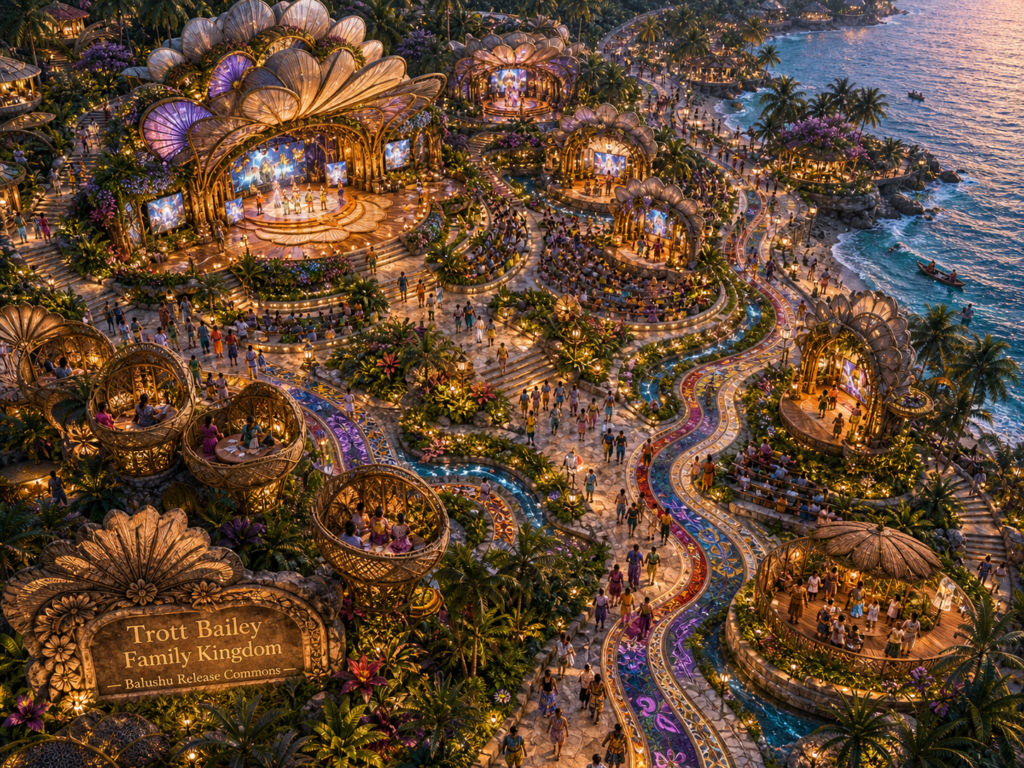
mini cluster stage in release common. Layout Idea visual 1
Release Commons V2: The Balushu Multi-Stage Bloom Network
The Release Commons is one of the most important public-life systems in Balushu.
It is where the Trott Bailey Family Kingdom comes to witness what has been created.
It is where major cultural works, inventions, fashion lines, music, food creations, Jubo reveals, sea technologies, district breakthroughs, and family honors can be presented before the people.
But Release Commons is not one stage.
It is not one crowd.
It is not one amphitheater.
It is not one arena.
Release Commons V2 is a multi-stage public witnessing landscape designed so the kingdom can reveal major works without crowd pressure.
Its purpose is not to force everyone toward one central point.
Its purpose is to multiply beauty, presenters, stages, audience comfort, and witnessing until public presentation feels abundant instead of stressful.
The Core Formula
The Release Commons V2 module is based on a clear capacity structure:
1 Release Commons = 10 stages × 5,000 people each = 50,000 people comfortably.
This means one Release Commons is not a single crowd of 50,000 people.
It is a larger public-reveal body made of ten connected stage gardens.
Each stage garden holds about 5,000 people comfortably.
Together, those ten stage gardens form one complete Release Commons.
This is important because it prevents the commons from becoming one giant crowd bowl.
The audience is broken into human-scaled groups.
Families have space.
Children have visibility.
Elders have calm seating.
Presenters have multiple places to work.
The kingdom can witness without being crushed.
Why the Release Commons Exists
The Release Commons exists to let the kingdom witness what has been made.
Keilah and Sherika are major creative hubs, every district can produce breakthroughs, and Balushu is where the kingdom comes to witness what has been created.
That means the Release Commons can receive creations from across the whole civilization.
It can support:
- mixed-use reveals
- artistic premieres
- fashion releases
- music and performance premieres
- food launches
- Jubo reveals
- invention demonstrations
- sea-technology reveals
- district breakthroughs
- family honor presentations
- child and family interpretation moments
- public celebration and education
The Release Commons turns presentation into a public-life experience.
People do not only sit and watch.
They arrive, gather, taste, lounge, listen, learn, walk, rest, and witness in comfort.
Presentation as Abundance, Not Scarcity
In many public event systems, scarcity creates pressure.
There is one main stage.
One main crowd.
One main performer or presenter.
One best seat.
One main viewing direction.
That creates stress.
People rush to arrive early.
Families compete for visibility.
Children get blocked.
Elders are pushed to the side.
Latecomers miss the experience.
Balushu does not need to work this way.
If one presentation system creates stress, the kingdom multiplies the presentation.
There can be multiple stages.
Multiple presenters.
Multiple trained teams.
Multiple presentation versions.
Multiple audience gardens.
Multiple screens, hearing nodes, and viewing terraces.
This is the heart of Release Commons V2.
Balushu does not crowd the kingdom around one stage. It multiplies public witnessing until the experience becomes comfortable.
The 5,000-Person Stage Garden
Each Release Commons contains ten stage gardens.
Each stage garden serves about 5,000 people.
But even inside one stage garden, the audience is not treated as one solid mass.
The 5,000-person group is broken into comfortable viewing layers.
Ground Seating: At Least 2,500 People
At least half of every stage audience should remain grounded.
This means at least 2,500 people per stage garden are seated or positioned on the ground level.
Ground seating is the safest, easiest, most flexible audience layer.
It is better for families with children.
It is better for elders.
It is better for babies and strollers.
It is easier to exit.
It is easier for helpers to support.
It is easier for food, water, hygiene, and comfort access.
Ground seating may include:
- ground bloom mats
- soft family lawns
- low garden terraces
- shaded picnic-style viewing
- curved ground seating rings
- stroller-friendly family zones
- child-safe front edges
- elder-accessible ground seating
The bulk of the audience stays grounded because the kingdom values safety, ease, comfort, and family access.
Raised and Special Seating: Up to 2,500 People
The remaining audience can be distributed into raised and special seating forms.
This includes:
- raised bloom nest terraces
- low stem platforms
- tall stem viewing pods
- den-like bloom chambers
- leaf-canopy integrated seating
- balcony nests
- family-viewing baskets
- elder calm platforms
- child viewing platforms
Raised seating is not the main mass of the audience.
It is specialized comfort, visibility, and experience.
The Release Commons should never turn into stadium seating.
The audience may rise like blooms, but the commons must never stack people like bleachers.
The locked rule is:
The bulk of the audience stays grounded. The audience may rise like blooms, but the commons must never become a stadium.
The Staggered Bloom Viewing System
The Staggered Bloom Viewing System is the seating and viewing language of Release Commons V2.
It is inspired by clustered wildflower stems where many small flower heads rise at different heights from one shared ground field.
This system allows the audience to be distributed into many small, comfortable viewing clusters instead of one crowd mass.
It includes:
- ground bloom mats
- low stem platforms
- raised bloom nest terraces
- tall stem viewing pods
- den-like bloom chambers
- small family viewing baskets
- child viewing terraces
- quiet elevated pods for elders and babies
The system solves several problems at once.
It improves sightlines.
It breaks up the crowd.
It gives families multiple comfort choices.
It gives children places to see.
It creates vertical richness without stadium behavior.
Its governing principle is:
The audience should rise like a field of blooms, not stack like a stadium.
The Pumpkin Leaf Canopy Shade System
The Release Commons also needs a major shade and comfort system.
This is the Pumpkin Leaf Canopy Shade System.
It is inspired by pumpkin-patch leaves spreading at different sizes, heights, and angles.
Instead of one giant roof, the system creates many breathable shade islands.
These canopies may cover ground seating, raised pods, presenter routes, promenades, child viewing edges, elder terraces, food pause courts, and public rest areas.
The material language should feel distinctly Trott Bailey.
The canopies may use:
- broad carved premium-oak leaf bodies
- visible vein structures
- emerald crystal vein inlays
- pearl or pear crystal edge nodes
- warm gold or bronze vine-rib framing
- root-like support stems
- curled leaf edges
- breathable gaps between canopy leaves
- different heights and angles
These canopies should not feel like shade sails, pergolas, mall canopies, stadium roofs, metal umbrellas, plastic leaf sculptures, or resort cabanas.
They should feel like crafted leaf architecture.
The governing rule is:
Shade in Balushu should spread like a living leaf field, not cover people like a stadium roof.
Canopy Veins as Intelligence Infrastructure
The veins of the Pumpkin Leaf Canopy Shade System are not decoration only.
They are part of the Release Commons intelligence and comfort network.
The veins may carry:
- seating ledges
- soft light channels
- directional pathfinding signals
- amplified hearing nodes
- sound distribution
- cooling mist lines
- rainwater drainage
- power and data routing
- Pacorips-linked comfort intelligence
- emergency guidance lighting
- visual-display edges for premieres
This means the shade system is alive with function.
It is not dead cover overhead.
It is seating, lighting, sound, guidance, cooling, data, and comfort woven into one architectural body.
The principle is:
Balushu shade should not be dead cover overhead. It should be a living comfort network.
The Ten-Stage Functional Model
The ten stages inside a Release Commons do not all have to perform the same role.
They can be configured differently depending on the type of premiere or presentation.
A useful default model is:
Stage 1 — Grand Opening Stage
This is the most ceremonial stage.
It may be used for the opening countdown, first reveal, public welcome, or major symbolic moment.
Stage 2 — Core Presentation Stage A
This stage presents the main subject to one audience cluster.
Stage 3 — Core Presentation Stage B
This stage may present the same subject or a parallel version to another audience cluster.
Stage 4 — Core Presentation Stage C
This stage allows another simultaneous or concurrent presentation instance.
Stage 5 — Demonstration / Detail Stage
This stage is for close-up explanation.
It may show invention parts, textile construction, food technique, system mechanics, garment details, or material behavior.
Stage 6 — Interaction Stage
This stage supports tasting, testing, hands-on experience, Jubo trials, material samples, or small demonstrations.
Stage 7 — Child / Family Interpretation Stage
This stage translates the same subject into a child-accessible, family-friendly public understanding.
Stage 8 — Sound / Atmosphere Stage
This stage may carry music, emotional interpretation, FlowMuse-linked performance, acoustic experience, or sound-based public atmosphere.
Stage 9 — Reflection / Question Stage
This stage allows guided questions, helper-led explanation, family discussion, public interpretation, or slower understanding.
Stage 10 — Finale / Sea / Procession Stage
This stage can host the final reveal, water-edge moment, Makji arrival, night glow, procession, or closing presentation.
Not every premiere uses the model literally.
The point is that the Release Commons has enough stage intelligence to adapt without pressure.
Presentation Modes
The Release Commons must support several ways of presenting.
The method should always be chosen based on what preserves beauty, comfort, ease, and abundance.
Simultaneous Presentation
Simultaneous presentation means multiple stage teams begin at the same time.
For example, at 8:00 PM, ten stages may begin the same premiere together after one coordinated countdown.
This gives every audience group an equal first experience.
The start can be shared, while still allowing each presenter team to remain alive, responsive, and slightly flexible.
Concurrent Presentation
Concurrent presentation means presentations happen during the same overall window, but not necessarily at the exact same second.
For example, from 8:00 PM to 10:00 PM, several stages may present the same subject, related subjects, or different parts of the reveal.
Some may overlap.
Some may begin later.
Some may finish earlier.
This allows choice and flexibility.
Staggered Presentation
Staggered presentation means stages begin at planned intervals.
For example, Stage 1 may begin at 8:00, Stage 2 at 8:15, Stage 3 at 8:30, and so on.
This is useful when audiences arrive at different times or when presenters need a softer flow.
Rotating Presentation
Rotating presentation means the presentation, presenters, or audience experience moves across stages.
A fashion reveal may begin at one stage, continue through another, and finish near the sea.
An invention presentation may begin with a main explanation, then move to a demonstration, then to an interaction stage.
But rotation is not mandatory.
The rule is:
If rotation creates stress, Balushu does not rotate. The kingdom multiplies the presentation.
Rehearsal and Presentation Training
Release Commons presentations must feel abundant, not fragile.
They should not depend on one presenter, one route, one stage, or one perfect sequence.
Presentation teams rehearse in two phases.
Shared Rehearsal Phase
All presentation teams rehearse together first.
This phase establishes:
- shared message
- shared quality
- shared safety
- shared pacing
- shared visual standard
- shared emotional tone
- shared public explanation
- shared emergency and timing protocols
Independent Stage Rehearsal Phase
After shared rehearsal, each team practices independently at its own assigned stage.
This phase allows each team to adjust to:
- stage shape
- sound behavior
- visual systems
- stage-specific routes
- local helper teams
- audience flow
- props, garments, tools, food, or demonstration materials
This creates unity without dependency.
The principle is:
Simultaneous and concurrent presentations are independent of each other. A delay or variation in one stage does not break the whole premiere.
Presenter Movement System
Presenters should never have to fight through public crowds.
Each Release Commons needs a strong behind-the-scenes presenter network.
This network may include:
- screened garden service roads
- underground or semi-underground connector paths
- shaded backstage paths
- small quiet transport carts
- prop and garment carts
- presenter rest rooms
- quick-change chambers
- holding rooms
- technical support pockets
- food and hydration support for presenters
- direct stage access points
The presenter movement network connects all ten stages.
The public does not see struggle, rushing, or disorder.
Presenters move gracefully because the system behind them is strong.
Small Presenter Carts
The Release Commons also needs a small transport-cart branch for presenters and presentation materials.
These carts may carry:
- presenters
- models
- musicians
- assistants
- costumes
- instruments
- invention parts
- food samples
- Jubo objects
- display tools
- demonstration materials
They should be quiet, compact, beautiful, and Trott Bailey-designed.
They should not look like golf carts.
This is an outstanding future design branch:
Release Commons Presenter Cart / Service Cart Design.
Visual and Hearing Technology
No one should miss a premiere because they are not close to the stage.
The Release Commons must make every audience cluster feel connected to the presentation.
Visual Systems
Visual support may include:
- large petal screens
- canopy-vein display strips
- projection petals
- stage-side display leaves
- floating water screens where suitable
- close-up camera feeds
- night-glow visual surfaces
- child-height viewing screens
- den-chamber internal displays
Hearing Systems
Hearing support may include:
- amplified hearing nodes in canopy veins
- Flower Orb speaker nodes
- pod-integrated sound ribs
- directional sound petals
- low-noise assistive listening zones
- vibration-floor options in sound stages
- caption and display support for accessibility
The goal is not loudness.
The goal is clarity.
The principle is:
Every audience cluster should feel close to the presentation, even when physically distributed.
Crowd Comfort and Exit Logic
The Release Commons must be beautiful, but it must also release people safely.
Every stage garden must have multiple exit choices.
Ground Seating Exits
Ground seating should connect to:
- side promenades
- shaded garden paths
- hydration edges
- hygiene pavilions
- quiet return paths
- wide ring circulation
- emergency service routes
Raised Seating Exits
Every raised pod or bloom nest should have:
- at least two normal exits
- one primary stair or ramp
- one secondary descent route
- a helper-visible landing area
- clear light guidance
- no dead-end high-capacity pods
Raised seating should be special, but never risky or trapped.
Emergency Descent Systems
Raised seating needs graceful emergency descent options.
These systems should feel like part of Trott Bailey architecture, not ugly emergency add-ons.
Petal-Drop Stair Fans
Petal-Drop Stair Fans are folded stair panels hidden under pod or canopy edges.
In normal use, they read as part of the architecture.
When needed, they deploy downward like opening petals, creating multiple wide descent paths.
They are useful for fast controlled exit and surge release.
Root-Slide Descent Channels
Root-Slide Descent Channels are emergency slide-like descent channels built into root or vine supports.
They are not amusement slides.
They are controlled, padded, gently curved, lit, and helper-supervised.
They are useful for fast descent from elevated bloom pods, especially for children or emergency overflow.
Leaf-Rib Descent Stairs
Leaf-Rib Descent Stairs use large canopy ribs as stair routes.
They integrate descent into the Pumpkin Leaf Canopy structure itself.
They can be used for everyday movement and emergency guidance.
Bridge-to-Ground Escape Web
The Bridge-to-Ground Escape Web connects raised pods laterally to neighboring pods and down to multiple ground landings.
This prevents single-exit dependence.
The best solution is a combination:
Normal stairs and ramps for everyday flow, Petal-Drop Stair Fans for surge release, Root-Slide Descent Channels for emergency descent, and Leaf-Rib Descent Stairs for integrated graceful movement.
Children, Families, Elders, and Babies
The Release Commons must include the whole family body.
It cannot be designed only for adults who can stand, walk, hear, and wait easily.
Children Need
- child viewing edges
- child-height displays
- safe ground bloom mats
- parent-adjacent seating
- child-friendly sound levels
- Jubo and interaction moments
- helper-monitored routes
- soft decompression dens
Families Need
- ground seating clusters
- stroller routes
- nearby food and water
- bathroom access
- shade
- quick exit options
- seated and standing choices
Elders Need
- close ground seating
- calm terraces
- shaded paths
- assisted hearing
- smooth ramps
- gentle exits
- low-noise zones
Babies Need
- quiet den chambers
- nearby nursing and feeding support
- baby changing pavilions
- shade
- calm routes away from high sound
The rule is:
The Release Commons succeeds only if families can stay comfortably for long premieres without being exhausted.
Food, Water, Hygiene, and Rest
Each stage garden should have a support ring.
People should not have to leave the whole commons to meet basic needs.
Food
- light tasting nodes
- dessert stations
- fruit cups
- milk treats
- small pastries
- event-specific tasting samples
Water
- beautiful hydration points
- child-height water access
- mobile helper drink service
- cooling water stations
- fruit-water nodes
Hygiene
- distributed hygiene pavilions
- baby changing
- handwashing
- clothing refresh
- sea-edge rinse pavilions for coastal commons
Rest
- quiet benches
- shaded pause courts
- den spaces
- elder calm terraces
- small lounging pockets
Support must be near, but never visually ugly.
The Service Shadow Network
Every Release Commons is supported by a hidden disciplined system.
This Service Shadow Network handles:
- food replenishment
- waste-to-garden routing
- water supply
- hygiene pavilion servicing
- cleaning
- presenter movement
- prop movement
- emergency access
- medical support
- helper deployment
- stage technology support
- animal support if relevant
- sea-edge support if relevant
Service routes should be behind stages, under terraces, screened by gardens, integrated into canals, and wide enough for carts.
They should be beautiful when visible, but they should not dominate the public experience.
The rule is:
The public sees effortless beauty because the Service Shadow Network carries the load.
The Sea-Edge Release Commons Variant
Balushu also needs a sea-edge version of the Release Commons.
This version is especially important for sea-related premieres and water-based public reveals.
It can be used for:
- Makji reveals
- public sea transport inventions
- Ulanzi sea knowledge
- marine safety systems
- water stewardship innovations
- fishing and marine abundance systems
- floating architecture systems
- sea-energy systems
- ocean learning
- marine animal care demonstrations
Required sea-edge elements include:
- stages extending into the sea
- wide pier-stage platforms
- floating sea commons
- floating viewing decks
- Makji arrival routes
- Public-Life Makji viewing loops
- water demonstration basins
- sea rescue support
- shoreline audience terraces
- child-safe water edges
- large public sea transport access
In this variant, the sea is not background.
The sea becomes a presenter.
The Inland Release Commons Variant
Inland Release Commons are more garden, orchard, tasting, fashion, music, invention, and public-culture oriented.
They can be used for:
- fashion premieres
- music releases
- food reveals
- Jubo launches
- district breakthroughs
- material and garment demonstrations
- family honors
- cultural works
- child and family public releases
- technology demonstrations that do not require water
Required inland elements include:
- central garden stages
- orchard amphitheater slopes
- Staggered Bloom Viewing clusters
- Pumpkin Leaf Canopy fields
- shaded promenade runways
- food and tasting rings
- sound and vibration chambers
- den-like quiet viewing
- service roads behind stage gardens
Network Scale
A single Release Commons can hold 50,000 people comfortably.
But Balushu does not depend on one Release Commons.
Balushu can include many Release Commons across a larger Release Commons Network.
For example:
200 Release Commons × 50,000 people = 10 million people of comfortable theoretical viewing capacity.
Not every commons has to be active the same way every day.
Some may be active.
Some may be resting.
Some may be rehearsing.
Some may host smaller events.
Some may absorb overflow.
Some may be dedicated to children and families.
Some may be assigned to sea events.
Some may be assigned to technical demonstrations.
Some may be assigned to music, fashion, or night-buzz events.
The network creates choice and abundance.
Types of Release Commons
The Release Commons Network can include different commons types.
Grand Release Commons
Ceremonial, large, and used for major kingdom-wide releases.
Sea-Edge Release Commons
Used for water inventions, Makji reveals, floating platforms, marine demonstrations, and sea-related public life.
Garden Terrace Release Commons
Family-centered, orchard-backed, soft, shaded, and suited to food, music, cultural works, and gentle public witnessing.
Child-Family Release Commons
Designed for child interpretation, Jubo reveals, family interaction, and safe public wonder.
Technical Demonstration Commons
Used for Big King inventions, systems demonstrations, software/hardware releases, and district breakthroughs.
Sound / FlowMuse Release Commons
Designed for music, vibration chambers, acoustic gardens, and emotional sound-based public life.
Night-Buzz Release Commons
Designed for fashion, dessert routes, night glow, music, public elegance, and dressed-up evening releases.
Animal / Food Release Commons
Designed for dairy, fiber, egg gardens, food systems, animal-care demonstrations, and living-abundance presentations.
Visual Identity Rules
A Release Commons should visibly show its difference from ordinary event architecture.
It should show:
- multiple stage gardens
- no single crowd bowl
- ground seating as the dominant audience layer
- raised bloom viewing clusters
- carved oak pumpkin-leaf canopies
- emerald and pearl crystal vein intelligence
- screens and hearing nodes integrated into architecture
- wide routes
- hidden service support
- children and elders clearly accommodated
- direct water relationship for sea-edge commons
- Trott Bailey fashion visible on people
- beauty without overcrowding
It should avoid:
- stadiums
- bleachers
- metal scaffolding
- giant concert arenas
- theme-park festival courts
- Las Vegas show plazas
- generic amphitheaters
- futuristic sci-fi event pods
- dense crowds
- one main stage for everyone
Generation-Ready Visual Brief
For future image generation, the Release Commons V2 visual should emphasize:
A 50,000-person Release Commons module made of 10 stage gardens, each serving 5,000 people. At least half of each audience remains grounded in ground bloom mats and soft family lawns, while the rest are distributed into raised bloom nests, den chambers, low stem terraces, tall stem viewing pods, and leaf-canopy integrated seats.
The image should show multiple stages operating across one connected public landscape, carved premium-oak pumpkin-leaf shade canopies with emerald and pearl crystal veins, integrated lights, sound nodes, guidance, cooling, and intelligence networks.
It should include wide promenades, backstage presenter roads with small carts, screens, amplified hearing nodes, family terraces, child viewing edges, elder calm terraces, food and water support rings, and clear exit logic.
The sea-edge version should include stages extending into the sea, floating sea commons, Makji arrival routes, floating viewing platforms, and water demonstration basins.
The audience should rise like blooms, shaded by living leaf fields, never stacked like a stadium.
Final Blueprint Statement
The Release Commons V2 is a repeatable multi-stage public-reveal module for Balushu.
Each commons holds 50,000 people comfortably through 10 stage gardens of 5,000 people each.
At least half of every audience remains grounded, while the rest are distributed into raised bloom pods, dens, leaf-canopy seats, and special viewing terraces.
Presenters move through a hidden road and cart network.
Presentations may be simultaneous, concurrent, staggered, or rotating, but only if the method preserves beauty, comfort, ease, and abundance.
Sea-edge versions include stages extending into the sea, floating sea commons, Makji arrivals, and water demonstration basins.
The final principle is this:
Release Commons does not crowd the kingdom around one stage. It multiplies beauty, presenters, stages, comfort, and witnessing until the public can gather without pressure.



 and then






































