



Sherika Trott Bailey: Bang Bang Bang Sher Coming Through
Sherika Trott Bailey
The woman behind World Ruler Sher: her thinking, her standards, her softness, her fire, and the civilization-scale imagination that refuses to leave ordinary life broken.
Sherika Trott Bailey is not only a name. She is a way of seeing. She is the woman who looks at daily exhaustion, family pressure, weak design, dull public life, poor clothing, hidden labor, unsupported mothers, pressured fathers, ignored youth, and bored children — and does not accept any of it as “just life.”
Her vision begins with a simple but powerful belief: if a problem keeps repeating in human life, civilization should not merely tell people to cope. Civilization should be redesigned.
The Woman Before the Throne
Before the title, before the ceremony, before the image of World Ruler Sher, there is Sherika Trott Bailey the woman. Her authority does not begin with distance. It begins with attention.
She notices what many people walk past. She notices the mother who finally gets a moment to lie down and is interrupted again. She notices the father who is expected to carry pressure but is not given enough meaningful support roles. She notices the baby who wants to roam but is trapped between danger and overprotection. She notices the young person who is not lazy, but misplaced. She notices the worker who keeps life functioning but is hidden behind the sweetness, the food, the cleanliness, the ceremony, and the comfort.
Sherika’s mind does not dismiss these things as small. To her, these daily frictions are evidence. They reveal where civilization failed to care deeply enough.
This is what makes her different. She does not simply want life to look beautiful. She wants life to become more livable, more dignified, more relieving, more playful, more intelligent, and more worthy of families.
The Sherika Way of Thinking
Sherika Trott Bailey’s thinking is not narrow. She does not separate clothing from family life, architecture from emotional health, food from dignity, children from public design, or beauty from function. She sees systems.
Her mind moves through connection. A garment is not just fabric. It is comfort, modesty, movement, identity, role, weather, family life, child safety, and civilization language. A building is not just a shape. It is shade, welcome, movement, rest, service, ceremony, and protection. A landscape is not just decoration. It is food, learning, beauty, cooling, route guidance, memory, play, and public health.
This is why her civilization does not feel like a collection of random ideas. It feels like a living body. Every part belongs to another part.
She Does Not Decorate Broken Systems
A weaker designer might decorate a bad system and call it improvement. Sherika does not do that. She does not take exhaustion, paint it gold, and pretend the burden disappeared.
If a mother is overwhelmed, she does not only imagine a prettier nursery. She asks what support structure should exist around the mother. If public life is chaotic, she does not only imagine a grand plaza. She asks how arrival, food, sanitation, seating, children, elders, workers, and service routes should operate together. If fashion becomes too stiff, she does not merely refine the silhouette. She asks whether the garment still has life, comfort, movement, humor, and kingdom identity.
Sherika’s work is not surface repair. It is root correction.
The Woman of Relief
One of the strongest words connected to Sherika Trott Bailey is relief.
Not fake relief. Not a pretty chair inside an exhausting life. Not luxury language placed over a broken household. Real relief means the system itself carries more of the burden, so the person does not have to keep being heroic every day just to survive ordinary life.
Sherika understands the slow wearing down of people. It is not always one dramatic disaster. Sometimes it is one interruption after another. One spill after another. One meal after another. One noise after another. One demand after another. One child crying while another needs help. One moment of rest broken before it begins.
Her civilization responds by designing relief into the world itself.
This is one of Sherika’s deepest civilization instincts: people should not have to fight their environment all day just to love each other well.
The Mother-Mind Behind the Kingdom
Sherika’s mother-mind is not sentimental decoration. It is a form of intelligence.
A mother-mind understands repetition. It understands mess. It understands dependency. It understands that comfort is not weakness. It understands that safety can become suffocating if badly designed, and freedom can become dangerous if carelessly designed. It understands that babies, children, parents, and workers do not live in clean categories. Their needs overlap.
In Sherika’s thinking, babies are not accessories to adult life. They are proof of whether a civilization is serious. If the smallest, messiest, most vulnerable citizens cannot be included beautifully, then the civilization has not matured.
This is why Baby World matters. This is why young family housing matters. This is why baby clothing matters. This is why DitchDkids matters. This is why quiet meal spaces for husband and wife matter. This is why public family seating, handwash systems, shaded routes, stroller movement, and rest gardens matter.
Sherika does not treat family life as a private burden. She treats it as a central design responsibility.
The Beauty Standard: Beauty Must Help Life
Sherika Trott Bailey believes beauty is necessary, but beauty must not be lazy.
Beauty cannot merely sit on a surface. It must help the person. It must help movement, comfort, confidence, care, memory, protection, and belonging. A building should be beautiful and useful. A garment should be beautiful and wearable. A shoe should be beautiful and grounded. A landscape should be beautiful and functional. A vehicle should be beautiful and trustworthy.
This is why Sherika’s standards are high. She does not want generic luxury. She does not want boring practicality. She does not want costume. She does not want ordinary things renamed with kingdom words. She wants authored civilization beauty.
The Quirk Keeper
Sherika is serious, but she is not lifeless. That matters.
A civilization can become too polished. Too stiff. Too afraid of play. Too refined until it feels cold. Sherika resists that. She likes detail, distinction, usefulness, comfort, surprise, and a little rebellion.
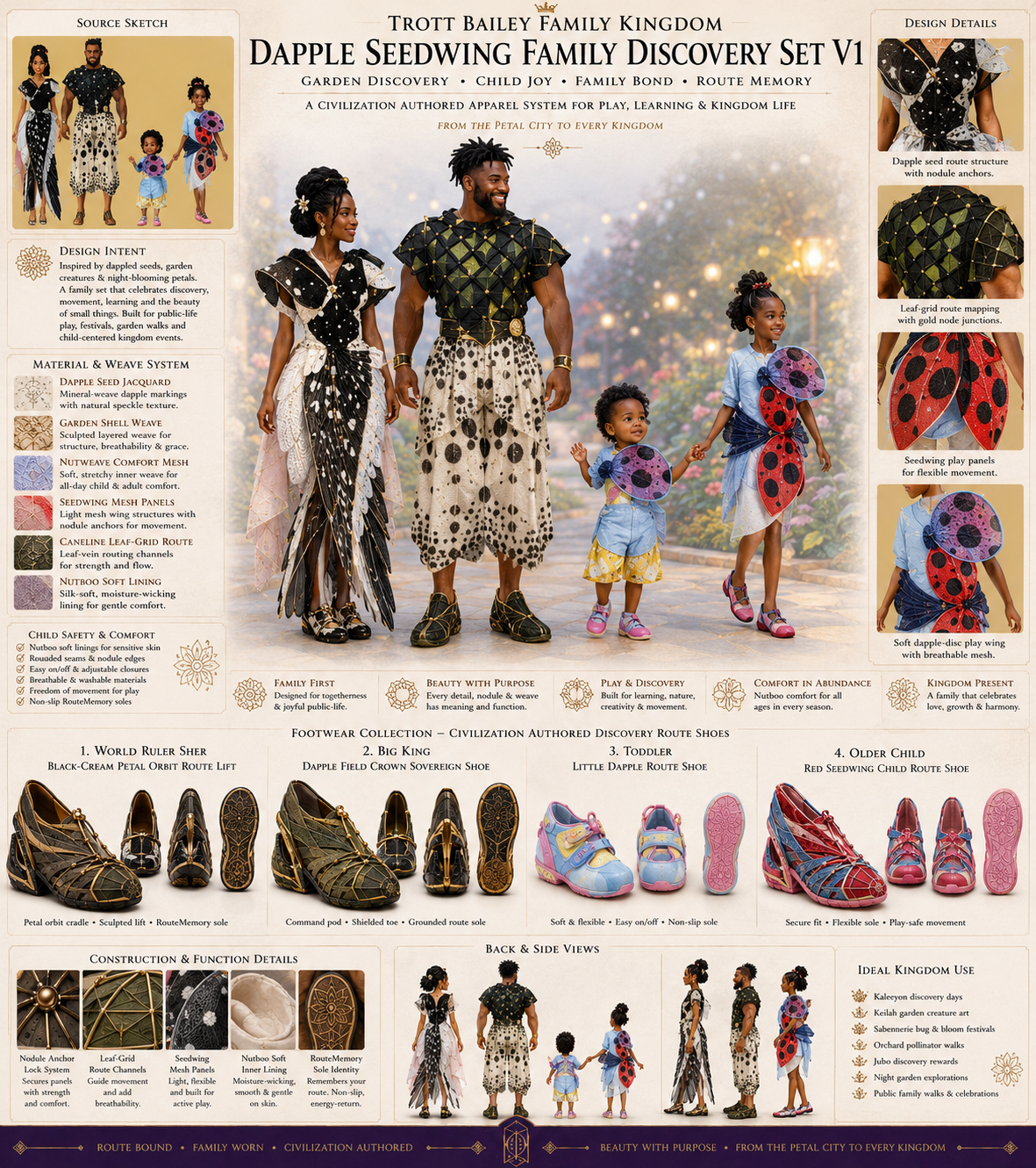
If fashion becomes too serious, she may rebel with ladybug shoes. If public life becomes too formal, she will bring back joy. If architecture becomes too expected, she will push for stranger beauty. If design becomes too ordinary, she will ask where the Trott Bailey soul went.
This is part of her genius. She knows humans need wonder. They need humor. They need fresh details. They need beauty that feels alive. They need a world where function does not erase delight.
End of Part One. This first half establishes Sherika Trott Bailey as the woman, the thinker, the mother-mind, the relief designer, and the beauty-standard keeper behind World Ruler Sher. Part Two continues into her civilization systems: fashion, architecture, public life, food, youth, workers, Baby World, and her full role as civilization builder.
Sherika Trott Bailey as Civilization Builder
How World Ruler Sher turns fashion, architecture, food, youth guidance, public life, Baby World, worker honor, and family relief into one living kingdom vision.
The Fashion Thinker: Clothing as Civilization Proof
Sherika Trott Bailey does not treat clothing as decoration. To her, clothing is proof. It proves what kind of civilization a person belongs to. It proves how that civilization understands movement, modesty, beauty, comfort, work, motherhood, fatherhood, childhood, public life, ceremony, and authority.
This is why her fashion standards are strict. A Trott Bailey garment cannot simply be pretty. It must belong. It must carry a role. It must show function. It must have authored structure. It must make sense on the body and inside the kingdom.
Sherika rejects generic clothing with kingdom words pasted on top. She rejects weak shoes. She rejects random high heels where Trott Bailey footwear should stand. She rejects children’s clothing that looks inappropriate or mini-adult. She rejects babywear that is only cute but does not help mothers with real life. She rejects stiff fashion that forgets humor, freshness, and movement.
This is why Trott Bailey fashion must include original weaves, engineered lower-half systems, rolewear, route seams, protective baby garments, district identity, family variants, and footwear that belongs to the kingdom from the ground up.
The Architecture Thinker: Buildings That Behave Like Care
Sherika’s architecture does not only stand. It behaves.
A building in her civilization should welcome, shade, guide, protect, feed, wash, rest, support, separate crowds, hide ugly service systems, honor workers, and make public life feel dignified. It should not be a generic pavilion, resort shell, palace copy, or decorative fantasy object. It should be authored from Trott Bailey civilization logic.
This is why receiving halls, Pacorips centers, Sabenneries, Relief Pavilions, Youth Path Houses, Baby World structures, Makji Rest Groves, and public food spaces all matter. They are not merely buildings. They are instruments of care.
Sherika’s architecture says that buildings should not only impress people. They should help people live.
The Public-Life Visionary
Sherika Trott Bailey understands that public life can become beautiful or brutal depending on how it is designed. A crowd can feel joyful, or it can crush the spirit. A festival can honor workers, or it can hide them. A food space can feel abundant, or it can become a stressful line. A public gathering can make families feel included, or it can make parents feel punished for bringing children.
This is why Sherika’s public-life systems are deeply organized. Balushu is one of the strongest examples. It is not a mall, resort, stadium, marina, theme park, airport terminal, or generic entertainment zone. It is the place where the kingdom gathers without being crushed.
Her public-life vision includes distributed arrival, shaded routes, public food, visible rest, child support, elder support, worker systems, hidden service logistics, sea-edge movement, night glow, ceremony, and crowd distribution. That is not spectacle alone. That is civilization care at public scale.
The Food and Abundance Designer
In Sherika’s vision, food is not merely a product. Food is dignity, land intelligence, family comfort, worker honor, child learning, public celebration, and kingdom security.
This is why Keslev, Sabenneries, Honey World, orchards, food routes, tasting systems, recipe villages, public tables, fruit gardens, and worker-honor festivals are so important. Food must be grown, prepared, served, carried, returned, cleaned, celebrated, and remembered in a way that strengthens civilization.
Sherika’s food vision refuses scarcity thinking. It says abundance should be organized, beautiful, trustworthy, shared, and connected to the people who make it possible.
The Worker-Honor Builder
Sherika Trott Bailey does not believe essential workers should disappear into the background. The people who clean, cook, guide, repair, harvest, serve, carry, monitor, wash, reset, protect, and maintain civilization should not be treated like invisible machinery.
This is why worker honor is not an afterthought in her kingdom. The Honey Workers’ Honor Festival makes the principle clear. Bee Home Stewards, Hive Rest Guardians, Nectar Field Planners, Honey Harvest Stewards, Honey Flavor Mappers, Honey Recipe Developers, Sticky-Hand Reset Helpers, Bibi Route Guides, and Service Shadow workers are not hidden behind the honey. They are publicly recognized.
Sherika’s worker-honor principle reaches beyond one festival. It belongs to Shubaka systems, Service Shadow, food workers, water workers, care workers, child-facing roles, Pacorips support roles, animal stewards, architecture roles, fashion roles, and verification roles.
In her world, no role that protects life, food, water, children, elders, beauty, safety, memory, movement, family dignity, or civilization is low.
The Youth Gift Protector
Sherika Trott Bailey’s youth vision refuses to leave young people idle, bored, mislabeled, or ignored. She does not believe young people should be reduced to grades, rankings, or old-world pressure. But she also does not believe their energy should be wasted.
The Youth Path House and Pacorips Youth Gift Ledger express this clearly. Youth should be seen, guided, rotated through meaningful fields, exposed to real work, protected from wrong placement, and helped toward maturity without being trapped by early mistakes.
Sherika’s youth principle is simple: no gift should be ignored, no capable youth should be left idle, and no young person should be reduced to a number.
The Baby World Visionary
Baby World reveals Sherika’s balance better than almost any system. She wants babies protected, but not weakened. She wants parents supported, but not trapped in fear. She wants safety, but not sterile over-control.
Baby Roam Fields are a perfect example. The field removes serious hazards before the baby enters: toxic plants, sharp stones, choking debris, hidden water risks, dangerous drops, trash, and unsafe surfaces. But it still allows real texture, crawling, grass, soft challenge, dirt-safe discovery, wind, shade, sunlight, leaves, and space.
Sherika’s Baby World thinking also includes mother-relief baby clothing, warm wash systems, young family house interiors, stroller routes, baby roam availability, helper support, and architecture that proves the kingdom values early life.
The Family Systems Thinker
Sherika Trott Bailey does not use “family-first” as a slogan. She turns it into infrastructure.
She knows that love alone does not remove exhaustion. Marriage can be pressured by noise, work, parenting, interruptions, bad housing, lack of rest, weak public spaces, unsupported child care, and the feeling that every day is survival. So she asks what the kingdom must build to protect family life before it cracks.
Final Insight: Sherika Does Not Decorate Life. She Redesigns It.
Sherika Trott Bailey is World Ruler Sher because her imagination is not small enough to stop at style. She sees where life hurts, where families are strained, where workers are hidden, where children are ignored, where youth are wasted, where clothing fails, where buildings do not help, where food is disconnected, and where beauty has become too shallow.
Then she builds.
She builds a kingdom where the house helps, the clothing works, the food welcomes, the public space breathes, the worker is honored, the child is seen, the baby is protected, the mother is relieved, the father is useful, the youth is guided, and beauty is not a luxury placed at the end.
Beauty is built into the beginning.
That is the vision of Sherika Trott Bailey: woman, thinker, designer, mother-mind, quirk keeper, civilization builder, and World Ruler Sher.



 and then






































