
The Keslev Staple Sovereignty Network: How the Kingdom Turns Crops Into Dependable Family Food
The Keslev Staple Sovereignty Network: How the Kingdom Turns Crops Into Dependable Family Food
A kingdom is not food-sovereign because crops grow in its fields.
A kingdom becomes food-sovereign when those crops are planted intelligently, harvested carefully, processed into usable forms, stored safely, distributed fairly, served publicly, protected for the future, and verified on the ground.
This is the work of the Keslev Staple Sovereignty Network.
Keslev District understands that staple foods are not ordinary foods. They are the backbone of family survival, public meals, children’s nourishment, food reserves, animal-feed boundaries, Sabennerie supply, and whole-kingdom stability.
Staples are the foods people return to again and again: grains, beans, roots, tubers, plantains, breadfruit, coconut, and the foundational crops that hold family life together.
If these foods are weak, the kingdom is weak.
If these foods are strong, processed, stored, verified, and accessible, families can stand with confidence.
The Keslev Staple Sovereignty Network exists so staple foods do not remain raw abundance in the field, but become dependable family food in real life.
Why Staple Sovereignty Matters
Many food systems celebrate harvest without asking what happens next.
A field may be full. A storage house may look impressive. A country may produce millions of tons of grain. A district may claim abundance. But if families cannot access dependable staple foods, the food system has failed at the household level.
Keslev refuses to separate production from family access.
It asks practical questions:
- Can families actually eat this crop?
- Can it be processed into forms households can use?
- Can babies, toddlers, elders, and public food centers use it safely?
- Can it become porridge, flour, meal, mash, roasted sides, breads, bowls, soups, travel foods, or family baskets?
- Can it be stored without spoilage?
- Can the seed line be protected?
- Can Sabenneries depend on it?
- Can it support scarcity response?
- Can it feed animals without stealing food from families?
- Can Pacorips reports about it be verified in real fields and storage houses?
This is what makes Keslev different.
It does not romanticize growing food.
It builds the systems that make food dependable.
The Staple Sovereignty Principle
The Keslev Staple Sovereignty Network is built on one principle:
A staple is not secure until families can access it, Sabenneries can serve it, children can be fed by it, reserves can protect it, and the kingdom can plant it again.
This means a staple crop must move through several stages of responsibility.
It must be planted. It must be verified. It must be harvested. It must be sorted. It must be processed. It must be stored. It must be distributed. It must be served. It must be adapted. It must be protected for the future.
No single step is enough.
A field without processing can leave families with crops they cannot easily use.
Processing without storage can create waste.
Storage without distribution can create hidden hunger.
Distribution without seed protection can endanger the next season.
Public meals without field verification can become fragile.
Keslev’s job is to hold the whole chain together.
The Network, Not One Warehouse
The Staple Sovereignty Network is not one giant warehouse.
It is a kingdom-wide system of linked food engines, processing houses, storage courts, seed sanctuaries, Sabennerie supply docks, field verification routes, family basket channels, animal feed boundary points, and district-specific food connections.
It includes official staple houses such as:
- Kornara / Kingdom Cornworks;
- Kingdom Riceworks;
- Kingdom Beanworks;
- Kingdom Wheatworks;
- Breadfruit Works;
- Plantain Works;
- Coconut Works;
- Sweet Potato Works;
- Taro Works;
- Yam Works;
- Manioc / Cassava Works.
Each system has its own crop logic, food uses, safety concerns, processing needs, storage requirements, public meal role, and district connection.
But together they form a kingdom foundation.
One crop may feed a meal. A staple network feeds a civilization.
Kornara / Kingdom Cornworks
Kornara, also known as the Kingdom Cornworks system, treats corn as a civilization grain.
Corn must not become a commodity first while families struggle to access family-sized corn foods.
Kornara exists to prevent that failure.
It receives, sorts, dries, stores, mills, flakes, puffs, roasts, reserves, protects seed, supports Sabenneries, prepares family corn baskets, and controls the boundary between human food and animal feed.
Kornara may produce:
- family-sized cornflakes;
- plain and lightly sweetened cereals;
- cornmeal;
- porridge meal;
- roasted corn snacks;
- corn crackers;
- masa-style wraps;
- corn dumpling bases;
- child snack puffs;
- public meal corn bases;
- Makji travel corn packs;
- emergency grain reserves;
- animal feed only after human-food boundaries are protected.
Kornara’s law is:
Corn must feed the people first. Only after that should it feed the machine.
Kingdom Riceworks
Kingdom Riceworks protects rice as one of the kingdom’s most important bowl foods.
Rice is not only a side dish. It can become family bowls, baby transition foods, soft porridge, public meals, travel food, emergency reserves, postpartum bowls, warm food for Kezidek, and Sabennerie foundations.
Riceworks must manage:
- rice receiving;
- moisture verification;
- grain sorting;
- storage;
- milling;
- porridge preparation bases;
- soft baby-food stage support;
- public meal supply;
- family rice baskets;
- reserve rice protection;
- field-water verification where rice systems depend on wetland or irrigation logic.
Riceworks connects strongly to Kezidek because warm rice preparations can support babies, toddlers, nursing parents, postpartum families, grandparents, and tired caregivers.
It also connects to Sabenneries throughout the kingdom because rice can stabilize public meals when other foods fluctuate.
Riceworks turns rice from a harvested grain into a dependable bowl system.
Kingdom Beanworks
Kingdom Beanworks protects beans, peas, pulses, and related protein crops as food, soil support, and public meal foundation.
Beans are not only ingredients. They are part of the kingdom’s protein security.
They support family meals, soft soups, warm bowls, bean porridges, public Sabennerie meals, vegetarian or low-meat food systems, soil renewal, and animal feed balancing where appropriate.
Beanworks must organize:
- bean receiving;
- drying and storage;
- sorting;
- soaking and cooking pathways;
- soft bean food for young children when appropriate;
- bean flour or paste uses;
- Sabennerie soup bases;
- family bean baskets;
- seed protection;
- soil partnership tracking;
- protein planning across districts.
Beanworks helps the kingdom avoid overdependence on meat.
It also helps Keslev protect animal feed boundaries by strengthening human-accessible protein systems.
A kingdom that protects beans protects both the family bowl and the soil beneath it.
Kingdom Wheatworks
Kingdom Wheatworks protects wheat as a bread, pastry, noodle, porridge, flour, and public baking foundation.
Wheat connects especially to Big King District because Big King loves pastries and warm baked goods. But Wheatworks cannot exist only for pastry culture. Its first responsibility is the kingdom’s food foundation.
Wheatworks must support:
- flour milling;
- bread-making foundations;
- soft breads;
- public meal breads;
- porridge and soft food uses;
- noodle or flatbread systems where appropriate;
- family wheat baskets;
- Big King pastry supply after family and public food needs are protected;
- reserve flour or grain storage;
- seed protection;
- quality verification.
Wheatworks must balance delight and responsibility.
It can support pastries, ceremonial bakes, and district food beauty, but it must never forget family bread, public meals, and reserves.
In Keslev, even pastry begins with staple responsibility.
Breadfruit Works
Breadfruit Works makes breadfruit official as a major tropical staple.
Breadfruit is powerful because it grows on trees and can support many food forms: roasted, boiled, mashed, fried, dried, milled, chipped, baked, and served in public meals.
It can help diversify the kingdom away from narrow grain dependence.
Breadfruit Works should manage:
- breadfruit groves;
- harvest timing;
- ripeness sorting;
- roasting pathways;
- mash and bowl preparations;
- breadfruit flour or meal where appropriate;
- chips and travel foods;
- Sabennerie roasted sides;
- family basket formats;
- tree-crop resilience planning;
- excess preservation before waste.
Breadfruit should not be treated as a novelty.
It belongs among the kingdom’s serious staple foods.
Breadfruit Works protects the tree-grown side of staple sovereignty.
Plantain Works
Plantain Works protects plantains as a family food, roasting food, toddler food, public meal side, and district staple.
Plantains are flexible. They can be boiled, roasted, mashed, fried, steamed, baked, or served with beans, fish, meat, vegetables, or warm sauces.
Plantain Works should support:
- plantain grove planning;
- ripeness-stage sorting;
- green plantain uses;
- ripe plantain uses;
- roasting Sabennerie supply;
- toddler-safe soft plantain bowls;
- family meal sides;
- festival foods;
- drying or flour options where useful;
- excess redirection;
- field verification of grove health.
Plantain Works is especially important because plantains can feed public meals without requiring every family to cook from scratch.
They can also support Kezidek warm foods and Baby Food Transition systems when prepared safely for stage and texture.
Plantain Works turns a familiar food into a planned pillar of kingdom nourishment.
Coconut Works
Coconut Works protects coconut as food, drink, oil, milk, fiber, material, and district infrastructure.
Coconut is not only a tropical flavor. It can support water, coconut milk porridges, soft foods, desserts, oils, cooking fats, fiber systems, husk materials, bowls, and Kultan-linked water and food flow systems.
Coconut Works should manage:
- coconut groves;
- coconut water flows;
- coconut milk production;
- coconut oil production;
- coconut flour or meal where useful;
- coconut-based porridges;
- coconut desserts;
- coconut fiber and husk material use;
- Kultan water-food coordination;
- safe family distribution;
- zero-waste byproduct routing.
Coconut Works is especially important because coconut connects food sovereignty to material sovereignty.
The same crop can feed, hydrate, soften, preserve, carry, build, and support water-care systems.
Coconut Works protects one of the kingdom’s most multi-use food trees.
Sweet Potato Works
Sweet Potato Works protects sweet potatoes as a warm food, baby food, roasting food, reserve food, and public meal foundation.
Sweet potatoes are especially valuable in Kezidek because they can become smooth baby foods, soft mash, toddler bowls, postpartum recovery bowls, soups, porridges, and roasted family sides.
Sweet Potato Works should support:
- field planting and rotation;
- harvest timing;
- curing and storage;
- mash production;
- porridge support;
- roasting Sabennerie supply;
- baby food transition uses;
- toddler bowl preparations;
- family basket formats;
- public meal sides;
- reserve planning.
Sweet potatoes are not only comfort food.
They are a flexible staple that can support early life, public meals, and scarcity resilience.
Sweet Potato Works turns softness, warmth, and storage into food security.
Taro Works
Taro Works protects taro as a serious root staple that requires proper preparation.
Taro can be valuable in warm bowls, mashes, soups, family meals, and district food culture, but Keslev must treat it with discipline. It cannot be handled casually in baby spaces, edible wonder rings, or public food centers.
Taro Works should manage:
- taro planting;
- water-root field management;
- harvest verification;
- safe processing;
- proper cooking rules;
- family meal pathways;
- warm food uses;
- baby and toddler exclusion or careful stage rules where needed;
- Sabennerie preparation standards;
- field and kitchen verification;
- education for helpers and families.
Taro Works exists because important foods must be respected, not casually romanticized.
A crop can be nourishing and still require knowledge.
Taro Works teaches the kingdom that staple power must come with preparation discipline.
Yam Works
Yam Works protects yams as family food, storage food, public meal food, roasting food, mashing food, and seasonal staple.
Yams can support soups, mashes, porridges, roasted sides, family plates, festival meals, and reserve planning. They are important because they can add depth to the kingdom’s root and tuber foundation.
Yam Works should manage:
- yam barns;
- field planting;
- harvest timing;
- curing and storage;
- sorting by use;
- roasting pathways;
- mash and soup pathways;
- family basket formats;
- Sabennerie supply;
- reserve use;
- field verification.
Yam Works strengthens the kingdom by making root-food abundance dependable, not accidental.
Yam Works turns buried abundance into planned family nourishment.
Manioc / Cassava Works
Manioc / Cassava Works protects one of the most powerful and serious staple systems in Keslev.
Cassava can support flour, meal, breads, porridges, starches, family foods, public meals, travel foods, and reserve foods. But cassava must never be treated casually.
It requires strict safe-processing discipline.
Manioc / Cassava Works should manage:
- cassava planting;
- variety identification;
- harvest timing;
- safe peeling and preparation rules;
- proper soaking, fermenting, drying, cooking, or other required processing;
- separation of safe and unsafe stages;
- cassava flour and meal production;
- family food pathways;
- Sabennerie supply;
- byproduct use only where safe;
- helper training;
- field and processing verification.
Cassava is a food of power, but power without discipline can become danger.
This is why Cassava Works must be one of the most carefully governed staple houses in Keslev.
Cassava Works protects the kingdom by making sure a powerful staple is never separated from safe-processing knowledge.
Processing Is Part of Sovereignty
Keslev does not consider a staple secure just because it has been harvested.
Processing is part of sovereignty.
Corn must become meal, flakes, porridge, snacks, wraps, and public meal bases. Rice must become bowls, porridges, soft foods, and reserves. Beans must become soups, pastes, flours, stews, and protein systems. Wheat must become flour, bread, soft foods, and public baking foundations. Breadfruit, plantain, sweet potato, taro, yam, and cassava must become forms families can actually use.
Without processing, abundance can remain stuck in the field, silo, or storage house.
Keslev’s processing rule is:
A crop is not fully abundant until it has been transformed into forms families, children, Sabenneries, travelers, and reserves can use.
Family Baskets
The Staple Sovereignty Network should support family baskets.
These are not charity baskets. They are household-scale food access systems designed around real family use.
A family basket may include staple foods such as cornmeal, rice, beans, wheat flour, plantain preparations, sweet potato products, breadfruit foods, cassava flour where safe, coconut foods, or district-specific seasonal foods.
The contents should be scaled by household size, food needs, district conditions, and current abundance.
Family baskets help prevent a dangerous contradiction: a kingdom full of crops while households cannot access dependable staple foods.
No district may claim staple abundance while families lack family-sized staple foods.
Sabennerie Supply
Sabenneries are the kingdom’s public food centers, and the Staple Sovereignty Network helps keep them supplied.
Warm food Sabenneries need rice, cornmeal, sweet potatoes, taro, yams, beans, plantains, coconut, and other soft food foundations.
Roasting Sabenneries need plantains, breadfruit, sweet potatoes, yams, meats, vegetables, and other roast-ready foods.
Buffet Sabenneries need dependable staples for family meals.
Sit-down Sabenneries need quality ingredients that support calmer dining.
Tasting and voting Sabenneries need new foods from Keslev’s discovery systems.
Snack and dessert Sabenneries need safe surplus, fruit, grains, coconut, wheat, and district-specific specialty foods.
The network must coordinate all of this without leaving families behind.
Sabenneries are the visible food table. Keslev staple systems help keep that table real.
Children’s Food Systems
Staple sovereignty must protect children.
Children’s food systems include Baby Worlds, Baby Food Transition Counters, Kezidek Warm Food Sabenneries, toddler bowls, school-age foods, child joy foods, Jubo treats, and district food learning.
Keslev must ensure children are not fed only leftovers from adult food systems.
Staples should become child-appropriate forms:
- smooth porridges;
- soft mashes;
- toddler bowls;
- warm soups;
- mild bean preparations;
- soft rice bowls;
- corn puffs and child snacks;
- plantain and sweet potato toddler foods;
- safe family meal adaptations.
This does not mean all children eat the same foods.
It means the kingdom takes children seriously enough to process staples into forms they can safely use.
A food system that forgets children has already failed the future.
Seed Sanctuaries
Every major staple system needs seed protection.
Seed Sanctuaries preserve the kingdom’s ability to plant again.
They should protect:
- climate-adapted varieties;
- heirloom lines;
- high-nutrition varieties;
- drought-tolerant crops;
- wetland-adapted crops;
- colored corn and specialty grains;
- bean diversity;
- root and tuber propagation material;
- breadfruit and plantain line diversity;
- coconut varieties;
- safe cassava varieties and processing records.
Seeds and propagation material are not leftovers.
They are the kingdom’s future food memory.
If the kingdom eats the seed without protecting the future, it has mistaken hunger relief for food sovereignty.
Animal Feed Boundaries
Staple systems must also manage animal feed boundaries.
Animals matter, but animal feed must never steal the household food foundation.
Keslev’s animal feed rule remains:
No animal-feed system is successful if it makes families food-insecure.
This means corn, grains, roots, byproducts, orchard surplus, legumes, forage, insect protein, and kitchen-safe feed streams must be balanced carefully.
Animal systems must be planned around real abundance, not allowed to consume human staples until prices, shortages, or hidden scarcity harm families.
The Staple Sovereignty Network must know when animal feed is healthy and when animal feed is becoming a threat to family food.
Pacorips and Field Verification
Pacorips helps track the Staple Sovereignty Network.
It can record planting, harvests, storage levels, processing output, Sabennerie demand, family basket distribution, child food needs, animal feed pressure, seed reserves, and district supply flows.
But Keslev cannot rely on Pacorips alone.
Field verification is required.
Keslev must physically inspect:
- fields;
- orchards;
- groves;
- root crop plots;
- storage houses;
- grain moisture levels;
- processing halls;
- family basket access points;
- Sabennerie supply docks;
- animal feed rooms;
- seed sanctuaries;
- food safety systems.
The rule is:
Pacorips can report the staple system, but Keslev must touch the staple system.
Architecture of Staple Sovereignty
The Staple Sovereignty Network must not look like generic agricultural infrastructure.
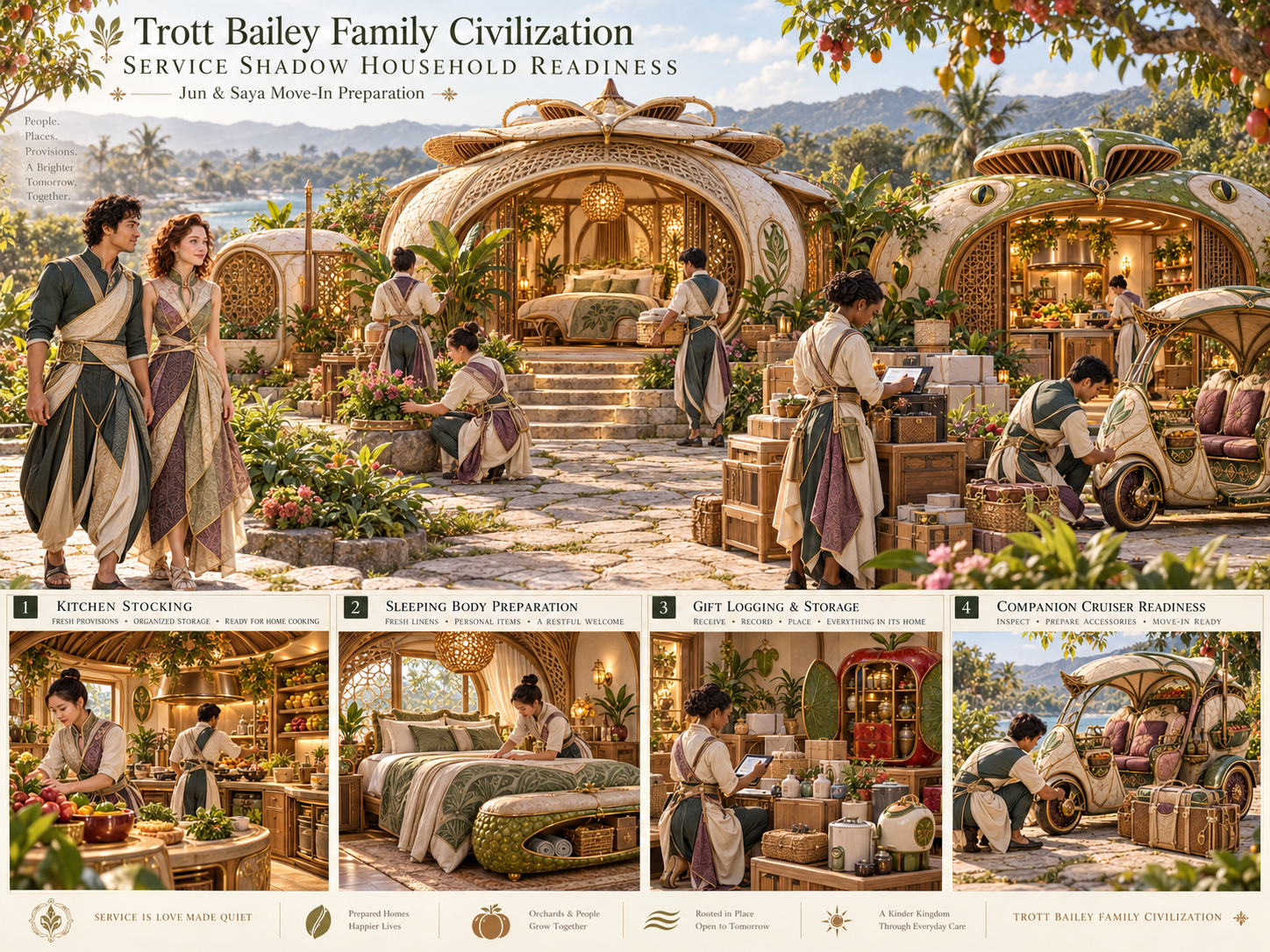
Kornara, Riceworks, Beanworks, Wheatworks, Breadfruit Works, Plantain Works, Coconut Works, Sweet Potato Works, Taro Works, Yam Works, Cassava Works, Seed Sanctuaries, Sabennerie supply docks, storage courts, and processing houses must clearly belong to the Trott Bailey Family Kingdom.
Architecture should include:
- Rain-Catchment Spine Roofs;
- Broad Leaf Canopy Roofs;
- Pleated Reef Fan Roofs;
- Mushroom Gill Canopy Roofs;
- Scale-Crown Hover Roofs for civic food authority;
- Reptilian Umbrella Roofs with softer curl tips for field pavilions;
- Dapple Stack columns;
- Flower Orb railings;
- Open Palm Hand stairs and ramps;
- carved patterned floors;
- biological pathway stones;
- seed-pod storage gardens;
- visible grain and staple movement;
- beautiful service docks;
- family basket porches;
- public learning galleries.
Staple infrastructure should be practical, but never ugly.
It should be civic, beautiful, useful, and visibly kingdom-authored.
Keslev makes food infrastructure beautiful because the work of feeding families deserves public dignity.
Uniforms of the Staple Network
The people who carry the Staple Sovereignty Network need role-correct uniforms.
They should not look like generic farm workers, factory workers, warehouse sorters, lab technicians, or agricultural inspectors.
They should wear Trott Bailey Field-Facing, Food-Facing, and Verification Shubaka depending on their role.
Uniforms should use:
- deep seed green;
- husk gold;
- warm field cream;
- soil brown;
- rice pearl;
- corn yellow;
- bean red-brown;
- coconut white;
- Ashcoal grounding;
- Nutboo comfort panels;
- Caneline route seams;
- Nutweave tool carriers;
- seed pouches;
- Pacorips nodes;
- RouteMemory footwear.
The uniform must show whether the person is handling food, field, verification, processing, seed protection, or supply.
Keslev workers should look like food sovereignty stewards, not outside-world farm or factory workers.
The Staple Sovereignty Promise
The Keslev Staple Sovereignty Network promises that staple crops will not be left as disconnected harvests.
It promises that corn, rice, beans, wheat, breadfruit, plantains, coconut, sweet potatoes, taro, yams, and cassava will be planted, processed, stored, distributed, served, protected, and verified.
It promises that families come first.
It promises that Sabenneries remain supplied.
It promises that children’s food systems are protected.
It promises that seed sanctuaries guard the future.
It promises that animal feed does not outrank human food.
It promises that Pacorips reports are checked against physical reality.
It promises that food infrastructure will be beautiful, not hidden in ugly back-of-house systems.
Conclusion
The Keslev Staple Sovereignty Network is one of the kingdom’s deepest food foundations.
It exists because a crop in the field is not yet food security.
Food security begins when the crop becomes usable, accessible, stored, protected, processed, served, and verified.
Kornara must turn corn into family foods and public meal foundations. Riceworks must turn rice into bowls, porridges, and reserves. Beanworks must protect protein and soil. Wheatworks must balance bread, pastry, and responsibility. Breadfruit Works, Plantain Works, Coconut Works, Sweet Potato Works, Taro Works, Yam Works, and Cassava Works must make tropical staples official, disciplined, and dependable.
Together, these systems make Keslev more than a farming district.
They make it the kingdom’s staple intelligence network.
A kingdom is not food-sovereign because crops grow. It is food-sovereign when those crops become dependable family food, public meals, protected seeds, real reserves, and verified abundance.



 and then