




The Kezidek Baby Food Transition System
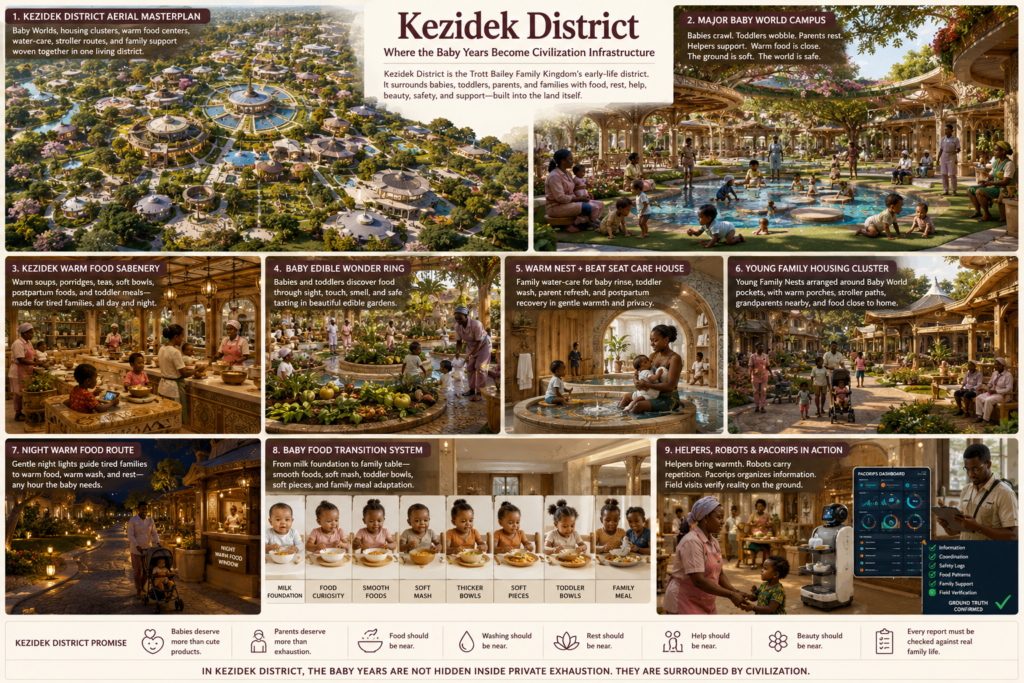


From Milk to the Family Table: The Kezidek Baby Food Transition System
The journey from milk to food should not be rushed, confusing, commercialized, or left entirely to exhausted parents.
In Kezidek District, the baby food transition is treated as one of the most important early-life systems in the Trott Bailey Family Kingdom.
This is not only about feeding a baby.
It is about how a child first meets food, how parents are supported, how safety is protected, how culture enters the family table, and how the kingdom teaches children that food is not merely a product on a shelf. Food is living, grown, prepared, shared, and connected to family life.
Kezidek’s baby food transition system is built around one gentle arc:
Milk foundation → food curiosity → safe touch and smell → prepared first tastes → smooth foods → soft mash → thicker warm bowls → soft pieces → toddler bowls → family meal adaptation → district food culture participation.
This arc does not replace the parent. It supports the parent.
Kezidek’s rule is clear:
Kezidek supports feeding, but parents decide feeding.
Why Baby Food Transition Needs a System
Many families experience the move from milk to food as a stressful stage.
Parents wonder what to introduce first, what texture is safe, what the baby can swallow, what may cause choking, what should be avoided, what foods should be softened, what foods require special preparation, and how to handle the mess.
One parent may be nervous. Another may be excited. A grandparent may have advice from older traditions. A doctor or specialist may have guidance. A baby may reject one food and love another. A toddler may demand independence before they are truly ready.
In the outside world, baby food is often commercialized into jars, pouches, boxes, powders, and branded stages. Families are made to feel that feeding a baby is either a private guessing game or a product category.
Kezidek rejects that narrow approach.
The kingdom understands that food transition is physical, emotional, cultural, agricultural, and architectural.
A baby learning to eat needs safe textures, careful preparation, clean hands, calm surroundings, parent authority, helper guidance, and access to real foods grown and prepared through kingdom systems.
A parent needs confidence without being pressured.
A family needs support without being judged.
A district needs food infrastructure that makes early eating safer and less lonely.
The Milk Foundation
The first stage is milk foundation.
Kezidek does not rush babies away from milk. Milk is treated as the early base of nourishment, closeness, rhythm, and comfort.
Whether a baby is breastfed, bottle-fed, combination-fed, or supported through another appropriate feeding plan, the parent remains central. Kezidek’s role is not to shame or force one family pattern. Its role is to create dignity, calm, and support around early feeding.
This is why Kezidek includes:
- Nursing Garden Rooms;
- parent rest porches;
- warm tea support;
- quiet feeding corners;
- postpartum recovery spaces;
- night warm food routes;
- family helper support;
- comfortable grandparent seating nearby.
The milk foundation stage is not treated as invisible private labor.
It is supported as part of early family life.
Before a baby meets the wider food world, the feeding parent must be supported too.
Food Curiosity Comes Before Eating
Before a baby truly eats, a baby becomes curious.
They watch adults chew. They reach toward bowls. They smell fruit. They stare at spoons. They grab leaves. They touch food. They make faces. They explore texture with hands before the mouth understands what food is.
Kezidek respects this stage.
Food curiosity is not dismissed as mess. It is treated as learning.
That is why Baby Worlds and Baby Edible Wonder Rings are connected to the food transition system.
A child may first meet food through:
- watching fruit grow;
- touching a safe leaf;
- smelling herbs;
- seeing roots and grains;
- washing hands after garden touch;
- watching a helper prepare a soft taste;
- seeing the same food become a warm bowl.
This teaches a child that food is not random. Food comes from somewhere. It has a body, a smell, a texture, a process, and a place in family life.
The official Baby Edible Wonder Ring arc is:
Living plant → safe touch → clean hands → prepared food → warm bowl → family table.
Safe Touch and Smell
Not every food should be tasted immediately.
Some foods are better introduced through sight, smell, or touch first. Some must be cooked. Some must be softened. Some must be cut carefully. Some must be avoided at certain stages. Some require special processing before they are safe.
Kezidek separates food discovery into clear zones:
- touch-safe zones;
- smell-safe zones;
- taste-safe zones;
- prepared-only zones;
- helper-only preparation zones;
- parent-approved tasting zones.
This prevents the dangerous idea that “natural” automatically means safe for babies.
A baby may touch a leaf, but not eat it. A toddler may smell an herb, but not chew it. A child may see cassava growing, but only eat cassava after safe processing. A baby may watch taro being prepared, but not taste it casually from a plant bed.
Kezidek makes this distinction beautiful and understandable.
It uses guided garden rings, wash channels, helper explanation, carved labels, floor symbols, parent choice, and Keslev plant verification.
Food discovery must be joyful, but joy does not replace safety.
Prepared First Tastes
The first taste should not be random.
In Kezidek, prepared first tastes are small, soft, parent-approved, and guided by food readiness.
These first tastes may come from foods already familiar through sight and smell: a soft fruit preparation, a mild vegetable, a gentle grain porridge, a smooth root mash, or a small spoon of warm food connected to the family’s own food culture.
The goal is not to overwhelm the baby.
The goal is to introduce food as something calm, safe, and connected.
Prepared first tastes should be:
- soft;
- simple;
- clean;
- fresh;
- safe for the baby’s stage;
- served in tiny portions;
- approved by the parent;
- observed carefully;
- connected to warm bowl culture, not disconnected product culture.
Helpers may guide, but they do not pressure.
A baby may reject a food. A parent may pause. A family may choose another path.
Kezidek supports the process without turning feeding into performance.
Smooth Foods
Smooth foods are often an early bridge between milk and thicker food.
They may include soft fruit preparations, mild vegetable blends, gentle grain porridges, coconut milk porridges, rice preparations, corn porridges, and smooth root-based foods.
In Kezidek, smooth food is not treated as factory baby mush.
It is treated as carefully prepared kingdom food adapted for the baby’s stage.
For example:
- Kornara corn may become a mild smooth porridge;
- Riceworks rice may become a soft rice preparation;
- sweet potato may become smooth warm mash;
- plantain may become a soft stage-appropriate bowl;
- coconut milk may support gentle porridges;
- soft fruit may become a smooth first taste.
These foods are tied back to Keslev’s food sovereignty systems.
The baby does not meet food as a brand first.
The baby meets food as part of the kingdom’s living food foundation.
Soft Mash
Soft mash is the next stage for many babies.
This stage begins to introduce more body and texture while remaining safe and manageable.
Soft mash may include:
- sweet potato mash;
- yam mash;
- soft plantain mash;
- soft rice mash;
- soft bean blends;
- mild vegetable mash;
- soft breadfruit preparations;
- safe cassava preparations only when fully processed;
- taro preparations only when properly cooked and verified.
This is where Kezidek’s food transition guides become important.
A Baby Transition Food Guide can explain texture, thickness, and risk. They can help parents understand the difference between smooth, mash, thick mash, and soft pieces.
But they still do not take control from the parent.
The guide explains the pathway. The parent decides the pace.
Thicker Warm Bowls
As babies grow, food can become thicker, warmer, and closer to family meals.
Thicker warm bowls are one of Kezidek’s major food transition tools.
They may include:
- thicker corn porridge;
- soft rice bowls;
- mild bean and grain bowls;
- root-and-broth bowls;
- sweet potato and greens prepared safely;
- soft plantain bowls;
- coconut grain bowls;
- soft family stew adaptations.
Warm bowls help babies move from isolated baby food toward family food culture.
The bowl can be soft enough for the child, but connected enough to what the family eats that the baby begins to participate in household rhythm.
This matters.
Food is not only nutrition. Food is belonging.
A warm bowl can say to the child:
You are joining the family table little by little.
Soft Pieces
Soft pieces are introduced when a child is ready for more texture and controlled self-feeding.
This stage requires discipline because many foods can look soft but still present choking risks.
Kezidek food helpers must help families think carefully about size, shape, softness, skin, seeds, stickiness, slipperiness, and fibrous texture.
Some foods may need to be mashed. Some need to be cut differently. Some need to be cooked longer. Some need skins removed. Some should wait until later.
The goal is not fear.
The goal is intelligent confidence.
Soft pieces should help the child practice:
- grasping;
- chewing readiness;
- tongue movement;
- self-feeding;
- food confidence;
- joining family meals safely.
Parents remain central in deciding when the child is ready.
Kezidek provides safe options, guidance, washing, seating, and observation.
Toddler Bowls
The toddler bowl is a major step.
A toddler bowl is not just a baby meal. It is the beginning of independent eating within family food culture.
Toddler bowls should be:
- soft enough for safe eating;
- interesting enough for curiosity;
- nutrient-dense enough for growth;
- not overloaded with sugar;
- not shaped by commercial snack culture alone;
- adapted from real district foods;
- served in portions a young child can manage;
- easy for parents to support without mess becoming overwhelming.
A Kezidek toddler bowl might include soft rice, gentle beans, mashed sweet potato, soft plantain, warm cornmeal, mild vegetables, coconut-based preparations, tender breadfruit, or fruit served safely.
This is where the child begins to feel more like a participant in the family meal.
They are not eating separate fake child food.
They are receiving an early version of real food culture.
Family Meal Adaptation
The goal of the baby food transition is not to trap children forever in baby food.
The goal is to bring them gradually into the family table.
Family meal adaptation means the same ingredients, memories, and food culture can be adjusted for the child’s stage.
A family stew may become a soft bowl. A rice dish may become a gentler toddler version. A root meal may become a soft mash. A bean dish may become a smooth blend first, then a thicker toddler bowl later.
This keeps the child connected to the household.
It also respects the diversity of families in Kezidek.
Kezidek is global. Families may come from many food cultures, many racial backgrounds, and many traditions. The baby food transition system should not erase that. It should help families adapt their own food identity safely.
The kingdom does not use baby food transition to flatten families. It uses the system to support families as they bring children into their own food life safely.
District Food Culture Participation
Eventually, the child begins to participate in district food culture.
That may mean warm food in Kezidek, ice cream and playful foods in Kaleeyon later, sugar cane drinks in Sherika, seafood and coconut-linked foods in Kultan, chocolate culture in Keilah, pastries in Big King District, and staple sovereignty foods from Keslev.
The baby does not begin with all of that at once.
But the transition system prepares the child to understand that food belongs to family, district, land, culture, and kingdom.
A young child who first learned food through living plants, safe washing, prepared tastes, warm bowls, and parent-guided meals will enter the broader food culture with more confidence.
They will not think food is only packaging.
They will know food has roots, fields, kitchens, helpers, seasons, and family meaning.
The Role of Baby Food Transition Counters
The Baby Food Transition Counter is one of the key physical spaces in this system.
It is not a restaurant counter. It is not a medical station. It is not a baby-food sales shelf.
It is a guided food support point where families can receive age-appropriate, texture-aware, parent-approved food transition help.
A Baby Food Transition Counter may include:
- smooth food options;
- soft mash options;
- warm bowl options;
- toddler bowl options;
- texture-stage guidance;
- choking-risk reminders;
- Doon bib and glove access;
- wash support nearby;
- seasonal fruit preparations;
- Keslev staple pathways;
- parent feedback recording;
- helper guidance without pressure.
The counter should be beautiful, calm, and clearly Trott Bailey.
It should not look like a hospital nutrition desk, daycare feeding station, supermarket baby aisle, or café counter.
It should feel like early food intelligence made public and gentle.
The Role of Doon
Food transition is messy.
Babies smear. Toddlers spill. Fruit sticks. Porridge lands everywhere. Hands go into bowls, hair, clothes, stroller straps, and parent laps.
Kezidek does not shame mess.
It designs for it.
The Doon system supports messy eating through bibs, gloves, return stations, wash channels, and reset points. Doon makes it easier for children to explore food without destroying clothing or turning every meal into household stress.
In Baby Food Transition spaces, Doon access should be close.
A parent should not have to choose between letting a child explore food and keeping the day manageable.
Mess is part of learning, but the kingdom can design so mess does not crush the family.
Cassava, Taro, and Safe Processing Discipline
Some foods require special seriousness.
Cassava and taro are important examples.
They may belong to kingdom staple systems, but they must never be treated casually in baby food spaces. They require safe processing, correct cooking, clear verification, and helper discipline.
A child may see cassava growing in an edible wonder setting, but that does not mean cassava is casually tasted from the garden.
A family may use taro in warm food traditions, but taro must be prepared correctly before being offered.
Kezidek’s food transition system must clearly show which foods are:
- safe to touch;
- safe to smell;
- safe only after preparation;
- safe only at later stages;
- not appropriate for a particular baby.
This is where Keslev’s food safety intelligence matters.
Kezidek provides the family-facing care.
Keslev verifies the food foundation.
Pacorips Records, Kezidek Watches
Pacorips can help track feeding patterns, food demand, family preferences, texture-stage needs, allergy concerns, supply pressure, and parent feedback.
But Pacorips is not enough.
A dashboard can say a baby food option is available, but that does not mean the family is comfortable. A report can say a toddler bowl was served, but it does not show whether the texture worked. A record can show that a family received food, but not whether the parent felt pressured, confused, supported, or ignored.
That is why Kezidek’s verification rule is:
Pacorips records the feeding pattern, but Kezidek watches the family eat.
Field verification matters.
Helpers and verifiers must observe whether the system actually supports families. Are the foods too thick? Are the lines too long? Are parents confused? Are helpers pressuring? Are wash stations close enough? Are Doon supplies available? Are seasonal foods being introduced safely?
The real measure is not whether the system exists.
The real measure is whether young families are being helped.
Helpers Guide, Parents Decide
Baby Transition Food Guides are important, but they must never become feeding authorities over the parent.
They may:
- explain texture stages;
- identify choking risks;
- show safe preparation paths;
- connect edible rings to warm bowls;
- explain cassava and taro safety;
- offer food options;
- record parent feedback;
- call for specialist help when needed.
They may not:
- force tasting;
- shame parents;
- override family food choices without emergency reason;
- treat all babies as the same;
- turn food transition into performance;
- use Pacorips notes as more important than parent reality.
The helper’s role is to make the pathway clearer.
The parent’s role is to decide what happens with their child.
Architecture of the Baby Food Transition System
The Baby Food Transition System must be housed in real Trott Bailey architecture.
It should not look like a clinic, daycare counter, supermarket aisle, school cafeteria, or generic wellness café.
Its spaces should include:
- Warm Bowl Hearth Bodies;
- Baby Edible Wonder Rings;
- Little Threshold Pavilion Bodies;
- soft wash channels;
- parent seating coves;
- shaded food porches;
- Flower Orb baby railings;
- Pink-Mottle Snowleaf Veil privacy edges;
- carved food-stage counters;
- patterned floors with texture-stage route markings;
- wide stroller access;
- soft lawns nearby.
The architecture should teach without becoming a classroom.
A parent should be able to understand the flow: garden, wash, prepared taste, warm bowl, rest, and return to family life.
The building itself should help the family move through the system.
Uniforms for Baby Food Transition Roles
Baby Transition Food Guides must not look like nurses, cafeteria workers, nutrition-company representatives, or daycare feeding staff.
They should wear Trott Bailey Shubaka uniforms built from food-facing and care-facing logic.
Their uniforms should include:
- soft food-safe front panels;
- warm food and care-facing wrap structure;
- texture-stage card integration;
- Doon pocket;
- parent guidance tablet or Pacorips node;
- washable sleeves;
- RouteMemory footwear;
- Kezidek warm cream, rice pearl, soft fruit colors, gentle green, and baby-water blue cues.
The uniform should communicate warmth, cleanliness, guidance, and respect for parent authority.
It should not communicate control.
In Kezidek, the feeding guide dresses like a helper of family wisdom, not a replacement for it.
The Baby Food Transition Promise
The Kezidek Baby Food Transition System promises that families will not have to move from milk to food alone.
It promises that babies can meet food gently.
It promises that parents remain in authority.
It promises that helpers guide without pressuring.
It promises that food is connected to living plants, safe washing, prepared tastes, warm bowls, family meals, and district culture.
It promises that safety matters as much as wonder.
It promises that food transition is not a product aisle.
It is a pathway.
Conclusion
The journey from milk to the family table is one of the earliest ways a child enters culture.
It should be handled with care.
In Kezidek District, baby food transition is not reduced to jars, pouches, confusion, pressure, or private exhaustion.
It becomes a civilizational pathway built from milk foundation, food curiosity, safe touch, prepared tastes, smooth foods, soft mash, warm bowls, toddler bowls, family meal adaptation, and district food culture.
It connects Baby Worlds, Baby Edible Wonder Rings, Warm Food Sabenneries, Warm Bowl Porches, Doon systems, Keslev food sovereignty, parent authority, helper guidance, Pacorips tracking, and field verification.
Most importantly, it keeps the family at the center.
Kezidek supports feeding, but parents decide feeding.
Food is one of the first ways a baby learns the world.
In the Trott Bailey Family Kingdom, that first food world should be warm, safe, living, beautiful, and connected to family.



 and then






































