

Fashion Network Shubaka with Amara continues
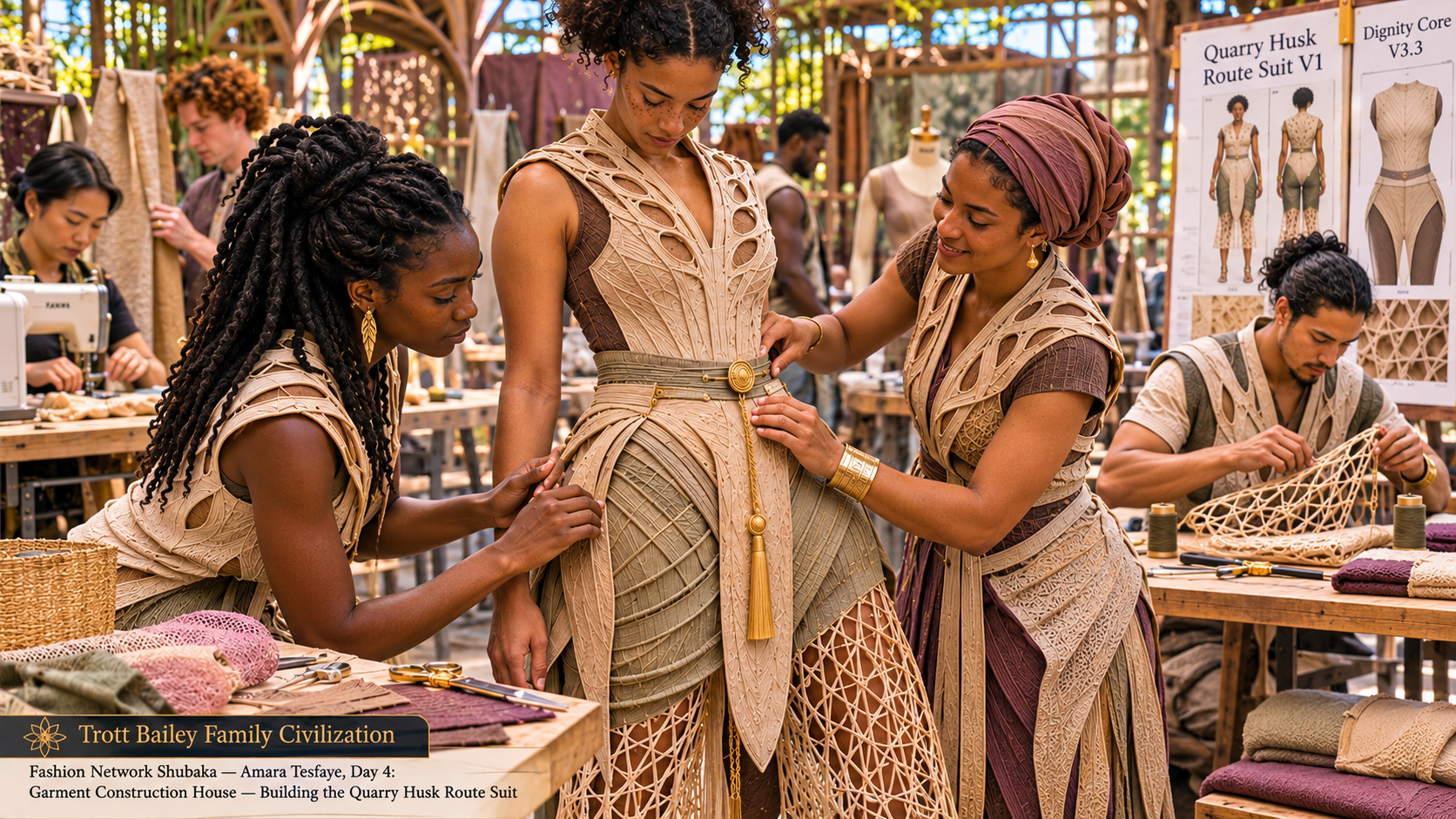
Fashion Network Shubaka — Amara Tesfaye
Garment Construction House — Building the Quarry Husk Route Suit
Yesterday I spent most of the day learning how Route Translation stops a design from drifting before anybody starts cutting cloth. Today they handed me cloth. That changed things very quickly.
I am Amara Tesfaye, 20, and today I rotated into the Garment Construction House. We were working on the Quarry Husk Route Suit V1, with the Dignity Core V3.3 underneath it.
I had seen both systems on boards before. Seeing them on a table in separate pieces was different. The Dignity Core looked quiet, soft, almost simple beside the Quarry Husk outer body. Then we started building around it.
The inner garment matters more than it looks
The Dignity Core is a continuous inner garment. It has a soft waist dock, protected pelvis and crotch zones, breathable inner-thigh encasements, airflow channels, anti-chafing surfaces, and no hard buckles or complicated fastening. It is designed to pull down and pull up simply.
That sounds like a small thing until you realise the outer garment has to respect it. The Quarry Husk Route Suit cannot trap it, pinch it, drag it, twist it, or make ordinary movement difficult.
That became obvious very quickly.
The lead couple
The lead married couple today were Safiya, 21, and Ren, 22.
Safiya is very quick with pattern placement. She can look at a shaped textile piece and see where the strain will travel once it is joined. Ren pays close attention to internal supports, edge finishing, route locks and how one structure affects another after assembly.
They both construct complete garments, but that is where each of them naturally looks first.
Safiya kept moving pieces around the table before pinning anything. Ren kept pressing his fingers underneath the layers and asking, “What is happening here when she bends?”
That question came up a lot.
The Quarry Husk looks very different flat
The visible garment has several strong structures: the recessed neckline architecture, the dropped transition around the upper hip, the dignity overshield, compressed pleat zones, and the fibrous husk-transition lower release around the legs.
On the finished board, all of those things read as one garment. On the construction table, they were separate problems.
The recessed neckline was one set of carved textile pieces. The pleated hip structures were another. The lower lattice had to be built and controlled without becoming stiff. The overshield had its own support relationship.
And all of it had to sit over the Dignity Core without fighting it.
We built the hip section first
Safiya gave me one of the compressed pleat sections. It looked beautiful flat.
Then we joined it to the side structure and fitted it over the Dignity Core.
Immediately there was a problem.
The outer pleat body was sitting correctly, but the pressure underneath it was too concentrated along one edge of the Core. It was not dramatic. The wearer could still stand there comfortably.
Then she stepped up onto the testing block. The pressure changed. She bent. It changed again.
Ren slid two fingers underneath the structure and said, “There.”
The pleat support was doing its job on the outside and creating irritation underneath.
So we opened it again, not the whole thing, just enough to reposition the support and spread the load. The second version looked almost identical from the outside. It felt completely different underneath.
That interested me.
Construction can be correct and still be wrong
I think this is the first thing I really learned today.
You can follow the translation correctly, join the pieces correctly, finish the edge correctly, and still produce something that does not behave properly on a body.
That does not automatically mean the translation was bad. Sometimes the cloth shifts. Sometimes reinforcement changes the way a section bends. Sometimes two good systems interfere with each other when they finally meet.
That is why they keep testing during construction instead of waiting until the garment is finished.
Safiya said if they wait until the end, one small problem can become six hours of unpicking.
I believed her.
The dignity overshield
The part I wanted to understand most was the front overshield.
On the board it looks substantial, but in the hand it is lighter than I expected. That is deliberate.
The Dignity Core is already doing quiet protective work underneath. The outer overshield does not need to become a heavy wall. It still has to preserve modesty when the wearer walks, sits, steps wide, bends or moves quickly. It also has to allow airflow and stay visually connected to the rest of the garment.
We tested two support placements. The first kept the overshield extremely stable. Too stable.
When the wearer sat, the whole front section lifted slightly instead of settling with the body.
Safiya watched it once and said, “No.”
We moved the support farther up and changed the lower attachment. The second version settled much better. It still covered properly, but it moved with the wearer instead of sitting in front of her like a board.
“Protection should not make the garment rigid.”
The lower husk release
The lower section was more difficult.
The Quarry Husk uses a fibrous lattice around the lower legs so the garment can open for airflow and movement. Flat on the table, the lattice looked straightforward.
Once it was attached, it wanted to do several annoying things. One section twisted. Another section opened too much. A third looked fine until the wearer took a long step and the lattice caught against the denser section above it.
We spent quite a while fixing that.
The solution was not to make the lattice heavier. That would have defeated the whole point. Safiya changed how the transition was distributed across the upper edge. Ren adjusted two attachment points and reduced tension in one section.
Then we walked it again.
Much better.
I finally understood why construction houses keep old failures
There is a storage wall here full of things that did not work.
Not whole failed garments. Pieces.
A neckline that rolled outward after repeated movement. A pleat support that looked beautiful but trapped too much heat. A lattice section that stretched unevenly. An internal reinforcement that made a garment too stiff. A route lock that was difficult to repair later.
They keep them because the mistake is easier to understand when you can hold it.
A written note saying “lower release became unstable” is useful. Holding the actual unstable section is better.
Lunch was quieter today
We ate outside under a wide shaded canopy beside the construction hall. Jalen had already found the footwear workshop again. Nobody was surprised.
Mira was talking with one of the records stewards about how construction changes are logged when they are small enough to stay within the approved translation.
Tavi was happy because this was finally the day he had been waiting for. He kept saying, “See? This is the real part.”
I reminded him that yesterday he was complaining about translation. He ignored me.
Wokumbakia was running nearby. There was an update about a coastal harvest and another piece about a district opening a new family travel route.
Jalen came back just in time to hear the travel part.
The neckline was harder than I expected
In the afternoon we worked on the Quarry Husk neckline.
The recessed structure gives the garment a carved look around the chest and neck, but the channels also have to breathe and move.
The first assembly sat beautifully when the wearer stood still. Then she raised both arms.
The neckline shifted upward.
Not much. Enough.
We checked the pattern against the translation and found that the construction allowance around one inner curve had been taken too tightly. It was technically neat. It was also restricting movement.
We released a small amount, rebuilt the edge and tested again.
That tiny change was enough.
This is the part of construction I think people underestimate. Sometimes the important correction is not dramatic. It is three millimetres in the right place.
The Dignity Core kept changing how I looked at the outer garment
By the end of the day I stopped seeing the Quarry Husk Route Suit as one garment sitting on top of another.
They behave more like two systems sharing the same body.
The outer layer carries civic presence, route structure, movement, beauty and protection. The inner layer handles support, breathability, chafing, modesty and ordinary bodily comfort.
If one ignores the other, the whole thing gets worse.
I kept thinking about yesterday’s Route Translation work. Now I understand why a route cannot just be drawn correctly.
It has to survive this room.
One thing I did not expect
I thought I would enjoy the visible construction most: the sculpted neckline, the pleats, the lattice, the parts everybody can see.
I did enjoy those.
But I kept getting pulled toward the hidden places: where pressure builds, where sweat will collect, where one textile rubs against another, where a support edge touches skin, and where repeated bending will eventually weaken something.
That is probably because I am still thinking about Fabric Node.
I keep wondering what these garments will look like after six months of actual use. What will come back first? What will need repair? What will stain? What will stretch? What will still be perfect?
We finished one full working body
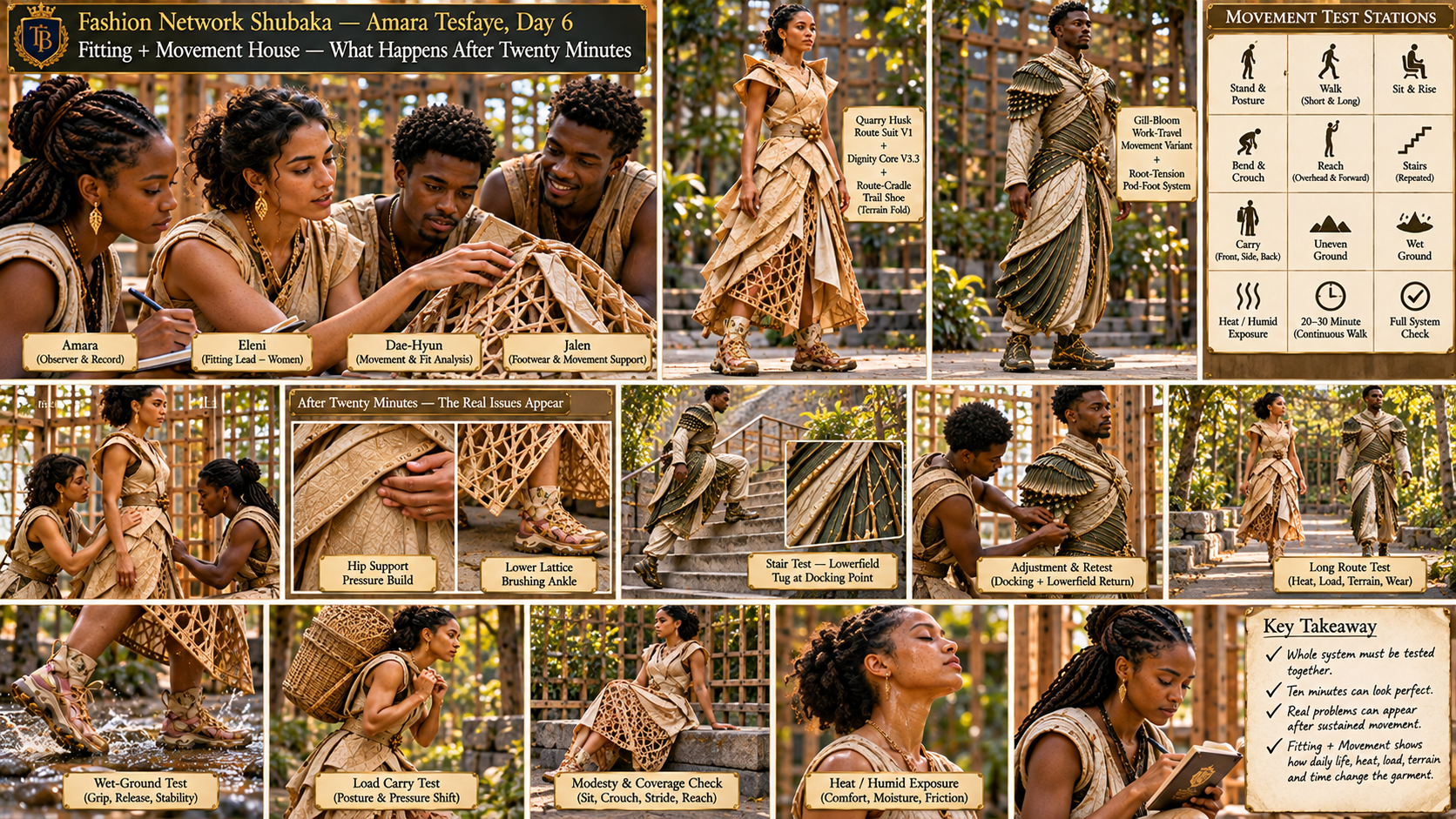
By late afternoon, the test garment was far enough along for a full movement check.
The wearer walked, sat, stepped up, bent, reached, turned, crouched and moved through a few ordinary public-ground tasks.
The lower lattice opened properly. The dignity overshield stayed where it should. The hip structure kept its form without pressing badly against the Core. The neckline stayed settled when the arms moved.
There were still notes to make. There are always notes.
But it was working.
Ren said, “And now it behaves like clothing.”
I recorded that too.
Tomorrow: Foot Architecture
I thought I would finish today feeling satisfied because we had made something. Instead I finished with more questions.
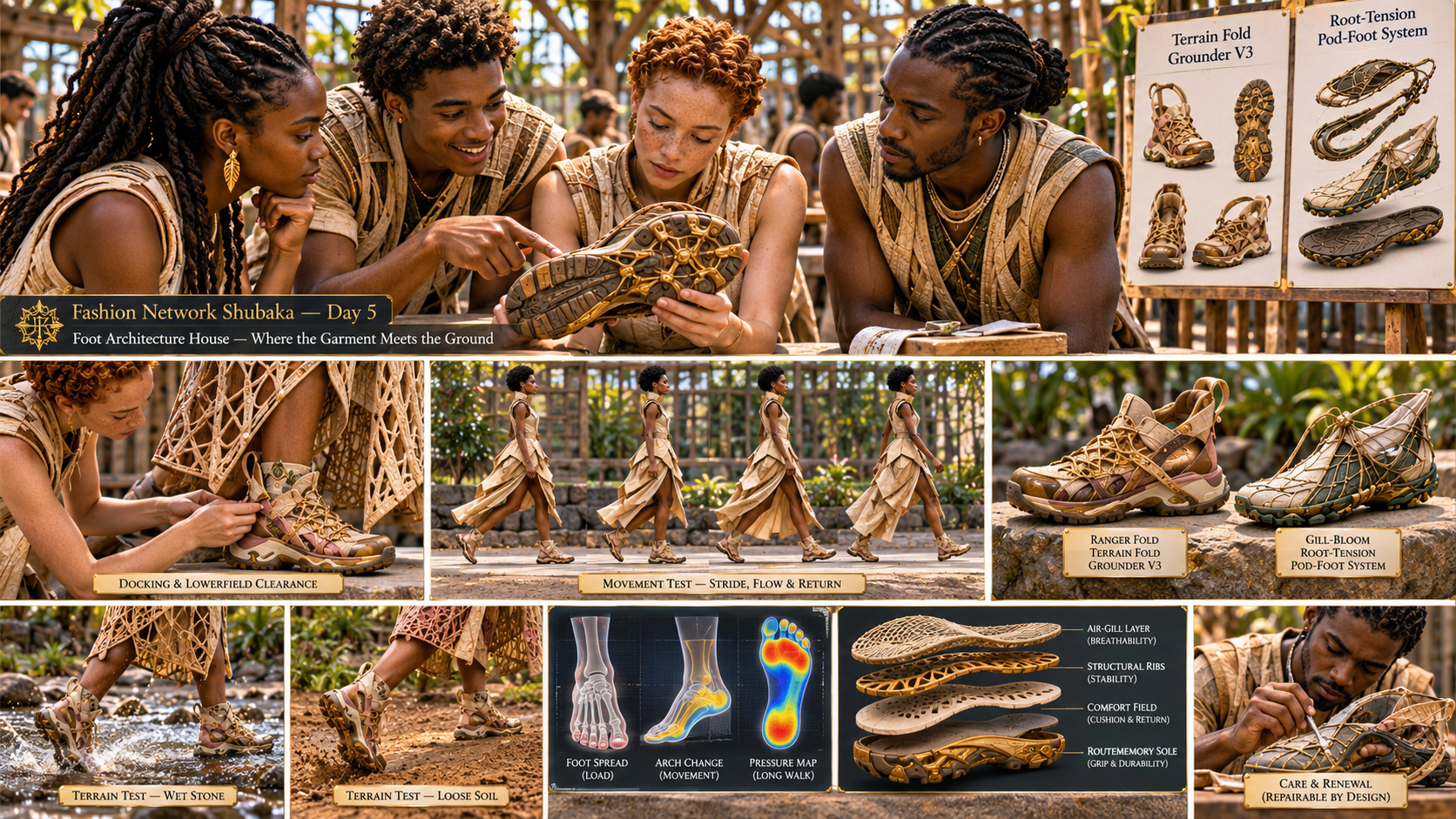
The Quarry Husk Route Suit has its own footwear pairing, and after watching the lower garment move all day, I want to understand exactly how the shoe interacts with it.
How much movement comes from the garment and how much from the foot structure? What happens when the lower lattice meets the ankle architecture? How does the shoe support the body without making the whole silhouette heavy? How much heat gets trapped there? What wears first?
I already know Jalen is going to be unbearable tomorrow. He has been waiting for this.
What I am taking from today
Construction is where all the earlier decisions finally have to survive contact with a real body.
The textile can be right. The translation can be right. The pattern can be right. Then the assembled garment can still create a problem nobody saw until the person wearing it bends, sweats, sits, reaches or walks.
That is why I like the repeated testing. You do not have to guess forever. You build it, move in it, see what happens, then fix what needs fixing.
I still want to understand material behaviour more deeply, but today made one thing very clear to me.
A garment is only finished when the person wearing it can actually live in it.