

Fashion Network Apprenticeship with Amara continues- Foot Architecture
Fashion Network Shubaka — Amara Tesfaye
Foot Architecture House — Where the Garment Meets the Ground
Jalen was already there before me. Of course he was.
I am Amara Tesfaye, 20, and today I rotated into the Foot Architecture House. Jalen has been waiting for this day since the beginning of the week, and by the time I arrived he had already found the sole wall, the terrain testing route, and one of the old pressure-map drawers.
He was talking to one of the stewards as though he had worked there for months. I told him to calm down. He did not.
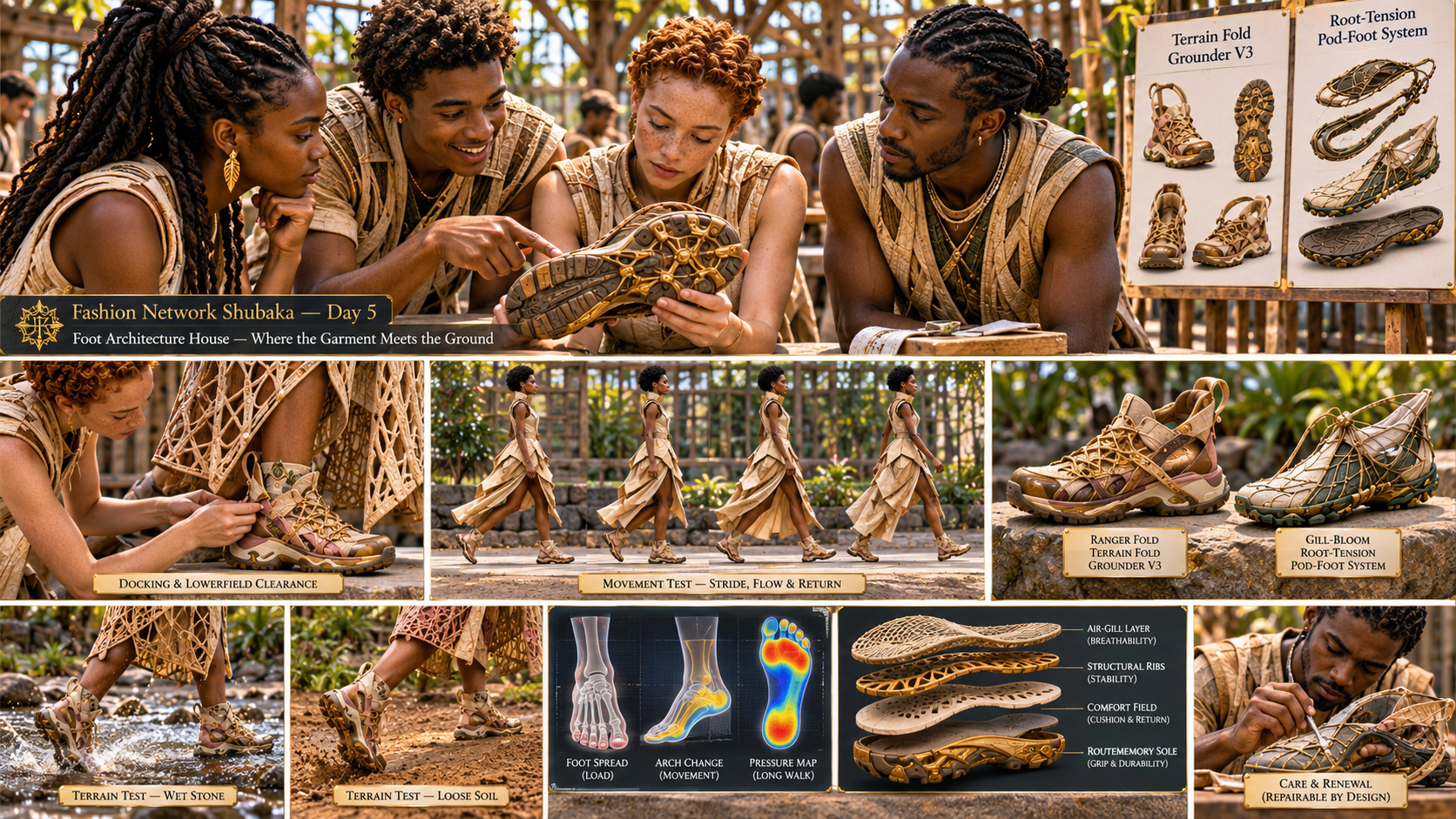
Today we were working with two very different footwear systems: the Terrain Fold Grounder V3 from the Ranger Fold Steward Species, and the Root-Tension Pod-Foot System from the Men’s Gill-Bloom Route Species V1.1.
I thought the day would mostly be about shoes. It was really about everything that happens between a moving body, a garment, and the ground.
The lead couple
The lead married couple today were Anouk, 22, and Idris, 23.
Anouk pays closest attention to foot spread, pressure and flex. Idris watches how footwear connects to the garment above it, especially ankle routes, docking structures and lowerfield clearance. Both of them can build the whole system, but they notice different problems first.
The Ranger shoe made sense immediately
The Terrain Fold Grounder V3 is built for long walking, soil, stone, wet ground, leaf matter, uneven routes and ordinary public-ground work.
Jalen showed me the underside before I had even finished looking at the upper.
I said, “Good morning to you too.”
The shoe has a heel cradle that keeps the rear foot stable, a flexible forefoot so the toes and front foot can move naturally, a route arch that supports long walking and heavier loads, a ground-grip pattern for changing surfaces, and a docking structure that keeps the upper secure without making the whole thing stiff.
The Ranger Fold garment above it is designed to move around that shoe. The lowerfields open, swing and return while leaving enough clearance for the ankle and foot.
The whole thing feels prepared for walking, not standing around looking impressive.
Then we looked at the Gill-Bloom system
The Root-Tension Pod-Foot System was different. It has a lowerfield docking collar, an ankle route lock, a root-tension instep bridge, a crescent gill heel cradle, shell-cell toe protection, pressure-node locks and a RouteMemory sole.
The first thing I noticed was how connected it is to the garment above it. The shoe does not just sit under the Gill-Bloom lowerfield. The two systems meet.
The docking collar helps control how the lower garment approaches the ankle. The tension routes across the foot help distribute load. The heel cradle keeps the back of the foot stable. The sole has to grip and flex while still carrying the visual route of the garment downward.
It is much more architectural than I expected.
Jalen looked very pleased that I said that.
The problem showed up during a long stride
We were testing the Work-Travel Movement version of the Gill-Bloom system. Standing still, everything looked right. Short steps were fine. Then the wearer took a longer stride.
The lowerfield caught against the ankle docking structure.
It did not trap the foot or stop movement. It was just enough to pull the lowerfield slightly out of its intended path.
The first time, I thought it was the garment.
Idris said, “Maybe.”
That meant it was not going to be that simple.
We walked it again and the same thing happened. Then we slowed the movement down and watched the point where the lowerfield crossed the docking collar.
The problem could have belonged to three places. The lowerfield route might have been too close, the docking collar might have been sitting too high, or the ankle structure might have been returning too slowly after flex.
Nobody immediately decided the shoe was wrong. Nobody immediately blamed the garment either. They started testing.
We changed the collar first
Idris reduced the docking collar height slightly and adjusted its angle. We tested again. Better, but it was still catching.
Then Anouk changed one of the tension relationships around the instep so the structure returned faster after the foot flexed. That improved the ankle position during the next step.
The catch almost disappeared. Then they adjusted the lowerfield route by a very small amount so it cleared the docking zone more naturally during the longest part of the stride.
That solved it.
Three small changes, none of them dramatic. Together they fixed the movement.
“Do not assume the problem belongs to the thing you can see touching.”
Foot Architecture is really body architecture
After that, Anouk had us work barefoot for a while. She wanted us to watch what the foot actually does before putting anything around it.
The toes spread when the body loads forward. The arch changes. The heel settles differently on flat ground and sloped ground. The ankle moves much more than I realised when walking across uneven surfaces.
Then she put the Terrain Fold Grounder back on the wearer and we watched the same movement again.
The footwear was not supposed to stop any of that. It was supposed to guide and support it.
A shoe can be very stable and still be wrong if it stops the foot doing what the body needs.
Heat matters down here too
We also spent time on airflow. Feet get hot. That should not be surprising, but I had been thinking so much about garment airflow around the torso and legs that I had not paid much attention to what happens inside footwear.
The Ranger Grounder uses open route areas and breathable structural zones so heat can escape while still keeping the foot protected from soil and rough ground. The Gill-Bloom system uses gill-like structures and routed openings around the upper and heel areas.
Anouk showed me one old test shoe that had excellent grip and support but held too much heat during long movement.
It had been rejected.
It still looked beautiful. That did not save it.
Jalen was having the best day of his life
Break beside the Foot Architecture House
At lunch, Jalen would not stop talking. He had already found a pressure-node test he wanted to try later and was trying to convince Mira that footwear records were more useful than route records.
Mira said that was ridiculous. Tavi told both of them to eat.
Wokumbakia was running nearby with an update about a mountain travel route reopening after heavy rain and another about a root crop harvest. Jalen heard “mountain route” and immediately started talking about which sole pattern he would want for it.
I told him he had a problem.
He said, “A useful one.”
Fair enough.
We tested wet ground after lunch
The terrain lane behind the Foot Architecture House has different ground surfaces built into it: dry stone, wet stone, packed soil, loose soil, leaf matter, sloped ground, rough ground and soft ground.
We tested the Ranger Grounder across all of them.
The difference between walking on wet stone and loose soil was obvious. On wet stone, the important thing was controlled grip without the sole locking too hard. On loose soil, the shoe needed enough bite to stop sliding but still had to release cleanly when the foot lifted.
If the tread held onto too much soil, it became heavy. If it shed too quickly without enough grip, the wearer slipped.
The sole had to find the middle.
The foot changes during the day
Another thing I learned is that a foot is not exactly the same size all day. Heat, long walking and repeated loading can change how it spreads and swells.
A shoe that fits perfectly first thing in the morning can become annoying after hours of movement if the structure does not allow for that.
Anouk showed me how the Ranger system gives controlled room in the forefoot while keeping the heel stable. The Gill-Bloom system does something different. It uses tension routes that can hold the foot without crushing it.
That made me think about the Dignity Core again.
Different part of the body, same kind of problem: support without over-controlling.
The footwear has to survive cleaning too
This was the part that brought me straight back to Fabric Node.
Footwear gets filthy. Soil, sweat, rain, fruit, mud, salt, whatever somebody walks through. The Foot Architecture House has to think about how the shoe will be cleaned and restored long before it gets dirty.
Can the inner surface dry properly? Can the sole release packed soil? Can the tension routes be cleaned without losing their shape? Can a worn pressure node be replaced? Can the heel cradle be repaired without rebuilding the whole shoe? Can the docking collar survive repeated care?
I asked Idris what comes back most often. He said sole wear, route tension changes and damage around high-contact points.
Then he showed me a repaired Grounder that had already been through several renewal cycles. You could see where work had been done if you knew where to look.
It was still in service.
I liked that.
Two systems, two ground relationships
Near the end of the day, Anouk put the Ranger Grounder and the Gill-Bloom Pod-Foot side by side.
They barely look related.
One is built around terrain, long walking and a fold-route steward garment. The other is much more tightly connected to a routed lowerfield and has a different kind of tension and docking logic.
But the questions underneath are similar. Does the foot have room to move? Is pressure distributed properly? Does the ankle stay free? Does the footwear grip without becoming heavy? Can heat escape? Can the garment clear the shoe? Can the system be repaired? Can somebody wear it for hours without thinking about it all the time?
That last one is probably the hardest test.
I understand Jalen a little better now
I am not going to tell him that.
But I do.
Foot Architecture is much more interesting than I expected. It is not just designing something attractive to put on the foot. It is one of the places where the whole garment system either starts working properly with the body or starts fighting it.
The foot carries everything above it. If the shoe is wrong, eventually you feel it somewhere else.
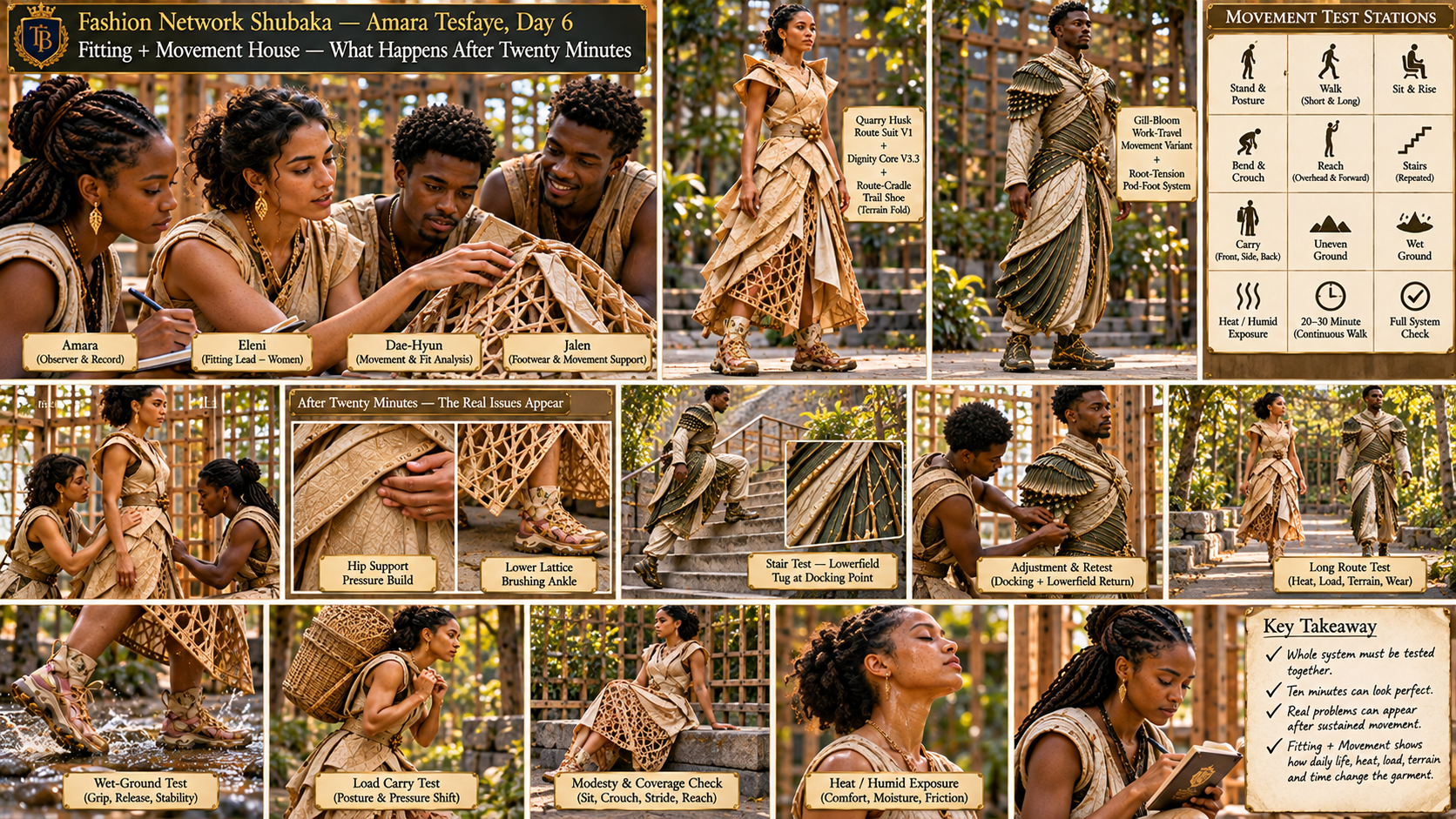
Tomorrow we move into Fitting and Movement. That feels like the right next step because now I want to see what happens when the garment body, the inner support system and the footwear are all tested together instead of one piece at a time.
I suspect we are going to find problems. I also suspect that is the point.
What I am taking from today
The Ranger Grounder and the Gill-Bloom Pod-Foot solve different problems, and they look very different doing it.
What matters is whether each one serves the body, the garment and the ground it was built for.
A shoe can look perfect standing still and become wrong three steps later.
Today I learned to watch the steps.

Follow the daily experiences of apprentices throughout World Ruler Sher Fashions Network from Garment Construction to Fabric Node, Fabric Preservation etc