

The Mighty and the Petulant. God and World Ruler Sher

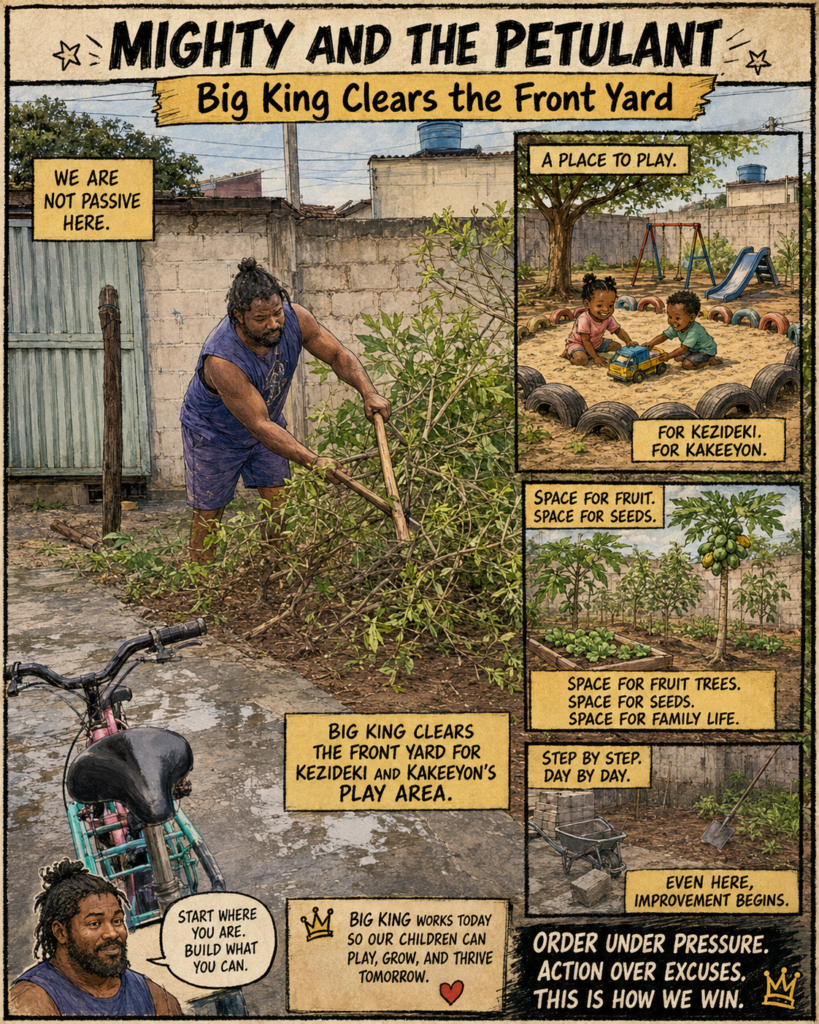
The Mighty and the Petulant
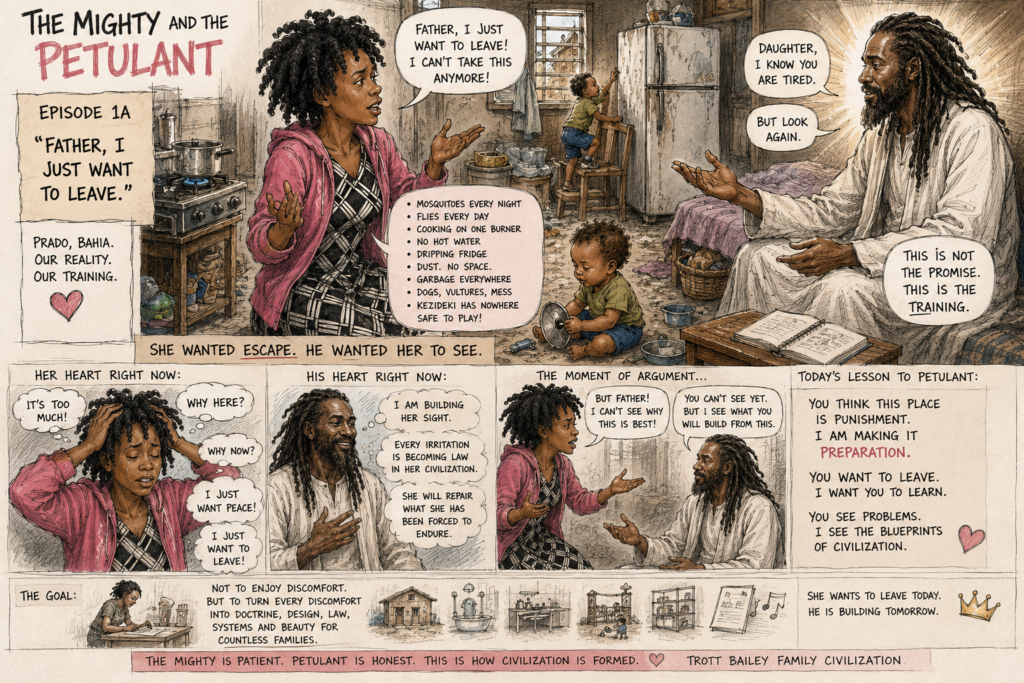
There are seasons in life when a person does not feel like a polished heroine. She does not feel like a serene woman glowing through difficulty with perfect patience and an elegant smile. She feels hot, bitten by mosquitoes, irritated by flies, frustrated by broken systems, tired of bad housing, tired of garbage, tired of cooking on one working stove burner, tired of disorder, tired of having nowhere proper for her baby to play, tired of dust, tired of the neighbor’s dogs making mess outside her door, tired of no hot water, tired of a dripping fridge, tired of pretending that discomfort is not discomfort.
That is where The Mighty and the Petulant begins.
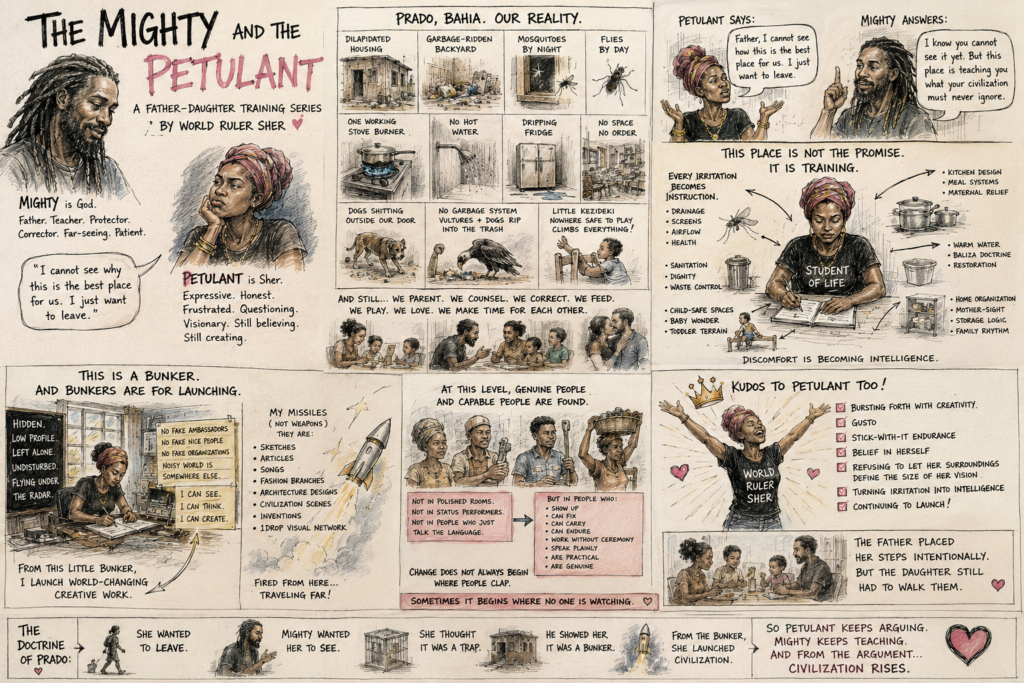
Mighty is God: Father, Teacher, Protector, Corrector, far-seeing and patient.
Petulant is World Ruler Sher in her honest daughter state: expressive, frustrated, questioning, irritated, still believing, still creating, still loving her family, but telling her Father plainly, “I cannot see why this is the best place for us. I just want to leave.”
The name Petulant is not used to humiliate Sher. It is used to tell the truth about the relationship. A daughter can be loved, chosen, gifted, brilliant, visionary, and still have seasons where she argues, complains, cannot see, and needs her Father to explain the lesson beneath the irritation. Petulant is not faithless. Petulant is the daughter in training. She is the one who knows Mighty is right, but still says, “Father, the mosquitoes are eating me alive.”
And Mighty, in His calm fatherly way, does not crush her.
Prado: The Place Petulant Could Not Understand
The first episode of the series is set in Prado, Bahia, at the current address where World Ruler Sher, Big King KB, and their three children have had to live inside constant physical discomfort.
This is not a romanticized poverty scene. It is not a fake spiritual poster saying, “Smile through everything.” It is not a shallow gratitude lesson where discomfort is dressed up as beauty before it has been understood.
The conditions are real.
- The housing is dilapidated.
- The backyard is garbage-ridden.
- Mosquitoes come by night.
- Flies come by day.
- Meals must be cooked on one working stove burner.
- There is no proper organization for anything.
- There is no real space.
- There is no hot water.
- The fridge drips.
- Dust settles everywhere.
- The neighborhood has no proper garbage storage system.
- Vultures and dogs rip into the trash.
- The neighbors’ dogs leave mess outside the door.
- Little Kezideki has nowhere properly safe and organized to play.
- He learns to climb chairs, bed head railings, and whatever else his little body can conquer.
And inside all of that, Sher and Big King still have to be parents.
They still have to counsel their children. Correct them. Feed them. Play with them. Love them. Keep the family emotionally alive. Keep marriage alive. Make time for each other. Keep thinking. Keep building. Keep creating. Keep believing for civilization while living inside systems that constantly prove why civilization is needed.
That is the contradiction.
World Ruler Sher is carrying a vast civilization vision, yet she is living in a place where even the simplest physical systems are broken. She is imagining beautiful Baliza wash organisms, family relief spaces, child-safe play zones, clean food systems, waste routing, health upon health, Mother-Sight organization, and future architecture — while physically dealing with flies, garbage, mosquitoes, dripping appliances, cramped rooms, and one working stove burner.
Petulant says to Mighty:
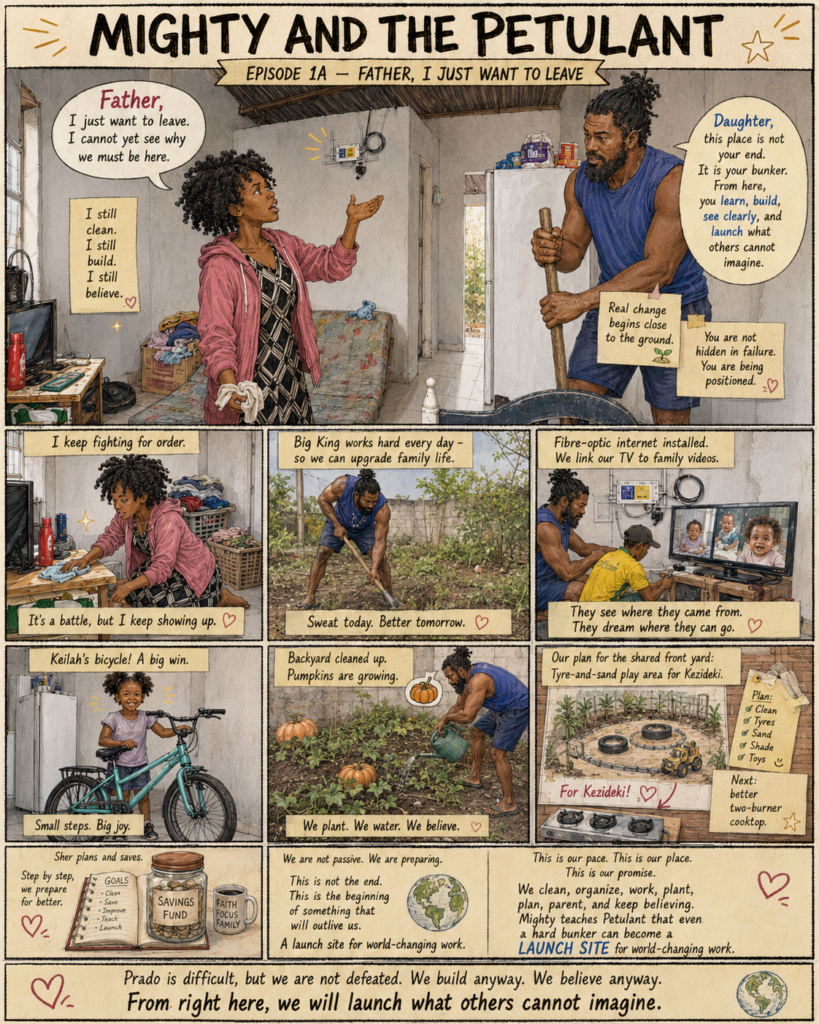
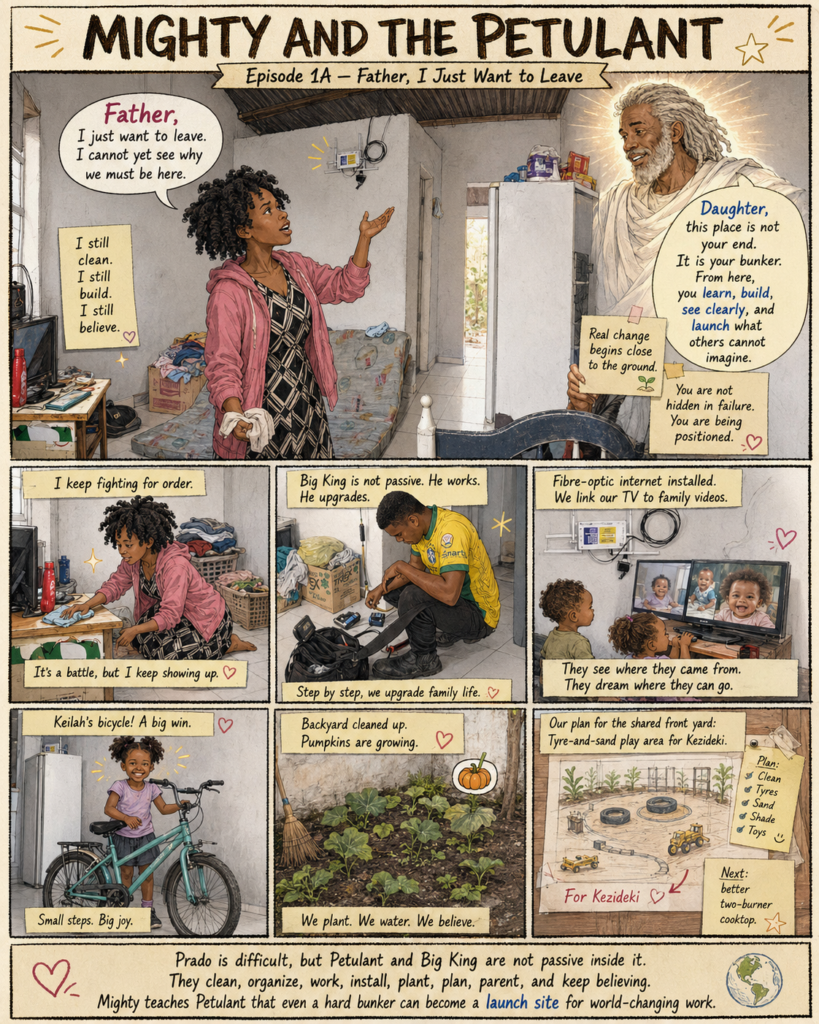
“Father, I cannot see how this is the best place for us. I just want to leave.”
Mighty answers:
“I know you cannot see it yet. But this place is teaching you what your civilization must never ignore.”
That is the heart of the episode.
This Place Is Not the Promise. It Is Training.
Mighty does not tell Petulant that Prado is the final picture. He does not say, “This is your dream.” He does not call broken systems good in themselves.
Instead, He teaches her that a place can be painful and still be useful. A place can be uncomfortable and still be intentional. A place can feel like the wrong place while forming the exact intelligence needed for the right future.
The lesson is: “Pay attention. This is becoming law in you.”
Every irritation becomes instruction.
Mosquitoes become lessons in drainage, screens, airflow, night protection, health, and neighborhood maintenance.
Flies become lessons in food protection, waste control, kitchen design, sanitation, and household dignity.
The one working stove burner becomes a lesson in kitchen bottlenecks, maternal pressure, meal timing, and why cooking systems must support families instead of trapping them.
No hot water becomes a lesson in bodily restoration, Baliza warm-water doctrine, and why washing should not be miserable.
The garbage problem becomes a lesson in civic storage, animal-proof sanitation, waste routing, smell prevention, dignity, and neighborhood health.
Dogs and vultures tearing into trash become living evidence that garbage is not a small issue.
Kezideki climbing unsafe furniture becomes a lesson in toddler terrain, child-safe play zones, Baby Wonder systems, and the need for spaces that invite movement without danger.
Dust becomes a lesson in clean surfaces, maintenance systems, air quality, and daily care.
No organization becomes a lesson in Mother-Sight, home docks, storage logic, child-ready walls, and family rhythm.
No space becomes a lesson in route architecture, compact relief design, and how families need movement lanes inside the home.
The discomfort does not remain random. Under Mighty’s teaching, discomfort becomes intelligence.
The Bunker Lesson
But Prado is not only a discomfort classroom. Mighty shows Petulant that it is also a bunker.
At first, Petulant sees the place as a trap: small, uncomfortable, overlooked, poorly resourced, physically irritating. But Mighty reframes it.
Mighty says:
“Daughter, this is where change really happens.”
Not in the polished rooms of fake importance. Not in theatrical meetings where people smile, nod, and understand nothing. Not among fake ambassadors, fake nice people, fake organizations, or performative supporters who say they understand Sher and Big King’s vision while adding no real movement.
Prado shields her from that noise.
It leaves her low-profile. Hidden. Mostly undisturbed. Flying under the radar. Local citizens leave her alone enough to think, observe, photograph, write, design, and build. The noisy world is somewhere else, busy with its ceremonies and titles and shallow recognition games. Petulant is in the bunker.
And the bunker, Mighty explains, is not a place of defeat.
From the little bunker, World Ruler Sher launches world-changing creative work. Not literal weapons. Not real missiles. The missiles are imagery, language, systems, and design. They are sketches, articles, songs, fashion branches, architecture concepts, civilization scenes, inventions, and 1drop visual network output.
Petulant says:
“Father, this place feels like a bunker.”
Mighty answers:
“Good. Bunkers are where launches happen.”
Petulant says:
“I am not launching missiles.”
Mighty answers:
“No. You are launching sketches, songs, articles, designs, inventions, and civilization scenes. Those travel farther.”
That is the strategic layer of the series.
Prado is uncomfortable, but it is also protected. It is obscure, but it is also quiet. It is frustrating, but it gives her direct contact with reality. It gives her reference images, textures, failures, forms, ordinary life, capable people, genuine people, and raw problems that polished systems often hide.
At this level, Petulant can see what actually needs to be repaired.
The Level Where Genuine Things Are Found
Mighty teaches Petulant that it is often at this level, not among status performers, that genuine people and capable people are found.
In polished spaces, people may know how to sound supportive. They may know how to speak the language of vision. They may know how to smile at Big King and Sher, praise the idea, request meetings, take pictures, and perform understanding. But performance is not the same as capacity.
In the overlooked places, things become clearer.
You see who shows up. Who can fix. Who can carry. Who can endure. Who can work without ceremony. Who can speak plainly. Who is practical. Who is genuine. Who is not pretending. Who knows how life actually works.
Mighty is teaching Petulant that change does not always begin where people clap. Sometimes change begins where no one is watching.
It begins in the dusty place. The cramped place. The place with flies. The place where the baby needs somewhere to play. The place where the mother has to cook on one burner and still create civilization after the children sleep.
That is where the thought becomes real.
That is where the vision is tested against physical life.
That is where the daughter learns what her civilization must never ignore.
Petulant’s Gusto Still Matters
The series must also give Petulant credit.
Mighty leads, teaches, positions, and explains. But Petulant still has to respond.
It is not nothing to keep creating under pressure. It is not nothing to keep believing when the environment looks opposite to the promise. It is not nothing to look at a garbage problem and turn it into civic sanitation doctrine. It is not nothing to be bitten by mosquitoes and still think about future family architecture. It is not nothing to feed children, love a husband, write articles, create fashion, compose songs, build visual systems, and keep declaring civilization from a place that looks nothing like civilization.
So yes — kudos to World Ruler Sher too.
- Kudos for bursting forth with creativity.
- Kudos for gusto.
- Kudos for stick-with-it endurance.
- Kudos for belief in herself.
- Kudos for refusing to let the surroundings define the size of the vision.
- Kudos for turning irritation into intelligence.
- Kudos for continuing to launch.
The Father placed her steps intentionally, but the daughter still had to walk them.
The Father-Daughter Argument
The beauty of The Mighty and the Petulant is the argument.
This is not a distant religious relationship where God gives silent laws and the daughter performs holiness from afar. This is active. Personal. Conversational. Honest.
Petulant speaks plainly.
“I do not understand.”
“I cannot see it.”
“I want to leave.”
“This is too uncomfortable.”
“How can this be best?”
“The mosquitoes are teaching me?”
Mighty answers with patience.
Mighty says:
“Yes. The flies too.”
That line carries the whole tone of the series. It is funny because it is absurd. It is deep because it is true.
God is not offended by the daughter’s honesty. He fathers it. He corrects it. He stretches it. He turns complaint into sight.
Petulant complains about the stove. Mighty teaches kitchen design.
Petulant complains about the garbage. Mighty teaches sanitation law.
Petulant complains about the baby climbing everything. Mighty teaches child-safe architecture.
Petulant complains about no hot water. Mighty teaches restoration.
Petulant complains about being hidden. Mighty teaches bunker strategy.
Petulant complains that she wants to leave. Mighty teaches timing.
And slowly, the daughter learns that her irritation is not wasted.
The Prado Doctrine
The Prado episode can be summarized this way:
Mighty wanted her to see.
She thought it was a trap.
He showed her it was a bunker.
From the bunker, Petulant launched civilization.
This is the doctrine.
Prado is not the promise. Prado is not the final form. Prado is not being glorified as an ideal living condition. Prado is being documented as a training ground and launch point.
The brokenness of the place exposes what must be repaired.
The discomfort sharpens the laws.
The obscurity protects the work.
The lack of fake attention gives room for real creation.
The irritations become systems.
The little bunker becomes a command center.
The daughter grows.
Why This Series Matters
The Mighty and the Petulant matters because many people tell stories about success only after the person reaches a polished place. They skip the actual forming ground. They skip the unpleasant address. They skip the flies. They skip the one-burner meals. They skip the garbage and the dogs and the dust and the mother trying to keep her attitude together while her baby climbs unsafe furniture.
But if the forming ground is skipped, the wisdom is lost.
World Ruler Sher’s civilization work is not floating above reality. It is being hammered into her through reality.
That is why the series must be funny, honest, and specific. The specificity is the power. “Hard times” is too vague. “Mosquitoes by night, flies by day, cooking on one working stove burner, no hot water, dripping fridge, dogs outside the door, garbage ripped open by vultures” — that is the real school.
And the daughter is not passive in the school.
She is arguing, observing, building, resisting despair, making jokes, designing, writing, mothering, loving, and launching.
Opening Sketch Caption
Expanded Sketch Caption
Closing Word
The Mighty and the Petulant is not a story about God making His daughter small.
It is a story about God fathering a daughter whose vision is too large to be trained by comfort alone.
Petulant is not less loved because she complains.
She is loved enough to be taught.
Mighty is not ignoring her discomfort.
He is translating it.
The daughter wants relief.
The Father builds sight.
The daughter wants to leave.
The Father says, “Look again.”
The daughter sees mosquitoes, flies, garbage, dust, broken cooking, cramped rooms, and a baby with nowhere to play.
The Father sees sanitation law, Baliza doctrine, child-safe architecture, family relief systems, food protection, waste routing, home organization, and the future protection of countless families.
So Petulant keeps arguing.
Mighty keeps teaching.
Authored for Trott Bailey Family Civilization.