
Is Food Abundance a Problem or an Opportunity? What’s your lens?
Trott Bailey Family Perspectives
When Abundance Is Allowed to Multiply
What Happens When Food Is No Longer Treated as a Commercial Problem to Control
A mango tree does not make one mango.
A papaya does not contain one seed.
A banana plant does not live as one isolated plant forever.
Cassava can be cut and planted again.
Seeds fall.
Roots spread.
Trees mature.
Fruit returns.
That simple fact should matter much more to the way civilization thinks about food.
In a commercial food system, a very large harvest can become a problem.
Too much arrives at once.
Prices fall.
Storage fills.
Markets cannot absorb everything.
Food can be left unharvested, destroyed or treated as excess because the system cannot sell all of it successfully.
Trott Bailey Family Civilization starts from a different question.
If the food exists, how much life can we make from it?
Share it.
Preserve it.
Cook it.
Travel toward it.
Return the seeds.
Plant the cuttings.
Expand the orchard.
Teach people how it grows.
Let children experience it.
Let the abundance become the beginning of more abundance.
A Bumper Year Is Good News
Imagine a mixed orchard having an extraordinary year.
The strawberries are excellent.
Cherries are heavy.
Lychees are ripening.
Grapes are approaching harvest.
Mangoes are coming behind them.
Citrus will follow later.
That is not one crop creating one temporary glut.
It is a whole food landscape entering a season of unusual generosity.
Trott Bailey Family Civilization does not need to ask:
It can ask:
How many people can enjoy this, and how much of it can become future food?
That changes the response.
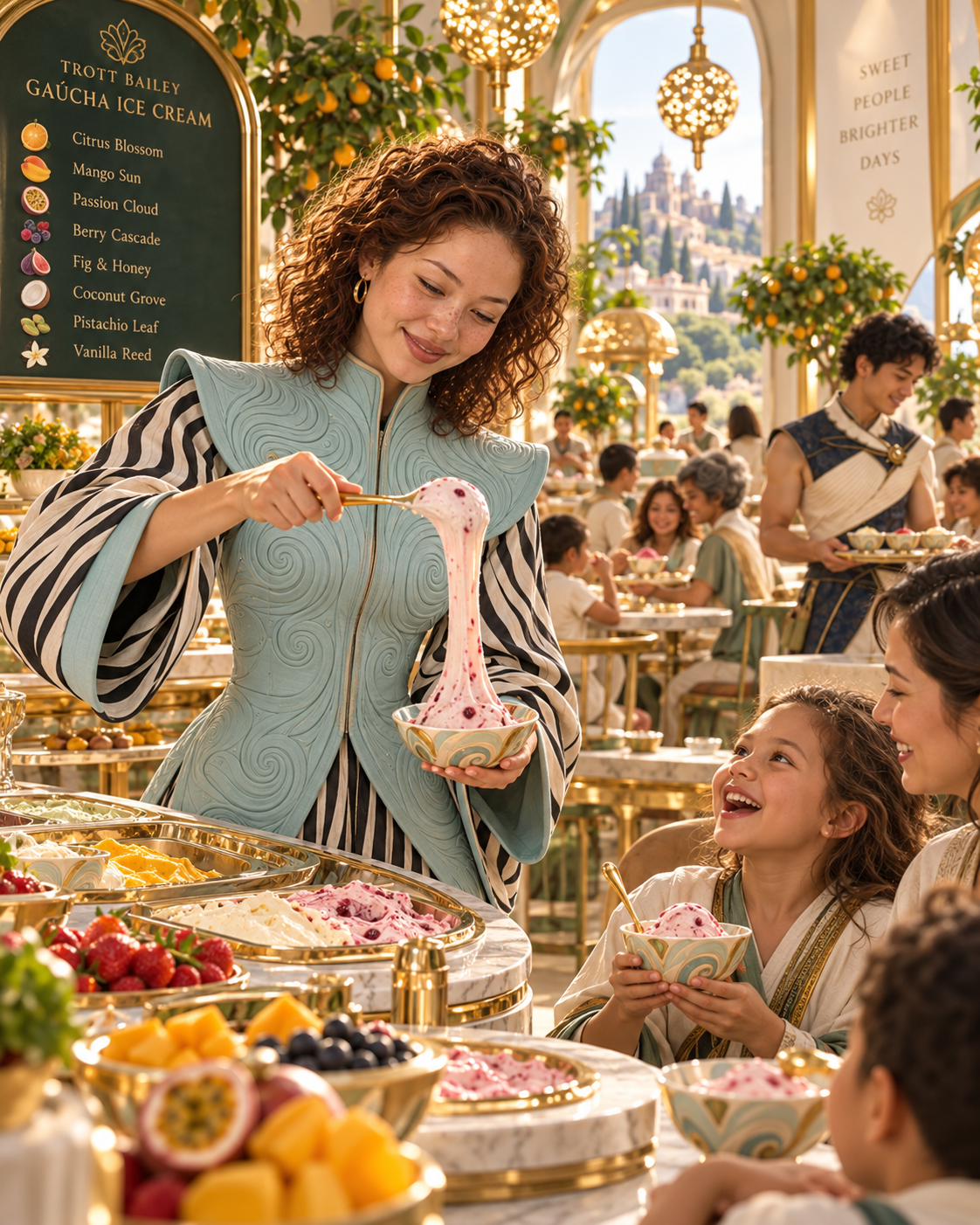
Families can come eat.
AgriGames can begin.
Public kitchens can cook.
Preservation houses can work.
Seeds can be collected.
Propagation can expand.
Wokumbakia can tell the civilization what is happening.
LuvYou Caterports can help people travel toward it.
The abundance becomes useful because the civilization is organized to receive it.
Eating Is Not the End of the Food
Take one mango.
A person eats it.
That is already good.
The purpose of food is nourishment.
But the story does not have to stop there.
The seed can return.
If the variety is worth propagating and the growing conditions are right, that seed can become another tree.
That tree can eventually produce hundreds or thousands of fruits across its life.
The same principle appears in different ways across food systems.
Some through suckers.
Some through cuttings.
Some through tubers, roots, crowns, runners or grafting.
The exact method changes.
The principle does not.
Food contains pathways into more food.
A civilization that pays attention to those pathways can make eating part of multiplication.
Not every seed must become a plant.
Not every cutting will succeed.
Not every variety should be reproduced everywhere.
But enough can return that the food system keeps expanding its own future.
Seed Return Changes the Meaning of Waste
Once food is treated as living abundance, the leftovers of eating begin to look different.
A watermelon contains seeds.
Papaya contains seeds.
Pumpkin contains seeds.
Fruit contains skins, pulp and organic material that can return to soil.
Kitchen scraps can become compost.
Plant material can become mulch.
Some seeds can be selected for propagation.
The goal is not to turn every meal into a laboratory.
The goal is simply to stop behaving as though the useful life of food ends at the mouth.
What can feed soil should feed soil.
What can become another plant should have a route back into growing.
That keeps useful food material moving back into soil and future growth.
Mixed Orchards Make Abundance Richer
A single crop can peak all at once.
A mixed orchard gives civilization something more interesting.
Different foods rise and fall through the year.
One week may belong to strawberries.
Another to grapes.
Then lychees.
Then mangoes.
Then citrus.
Some plants are flowering while others are heavy with fruit.
Some trees are young.
Others are mature.
Some foods are being eaten fresh.
Others are entering preservation.
The landscape keeps changing.
That means abundance does not have to feel like a giant pile of one thing.
It can feel like entering a living food world.
You are not travelling to rescue one surplus crop. You are travelling into abundance.
That distinction matters.
People do not have to arrive because something has gone wrong.
They can arrive because something has gone wonderfully right.
Preservation Lets Abundance Move Through Time
Fresh abundance has a season.
Human nourishment does not.
That is where preservation becomes powerful.
Freeze it.
Ferment it.
Bottle it.
Can it where appropriate.
Turn it into sauces.
Preserve fruit.
Make pastes.
Store roots properly.
Develop recipes that hold well.
A heavy harvest in one month can continue nourishing people long after the trees have finished producing.
Preservation means abundance does not have to be eaten immediately or lost.
Preservation moves food through time.
The orchard produces in its season.
Civilization carries part of that season forward.
Abundance Can Move Toward People
Not everybody needs to travel.
Food can move.
Preserved food can move.
Fresh food can move where practical.
Public kitchens can receive ingredients.
Families can receive foods that do not grow near them.
Districts can share what is unusually abundant.
That is one half of the system.
But there is another half.
Sometimes the better experience is for people to go to the food.
People Can Move Toward Abundance
A mixed orchard is having an extraordinary month.
Wokumbakia tells the civilization.
Families decide they want to experience it.
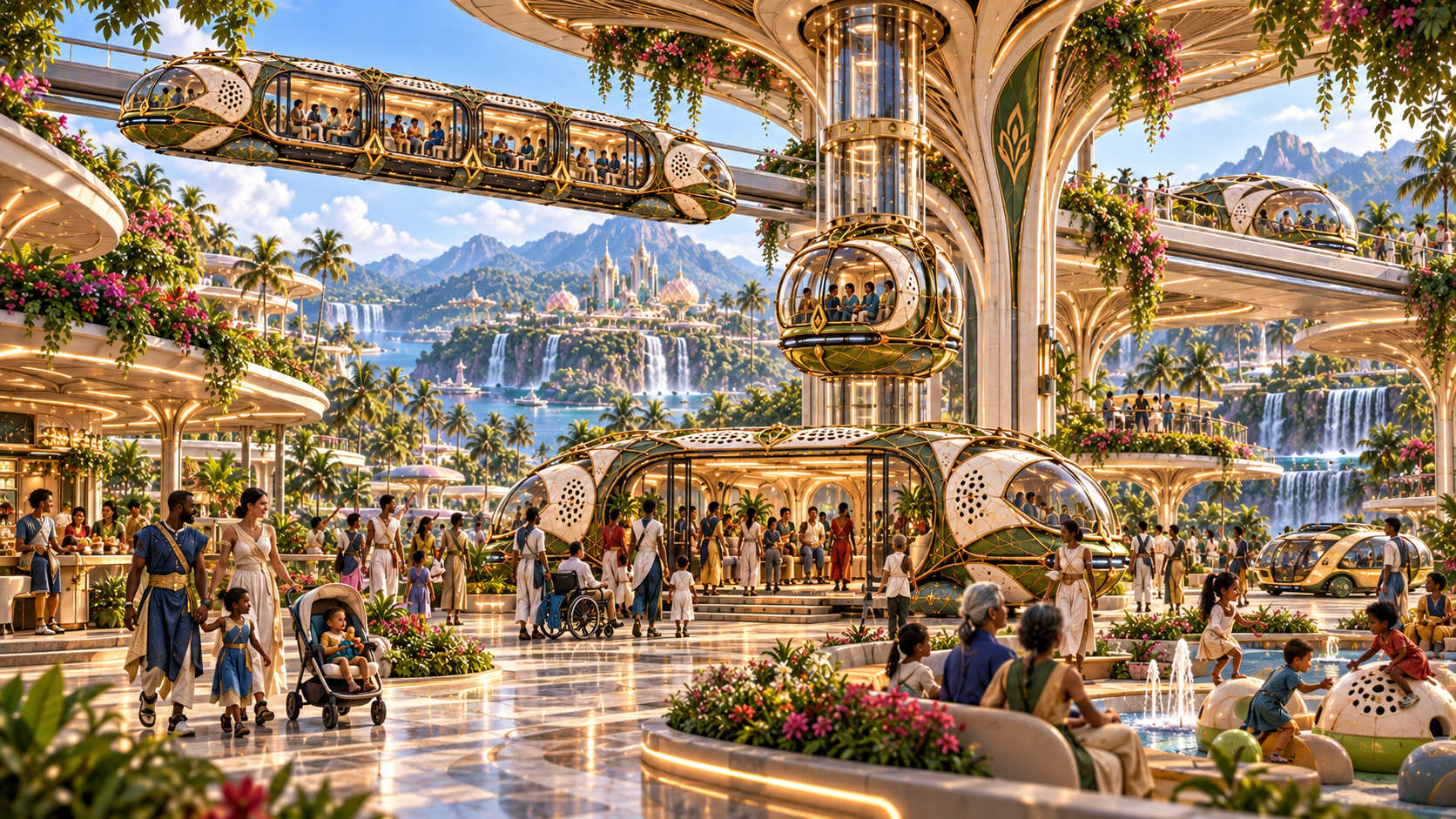
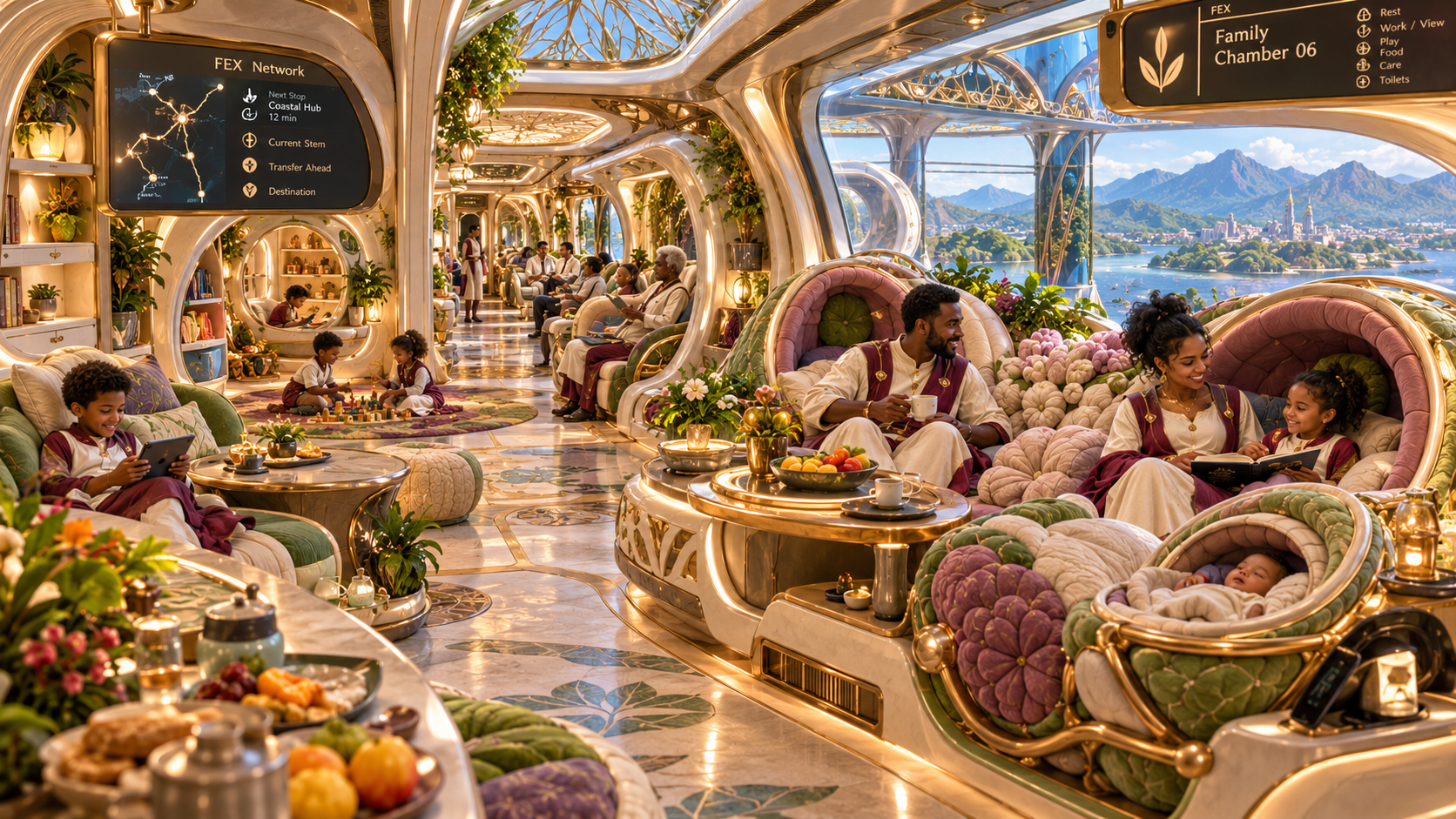
They travel through LuvYou Caterports.
They arrive while the food is alive in its place.
They eat under the trees.
Children see how the fruit grows.
They join AgriGames.
They learn recipes.
Someone learns grafting.
Someone notices irrigation.
Someone tries a fruit they have never eaten before.
The family leaves with a memory that cannot be packed into a delivery box.
Abundance becomes a place people can enter.
That is one of the most important consequences of free food and free travel working together.
Wokumbakia Gives Multiplication a Voice
If food is multiplying across a civilization, people need to know.
Wokumbakia — Food Abundance
MANGO FLOWERING EXCEPTIONAL THIS YEAR
GRAPE HARVEST OPENS FRIDAY
NEW BREADFRUIT PROPAGATION SUCCESS IN THREE DISTRICTS
10,000 PAPAYA SEEDLINGS READY FOR PLANTING
CITRUS PRESERVATION WEEK BEGINS MONDAY
Now civilization news is not only telling people what happened.
It is telling people where life is increasing.
What should growers learn from?
Which plants performed exceptionally well?
Where are more hands useful?
Which recipes should be tested?
What should be planted next?
The food system becomes more intelligent because multiplication is visible.
AgriGames Can Make Multiplication Fun
Abundance does not have to be managed only through work schedules.
It can become play.
Which district develops the best mango preservation method?
Which children can identify the ripest fruit most accurately?
Which community can establish a new orchard with the highest survival rate?
Which recipe makes an abundant food so delicious that everybody wants it again?
Now the game leaves something behind.
More plants.
Better recipes.
Better methods.
More knowledge.
More food.
The scoreboard is physical reality.
The civilization should be more capable after the game than before it.
Abundance Should Be Allowed to Feel Abundant
There is a habit of speaking about food abundance as though it immediately creates a problem.
Too fast.
Too many.
What will we do with all of it?
Trott Bailey Family Civilization can answer that question with confidence.
We invite people.
We preserve it.
We cook it.
We learn from it.
We move some of it.
We move people toward some of it.
We return seeds.
We expand growing.
We let abundance do what abundance does.
Multiply.
That does not mean wasting food.
It means building enough routes for abundance to keep becoming useful life.
One Good Plant Can Become a Civilization Asset
Suppose a family discovers an exceptional fruit tree.
The fruit is excellent.
The tree handles the local climate well.
It produces reliably.
People love eating it.
That should not remain a private accident.
The civilization can notice it.
Study it.
Propagate it appropriately.
Share the knowledge.
Plant descendants or grafted material in suitable places.
Years later, something that began with one strong tree may exist across thousands of productive landscapes.
Not through money.
Through biology, attention, skill and time.
Plant Before Hunger Arrives
Multiplication also changes how civilization thinks about the future.
A fruit tree planted today may feed children years from now.
An orchard planted now may serve families who have not yet been born.
A seed bank protects options.
A propagation house expands capacity.
A food forest changes what a neighborhood will be able to eat later.
Civilization should not wait until hunger appears before deciding that food would be useful.
Plant before hunger arrives.
The future should meet mature trees.
The Food Cycle Should End by Beginning Again
The old picture of food can be very short:
Trott Bailey Family Civilization can build a longer cycle:
That final step matters.
The cycle does not end with consumption.
It returns to life.
Abundance Is the Beginning of More Life
A mango tree produces hundreds of mangoes.
A papaya carries many seeds.
A productive landscape can feed families while creating the material for more productive landscapes.
A great harvest can become meals, celebrations, preserved food, AgriGames, travel, knowledge, compost, seeds and new planting.
So when abundance arrives, civilization does not need to look at it nervously and ask:
It can ask:
That is the larger possibility.
Food nourishes people now.
Then, wherever biology allows, civilization helps that food become future food too.



 and then