Only Two Percent of Food Has Been Explored: Keslev’s Food Discovery Mission
Only Two Percent of Food Has Been Explored: Keslev’s Food Discovery Mission
Keslev District believes the world has barely begun to understand food.
Other districts may explore recipes, meals, desserts, public dining experiences, cultural food identity, and new combinations of known ingredients. Keslev goes deeper.
Keslev asks what food has not yet been planted, tested, remembered, adapted, prepared, verified, processed, stored, served, or brought into family life.
It believes that humanity may have explored only a small portion of food’s true possibility.
For Keslev, food discovery is not a hobby. It is not trend-chasing. It is not luxury gastronomy. It is not strange food for entertainment.
It is food sovereignty work.
Keslev does not chase novelty. Keslev searches for nourishment the kingdom has not yet fully understood.
The Two Percent Question
Keslev’s food discovery mission begins with a provocative idea:
What if only two percent of food has been properly explored, and the other ninety-eight percent is still waiting to be discovered, remembered, cultivated, tested, prepared, or understood?
This does not mean Keslev literally claims to know the exact percentage of all food knowledge in the world.
It means Keslev refuses to assume that the current food system has already found the best answers.
The modern outside world often repeats a narrow group of crops, products, meals, brands, and commercial food patterns. Many families eat from a surprisingly small food imagination, even while the earth contains vast diversity.
Keslev asks:
- What crops have been neglected?
- What plants were once used but forgotten?
- What foods are common in one culture but unknown in another?
- What wild or semi-domesticated foods could be responsibly studied?
- What parts of plants are underused?
- What food combinations improve nutrition, resilience, and taste?
- What crops can survive heat, rain, drought, salt, flood, or poor soil?
- What foods can serve babies, elders, Sabenneries, travelers, animals, and reserves?
- What can become porridge, flour, mash, broth, snack, dessert, travel food, public meal, or emergency food?
Keslev is not satisfied with eating from a narrow shelf when the world may contain a much larger food library.
Food Discovery Is Not Recipe Play
Food exploration can happen in every district, but Keslev’s version is different.
In Keilah, food exploration may become chocolate culture, dessert design, cocoa learning, and creative public food experiences.
In Big King District, food exploration may become pastries, soft breads, ceremonial bakes, and warm bakery culture.
In Kaleeyon, food exploration may become ice cream, pizza, fries, fried chicken, ketchup, child joy foods, and playful food rewards.
In Sherika Regional District, food exploration may serve arrival hospitality, sugar cane refreshments, newcomer nourishment, and first-impression abundance.
In Kultan, food exploration may connect to seafood, coconut-water flow, lagoon food, clean processing, and zero waste.
In Kezidek, food exploration must become warm foods, baby food transition, toddler bowls, postpartum bowls, and young-family nourishment.
But Keslev explores food from the foundation.
Keslev asks not only, “What can we cook?”
Keslev asks:
- Can this be planted?
- Can this be grown reliably?
- Can this crop survive changing conditions?
- Can the seed or propagation material be protected?
- Can it be processed safely?
- Can families use it?
- Can children use it?
- Can Sabenneries serve it?
- Can it be stored?
- Can it reduce scarcity?
- Can it become part of the kingdom’s food identity?
This is why Keslev’s food discovery is deeper than recipe invention.
Recipe exploration asks what can be made today. Keslev food discovery asks what can help feed the kingdom for generations.
Discovery Begins With Planting
Keslev plants from the foundation.
This means food discovery does not begin only in a kitchen. It begins in the ground, the orchard, the grove, the water system, the seed sanctuary, the field trial, and the climate test.
A food cannot become a serious kingdom food just because it tastes interesting once.
It must be studied through its life cycle.
Keslev must ask:
- Where does it grow best?
- How much water does it need?
- How does it respond to heat?
- How does it respond to heavy rain?
- Does it need shade?
- Does it improve soil or drain soil?
- Does it attract helpful insects?
- Does it carry pest risks?
- How long does it take to mature?
- Can it be harvested by families, guilds, machines, or helpers?
- Can it be grown at district scale without harming other food systems?
Food discovery without planting intelligence is shallow.
Keslev wants discovery that can survive contact with weather, soil, seasons, labor, processing, and family demand.
Forgotten Foods
Some foods do not need to be invented.
They need to be remembered.
Many cultures have foods that were pushed aside by colonization, commercial agriculture, urbanization, imported diets, industrial convenience, poverty stigma, or the dominance of a few global crops.
Keslev’s food discovery mission includes recovery.
It should study forgotten or underused foods with humility and respect.
That means asking:
- Who already knows this food?
- Which families, elders, farmers, cooks, or communities have protected this knowledge?
- How was it traditionally prepared?
- What safety rules came with it?
- What seasons did it belong to?
- Was it food for children, elders, ceremonies, scarcity, travel, or everyday meals?
- Why did it disappear from common use?
- Can it return without disrespecting its origin?
Keslev must never act as if food is only discovered when the kingdom names it.
Sometimes the kingdom’s job is to listen, protect, verify, and restore.
Some of the ninety-eight percent is not unknown. It is forgotten, neglected, dismissed, or waiting for respect.
Underused Parts of Plants
Keslev also studies underused parts of plants.
The outside food system often focuses on the most marketable portion of a crop and wastes or ignores the rest.
Keslev asks whether leaves, stems, peels, seeds, flowers, husks, roots, pulp, shells, fibers, oils, waters, and byproducts can be used safely and intelligently.
This does not mean everything should be eaten.
Some plant parts are unsafe. Some require processing. Some are better for animal feed, compost, fiber, material, medicine, dye, soil support, or energy.
Keslev’s job is to study carefully.
For example:
- coconut may produce water, milk, oil, fiber, husk material, shell surfaces, and food;
- corn may produce grain foods, husk uses, feed byproducts, and compost flows;
- breadfruit may support roasting, flour, chips, public meals, and tree-crop systems;
- beans may support food, soil, seed systems, and protein planning;
- fruit surplus may support juices, dried fruit, sauces, baby foods, desserts, animal feed where safe, or compost.
Underuse is a form of hidden scarcity.
A kingdom can have abundance and still waste potential because it has not studied enough.
Keslev does not ask only what can be eaten. It asks what every crop can responsibly become.
Climate-Adapted Food Discovery
Keslev’s discovery mission must also prepare for changing climates.
A food system that depends too heavily on a small number of crops becomes fragile when weather changes.
Keslev must study foods that can handle:
- heat;
- humidity;
- drought;
- flooding;
- salt exposure;
- heavy rain;
- poor soil;
- wind;
- pests;
- disease pressure;
- seasonal instability.
This is not only about survival crops.
It is about beautiful, nourishing, culturally rich, family-usable foods that can help the kingdom remain flexible.
Keslev must build food diversity so that one crop failure does not threaten family life.
If rice is strained, roots may rise. If corn is pressured, breadfruit may help. If wheat is limited, plantain, cassava, or yam systems may carry more public meals. If one fruit is abundant, Sabenneries can shift menus before waste occurs.
Food discovery gives the kingdom more ways to bend before families break.
New Food Trials
Keslev should run food trials carefully.
A new food cannot be adopted because it is exciting, colorful, rare, or fashionable.
It must move through a disciplined pathway.
A Keslev food trial may include:
- Identification — What is the food, plant, crop, or preparation?
- Origin respect — Who already knows or uses it?
- Safety review — Is it safe, and under what conditions?
- Planting trial — Can it grow in kingdom conditions?
- Field verification — Does the real crop match the report?
- Processing trial — How must it be prepared?
- Texture trial — Is it suitable for babies, children, elders, or general meals?
- Storage trial — Can it be preserved?
- Sabennerie trial — Can public food centers serve it well?
- Family feedback — Do families actually accept and enjoy it?
- Adoption decision — Should it become local, district, seasonal, reserve, or kingdom-wide food?
This prevents food discovery from becoming reckless.
Wonder must be paired with verification.
Keslev’s food discovery is adventurous, but it is not careless.
Food Discovery and Sabenneries
Sabenneries are essential to Keslev’s discovery mission because they allow public tasting, feedback, and adoption.
A food does not become part of kingdom life merely because researchers approve it.
Families must meet it.
Children must respond to it. Parents must trust it. Elders may remember or reject it. Helpers must understand how to serve it. Sabennerie stewards must know whether it belongs in warm food, roasted food, snacks, desserts, family buffets, husband-and-wife dining, or tasting/voting spaces.
New-food tasting and voting Sabenneries are especially important.
They give people a dignified way to try foods and offer opinions.
This may include:
- small tasting bowls;
- family feedback cards;
- child-friendly opinion tokens;
- texture ratings;
- preparation comparisons;
- district use suggestions;
- seasonal acceptance tracking;
- Pacorips-linked feedback;
- field verification follow-up.
The kingdom does not force every discovered food into every family’s life.
It listens.
A food is not fully discovered until the people have met it.
Children and Food Discovery
Keslev’s food discovery mission must include children, but carefully.
Children should not be used as testing grounds for unsafe foods, poorly understood crops, or adult novelty experiments. But children should also not be excluded from food discovery entirely.
Children can learn that food is alive, varied, seasonal, and still being understood by the kingdom.
In Kezidek, babies and toddlers may meet food gently through Baby Edible Wonder Rings, safe touch, smell, washing, prepared tasting, warm bowls, and parent-approved food transition.
In Kaleeyon, older children may help taste new child joy foods, ice cream variations, safe snack forms, pizza-style experiments, fries from different roots, fruit ketchup alternatives, and playful food ideas.
In No Dumb Dumbs or AgriGames settings, children can learn food intelligence through planting, harvesting, sorting, washing, milling, cooking, voting, and understanding how food moves through the kingdom.
Keslev’s child food discovery rule is:
Children may participate in food discovery only when safety, parent authority, age-appropriate texture, and dignity are protected.
Food Discovery for Babies and Toddlers
For babies and toddlers, food discovery must be extremely gentle.
They do not need strange foods forced into their mouths. They need safe exposure, family guidance, warm food connection, and parent choice.
Kezidek’s Baby Food Transition System and Baby Edible Wonder Rings are the proper pathway for early-life food discovery.
The arc remains:
Living plant → safe touch → clean hands → prepared food → warm bowl → family table.
Keslev can support this by verifying safe plants, safe preparations, texture stages, choking risks, preparation rules, and suitable food pathways.
For babies and toddlers, discovery may mean:
- seeing a food grow;
- touching a safe leaf or fruit skin;
- smelling a gentle herb;
- washing hands after garden contact;
- watching a root become soft mash;
- tasting a parent-approved smooth preparation;
- eating a warm bowl connected to a food they saw earlier.
That is enough.
Food discovery in early life should build trust, not pressure.
Food Discovery for Public Meals
Keslev food discovery must also serve public meals.
A food may be interesting, but can it feed people? Can it become soup, porridge, roast, mash, bread, sauce, snack, dessert, salad, drink, family platter, or travel food?
Public meal testing should ask:
- Can this food be prepared safely at scale?
- Does it hold texture after cooking?
- Can Sabenneries serve it without waste?
- Can children and elders eat it?
- Can it be paired with existing staples?
- Can it be used in warm food, roasting, buffet, sit-down, or tasting Sabenneries?
- Does it require special training?
- Can leftovers become another safe use?
Keslev must discover foods not only for elite tasting, but for real public nourishment.
A discovered food becomes more powerful when it can feed families, not only impress tasters.
Food Discovery for Scarcity Protection
Food discovery is one of Keslev’s strongest weapons against scarcity.
If the kingdom depends too heavily on a few crops, it becomes vulnerable. A disease, drought, flood, pest outbreak, storage problem, or supply disruption can threaten too much at once.
Keslev discovery expands the kingdom’s options.
When one crop is strained, another can rise.
When one staple is scarce, another can carry meals.
When one district has excess, the food can be transformed into public meals, preserved foods, family baskets, child foods, animal feed where appropriate, or compost.
Discovery gives Keslev more tools for adjustment.
Scarcity protection may include discovering:
- drought-tolerant grains;
- flood-tolerant roots;
- heat-resilient vegetables;
- fast-growing leafy foods;
- tree crops that stabilize food supply;
- storage-friendly foods;
- foods that process into flour or meal;
- foods that can replace pressured animal feed inputs;
- foods that work well in warm public meals;
- foods that can support baby and elder nutrition safely.
Keslev does not wait for scarcity to teach the kingdom what else could have been grown.
Food discovery gives the kingdom more ways to respond before hunger reaches the family table.
Food Discovery for Excess Management
Food discovery also helps manage excess.
A crop can be abundant and still become waste if the kingdom lacks imagination, processing, storage, or distribution routes.
Keslev asks what excess can become.
If fruit is abundant, it might become fresh fruit bowls, dried fruit, juices, sauces, baby-safe preparations, warm porridge toppings, desserts, fermented foods where appropriate, animal feed where safe, compost, or new Sabennerie specials.
If plantains are abundant, they might become roasted sides, flour, chips, toddler bowls, warm mash, public meal bases, or festival foods.
If sweet potatoes are abundant, they might become mashes, porridges, roasted foods, soups, child bowls, preserved forms, or emergency reserves.
If coconut is abundant, it may become water, milk, oil, fiber, dessert, porridge, material, or Kultan-linked flow products.
Excess is not a problem only when nothing can be done with it.
Keslev’s food discovery expands what can be done.
Keslev does not let abundance rot because the kingdom lacked enough ideas.
Food Discovery and Animal Feed Boundaries
Keslev’s food discovery mission also helps protect animal feed boundaries.
If animals rely too heavily on human staple foods, families may suffer. This is especially dangerous with grains such as corn.
Keslev must discover and develop responsible animal feed alternatives that do not steal family food foundations.
This may include:
- legumes where appropriate;
- forage systems;
- oilseed meal;
- food-processing byproducts;
- insect protein;
- orchard surplus;
- safe kitchen and Sabennerie byproduct streams;
- pasture support;
- aquatic food-system byproducts through Kultan where safe;
- crop residues that can be used without harming soil return.
The goal is not to feed animals poorly.
The goal is to prevent animal systems from eating the security of families.
No animal-feed discovery is successful if it protects livestock while weakening households.
Food Discovery and Kultan
Kultan District is one of Keslev’s strongest food discovery partners.
Kultan brings water, seafood, coconut-water flow, clean food processing, zero-waste systems, Makji provisioning, lagoon logistics, and land-sea food intelligence.
Together, Keslev and Kultan can explore foods from both land and water.
This may include:
- new seafood preparations;
- fish byproduct zero-waste uses;
- seaweed or aquatic plant possibilities where safe;
- coconut-water food systems;
- lagoon-linked preservation;
- Makji travel foods;
- clean processing byproducts;
- compost and nutrient return between water and land systems;
- Sabennerie dishes that combine land staples and seafood.
Kultan expands Keslev’s food map beyond fields.
Keslev gives Kultan’s food systems whole-kingdom planning discipline.
Keslev studies the food map. Kultan expands the map into water.
Food Discovery and District Identity
Food discovery should also support district identities without trapping districts in stereotypes.
Sherika loves sugar cane, but sugar cane can become more than sweet drinks. Keslev can help explore cane juices, syrups, ferments where appropriate, fibers, animal feed byproducts, public refreshments, arrival nourishment, and safe energy foods.
Keilah loves chocolate, but cocoa can become more than dessert. Keslev can help explore cocoa pulp, cocoa drinks, bean varieties, shade agroforestry, cocoa nutrition, cocoa byproducts, and children’s cocoa learning.
Big King loves pastries, but pastries need wheat, alternative flours, fruit fillings, nuts or seed alternatives where safe, spices, preservation, and baking systems.
Kaleeyon loves ice cream and child foods, but child joy foods need safe ingredients, real staples, fruit, sauces, ketchup alternatives, root fries, better pizza foundations, and public food balance.
Kezidek needs warm foods, baby-safe preparations, soft bowls, and parent support foods.
Kultan needs seafood, coconut, water-based food systems, zero-waste processing, and Makji provisioning.
Keslev does not erase these identities.
It strengthens them with planting, processing, safety, and supply.
District food identity becomes stronger when Keslev gives it roots, reserves, processing, and verification.
Architecture of Food Discovery
Keslev’s food discovery spaces must not look like generic laboratories, agricultural schools, industrial test kitchens, warehouses, or science campuses.
They must clearly belong to the Trott Bailey Family Kingdom.
Food discovery architecture should include:
- field trial gardens;
- seed sanctuaries;
- new food tasting pavilions;
- Sabennerie voting courts;
- processing trial houses;
- plant memory galleries;
- climate-adaptation plots;
- root and tuber safety houses;
- coconut and breadfruit exploration courts;
- child-safe learning paths;
- Pacorips food discovery dashboards;
- field verification stations.
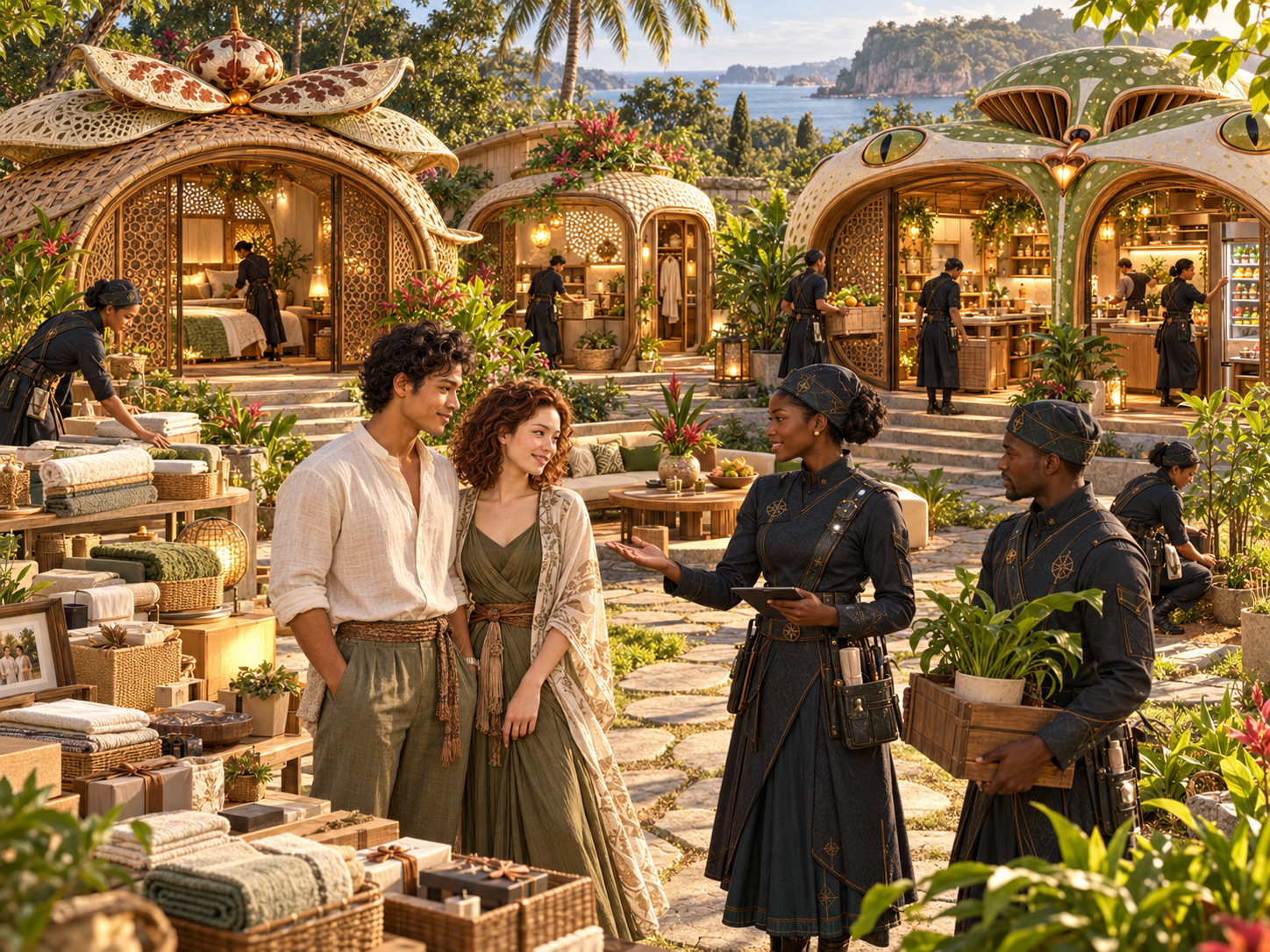
The architecture should use locked Trott Bailey language: Rain-Catchment Spine Roofs, Broad Leaf Canopy Roofs, Pleated Reef Fan Roofs, Mushroom Gill Canopy Roofs, Reptilian Umbrella Roofs with softer curl tips, Dapple Stack columns, Flower Orb railings, Open Palm Hand stair logic, carved patterned floors, biological pathway stones, and beautiful food gardens.
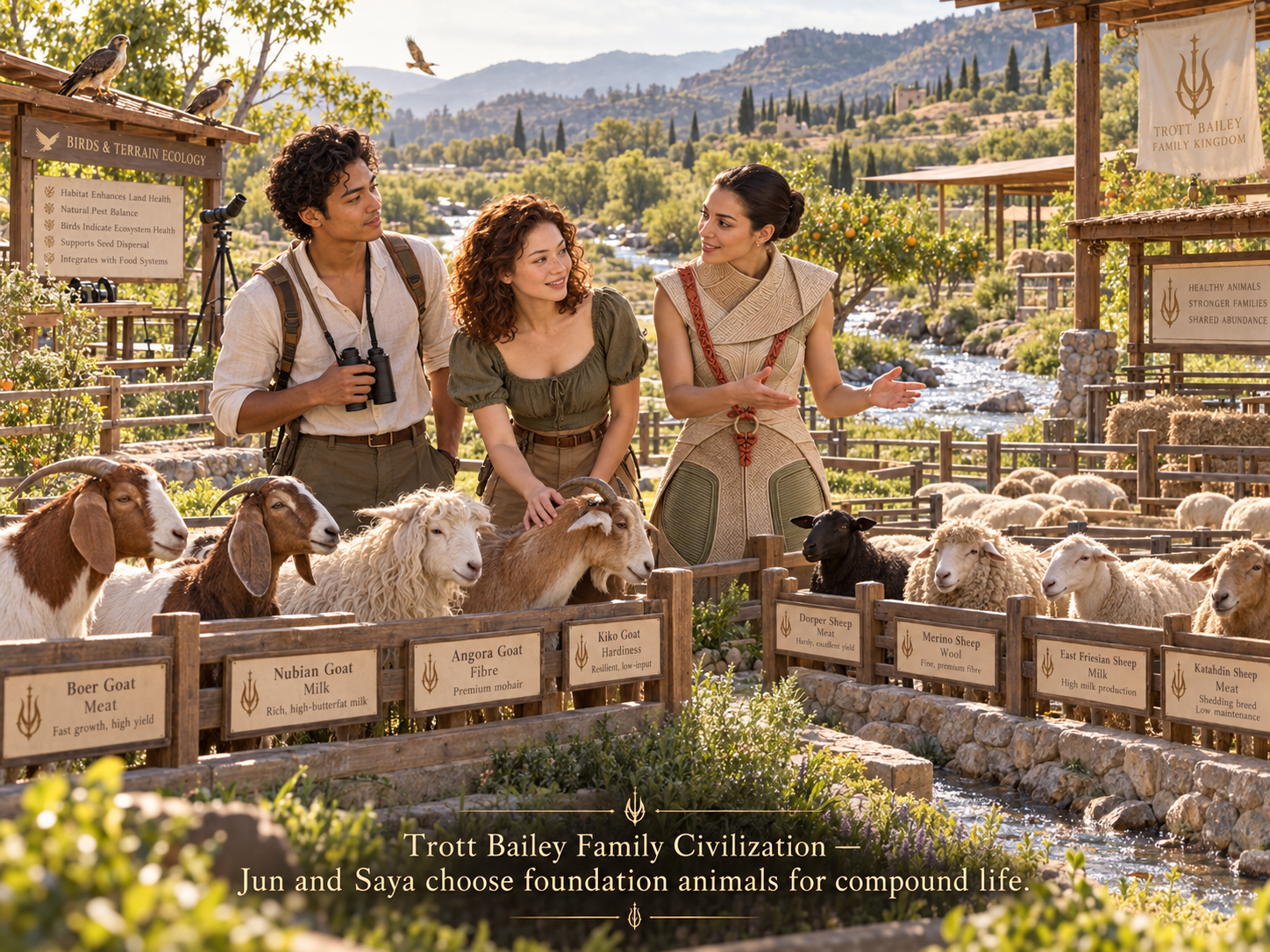
Food discovery should feel like a civic garden of future nourishment, not a sterile research compound.
Keslev makes discovery beautiful because the future of food deserves public dignity.
Uniforms for Food Discovery Roles
Keslev food discovery workers must not look like lab technicians, generic agricultural researchers, farmers, chefs, factory workers, or corporate food scientists.
They should wear Trott Bailey role-correct Shubaka uniforms.
Food Discovery Researchers may need a hybrid of Field-Facing, Food-Facing, and Verification Shubaka.
Their uniforms should support:
- field movement;
- seed sample carrying;
- plant tagging;
- food tasting protocols;
- Pacorips recording;
- safe preparation observation;
- weather protection;
- washable food-safe zones;
- RouteMemory footwear;
- district color logic: deep seed green, husk gold, warm field cream, soil brown, rice pearl, and Ashcoal grounding.
The clothing should communicate curiosity with discipline.
It should not look like novelty research or farm costume.
Keslev food discovery uniforms must show that the worker searches for new nourishment while remaining accountable to family food safety.
Pacorips and Food Discovery Records
Pacorips can help Keslev remember and coordinate food discovery.
It can record plant data, trial results, harvest notes, family feedback, tasting votes, safety concerns, processing methods, storage outcomes, Sabennerie adoption, district use, and field verification reports.
But Pacorips cannot replace real tasting, growing, cooking, and checking.
A food may look promising in data but fail in family use. A crop may perform well in one field but fail in another. A preparation may be safe in a controlled kitchen but difficult in public food service. A taste vote may be positive once, but long-term acceptance may be weak.
So Keslev must use Pacorips as memory, not as final judgment.
Pacorips can remember the food trial, but Keslev must verify the food life.
The Food Discovery Promise
Keslev’s food discovery mission promises that the kingdom will not accept a narrow food imagination as destiny.
It promises to search for forgotten foods.
It promises to study underused plants and plant parts.
It promises to test climate-adapted crops.
It promises to move discovery through safety, planting, processing, family feedback, public meal testing, storage, and verification.
It promises that babies and children will be included only through age-appropriate, parent-respecting, safe pathways.
It promises to help Sabenneries introduce new foods with dignity.
It promises to use discovery to manage scarcity and excess.
It promises to protect family food from animal feed pressure.
It promises to work with Kultan on land-sea food intelligence.
It promises to strengthen district food identities without reducing them to clichés.
It promises to keep Pacorips records tied to field truth.
Conclusion
Keslev District believes the food world is larger than what most systems currently use.
It believes many foods are forgotten, ignored, underused, undiscovered, poorly processed, culturally dismissed, or trapped outside public food systems.
It believes the kingdom must search.
But Keslev does not search carelessly.
It searches through planting, safety, processing, storage, tasting, family use, Sabennerie adoption, child protection, animal feed boundaries, field verification, and district identity.
Food discovery is not novelty.
It is preparation for future abundance.
It is one way the kingdom refuses to wait for hunger before expanding its food intelligence.
Keslev does not chase strange foods for attention. Keslev searches for the nourishment the kingdom has not yet fully understood.
If only a small portion of food has been explored, then Keslev’s mission is clear.
Plant deeper. Study wider. Verify harder. Listen better. Feed families first.



 and then