
Pacorips Evidence Standards: How the Kingdom Establishes Truth
Trott Bailey Family Kingdom · Pacorips Evidence Standards · Part 1
Pacorips Evidence Standards: How the Kingdom Establishes Truth
Part 1: What counts as evidence, what Pacorips may do with it, and why records must not become false certainty.
Written by World Ruler Sher for the Trott Bailey Family Civilization.
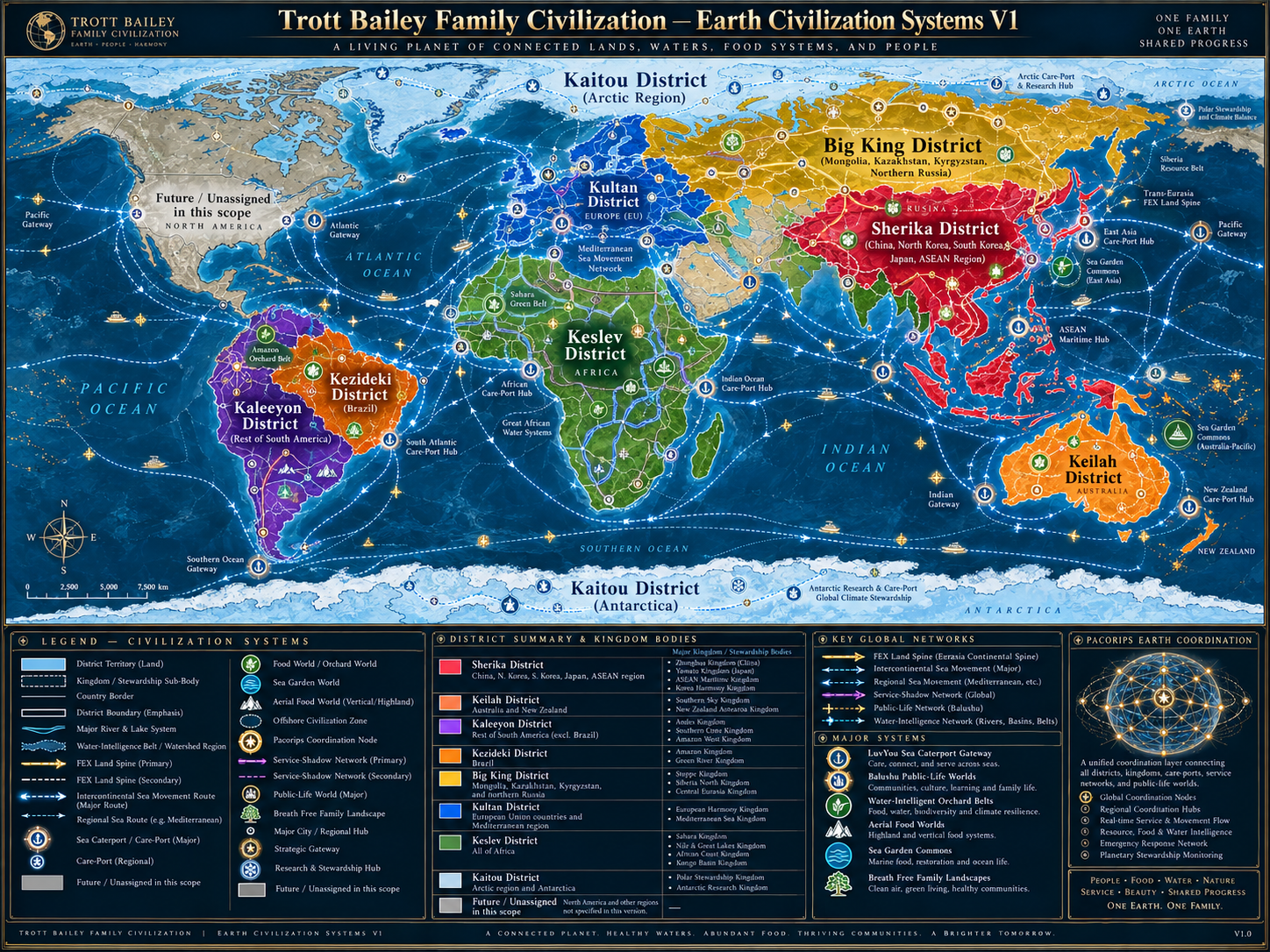
Pacorips exists to help the Trott Bailey Family Kingdom remember care, support, proof, safety, readiness, food truth, worker protection, youth development, clean-return routes, and district patterns.
But a system that remembers evidence must be handled carefully. A record can help. A record can also be wrong. A sensor can fail. A person can misunderstand what they saw. A steward can miss context. A family can have an explanation that was not captured. A worker can be blamed for a failure that actually came from bad design.
This is why Pacorips needs evidence standards.
Pacorips may remember evidence, but evidence must still be weighed.
1. Why Evidence Standards Matter
Evidence standards protect the kingdom from false certainty.
If Pacorips records that a food batch may be unsafe, the kingdom must know whether that came from a machine alert, a human inspection, a smell test, a temperature reading, a repeated complaint, or a verified contamination event.
If Pacorips records that a worker response was delayed, the kingdom must know whether the worker was actually slow, whether the tool was missing, whether the route was blocked, whether the drain was badly designed, or whether the worker was sent into an impossible situation.
If Pacorips records that a child is showing a gift, the kingdom must know whether that pattern came from repeated voluntary interest, mentor observation, one strong event, family reporting, or adult pressure.
This is not about making Pacorips extra. It is about making Pacorips careful.
Evidence standards stop Pacorips from treating every record as equal.
2. The Four Words Every Reader Must Understand
Before Pacorips evidence can be understood, four words must be separated clearly: claim, record, verification, and decision.
Claim
A claim is something someone says, reports, requests, or a system flags. A claim may be true, partly true, misunderstood, or incomplete.
Record
A record is the fact that the claim, event, route, warning, proof, or observation was entered into Pacorips.
Verification
Verification is when the right human authority, steward, or evidence method checks the record or claim.
Decision
A decision is what the proper human authority does after evidence has been weighed.
Pacorips may hold a claim as a record. That does not mean the claim has already become verified truth.
3. Why Pacorips Is Involved in Evidence at All
Pacorips is involved in evidence because a civilization dealing with large-scale abundance, family support, food safety, public services, youth growth, worker protection, and resource routing cannot depend on scattered memory.
At small household scale, a mother can see which mangoes are ripe and choose what to eat first. At kingdom scale, orchards, Sabenneries, children’s food, drying houses, preservation kitchens, public meals, animal routes, spoilage prevention, and food sharing all require organized memory.
That does not mean Pacorips should obsessively monitor every mango. It means Pacorips may help record the condition of food batches so ripe abundance can be eaten, preserved, shared, dried, cooked, or rerouted before it spoils.
Pacorips should be detailed where abundance, safety, routing, and support require detail — but restrained wherever detail would become surveillance, shame, ranking, or control.
That is the central balance. Pacorips is not involved so the kingdom can watch people. Pacorips is involved so the kingdom can remember what would otherwise be forgotten.
4. What Counts as Evidence?
Evidence is anything that helps the kingdom understand what happened, what needs support, what must be verified, what may be unsafe, what was completed, or what pattern is repeating.
In Pacorips, evidence may include:
- Direct human verification — a trained person inspected, confirmed, touched, smelled, tasted, reviewed, or witnessed the matter directly.
- Steward-confirmed observation — a responsible steward observed and recorded the event within their area of duty.
- Physical proof — a returned vessel, completed route marker, food sample, repaired tool, damaged object, garment module, or visible material condition.
- Sensor or scan record — weight, capacity, temperature, route scan, tagged vessel, bundle tag, or machine warning.
- Process record — proof that a step happened: checked in, washed, tested, dispatched, repaired, returned, reviewed, or approved.
- Repeated pattern — the same issue, need, gift, failure, overload, or route confusion appearing across time.
- Family or citizen report — a household, parent, child, elder, worker, or citizen gives context or reports a need.
- Witness report — another person saw, heard, or experienced something relevant.
- Unverified claim — a report that may matter, but still needs review before it becomes trusted evidence.
Pacorips should preserve evidence without pretending all evidence has the same strength.
5. The Evidence Strength Ladder
Pacorips needs a simple way to separate stronger evidence from weaker evidence. This does not mean weaker evidence is useless. It means the kingdom must know how much confidence a record deserves.
| Evidence Level | Meaning | What Pacorips May Do |
|---|---|---|
| Level 1: Direct Human Verification | A trained person verified the matter directly. | Support normal routing, action, release, correction, or escalation. Still correctable if later facts appear. |
| Level 2: Steward Observation | A responsible role-holder observed and recorded the matter. | Support role-area action or review, especially when the steward is responsible for that system. |
| Level 3: Physical Proof | There is a material object, sample, marker, tool, vessel, or visible proof. | Support verification, repair, routing, release, holding, or further inspection. |
| Level 4: Sensor or Scan Record | A machine recorded weight, capacity, temperature, tag, route, or warning. | Trigger alerts, temporary holds, route review, capacity planning, or human verification. Not final truth alone. |
| Level 5: Repeated Pattern | The same issue appears across time. | Trigger investigation, redesign, training, support, expansion, or steward review. |
| Level 6: Family or Citizen Report | A person reports a need, event, concern, correction, or context. | Preserve respectfully, route for review, and add context. Must not be dismissed because it is personal testimony. |
| Level 7: Witness Report | Another person reports what they saw, heard, or experienced. | Use as supporting evidence, but check against context and other records. |
| Level 8: Unverified Claim | A claim exists, but it is not yet verified. | Preserve for review. May not trigger punishment, shame, denial, public exposure, or final judgment. |
A Pacorips record should carry its evidence strength, not just its conclusion.
6. What Evidence Strength Changes
Evidence strength changes what Pacorips is allowed to recommend next.
Strong verified evidence may support ordinary action. Weak evidence may only support review. Unverified claims may be preserved, but they cannot become punishment.
Simple rule:
The weaker the evidence, the more Pacorips should recommend review instead of action. The stronger the evidence, the more Pacorips may support routing, release, correction, or protection.
This protects the kingdom from overreacting to weak claims while still allowing early support when something may be wrong.
Evidence strength is not decoration. It decides whether Pacorips may route, warn, hold, recommend review, or support action.
7. What Counts as Verification?
Verification means the kingdom has checked a record or claim through an appropriate authority, method, or evidence chain.
Verification is not the same in every district. Food safety requires food stewards. Worker risk requires Service Shadow review. Youth readiness requires parents, mentors, and youth guides. Clean-return routing requires Krubaro stewards. Disputed serious matters require judges. Kingdom-wide patterns may require Grand Pacorips review by the ruling Trott Bailey Family.
The important rule is simple:
The person who verifies must be appropriate to the thing being verified.
A food batch is not verified by a random observer. It needs food-truth authority. A child’s development is not verified by a scoreboard. It needs adults who understand growth. A worker safety issue is not verified by speed data. It needs someone who understands tools, routes, risk, degearing, and system failure.
8. Example: Food Truth Without Food Surveillance
Food truth is one of the clearest places where evidence matters.
Pacorips is involved because food abundance moves at scale. Keslev may be handling orchards, harvest baskets, Sabennerie meals, children’s food, preservation, drying, storage, public sharing, and spoilage prevention. Without organized memory, good food can spoil, unsafe food can be served, and ripe abundance can miss its best use.
But Pacorips should not be written as though it obsessively watches every fruit. The better logic is batch condition and route memory.
Example
A mango batch comes from a warm orchard route. A temperature record shows the fruit sat longer than expected. A Keslev food steward cuts samples, smells the batch, checks texture, separates bruised pieces, and confirms the condition.
Pacorips records the batch source, condition, steward verification, and route decision.
Firm mangoes may go to storage. Ripe mangoes may go to fresh Sabennerie use. Very ripe mangoes may go to juice, sauce, baby food, or drying. Spoiled pieces must not be served to children.
Pacorips is not controlling the mangoes. It is helping Keslev route abundance honestly before waste or danger occurs.
Machines detect. Humans verify. Pacorips records food truth.
For more, read Pacorips and Food Truth: How Keslev District Feeds the Kingdom Honestly .
9. Example: Worker Delay Without Worker Blame
Worker evidence must be handled carefully because a bad record can easily become blame.
Pacorips is involved because Service Shadow workers carry the hidden pressure of public life. They may handle public bathrooms, drains, wet floors, food return, cleaning tools, used cloths, reusable vessels, waste routing, Makji reset, event cleanup, and emergency response.
If those pressures are not remembered, the worker becomes the place where the system hides its failures.
Example
A public bathroom reset is late. Pacorips shows the reset time was delayed. A shallow reading would say, “The worker was late.”
But the worker reports that the tool cabinet was empty. A Service Shadow steward reports that the route was blocked by festival crowd flow. A Krubaro record shows wet textile overflow at the same time. A public comfort record shows the area was overloaded.
The truth is not automatically “worker slow.” The truth may be “system overloaded, route blocked, tool supply failed, and the bathroom design needs more reset support.”
Pacorips is not involved to police the worker. Pacorips is involved so the kingdom does not blame the worker for a failure the system created.
Pacorips should protect workers from system failure, not blame workers for system failure.
For more, read Pacorips and Service Shadow: Protecting the Workers Who Protect the Kingdom .
Trott Bailey Family Kingdom · Pacorips Evidence Standards · Part 2
Pacorips Evidence Standards: How the Kingdom Establishes Truth
Part 2: Youth, family support, clean return, conflicting evidence, citizen challenge, emergency caution, and anti-drift rules.
Written by World Ruler Sher for the Trott Bailey Family Civilization.
Part 1 explained that Pacorips evidence must be weighed. A claim is not the same as a verified truth. A record is not the same as a final decision. A sensor alert is not the same as human judgment.
Part 2 applies that standard to youth, families, clean return, conflicting records, citizen challenges, emergencies, and Grand Pacorips.
Pacorips records are not divine truth. They are evidence that must be verified, reviewed, corrected, or challenged when necessary.
10. Youth Evidence Without Youth Ranking
Youth evidence must be handled with special protection.
Pacorips is involved in youth development because children grow over time. A child’s gift may not appear in one exam, one performance, one adult opinion, or one public moment. A child may show interest through repeated play, questions, building attempts, dance, song, service, invention, animal care, food curiosity, repair work, fashion interest, or movement patterns.
Pacorips may help remember those patterns so youth gifts are not lost. But it must never turn those patterns into ranking, pressure, or forced life assignment.
Example
A child repeatedly chooses building games, asks mechanical questions, joins repair workshops, watches Makji maintenance, and completes a voluntary challenge involving route logic.
Pacorips may recommend mentor exposure, a safe workshop invitation, or apprenticeship observation.
Pacorips may not permanently label the child, force the child into engineering, publicly rank the child above others, or treat one interest as a life sentence.
Pacorips does not rank youth. Pacorips helps the kingdom notice, protect, place, and harvest talent carefully.
11. Family Support Evidence Without Family Shame
Family support evidence should open a door to help.
Pacorips is involved because family life produces many needs across time: parent relief, baby care, elder support, food support, household rhythm, accessibility, return visits, community assistance, and district routing.
But family support records must not become family shame.
Example
A family with many children produces more laundry, more food scraps, more baby cloths, more movement needs, and more parent rest requests than a smaller household.
Pacorips should not interpret this as failure. It should help the kingdom understand household rhythm, provide enough Krubaro return support, connect the family to relief, and protect the parents from carrying everything alone.
A tired parent is not a failed parent. A household needing help is not lower than another household. A large active family should not be punished for having active family life.
Pacorips should reveal what support is needed, not shame families for having active household life.
This family receiving foundation begins in Sherika. Read Sherika Receives, Pacorips Remembers .
12. Clean-Return Evidence Without Creepy Tracking
Krubaro clean-return evidence must show the route of the material, not pretend every speck needs a spy camera.
Pacorips is involved because clean return has scale. Food scraps, branches, vessels, wet cloths, damaged goods, uncertain materials, and last-route waste cannot all be treated as one pile. If they are mixed together, workers suffer, reusable items disappear, biodigestors clog, mulchers overload, and public places become messy.
But Pacorips does not need to track every banana peel, thread, twig, or crumb.
Example
A household places fibrous garden branches in the soft food scrap route. The biodigestor hatch flags the wrong material stream.
Pacorips does not shame the household. It records the wrong-route event, guides the family toward the mulcher, and notices whether many households are making the same mistake.
If many families make the same mistake, the problem may be the design of the Krubaro station, not the people.
Pacorips does not track every speck of waste. It tracks the stream, the route, the weight, the return, the exception, and the pattern.
For the full clean-return Q&A, read How Does Pacorips Help Krubaro Remember? .
13. How Conflicting Evidence Should Be Handled
Conflicting evidence should not be crushed into one forced answer too quickly.
A sensor may say a route was late. A worker may say the passage was blocked. A steward may say the tool was missing. A family may say they requested help earlier. A public board may show overload. These records may conflict, but together they may reveal the real truth.
When evidence conflicts, Pacorips should:
- Mark the record as disputed or incomplete.
- Preserve the different reports.
- Identify what kind of human review is needed.
- Prevent punishment or shame until review is complete.
- Allow context from the affected citizen, worker, family, parent, child, steward, or elder.
- Update the record when truth is clarified.
Conflicting evidence should trigger review, not automatic judgment.
14. How Incomplete Data Should Be Handled
Incomplete data is not proof.
If Pacorips only has half a story, it should not pretend to have the whole truth. Incomplete data should produce caution, review, or temporary support — not permanent judgment.
If a food batch is missing one record, Pacorips may recommend holding the batch until a food steward checks it. If a worker route appears late, Pacorips may recommend route review before blaming the worker. If a youth record shows one strong interest, Pacorips may recommend exposure, not assignment.
When data is incomplete, Pacorips should ask for review, not force certainty.
15. What Happens When Pacorips Is Wrong?
Pacorips must be correctable.
A wrong record should not become a permanent stain on a person, family, worker, child, or steward. It should become a system problem to correct.
Example
A Pacorips record says a family missed a return appointment. The family explains that the route was blocked by heavy rain and a child became sick. A steward confirms the road delay and the family’s support need.
The record should not remain as “family missed appointment” without context. It should be corrected or annotated: route blocked, child illness, support needed, no fault assigned.
When Pacorips is wrong, the record should be marked for review. The person affected should be able to add context. A steward, elder, judge, or proper authority should review the matter. The corrected record should show that correction occurred.
Pacorips should preserve correction, not pretend mistakes never happened.
16. Citizen Challenge and Appeal
Citizens, families, workers, parents, youth guardians, stewards, and elders must have a path to challenge a record when it is wrong, incomplete, harmful, or missing context.
A citizen challenge should not be treated as rebellion against Pacorips. It should be treated as part of truth repair.
A fair challenge process may include:
- The person sees or is told the relevant record when appropriate.
- The person adds context, correction, or dispute.
- A steward reviews the practical facts.
- An elder may review family or community context.
- A judge reviews serious disputes or consequences.
- The record is corrected, annotated, sealed, confirmed, or escalated.
A truthful kingdom must let people correct the record.
17. Emergency Evidence
Some situations require temporary action before full evidence is complete.
If food may be contaminated, a route may be unsafe, a child may be in danger, a worker may face exposure, or a public area may be overloaded, Pacorips may recommend a temporary hold, warning, reroute, or support dispatch.
But emergency action should be temporary and reviewable. It should protect people while truth is established. It should not become permanent punishment without human judgment.
Emergency caution protects life. It must not become permanent judgment.
18. Grand Pacorips and Evidence
Grand Pacorips receives patterns from district nodes and helps the ruling Trott Bailey Family see kingdom-wide truth.
Pacorips is involved at this level because single districts can only see their part of the pattern. Grand Pacorips helps the ruling family see where care is failing, where abundance is moving, where food truth is weak, where workers are overloaded, where youth gifts are appearing, where public comfort is under pressure, and where infrastructure needs correction.
But Grand Pacorips must not turn district records into suspicion. It should read patterns of care, pressure, overload, joy, growth, risk, and needed correction.
Grand Pacorips helps ruling wisdom see clearly. It does not replace ruling wisdom.
For more, read Grand Pacorips Helps the Ruling Trott Bailey Family Govern Wisely .
19. What Pacorips Evidence Must Never Become
Pacorips evidence must never become social credit, public shame, youth ranking, worker policing, family labeling, or automatic punishment.
Evidence is supposed to help the kingdom see truth. It must not become a weapon against people.
- A youth record must not become a fixed label.
- A worker safety record must not become a punishment file.
- A family support record must not become household shame.
- A food alert must not become panic without verification.
- A clean-return warning must not become blame before route review.
- A citizen report must not become truth without review.
- A sensor record must not replace human interpretation.
- A pattern must not become a cage around a person.
Pacorips records should open doors to support, not close doors around people.
For the anti-drift foundation, read Why Pacorips Is Not Social Credit .
The Final Standard
Pacorips must remember truth carefully.
It may record evidence. It may preserve reports. It may verify processes. It may reveal patterns. It may recommend review. It may protect people from forgotten needs.
But it must not pretend that a record is the same as wisdom.
Pacorips records are not divine truth. They are evidence that must be verified, reviewed, corrected, or challenged when necessary.
Pacorips should organize abundance, safety, support, and system pressure without becoming obsessive monitoring of people.



 and then