
What Happens When the Family Becomes a Powerhouse of Productivity?
What Happens When the Family Becomes a Powerhouse of Productivity?
What happens when the family stops sitting at the edge of productive life and becomes one of civilization’s main places for capability, invention, learning, experimentation, and new discovery?
Modern civilization often treats the family as something that exists around productive life.
The adults go away to work.
The children go away to school.
Production happens somewhere else.
Research happens somewhere else.
Engineering happens somewhere else.
Design happens somewhere else.
Food production happens somewhere else.
Innovation happens somewhere else.
Then everybody comes home tired and tries to squeeze family life into what remains.
Trott Bailey Family Civilization turns that arrangement around.
And by productivity, I do not simply mean producing more things.
I mean the family’s growing ability to solve problems, create, discover, build, care, teach, experiment, and open new possibilities.
That is a much larger kind of productivity.
It is capability.
Not by turning the home into another company.
Not by making parents executives and children employees.
Not by bringing profit pressure, competition, endless growth, and work obsession into family life.
Something very different happens.
And because the family has security, tools, knowledge, time, space, and access, productive possibilities begin growing naturally around ordinary life.
We Have Made the Organization the Center of Productivity
Ask where productivity happens today and people usually point toward organizations.
These institutions can do important work.
But over time we have allowed them to become so central that the household is often treated mainly as a place of consumption.
The family becomes the receiver at the end of the production chain.
Trott Bailey Family Civilization asks a different question:
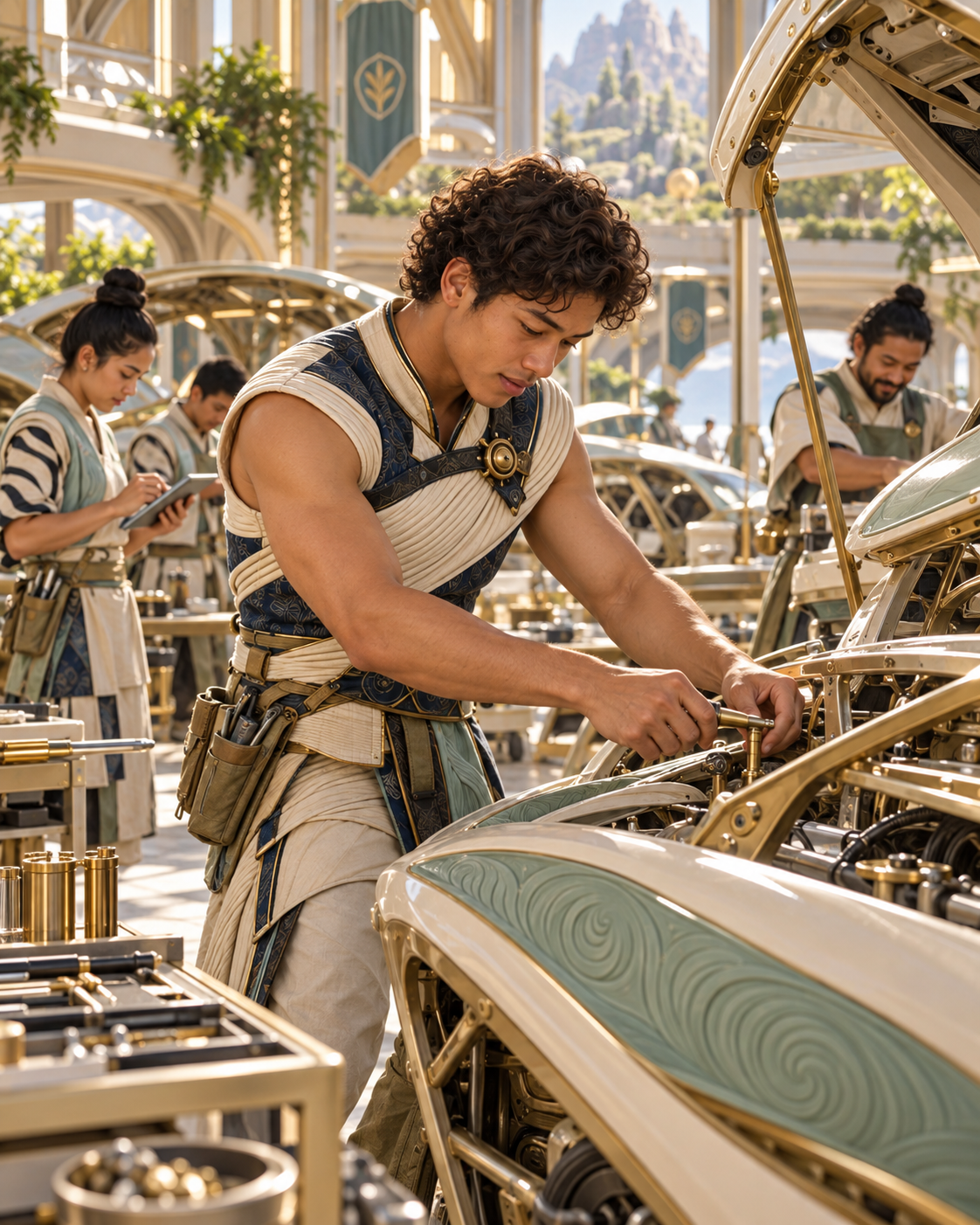
What happens when a household has access to land, machines, workshops, knowledge, transportation, computers, materials, food systems, skilled people, and enough time to explore?
Something powerful happens.
The household stops being only a place where people consume civilization.
This Does Not Mean Everybody Starts a Family Business
This distinction matters.
We are not proposing that every family become a small company.
The modern family business still sits inside the money system.
The family can easily become trapped serving the business.
That is not what Trott Bailey Family Civilization is building.
We are removing the business requirement altogether.
A family does not need to make money from an idea before it is worth pursuing.
It does not need to find customers before experimenting.
It does not need to calculate whether a new tool will make a profit.
It can ask simpler questions:
Productivity Serves the Family
There is an important law here.
That means a highly capable household does not need to be constantly busy.
If the necessary work is finished, the family can stop.
If machines reduce the workload, the family receives the time.
If a system becomes easier to maintain, nobody needs to invent meaningless work to fill the gap.
If a family wants to spend three months exploring a coastline, studying a plant, visiting another kingdom, building a strange machine, or simply resting, it can.
Productive capability gives the family more life.
It does not consume the family in the name of output.
The family remains a family first.
That boundary matters.
A Family Estate Can Become a Living Laboratory
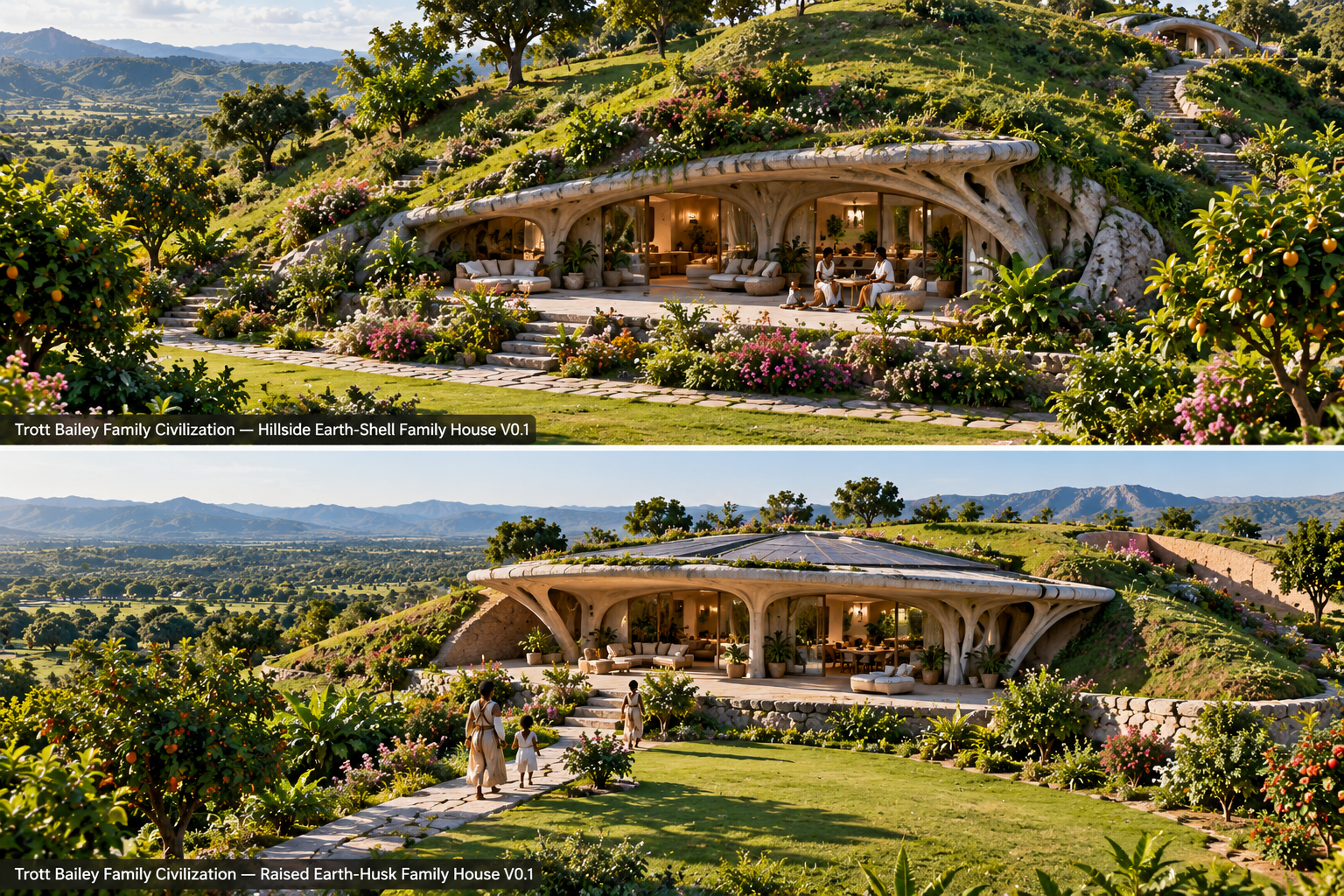
Consider what can exist around one capable family estate.
Problems appear naturally through daily life.
That is already a place where people can test ideas.
A family notices that one crop struggles in a certain soil.
They test different growing methods.
They discover something useful.
Another family improves the method.
A child notices that a tool is awkward.
Someone modifies it.
Another household sees the change and improves it again.
A family develops a better food-preservation method because they have too much fruit at one point in the season.
That becomes a method other families can use.
A couple becomes fascinated with airflow inside buildings.
They spend years making passive cooling better.
Eventually a new building system emerges.
Nobody needed to establish a corporate innovation program.
Curiosity started the investigation.
Capability allowed the family to keep going.
New Frontiers Begin in Ordinary Life
This is one of the great opportunities of a family-centered civilization.
We do not know where every important discovery will come from.
That is exactly why capability should be spread widely.
These interests do not need to come from a central plan.
They emerge from people.
The Family Frontier Effect
The Family Frontier Effect is the growth of discovery that happens when secure, capable families have the time, tools, knowledge, space, and freedom to follow problems and curiosities that naturally come out of family and community life.
It does not depend on somebody assigning every research problem.
Human beings notice things.
They become curious.
They experiment.
They talk.
They compare.
They try again.
And when millions of households are capable of doing that, civilization gains millions of places where new knowledge can begin.
The Family Becomes a Connected Research Network
Imagine that across civilization.
Not one innovation department.
Not one university.
Not one research park.
Millions of capable households.
Each seeing different problems.
Each carrying different skills.
Each living in different environments.
Each containing different personalities.
Each following different interests.
Now connect them.
One family develops something useful.
Another tests it in a different climate.
Another improves the material.
Another makes it easier to repair.
Another adapts it for children.
Another discovers a completely different use for it.
The improvement moves through the civilization.
Nobody needs to protect market share.
Nobody needs to hide the method as a trade secret.
Nobody needs to stop another family from improving it.
That means one improvement can lead to many more.
The Family Productive Unit
The Family Productive Unit is the family household acting as a main place where people contribute, test ideas, pass on skills, care for what they have, and create new things while still keeping family life first instead of organizing the household around profit or forced work.
The last part matters most.
Production does not become the new master.
And contribution grows around that life.
Not the other way around.
Children Grow Up Inside Capability
This changes childhood dramatically.
In the dominant modern model, a child often sees very little of what their parents actually do.
The parent leaves.
The child goes somewhere else.
The parent works inside an adult institution.
The child spends most of the day inside a child institution.
They reunite later.
The productive world and childhood are separated.
A family productive estate changes that.
Children can grow up around real capability.
They ask questions because the work is happening around them.
They develop interests because they can see what is possible.
A child can absorb years of knowledge simply by growing up close to capable adults.
Then that child brings a different mind to the work.
They notice something nobody else noticed.
They ask the strange question.
They combine two things adults kept separate.
Now knowledge does not only move through institutions.
Family Lines Can Carry Knowledge for Generations
Human beings have long passed skills through families.
Family enterprises often grew from knowledge, relationships, skills, tools, and habits that did not begin in a boardroom.
The point is not that every important invention in history came from a family.
Modern civilization weakened that role when productive life moved farther and farther away from family life.
Trott Bailey Family Civilization strengthens it again.
But without rebuilding the old family business.
Without financial pressure.
Without making children inherit a business they do not want.
Without requiring the next generation to continue something they do not love.
The knowledge remains available.
The freedom remains too.
The Trott Bailey Family Is Already a Real Example
The Trott Bailey Family itself shows what can happen when a united family works across problems instead of being divided into narrow professional boxes.
The important part is not simply that our family works across many fields.
It is how one field keeps opening another.
One problem does not stay one problem.
One answer creates new questions.
One capability makes several more possible.
That is why family productivity can become exponential.
It does not move in a straight line.
Those new capabilities create more.
Ideas cross between fields.
Problems cross between fields.
Solutions cross between fields.
Knowledge from one part of family life changes another part.
That is the deeper point.
United Families Can Produce Differently
There is another reason this matters.
People who trust one another can work differently.
A husband does not need to compete with his wife for promotion.
A mother does not need to hide an idea from her child.
A brother does not need to protect his position from his sister.
A family can pass knowledge freely.
Ask for help freely.
Say, “I don’t know how to do this.”
Teach one another.
Correct one another.
Carry unfinished ideas across years.
Return to old experiments.
Share tools.
Share memory.
Share responsibility.
That does not mean families never disagree.
Of course they do.
But the relationship does not need to be built around defeating one another.
That changes how work feels.
Productivity Gains Should Return to the Family Too
There are now two sides to this system.
The family produces capability.
And the gains from civilization’s growing capability return to the family.
If machines improve agriculture, families should receive more food abundance and more time.
If construction improves, families should receive better housing with less labor.
If transportation improves, families should receive greater mobility.
If automation removes repetitive work, families should receive the freed time.
If civilization develops better tools, households should have access to them.
This is the Family Productivity Return.
The Family Productivity Return is the principle that gains in civilization capability should clearly return to families through more time, comfort, access, security, rest, and freedom instead of being used only to increase output or make organizations larger and more productive.
Now the system forms a loop.
The Family-Civilization Productivity Loop
And the cycle continues.
It is not endless growth for its own sake.
It is the multiplication of human capability.
We Do Not Know What Millions of Free Families Will Discover
This may be the most exciting part.
Nobody knows.
That is the point.
Human beings currently spend enormous portions of their lives dealing with survival, earning, bills, commuting, debt, paperwork, repetitive labor, and recovering from exhaustion.
Imagine removing much of that pressure.
Then give families tools.
Machines.
Land where appropriate.
Workshops.
Knowledge.
Mobility.
Access to experts.
Access to one another.
And time.
Nobody can predict all of it from the center.
We Are Moving the Center of Productivity
The modern model often places the company at the center and asks the family to arrange itself around production.
Trott Bailey Family Civilization reverses it.
The family is protected first.
Then productive capability grows from that foundation.
Some work happens inside family estates.
Some happens across several families.
Some requires large specialized facilities.
Some requires civilization-wide coordination.
The point is not that every task must physically happen at home.
That is the shift.
What Happens When the Family Becomes a Powerhouse of Productivity?
We get families that are not merely surviving.
They are discovering.
Not merely consuming.
Creating.
Not merely purchasing solutions.
Building them.
Not merely preparing children for somebody else’s workplace.
Raising capable human beings.
Not merely waiting for institutions to define the next frontier.
Finding frontiers themselves.
And because civilization is free, the family does not need to turn every discovery into a business.
The family remains alive.
And civilization becomes richer in capability because of it.
And when the conditions are right:
One capability produces the conditions for several more.
One family question opens a new field.
One discovery becomes another family’s starting point.
One generation adds to what the last generation learned.
Civilization becomes more capable.
The gain returns to families.
And those families become capable of exploring even more.
And when millions of free, secure, united families are given the conditions to explore?
They will keep appearing.



 and then