

The Complete Reordering of Earth’s Food System

The Complete Reordering of Earth’s Food System
How Trott Bailey Family Civilization Reorders Food Around Human Nourishment, Abundance, Enjoyment and Continuing Life
The money gate is only the most visible part of the reordering.
The deeper reordering is about what the food system is organized around, what information moves it, what happens to abundance, and where the human being enters the system.
Abundance is not the final goal.
Technology is not the final goal.
Efficiency is not the final goal.
Beautiful orchards are not the final goal.
Preservation is not the final goal.
Food logistics are not the final goal.
All of these things matter because they help civilization do something fundamental:
Reliably.
Generously.
Deliciously.
And without money standing between the human being and the food.
Right now, in most of the world, food is broadly ordered as a commercial commodity system. Food may begin biologically—seed, soil, rain, tree, animal, sunlight—but civilization quickly wraps that biology in ownership, contracts, prices, wages, credit, markets and transactions.
A simplified version of the current order looks like this:
There are many exceptions—home gardens, subsistence farming, public school meals, food banks, state reserves, family sharing and other systems—but the dominant large-scale mechanism is still commercial exchange.
The important thing is that money does not appear only at the supermarket checkout.
It influences decisions all the way upstream.
A farmer asks what can be sold.
A processor asks what is economically worth preserving.
A transporter asks what is worth moving.
A supermarket asks what is profitable to stock.
A restaurant asks what can be sold at a viable margin.
A household asks what it can afford.
And therefore even enormous physical abundance does not automatically become abundance available to human beings.
The First Reordering Is the Objective
The current system largely asks:
Trott Bailey Family Civilization begins with a different question:
That sounds like a philosophical distinction.
It is not.
It changes practical decisions everywhere.
You no longer grow only because there is a purchaser at the end.
You can grow because people eat.
You can establish orchards whose value unfolds across decades.
You can multiply seedlings without asking whether every seedling already has a customer.
You can preserve a glut because preserving abundance is useful, even if nobody has yet bought the preserved food.
You can move pumpkins from one district to another because people there would enjoy pumpkins—not because somebody successfully constructed a profitable transaction around that movement.
And people can travel to the pumpkins.
That is an entirely different organizing principle.
The great reordering is not:
It is:
The Second Reordering Is Spatial: Put Food Back Into Civilization
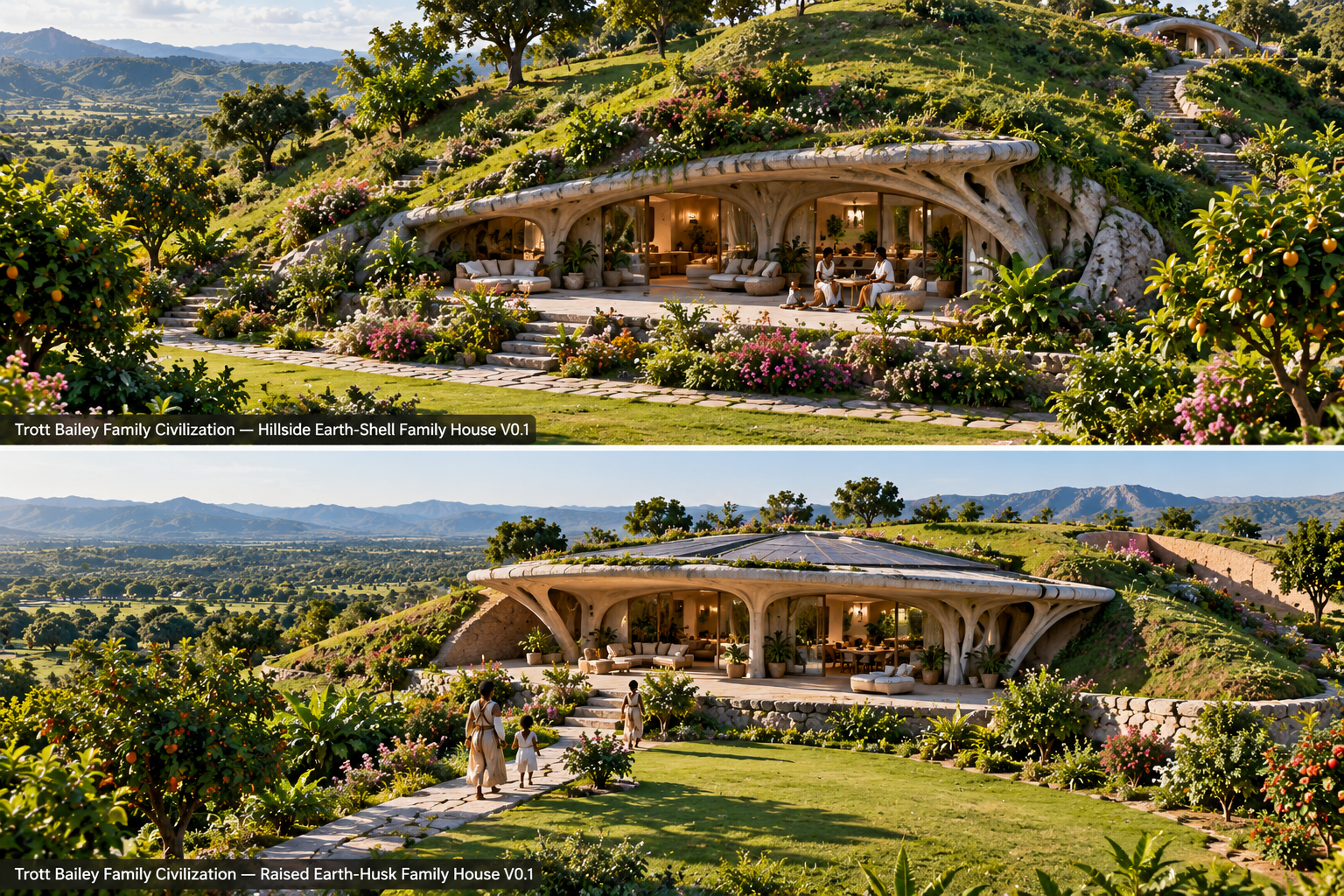
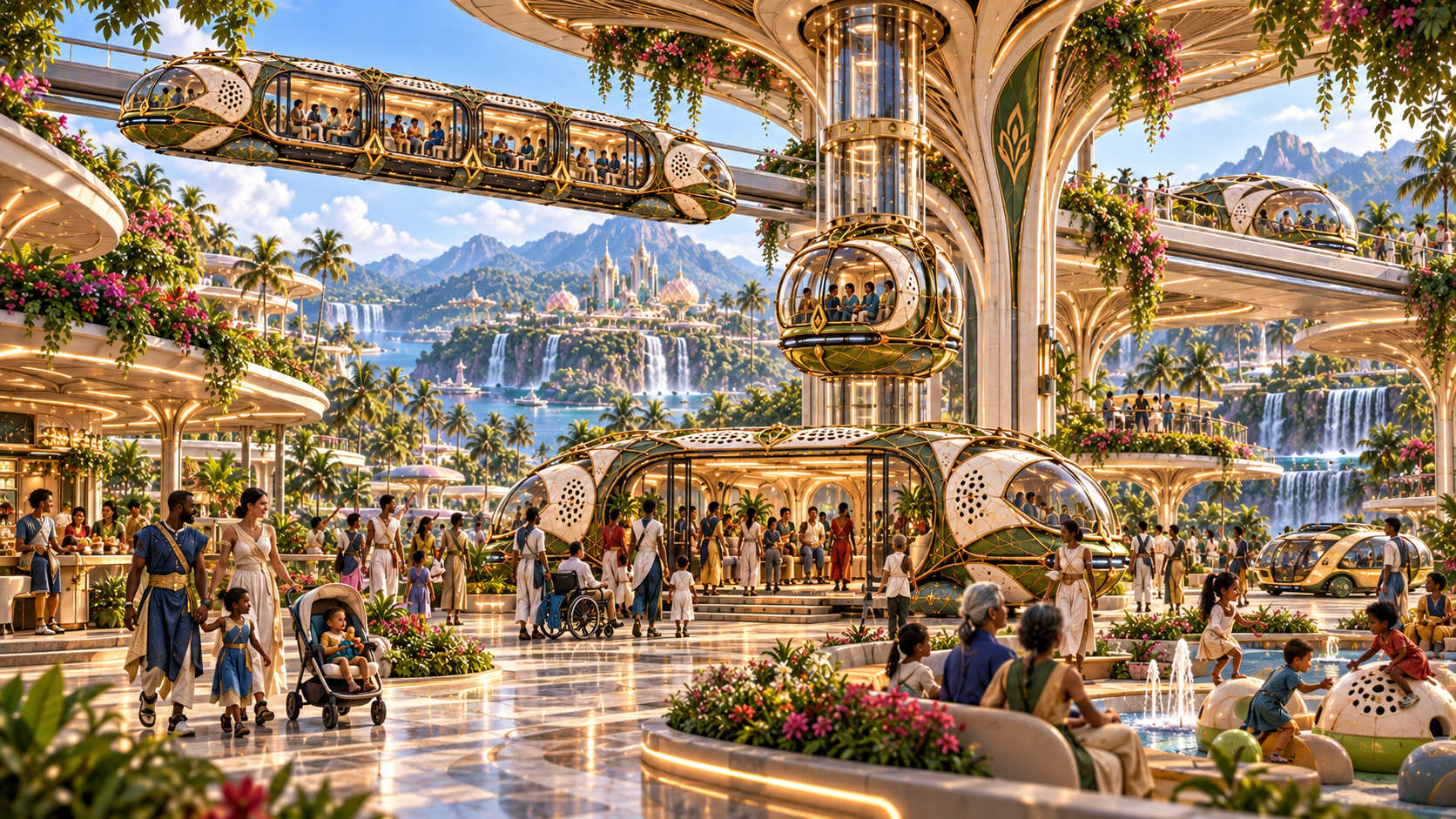
Instead of food production being pushed far away into invisible industrial zones, orchards, vineyards, farms, food forests, gardens and productive landscapes become major civilization infrastructure.
They are not leftovers on the edge of development.
A road can pass through food.
A neighbourhood can open onto orchards.
A family can walk past fruit on the way somewhere.
Children can grow up knowing what is ripe because they can see it.
People can come outside and harvest.
The productive landscape becomes part of ordinary life rather than something hidden behind fences until food reappears later in packaging.
That changes the relationship between human beings and food immediately.
You no longer only “buy” a mango.
You may have watched that mango tree flower.
You may know when the fruit is nearly ready.
You may walk outside and pick it.
You may know which tree tastes best.
You may bring some home and leave plenty for others.
You may collect seedlings beneath it.
You may return seeds to propagation.
A mango tree is not merely scenery.
It is nourishment infrastructure.
A vineyard is not merely picturesque land.
It is productive civilization.
A food forest is not merely landscaping.
It is living capacity.
That is a completely different food civilization.
The Third Reordering Is Giving People Space to Participate in Their Own Food Security
Civilization should not create populations that are entirely dependent on distant systems for every mouthful of food.
That does not mean every person must become a full-time farmer.
It means people should have meaningful physical access to productive space.
Enough room around homes.
Shared orchards.
Neighbourhood growing areas.
Family plots.
Foodways.
Public edible landscapes.
Community farms.
Larger agricultural districts.
A household may grow papaya, banana, herbs, cassava, pumpkin, peppers, fruit trees or whatever makes sense in that place.
Another family may grow very little and participate mainly through shared food systems.
That is fine.
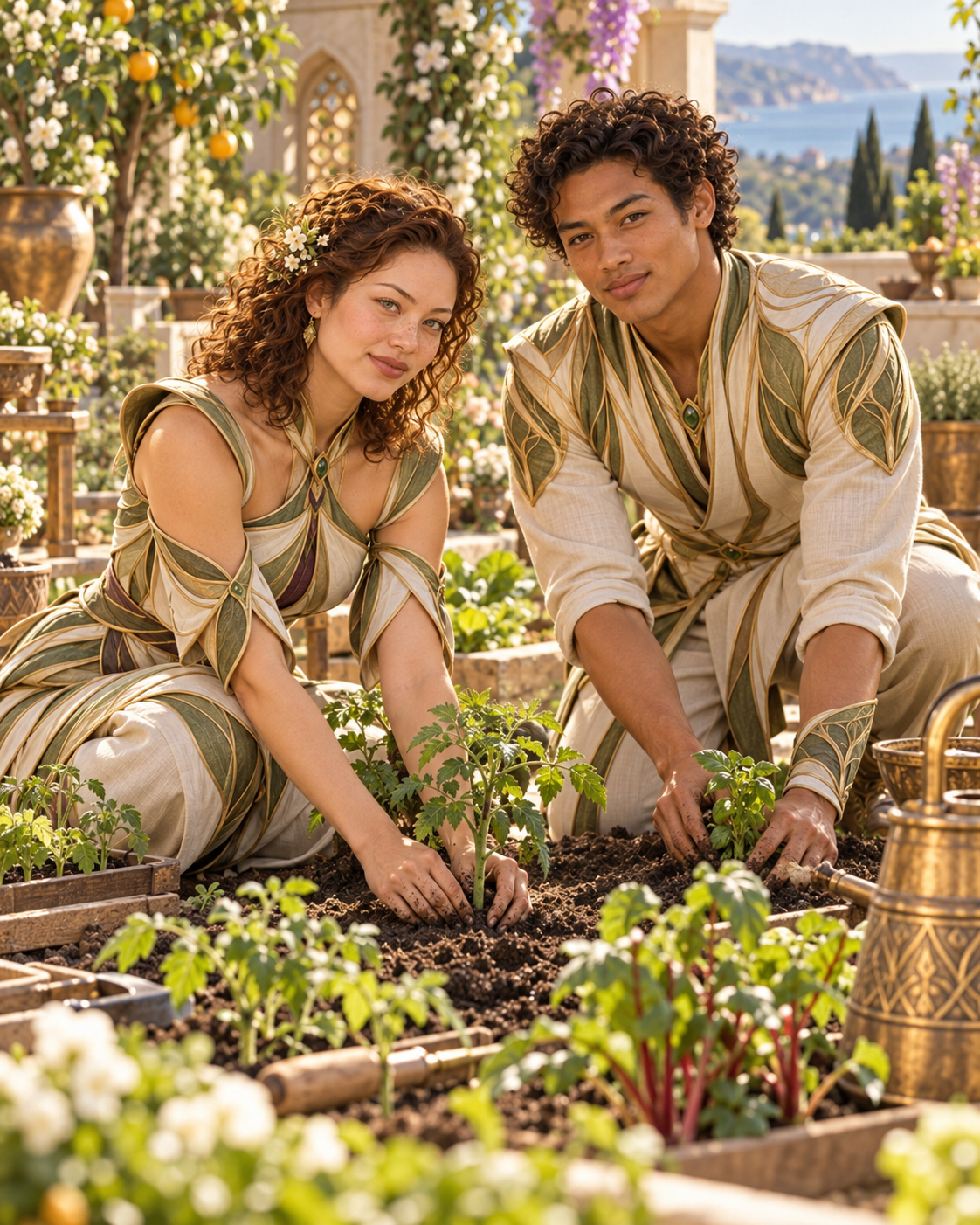
But civilization itself should create conditions where growing some of your own food is normal and possible rather than a luxury available only to people who can afford land.
This adds resilience.
If households, family clusters, neighbourhoods and districts contain different levels of productive capacity, food security becomes distributed.
You have food everywhere at different scales.
Human nourishment is therefore supported by many overlapping sources rather than one distant chain.
The Fourth Reordering Is From Managing Commercial Gluts to Managing Abundance
Food is biologically peculiar.
One mango tree can give hundreds of mangoes.
Those mangoes contain seeds.
A banana plant produces suckers.
Papaya gives hundreds of seeds.
Cassava can be propagated from stems.
Sweet potatoes spread.
Pumpkin vines can produce pumpkins containing enough seeds to begin many more vines.
Food comes with multiplication built into it.
Commercial food systems can sometimes experience abundance as an economic problem when supply exceeds profitable demand.
A bumper harvest can push prices down.
Perfectly edible crops can become uneconomical to harvest, move or sell.
But biologically, the abundance itself is not the problem.
A civilization food system should become extraordinarily good at answering that question.
That changes the order from:
to something more alive:
The glut is no longer simply an economic malfunction.
When the trees produce heavily, civilization should be ready.
Some food is eaten now.
Some is shared.
Some is moved.
Some people travel toward it.
Some is dried.
Some is frozen.
Some is fermented.
Some is pulped.
Some becomes sauces, flours, drinks, preserves and other foods.
Some planting material is multiplied.
The response is not:
It is:
That is abundance intelligence.
The Fifth Reordering Is Who Gets the First Claim on Food
Under a market system, possession and purchasing power strongly determine access.
That gives us the strange possibility that food can exist, the owner can be willing to sell it, the hungry person can physically stand beside it—and the food still does not move because the person lacks the agreed financial claim.
Trott Bailey Family Civilization reverses that relationship at the civilization level.
There is food.
The system then works on connecting those realities.
That does not mean people simply walk into any growing operation and take whatever they want.
Coordination still exists.
Harvest timing still exists.
Reserves still exist.
Safety still exists.
Ecological limits still exist.
Stewardship still exists.
Planning still exists.
But money is no longer the civilization-level proof that you are entitled to nourishment.
Human nourishment is the objective from the beginning.
The Sixth Reordering Is How Demand Is Discovered
This is enormous.
Today, much demand becomes legible through purchases.
Sales tell businesses what people bought.
Prices help communicate supply and demand.
Low sales may tell producers to reduce supply.
High sales may tell them to increase it.
But purchasing data answers a particular question:
It does not perfectly answer:
Those are different questions.
A family buying beans, rice and the cheapest available protein every week may not be revealing its ideal food preferences.
It may simply be revealing its budget.
A child repeatedly eating the cheapest available fruit is not necessarily telling civilization:
This is the fruit I love most.
Remove the price gate and civilization gets to learn something that markets partially obscure:
What fruits do people keep choosing?
What dishes disappear immediately?
What foods do children love?
What foods remain untouched?
What varieties do people prefer?
What do travellers want at breakfast?
What foods suddenly become popular after people encounter them?
Which unfamiliar crops become beloved once good cooks learn how to prepare them?
Food planning can then respond more directly to human appetite, nourishment and need rather than purchasing power alone.
The Seventh Reordering Is Planting for Future Nourishment and Abundance
You can plant for future abundance.
A mango tree planted today might feed people for decades.
A coconut grove.
Breadfruit.
Citrus.
Avocado.
Cashew.
Bananas.
Cassava.
Papaya.
Pumpkin.
Food forests.
Large orchards.
Vineyards.
Public edible landscapes.
Some of these investments make tremendous civilization sense even if there is no business plan showing who will buy every future fruit.
If yes, plant.
Plant before somebody has purchased the future harvest.
Plant before hunger arrives.
Plant because people will eat.
Plant because children will grow.
Plant because travellers will arrive.
Plant because one healthy productive tree may produce for decades.
Plant because seedlings can multiply the original planting again.
This does not mean planting blindly.
Climate matters.
Water matters.
Soil matters.
Ecology matters.
Actual human appetite matters.
Resilience matters.
What grows beautifully in one region may perform badly in another.
The Eighth Reordering Is Civilization-Level Food News
Today we have enormous information systems telling people about:
stock prices,
sports scores,
celebrity news,
weather,
traffic,
politics,
sales,
financial markets.
But imagine civilization having equally sophisticated awareness of food abundance.
Not advertising.
Actual food truth.
The mangoes are heavy in this district.
Watermelons are coming in strongly here.
This vineyard is entering harvest.
Breadfruit is abundant this week.
These orchards are open for family harvesting.
This region has more pumpkins than it can use locally.
These preservation houses are accepting fruit.
These seedlings are available for planting.
This variety performed exceptionally well this season.
This district needs more citrus.
This Foodway has ripe papaya today.
This Sabennery is featuring cassava because local production is abundant.
That becomes civilization news.
This matters because abundance can be useless if nobody knows it exists.
A tree can be full.
A preservation centre can have capacity.
A family can want fruit.
A nearby district can have too much.
But if those facts remain disconnected, food can still rot.
Digital technology therefore becomes a way of making the physical reality of food visible.
Not:
But:
The Ninth Reordering Is Pacorips as an Abundance Nervous System
Pacorips can help create a civilization memory and routing layer around food.
Not a market.
Not a price board.
Not a surveillance system.
It helps civilization see and remember relevant food reality.
What is growing?
What is ripe?
What is becoming abundant?
What should be harvested soon?
What needs preserving?
Where is there excess?
Where is there less?
What seeds are available?
Where can people go and harvest?
Where would extra hands be welcome?
Where can families travel to experience a harvest?
What foods are people enjoying?
Which recipes are helping use a glut?
Which crops are performing beautifully?
Which soils are improving?
Where should more be planted?
One region says: We have abundance.
Another responds: We can use some.
A preservation house says: Send some here.
Families say: We want to come.
Growers say: This seed variety is excellent.
Other districts say: Send us seedlings.
That is food circulation.
The tree does that.
Pacorips helps civilization notice the mango, remember the mango, and connect the mango to human nourishment.
Price no longer has to carry so much of the informational burden of the food system.
The Tenth Reordering Is Logistics: Sometimes Move the Food, Sometimes Move the People
Modern food logistics overwhelmingly assumes:
Trott Bailey Family Civilization can have both:
and
people → food
If Bahia suddenly has absurd quantities of mangoes, there is no rule saying the entire solution must be trucks carrying every mango away.
Preserve some.
Route some.
Eat a lot locally.
And tell people:
Families can travel.
Children can travel.
Cooks can travel.
Growers can travel.
Young people can travel.
People can experience the food where it is actually abundant.
They can taste it immediately after harvest.
They can learn how it grows.
They can learn preservation.
They can meet the people who know the crop.
They can help harvest.
They can discover varieties they may never encounter elsewhere.
This suddenly connects travel, food, agriculture, culture, learning, leisure and recreation.
Sometimes move the food to the people.
Sometimes move the people to the food.
If the mangoes are taking over somewhere, go eat mangoes.
That is playful.
It is also a genuine reordering of food logistics.
The Eleventh Reordering Is Preservation: Let Abundance Move Through Time
Today preservation is often downstream of commercial viability.
Can this frozen product sell?
Can dried mango command enough margin?
Is processing worthwhile?
Trott Bailey Family Civilization can ask something simpler:
So preservation becomes abundance across time.
Fresh fruit might last days.
Dried, frozen, pulped, fermented or otherwise preserved food might let that harvest continue nourishing people for months.
Preservation stops being merely a product category.
It becomes part of civilization memory:
Preservation carries abundance through time.
The Twelfth Reordering Is the Place of the Kitchen
Commercial kitchens are normally businesses, institutional kitchens or private household kitchens.
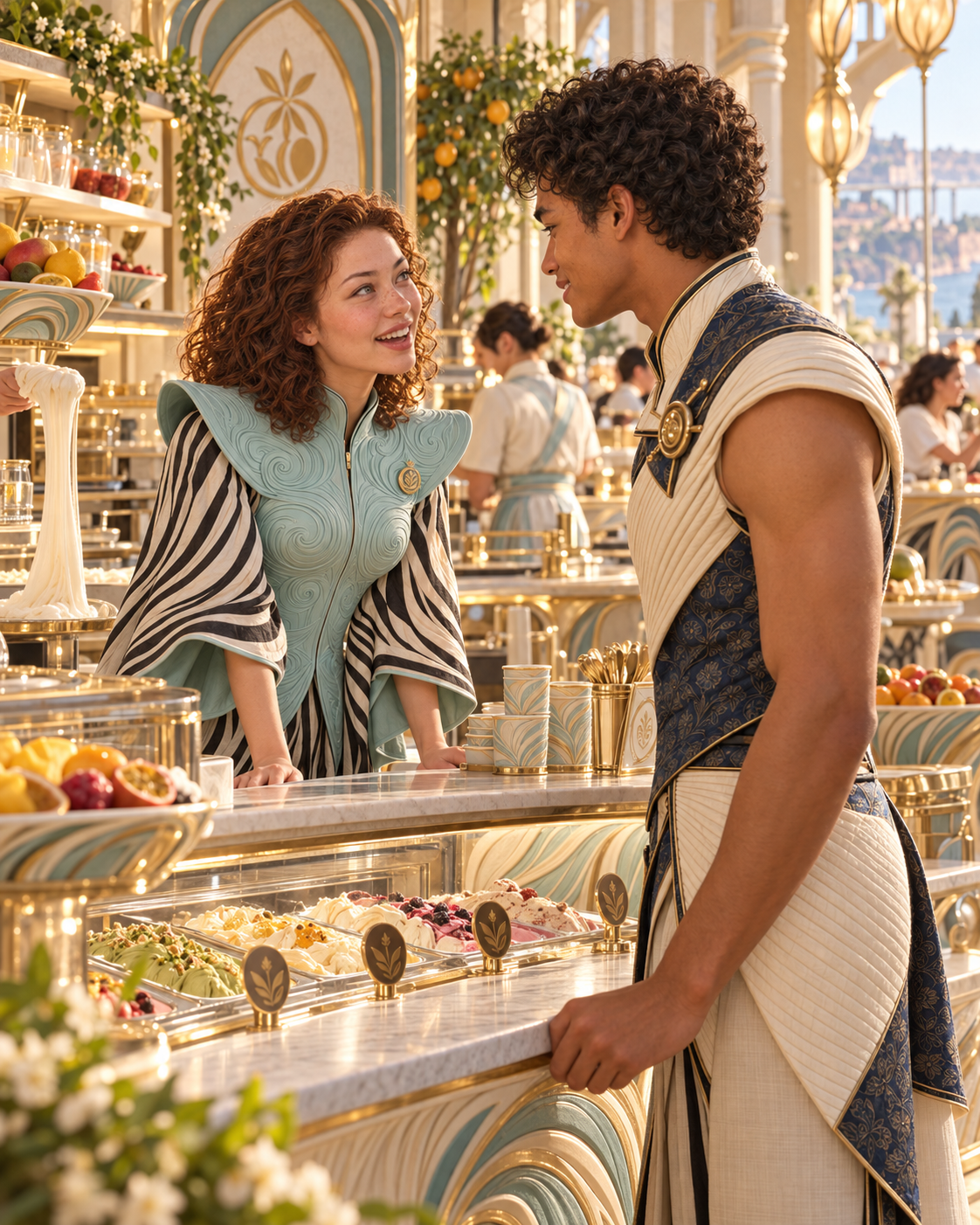
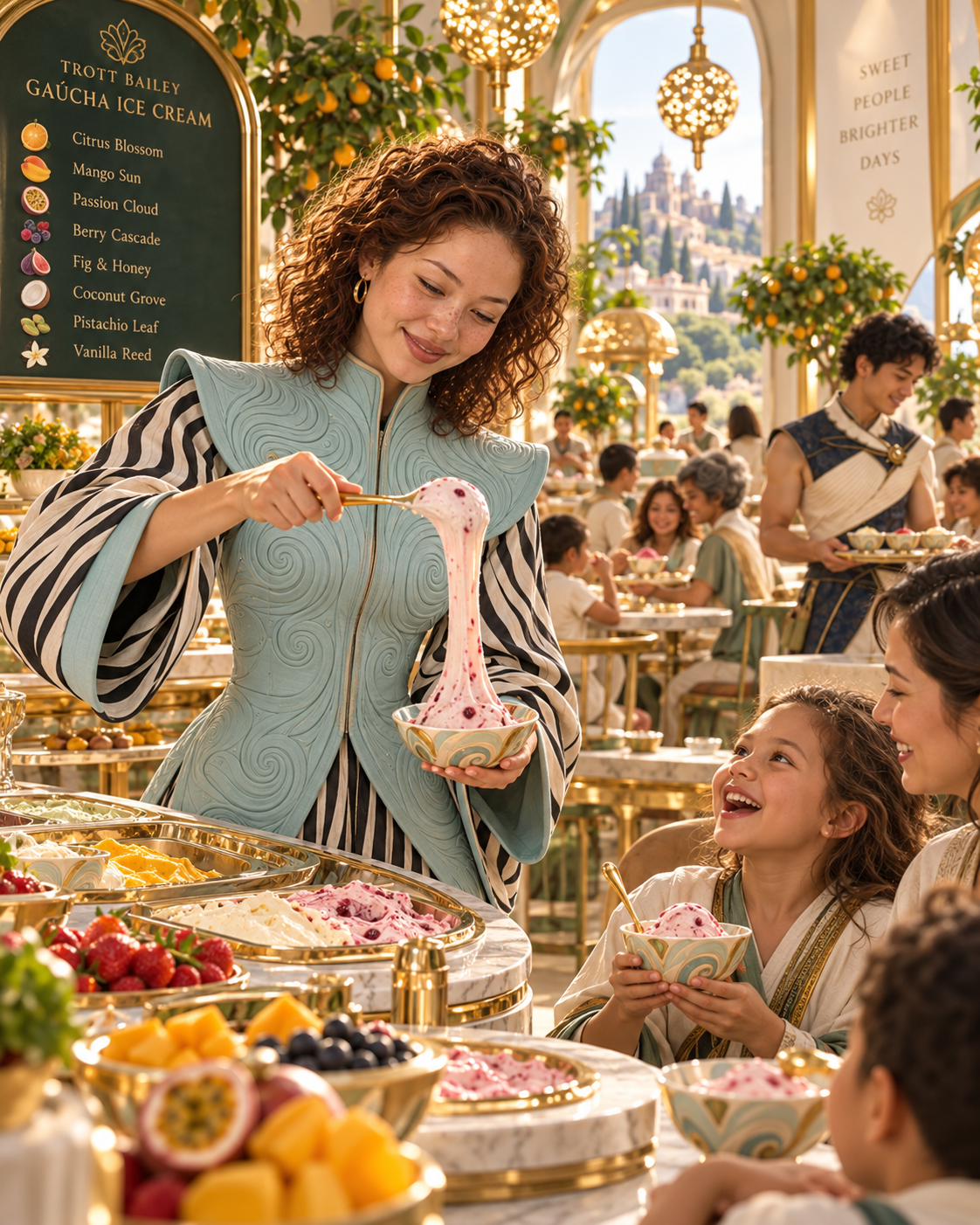
In Trott Bailey Family Civilization, a Sabennery can instead be public food infrastructure.
Its first task is not to sell meals.
That changes menu design.
If pumpkins are overwhelming one district, the kitchen can become extraordinarily creative with pumpkin.
If mangoes are everywhere, mango can appear everywhere.
If one particular crop has temporarily fallen, menus adapt.
The kitchen starts speaking directly to the farm.
The farm starts speaking to the kitchen.
The preservation system speaks to both.
The people eating speak back through what they actually enjoy.
And deliciousness matters.
Human nourishment should not be reduced to:
Food is also culture.
Pleasure.
Comfort.
Memory.
Hospitality.
Curiosity.
Celebration.
A civilization capable of nourishing everyone should care whether the food is good.
The Thirteenth Reordering Is the Status of Food Shubaka
Present systems can create strange status hierarchies around food work.
Investment banker above farmer.
Executive above cook.
Technology role above fruit grower.
But if civilization understands food correctly, the person who knows how to make a hundred mango trees thrive is holding enormous civilization capability.
The preservation expert who saves a glut is not doing marginal labour.
The cook who turns abundance into delight is not merely “serving food.”
The seed steward is carrying tomorrow’s nourishment.
The logistics coordinator who sees that tonnes of fruit are ripening and connects them to people is protecting abundance from becoming waste.
The person who plants an orchard may be creating food that people will enjoy long after the planting itself is finished.
So the reordering is also cultural:
Not because it is miserable.
These people are in charge of one of the most delightful recurring experiences of human life.
They also help remove one of humanity’s most burdensome recurring questions:
And replace it with:
Do not underestimate the honour attached to that work.
The Fourteenth Reordering Is What Happens After Eating
The commercial food chain is often represented as a line.
But living food is not really a line.
Seeds.
Peels.
Bones.
Organic matter.
Cooking water.
Plant trimmings.
Spoiled fruit.
Compost.
Animal feed.
Planting material.
Soil.
Instead of treating all of that as garbage requiring removal from civilization, much of it can become soil infrastructure.
Composting.
Mulching.
Animal feeding where appropriate.
Soil building.
Seed return.
Propagation.
Organic matter returning to productive landscapes.
The reordering reconnects the end of eating with the beginning of growing.
Instead of:
you get:
Or, more completely:
That is continuing abundance.
What appears to be the end of food is often material for the next round of food.
The Fifteenth Reordering Is Civilization-Level Food Competency
This reordering does not stop with farms, logistics, kitchens and technology.
It changes the capability of the people themselves.
In the current food system, many people can eat for years without knowing very much about the food they are eating.
They may not know:
where it grows,
when it is naturally in season,
how to tell when it is ripe,
how to harvest it,
how to plant it,
how to preserve it,
how to cook it in several ways,
which parts can return to soil,
which seeds can be saved,
what conditions help it thrive,
or what to do when there is far too much of it at once.
Much of that knowledge becomes concentrated among farmers, agronomists, cooks, processors, gardeners, logistics specialists and other professionals.
Trott Bailey Family Civilization should reorder that relationship.
That does not mean everybody becomes a farmer.
It means ordinary people should grow up with a practical understanding of one of the most fundamental systems keeping them alive.
When orchards, vineyards, farms, Foodways, gardens and productive landscapes are integrated into daily life, people see food growing.
When families have meaningful access to productive space, they learn to plant.
When children harvest fruit, they learn ripeness.
When seeds are returned for propagation, they learn reproduction.
When organic matter goes to compost, they learn that food does not simply end in a garbage bin.
When gluts are preserved, people learn how abundance moves through time.
When civilization-level food news says mangoes are heavy in one district or cassava is abundant somewhere else, people learn to read the food reality of the civilization around them.
When people travel toward harvests, they learn where food comes from and how other communities grow, prepare and preserve it.
When Sabenneries turn seasonal abundance into many different meals, people learn that one crop can become many food experiences.
Over time, a much larger share of the population becomes capable of understanding and participating in food.
A child may know how to plant papaya.
A teenager may know how to preserve excess fruit.
A parent may recognize when a fruit tree needs attention.
A family may know how to turn kitchen scraps into productive compost.
A traveller may know what is coming into season.
A neighbourhood may understand what it can grow particularly well.
A community may know when it has enough planting material to expand an orchard.
That is civilization competency.
It creates resilience because knowledge is not trapped in a few hands.
If one grower leaves, the knowledge does not disappear.
If one supply route fails, people are not completely helpless.
If a new food begins growing exceptionally well, more people know how to use it.
If there is a glut, people already understand that the response can be:
A civilization should not be full of people who know how to operate phones, navigate financial systems and consume packaged products but do not know what to do with a pumpkin growing outside their own home.
Food is too fundamental for that.
Food knowledge should become ordinary civilization knowledge.
And again, human nourishment remains the purpose.
We are not building food competency so people can admire how sophisticated the civilization has become.
We are building it because:
So What, Precisely, Is Being Reordered?
| Current dominant ordering | Trott Bailey Family Civilization ordering |
|---|---|
| Food as commodity | Food as living civilization abundance whose central purpose is human nourishment |
| Commercial viability strongly shapes what moves through the system | Human nourishment, appetite, abundance, ecology and capability shape decisions |
| Food production is often separated from ordinary life | Orchards, vineyards, farms, Foodways and productive landscapes become major civilization infrastructure |
| Many people have little access to productive land | People and families have meaningful opportunities and space to participate in their own food security |
| Purchasing power helps reveal demand | Human appetite and nourishment needs reveal demand more directly |
| Produce for viable markets | Grow for nourishment, delight, resilience and future abundance |
| Surplus can become an economic problem | Surplus becomes an abundance opportunity |
| Price carries much of the food system’s information | Civilization-level food news makes actual abundance, need, seasons and capacity visible |
| Food primarily moves toward buyers | Food moves toward people and people move toward food |
| Preservation must generally justify itself commercially | Preservation carries abundance through time |
| Access occurs primarily through transaction | Access follows the civilization right to eat |
| Kitchens sell or ration meals | Kitchens transform shared abundance into nourishment and delight |
| Food work can be treated as low-status | Feeding civilization carries enormous honour |
| Consumption often ends in disposal | Seeds and organic matter help begin the next food cycle |
| Food knowledge can remain concentrated among specialists | Food competency becomes widely distributed across civilization |
| The consumer appears at the end of the chain | The human being to be nourished is the purpose from the beginning |
The Actual Reordering
So no—the reordering is not merely removing the money gate.
The money gate matters because it currently acts as the final permission to eat and influences decisions throughout the chain.
But the deeper reordering is much larger.
It means bringing food production into the physical structure of civilization.
Giving people meaningful space to participate in growing.
Allowing living food to multiply.
Planting for future nourishment.
Making abundance visible through civilization-level information.
Learning what people actually enjoy eating.
Moving food toward people.
Moving people toward food.
Preserving abundance across time.
Turning abundance into delicious meals.
Returning organic matter to soil.
Multiplying seeds and planting material.
Spreading practical food competency across civilization.
And giving enormous honour to the people who keep the whole living cycle flourishing.
The old order can be simplified as:
The reordered system becomes:
Digital civilization intelligence sits across the whole system, helping people see what is happening.
And human nourishment sits at the center of it.
That is the actual reordering.
The money gate disappears inside that larger transformation.
The deeper transformation is that civilization itself begins behaving like a steward of living abundance—with human nourishment always as the central goal.