

A Day in the Life of Malik apprenticing in Precision Machining
Trott Bailey Family Civilization · Day in the Life Record
A Day in the Life of a Young Apprentice
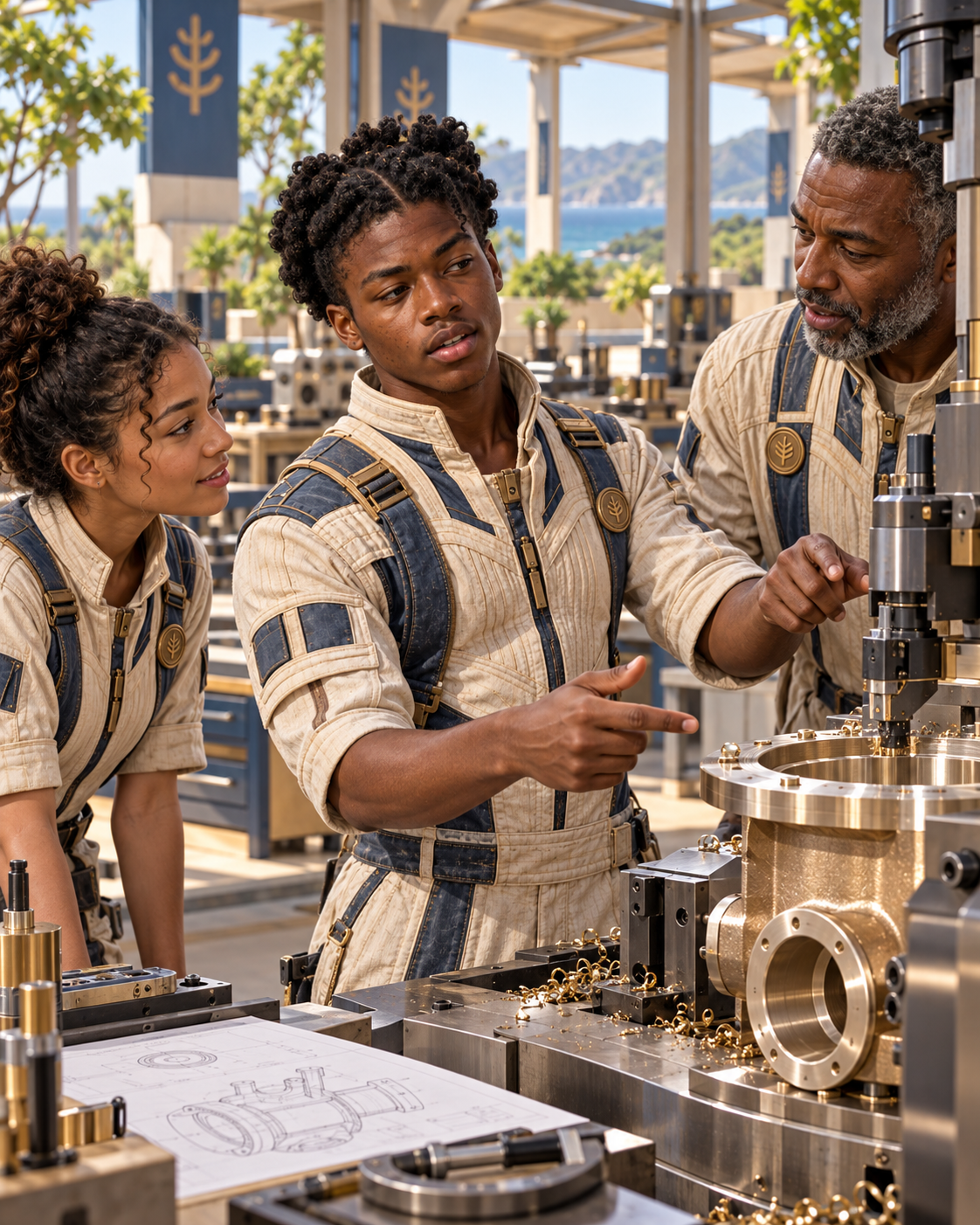
Malik Abeni is nineteen years old and learning precision machining inside the Productive Works. Today his team is shaping a large pump body that will eventually move water through a district where families live.
Keslev 14
I reached the Productive Works before the vertical lathe started. I like getting there before everything wakes up.
The building sounds different when the machines are quiet. I can hear water moving through the service channels outside, birds beyond the open side of the hall, somebody rolling a tool body across the floor, and somebody else laughing too loudly because it is still early.
Then the systems start coming alive. Lights come on over the machining field. Coolant begins circulating. Control bodies wake up. The lifting system checks its position. Somebody tests a measurement head. The hall changes from a building into a working place.
I was on the large pump-body team again today. That is still the part of my apprenticeship I like most.
I Went Upstream
My father works in district water-system stewardship, so I grew up around pumps, worn bearings, damaged housings, shafts, and people trying to figure out why something that worked yesterday suddenly sounds wrong today.
When I was younger, I sometimes went with him. He would be talking about water pressure and distribution routes, while I would be staring at the shaft wondering who made it.
Then I started wondering who made the bearing seat, who machined the housing, and eventually who made the machine that machined the housing.
Dad says I went upstream.
Mom says I found a more complicated way to get dirty.
She does not love machines the way Dad and I do. She understands them and respects what they do, but if you gave her a choice between spending the afternoon beside a vertical lathe or working around food plants, fermentation bodies, and people, she would disappear toward the food systems before you finished the question.
My younger sister Nia has even less patience for machine talk. She thinks every large metal thing I work on looks almost exactly like the large metal thing I worked on yesterday.
She is wrong, obviously.
The Pump Body
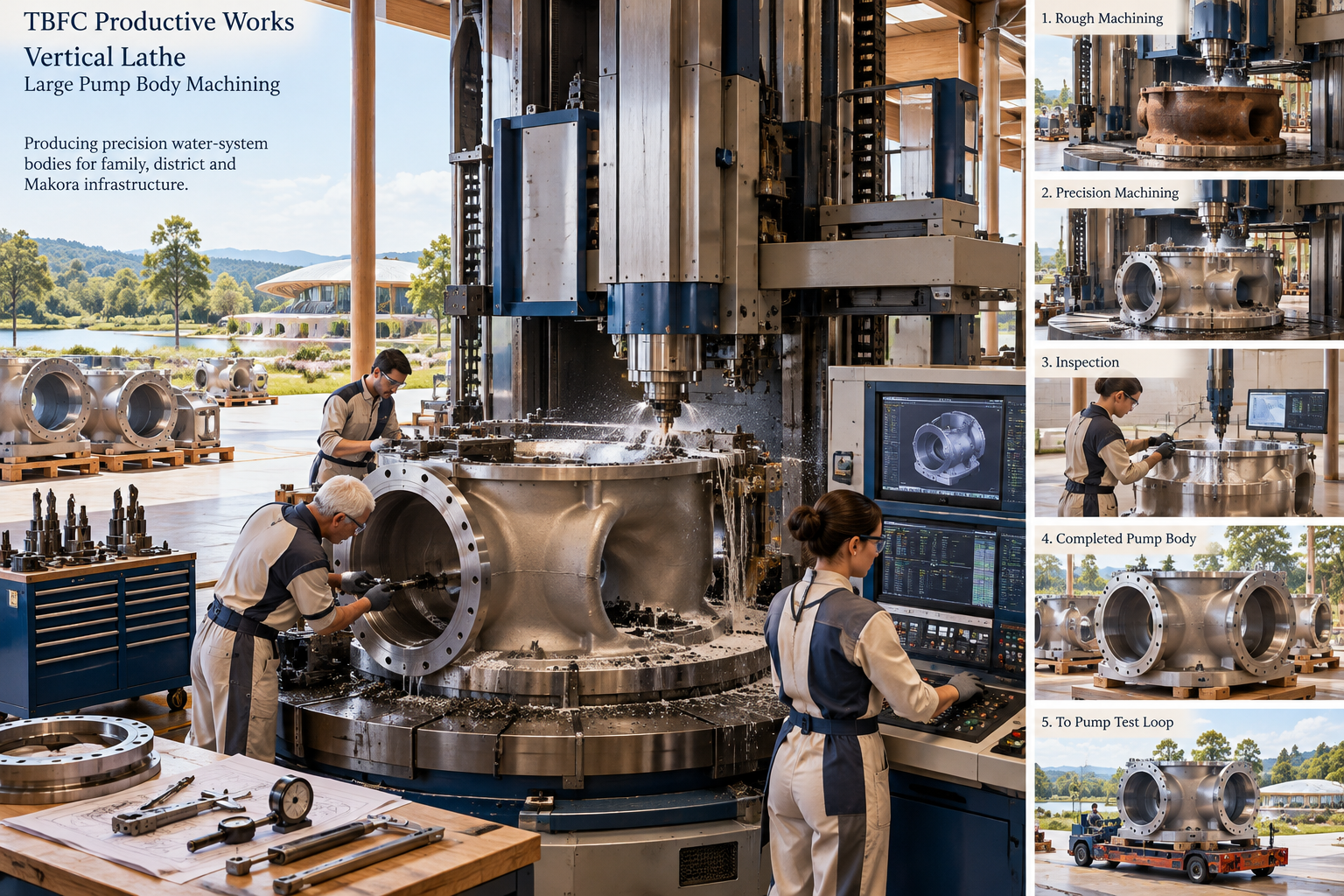
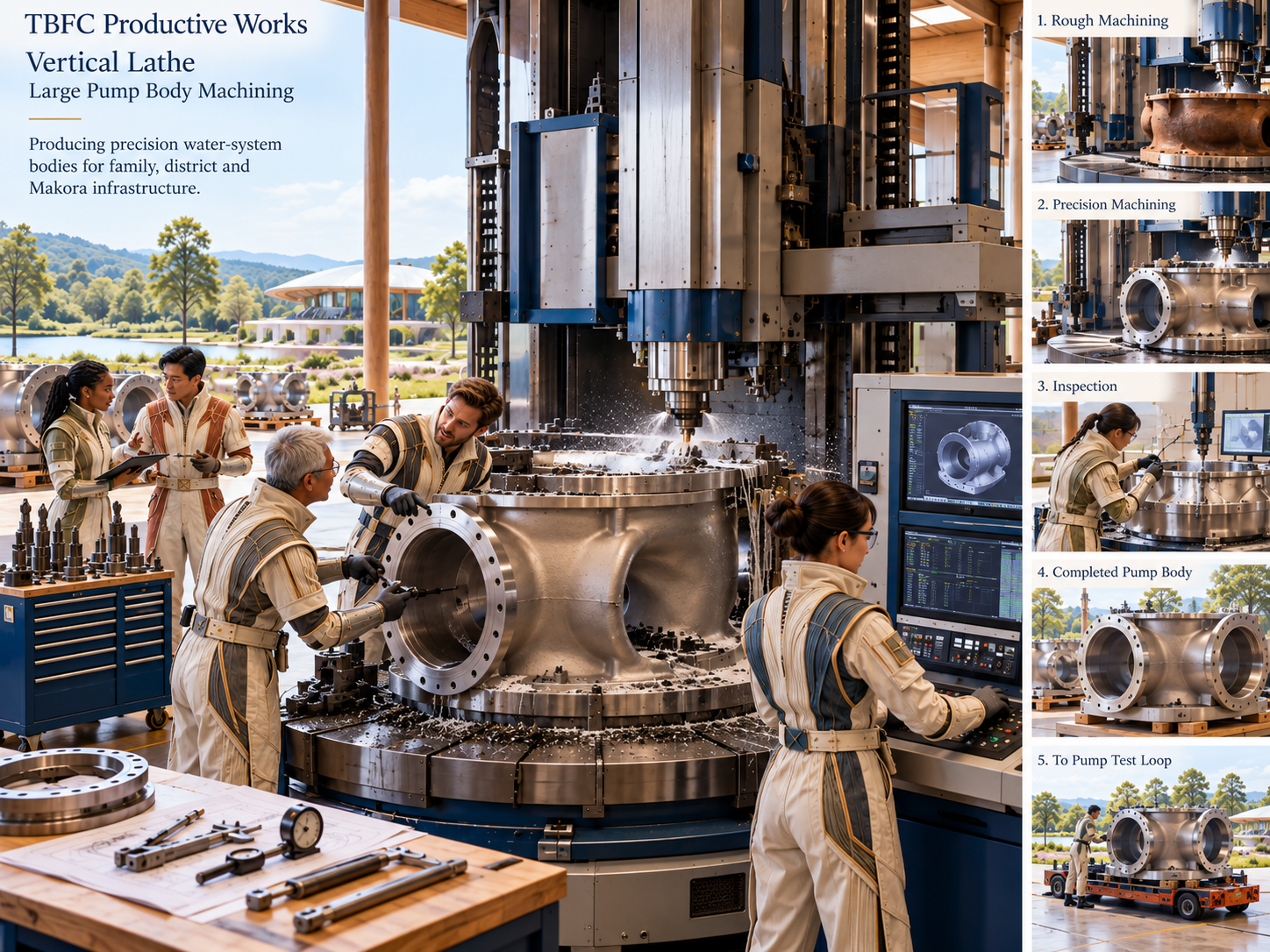
Today’s pump body had already gone through rough preparation before it reached us, but there was still plenty of material left to remove.
Finished components look obvious. When I see a pump already installed, it seems as though it was always supposed to have exactly that shape. A rough casting does not look inevitable at all. It looks heavy, ugly, and unfinished.
He says short things like that and then expects you to think about them for the rest of the day.
The lifting system moved the casting into position while we stood clear and guided alignment. Nobody proves strength here by trying to carry something a machine should carry. The support body took the weight, rotated the casting, lowered it slowly, and we checked its position against the fixture.
I was watching Mara measure one of the faces. She is twenty-one and has been machining longer than me. She can use a micrometer without looking as though she is negotiating with it.
Apparently I cannot.
“I’m not.”
“You are.”
“I’m being accurate.”
“You’re bullying the measurement.”
Mr. Daro heard us and asked what was funny. Mara told him I was trying to compress steel with a micrometer.
He nodded once and said, “Ambitious.”
I loosened my grip.
Learning to Hear a Machine
The first machining pass took a while. There is no dramatic moment when a large component suddenly becomes precise. A face gets cleaned. A bore gets corrected. A surface starts showing the tool path properly. One measurement comes in where it should, then another.
At one point Mr. Daro stood beside me and told me to stop looking at the display.
“Listen.”
The cut had a steady sound underneath the coolant. He asked what I heard, and I told him I heard the machine.
He looked at me.
“I know,” I said. “Bad answer.”
A few seconds later he stopped the cut and checked the insert. It was beginning to wear. He changed it, started the machine again, and the sound was cleaner.
I heard it then.
Not before him. Not even close. But I heard the difference.
We have gauges, measurement systems, drawings, operating records, and people who can verify geometry down to very small differences. The older machinists also know things by sound, vibration, smell, and feel. You only get some of that knowledge by spending time near the work.
I did not have to buy my way near it.
Once I showed interest and completed the basic learning, the civilization opened the next layer to me: materials, measurement, machine behavior, tooling, maintenance, supervised operation, and eventually real productive work.
Nobody handed me a machine and called me capable. They gave me somewhere to become capable.
Inspection
By late morning the pump body finally started looking like something that belonged in the water network. The main faces were cleaner, the large bore was taking shape, and the mounting points were beginning to make sense.
Mara stood beside the controls talking through the next operation with an older technician. Neither of them was really looking at the other. They were both watching the component while Mara talked and pointed toward the upper face.
People do that here all the time. The conversation happens while everybody is looking at the same thing.
Before lunch we moved into inspection. I like inspection because the mood changes. Machining is motion. Inspection is attention.
We checked the flange face, then the bore, then the relationship between them. One measurement was outside the range Mr. Daro wanted, so we checked it again.
Same result.
Nobody shouted and nobody tried to explain the number away. We marked it, worked out where the error was likely coming from, and planned another pass.
That was it.
Lunch Under the Trees
Lunch was outside under the trees. There were seven of us from machining and two people from sheet forming. Mara’s husband joined us halfway through.
Their son spent most of lunch trying to climb a low branch while both of his parents kept telling him to eat. He kept saying he was eating.
He was not eating.
I had roasted fish, cassava, greens, rice, fruit, and two coconuts. Mom would probably say the second coconut proves I did not eat enough breakfast.
I am not telling her that.
One of the older workers asked whether I could hear the worn insert that morning. Before I answered, Mr. Daro said, “Eventually.”
Everybody laughed.
I told him I heard it after he changed it.
“That counts as hearing,” he said.
I think that was encouragement. With him it is hard to know.
The Correction Pass
After lunch we did the correction pass, and I was allowed to help set the tool position.
I checked the value three times.
“You checked it three times.”
“Yes.”
“Good.”
He waited a second.
“Tomorrow, maybe two.”
The cut went well. Nothing dramatic happened. The machine did what it was supposed to do, and the component came back into range.
Sometimes that is the good part.
By late afternoon the pump body was ready to leave our machine field. It was finished with us, but it was not finished altogether.
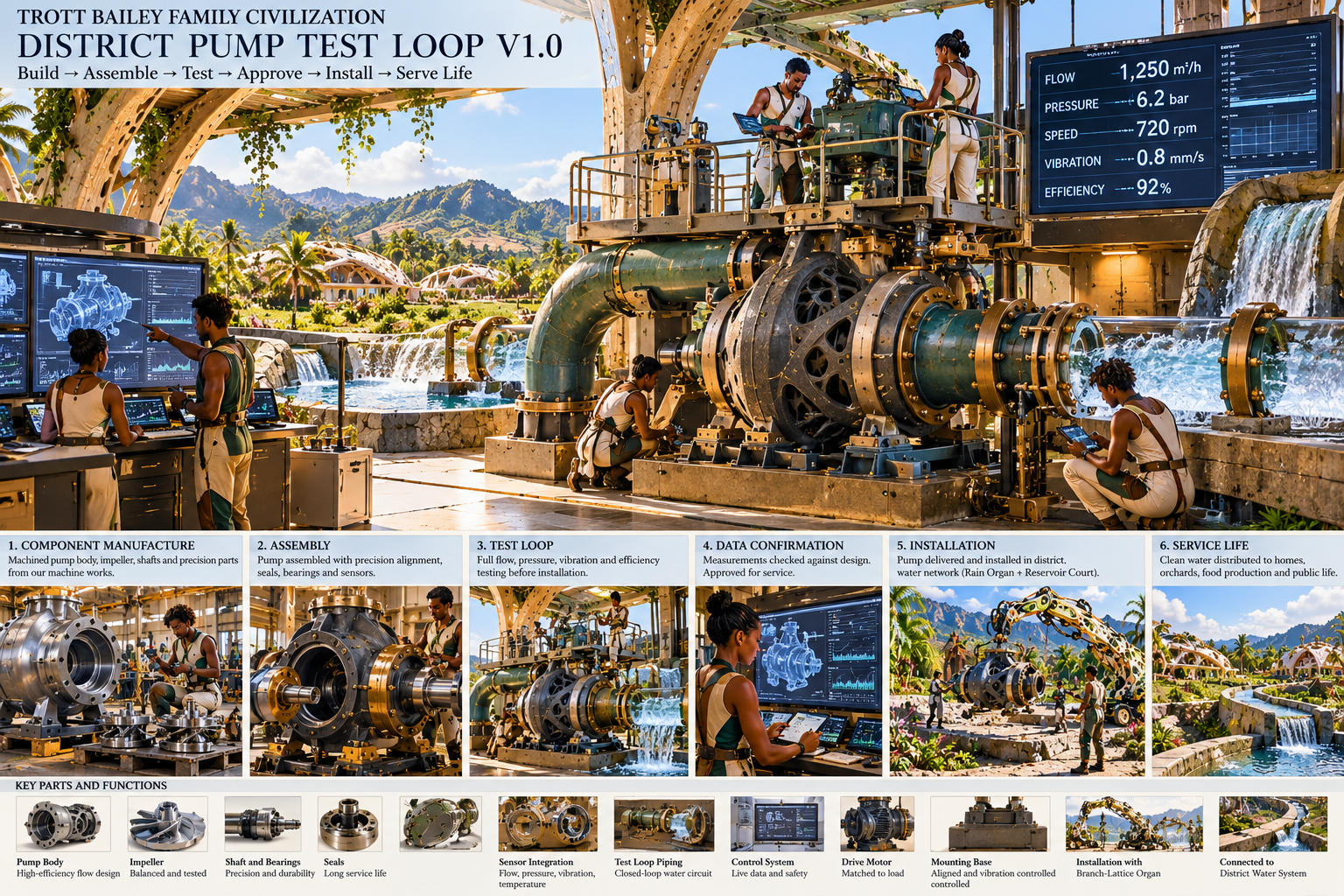
From here it goes to full geometry verification. Later it will meet its rotating parts. Those parts will be balanced, the assembly will be checked, and eventually somebody will connect it to the pump test loop and run real water through it.
Flow, pressure, vibration, and load.
If everything behaves properly, it goes into service.
Maybe I will see it again. Probably not.
I actually like that.
Clean Return
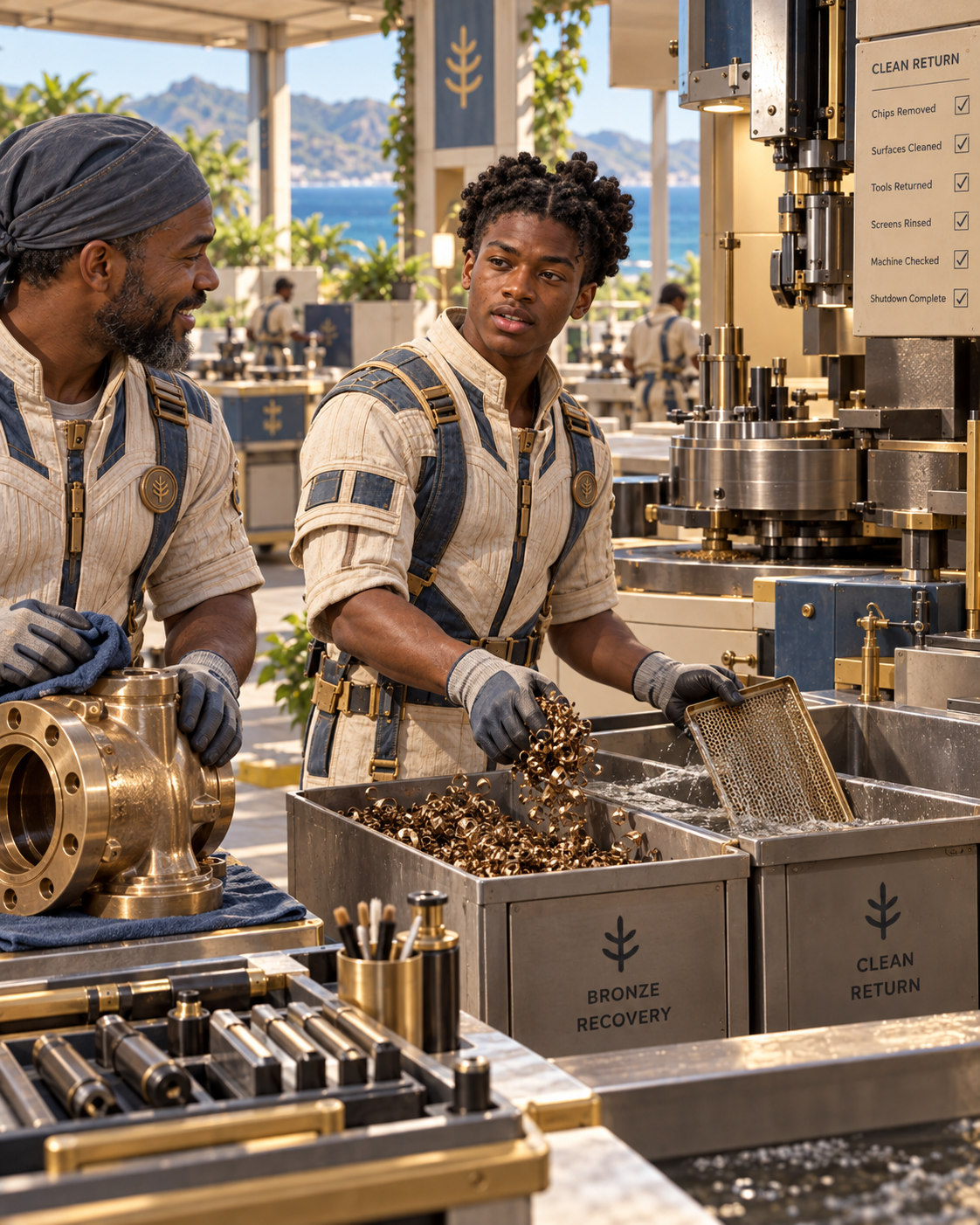
Before we left, we did Clean Return.
That is part of the work. It is not what happens after the work.
Metal chips are separated into the correct material stream. Coolant is recovered from them and returned through filtration and checking. Reusable tooling is cleaned and returned. Worn tooling follows its own recovery route.
Oily material does not go into ordinary return, and sharp fragments are not left where the next person’s hand can discover them.
We cleared the machine channels, checked the floor, returned the tools, logged the unusual insert wear, recorded the correction pass, and attached our final measurements to the component record.
I like that because the place does not reset itself.
We reset it for one another.
Home
When I left the Productive Works, the pump body was sitting on the transfer platform. It was clean, measured, and ready for the next team.
This morning it looked like a rough lump of metal. By the end of the day it had a bore that mattered and surfaces that had to meet something else properly.
One day water will move through it somewhere people live. They will probably never think about the people who machined it.
I think that is fine.
When I got home, Dad was sitting outside. He asked what we machined, and I told him which pump body.
That was enough for him to start asking about the bore and whether we found any trouble in the casting.
Mom called from inside, “Did he eat?”
I said yes.
Dad kept asking questions, so I told him about hearing the worn insert. Then I admitted I only heard the difference after Mr. Daro changed it.
Dad laughed.
“That is still how you learn.”
Nia came through carrying something from the animal ground and asked what I did today.
I told her we finished machining a pump body.
“Yes.”
“So another round metal thing.”
Then she walked away.
I told Dad she has no respect for precision engineering.
He said she probably has the correct amount.
I am tired now. Not destroyed. Just properly tired.
Tomorrow I go back.
I still take too long measuring some things. I still ask questions that everybody else seems to know the answer to, and I still check values one extra time.
But this morning I could not hear the difference between a good cut and a worn insert.
By midday, I could.
Not before Mr. Daro. Not even close.
But I heard it.
That is enough for one day.