

Make the World Truly Productive Again
Trott Bailey Family Civilization · Civilization Audit
Make the World Truly Productive Again
A civilization-wide audit of what we are actually producing, what human capability we are wasting, and whether productivity is returning life to families.
Productive again? I thought the world was already productive.
That is the first question the title raises. We have factories running day and night, farms producing at industrial scale, cargo ships crossing oceans, aircraft filling the sky, cranes over cities, computers processing unimaginable amounts of information, packages appearing at people’s doors and trillions of dollars moving through the global economy. Governments measure growth. Companies measure output. Economists measure productivity.
So what exactly am I asking humanity to make productive again?
I am asking us to brush some of the dust off the measurements and look underneath them.
What did we actually produce? What physical resource became more abundant? What useful human capability increased? What became easier for a family to access? What was improved, and what was merely replaced with something cheaper? How much apparent productivity was repairing damage created somewhere else? How much was duplication, waste, unnecessary administration, planned replacement or money repeatedly changing hands around the same underlying resource?
Can a family access excellent housing, nourishing food, good clothing, clean water, dependable energy, transport, healthcare, education, tools, materials and useful knowledge without spending most of its life worrying about money? Do husbands and wives have time for one another? Do parents have time with their children? Are people rested? Are they healthy? Are ordinary human beings becoming more capable of making, growing, repairing, understanding and maintaining the physical world around them?
Those questions take us somewhere very different from GDP.
I am not saying economic statistics tell us nothing. I am saying they are not the final measurement of whether civilization is working. A polyester shirt is technically clothing. A heavily processed edible product is technically food. A tiny expensive apartment is technically housing. An electrical connection that fails constantly is technically electrification. A hospital that somebody cannot afford to enter is technically healthcare infrastructure.
That is what I mean by true productivity.
True productivity is civilization becoming increasingly capable of producing, maintaining and distributing the real resources, knowledge and abilities human beings need to live well.
And there is an important distinction at the heart of this audit. Some constraints are real. A desert can genuinely lack freshwater. An aquifer can be depleted. A mineral deposit is finite. A surgeon cannot be trained overnight. A river cannot be drained without consequences downstream. Land has geography, ecosystems have limits and physical work requires materials, knowledge, energy and time.
Those are real constraints. But a financial constraint is not automatically a physical constraint.
This article repeatedly asks us to determine which one we are actually facing.
The recurring test
If the need exists, the physical resources exist, the human knowledge exists, and human capability already exists or can be trained, yet civilization still says the work cannot proceed because the financial arrangement is missing, we should at least be able to recognize what kind of barrier we are looking at.
That is where the money trance begins to reveal itself.
Audit One
What Is Actually on Our Backs?
Start with clothing.
Humanity produced an estimated 139 million tonnes of fiber in 2025, equivalent to about 17 kilograms for every person on Earth. Polyester alone accounted for 82.5 million tonnes, or 59% of global fiber production. Cotton accounted for about 18%. Of the polyester produced, 88% was virgin fossil-based polyester, while 97% of recycled polyester still came from plastic bottles rather than discarded textiles. Textile Exchange
That sounds extremely productive until we ask what we became extraordinarily productive at producing.
Polyester. Polyester everywhere.
We have become extremely capable at making polyester. We could do without it. Bitch I don’t want to walk around with fucking plastic polyester on my back or on my pussy!
I want to know where the equivalent civilization-wide effort is around cotton, flax, hemp, wool, silk and other useful natural fibers. Where is the corresponding expansion in growing those materials well, improving them, spinning them, weaving them, engineering them for different climates, dyeing them beautifully, maintaining the machinery that processes them, teaching people how to work with them and making excellent finished clothing abundant?
Cotton did not simply disappear. Humanity still produced about 25.7 million tonnes of it in 2025. The larger story is that global fiber production expanded dramatically around it, driven particularly by synthetic fibers. Textile Exchange
That distinction matters because more output is not automatically more capability.
If humanity doubles the amount of material it produces by becoming exceptionally good at manufacturing a cheap substitute while much of the agricultural diversity, machinery, craftsmanship and knowledge behind other materials stagnates or shrinks as a share of the system, I do not automatically call that progress.
I want the whole productive chain. Grow cotton well. Grow flax and other fiber plants where the climate and land suit them. Raise animals for useful fibers where that is sensible. Preserve and advance silk systems. Improve spinning, weaving and textile engineering. Develop better machinery. Produce materials intelligently for hot, cold, wet and dry climates. Preserve fitting, sewing and repair knowledge. Make excellent footwear too. Then make finished clothing so abundant that keeping a family properly clothed does not become another recurring financial burden.
That is productive capacity.
The clothing audit therefore cannot stop at asking how many tonnes of fiber we produced. It should ask what materials we became capable of producing, what we substituted away, what knowledge survived, what knowledge weakened, what burdens our substitutes created and whether the human being at the end actually received better clothing.
Audit Two
Are We Producing Food or Nourishment?
Food makes the distinction even more obvious.
In 2025, an estimated 645 million people faced hunger, while about 2.7 billion people could not afford a healthy diet. FAO
That should trouble us before we even begin celebrating record agricultural output, because I am not merely asking whether enough edible material exists somewhere in a supply chain.
I want nourishment.
Bitch I want to drink real milk, not white painted water!
I want fresh meat, not meat chosen primarily for how long it can survive industrial storage and transport, or packed with so much sodium that my tongue and tripes despair as I bring it to my mouth. I want sweet fruit from the tree. I want vegetables with flavor, eggs that are fresh and fish that tastes like it came from life rather than from a long industrial journey.
I want food that tastes alive, and I want to feel alive after I’ve eaten, not slow and sleepy. I want a diet that does not leave me bloated, farty and uncomfortable in my guts, menacing to my teeth no matter how much I brush, and wondering what the hell I just ate.
Those may sound like ordinary complaints about food, but underneath them is a serious productivity question: what exactly are our food systems optimizing?
Shelf life? Transportability? Uniformity? Industrial processing? Profit margin? Or nourishment?
True food productivity should mean civilization becomes increasingly capable of growing and raising diverse nourishment close enough to people that freshness becomes normal rather than premium. That requires excellent seed systems, orchards, vegetables, roots, tubers, grains, legumes, nuts, herbs, spices, healthy animal systems, fisheries, soil knowledge, water knowledge, harvesting, preservation and cooking.
Food should grow wherever it sensibly can grow. Abundance should actually abound.
That does not mean planting every square metre of Earth with food crops. It means we should stop acting as though nourishment can only be produced inside a fenced commercial farm hundreds or thousands of kilometres from the person who eats it. Fruit trees can grow in settlements. Useful plants can grow around homes. Communities can have orchards. Cities can contain productive landscapes. Families can understand how food grows. Regional farms can provide what cannot sensibly be produced close by.
When fruit falls, feeds the soil and sometimes produces another plant, that is abundance expressing itself physically. The productive question is how much civilization helps life multiply intelligently rather than merely how efficiently products move through markets.
The food audit therefore asks what physically grew, how nourishing and diverse it was, how fresh it was when someone ate it, how far it travelled unnecessarily, how much was wasted and how much knowledge of growing, harvesting, preserving and cooking still lives inside ordinary people.
More food transactions do not necessarily mean more food capability.
A truly productive food civilization should make nourishment physically abundant while making human beings increasingly capable of producing, managing and preparing it.
Audit Three
Are We Producing Homes or Housing Costs?
Now look at housing.
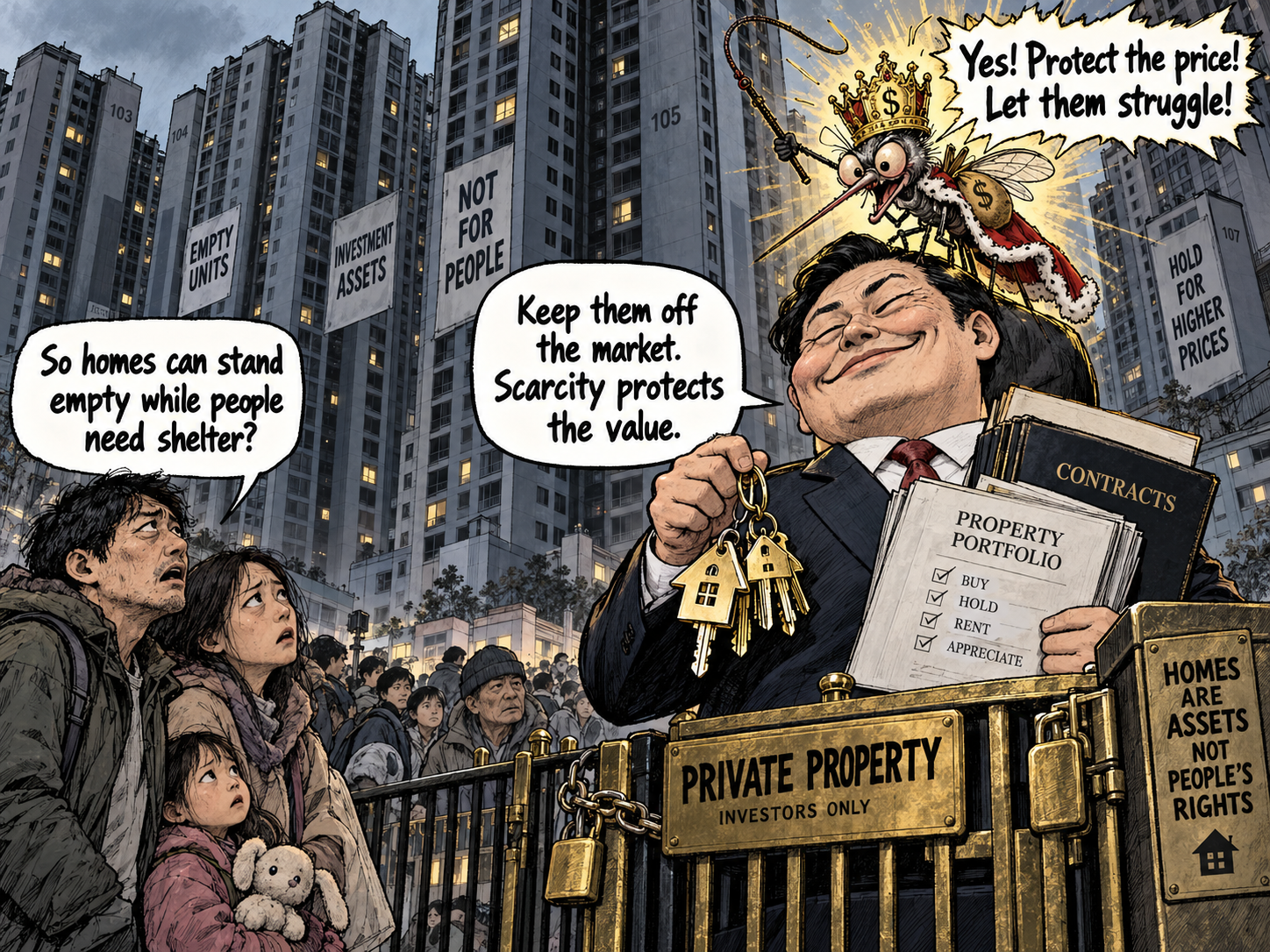
UN-Habitat’s World Cities Report 2026 estimates that up to 3.4 billion people lack access to secure, safe and adequate housing, including more than one billion people living in informal settlements and slums. Its estimates put the global housing deficit at about 288 million units in 2023, up from 251 million in 2010. UN-Habitat
How is that possible in a civilization with cranes, excavators, concrete plants, timber systems, steel, glass, plumbing, electricity, architects, engineers, builders, prefabrication and centuries of accumulated construction knowledge?
Again, do not tell me merely how large the construction or property sector is. Audit the result.
A house can generate financial activity repeatedly without another house ever being created. Land appreciates. A mortgage is issued. Interest is paid. Rent is collected. The property is valued, insured, refinanced, sold and commissioned. Money can move around housing again and again.
But where is the additional shelter?
Where is the land families can actually use? Where are the durable materials, ventilation, drainage, roof-water management, energy systems, repairability, family space and productive land around the home where the environment allows it?
And why has understanding shelter become so distant from ordinary human capability?
I am not saying everybody should be a professional architect, structural engineer, electrician and plumber. Specialists are necessary. But it is strange that a highly educated adult can know almost nothing about how a foundation works, how a roof sheds water, how drainage protects a building, how common materials behave, how ventilation works or how to participate meaningfully in constructing and repairing shelter.
Building a house should not be mysterious knowledge belonging almost entirely to somebody else.
True housing productivity would mean civilization possesses abundant building capability—land access, materials, machinery, specialist knowledge and general practical knowledge—and that families can actually receive excellent shelter without spending half their adult lives earning permission to live somewhere.
That is the audit. Not how expensive property became, not how much mortgage debt exists and not how many transactions happened around a house. How many good homes did civilization actually make available to human beings, and how capable are ordinary people of understanding and maintaining the places where they live?
Audit Four
Do We Have Water Scarcity or a Water-Organization Problem?
Water may be one of the clearest examples of why this kind of audit matters.
In 2024, about 2.1 billion people still lacked safely managed drinking water, despite global coverage reaching 74%. UNICEF / WHO JMP
But do not lazily turn that statistic into the conclusion that Earth simply does not have enough water.
We have to diagnose the actual problem region by region, basin by basin and season by season. Some places have genuine physical water scarcity. Some receive enormous rainfall but capture too little of it. Some sit beside large rivers but lack distribution. Some have polluted water. Some receive tremendous seasonal rainfall and watch much of it rush away before the dry season returns. Some possess groundwater but lack the infrastructure or energy to reach and manage it. Some are genuinely dry countries sitting directly beside an ocean.
Those are not one problem.
Africa shows why the distinction matters. The continent contains 63 international transboundary river basins covering about 62% of its land area and accounting for about 90% of its surface-water resources. African Development Bank
Why, then, should Africa’s water be thought about primarily as isolated national possessions when the hydrology itself is continental and transboundary? Angola, Zambia, Zimbabwe, Botswana, Namibia, Malawi, Tanzania and Mozambique all share the Zambezi basin. Water should be mapped as one living system: who has seasonal surplus, who has storage, who has drought, what downstream flows must remain, where pumping is reasonable, where gravity can move water and where reservoirs, wetlands and aquifers can carry wet-season abundance into dry months.
That does not mean recklessly draining a river or destroying downstream life because somebody else wants the water. It means organizing the basin intelligently.
Share water regionally where geography makes sense. Move water between neighbouring systems where a serious deficit and a usable surplus genuinely coexist. Use gravity where possible and pumping where necessary. Build storage where seasonal abundance needs to survive into the dry season, while protecting the flows that people, agriculture and ecosystems still depend upon.
Then look at genuinely dry coastal countries. Djibouti, Somalia, Eritrea and Namibia are not sitting a continent away from seawater. Desalination is not a magical answer to every water problem, and moving huge volumes of desalinated water far inland or uphill can require enormous energy and infrastructure. But where populations and demand sit close to the coast, why would genuine water scarcity not trigger serious desalination, energy, storage and reuse planning?
Again: diagnose the real constraint first.
And when a dry inland region genuinely needs outside water, the goal should not be permanent helplessness. A drought-stricken region might initially receive water from a wetter neighbouring basin, desalination, reservoirs or other regional sources. But civilization should simultaneously rebuild that region’s own ability to hold water through soil organic matter, appropriate native vegetation, shaded ground, contour systems, ponds, reservoirs, cisterns, wetlands, aquifer recharge and rainfall capture.
I am not saying, “Plant trees and magically make rain.” Vegetation affects infiltration, shade, soil moisture, evapotranspiration and water cycling, but badly chosen vegetation in dry regions can also reduce available streamflow. The whole water-holding organism of the land has to be rebuilt intelligently: soil, roots, shade, ground cover, wetlands, catchments, reservoirs, aquifers and storage.
Do not endlessly pipe water into a damaged landscape while doing nothing to increase what that landscape can retain. Bring water where life needs it, keep people alive, grow food, establish appropriate vegetation, restore soils, create shade, build storage, recharge groundwater and capture the next rainfall better. Let the first imported water help build the conditions for less dependence on imported water later.
And this is where the money trance becomes difficult to ignore.
The African Development Bank estimates that Africa’s water-sector financing gap is about $59–69 billion every year. African Development Bank
Inside the current system, that number becomes one of the great walls standing in front of action. Governments know households need water. Engineers know how to build water systems. Human beings capable of learning construction, maintenance, soil restoration and watershed work exist. Rivers, rainfall, groundwater, coastlines, machinery and energy resources exist in different combinations across the continent. Yet projects can become bogged down in budgets, financing packages, debt, tariffs, lenders and whether they are sufficiently “bankable.”
Look at how backwards that can become. The household needs water. The physical resources exist somewhere in the system. The knowledge exists. Human capability exists or can be trained. Yet civilization can still say that the work cannot proceed because the financial arrangement is missing.
That is what I mean by the money trance.
A budget is not water and a financing package is not a pipe. I understand what money is supposed to do inside the present system: coordinate exchange, allocate claims on resources and help institutions plan. My argument is not that a project suddenly requires no materials, no engineering, no energy and no difficult choices once we stop talking about money. My argument is that the financial mechanism is not itself the physical resource, and we should stop treating a shortage of financial permission as though it automatically proves a shortage of real productive capability.
Why should enormous human capability remain scattered around trying individually to survive while households nearby are still carrying water?
Organize people around something that matters. Train them. Put engineers over work requiring engineering, experienced builders over construction and machine operators where machinery is necessary. Teach communities to maintain what gets built. Build catchments, reservoirs, cisterns and pipelines. Restore watersheds and soil. Recharge aquifers. Keep repair knowledge and spare parts close to the systems that need them.
Violence and instability are real in some regions. Armed groups can damage pumps, pipelines and electrical systems. But the answer cannot therefore be to leave families without water. Build systems with distributed storage, multiple water points, redundancy and local repair capability so the survival of an entire region does not sit behind one vulnerable pump or pipe. Instability changes how infrastructure must be designed, maintained and protected; it should not cancel the obligation to provide the water.
Instead of beginning every problem with “Where is the money?”, begin with the need, the physical resources, the capabilities already present, the capabilities that can be trained and what is genuinely missing. Then organize people and resources around closing the real gap.
Civilization Framework
The Human Capability Horizon
At this point another measurement becomes necessary.
I call it the Human Capability Horizon: the human capability civilization has available now and coming toward it, measured against the useful work humanity still needs to accomplish.
The present side includes people who are unemployed, underemployed, trapped in insecure work, badly matched to their abilities or otherwise prevented from contributing as fully as they could. The International Labour Organization projects a global jobs gap of about 408 million people in 2026— people who want paid work but cannot access it. It also estimates that around 2.1 billion workers remain in informal employment and nearly 300 million workers live in extreme working poverty. International Labour Organization
Then there is developing human capability. UNICEF describes a world containing at least 2.4 billion human beings who have not yet reached their eighteenth birthday. UNICEF
They are growing. Year after year, enormous numbers of them will enter adulthood carrying intelligence, strength, curiosity, creativity and the ability to learn.
Now place those human beings beside the unfinished work we have already identified. Water systems need building and restoring. Homes need building. Food systems need improving. Energy systems need extending. Land needs regeneration. Clothing capability needs rebuilding. Infrastructure needs maintenance. Health systems need people. Children need teaching. Older people need care. Machines need repair and resources need intelligent harvesting and management.
And somehow humanity can look at enormous unfinished work sitting beside enormous unused or badly used human capability and say there is a shortage of jobs.
The problem is that under the money system, work that genuinely needs doing and a funded job somebody can afford to pay you to do have become two different things.
A village can need a reservoir whether a funded vacancy exists or not. A watershed can need restoration whether somebody has created a payroll line or not. A family can need a house whether a developer can make enough money from building it or not.
That gives us the Human Capability Test. Whenever civilization says some enormous necessary work cannot be done, ask what actually needs doing, how many people already possess the relevant capability, how many more could be trained, what tools and physical resources are really missing, and whether the blockage is physical or merely financial.
A person is not useless because an employer has not purchased their time. Necessary work does not cease to be necessary because nobody found a budget for it, and a child should not have to grow up hoping that one day somebody with money will give them permission to be useful.
Audit Five
Are We Producing Energy or Selling Access to Power?
Now apply that thinking to energy.
Around 600 million people in Africa still lack access to electricity, while more than one billion people lack clean cooking. At the same time, the International Energy Agency describes Africa as possessing some of the world’s strongest renewable-energy resources. It estimates that the continent holds about 60% of the world’s best solar resources, alongside substantial hydropower, wind and geothermal potential. International Energy Agency
So once again we have to ask what exactly is scarce.
Sunlight is not scarce across huge portions of Africa. The knowledge of how to build solar systems, turbines, transmission lines, substations, batteries, mini-grids and household systems is not unknown to humanity. Africa has rivers capable of producing electricity, geothermal resources in East Africa and strong wind resources in multiple regions.
Yet hundreds of millions of people remain without electricity.
Producing energy somewhere is not the same thing as producing energy capability that reaches human life.
Africa’s resources and generation capacity are also distributed unevenly. The IEA reports that North Africa and South Africa together account for less than 20% of the continent’s population but more than 65% of installed electrical capacity. International Energy Agency
That is why energy, like water, has to be organized regionally as well as nationally and locally. One place may have excellent hydro, another exceptional solar, another dependable geothermal and another powerful wind. Population, agriculture and industry may sit somewhere else entirely.
Why should every national grid behave like an island?
Connect regions where interconnection makes sense. Build regional generation and transmission. Use mini-grids where communities are too distant for immediate large-grid connection. Use stand-alone systems where those make more sense. Build storage. Strengthen grids. Train electricians and technicians. Manufacture more equipment and replacement parts closer to where they are used.
Then ask what the electricity actually produced in life. Did it pump and treat water, refrigerate food, power a workshop, run a hospital, cool a home, remove smoke from cooking, power tools, support transport and allow machinery to take unnecessary physical burden away from human beings?
A country can report megawatt-hours while households remain energy-poor.
The productive resource is not simply electricity sold. It is usable power reaching life.
And here the recurring chain deserves to be stated again because the contradiction is this clear: the need exists, the physical energy resource exists, the technical knowledge exists, and human capability exists or can be trained, yet the work can still stall because the financing arrangement is missing. The IEA itself identifies financing conditions and access to capital as major obstacles to expanding electricity access and clean-energy investment in much of Africa. International Energy Agency
Copper, steel, silicon, glass and battery materials are real. Sun, wind, water and geothermal heat are real. Engineers, electricians, technicians, line workers and machine operators are real. Money is the human arrangement currently used to coordinate access to those things.
It should never become so mentally dominant that we forget what the actual productive resources are.
A truly productive civilization should not be able to point at blazing sun, powerful rivers, geothermal heat, engineers and millions of capable human beings and then tell a mother she must continue cooking over smoke because there was not enough money to organize them.
Audit Six
Are We Producing Health or Managing Illness?
Health exposes an especially absurd form of the money trance.
Humanity knows more about the body than any civilization before us. We perform heart surgery, replace joints, image organs without opening the body, support premature babies, treat infections, provide anesthesia, transfuse blood, diagnose through laboratories and intervene in emergencies that once meant almost certain death.
Those are genuine productive achievements.
The audit is not an attack on medicine. It asks whether all that medical capability is actually organized around producing the healthiest human life we reasonably can.
In 2023, about 4.6 billion people were still not fully covered by essential health services. In 2022, about 2.1 billion people experienced financial hardship because of out-of-pocket health spending, including around 1.6 billion who were already poor or were pushed further into poverty by those costs. World Health Organization
Think about what that means. A human being can be sick, a doctor can know how to help, the medicine can already exist, a laboratory can know how to identify what is wrong and the necessary equipment may already have been invented, yet the connection between those things can still fail because somebody cannot afford the consultation, treatment, transport, medicine, test or time away from paid work.
The medical capability did not necessarily fail. The human knowledge did not necessarily fail. The medicine did not necessarily fail. The financial connection failed, and because of that, the human being may be denied access to capability civilization already possesses.
That is absurd.
We produced the knowledge, trained the doctor, manufactured the medicine and built the machine, then placed a financial gate between the capability and the human being who needs it.
And we are still waiting too long to care for people.
The most productive health system cannot simply be a magnificent hospital waiting at the end of sickness. What happened before the hospital matters. Was the person drinking clean water, eating nourishing food, sleeping enough, breathing clean air and living in decent housing? Could they receive dentistry before severe damage? Could a pregnant woman receive good care close to home? Could blood pressure, diabetes or another emerging condition be found before it became catastrophic?
Primary care, prevention, nutrition, water, sanitation, rest, movement and housing are health infrastructure too. WHO estimates that scaling up primary-health-care interventions across low- and middle-income countries could save 60 million lives by 2030. World Health Organization
Maternal mortality shows the difference between knowledge existing and capability reaching life especially painfully. In 2023, more than 700 women every day died from preventable causes related to pregnancy and childbirth. World Health Organization
Knowledge existing somewhere in civilization is not enough. Capability must reach life.
A medical textbook in a university is capability in potential; a trained midwife beside a laboring woman is capability in use. Medicine inside a warehouse is potential capability; that medicine reaching the person who needs it is capability in use. A sophisticated hospital three hundred kilometres away is healthcare infrastructure, but the person actually receiving appropriate care when they need it is health capability reaching life.
The same distinction appears in the workforce. WHO projects a shortage of about 11 million health workers by 2030, concentrated largely in low- and lower-middle-income countries. World Health Organization
Now put that beside the Human Capability Horizon.
We have enormous numbers of people wanting useful contribution while civilization simultaneously reports shortages of nurses, midwives, community health workers, caregivers, rehabilitation workers, technicians and people capable of maintaining health facilities.
Of course not every unemployed person can suddenly become a doctor. Serious professions require serious education. So train people.
A health civilization needs specialists, but it also needs many levels of health capability: doctors, nurses, midwives, dentists, pharmacists, laboratory workers, rehabilitation specialists, community health workers, caregivers, emergency responders, nutrition workers, sanitation teams, medical-equipment technicians and people teaching families practical health and first aid.
There is an enormous field of necessary human contribution here.
An infection does not care that payday is Friday. A painful tooth does not care that rent is due. Pregnancy does not pause because a household cannot afford transportation. Biology responds to biology.
Yet access can still respond to money.
If the doctor is available, the medicine is available, the room is available and the patient needs care, what productive purpose is served by preventing them from meeting because money is missing?
Produce health capability, not merely health transactions.
Audit Seven
Are We Producing Movement or Selling Access to Mobility?
Transport has to be audited at several levels. Can people move through their own neighbourhood? Can they reach food, healthcare, education, family and public life without spending enormous portions of the day in transit? Can rural families reach regional services? Can food and materials move intelligently? Can families move around their own countries easily?
And then there is a part of human mobility that gets dismissed too easily: travelling abroad, exploring, learning and immersing yourself in another culture by actually being there.
Humanity has built machines capable of carrying a person across an ocean in hours. That is extraordinary transport capability.
But who is actually free to go?
Not merely who can scrape together enough money for one ticket. Who has enough control over their life to travel slowly? Who can remain somewhere for a month or two? Who can live among another people long enough to stop simply consuming a destination and begin understanding it? Who can learn some of the language, eat with families, walk the land and understand how people build, farm, cook, celebrate, raise children and organize their lives?
That requires more than aircraft. It requires time.
Civilization has not only made travel expensive. It has made time itself difficult to obtain.
There is the fare, accommodation, passports, visas where required, baggage, food, insurance and local transport. Then there is another cost accumulating quietly in the background: the income a person may not be earning while away.
So even somebody who manages to afford the journey may have to squeeze another part of the Earth into seven days or two weeks because employment expects them back.
Who is truly free to travel and immerse?
And do not tell me international travel is merely “optional” as though that settles the question. When governments want tourists to come into their country, suddenly international travel is extremely important.
UN Tourism recorded an estimated 1.52 billion international tourist arrivals in 2025— a measure of trips or arrivals, not 1.52 billion unique people. UN Tourism
Countries advertise for tourists, develop destinations, expand airports, promote beaches, food, culture, architecture, history and wildlife, track receipts and celebrate rising visitor spending.
So clearly international movement is understood to have value.
The contradiction appears when we ask whether ordinary people themselves should possess enough freedom, time and transport capability to experience the world.
Then suddenly it becomes a luxury.
Look at the strange logic. A family arriving from another country to experience your culture is economically desirable because they bring money. A family from your own country wanting to spend meaningful time somewhere else—to learn a language, understand another culture, expose their children to another landscape or study architecture, agriculture, food and history—is treated as private consumption they must finance for themselves.
So what exactly do we value: human exchange, or the money attached to human exchange?
This is the money trance all over again.
A human being wants to cross a border to learn, explore, visit family, understand another culture or simply experience more of the Earth. Civilization asks where the money is. But let that same human being arrive carrying money to spend on hotels, restaurants, flights, tours and shopping, and suddenly governments understand perfectly well why international movement matters.
What changed? Not the movement, learning, curiosity, cultural encounter or beauty of experiencing another place.
Money appeared.
That is one of the deeper effects of the money trance. Money does not merely restrict access. It can distort what civilization recognizes as valuable in the first place.
Travel teaches. A farmer can see another agricultural system. A builder can encounter another building tradition. A child can hear another language being spoken around them. A cook can taste an ingredient where it grows. A researcher can observe, an artist can absorb and families can know one another across borders. A human being can also simply experience more of the planet they were born onto, and that has value without needing another justification.
The value does not begin when somebody generates a hotel bill.
This is why free transport means much more than eliminating a bus fare. If transport were treated as a civilization capability available to human beings rather than primarily as a product purchased trip by trip, the potential for family travel, cultural exchange, education, apprenticeships, exploration, medical movement and human connection would change radically. But removing fares alone would still not be enough if people remained too financially dependent on continuous employment to have time to go.
A truly productive transport civilization should therefore ask something more ambitious than how many tickets were sold: how much of the Earth can an ordinary family actually experience, and do they have enough usable lifetime to experience it properly?
The Earth should not merely be technically reachable. Human beings should have enough mobility capability and enough control over their own time to actually experience it.
Audit Eight
Are We Producing Capability or Credentials?
Education may be the most consequential audit because this is where civilization deliberately develops future human capability.
UNESCO estimates that 273 million children and young people were out of school in 2024. UNESCO
Access matters, but attendance is not enough. A child can sit inside a classroom for years without mastering what should have been learned there. A widely cited World Bank-led estimate published in 2022 put learning poverty at about 70% of ten-year-olds in low- and middle-income countries, meaning they could not read and understand a simple age-appropriate text. World Bank
So the education audit cannot simply ask how many years somebody spent in school.
What can they actually do?
Can they read with understanding, write clearly and reason mathematically? Can they investigate a problem, communicate what they know, learn independently, collaborate and understand the physical systems surrounding their own lives?
Then we need to go further.
How did building a house become somebody else’s knowledge?
Shelter is one of humanity’s oldest and most permanent requirements, yet a person can complete years of formal education and know almost nothing about foundations, drainage, ventilation, roofing, structure or common building materials.
The same question applies to food, water, clothing, health, tools, machinery and repair. How many highly educated adults can grow meaningful food, understand soil, explain how the water entering their home actually gets there, understand basic electrical systems, repair clothing, perform first aid, safely use common tools or understand the machines they depend on every day?
Specialization has produced extraordinary things, and I am not calling for its destruction.
I am asking why specialist capability had to expand while ordinary human capability became so narrow.
Education should produce specialists and capable ordinary human beings.
And before we ask what jobs will exist twenty years from now, we should ask something much more stable: what kind of education does Earth actually need and will always need?
Human beings will always need nourishment, which means civilization will always need people who understand how to grow, raise, harvest, preserve, store, cook and manage food intelligently. We will always need people who understand soil, seeds, orchards, livestock, fisheries, nutrition, freshness and how to produce abundance without destroying the living systems that make future abundance possible.
We will always need people capable of harvesting resources intelligently from the Earth and seas. Humanity will continue to use timber, stone, fibers, metals, clay, sand, salt, fish, sea plants, medicinal plants, water and energy. The important education is not merely how to extract them, but how to understand regeneration, ecological limits, reuse, substitution and the difference between harvesting a resource and destroying the source that must continue producing after us.
Human beings will always need shelter, so civilization will always require capability around land, foundations, structures, materials, ventilation, drainage, roofing, water, energy, maintenance and repair. We will always need people capable of clothing human beings, which means preserving and advancing knowledge of fibers, spinning, weaving, textile engineering, dyeing, fitting, sewing, footwear and repair.
People will always have bodies, so health, nourishment, pregnancy, birth, childhood development, dentistry, medicine, rehabilitation, movement, rest, aging and care will always matter. Human beings will always need people who can cook—not merely heat industrial products—but understand ingredients, freshness, preservation, fermentation, seasoning, nutrition and how to feed children, adults, older people and sick people well.
Things will always break, which means maintenance is not a lesser field of education. Pumps break, roofs leak, machines wear, pipes clog, roads deteriorate, clothing tears, buildings age and energy systems fail. Civilization does not merely need people capable of building new things. It needs people capable of keeping useful things alive.
We will always need to move people and resources, nurture children, care for people through vulnerable periods, carry knowledge into the next generation, investigate new problems, research, create and invent.
These are enduring civilization capabilities.
Job titles will change. Technology will change. Some tasks will disappear and others will emerge. Human beings will still require nourishment, shelter, water, clothing, health, movement, maintenance, care and knowledge.
That should be the stable foundation underneath education.
Then children can increasingly discover where their own interests and abilities belong within this enormous field. Some may become exceptional mathematicians, builders, growers, physicians, machine designers, caregivers, cooks, textile makers, researchers, artists or engineers. Others will combine capabilities in ways nobody had a job title for beforehand.
The goal should not be pushing everybody through one narrow gate. The goal should be developing human capability.
And here education runs directly back into the money trance. Children are still often taught a basic sequence: study hard, get good grades, get a degree and hopefully somebody will employ you.
Look at the destination.
Education becomes preparation for making yourself employable. Then the person reaches adulthood, looks around at enormous unfinished work and can still be told there is no job because nobody currently has enough money to purchase their labor.
That is an astonishing endpoint for education.
The person can be intelligent, capable, curious and trainable. Necessary work can surround them everywhere. But unless a funded position exists, the system can call them unemployed.
The need exists, the physical resources exist or can be produced, the knowledge exists, and human capability exists or can be trained, yet civilization still says the work cannot proceed because the financial arrangement is missing.
We have now seen that chain too many times to pretend it is accidental.
Education should connect the Human Capability Horizon to the unfinished work of civilization. It should not produce children whose final question is simply, “Who will hire me?” It should develop human beings capable of asking, “What does life continuously require, what am I capable of becoming excellent at, and where can my ability meet a real human need?”
The certificate is not the productive resource. The productive resource is what remains inside the human being after the certificate has been put away.
Audit Nine
Did Productivity Give Human Beings Their Time Back?
Now we arrive at what may be the final test.
Did all this productivity give human beings their time back?
We built machines because machines can reduce labor. We mechanized agriculture, automated factories and built pumps, washing machines, vehicles, excavators, cranes, refrigeration, computers, telecommunications, software and now artificial intelligence because tools can multiply human capability and reduce the amount of human effort required to accomplish something.
That is real productivity.
But where did the saved human time go?
If producing something now requires fewer hours of human labor, should some of those hours not eventually return to human beings as life? Should parents not gain more time with their children, couples more time with one another and people more time for sleep, cooking, exercise, care, learning, travel, community, creativity and sometimes simply sitting down without every available hour needing to justify itself financially?
Look at how strangely human time is distributed.
On one side, the ILO projects a global jobs gap of about 408 million people in 2026—human beings who want paid work but cannot access it. On the other side, the ILO’s global review of working time found that more than one-third of workers regularly work more than 48 hours per week, while about one-fifth work fewer than 35 hours. The same research found that working longer than people prefer is associated with worse reported work-life balance. International Labour Organization
Not everybody working shorter hours wants additional work, and different people possess different capabilities. I am not pretending we can simply take hours from one person and hand them to another.
But look at the overall mismatch.
On one side are underused human beings with time and desire in their hands. On the other are employed human beings carrying so much work that little usable life can remain around it.
Why are those realities sitting beside each other?
People are also telling us they are tired. Gallup’s 2026 global workplace data found that 40% of employees worldwide said they experienced stress during a lot of the previous day . Gallup Stress has many causes and cannot all be blamed on employment, but the ILO’s 2026 work on psychosocial risks estimates that more than 840,000 deaths annually are associated with health conditions linked to workplace psychosocial risks , including excessive demands, long working hours, low control and job insecurity. International Labour Organization
That is not intelligent organization of human capability.
The automation paradox makes the problem even clearer.
Suppose a machine makes it possible for work that once required ten people to be done by two. From the perspective of civilization, that should be excellent news because the necessary labor has been reduced and eight people’s time has been released.
Why should a machine that reduces necessary labor become a threat to the people whose burden it reduced? The work remaining on Earth is enormous, the human capability available is enormous, and the developing human capability coming behind us is enormous. The failure is not a shortage of work or people. The failure is in how we are matching human capability to the work that still needs to be done.
Under the money system, however, those eight people can experience the productivity gain as catastrophe. The machine succeeded, the labor requirement fell and productivity increased, but because access to housing, food, energy, transport and much of ordinary life still depends on money earned through work, the person whose labor was no longer required may suddenly lose the income needed to live.
Think about how backwards that is.
The person then has to search for another employer who will purchase their time, even though the supposed achievement of the machine was that less human time was required. Meanwhile other workers can remain overloaded.
This is the money trance again, but now it is consuming lifetime itself.
One organization says it cannot afford another worker, so one person carries too much work. Somewhere else, another human being sits outside wanting useful contribution because nobody can afford to hire them. Both lives are being arranged around the financial connection rather than around the intelligent distribution of necessary work.
Productivity should eventually return time.
If a machine saves a million labor hours, we should ask how much of those million hours became human life rather than merely reduced labor cost. If artificial intelligence allows a task to be completed in half the time, do people ever receive some of that time back, or do we automatically fill every saved hour with another task because employment purchased the working day? If something that once required forty hours can now be performed excellently in twenty, why must productivity always mean finding another twenty hours of production instead of sometimes returning those hours to the human being?
A human lifetime is finite. Every hour unnecessarily consumed is an hour nobody can give back.
And this returns us to the family-life test.
What use is an excellent house if everyone inside it is gone all day earning the money required to keep it? What use is excellent food capability if families have so little time that preparing and eating proper food together becomes difficult? What use is extraordinary transport capability if people possess neither the money nor the free time to explore? What use is advanced healthcare if the organization of daily life itself contributes to exhaustion? What use is education if adulthood means spending most of one’s waking life earning permission to access the things education supposedly helped civilization become capable of producing?
Human beings should contribute. I am not arguing for idleness.
Food has to be grown and prepared. Water systems need care. Buildings age. Children need teaching. People need medicine. Machines require maintenance. Land and seas need stewardship. Resources must be harvested intelligently. Research should continue and new things should be created.
But contribution should not consume the human being.
If machinery can reduce unnecessary labor, let it. If necessary work can be distributed across more capable people, distribute it. If somebody has carried an intense season, give them restoration. If productivity genuinely reduces the time required for a task, return some of the gain to life.
That is what progress should mean.
So What Would True Productivity Actually Measure?
We have now audited clothing, food, housing, water, energy, health, transport, education and human time.
Again and again, the same structure appeared: the need exists, physical resources exist, human knowledge exists, and human capability exists or can be trained, yet civilization can still say that the work cannot proceed because the financial arrangement is missing.
That is the money trance.
It is not simply that things cost money. It is that humanity has become so accustomed to beginning with money that we can forget to begin with reality.
The first questions should be: what actually needs to be done? What physical resources already exist and which ones genuinely have to be produced? What knowledge already exists? Who already possesses the required capability? Who can be trained? What machinery, tools, energy and materials are necessary? What ecological or physical limits must be respected? How should the work be distributed? How should the resource be maintained so it remains useful after us? How does the result actually reach households?
Those are productive questions.
“Where is the money?” is an administrative question inside one particular human arrangement.
We have confused the two.
Money is not food, water, shelter, electricity, medicine, cotton, transport, knowledge, land, skill or a human hour of life. Those are the real things. Money is the mechanism humanity currently places around access to many of them.
Trott Bailey Family Civilization begins from that distinction.
A money-free civilization does not mean that things require no work. It does not mean resources become infinite, geography disappears, engineering limits vanish or everyone can take everything without consequence. It means money no longer gets to stand between human needs and civilization’s actual productive capabilities.
Contribution is organized around what life requires. People develop capabilities according to their interests and abilities. Necessary work is shared intelligently. Machinery is used to reduce unnecessary burden. Intense contribution is followed by restoration. Knowledge is carried forward. Useful materials are maintained, recovered and reused. Land and seas are harvested intelligently rather than treated as disposable inventories.
And access to the basic requirements of life is not something a family has to purchase permission to receive.
The first stage of such a civilization would not even be some fantastical endpoint. It would bring humanity back to the starting line.
People could breathe. Families could recover from the constant pressure of money. Parents could stop measuring every hour by what it earns. Housing, nourishment, clothing, water, energy, healthcare, movement and education could become civilization capabilities rather than separate financial battles fought by every household.
Then we could discover what human beings are actually capable of when so much intelligence is no longer consumed by survival anxiety.
That is why I am asking humanity to make the world truly productive again.
Not because we need more meaningless output. Not because every forest should become a factory or every person should work harder.
Quite the opposite.
We need to become exceptionally capable of producing, maintaining and regenerating the things life actually requires while steadily reducing the amount of human lifetime unnecessarily consumed in doing it.
The final productivity test therefore cannot merely be how much we produced. It has to ask whether we produced better nourishment, better shelter, better clothing, stronger water security, abundant usable energy, better health, deeper knowledge, greater human capability, greater freedom to move through the Earth, less unnecessary labor and more usable human life.
If machines become more productive while human beings become more exhausted, something has gone wrong. If the economy becomes larger while families have less time together, something has gone wrong. If technology saves labor while the human being whose labor was saved becomes terrified of losing access to life, something has gone wrong. If hundreds of millions of people want useful contribution while enormous unfinished work surrounds them, something has gone wrong.
The answer is not to invent useless work merely to keep everybody employed.
The answer is to organize human capability around the work life actually requires, keep developing that capability, use machines to remove unnecessary burden and return the gains of productivity to human life.
Data note
The principal statistical sources used in this article are Textile Exchange’s Materials Market Report 2026 for 2025 fiber production; FAO’s State of Food Security and Nutrition in the World 2026; UN-Habitat’s World Cities Report 2026; the WHO/UNICEF Joint Monitoring Programme for 2024 drinking-water estimates; African Development Bank reporting on transboundary water and the African water-financing gap; the International Energy Agency’s Africa energy reporting; WHO’s 2025 universal-health-coverage monitoring, maternal-mortality estimates and health-workforce data; UN Tourism’s 2026 reporting on 2025 international travel; UNESCO’s 2026 Global Education Monitoring data; and ILO and Gallup reporting on employment, working time, workplace stress and psychosocial risk. Statistical years are stated in the article because the newest available observation differs by dataset.
True productivity should not merely produce more things.
It should produce more capability to live.