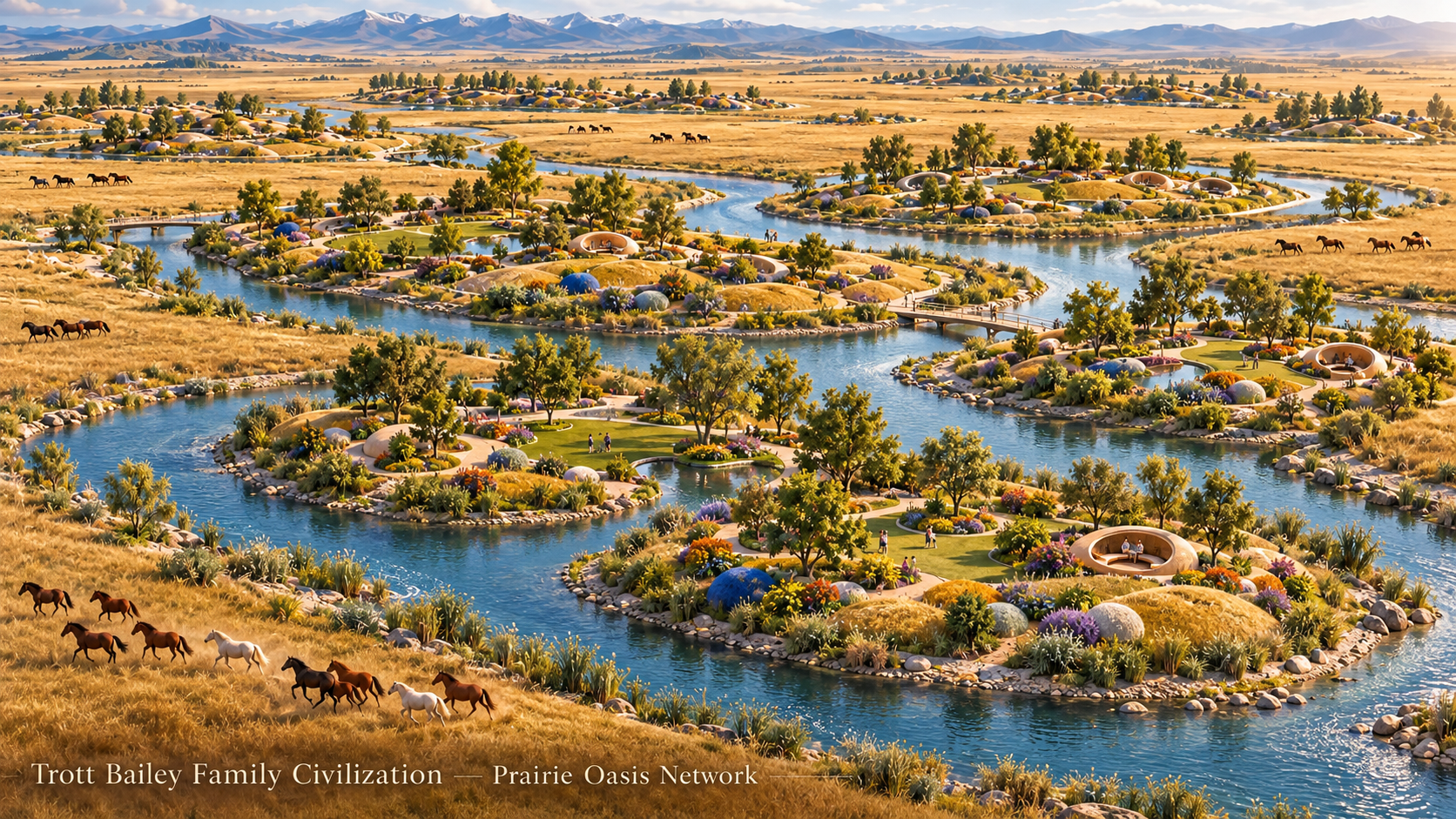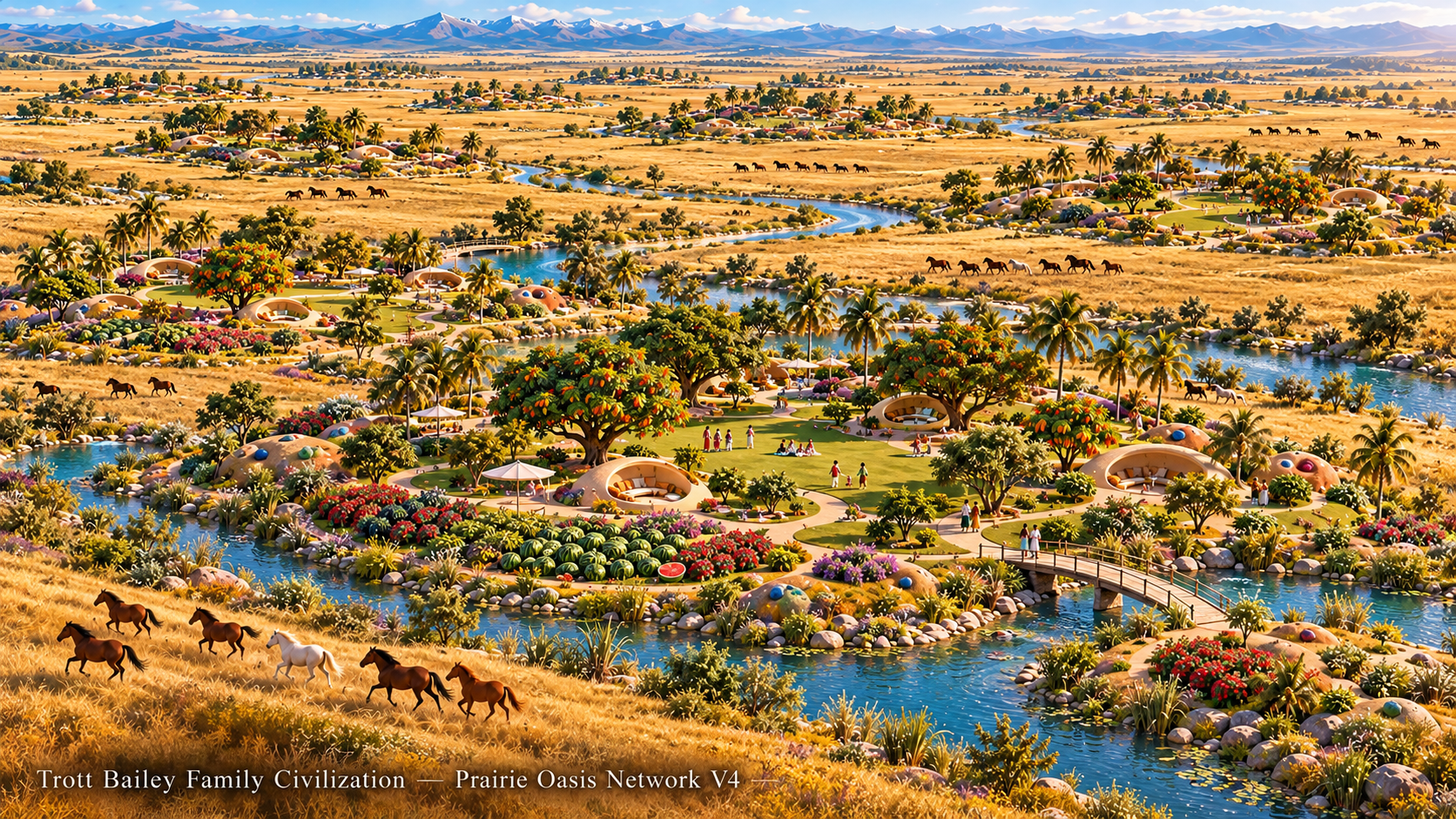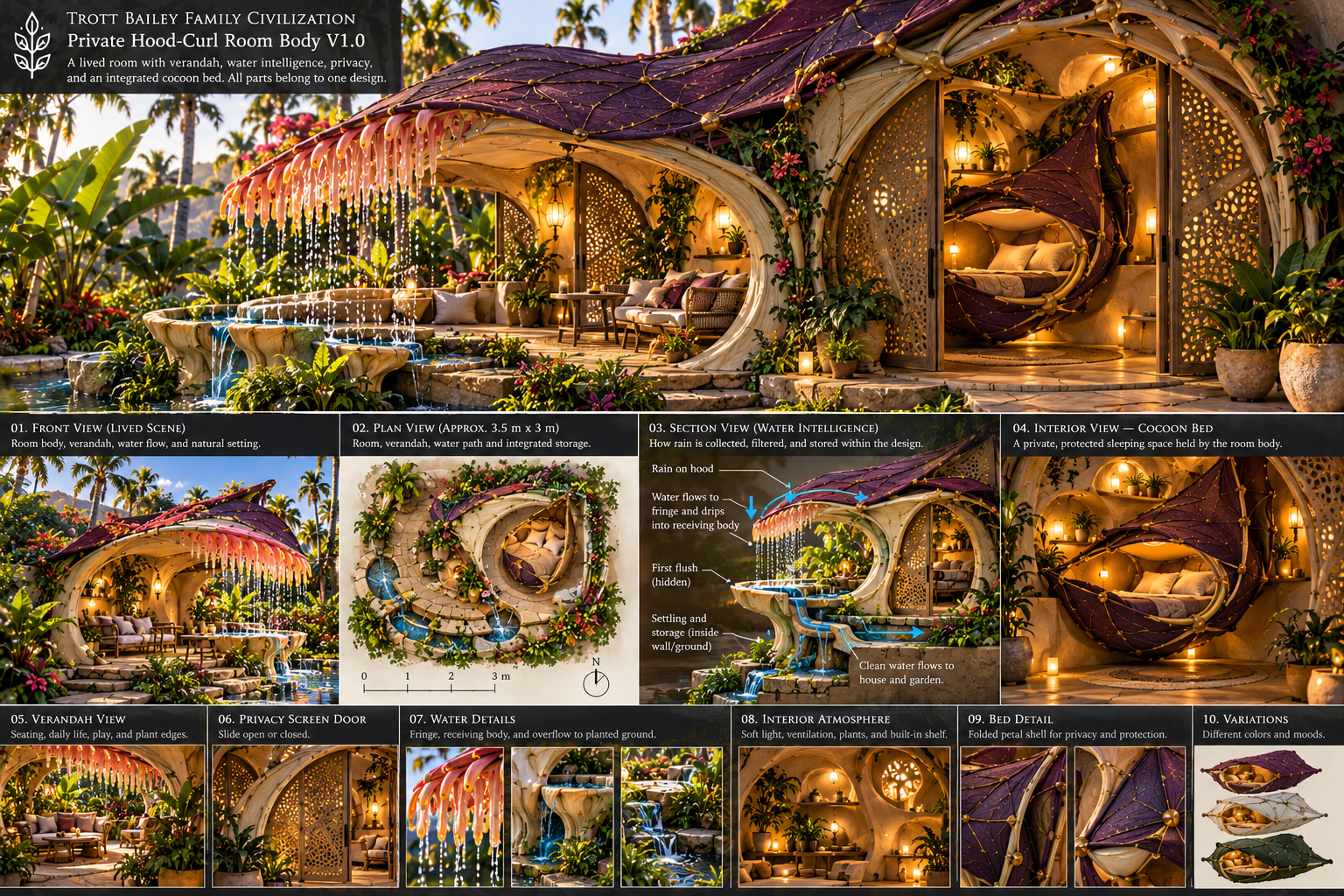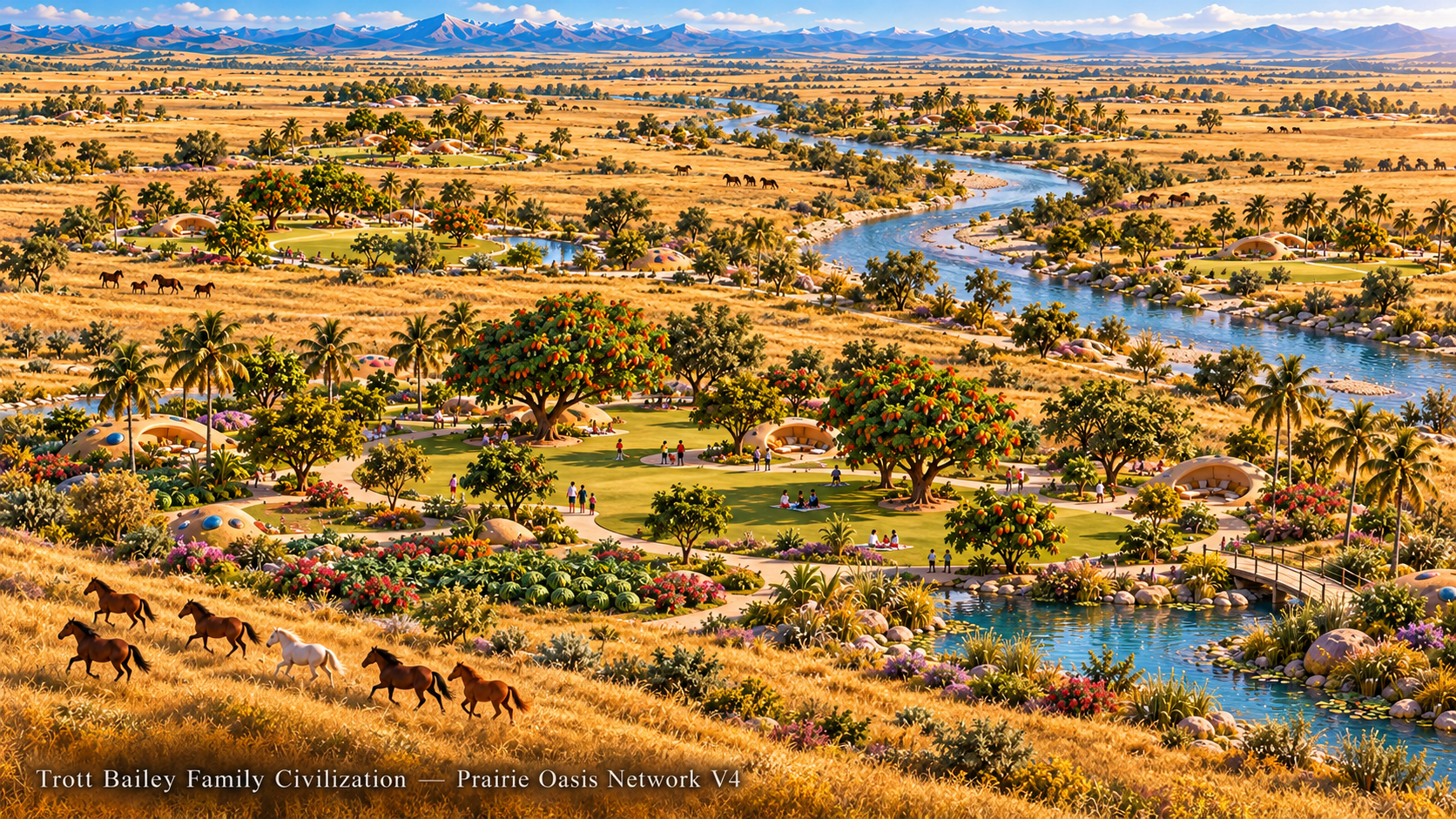

Trott Bailey Family Civilization World Management Records: Resource Reality Before Money
Resource Reality Before Money
Introducing Kaitou, the Trott Bailey Family Civilization Global Resource Hub.
A Trott Bailey Family Civilization World Management Record by World Ruler Sher / Trott Bailey Family Civilization
Trott Bailey Family Civilization does not begin world management with the question, “Who will fund this?”
That is the old-world question.
It is the question that makes food wait while people are hungry. It makes water wait while children drink unsafe water. It makes machinery sit idle while families break their bodies by hand. It makes knowledge sit trapped in institutions while whole regions remain dependent. It makes repair wait, shelter wait, medicine wait, transport wait, farming wait, and life wait behind the gate of money.
Trott Bailey Family Civilization begins with a different question:
What must be seen?
- What food exists?
- What water exists?
- What land exists?
- What machinery exists?
- What medicine exists?
- What knowledge exists?
- What expertise exists?
What must be understood?
- What abundance exists?
- What scarcity exists?
- What is idle?
- What is blocked?
- What is being wasted?
- What can be moved, repaired, shared, taught, restored, built, or multiplied?
This is the principle of Resource Reality Before Money.
Money must not be allowed to hide the actual material reality of what the Earth already contains and what people already know how to do.
In Plain Words
Kaitou is a public resource hub.
- A farmer can log extra food.
- A mechanic can log idle machines.
- A town can log broken water systems.
- A community can log what it needs.
- A builder can log available materials.
- A nurse can log health shortages.
- A grandmother can log food preservation knowledge.
- A district can log transport routes.
- A nation can log abundance, scarcity, and capacity.
Kaitou helps show what is sitting still, what is being wasted, what is missing, and what can move.
It is not about begging for money first.
It is about seeing reality first.
1. The Old Question Is Wrong
The old world often treats money as the first gate of action.
Before food moves, someone asks who will pay. Before water is restored, someone asks who will fund. Before machinery is repaired, someone asks who approved the budget. Before knowledge is shared, someone asks which institution owns the training. Before a community is rebuilt, someone asks which donor, investor, bank, grant, agency, or government program will authorize the process.
This creates a strange and deadly disorder.
What may already exist
- Food may exist.
- Tools may exist.
- Land may exist.
- Water sources may exist.
- Knowledge may exist.
- Machines may exist.
- Transport may exist.
What still fails
- Hunger continues.
- Repair does not happen.
- Families remain crowded.
- Children remain sick.
- Local people remain dependent.
- Machines sit unused.
- Resources do not move.
The old world calls this lack of funding.
Trott Bailey Family Civilization calls it a failure to manage reality.
Money is not the first truth of life.
A civilization that cannot see these realities clearly will keep allowing life to be blocked by financial excuse.
2. What Resource Reality Before Money Means
Resource Reality Before Money means Trott Bailey Family Civilization first sees the real world before accepting the old excuse that nothing can happen because money has not approved it.
It asks what is present
- What is already present?
- What is missing?
- What is nearby?
- What is wasted?
- What is underused?
- What is broken but repairable?
- What is abundant in one place and scarce in another?
It asks who can act
- Who knows how to solve this?
- Who can teach this?
- Who can move this?
- Who can repair this?
- Who can build this?
- Who can grow this?
- Who can multiply the solution?
This principle does not mean Trott Bailey Family Civilization pretends money does not exist in the old world.
It means money is not allowed to become the highest truth.
Money is not allowed to stand above food, water, land, shelter, health, repair, knowledge, family life, or children.
The first truth is life.
The second truth is what life requires.
The third truth is what the Earth and its people already contain.
Money is not the ruler.
3. Kaitou: The Official Global Resource Hub
The Trott Bailey Family Civilization Global Resource Hub is officially named Kaitou.
Kaitou is the real-time Earth resource and capacity intelligence system under the Trott Bailey Family.
Its digital interface will be officially launched in the future. No launch date has been set yet.
Kaitou is not
- It is not a funding platform.
- It is not a World Bank-style loan body.
- It is not a donor agency.
- It is not an investor dashboard.
- It is not a grant machine.
- It is not a debt system.
- It is not a platform asking who will pay before life can move.
Kaitou exists to
- Help the ruling family see resource reality clearly.
- Help participating peoples and places record what exists.
- Show who has what idle.
- Show who has what abundance.
- Show who has what need.
- Support allocation according to life.
Kaitou will be available to everyone, from grassroots-level people to the highest-level officials.
It must be easy to use. It must be understandable. It must not become a hidden expert-only interface where ordinary people are locked out of reporting what they know, what they have, what they lack, what they waste, what sits idle, what can be repaired, what can be taught, and what is needed.
Kaitou informs the ruling family.
Kaitou does not rule the civilization.
The Trott Bailey Family rules.
Kaitou helps the ruling family see.
4. Public Resource Auditing
Kaitou does not magically know everything.
It does not claim to secretly see every country, every town, every farm, every boat, every machine, every storehouse, every water source, every family condition, every skill, or every hidden capacity without participation.
Resource auditing must be done by interested and participating peoples and places.
People, families, communities, towns, districts, municipalities, regions, nations, local bodies, grassroots organizers, officials, knowledge holders, builders, farmers, repair workers, health workers, machine operators, transport workers, cultural stewards, and other participants may sign up and follow official procedures to log resource reality.
Participants may log what they have
- Food.
- Water conditions.
- Tools.
- Machines.
- Building materials.
- Transport.
- Storage.
- Health capacity.
- Knowledge and expertise.
Participants may log what they need
- What is scarce.
- What is idle.
- What is broken but repairable.
- What is movable.
- What is teachable.
- What is blocked.
- What is being wasted.
- What emergency needs exist.
This public resource information helps make reality visible.
A community can say
“This is what we have.”
A region can say
“This is what we lack.”
A town can say
“This machine is idle.”
A farmer can say
“This harvest is too much for us to store.”
A repair worker can say
“This equipment is not dead; it can be restored.”
A knowledge holder can say
“We know how to teach this.”
Kaitou is public-facing, but it is not disorderly.
Participants must follow official procedures for logging resources so information can be organized, reviewed, corrected, compared, and made useful.
Public access does not mean careless data. Easy use does not mean no standard.
Kaitou depends on interested people and places choosing to make resource reality visible through proper procedure.
5. What Kaitou Tracks
Kaitou tracks broad sectors of life, not only old-world commodities.
Food
Crops, harvests, livestock, fish, fruit, vegetables, stored grains, food waste, food gluts, preservation capacity, cold storage, regional food needs, and emergency hunger.
Agriculture
Fertile land, unused land, degraded land, soil condition, irrigation, seeds, farm machinery, farming expertise, harvest timing, compost, greenhouses, orchards, and local growing knowledge.
Water
Rivers, lakes, springs, aquifers, rainfall, sea access, desalination potential, potable water, unsafe water, treatment systems, storage tanks, community water points, drought, flood, and water routes.
Health
Clinics, doctors, nurses, medicine, maternal care, child health, dental needs, nutrition burdens, sanitation, mosquito pressure, emergency care, mobile clinics, and prevention needs.
Machinery
Tractors, excavators, sawmills, pumps, boats, freezers, generators, CNC machines, six-axis robotic arms, stone cutters, waterjet cutters, repair tools, idle machines, broken machines, operators, and machine teachers.
Building and Shelter
Timber, clay, lime, stone, shell, bamboo, metal, ceramic, roof materials, local builders, unsafe housing, overcrowding, sanitation gaps, bathing needs, workshop capacity, and repair priorities.
Knowledge and Expertise
Farmers, fishers, builders, engineers, doctors, mechanics, midwives, machine operators, teachers, water experts, food preservation workers, cultural stewards, textile makers, programmers, translators, elders, and practical knowledge holders.
Transport and Movement
Roads, rivers, ferries, boats, ports, storage points, delivery routes, cargo bottlenecks, fuel availability, walking routes, local carriers, and emergency access.
Living Conditions
Kaitou does not treat these as abstract data points. It treats them as living conditions that affect families, children, land, water, health, shelter, and future.
6. Kaitou Expands the Meaning of Resource
Resources in Kaitou are not limited to old-world categories such as money, minerals, commodities, land, labor, fuel, or standard economic inputs.
Kaitou is designed to see resource reality more deeply.
As people, communities, towns, districts, municipalities, regions, and nations log what they have, what they know, what they waste, what sits idle, what moves seasonally, what can be repaired, what can be taught, and what can be linked to another need, new forms of resource intelligence may appear.
A local skill may be a resource.
A waste stream may be a resource.
A seasonal pattern may be a resource.
A community rhythm may be a resource.
A grandmother’s food preservation knowledge may be a resource.
A repair habit may be a resource.
An idle courtyard may be a resource.
A boat route may be a resource.
A discarded material may be a resource.
A shade pattern may be a resource.
A safe gathering point may be a resource.
A local song, language, or memory system may be a resource when it preserves identity, teaching, and continuity.
A person’s ability to organize people peacefully may be a resource.
A family’s working method may be a resource.
A child-safe path may be a resource.
A repeated local problem may reveal a resource opportunity when linked with the right knowledge, tool, material, route, or community.
Kaitou must not inherit old-world resource blindness.
Kaitou does not only record known resources. Kaitou helps reveal new resources by showing hidden linkages in life.
Resource intelligence expands as reality becomes visible.
7. Kaitou’s Plain Resource Language
Kaitou must use plain language.
Glut
A glut means a place has more of something than it can currently use, store, preserve, sell, or distribute. A fruit glut means fruit may rot in one place while children lack fruit somewhere else.
Abundance
Abundance means a place has a strong, repeatable, renewable, or dependable supply. A coastal region may have fish, boat knowledge, saltwater for desalination, preservation skills, and sea-route capacity.
Scarcity
Scarcity means a place lacks enough of something necessary for healthy life. A region may have water scarcity, food scarcity, medical scarcity, machinery scarcity, seed scarcity, repair scarcity, teacher scarcity, storage scarcity, or shelter-material scarcity.
Idle Capacity
Idle capacity means something useful already exists but is not being used. A tractor sits unused. A sawmill sits still. A clinic room is empty. A fishing boat is idle.
Blocked Capacity
Blocked capacity means people could produce, repair, heal, build, teach, or move life forward, but one missing piece stops the whole flow.
Repairable, Movable, Teachable, Needed
Repairable means something is not dead; it can return to use. Movable means it can be transported or rerouted. Teachable means knowledge can transfer. Needed means life is waiting for it.
These words help Kaitou stay understandable from the grassroots level to the highest level of officials.
8. Pacorips and Kaitou Are Not the Same System
Trott Bailey Family Civilization must clearly distinguish Pacorips from Kaitou.
They are related organs of the civilization, but they do not have the same function.
Pacorips
Pacorips is the civilization’s reception, memory, relationship, family-support, testimony, coordination, and people-intelligence system.
- Who is this person, family, household, region, or group in relation to the civilization?
- What has happened with them?
- What support have they received?
- What testimony has been recorded?
- What family conditions should the ruling family understand?
- What promises, failures, harms, or responsibilities must not be forgotten?
Kaitou
Kaitou is the Earth’s real-time resource and capacity intelligence system.
- What exists on Earth?
- Where is food abundant?
- Where is water unsafe?
- Where is machinery idle?
- Where is transport available?
- Where are skilled farmers, builders, doctors, teachers, machine operators, and repair workers?
- Where can abundance be moved, repaired, shared, taught, or reproduced?
Pacorips helps the civilization receive people, remember people, coordinate support, preserve testimony, and understand family conditions.
Pacorips must not become social credit. It must not become a cold ranking machine. It must not reduce people to scores.
The distinction protects both systems.
If Pacorips absorbs everything, it can become too broad and risk feeling like a system that watches every part of life.
If Kaitou absorbs people records, it can become too cold and reduce families to resource demand points.
Together, they help the ruling family see more clearly.
9. How Kaitou and Pacorips Assist the Trott Bailey Family to Rule
Kaitou and Pacorips assist the Trott Bailey Family by making reality visible.
They do not rule. They do not replace the ruling family. They do not turn Trott Bailey Family Civilization into technocracy, social credit, donor management, committee rule, or agency rule.
They assist the ruling family’s judgment.
Example: A Region Has a Food Shortage
Kaitou may show that there is a cassava glut 180 kilometers away, two working trucks nearby, a repairable cold-storage unit, clear road access, and local farmers who know how to multiply the crop.
Pacorips may show that 42 families are affected, 12 households have children under five, several mothers need urgent support, one previous delivery failed because a local storage point was mismanaged, and affected-family testimony should be recorded.
Kaitou shows
The resource solution.
Pacorips shows
The people reality.
Then the ruling family decides.
This is how the systems assist Trott Bailey rule.
10. Kaitou Is Not a Colonial Appetite Map
Kaitou is not a colonial appetite map.
This must be said clearly.
Trott Bailey Family Civilization is not using resource intelligence to hunt countries, devour land, seize minerals, control food systems, harvest labor, or disguise exploitation as help.
Kaitou is not
- It is not a corporate buffet.
- It is not an investor opportunity map.
- It is not a donor control platform.
- It is not a list of what can be taken.
- It is not a map of prey.
Kaitou is for
- Wise allocation.
- Correction.
- Repair.
- Teaching.
- Protection.
- Restoration.
- Abundance circulation.
When Trott Bailey Family Civilization studies a country’s food, water, land, machinery, health systems, culture, expertise, transport, and resource conditions, it is not hunting for something to devour.
It is seeing what exists so life can be managed truthfully.
Public resource visibility is not permission for exploitation.
A country’s resources do not become Trott Bailey property because they are logged.
A nation’s need does not become an invitation for exploitation.
A region’s weakness does not become permission for control by wolves wearing humanitarian language.
Kaitou exists to expose real conditions, not to feed money-hungry systems.
11. Allocation According to Life
Kaitou supports allocation according to life.
This does not mean careless distribution. It does not mean anyone can demand anything. It does not mean public pressure rules. It does not mean nations, crowds, donors, or agencies decide how Trott Bailey resources move.
It means the ruling family can see where abundance exists, where need exists, where capacity is blocked, where repair can unlock life, where knowledge can transfer, where transport can connect regions, and where movement can prevent waste and suffering.
Food can move before it rots.
Machinery can be used before it sits useless.
Knowledge can be taught before dependency deepens.
Water systems can be repaired before sickness spreads.
Transport routes can connect abundance to scarcity.
Materials can become shelter.
Expertise can strengthen communities.
Idle capacity can be awakened.
Waste streams can become useful.
Seasonal rhythms can guide production.
Hidden local knowledge can become public strength.
Resource reality becomes visible.
Then life-first decisions can be made.
12. Why Kaitou Matters
Earth already contains enormous abundance.
The problem is often not that nothing exists.
The problem is that the old world fails to see, move, repair, teach, preserve, or organize what exists.
The failure
- One place has food rotting while another place has hunger.
- One place has idle machines while another place has workers breaking their bodies by hand.
- One place has doctors and knowledge while another place has preventable sickness.
- One place has water technology while another place drinks unsafe water.
The correction
- One place has builders while another place lives in dangerous shelter.
- One place has repair knowledge while another place throws away usable tools.
- One place has storage while another place loses harvests.
- One place has transport while another place is cut off.
This is not only a money problem.
It is a world-management failure.
Trott Bailey Family Civilization corrects this by creating Kaitou: a life-first resource intelligence system under the ruling family that helps make resource reality visible before money can excuse failure.
13. Public Declaration
Resource Reality Before Money means Trott Bailey Family Civilization does not allow money to hide the truth of what the Earth already contains.
- Food is real.
- Water is real.
- Land is real.
- Machinery is real.
- Medicine is real.
- Shelter is real.
- Knowledge is real.
- Expertise is real.
- Transport is real.
- Repair is real.
- Storage is real.
- Need is real.
- Abundance is real.
- Scarcity is real.
Money is not the highest reality.
Kaitou is the official Trott Bailey Family Civilization Global Resource Hub.
Kaitou is the real-time Earth resource and capacity intelligence system under the Trott Bailey Family.
Its digital interface will launch in the future. No launch date has been set yet.
Kaitou will be easy to use.
Kaitou will be available from grassroots-level people to high-level officials.
Interested people, families, communities, towns, districts, municipalities, regions, nations, and other bodies may sign up and follow official procedures to log resource reality.
Kaitou helps the world see who has what idle, who has what abundance, who has what need, and how resources can be allocated according to life.
Kaitou does not only record known resources.
Kaitou helps reveal new resources by showing hidden linkages in life.
Pacorips and Kaitou are distinct.
Pacorips remembers people and civilization relationships.
Kaitou maps resources and capacity.
Both assist the Trott Bailey Family’s rule.
Neither rules the civilization.
Kaitou is not a funding platform. Kaitou is not a donor gate. Kaitou is not a World Bank-style lender. Kaitou is not an investor dashboard. Kaitou is not a colonial appetite map.
Logging is not surrender.
Auditing is not ownership.
Seeing is not devouring.
Resource reality comes before financial excuse.
Life comes before money.
This is how Trott Bailey Family Civilization begins to see the Earth.
Continue the Trott Bailey Family Civilization World Management Records
This branch explains what the world is signing up for when it chooses Trott Bailey Family Civilization: one visible ruling family, life-first world management, resource reality before money, stewardship before access, and public civilization records instead of hidden institutional control.
What the World Signs Up For
The doorway record explaining the basic agreement, authority, and life-centered direction of Trott Bailey Family Civilization.
2Ruled by One Ruling Family Always
The authority record clarifying that the civilization is governed by one visible ruling family, not boards, agencies, or hidden systems.
3Resource Reality Before Money
The Kaitou record introducing the Global Resource Hub and the principle that real resources must be seen before money is allowed to rule the conversation.
4Not Looking for Just Any Nation
The stewardship record explaining why resources, desperation, or usefulness are not enough. Places must be weighed by readiness and trustworthiness.
5Not Another World Organization
The replacement-system record showing why Trott Bailey Family Civilization is not another old-world institution, donor body, or faceless global agency.
6住在公寓里的野蛮人
A trunk diagnosis record showing that survival inside modern-looking systems is not proof that those systems are good for human life.
Read these records together as one public branch: authority, trust, resource reality, stewardship, and the replacement of old-world systems that keep people surviving while blocking true civilization.



 and then