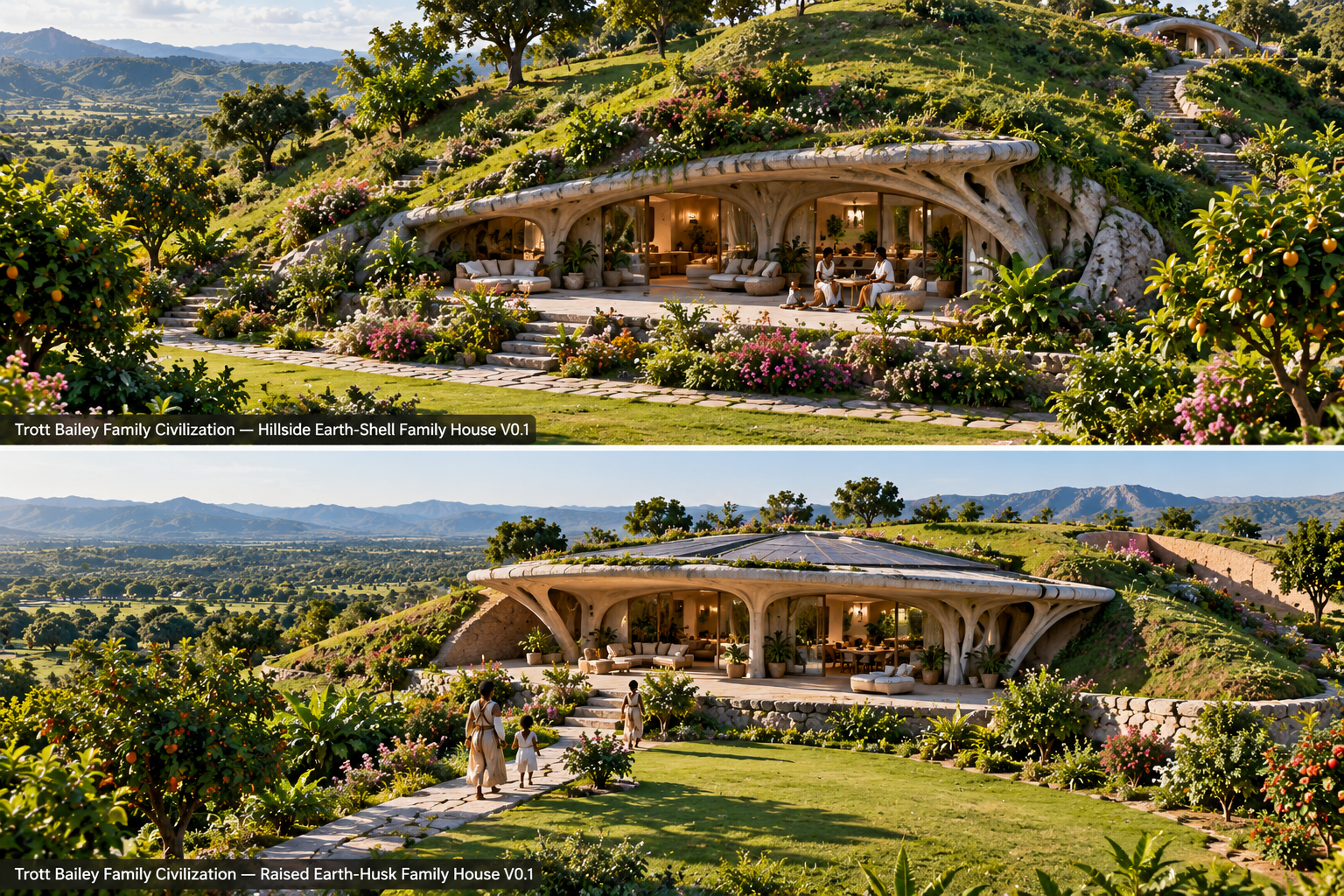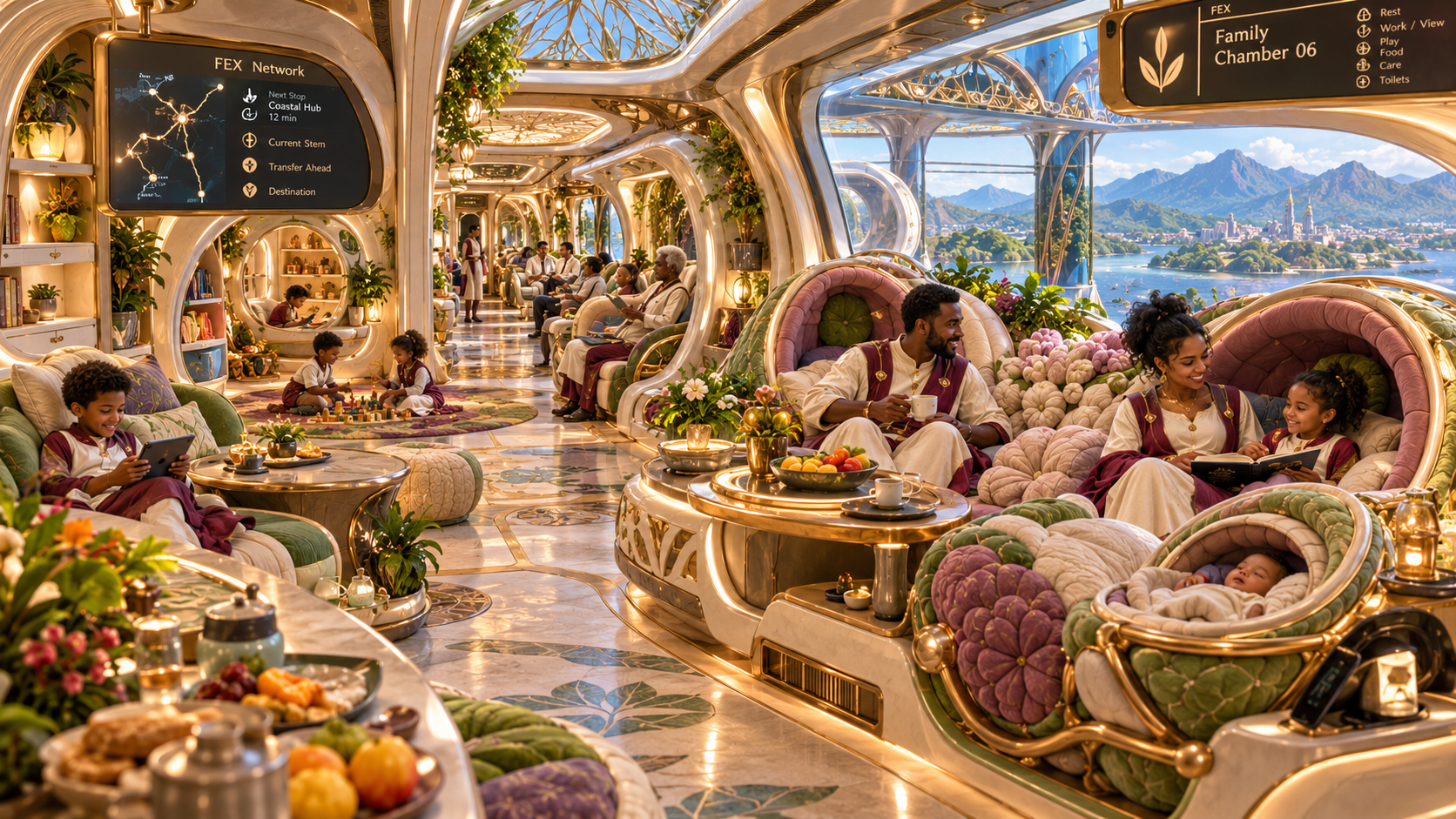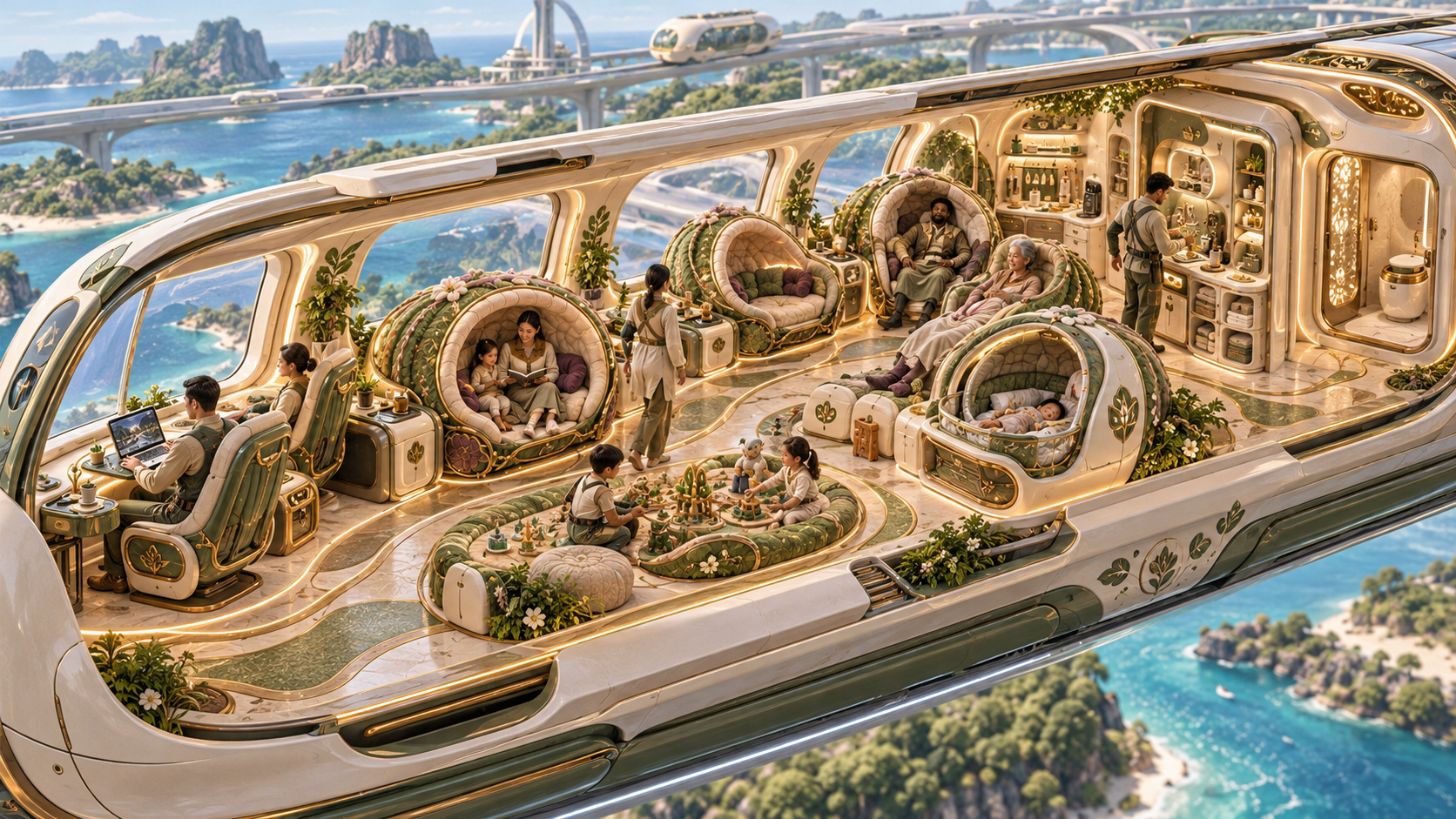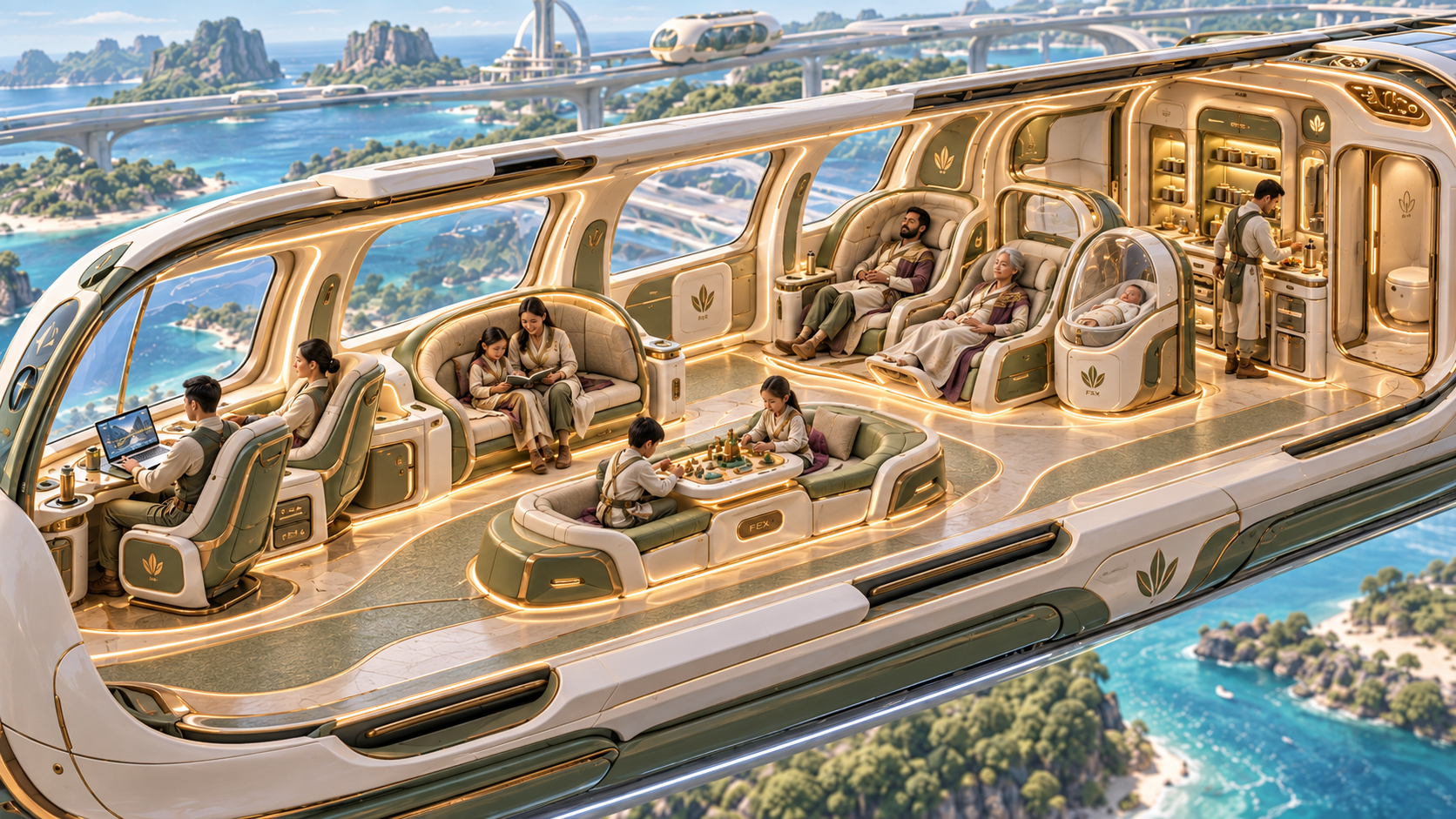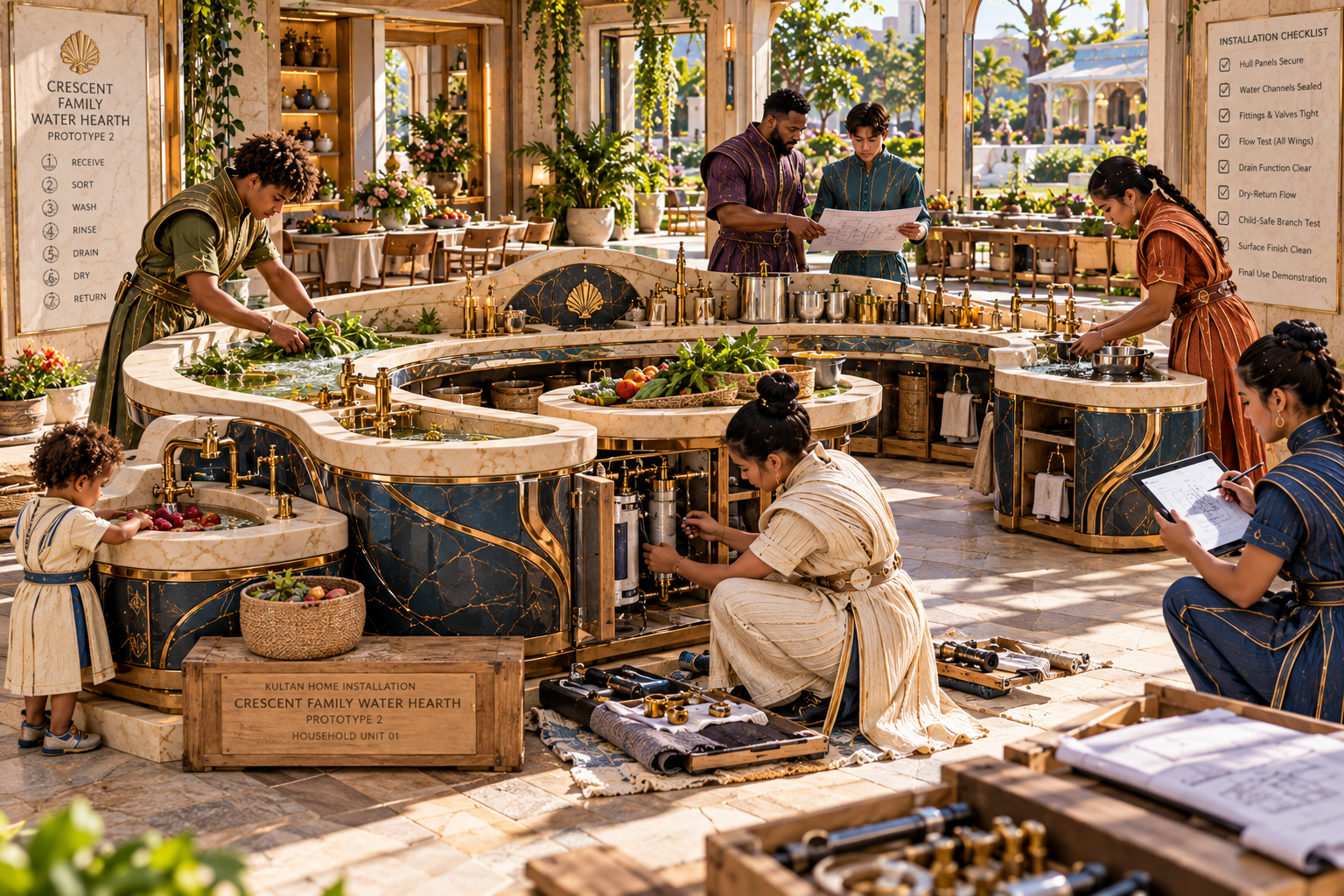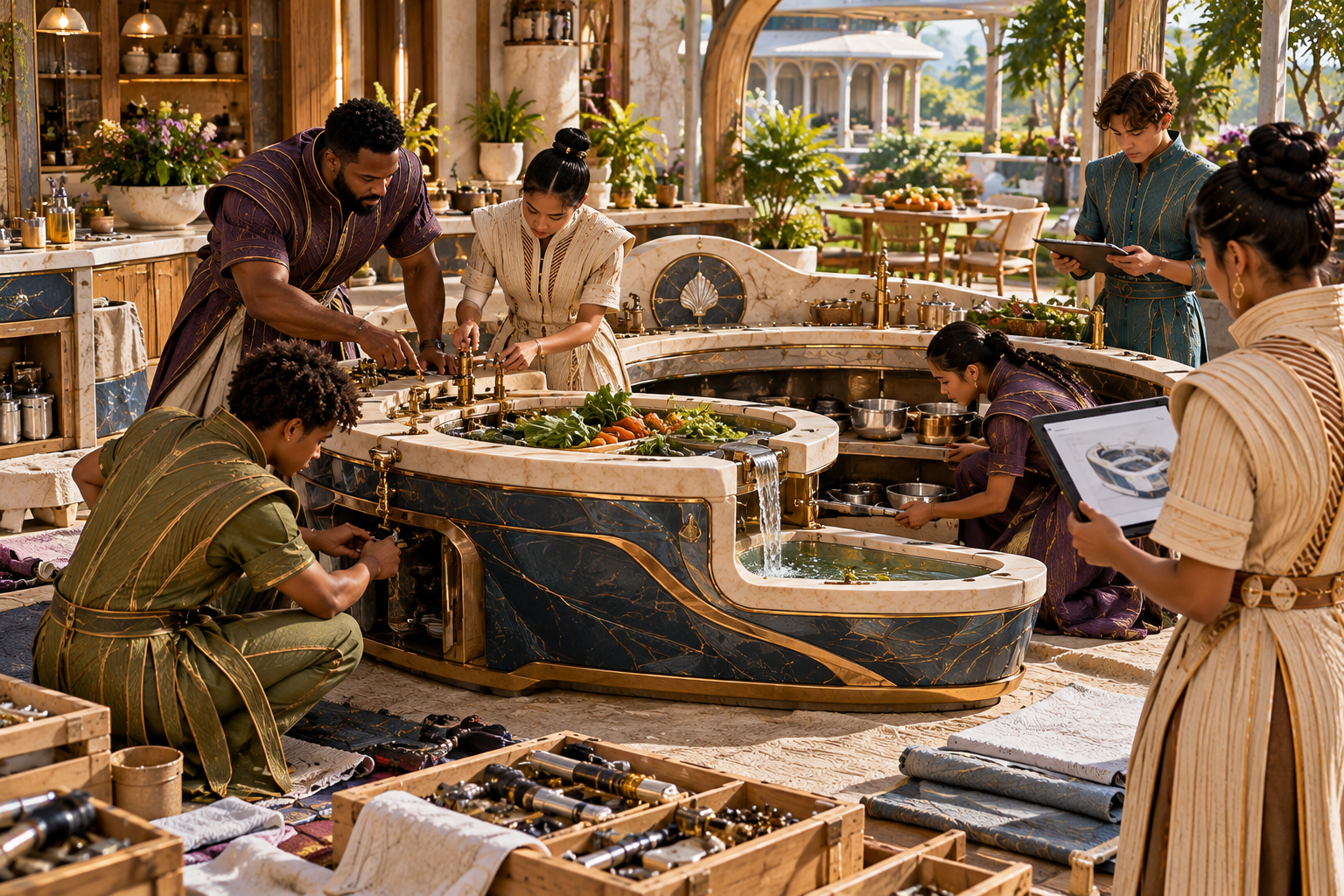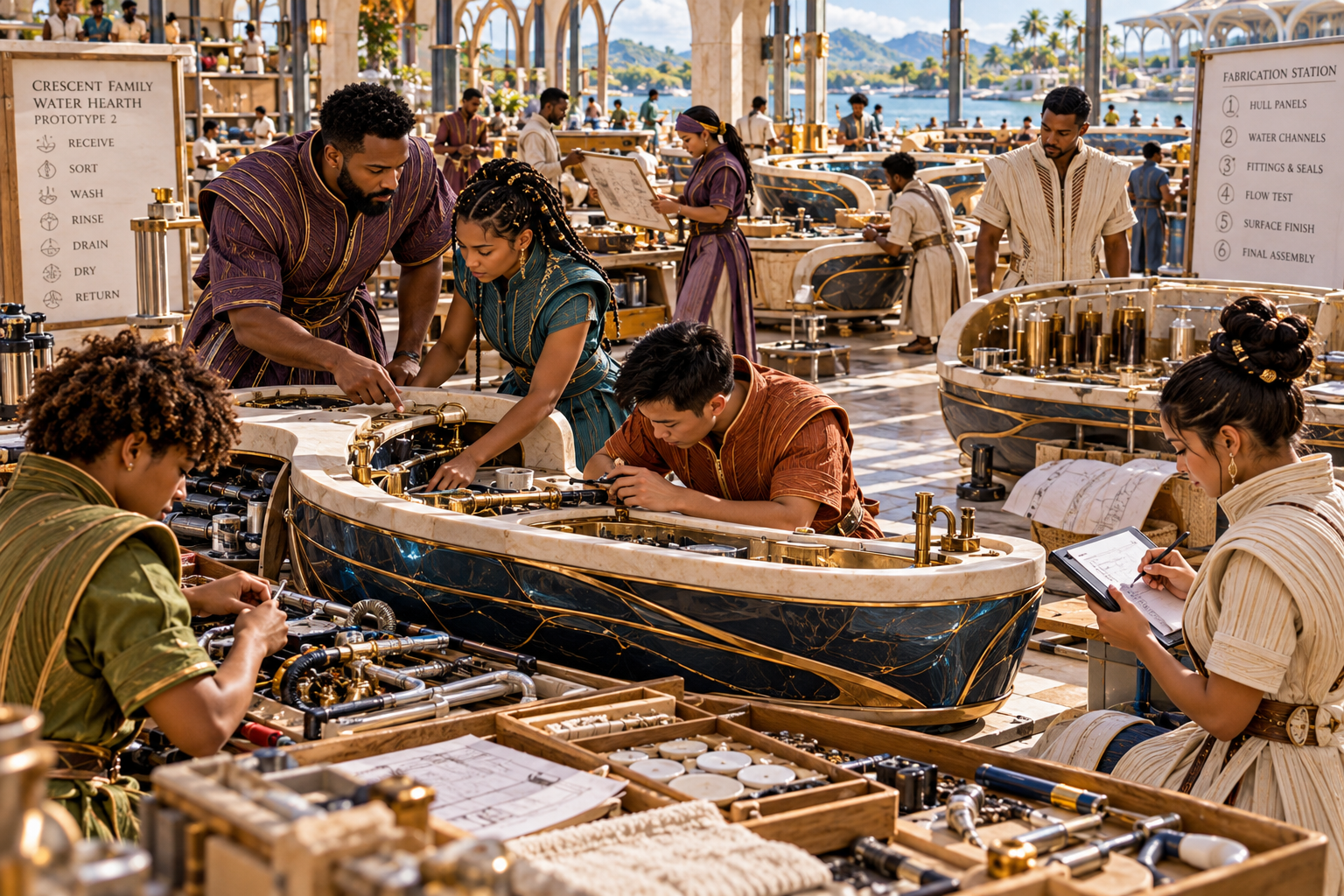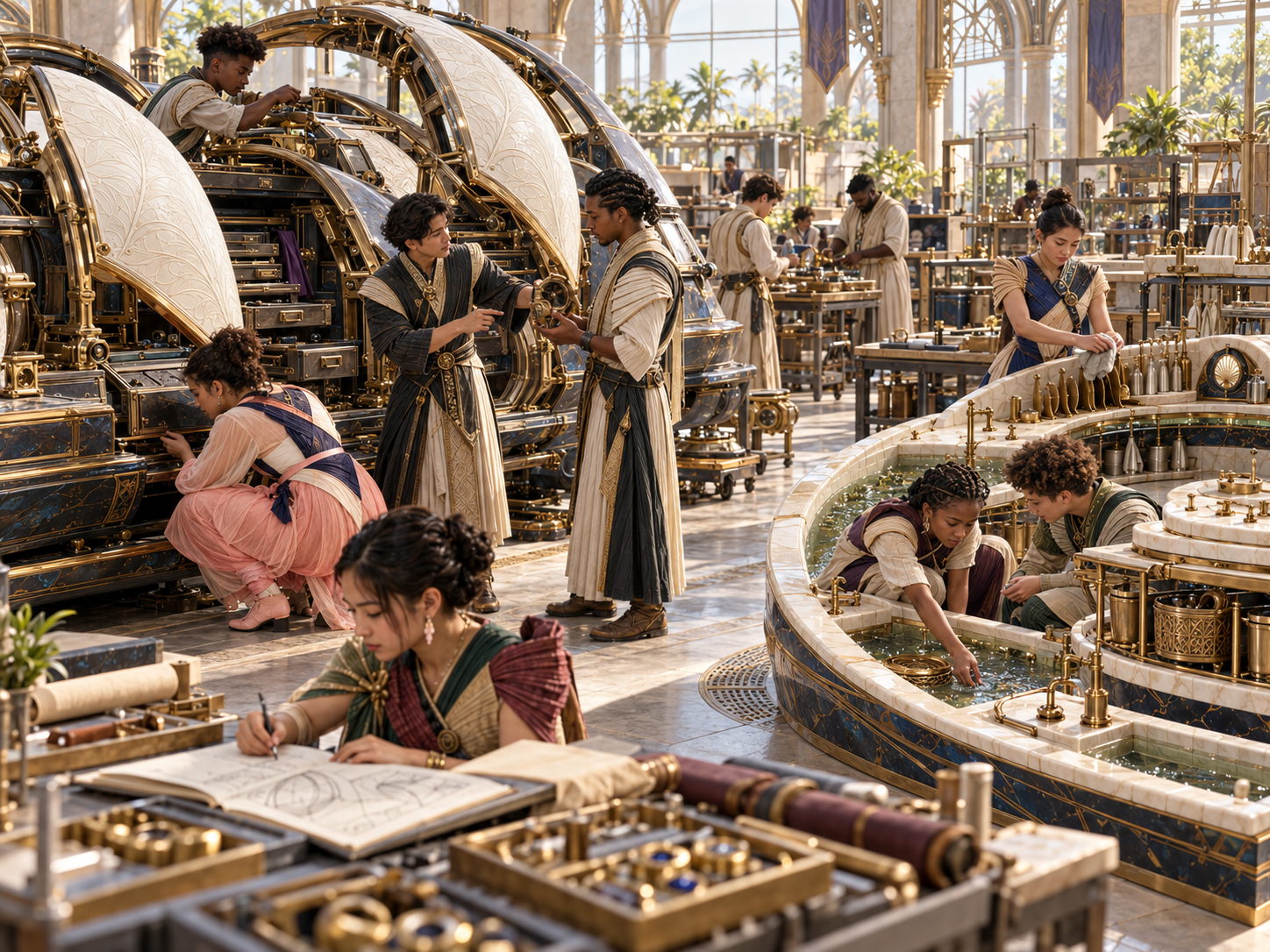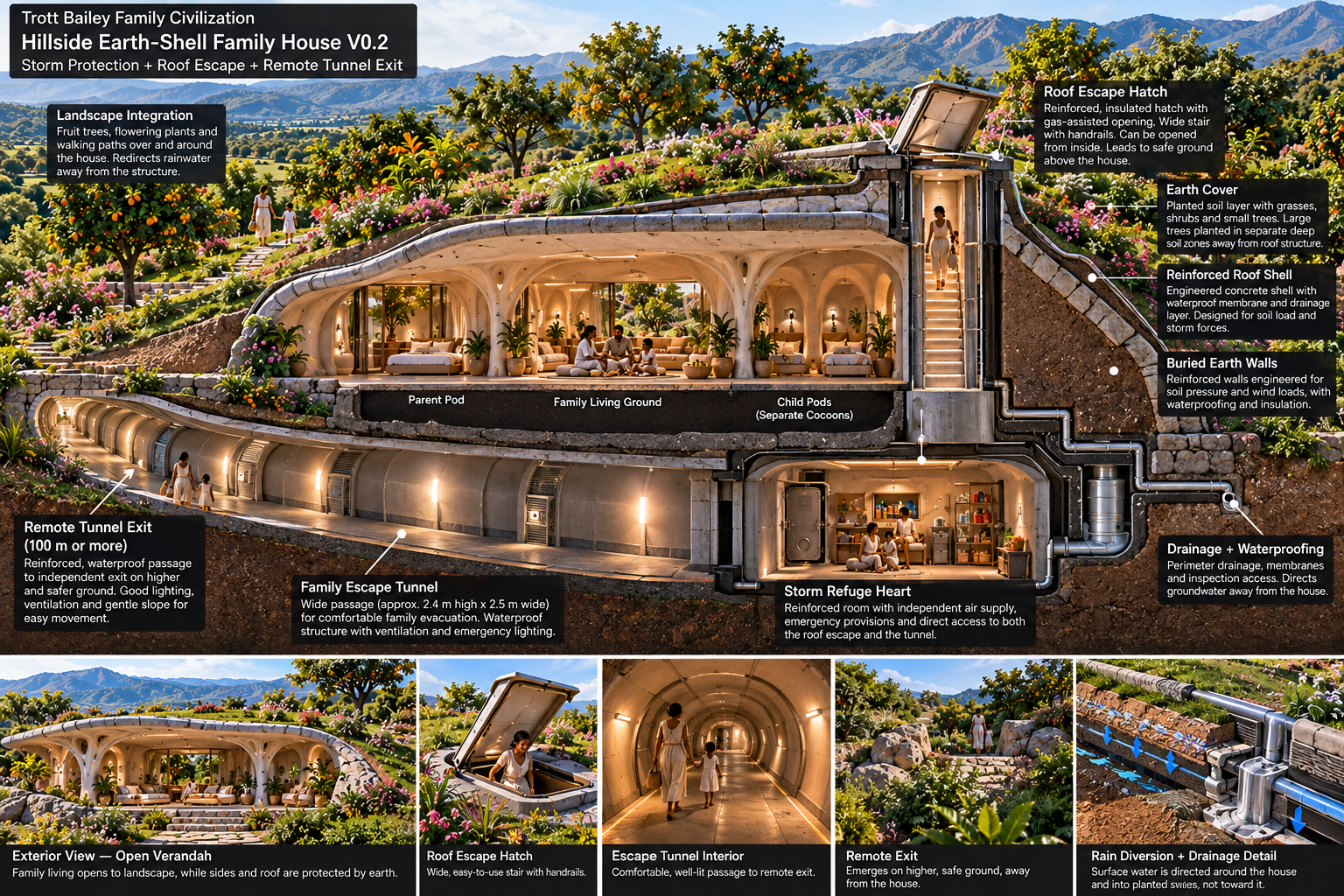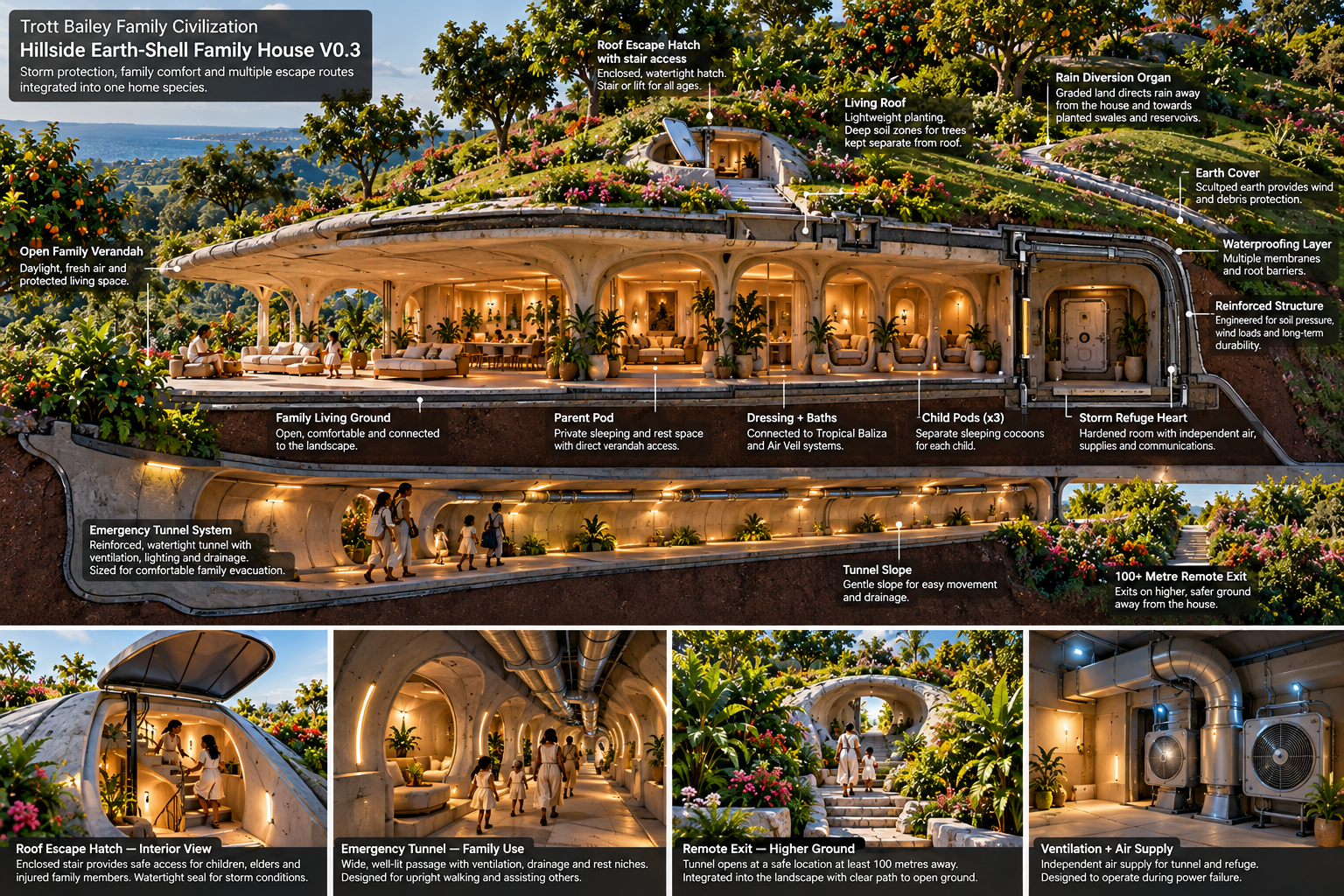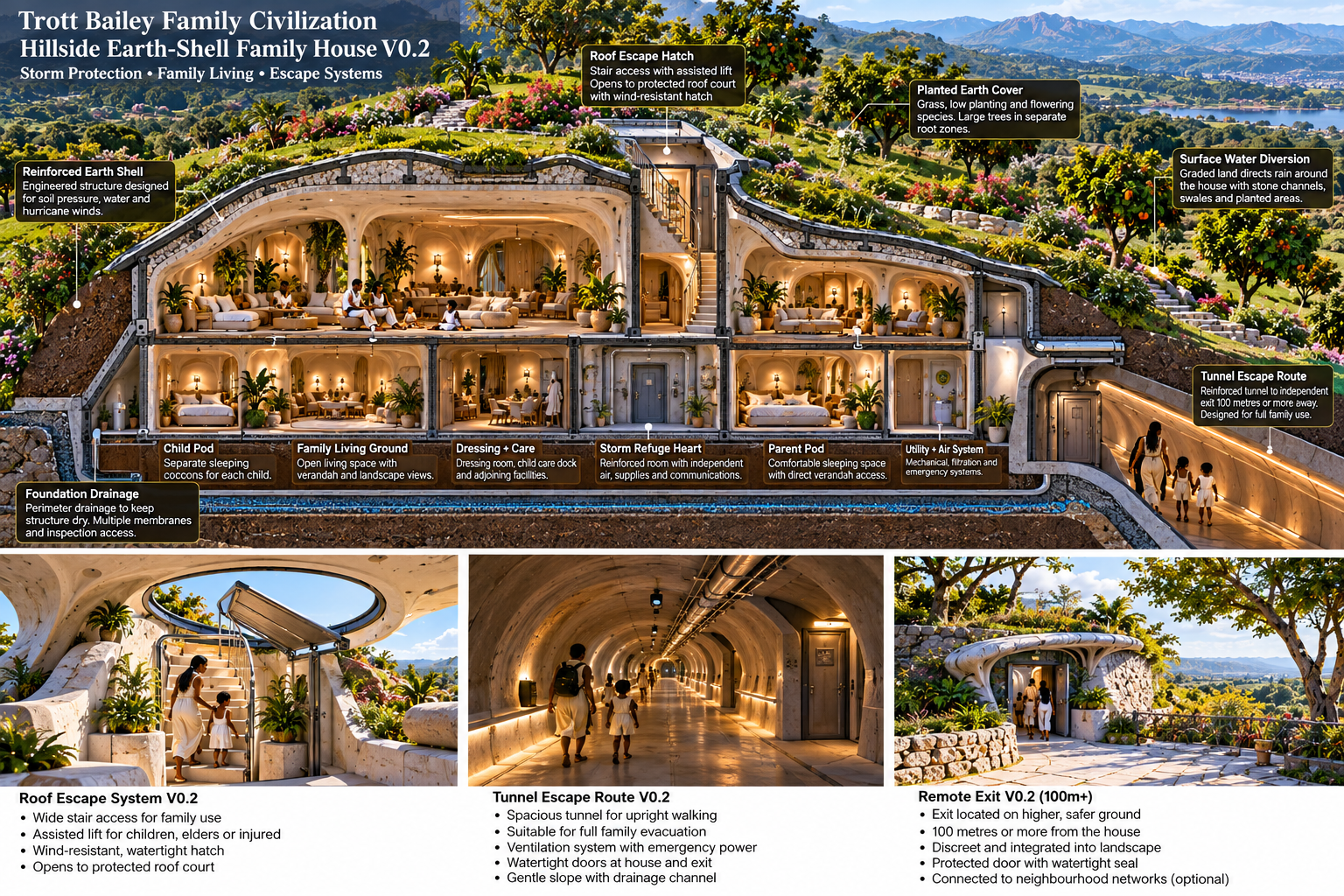


A Different Experience of Parenthood for Families in the Trott Bailey Family Civilization.

A Different Experience of Parenthood for the Family in the Trott Bailey Family Civilization Just by Getting Out of That Stupid Modern American Box Filled With Stupid Repetitive Chores and No Space
A systems argument about how the modern house accumulated, how it manufactures unnecessary work, and why Trott Bailey Family Civilization redesigns both the house and the support surrounding the family.
I don’t care how they did it in the past, but I know for sure if we follow this stupid modern way of living and running a house, it will drive you quietly miserable!
I mean the house itself.
That big enclosed box where almost every part of family life has been pushed under one roof.
You wake up and there is already work waiting.
Somebody spills something. Somebody brings dirt inside. Somebody leaves a wet towel somewhere. Somebody cannot find their shoes. Somebody puts something on a chair because there was never a proper place designed for it in the first place.
Then the adults spend the day resetting the house from the ordinary fact that a family lives there.
I reject that.
I do not want to spend the best years of parenthood maintaining the inside of a stupid box.
The House Manufactures Work
A huge amount of household work does not exist because families are unusually messy.
It exists because the house is badly organized for what families actually do.
Put wet bathing beside sleeping and water, towels, toiletries, dirty clothes and damp floors enter the sleeping world.
Store clothing in bedrooms and the bedroom becomes a sleeping room, dressing room, shoe room, grooming room, laundry holding area and storage room all at once.
Put cooking inside the main family building and steam, food preparation, smells, dirty dishes and cleaning spread into the center of family life.
Cover almost every meter of ground with finished flooring and every leaf, crumb, strand of hair and grain of sand becomes something requiring removal.
Put children’s ordinary activity inside precious finished interiors and childhood becomes something the house continually needs to recover from.
Then we tell parents to become better organized.
The architecture created half the problem.
That is why I am using the modern American-style house as the main target. Not because America is the only place living this way, but because this domestic ideal became extraordinarily visible and travelled far beyond the United States. Postwar American kitchens were actively promoted by builders, magazines and manufacturers at home, while American homes, consumer life and architecture were also circulated internationally through exhibitions, films and other cultural media. The 1959 American National Exhibition in Moscow even placed a model American home at the center of one of the Cold War’s most famous public confrontations. [1], [2]
The fitted kitchen, indoor bathrooms, bedrooms, finished interiors, living room, private outdoor space and increasingly larger versions of the same basic house became an especially powerful picture of modern family success.
Not every country copied America exactly. Strong local traditions survived in many places.
But the box travelled.
Is this actually the best arrangement for family life?
How We Ended Up Here
The answer becomes clearer when you look at how the modern house developed.
Nobody sat down 150 years ago and designed the whole thing from first principles.
Instead, different generations solved different problems.
In 1869, Catharine Beecher and Harriet Beecher Stowe published The American Woman’s Home. Smithsonian Libraries describes them as pioneers of scientific kitchen planning and notes that they anticipated the servantless household, teaching women how to manage the increasingly complex equipment and work of domestic life. [3]
Their problem was real.
More of the work of operating the household was falling directly on the woman living in it.
How can she operate it efficiently?
Then came enormous technological improvements.
These changed human life for the better. Electric appliances reduced some forms of physical labor, while refrigeration transformed the purchase, preparation and storage of food. [4]
Keep them.
But they also made the house capable of containing more functions.
Water came inside.
Bathing came inside.
Laundry became tied to plumbing and machinery.
Food preservation became tied to refrigeration.
More and more family activity could be concentrated beneath one roof.
Then people started applying industrial efficiency thinking to domestic work.
In the mid-1920s, Lillian Gilbreth turned the motion-study methods she had used in factory and office work toward housework and home management. She treated the kitchen as a workplace and rearranged it to reduce wasted movement. A documented efficiency test reduced the steps needed to prepare a strawberry shortcake from 281 to 45. Her objective was to reduce drudgery and recover what she called “happiness minutes” for leisure and creative activity. [5]
That was intelligent work.
How do we make the person performing the work more efficient?
A century later, I can ask the next question:
Gilbreth could reduce the steps between refrigerator, counter and stove.
I can respect that achievement while asking whether cooking needs to occupy the same environmental body as sleeping and resting.
A plumber could bring bathing indoors without proving that wet bathing should permanently live beside the bedroom.
An appliance manufacturer could make vacuuming easier without asking why we created so much flooring that requires vacuuming.
Each actor could improve a part without redesigning the whole.
Then America faced another problem.
After World War II, the United States entered 1945 with a housing shortage estimated at approximately five million homes. Automobile ownership was rising, suburban populations were expanding, and home construction accelerated enormously. FHA- and VA-supported mortgage terms and government housing policy helped enable the postwar building boom. [6]
William Levitt did not invent the modern house.
He helped industrialize its reproduction.
Levitt and Sons simplified designs, used standardized components and divided construction into specialized repeated tasks. The National Park Service records that a team of 36 builders could start and finish a Levittown house in a day; its more detailed history describes a 27-step construction process and a production system capable of completing houses at extraordinary speed. [6], [7]
How do we build huge numbers of acceptable private houses quickly?
That is not the same question as:
Repetition does not prove optimality.
The early Levittown Cape Cod demonstrates the connection especially clearly. The 1947 house contained about 750 square feet divided among a living room, kitchen, two bedrooms and a bathroom on a roughly 6,000-square-foot lot. The National Park Service identifies it as a somewhat enlarged development of the earlier FHA “minimum house” tradition. [7]
Then builders, magazines, appliance manufacturers, television and advertising strengthened the result.
The modern kitchen became a symbol of progress. Smithsonian historians document builders moving kitchens forward and integrating them increasingly with dining and living areas, magazines presenting kitchens as status symbols, and manufacturers promoting them as showcases of modern progress. [8]
The outside changed too.
Postwar tract development helped shift social activity away from front porches and stoops and toward the private backyard. Magazines and television helped idealize that backyard as part of suburban success. [9]
The house became larger.
But the basic response remained the same.
If clothes overwhelm the bedroom, add a larger closet.
If cooking overwhelms the kitchen, build a larger kitchen.
If children need somewhere else, add a playroom.
If possessions overwhelm the house, add storage.
The Modern House Was Never Designed as One Whole
Beecher and Stowe improved household management.
Plumbing solved sanitation.
Appliances removed specific forms of labor.
Gilbreth reduced wasted movement.
FHA standards and FHA/VA-supported finance helped shape and expand the postwar housing system.
Levitt helped make houses producible at enormous scale.
Each actor improved a piece.
Nobody had to ask whether the resulting whole produced the best experience of motherhood, fatherhood, marriage or childhood.
Nobody had to ask whether wet and dry activities belonged together.
Nobody had to ask whether clothing should live where people sleep.
Nobody had to ask how much finished flooring a family should maintain.
Nobody had to ask how much of a parent’s lifetime should disappear into resetting the environment.
At almost every stage, somebody was solving a real problem.
Nobody was required to stop and redesign the whole system.
We are.
And that changes the meaning of my opening completely.
They were solving their problems.
I am solving mine.
Trott Bailey Family Civilization Asks Different Questions
Sher’s New Style of Living is not anti-modern.
It is more modern.
We keep running water, excellent sanitation, electricity, refrigeration, washing machines, advanced materials, communication systems, good water storage and routing, and every machine that genuinely removes labor.
What we discard is the assumption that all those advances must remain arranged according to an inherited domestic geometry.
Trott Bailey Family Civilization is willing to modernize the arrangement itself.
That starts by changing the questions.
Different questions produce different architecture.
Redesign the House
If sleeping becomes difficult to maintain because bathing, clothing, grooming, shoes and laundry have accumulated inside it, remove those functions.
Let sleeping be sleeping.
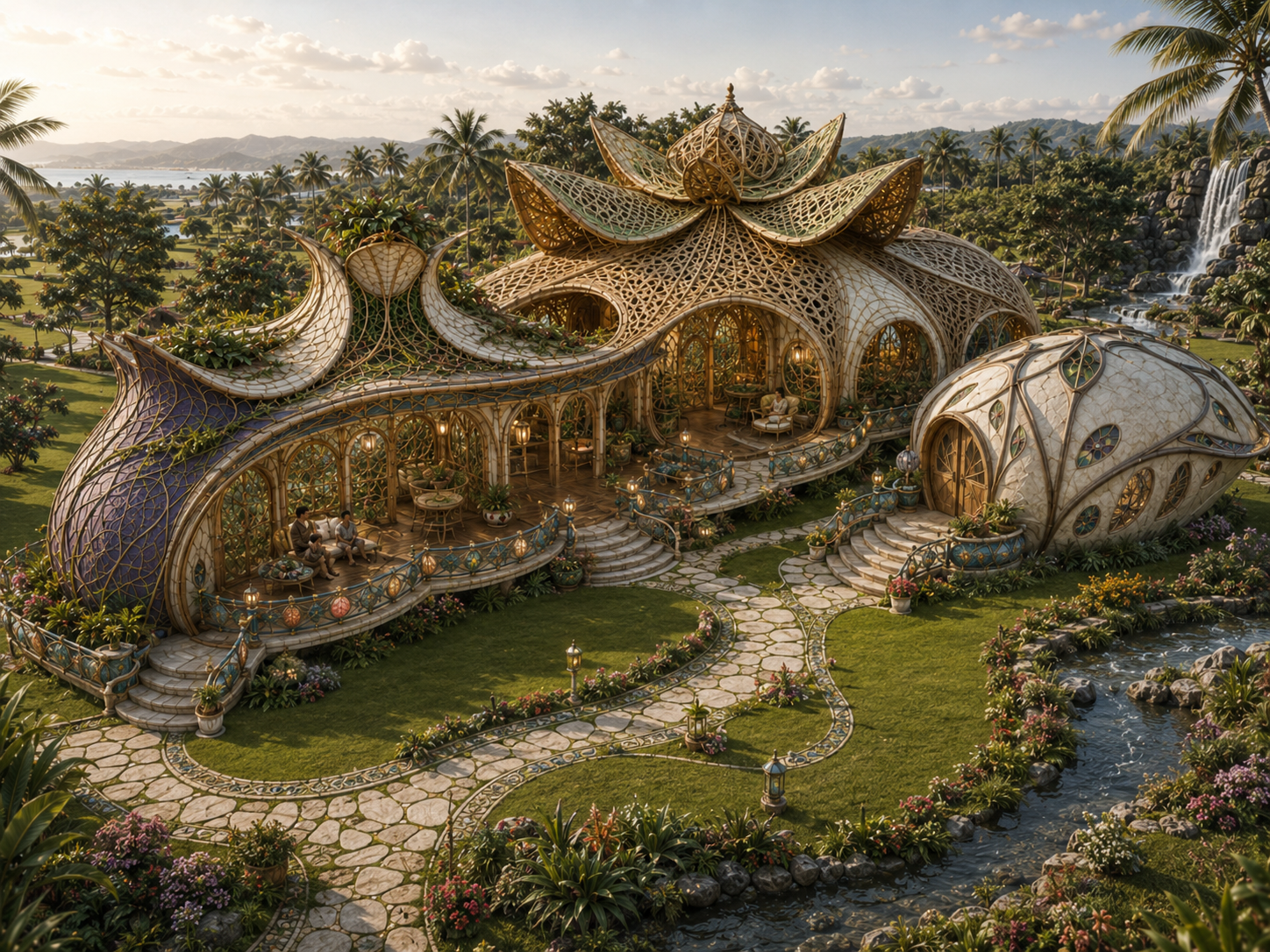
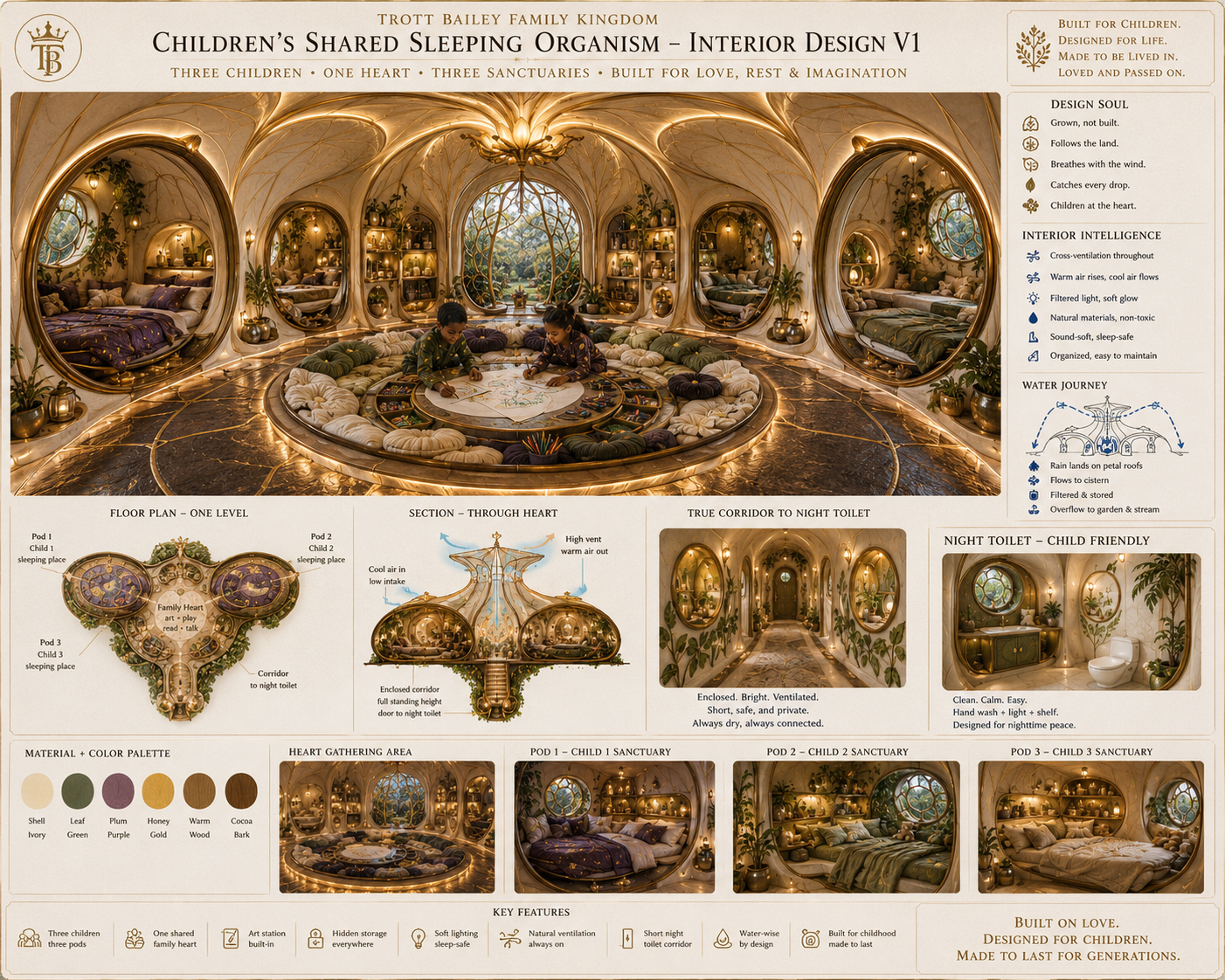
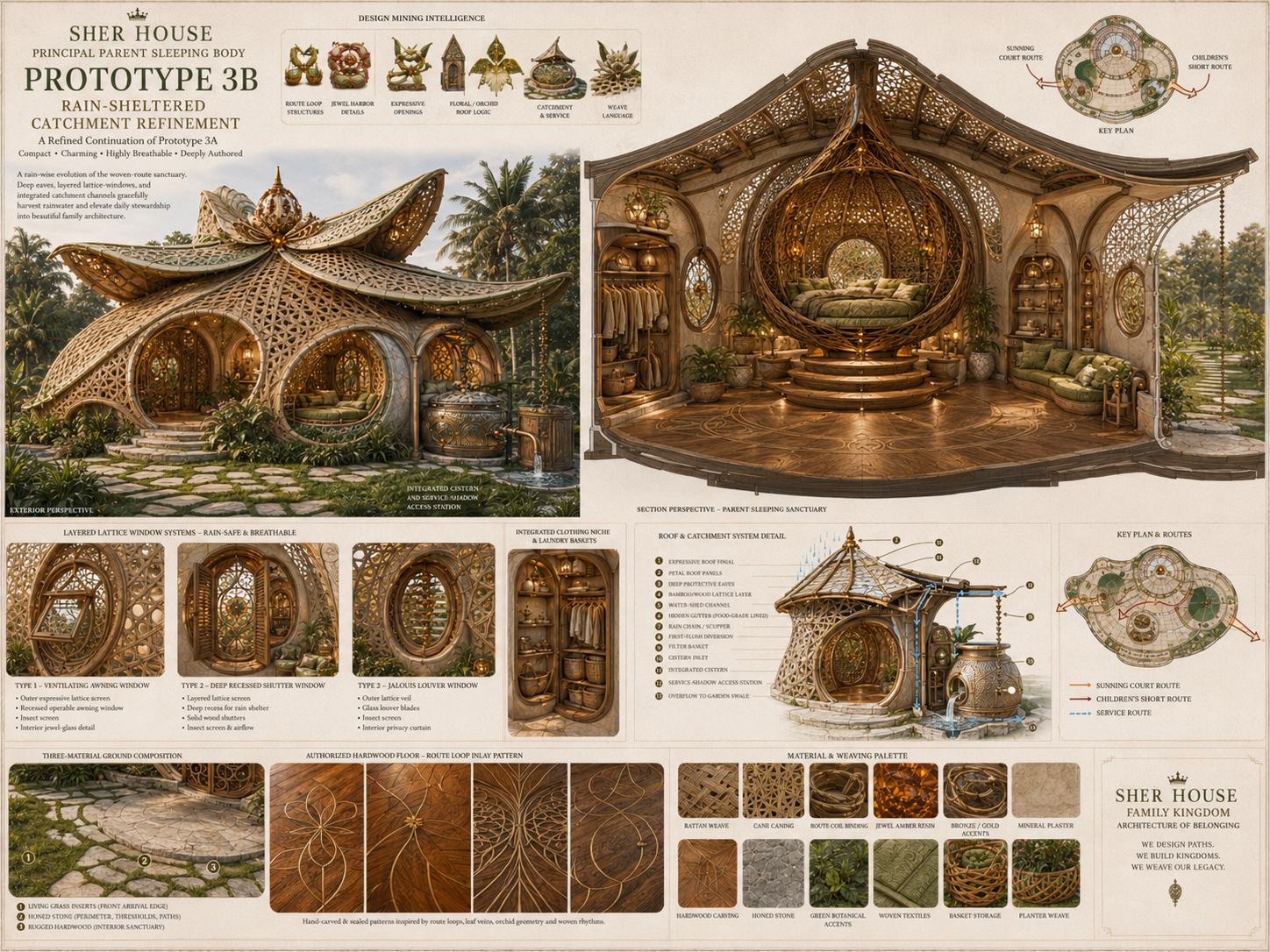
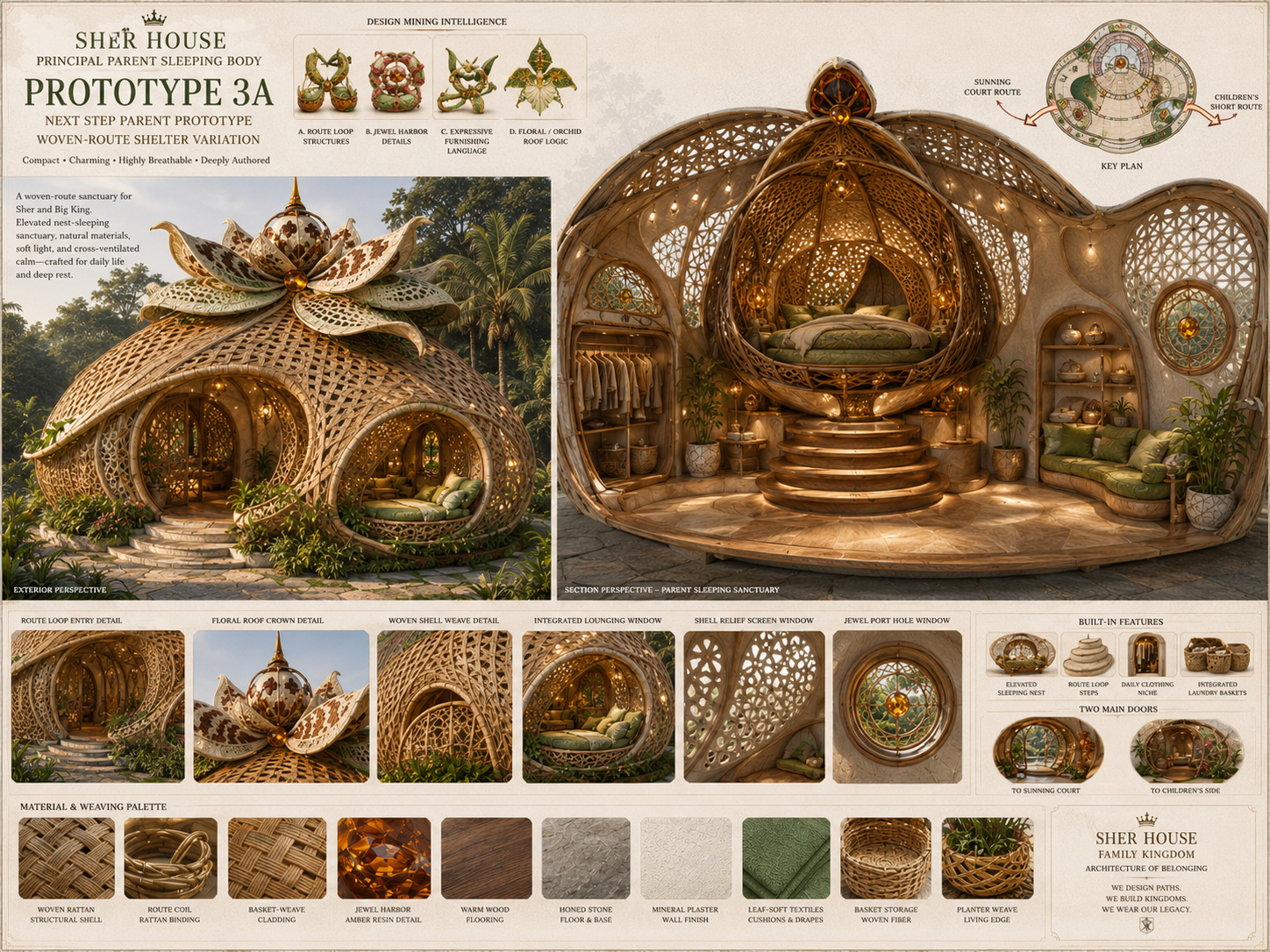
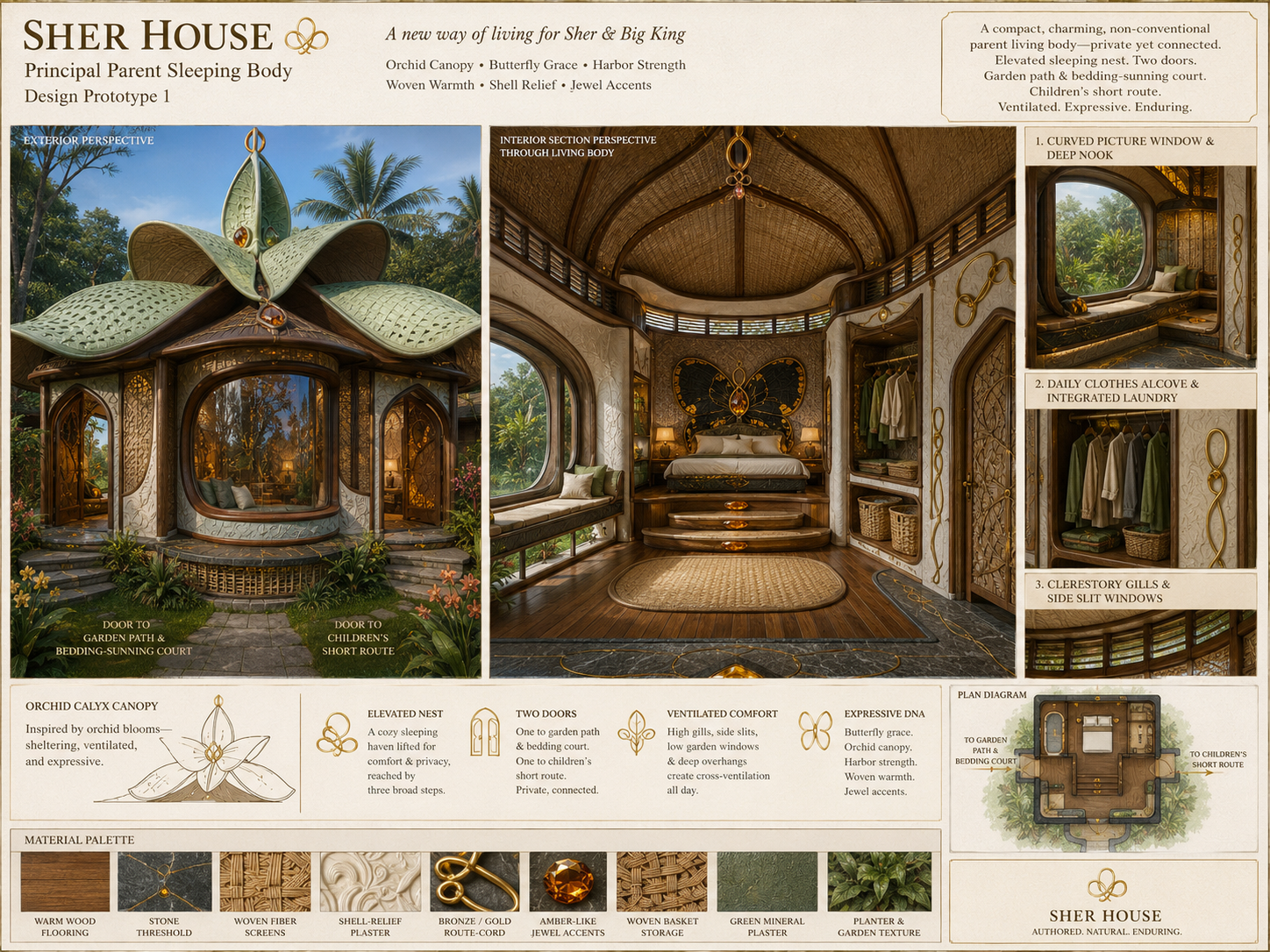
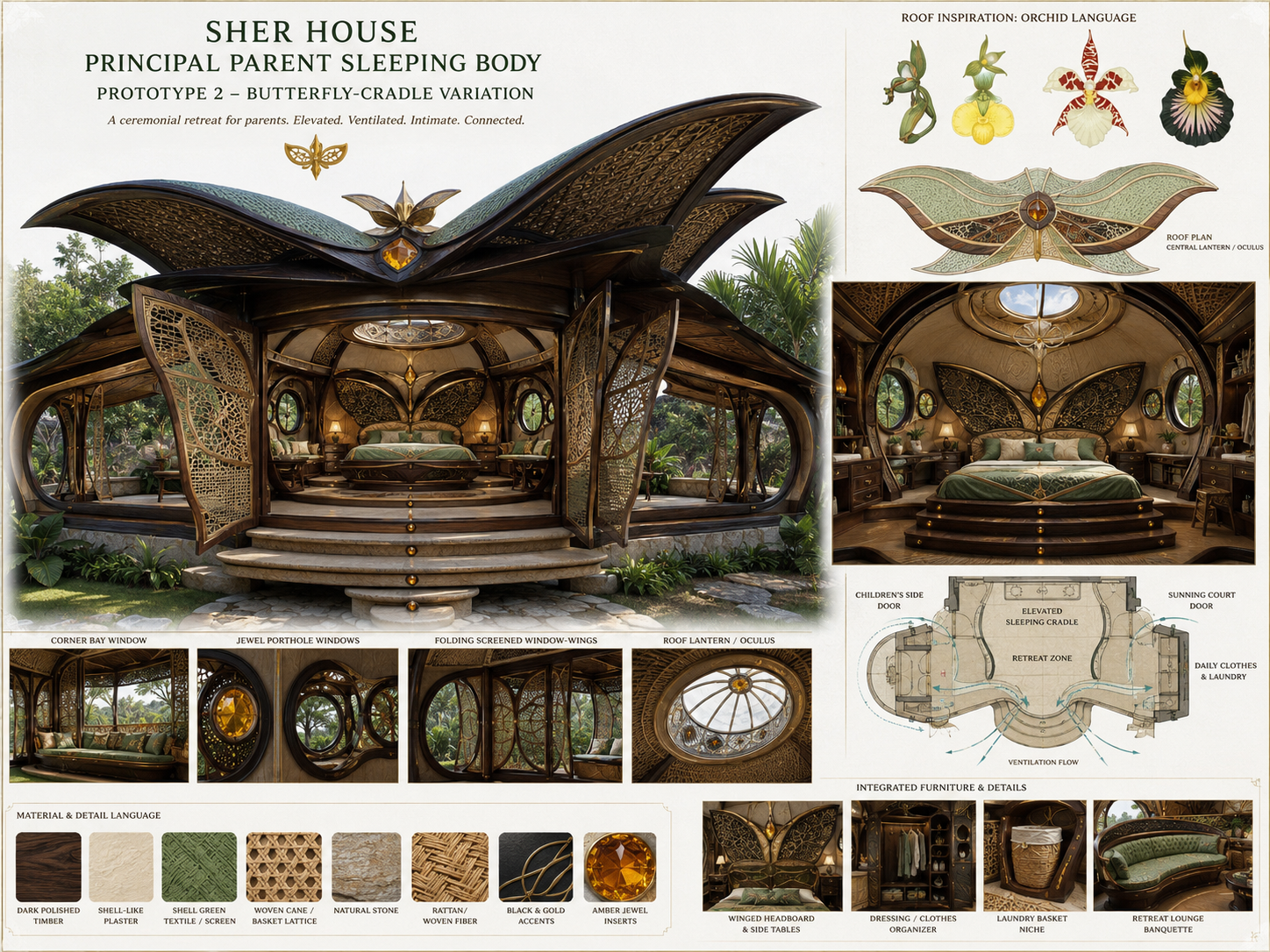
The parents have a quiet sleeping body. The children have nearby sleeping pods. A small night toilet can be close where it is genuinely useful.
But clothing goes somewhere else.
The Dressing Room Body holds clothes, shoes, grooming, laundry baskets and the weekly clothing system.
You go there to dress.
You finish.
You leave.
The bedroom does not spend the rest of the day recovering from everybody getting ready.
The same principle applies to water.
Indoor plumbing was a brilliant achievement.
That does not mean a wet bathing chamber must forever sit beside the bed.
Our Baliza can be designed around water: drainage, stone, sand, privacy, sunlight, plants and moving air.
Wet feet land where wet feet belong.
Children can splash where splashing was expected by the architecture.
That is not rejecting plumbing.
It is using plumbing better.
Cooking gets its own world too.
Our Flambeki does not need to be squeezed into the same environmental body as sleeping and family rest.
Fruit can arrive dirty.
Vegetables can be washed.
Steam can rise.
Big pots can exist.
Children can participate.
Preserving can happen.
Food can spread out.
Cooking gets enough room to actually be cooking without forcing the rest of the house to recover afterward.
Then look at the ground.
Some can be grass.
Some planted.
Some stone.
Some sand.
Some wood.
If a leaf falls on grass, nobody needs to sweep it.
If a child crosses a planted court with dirty feet, the family does not need to launch a cleaning operation.
There is a difference between something unhygienic and evidence that human beings live on Earth.
Good architecture should know the difference.
This distinction is especially important because labor-saving technology did not automatically eliminate domestic labor. Smithsonian historians note that electric appliances could coincide with rising expectations for cleaner houses and more elaborate household production, leaving housewives with more expected of them even as individual tools became easier to use. [10]
It must also ask why everything needs vacuuming.
Children also need territory built around the fact that they are children.
They get wet.
They collect stones.
They drag sticks around.
They build something and leave it unfinished.
They watch frogs.
They chase grasshoppers.
They make noise.
They change direction halfway through whatever they were doing.
The environment should absorb that.
Children should not spend childhood behaving like careful visitors inside an adult showroom.
And mothers should not spend motherhood continually resetting the evidence that their children exist.
Separation does not mean less family closeness either.
A family can sit in one room all day while five activities collide.
That is proximity.
It is not automatically togetherness.
In our system, we meet at the Family Heart.
We walk to breakfast.
We sit on verandahs.
We cross planted courts.
The children come looking for us.
We move between places.
The day gains departures and arrivals.
It gains rhythm.
The parents also get places where marriage can exist without waiting until every other demand is finished.
Wake up together.
Wash.
Step onto a private verandah.
Talk.
Look at the morning.
Then enter the larger family day.
Architecture cannot create love.
It can stop unnecessarily competing with it.
Reduce the Burden Twice
This is where Trott Bailey Family Civilization goes beyond house design.
We are not redesigning the house so one woman can become an ultra-efficient domestic operator.
We do not want her cleaning faster, organizing faster, cooking faster and then beginning the same cycle again tomorrow.
Historically, domestic reform repeatedly treated housework as a problem of female efficiency. Beecher and Stowe’s domestic instruction and Gilbreth’s later scientific-management work emerged in very different periods, but both illustrate how seriously reformers tried to improve the woman’s operation of the home.
Modern discussions sometimes improve on that by asking husbands and wives to divide the work more fairly.
Fairer division is better than dumping it on one person.
But it still leaves another question untouched:
Trott Bailey Family Civilization reduces the burden twice.
Separate functions properly. Use forgiving ground. Stop creating unnecessary wet-and-dry collisions. Give things proper places. Let the environment absorb ordinary family life.
If the family does not feel like cooking, there is Sabennerie.
A mother does not need to drag herself into the Flambeki because everybody has decided that dinner must automatically become her personal problem.
The father does not need to inherit that compulsory burden either.
The family can cook when they want to cook.
They can cook together.
They can experiment.
They can prepare special food.
And on the day nobody wants to cook, civilization still nourishes them.
The same principle applies to serious household cleaning.
Trott Bailey Family Civilization can provide professional household cleaning services at civilization level.
Deep cleaning, difficult sanitation, major resets and periodic work can be handled by trained people with proper equipment and systems.
The family still cares for its immediate environment.
Children reset the things they use.
Parents manage their personal things.
Everybody learns responsibility.
But responsibility does not require us to pretend every repetitive physical burden must remain inside the family.
That is the deeper distinction.
Trott Bailey Family Civilization first asks whether the work should belong to the individual household at all.
Eliminate what architecture can eliminate.
Mechanize what machines can remove.
Carry at civilization level what is better handled there.
Let the family carry what genuinely belongs to family life.
That is a different operating system.
A Different Experience of Parenthood
This is what I actually want.
I want to experience my children.
I want to hear the bizarre things they think about.
I want to watch what they invent.
I want to cook with them because we feel like cooking.
I want mornings with my husband.
I want to wander outside.
I want to watch the children disappear down one path and appear somewhere else.
I want them getting wet, finding insects, collecting things, making things and living without every ordinary action becoming another domestic recovery operation.
Remove unnecessary work and the time comes back.
Parenthood should contain more parenting.
Marriage should contain more marriage.
Childhood should contain more childhood.
Family life should contain more actual life.
The objective was never a better-managed box.
Make the house and the civilization more intelligent at serving the family.
They were solving their problems.
I am solving mine.
I am not trying to become extraordinarily efficient at maintaining the inherited box.
I am designing a different experience of parenthood.
The family should spend less of its life maintaining where it lives and more of its life living.
References
- National Museum of American History, Smithsonian Institution, “Modern Kitchens,” FOOD: Transforming the American Table. Smithsonian — Modern Kitchens .
- P. Minosh and H. Palmer, “Built in USA: Post-War Architecture—Midcentury Architecture as a Vehicle for American Foreign Policy,” Histories of Postwar Architecture, vol. 2, no. 4, pp. 163–183, 2019. Article and DOI information . See also Library of Congress, “Culture—The Work of Charles and Ray Eames: A Legacy of Invention.” Library of Congress exhibition .
- Smithsonian Libraries and Archives, “The American Woman’s Home,” Catharine E. Beecher and Harriet Beecher Stowe, 1869. Smithsonian Libraries record .
- National Museum of American History, Smithsonian Institution, “Lighting A Revolution: 19th Century Consequences,” and “Not Just a Cool Convenience: How Electric Refrigeration Shaped the ‘Cold Chain.’” Smithsonian — domestic electrification . Smithsonian — electric refrigeration .
- National Museum of American History, Smithsonian Institution, “Dr. Gilbreth’s Kitchen” and “Every Minute Counts!” Smithsonian — Gilbreth’s Kitchen . Smithsonian — Every Minute Counts .
- National Park Service, “The American Home Front After World War II: The End of the War and Its Legacies.” National Park Service .
- D. L. Ames and L. F. McClelland, Historic Residential Suburbs: Guidelines for Evaluation and Documentation for the National Register of Historic Places. Washington, DC: U.S. Department of the Interior, National Park Service, 2002, pp. 60–66. National Park Service bulletin .
- National Museum of American History, Smithsonian Institution, “Modern Kitchens.” Smithsonian — Modern Kitchens .
- Smithsonian Institution, “The Invention of the American Backyard,” May 22, 2018. Smithsonian — American Backyard .
- National Museum of American History, Smithsonian Institution, “Abundance,” American Enterprise. Smithsonian — Abundance .