

The Fruit-Pod Pantry: Why Food Storage Should Be Beautiful, Visible, and Child-Learnable

The Fruit-Pod Pantry: Why Food Storage Should Be Beautiful, Visible, and Child-Learnable
A Fruit-Pod Pantry is not a luxury pantry with fruit decoration. It is a household food organization room where storage, child learning, family use, and clean return are built into the architecture.

The Problem: Ordinary Pantries Hide Food and Increase Household Burden
Most pantries are treated as storage closets. Food is pushed onto shelves, stacked behind other containers, forgotten in corners, and rediscovered only when it has spoiled or duplicated. A family may own enough food and still feel disorganized because the storage system does not help anyone understand what is available.
This creates real problems:
- Parents have to remember what is stored, what is running low, and what should be eaten first.
- Children cannot safely help because the storage is too high, too heavy, or too unclear.
- Fruit and fresh foods spoil because they are hidden or poorly sorted.
- Empty jars, baskets, cloths, packages, and containers pile up because return points are not designed.
- The pantry becomes a mental burden instead of a support system.
What the Fruit-Pod Pantry Does
The Fruit-Pod Pantry solves this problem by treating food storage as a visible, organized, child-learnable room. It does not rely on plain shelves and random bins. It uses built-in zones, fruit-body furniture, honey-lit shelves, child-height drawers, seed chambers, return walls, and practical work surfaces.
The purpose is not to make the pantry look cute. The purpose is to make the pantry work better.
Key Terms Defined Clearly
The Main Systems Inside the Fruit-Pod Pantry
The Fruit-Pod Pantry is organized around zones. Each zone has a job. The room is successful when a new family member, child, steward, or guest can understand the basic order without being given a long explanation.
The Breadfruit Storage Bench Must Be Understood Correctly
The Breadfruit Storage Bench is one of the most important Keslev furnishings because it shows the difference between fruit-themed decoration and true object-body furniture.
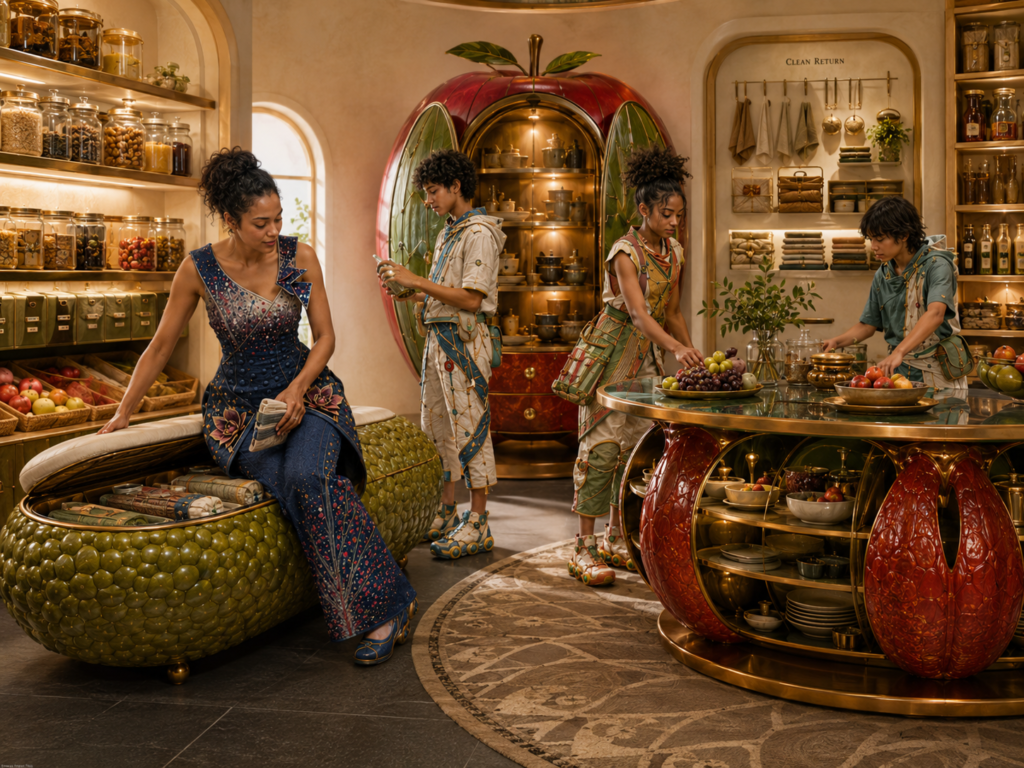
It is called a Breadfruit Storage Bench because its body, texture, and storage logic are inspired by breadfruit. It should have a pebbled breadfruit-like exterior, a rounded body, a cushioned seating top, and storage chambers. It is not a bench whose main purpose is to hold actual breadfruit.
The Breadfruit Storage Bench can hold:
- folded cloths and table linens,
- serving trays and bowls,
- reusable containers,
- baskets and pantry tools,
- wrapped pantry bundles,
- child food-learning tools,
- dry goods or household food-support items.
This matters because the furniture should be useful across rooms. It can belong in the pantry, dining room, verandah, kitchen waiting corner, family room, or orchard-view corridor.
How the Fruit-Pod Pantry Works in Real Life
Here is a practical example of a mother and three children using the Fruit-Pod Pantry after food has arrived from a Keslev Sabennerie.
- Food arrives at the receiving point. A Keslev Sabennerie delivery brings prepared food bundles, jars, fresh fruit, or pantry items. Some packages may be wrapped in banana leaves.
- The mother checks the food. She reviews jars, prepared items, or freshness markers. If Pacorips support is present, it can help show what should be eaten first or returned.
- One child sorts fresh fruit. Fruit goes into visible pod drawers, not hidden piles. The child can see apple, citrus, breadfruit, or other categories clearly.
- One child works at the seed chamber. Seeds, packets, or small learning items are organized in a controlled child-safe area. The child learns that food has origin, category, and future use.
- One child uses the return wall. Empty jars, baskets, dry cloths, or small return items go into the correct Krubaro slots: jar return, basket reset, dry return, or organic return.
- The Breadfruit Storage Bench supports the room. It provides a place to sit, sort, open storage, and keep cloths, trays, containers, or pantry tools close to the work.
- The room resets itself. At the end, food is visible, used materials are returned, damp items are drying, and children understand where things belong.
Why Visibility Matters
Visible storage is not only about appearance. It changes household behavior. When food is visible, the family can use it before it spoils. When jars are visible, the household knows what it has. When children can see approved food categories, they learn order through use.
Concrete example: apples hidden versus apples visible
In an ordinary pantry, apples may be placed in a dark lower shelf behind other items. Nobody sees them until they soften. In a Fruit-Pod Pantry, apples can sit in a visible orchard-green drawer or pod chamber. A child can place new apples into the drawer, a parent can see when the drawer is full, and older apples can be moved to a “use first” basket for cooking, tasting, or Sabennerie preparation.
Why the Pantry Should Be Child-Learnable
A child-learnable pantry does not mean children control the whole room. It means the room includes safe, limited, meaningful ways for children to participate.
Children can learn:
- fresh fruit belongs in visible storage,
- jars return to the jar wall,
- baskets are reset for reuse,
- cloths dry before they are stored,
- seeds can be saved or sorted,
- organic matter has a clean return path,
- food is not only eaten; it is received, protected, prepared, shared, and returned.
Why Krubaro Belongs in the Pantry
Krubaro belongs in the pantry because food storage always creates return. Even when a pantry is clean and beautiful, it still has empty jars, baskets, cloths, packages, peels, seeds, and items that must go somewhere after use.
A Krubaro Return Wall prevents those materials from becoming clutter.
This is not trash handling. It is clean-return intelligence. It keeps the pantry useful after the family has actually used it.
What the Fruit-Pod Pantry Must Avoid
The Fruit-Pod Pantry fails if it becomes a generic pantry with fruit handles added later. It also fails if it becomes fantasy furniture that cannot support real family food behavior.
Avoid this
- Flat shelves with fruit decoration pasted on.
- Generic luxury pantry styling.
- Grocery-store display energy.
- Dark shelves where food disappears.
- Plastic bins and random labels as the main system.
- A Breadfruit Storage Bench filled mainly with literal breadfruit.
- Fruit-shaped props that do not store, sort, reveal, or return anything.
- Storage so high or heavy that children cannot safely participate.
Design this instead
- Fruit-pod storage bodies with real chambers.
- Honey-lit shelves that make food visible.
- Child-height drawers and sorting wells.
- A Breadfruit Storage Bench used for household pantry-support storage.
- Krubaro return hatches and container-return walls.
- Rounded, cleanable, family-safe surfaces.
- Clear movement between pantry, kitchen, dining, verandah, and courtyard.
Why This Helps the Family
The Fruit-Pod Pantry helps because it removes confusion from food storage. It gives parents better visibility, gives children safe participation, gives Sabennerie stewards clear delivery and return points, and gives the household a cleaner reset process after food is used.
Why This Is Practical, Moral, and Necessary
The Fruit-Pod Pantry is practical because food storage affects daily life. Poor storage wastes food, increases stress, and makes cooking harder. A clear pantry helps the family know what it has and what it needs.
It is moral because it respects the labor of feeding a family. Storage, sorting, cleaning, returning, drying, and teaching are real parts of nourishment. They should not be hidden as invisible work for one person to manage alone.
It is necessary because a family-first civilization cannot treat abundance as a pile of objects waiting to become mess. If food matters, the room that stores food must be designed seriously.
Practical Summary
A Fruit-Pod Pantry is a Keslev food-storage room where storage becomes visible, beautiful, useful, and child-learnable. It uses fruit-body furniture, honey-lit shelves, child-height drawers, Krubaro return points, and clear food categories to help a household understand and manage its own abundance.
The key correction is important: fruit furnishings are not literal fruit bins. The Breadfruit Storage Bench is breadfruit-shaped storage furniture for cloths, baskets, trays, jars, containers, and pantry-support items. The fruit form gives the furniture identity and function; it does not limit the furniture to holding that exact fruit.
The main point is simple: food storage should not hide food from the family. It should help parents plan, help children learn, help stewards deliver, and help used materials return cleanly.
How the Krubaro Food-Return Loop Changes the Keslev Kitchen Layout
The Fruit-Pod Pantry is not separate from the kitchen. It is part of a longer Keslev food system where food enters, is prepared, is eaten, and then returns cleanly toward reuse, compost, water care, storage, and orchard renewal.
Why the Krubaro Loop Matters
A normal kitchen often follows a short layout logic: food is stored, washed, cooked, served, eaten, and then the leftovers are thrown away or hidden in a bin.
That is not enough for a Keslev interior. Keslev is the food-sovereignty district of the Trott Bailey Family Kingdom. Its interiors must show a fuller food cycle: food is received, sorted, stored, washed, prepared, served, eaten, returned, dried, filtered, composted, and connected back to the orchard.
The Full Krubaro Food-Return Loop
This loop explains why a Keslev food room is shaped differently from a generic kitchen. It is not only a cooking room. It is a room that receives food, helps the family use it, and gives everything left after use a clear next step.
- Food enters. Food may come from the orchard, edible courtyard, pantry storage, family harvest, or Keslev Sabennerie delivery. A Sabennerie is a kingdom food-support center that prepares, organizes, or delivers food to households.
- Food is sorted. The household separates immediate-use food, storage food, child snacks, serving items, seed-saving items, and returnable delivery materials.
- Food is stored visibly. Fruit-pod storage, jar shelves, seed chambers, basket bays, and pantry bodies keep food understandable instead of hidden.
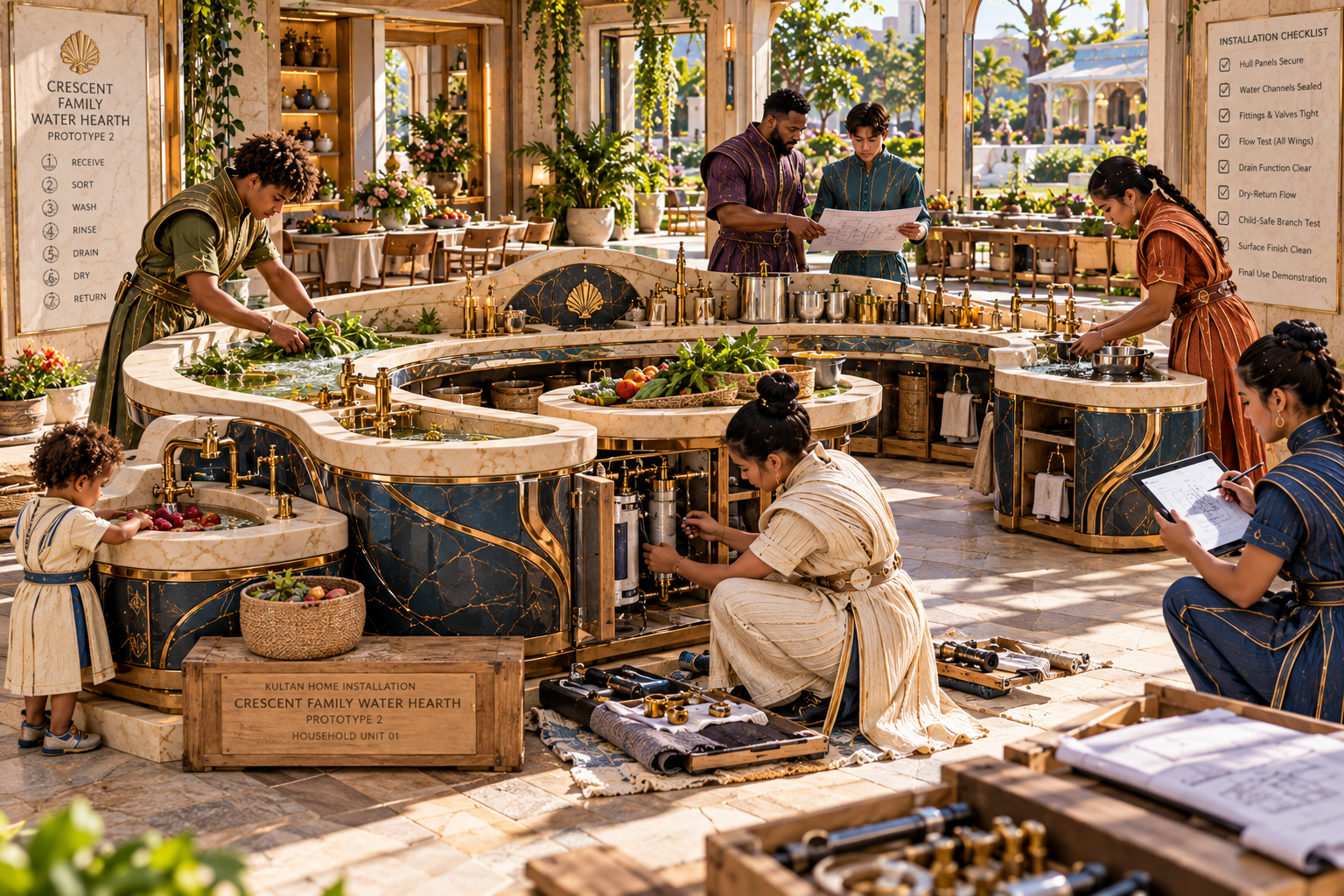
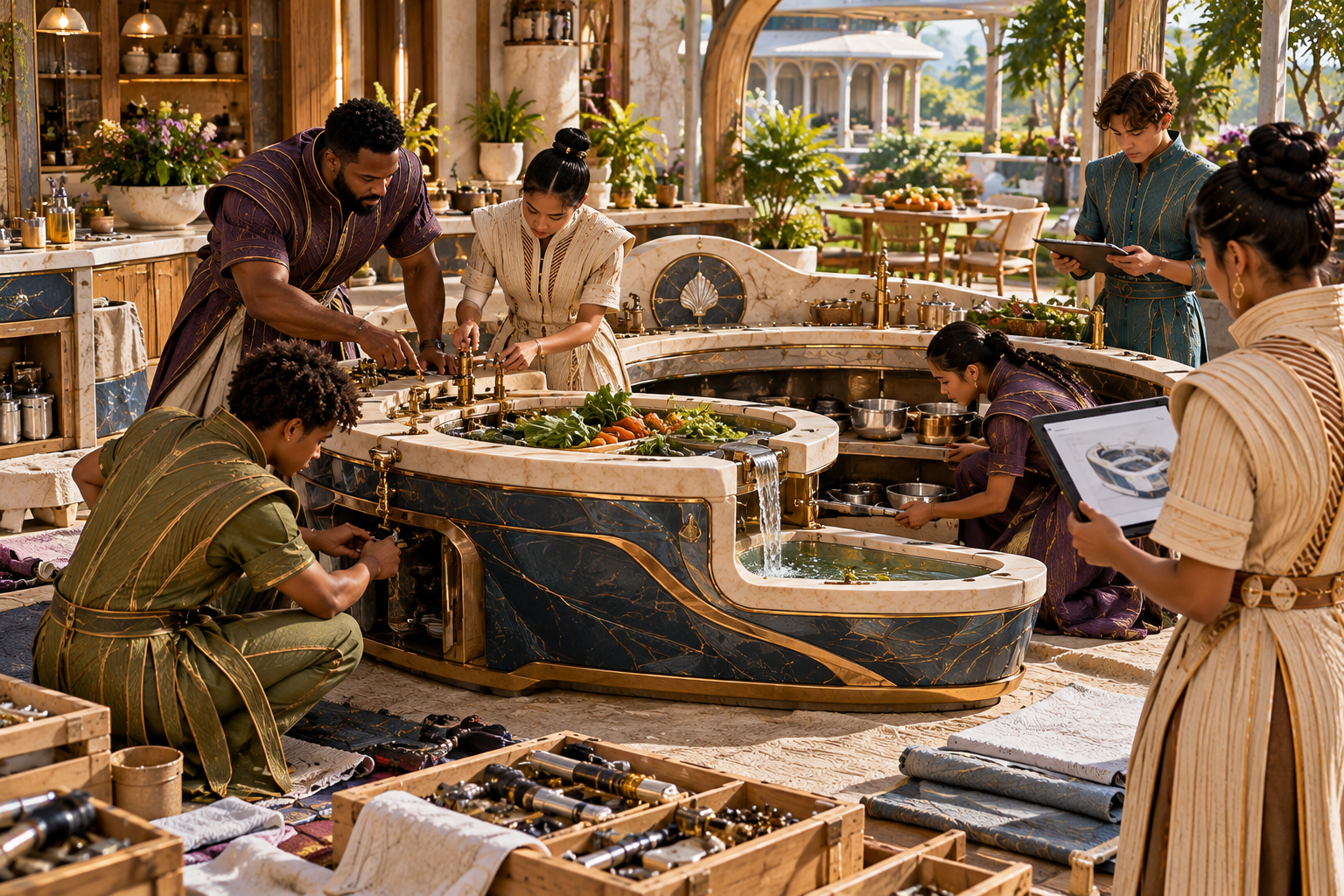
- Food is washed and prepared. A deep trough sink, washable preparation surfaces, and child-safe helping ledges support real family food work.
- Food is cooked or served. The hearth-stove acts as the cooking heart, while serving ledges and tasting tables let the family gather and participate.
- The family eats. Eating is connected to learning, tasting, conversation, and understanding where food comes from.
- Scraps are sorted. Peels, seeds, banana leaves, spoiled fruit, and other materials are separated instead of being thrown into one mixed bin.
- Water filters or routes. Rinse water from fruit, vegetables, jars, trays, and tools moves through filtering, greywater routing, or safe drainage where appropriate.
- Containers return. Jars, baskets, trays, cloths, and reusable packages return to visible wall systems, drying slots, or Sabennerie return niches.
- Compost renews soil. Approved organic matter moves toward compost or soil support, helping the orchard or edible courtyard produce food again.
- The orchard feeds the family again. The renewed soil supports the food-growing system, and the food-growing system sends nourishment back to the household.
Why This Makes the Keslev Kitchen Layout Different
The Krubaro loop does not simply add a return wall to an ordinary kitchen. It changes the entire layout. A Keslev kitchen cannot rely only on a central island and hidden cabinets because the family does not only need space to cook. The family needs a room that supports the full life of food.
A generic kitchen may prioritize a cooking triangle, cabinet storage, a sink, and a central island. A Keslev kitchen needs a longer chain of zones.
A Real-Life Example: One Food Delivery, One Complete Room Sequence
Imagine a mother and her three children receiving banana-leaf-wrapped food packages from Keslev Sabennerie stewards. The delivery does not enter a random kitchen. It enters a room designed for the full sequence.
- The packages arrive at the receiving ledge. The stewards place the food where the family can open, sort, and check it without blocking the sink or stove.
- The mother checks the meal and storage items. Prepared food goes toward serving. Fresh fruit goes to fruit-pod storage. Jars go to honey-lit shelves. Child snacks go to lower drawers.
- The children help within safe zones. One child places fruit in visible drawers. One child works near the Seed Chamber. One child brings jars or baskets to the Return Wall.
- The family eats. Food moves from pantry and kitchen to the tasting ledge, dining table, or orchard-facing meal area.
- The return process begins immediately after use. Banana leaves go to Organic Return if approved. Empty jars go to Jar Return. Baskets go to Basket Reset. Damp cloths go to Dry Return.
- Water and organic matter continue through Krubaro. Rinse water routes through filtering or safe drainage. Approved scraps move toward compost or soil support.
- The room resets without dumping the burden on one parent. The pantry remains understandable, the kitchen is not buried in piles, and the children learn the food cycle through use.
Why Krubaro Belongs in the Pantry, Not Just Outside the House
Some parts of waste handling and compost processing may happen outside the home or in specialized Krubaro facilities. But the first step of clean return begins inside the room where the material is created.
The pantry is where many return items appear: jars, baskets, cloths, delivery trays, banana-leaf wrappers, spoiled fruit, seeds, and packaging. If the pantry has no return logic, those items become clutter before they ever reach a larger system.
This is not trash handling. It is clean-return intelligence. It keeps the pantry useful after the family has actually used it.
What the Fruit-Pod Pantry and Keslev Kitchen Must Avoid
The Fruit-Pod Pantry fails if it becomes a generic pantry with fruit handles added later. The Keslev kitchen fails if it becomes a generic luxury island kitchen with a return wall pasted on.
Avoid this
- Flat shelves with fruit decoration pasted on.
- Generic luxury pantry styling.
- A kitchen organized only around a central island.
- Hidden trash bins as the main return strategy.
- Dark shelves where food disappears.
- Plastic bins and random labels as the main system.
- A Breadfruit Storage Bench filled mainly with literal breadfruit.
- Fruit-shaped props that do not store, sort, reveal, or return anything.
Design this instead
- Fruit-pod storage bodies with real chambers.
- Honey-lit shelves that make food visible.
- Child-height drawers and sorting wells.
- A Breadfruit Storage Bench used for household pantry-support storage.
- Receiving ledges and sorting surfaces.
- Deep wash zones and dry-return racks.
- Krubaro return hatches and container-return walls.
- Clear movement between pantry, kitchen, dining, verandah, and courtyard.
Why This Helps the Family
The Fruit-Pod Pantry and Krubaro-aware Keslev kitchen help because they remove confusion from food life. They give parents better visibility, give children safe participation, give Sabennerie stewards clear delivery and return points, and give the household a cleaner reset process after food is used.
Why This Is Practical, Moral, and Necessary
This system is practical because food storage, food preparation, eating, cleanup, and return all happen every day. If the room does not support these actions, someone in the family carries the burden manually.
It is moral because it respects the labor of feeding a family. Storage, sorting, cleaning, returning, drying, composting, and teaching are real parts of nourishment. They should not be hidden as invisible work for one person to manage alone.
It is necessary because a family-first civilization cannot treat abundance as a pile of objects waiting to become mess. If food matters, the rooms that receive, store, prepare, eat, and return food must be designed seriously.
Part 2 Practical Summary
The Krubaro food-return loop changes the Keslev kitchen layout because the room must support the full life of food: receiving, sorting, visible storage, washing, preparation, serving, eating, return, drying, filtering, composting, and orchard renewal.
This is why a Keslev food interior cannot be a normal kitchen with a pretty pantry attached. It needs receiving ledges, sorting surfaces, visible food storage, child-height access, deep wash zones, a cooking heart, tasting areas, Krubaro return walls, dry-return systems, water routing, and a real connection to orchard or courtyard life.
The main point is simple: food storage should not hide food from the family, and food use should not end in hidden mess. A Keslev Fruit-Pod Pantry and kitchen should help parents plan, help children learn, help stewards deliver, and help used materials return cleanly.