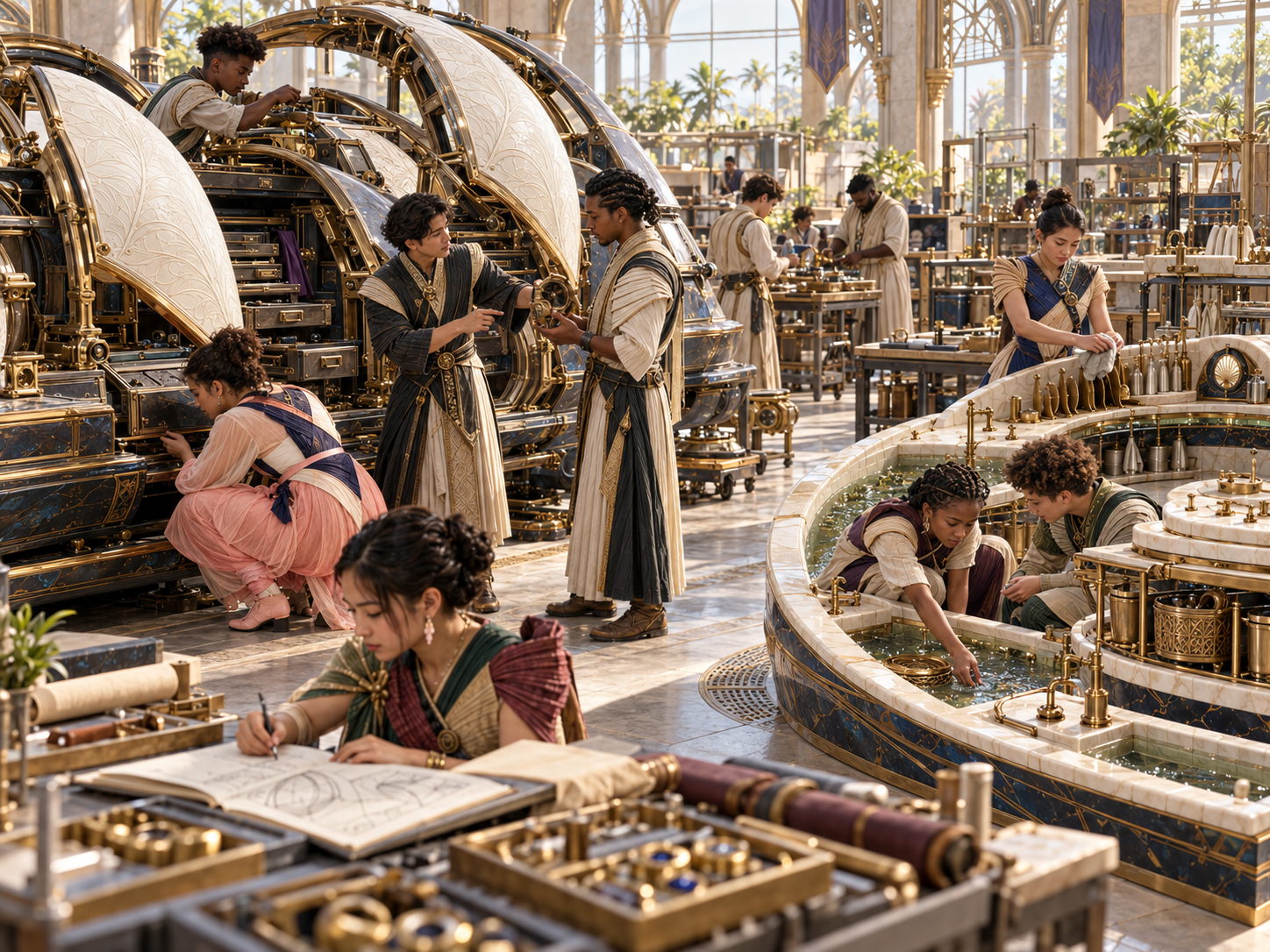


Turn Abundance Into a Game

Turn Abundance Into a Game
How Wokumbakia and AgriGames Can Turn Food News Into Competition, Discovery and Civilization Capability
Suppose Wokumbakia reports that thousands of watermelons are approaching peak ripeness across several Foodways.
That is useful news.
People now know the food exists.
They know where it is.
They know when it will be ready.
But why should civilization stop at knowing?
Can we eat, share, preserve and route almost all of it before unnecessary spoilage?
Who can create the most delicious new watermelon preparation?
Which community can return the greatest amount of strong planting seed?
Which family can invent the easiest recipe that other families can reproduce?
Can children learn how to tell when a watermelon is truly ripe?
Can another district come experience the harvest?
Suddenly a harvest is not merely something happening somewhere in agriculture.
It becomes a civilization event.
This is where Wokumbakia meets AgriGames.
Wokumbakia makes abundance visible.
AgriGames turns that abundance into participation, experimentation, competition, discovery and fun.
Then Wokumbakia comes back and tells civilization what happened.
That is a very different idea of gaming.
The game does not end when the screen turns off.
The result remains in the physical world.
There are more trees.
There are better recipes.
There is preserved food.
There are new varieties.
More people know what they are doing.
Children have learned.
Communities have become more capable.
People Do Not Need to Be Begged to Care if Caring Is Made Interesting
Civilization often approaches important subjects by telling people that they ought to care.
Food security is important.
Soil is important.
Seeds are important.
Preservation is important.
Agriculture is important.
Nutrition is important.
All true.
But repeatedly telling people that something is important does not automatically make them interested in it.
Human beings also respond to curiosity.
Competition.
Pride.
Discovery.
Play.
Recognition.
Surprise.
Belonging.
The desire to become good at something.
The pleasure of winning.
The pleasure of doing something together.
So instead of standing outside the food system shouting:
We can redesign the experience.
Who grew the sweetest mango?
Which neighbourhood restored its soil fastest?
What can we make with all these pumpkins?
Who discovered this flavour?
Can our district beat last year’s preservation result?
Can our children grow five food species successfully?
Now interest begins pulling people toward capability.
Start With What Is Actually Happening
The games should not be arbitrary competitions invented simply because civilization wants entertainment.
They should emerge from real conditions.
Wokumbakia: The mango harvest is unusually heavy.
AgriGames: Create a harvesting, preservation or recipe challenge.
Wokumbakia: A district needs more productive citrus trees.
AgriGames: Create a propagation challenge.
Wokumbakia: A watermelon variety performed exceptionally well.
AgriGames: Test and improve it across different conditions.
Wokumbakia: A region has degraded soil.
AgriGames: Create a soil-recovery challenge.
Wokumbakia: A crop is abundant but unpopular.
AgriGames: Create a recipe challenge.
This keeps the game attached to physical reality.
We are not inventing chores and dressing them up with points.
A Glut Can Become an Event
Suppose pumpkins are everywhere.
Under a narrow commercial logic, this may become an economic problem.
There is too much supply.
Prices fall.
Some pumpkins may not be worth moving.
Some may never be harvested.
AgriGames sees a different possibility.
What can civilization do with this abundance?
Eat it fresh.
Preserve it.
Share it.
Route it.
Create with it.
Return seed.
Teach people how to grow it.
Find preparations children enjoy.
Invent something nobody thought to make before.
Now the glut produces far more than calories.
It produces knowledge.
At the end, civilization can know which recipes worked, which ones travelled, which preservation methods were easiest, how much food was used, how much seed returned to propagation and what people learned about the crop.
Do Not Only Compete for More Food. Compete for Better Food.
There is a danger in measuring agriculture only by quantity.
More kilograms.
More tonnes.
More hectares.
More yield.
Those measures can matter.
But people are not storage warehouses.
People eat.
And eating is one of the great recurring pleasures of human life.
So AgriGames should care about excellence.
Which pineapple has the strongest aroma?
Which watermelon has the best combination of sweetness, texture and juiciness?
Which grape tastes exceptional in this climate?
Which guava has the most interesting flavour?
Which variety produced excellent fruit with less water?
Which orchard most improved fruit quality after rebuilding its soil?
Some qualities can be measured objectively.
Sweetness can be measured.
Yield can be measured.
Water use can be measured.
Storage life can be measured.
Disease resistance can be observed.
But human beings should still taste the food.
So a fruit competition can combine physical measurements with blind public tasting.
The result may reveal one fruit with exceptional sweetness, another with the best aroma, another with outstanding texture, and another that performs especially well under difficult conditions.
Winning Should Make the Knowledge Spread
The most important part happens after the winner is announced.
Suppose one district grows an extraordinary mango.
What happens next?
Do we simply give the grower a trophy?
That would waste much of the value of the competition.
What variety is it?
How old is the tree?
What were the soil conditions?
When was the fruit harvested?
How much water did it receive?
Was the growing method different?
Can the tree be grafted?
Can propagation material be distributed?
Will the result hold up in another district?
Other growers can test it.
They may reproduce the result.
Someone else may improve it.
The original winner has contributed something larger than a winning mango.
They have contributed new civilization capability.
Discovery Itself Can Become a Game
Agriculture and cooking are full of things civilization has not fully explored.
An overlooked fruit variety.
A forgotten preparation.
An aromatic leaf people have walked past for years.
A new combination of familiar spices.
A crop behaving differently under another soil condition.
A new culinary use for something already known.
There can be discovery competitions.
But discovery must not become recklessness.
If somebody believes they have found a genuinely new edible plant, spice or ingredient, proper botanical identification and food-safety evaluation must come before public tasting.
Once safety is established, imagine the Wokumbakia headline:
Cooks begin experimenting.
Families test it.
Sabenneries create dishes.
Growers begin propagation.
Different regions see whether it performs in their conditions.
People compare preparations.
A small discovery can spread outward until civilization has a new ingredient.
Recipe Creation Can Become Civilization Research
Recipe competitions become especially interesting because almost everybody can participate.
Suppose breadfruit is abundant.
Wokumbakia announces:
People begin creating.
A grandmother submits something she has cooked for forty years.
A teenager combines breadfruit with another cuisine.
A Sabennery develops a new breakfast.
A family creates a simple five-ingredient version.
A cook develops a preservation recipe.
A child suggests something adults would never have considered.
Then do not simply place ten judges in a room and declare the matter finished.
Publish the recipes.
Let people actually make them.
Did you try it?
How did it taste?
Would you make it again?
How easy was it to reproduce?
Could you find the ingredients?
Did your children enjoy it?
Would you serve it to somebody else?
Did you change anything?
Did your change improve it?
Now civilization itself becomes part of the testing process.
Recipes Can Evolve After They Are Published
Suppose someone in Jamaica develops a pumpkin recipe.
Thousands of people try it.
A family in Brazil adds lime.
People test that version.
It scores better.
Someone else changes the roasting method.
The texture improves.
Another person removes two unnecessary steps.
Now ordinary families can reproduce it more easily.
Another replaces an ingredient that is difficult to obtain in their region.
The recipe becomes adaptable.
At this point, the interesting question is no longer only:
Who invented the original recipe?
It becomes:
The creator still matters.
The history still matters.
But food knowledge does not need to stop developing because a first version has been written down.
The recipe can acquire a visible lineage:
Original version.
Variation.
Improvement.
Regional translation.
Child-friendly version.
Preservation version.
Simplified version.
Now civilization can watch culinary knowledge develop.
Replicability Is an Achievement
A master chef may create a remarkable dish that requires rare ingredients, specialized equipment and advanced technique.
That has value.
But consider another dish.
It tastes excellent.
And 200,000 ordinary families can reproduce it successfully.
That is a different kind of achievement.
So AgriGames can evaluate recipes across several dimensions.
That produces more interesting recognition.
Best-Tasting Recipe
Easiest Excellent Recipe
Most Replicated Recipe
Best Recipe for Children
Best Five-Ingredient Recipe
Best Preservation Recipe
Best New Use of an Abundant Crop
Best Recipe Improvement
Poll Civilization After the Experiment
A recipe can remain active after publication.
Wokumbakia can ask:
Then report what happened.
42,000 people made it.
86 percent would make it again.
Families rated it 9.1 for taste.
Replicability scored 8.7.
Parents reported that children particularly liked one variation.
A simplified version is now being tested.
One ingredient substitution performs better in tropical regions.
Now the headline becomes:
That is news.
It is also collective research.
And because the result is public, somebody else can build on it.
Wokumbakia Can Become the Civilization Scoreboard
Suppose the original report is:
AgriGames creates the challenge:
Eat.
Share.
Preserve.
Route.
Travel to it.
Return useful seed.
Experiment with recipes.
A week later Wokumbakia reports:
97.3 percent successfully used.
Thousands eaten fresh.
Thousands shared or routed.
Thousands preserved.
Large quantities of viable seed returned.
Hundreds of people travelled to the harvest.
Three new recipes reached strong public ratings.
A youth team developed a better harvesting method.
The civilization has not merely won a game.
It has learned something about itself.
That is a scoreboard worth watching.
Let Communities Become Proud of Capability
Games can exist at many scales.
Family.
Neighbourhood.
Community.
District.
Region.
Nation.
Civilization.
One community may become known for exceptional soil.
Another for fruit quality.
Another for preservation.
Another for seedlings.
Another for recipes.
Another for youth competency.
Another for extraordinarily low unnecessary spoilage.
That creates identity around useful capability.
Our district grows extraordinary citrus.
Our children are the best grafting team this year.
Our community restored that soil.
Our region developed that recipe.
Our growers discovered that variety.
Nations Can Compete Too
There is no reason the competition has to stop at community boundaries.
Imagine Wokumbakia reporting:
A year of planting produced extraordinary survival rates across multiple fruit species.
Or:
Regional teams successfully preserved an exceptional seasonal surplus with very low avoidable loss.
Or:
Kenya Leads the Soil-Recovery Challenge
Kazakhstan Wins the Cold-Climate Food Innovation Award
Now food capability can gain some of the excitement nations currently attach to sport.
People follow results.
Children know who is leading.
Communities want to improve.
Knowledge from the winning places spreads.
Rewards Do Not Need to Mean Money
Competition needs incentives.
But an incentive does not automatically mean cash.
Winning can bring:
Public recognition.
Celebration.
Travel.
The opportunity to host the next event.
Shared equipment.
Additional orchard development.
Experimental facilities.
Beautiful public markers.
Special meals.
The opportunity to teach elsewhere.
The privilege of leading the next civilization challenge.
Suppose a group of teenagers develops an excellent new drying method.
One reward might be:
A community that dramatically improves soil might become a learning destination.
A district with extraordinary fruit could host the next harvest gathering.
A winning recipe creator might work with Sabenneries across the civilization to translate the dish into different regional forms.
Not Every Game Needs an Opponent
Competition is powerful.
But some goals become more exciting when the entire civilization is playing together.
Can we cut avoidable mango spoilage in half?
Can every child learn to successfully grow five food species?
Can every district establish an accessible public orchard?
Can we return ten million viable seeds to propagation?
Can civilization develop 100 genuinely excellent preparations for an underused crop?
Can we restore a large area of damaged soil?
Now everybody contributes to one total.
Wokumbakia follows progress.
Who moved the number most this week?
Where are seedlings surviving best?
What technique just accelerated progress?
Where is help needed?
How close are we?
Then the whole civilization reaches the finish together.
The Score Must Never Become More Important Than the Food
Gamification can distort behaviour when people begin serving the metric instead of the purpose.
A district could hide food to improve its statistics.
A community could refuse to share because sharing might weaken its ranking.
People could produce useless quantities simply to break a record.
Somebody could manipulate reports.
A spectacular event could create more waste than nourishment.
The system must anticipate this.
If a measurement rewards the wrong behaviour, change the measurement.
If a competition creates hoarding, redesign the competition.
If spectacle creates waste, stop the spectacle.
If a community needs food more than another community needs a trophy, send the food.
Children Can Enter Through Play and Leave With Capability
A child wants to enter the sweetest-watermelon challenge.
Now the child wants to understand:
Why did this plant produce sweeter fruit?
What does the soil need?
How much water?
Which seed?
When is the fruit ripe?
A teenager wants to win a preservation challenge.
Now that teenager learns about drying, temperature, moisture, fermentation, storage and food safety.
A family wants to win a recipe challenge.
Now they become capable with an ingredient they barely used before.
A neighbourhood wants to win a seed-multiplication challenge.
Now hundreds of people understand propagation better than they did before.
They entered because the game looked interesting.
Food Becomes Public Culture
Imagine ordinary conversation:
“The mango finals are Saturday.”
“That district won sweetest pineapple again.”
“Did you try the winning cassava breakfast?”
“They’ve discovered a new spice.”
“The children want to enter the seed challenge.”
“Watermelon Week starts tomorrow.”
“We’re only two points behind the other district on orchard survival.”
“They need another 400 people for the harvest challenge.”
“Let’s go.”
Now food has story.
Anticipation.
Rivalry.
Humour.
Discovery.
Pride.
Travel.
Celebration.
Learning.
People begin following food almost the way they follow sport.
And civilization no longer has to repeatedly lecture people:
They already have an interest.
The Game Produces Evidence
The deepest value of these games is not the trophy.
It is the evidence generated while people play.
A sweetness measurement is evidence.
A public taste score is evidence.
A seedling survival rate is evidence.
A recipe replicated successfully by 50,000 households is evidence.
A preservation method failing repeatedly is evidence too.
A soil treatment improving fruit quality across several orchards is evidence.
A child-friendly recipe that children consistently reject tells civilization something useful.
So the scoreboard should not merely tell us who won.
It should help answer:
Which mango is sweetest?
Which variety survived dry conditions?
Which soil treatment improved flavour?
Which orchard design improved survival?
Which recipe children actually enjoy?
Which preservation method ordinary families can reproduce?
Which new flavour deserves wider cultivation?
Which seed-return method produces the strongest seedlings?
Which food practice should another community copy?
Games generate experiments.
Experiments generate observations.
People reproduce them.
Results become visible.
Wokumbakia reports them.
Other places test them.
Knowledge improves.
What Is the Game Really For?
Not the trophy.
Not the score.
Not the headline.
Not national bragging rights.
Not winning for the sake of winning.
The governing purpose remains:
The game creates interest.
Competition creates energy.
Discovery creates knowledge.
Public testing creates evidence.
Feedback improves what was discovered.
Wokumbakia spreads what civilization learned.
Recognition makes useful capability prestigious.
And the results remain in real life.
More capable people.
Better food.
Better-growing knowledge.
More useful seeds.
Better recipes.
Stronger preservation.
Better-fed human beings.
Turn Abundance Into a Game
Let Wokumbakia tell us where abundance exists.
Let AgriGames give people an exciting reason to enter it.
Let families experiment.
Let communities compete.
Let nations become proud.
Let children play.
Let growers discover.
Let cooks invent.
Let people taste.
Let civilization vote.
Let the winning knowledge spread.
And after every game, ask one final question:
Because the best game does not end when somebody receives a prize.