

Mamona Rapid Pioneer Growth Observed / Repeated

Mamona Rapid Pioneer Growth Observed / Repeated
What we observed
Mamona grows repeatedly around our current Prado site without us deliberately planting it.
Young plants appear on their own, then grow quickly and develop very large leaves.
We see mamona often enough in disturbed sandy areas around us that it has become one of the clearest examples of a plant already showing what it can do without waiting for our help.
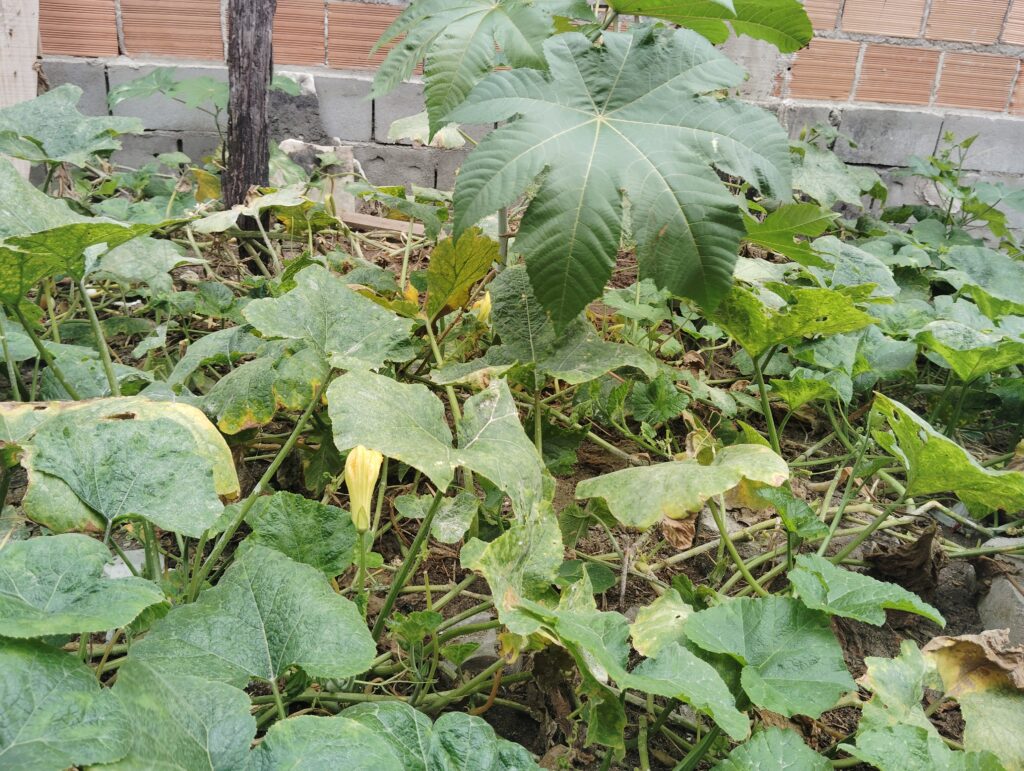
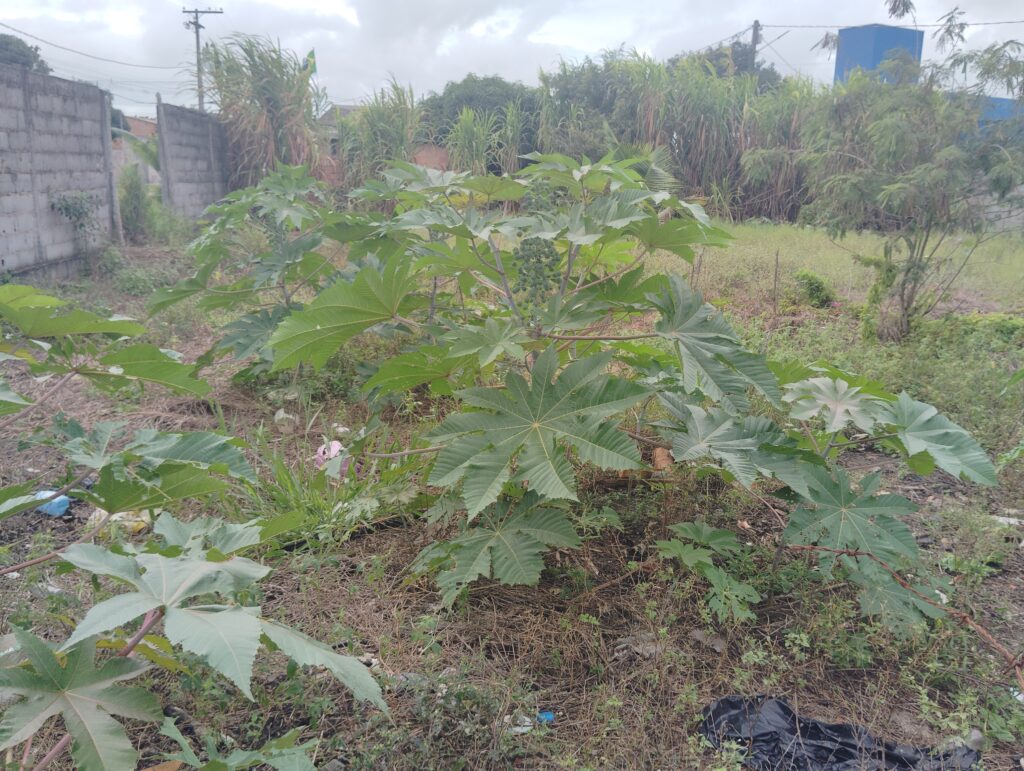
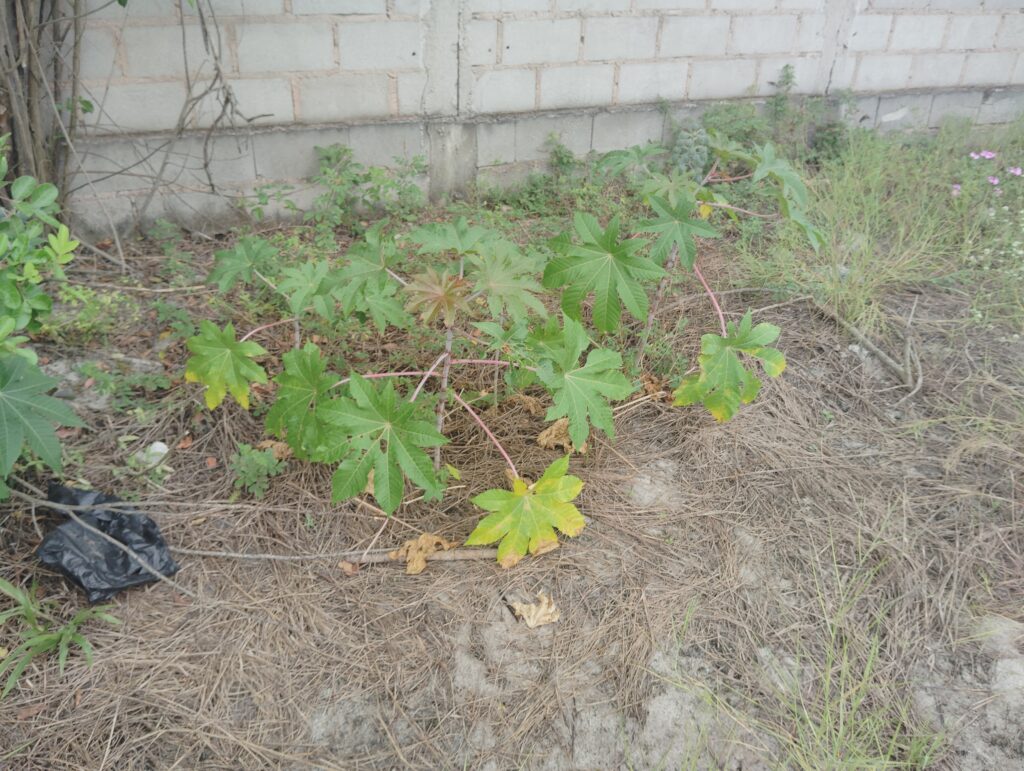
Young mamona plants emerging naturally in sandy ground and larger established plants showing rapid vertical growth and broad leaves.
Likely identification
From the visible plant form, large palmate leaves and spiny seed capsules, the plant is consistent with Ricinus communis, commonly called mamona or castor bean.
We are keeping that identification as likely unless it is formally confirmed.
What the evidence directly shows
- mamona emerging without deliberate planting
- repeated occurrence around disturbed sandy ground
- rapid upward growth
- large leaf development
- substantial above-ground growth in a relatively short period
- reproduction on site through seed production
This makes mamona important to the study even though it is not one of the long-term food plants we ultimately want dominating the landscape.
Why the plant caught our attention
We did not have to buy mamona, plant it carefully or convince it to grow.
It was already doing that.
That made us ask:
If a plant is already capable of growing quickly in difficult exposed ground, what useful job is it performing before we decide to remove it?
What interests us about mamona
We are not interested in mamona because of a commodity use.
We are interested in what the living plant is physically doing on disturbed ground.
The functions we are currently observing or investigating include:
- rapid vertical growth
- large-leaf shade
- quick occupation of open ground
- substantial biomass production
- root occupation of loose sandy areas
- leaf litter and other plant material returning to the site
- temporary habitat and structure for insects and other small life
Mamona as temporary support
Mamona does not need to become the final landscape.
It can be understood as a possible temporary pioneer layer in already disturbed areas.
A fast-growing plant may perform useful work while slower, more permanent productive plants are still establishing.
A future mango, coconut, papaya or banana may need time before it can create enough canopy, biomass or root structure to take over the space around it.
Temporary life can prepare the space for permanent life.
The lesson is the function, not the species
This record does not mean that mamona should be planted everywhere.
In Prado, mamona happens to be one fast pioneer we repeatedly observe.
In another region, a completely different local plant may perform the same job more appropriately.
So the transferable question is:
What does your region already have that grows quickly, tolerates difficult conditions and performs the same useful job?
Safety matters
Mamona also comes with an important safety boundary.
Its seeds are toxic.
That means a plant can be useful in one role while still requiring careful handling and management.
It should not be treated casually around children, animals or food-handling areas.
Life upon Life does not mean keeping every plant simply because it grows easily.
Safety remains part of the decision.
Ecological caution matters too
A plant that grows aggressively on disturbed land should not automatically be spread into healthy native ecosystems.
Prado includes native coastal environments such as restinga, mangrove and Atlantic Forest systems that should not be treated as blank degraded land waiting for intervention.
Mamona’s possible role in this study is specifically about already disturbed sandy areas where it is already present.
Use the life already suited to the disturbed site without creating a new ecological problem somewhere else.
Connection to the pumpkin record
Mamona and pumpkin perform different physical jobs.
In P-II01 — Pumpkin Ground-Cover Cycle, pumpkin spread horizontally across the ground.
Mamona grows upward.
This gives us the beginning of a functional layering system:
pumpkin or another crawler → horizontal cover
mamona or another pioneer → rapid vertical shade
mango, coconut or another long-lived tree → permanent productive canopy
That is more useful than expecting one plant to do every job.
A young mamona inside the pumpkin patch
One of our field images showed a young mamona plant emerging within the pumpkin area as the pumpkin cycle was declining.
Young mamona emerging within or beside the declining pumpkin patch.
We should not overinterpret one image.
But it creates a useful longitudinal question:
What living layer appears next as another temporary layer declines?
What this record does not prove
- the exact growth rate of mamona at our site
- the exact amount of shade it creates
- the temperature difference beneath its canopy
- the effect of its roots on sandy-soil stability
- the amount of biomass produced per plant
- the effect of its litter on soil organic matter
- which plants establish successfully beneath it
- whether it helps or competes with particular long-term food plants
Next tests
Growth rate
- mark newly emerging plants
- record height weekly or monthly
- record canopy width
- photograph the same plant from the same position
Shade and temperature
- measure exposed sandy-ground temperature
- measure temperature beneath mature mamona canopy at the same time
- repeat across several hot days
Biomass
- record leaf fall
- measure or estimate biomass when plants are selectively removed
- follow decomposition where safe
Plant interaction
- observe what grows beneath or beside established mamona
- record whether young fruit-tree seedlings show protection or excessive competition
- compare selective pruning with full removal
How long should the temporary pioneer remain?
One of the most useful future questions is not simply:
Keep mamona or remove mamona?
A better question is:
How long should a temporary pioneer remain before it begins competing too strongly with the permanent productive plants?
The goal is not permanent wilderness and it is not permanent clearing.
The plant layers can be changed deliberately over time.
Useful temporary life remains while it is helping.
Then it is reduced or removed as the permanent productive layer becomes capable of replacing its function.
Evidence assets
P-II02-A: young mamona emerging naturally in sandy ground.
P-II02-B: larger mamona showing broad mature leaves and rapid vertical form.
P-II02-C: reproductive plant showing spiny seed capsules.
P-II02-D: mamona growing among other plants in the current front field.
P-II02-E: young mamona emerging inside or beside the pumpkin patch.
Evidence provenance
Direct Trott Bailey Family observation: Yes
Photographic evidence: Yes
Repeated occurrence: Yes
Deliberately planted by family: No
Measurement: Not yet
Controlled comparison: Not yet
Scientific identification: Likely Ricinus communis based on photographed morphology; not yet formally confirmed
Current evidence level
Observed / Repeated
Mamona has been observed repeatedly at the current site rather than as a single isolated plant.
The record can move toward Measured once growth rate, canopy dimensions, temperature, biomass or root-zone observations are quantified.
It can move toward Tested when deliberately managed mamona is compared with cleared or differently managed areas around permanent plantings.
Why this record matters
Mamona helped sharpen one of the most important questions in Life upon Life.
When people see an aggressive plant growing on rough land, the first reaction is often:
Get rid of it.
Our question is different:
Before we remove it, what job is it already doing?
Then we can make a better decision.
Maybe the plant stays temporarily.
Maybe it is pruned.
Maybe it is removed immediately because of safety or competition.
Maybe another local plant is better suited to the same function.
The point is that the decision is no longer automatic.
We first read the job.
Then we decide what belongs in the next stage of the land.
Initial public version: V1
Current evidence level: Observed / Repeated
First publication period: August 2026