

Money is Dragging us Down!

Trott Bailey Family Civilization
Civilization Drag
How Money Slows Human Progress
There is a form of human restraint so common that most people barely notice it.
Money sits between a person and action.
A young person wants to learn something. Can they afford it?
An engineer wants to build a prototype. Can they afford the materials?
A machine breaks. Can somebody afford the replacement part?
A doctor knows what treatment a patient needs. Can the patient pay?
A talented person needs to travel to work with another talented person. Can they afford the trip?
A scientist has a promising question. Will somebody fund the research?
Again and again, people know what needs to be done and still do not do it.
Not always because the need is unclear.
Not always because the knowledge is missing.
Not always because nobody is capable.
Sometimes the problem is simply that permission to move has been tied to money.
That creates civilization drag.
What Is Civilization Drag?
Civilization drag is the delay, waste and lost human capability created when useful action cannot happen because money stands in the way.
The person exists.
The problem exists.
The skill exists.
The material may exist.
The machine may exist.
The knowledge may exist.
The need certainly exists.
But the pieces are prevented from meeting.
That is drag.
A civilization can have brilliant engineers and broken machinery at the same time.
It can have trained doctors and untreated patients.
It can have empty buildings and homeless families.
It can have fertile land and hungry people.
It can have young people desperate to become useful while enormous amounts of useful work remain undone.
It can have people willing to teach and people desperate to learn.
All of these things can exist beside one another without connecting because money has become the gate.
Money Is Not the Only Thing That Slows Civilization
War slows civilization.
Bad leadership slows civilization.
Incompetence slows civilization.
Poor design slows civilization.
Lack of knowledge slows civilization.
Real shortages of materials, energy, land or skilled people can slow civilization too.
Those are real limits.
But money often adds another layer of restraint on top of them.
The knowledge may already exist.
The material may already exist.
The machine may already exist.
The skilled person may already exist.
The problem may already be understood.
And still nothing moves because the money has not been arranged.
That is an artificial delay created by the way access has been organized.
Think About What That Does Over Time
One blocked action may seem small.
One young person does not get access to a workshop.
One machine does not get repaired.
One scientist does not test an idea.
One child does not get the lesson.
One farmer does not receive the tool.
One doctor delays treatment.
One inventor gives up on a prototype.
But civilization is made from millions of actions like these.
Now multiply the delay across cities.
Then nations.
Then billions of people.
Then repeat it every day for decades.
The result is not merely individual frustration.
The result is a slower civilization.
Knowledge spreads more slowly.
Machines improve more slowly.
Problems remain unsolved longer.
Human abilities remain undiscovered.
Useful people remain separated from one another.
Ideas die before they become physical.
Repairs are postponed.
Experiments do not happen.
Public systems deteriorate.
Young people lose years.
That is civilization drag.
Money Does Not Only Gatekeep Things
It gatekeeps time.
It gatekeeps movement.
It gatekeeps experimentation.
It gatekeeps access to machinery.
It gatekeeps access to parts.
It gatekeeps education.
It gatekeeps health care.
It gatekeeps collaboration.
It gatekeeps travel.
It gatekeeps the ability to fail and try again.
It can even gatekeep imagination.
After enough years, people learn not to seriously imagine things they believe they will never be able to afford.
Those are not the same question.
Look at the Young
A young person may have energy, intelligence and curiosity.
But first they must find some way to survive.
So enormous amounts of youth are spent chasing income.
Not necessarily pursuing the work the person is best suited to do.
Not necessarily solving an important problem.
Not necessarily learning what they are capable of.
Surviving.
The young person may have been an excellent engineer.
But they never reached the machine.
They may have been an extraordinary cook.
But they never reached the ingredients, equipment or mentors.
They may have been a brilliant designer.
But they never had access to design tools.
They may have understood plants unusually well.
But nobody ever placed them in an orchard with people who could develop that ability.
They may have become an inventor.
But their first idea cost more than they had.
We do not know.
That is part of the loss.
Look at Medicine
Suppose a doctor knows what needs to happen.
The medicine exists.
The equipment exists.
The trained people exist.
The patient exists.
Yet treatment is delayed because payment has not been solved.
From the perspective of the human body, this makes no sense.
The body does not care about the patient’s bank balance.
The disease does not wait politely while the family arranges financing.
Human beings created the gate.
Then human beings accept the delay created by the gate.
The same thing happens in research.
A medical problem may need an engineer, materials specialist, programmer, machinist and caregiver working together.
The problem may be urgent.
The people may be available.
The equipment may already exist.
And still the collaboration can stall because every person, trip, machine, component and hour has to be financially justified first.
That is civilization drag.
Look at Machinery and Repair
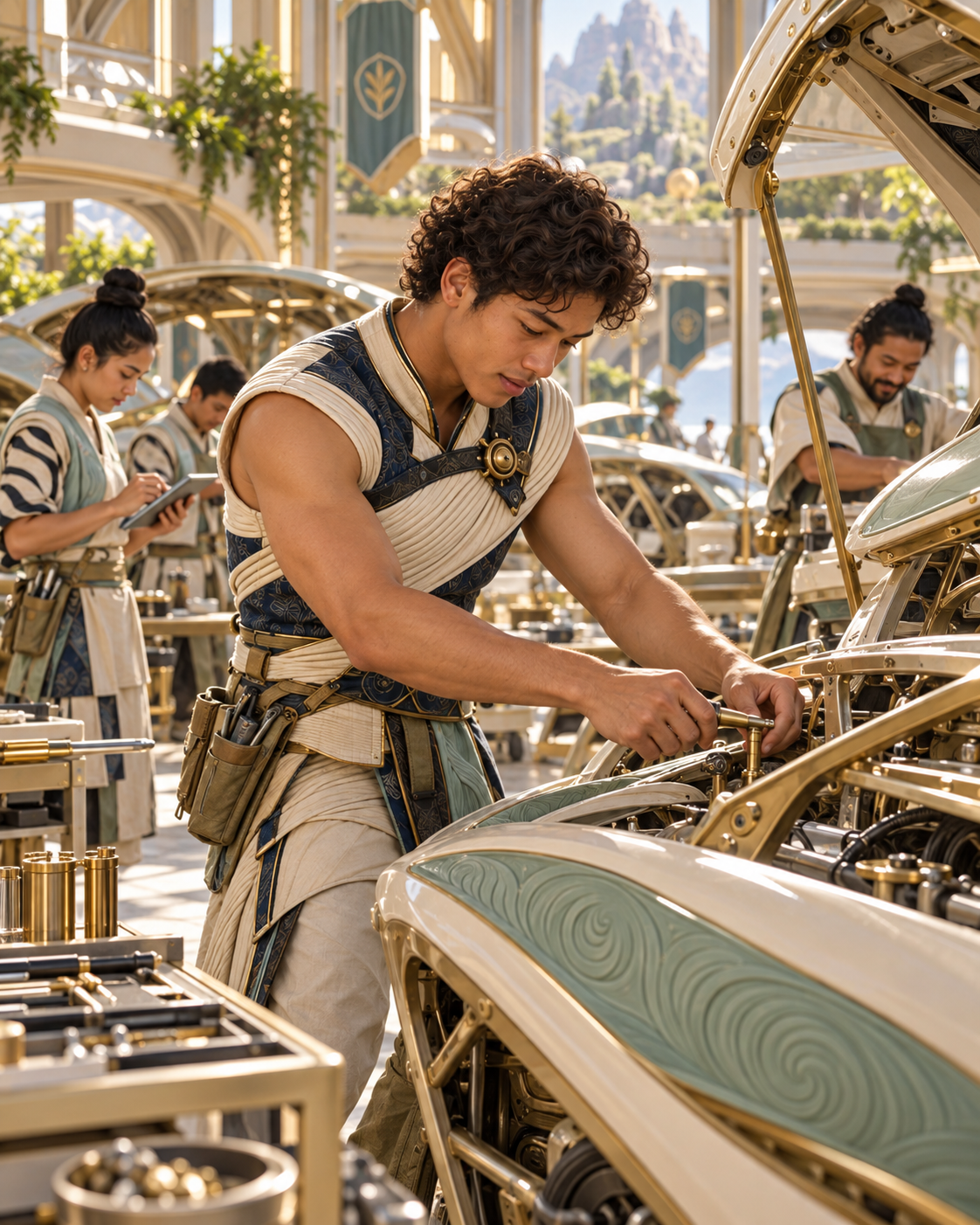
A machine can stop working because one small part is missing.
The machine may be needed for farming, water, construction, transport or manufacturing.
The people know what part is required.
It may even be possible to produce it.
But then come the questions.
Who will pay?
Which budget?
Can the organization afford it this month?
Is the imported component too expensive?
Can someone justify the purchase?
Meanwhile, the machine sits still.
Then the work that depended on the machine slows down too.
One financial gate creates another delay.
Then another.
This is how drag spreads through a civilization.
Look at Human Collaboration
One talented person is in Brazil.
Another is in Thailand.
A third is in Kenya.
Together they may be able to solve a problem none of them can solve alone.
But first:
Flights.
Accommodation.
Food.
Time away from paid employment.
Workshop access.
Equipment.
Materials.
Funding approval.
The collaboration may never happen.
Not because the people were unwilling.
Not because Earth was too large.
Because their abilities were prevented from meeting.
That is an extraordinary loss.
We Have Mistaken Restraint for Normal Life
People are so accustomed to financial gates that they often treat the consequences as natural.
Of course the project has to wait.
Of course the patient cannot get everything they need.
Of course the young person cannot travel.
Of course the experiment cannot happen.
Of course the machine will stay broken.
Of course the artist has to do something else to pay the bills.
Of course the scientist needs a grant.
Of course the child cannot participate.
But none of these are laws of nature.
They are consequences of how human beings have organized access.
That distinction matters.
The Earth Is Not Short of Human Potential
This is where the scale of the problem becomes difficult to ignore.
Earth is filled with people.
Earth has materials.
Earth has knowledge.
Earth has machinery.
Earth has land.
Earth has food-growing capacity.
Earth has engineers.
Earth has doctors.
Earth has cooks.
Earth has teachers.
Earth has builders.
Earth has artists.
Earth has scientists.
Earth has young people with abilities nobody has even discovered yet.
And still, useful action is stopped millions of times because someone cannot pay.
How much of what we call human limitation is actually human potential being repeatedly denied permission to move?
How much stagnation has been created because the person, tool, material, knowledge and need were all present but were not allowed to meet?
Remove the Drag
Trott Bailey Family Civilization proposes that the requirements of human life and useful civilization should not be held behind money.
Food.
Housing.
Clothing.
Health care.
Education.
Transport.
Tools.
Machinery.
Materials.
Child care.
Public spaces.
Research.
Travel.
These should be organized around human need, capability and civilization work.
Then the question changes.
Instead of:
Can we afford to do this?
we ask:
Does this need to be done?
Do we have the resources?
Who has the ability?
What needs to be built, grown, repaired, learned or moved?
Those questions do not remove real limits.
If a material is genuinely scarce, that still matters.
If skilled people are unavailable, that still matters.
If a machine has not yet been invented, that still matters.
Remove enough of that drag and civilization begins to move differently.
One repair restores a machine.
That machine restores production.
Production supplies another system.
That system frees more people.
Those people build something else.
One child gains access to an interest.
That interest becomes a skill.
That skill becomes an invention.
The invention improves thousands of lives.
One researcher follows an unusual question.
The answer creates an entirely new field of work.
One collaboration happens because talented people can simply travel to each other.
That collaboration creates something nobody planned in advance.
Remove the drag and you get more movement.
More experiments.
More repairs.
More learning.
More collaboration.
More discoveries.
More chances to find out what human beings are actually capable of.
Money has not only been measuring economic activity.
It has also been acting as a gate between human beings and action.
Once you see the scale of that restraint, it becomes difficult to unsee it.
The question is not only what money has helped humanity build.
The question is how much humanity has never built because money told us to stop.