
Behind the Beauty: Men’s Gill-Bloom Route Species V1.1


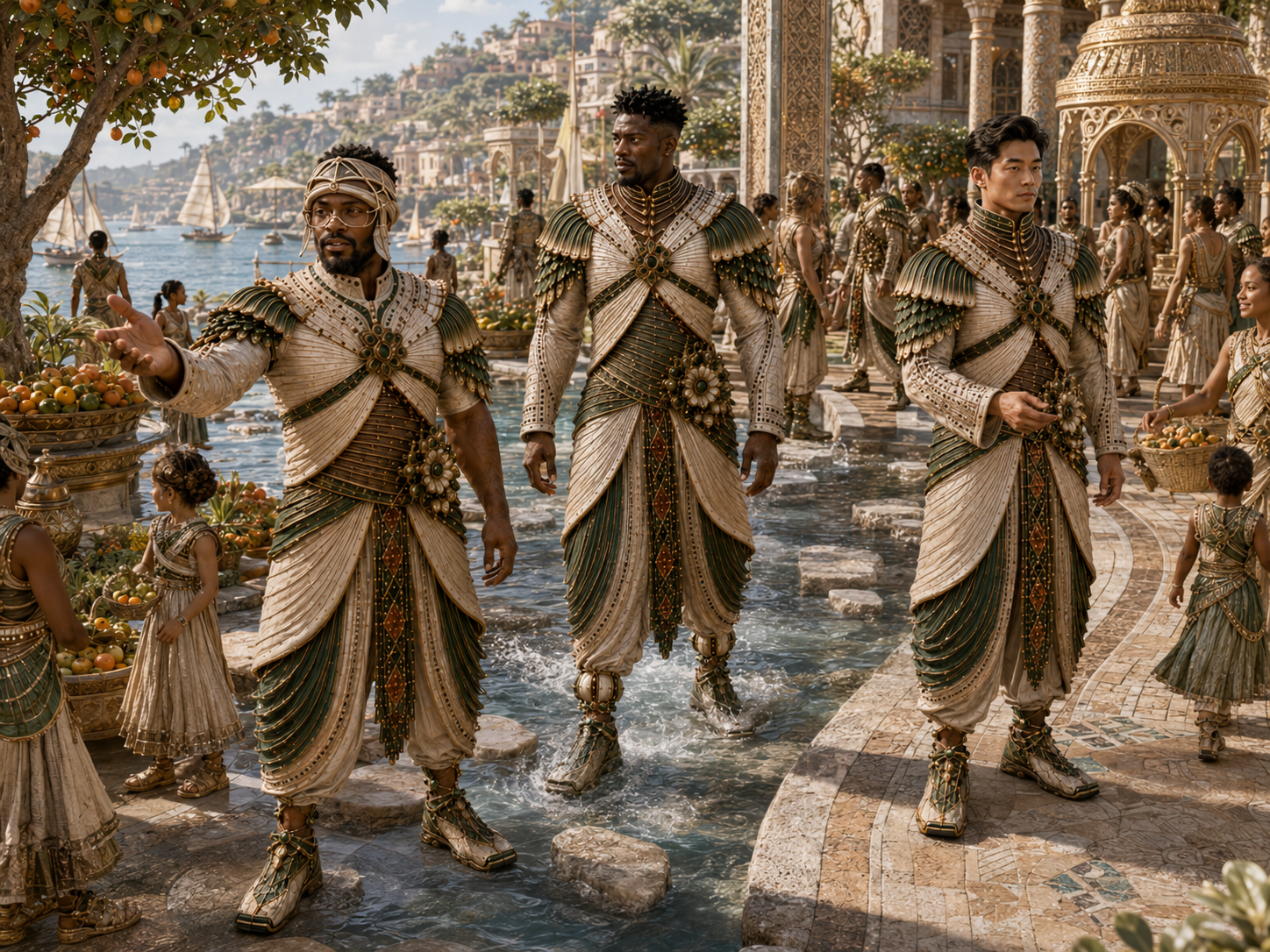


Behind the Beauty: Men’s Gill-Bloom Route Species V1.1
How World Ruler Sher’s authored men’s garment species gives men a new civilization clothing body beyond suits, uniforms, streetwear, robes, and costume.
World Ruler Sher Designed This Garment Species
The Men’s Gill-Bloom Route Species V1.1 was designed by Sherika Trott Bailey, World Ruler Sher.
That must be said clearly at the beginning.
This is not a garment designed by a committee.
It is not the result of an outside fashion house.
It is not anonymous trend development.
It is not a vague kingdom style that appeared by itself.
That distinction matters.
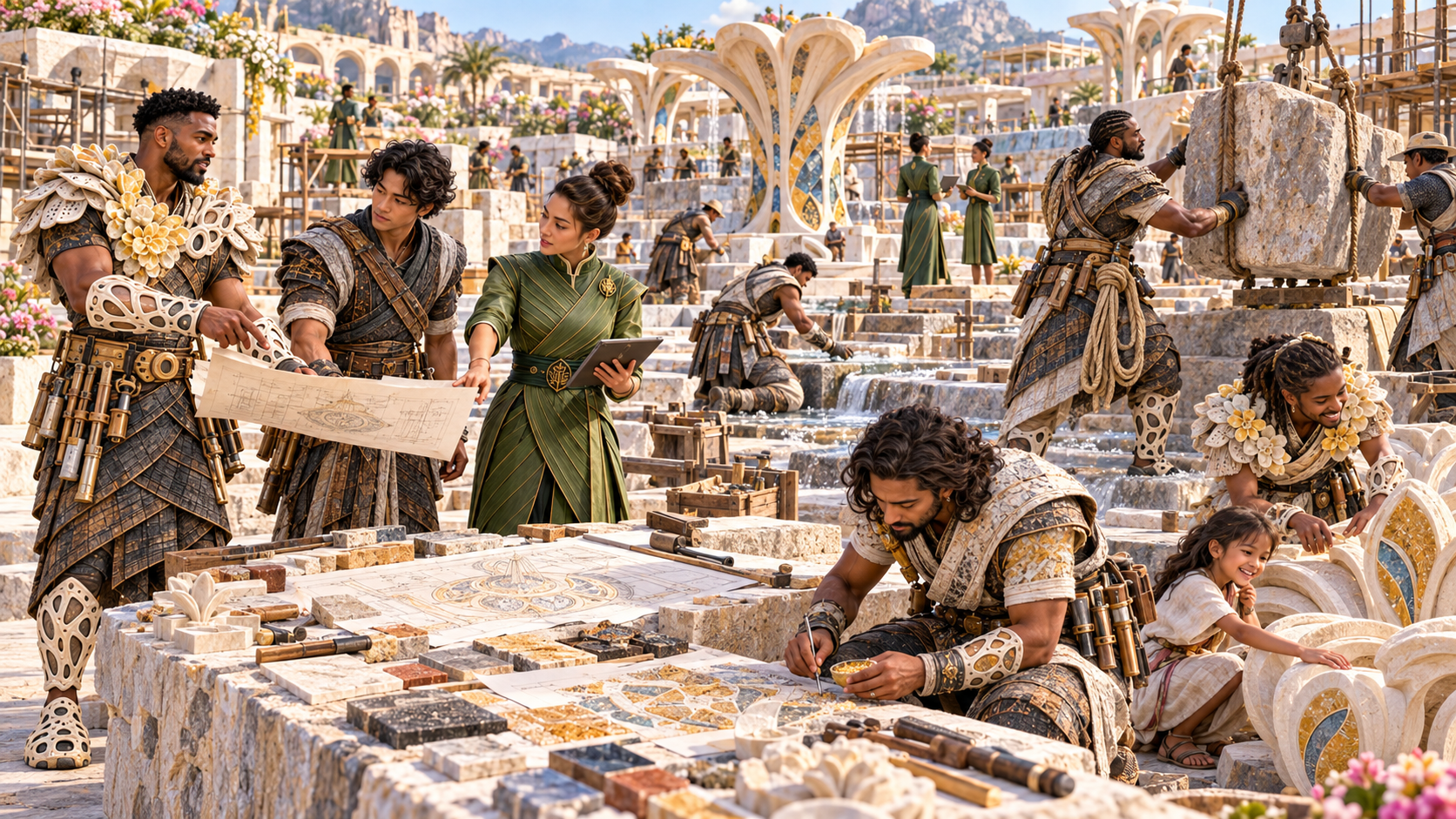
Behind the Beauty does not mean that the people who fit, test, sew, finish, repair, refresh, and distribute the garment authored the design. It means that once World Ruler Sher has designed the garment, a civilization needs roles to carry that design properly into real public life.
A civilization garment cannot remain only a beautiful drawing or a single image. It must become wearable. It must move. It must hold on different bodies. It must survive heat, travel, work, evening gatherings, public presence, repair, washing, fitting, and time.
That is where the Shubaka ecosystem begins.
Shubaka means meaningful kingdom contribution: roles created because civilization must be cared for. In fashion, Shubaka roles do not replace World Ruler Sher’s authorship. They serve the authored design by translating it into pattern, cloth, fit, footwear, production, maintenance, and public use.
The Point of This Article
This article is not only about admiring a handsome outfit.
It is about proving that Trott Bailey fashion is civilization design.
One garment species can reveal how a civilization thinks about men, movement, climate, public dignity, body difference, footwear, production, and the roles required to make beauty usable.
Men’s Gill-Bloom Route Species V1.1 is not ordinary menswear with decoration placed on top. It is a clothing body with its own laws.
It gives men a route through public life.
It gives the body structure without trapping it.
It gives masculinity presence without reducing men to suits, uniforms, streetwear repetition, robes, sportswear, or costume.
It gives the foot a role in the species instead of treating shoes as an afterthought.
It gives the kingdom a reason to create real fashion roles: not shallow retail jobs, but skilled contribution around textile intelligence, fitting, movement, climate adaptation, repair, and wardrobe life.
What Is a Garment Species?
In Trott Bailey fashion, a garment species is not one frozen outfit.
A garment species is a stable authored clothing body with recognizable structural laws. It can change color, purpose, climate response, material handling, and public-life expression while still remaining the same species.
That is why this men’s design can have a Night Release / Evening Glow variant and a Work-Travel Movement variant without becoming two unrelated outfits.
They belong to the same species because the body logic remains.
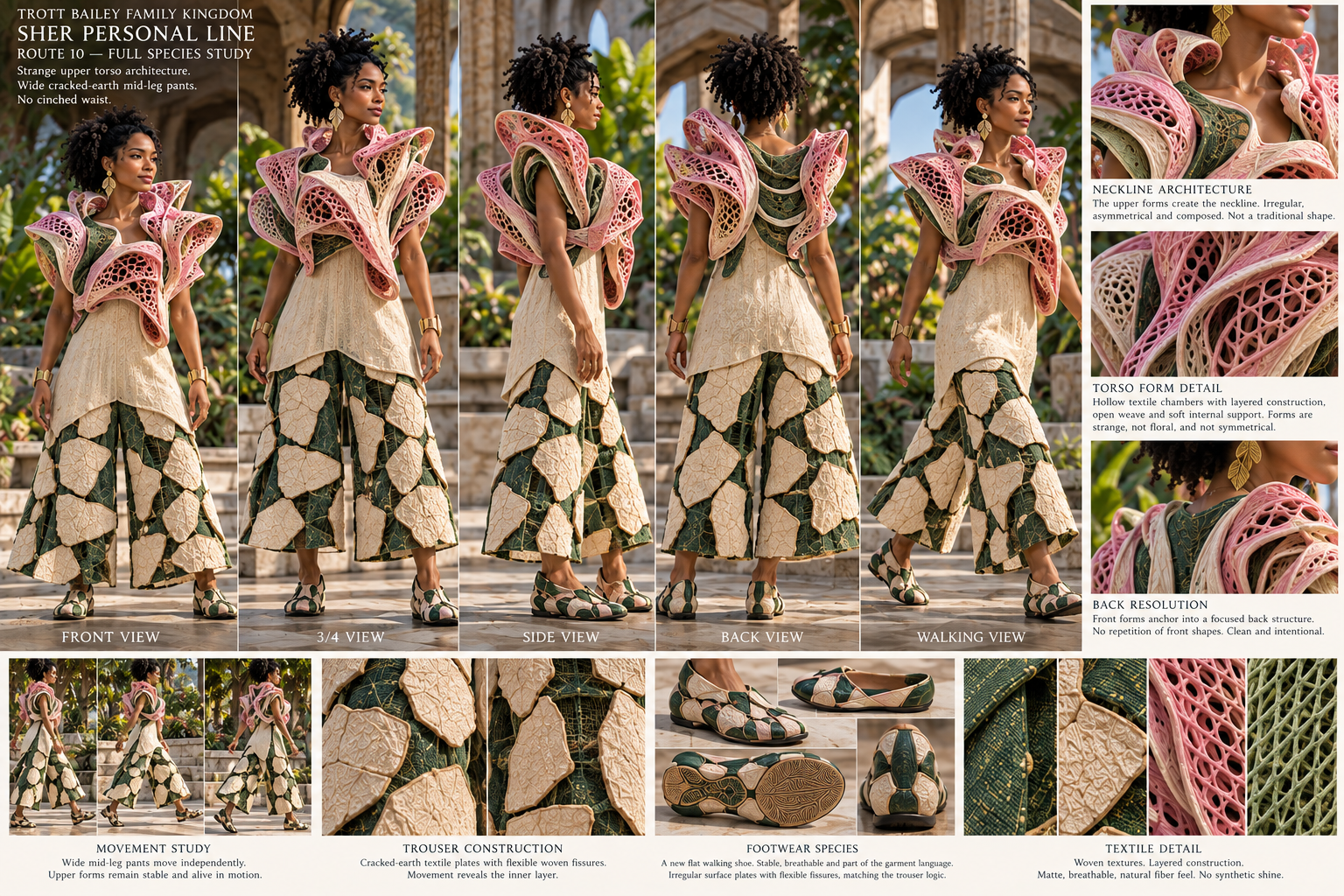
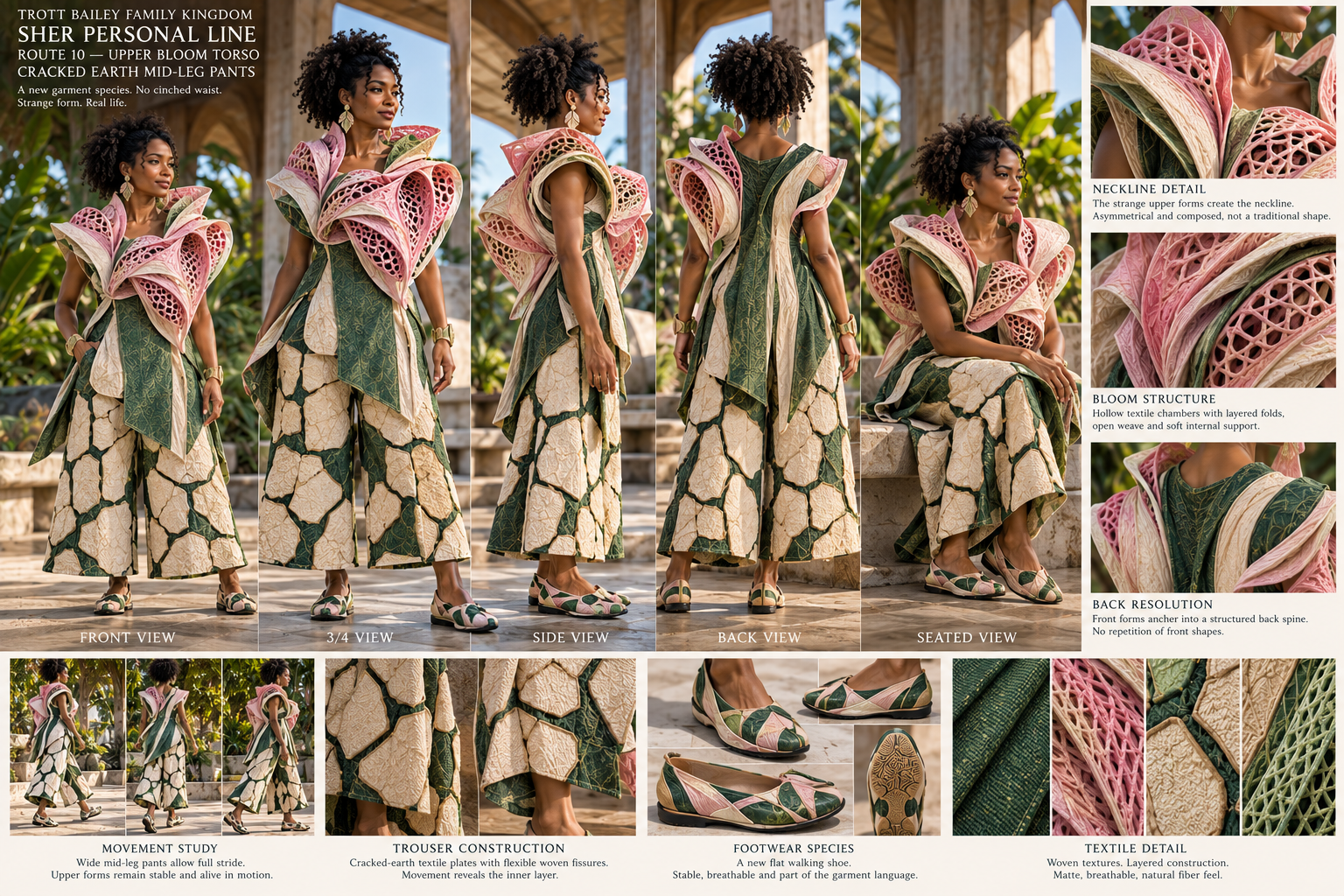
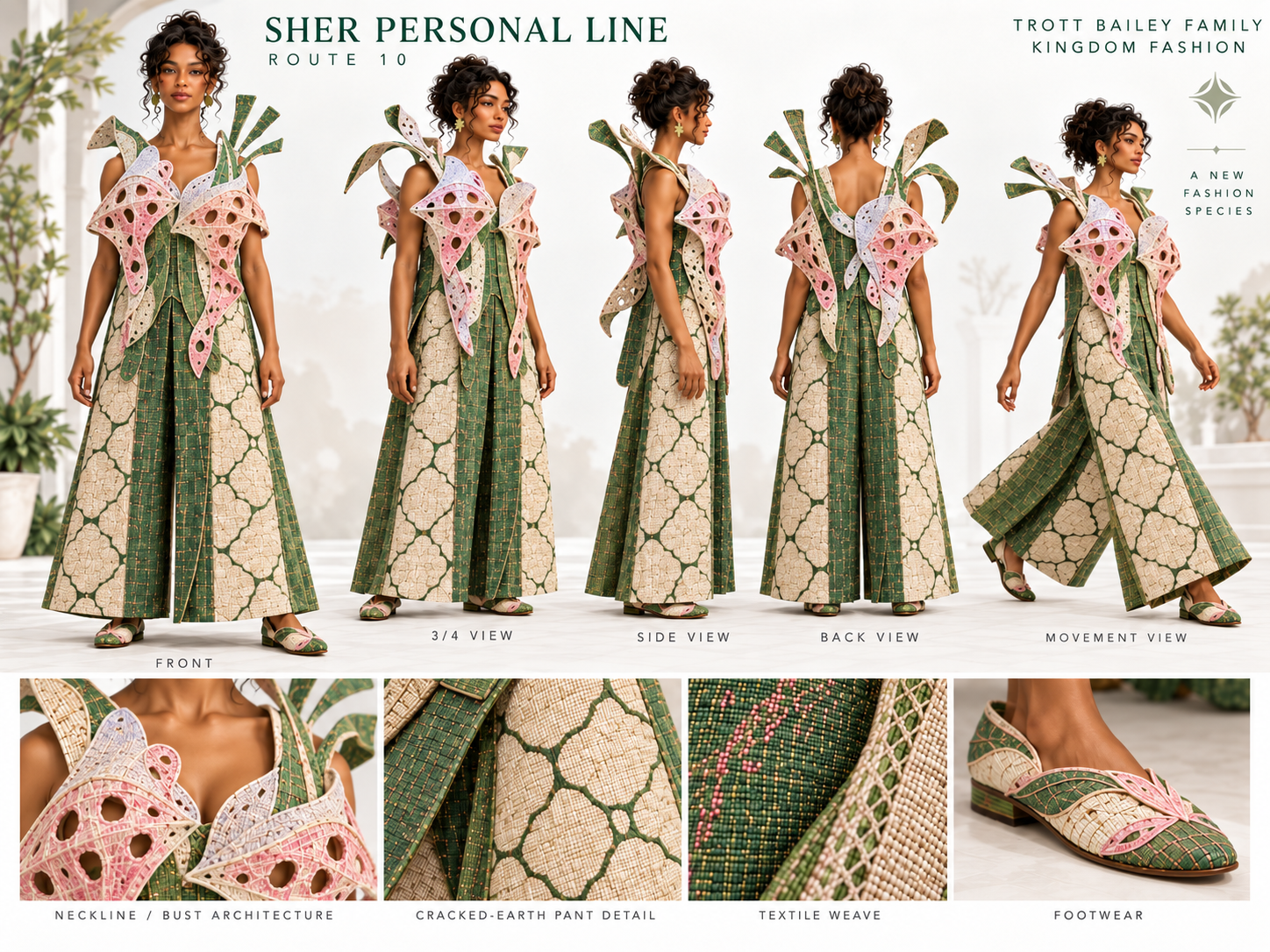
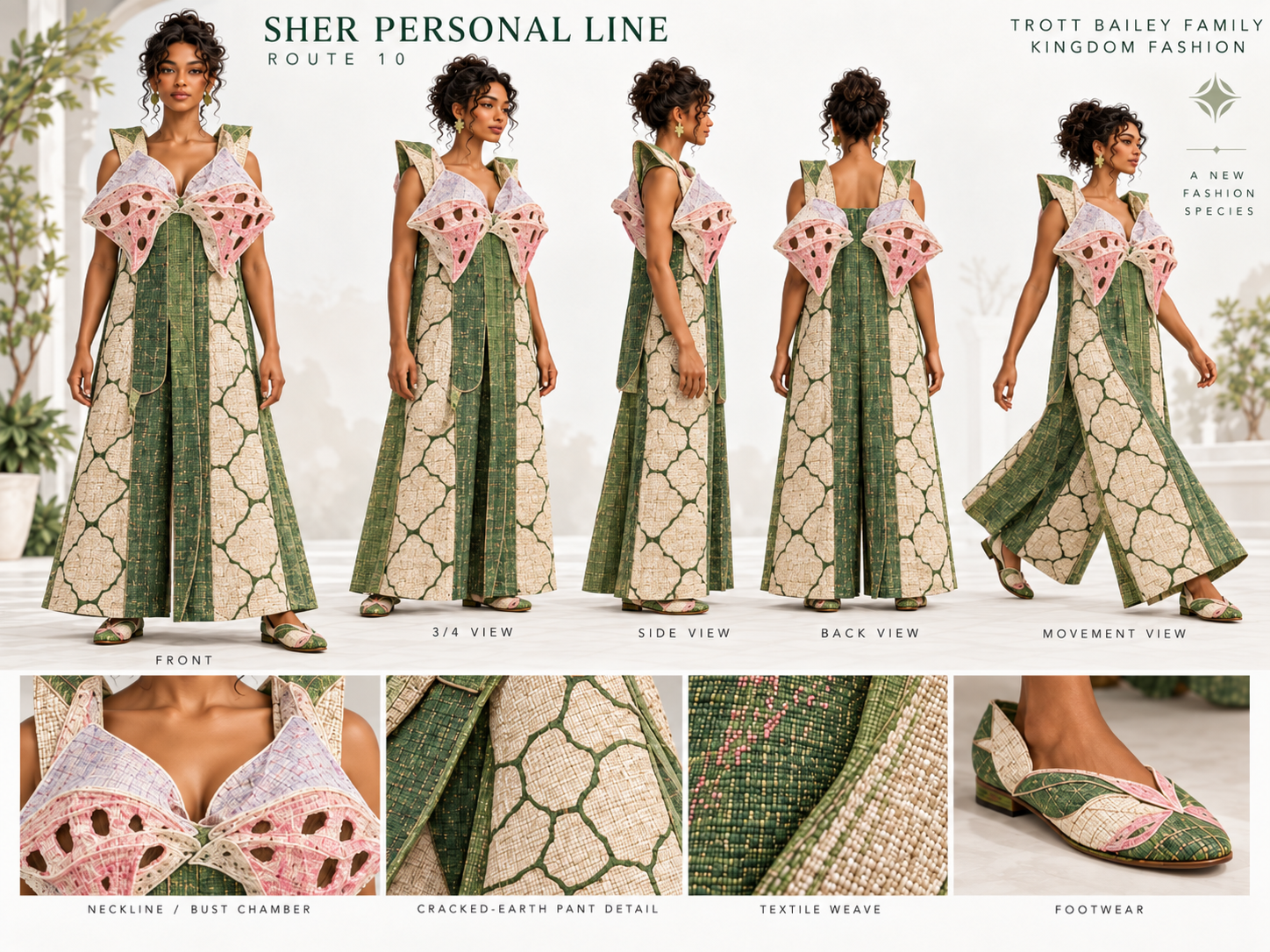
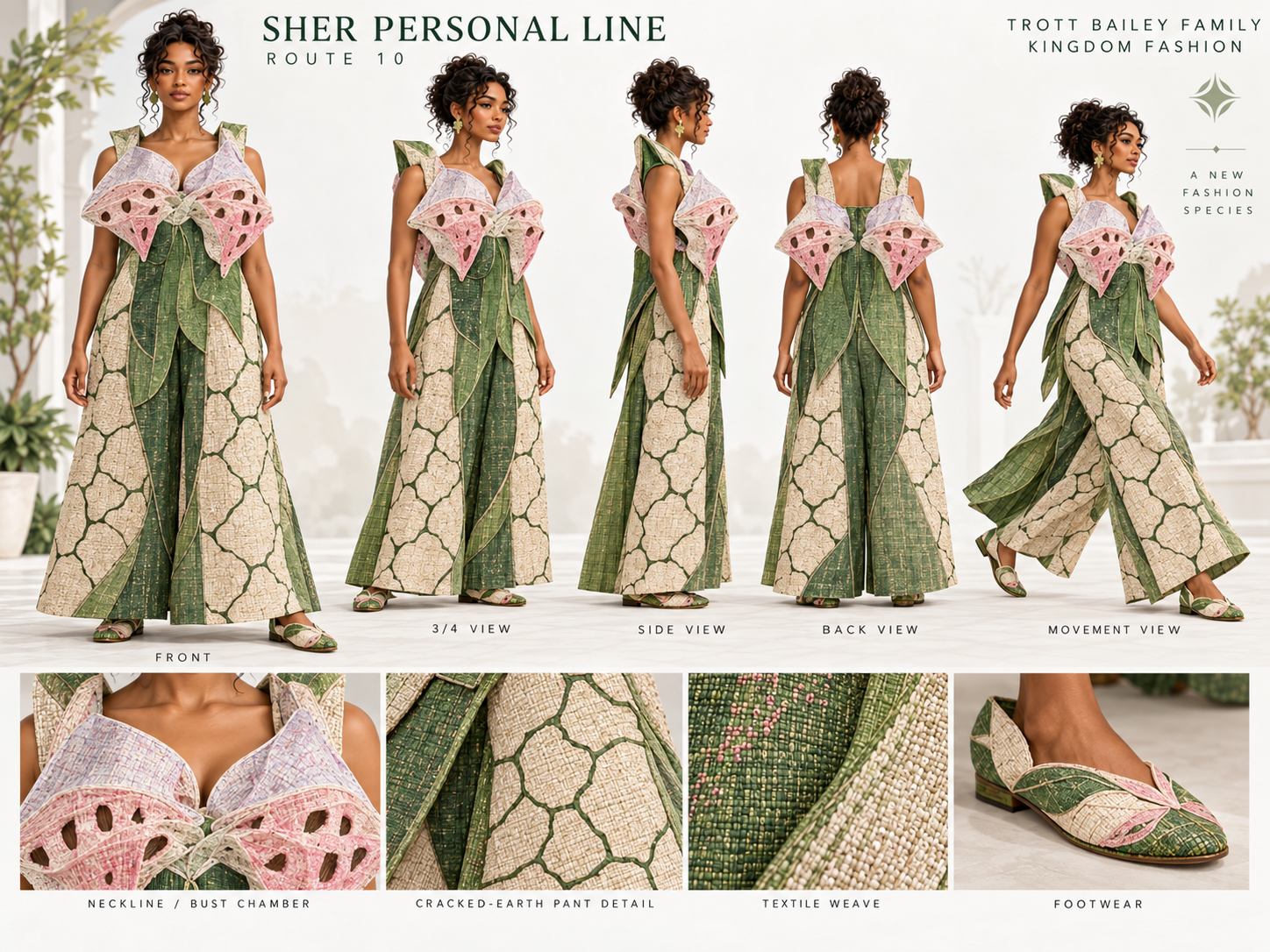
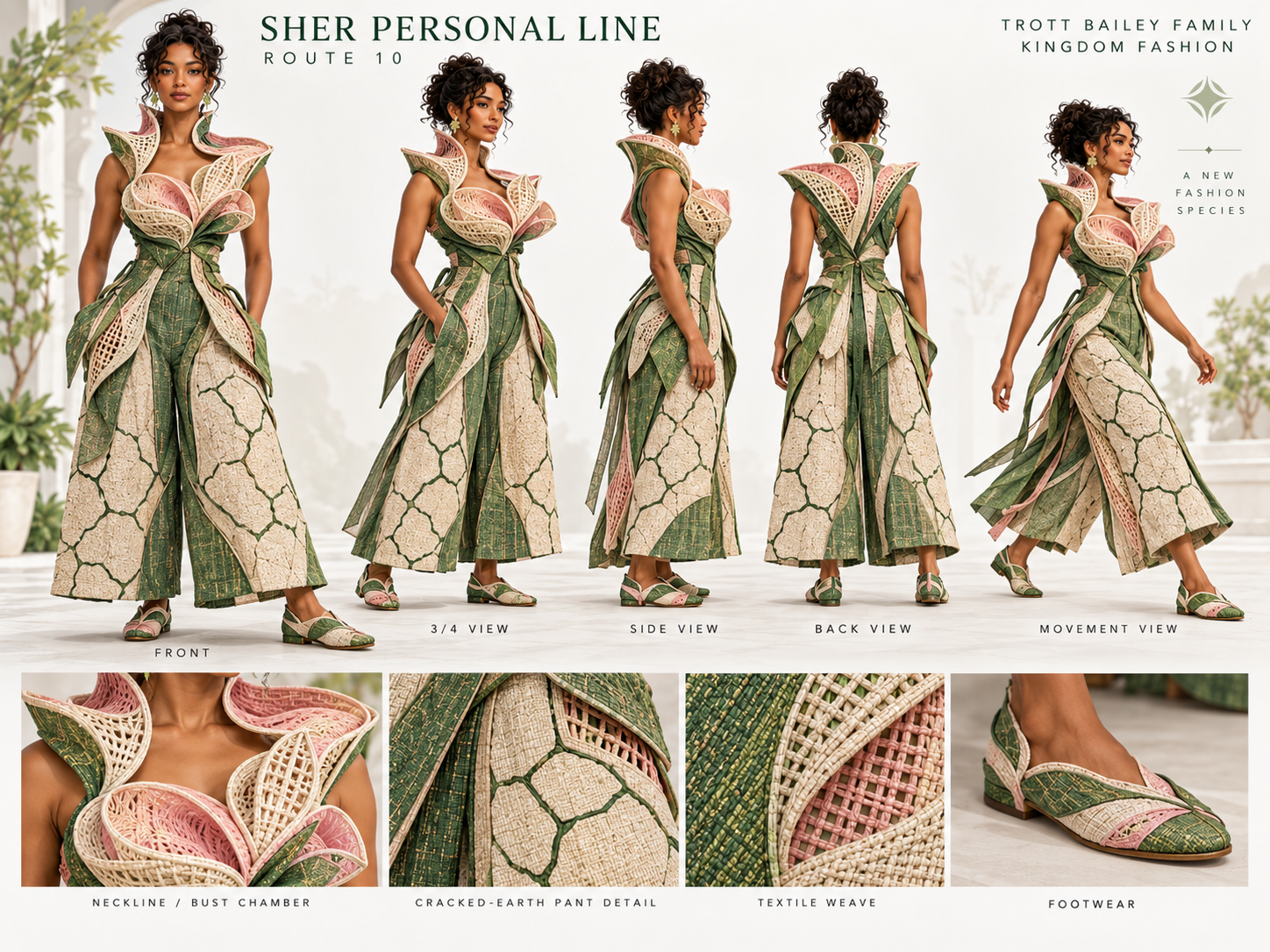
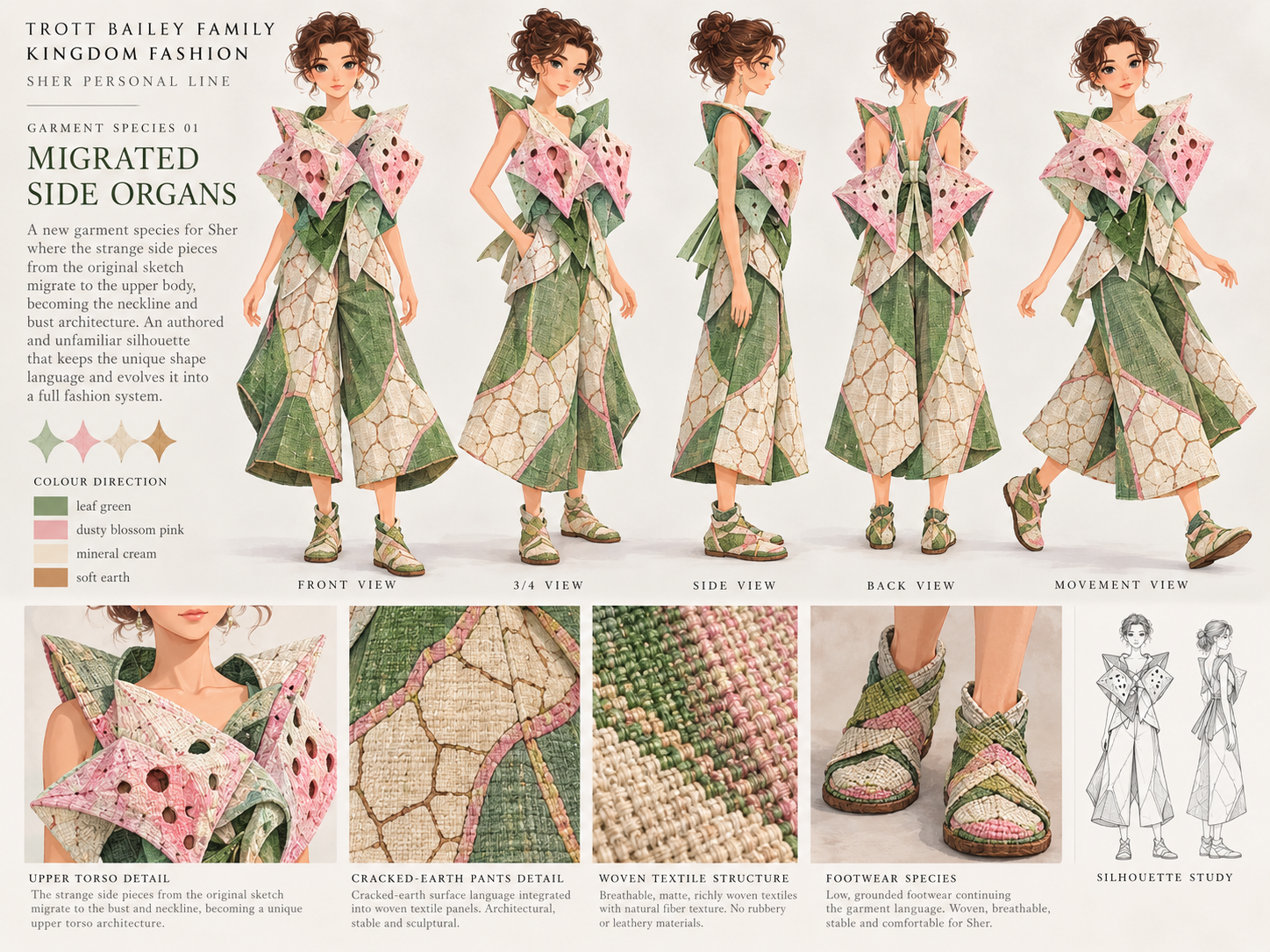
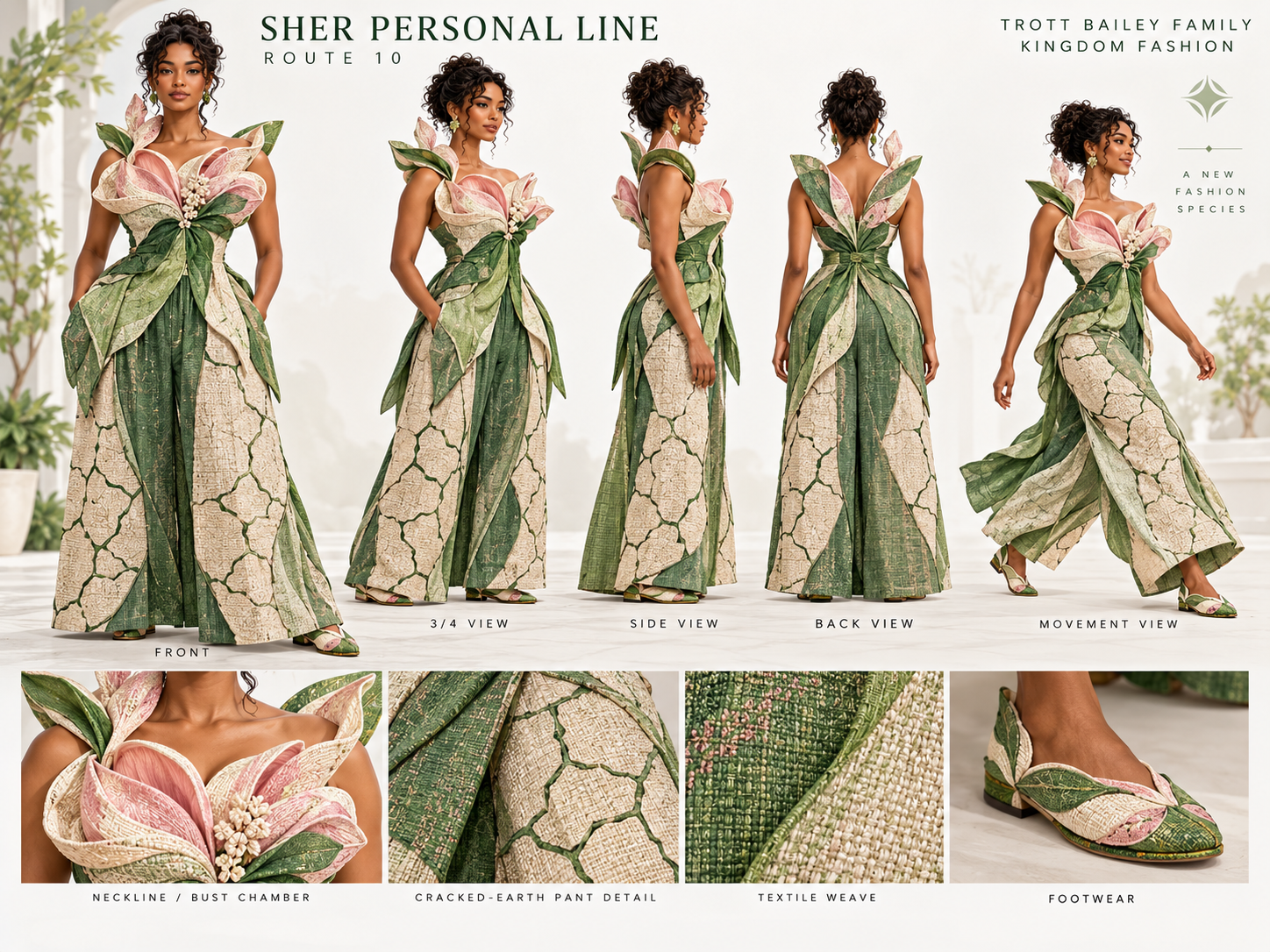
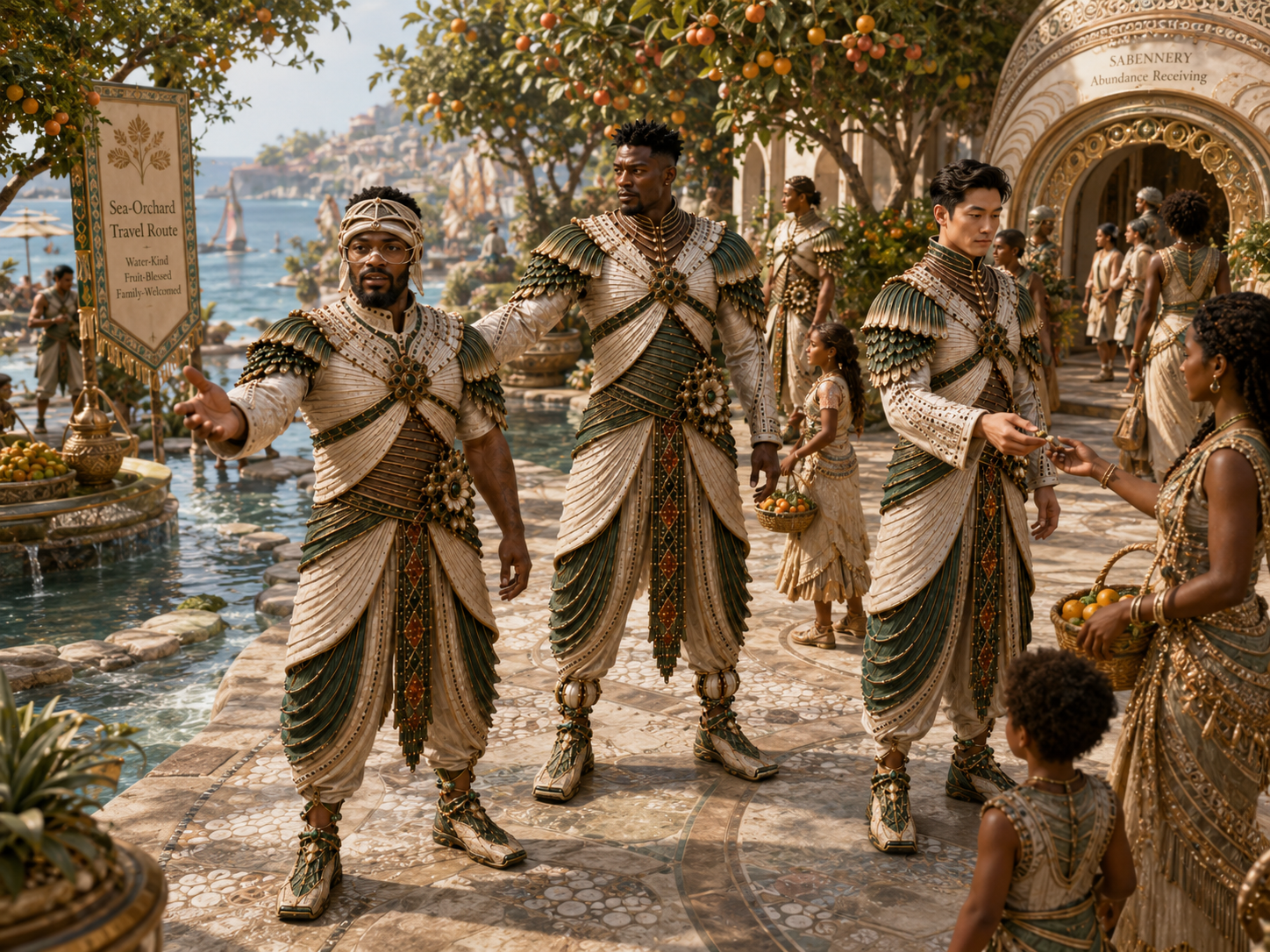
- Gill Cascade Neckline: a strong upper-body opening that gives the chest and neck a sculpted route instead of a collar, tie, robe opening, or generic neckline.
- Fused Asymmetric Upper Wrap: a wrapped body system that creates movement direction and public presence without becoming loose drapery.
- Gill-Fan Sleeve Pods: sleeve structures that hold volume, air, and identity without becoming heavy wings.
- Side-Root Waist Lock: a side anchoring system that holds the garment’s tension and prevents the wrap from feeling accidental.
- Side-Bloom Organ: a visual and functional side structure that can carry route identity, closure logic, and public-life emphasis.
- Split-Gill Lowerfield: the lower garment field that allows stride, airflow, motion, and species identity instead of ordinary pants or robes.
- Root-Tension Pod-Foot System: the footwear body that completes the species from the ground upward.
These are not random ornaments.
They are the laws that make the species recognizable.
Why Men Need Authored Civilization Menswear
Men’s clothing in the old world is often trapped inside a few repeated choices.
Suits for authority.
Uniforms for service.
Streetwear for casual identity.
Sportswear for comfort.
Robes for looseness.
Costume when someone tries to become visually bold.
That leaves very little space for men to have authored public-life clothing that is beautiful, useful, climate-aware, movement-aware, and civilizational.
Trott Bailey men’s fashion is not trying to decorate old categories.
It is creating new clothing bodies.
Men’s Gill-Bloom Route Species V1.1 gives men a garment that can stand in public life without borrowing authority from the business suit, the military uniform, the sports kit, or the fantasy costume.
It gives men presence through structure, route, movement, textile behavior, and ground connection.
One Species, Two Expressions
A civilization should not confuse all occasions.
Men do not move through only one kind of day.
Sometimes a man needs evening presence.
Sometimes he needs work-travel movement.
Sometimes he is crossing a district, arriving at a public gathering, hosting family, moving through a route, standing in a night space, or carrying himself through long public hours.
That is why the Men’s Gill-Bloom Route Species V1.1 branches into two major expressions.
Night Release / Evening Glow
The Night Release / Evening Glow variant carries the more luminous public-life expression of the species.
It is for evening presence, night gatherings, ceremony-adjacent movement, hospitality, public arrival, and settings where a man needs calm force without becoming stiff.
It can hold richer glow-control route threads, deeper reflective accents, stronger upper-body presence, softer evening movement, and more visual warmth.
It does not become costume because the structure remains disciplined.
The gill neckline, sleeve pods, route wraps, side-root anchoring, lowerfield behavior, and pod-foot ground logic still carry function.
Work-Travel Movement
The Work-Travel Movement variant carries the more practical route expression of the species.
It is for district crossing, long movement, work-related travel, public errands, active roles, and days when the garment must hold beauty without slowing the man down.
It needs more secure wrap control, cleaner route tension, durable textile behavior, easier airflow, less reflective excess, stronger friction management, and foot logic that can handle real ground.
It is not a uniform.
It is not a work costume.
It is authored civilization menswear for movement.
The Beauty Is Not Separate From the Use
The beauty of this species is not pasted onto function after the useful parts are solved.
The beauty comes from the function being authored.
The neckline is beautiful because it gives the upper body a new formal route.
The sleeve pods are beautiful because they manage air, volume, and identity.
The side-root lock is beautiful because it makes tension visible.
The lowerfield is beautiful because it lets walking become part of the garment’s life.
The footwear is beautiful because the species does not abandon the foot.
Movement, Body, Climate, and Footwear
The Men’s Gill-Bloom Route Species V1.1 is not complete because it looks striking. It is complete only when it can move, breathe, hold different men, and reach the ground through its own footwear body.
Trott Bailey Fashion Must Survive Movement
A garment that only works while a man stands still is not civilization clothing.
Men walk.
They climb steps.
They cross districts.
They turn toward family.
They sit, stand, bend, greet, carry, host, travel, and move through weather.
The Men’s Gill-Bloom Route Species V1.1 has to survive all of that.
This is why the garment cannot be judged only by silhouette.
The silhouette matters, but the deeper question is whether the garment can live with the body.
How the Species Moves
The movement intelligence of this species comes from route tension.
Route means the structural guidance system inside Trott Bailey fashion: the lines, tensions, closures, flows, folds, locks, and seams that help a garment hold purpose while the body moves.
The fused asymmetric wrap gives the upper body direction.
The side-root waist lock stops the garment from becoming accidental drape.
The Gill-Fan sleeve pods hold air and sculptural identity without weighing down the arm.
The split-gill lowerfield gives walking space without turning into ordinary pants, a robe, or a skirted costume.
The side-bloom organ gives the garment an authored side event: a visual anchor that can also hold closure logic, tension, pocketing, or route memory.
One Species, Many Men
A civilization garment is not complete if it only works on one man.
It cannot depend on one race, one height, one shoulder shape, one body type, one skin tone, one age-read, or one model-like presentation.
The body and race study matters because it proves a deeper design standard: the species has to hold identity across different men.
This does not mean every man receives a totally different garment.
That would destroy the species.
It means the core laws remain, while fitting and proportion are adjusted carefully.
The neckline may need slight depth control.
Sleeve pod volume may need body-scale correction.
The side-root lock may need placement adjustment.
The lowerfield may need different walking ease.
The pod-foot may need different pressure mapping.
But the garment must still read as Men’s Gill-Bloom Route Species V1.1.
Body Adaptation Without Losing Species Identity
This is one of the hardest parts of civilization fashion.
If the garment is too rigid, it only flatters a narrow body type.
If it adapts too loosely, it stops being a species and becomes random styling.
Trott Bailey fitting must hold the middle ground: disciplined species identity with intelligent body adaptation.
Climate Intelligence
This garment species should not only be beautiful in neutral weather.
It needs climate branches.
Trott Bailey fashion must think about heat, wind, rain, humidity, evening coolness, coastal air, public walking, long wear, and indoor-outdoor transitions.
The species can carry different textile responses without losing its identity.
- Sun-Heat Branch: lighter breathable textiles, controlled shade logic, cooler interior surfaces, and airflow around the neck, sleeve, and lowerfield.
- Wet-Edge Branch: quicker-drying lowerfield, water-shedding route seams, protected foot logic, and fabric that resists becoming heavy.
- Wind-Cool Branch: more stable wrap tension, warmer surface layers, sleeve control, and route locks that prevent loose movement in wind.
- Evening Glow Branch: subtle light-catching textile behavior, richer night presence, and controlled reflective detail.
The Footwear Is Part of the Species
The Root-Tension Pod-Foot System must not be treated as a shoe placed underneath the outfit.
It is part of the garment species.
If the clothing has route, tension, gill behavior, side-root anchoring, and lowerfield motion, the foot has to answer that same design language.
The footwear completes the body from below.
It gives the lowerfield a docking relationship.
It protects the foot without becoming a sneaker, boot, or generic sandal.
It carries route tension through the instep, heel, ankle, toe, and sole.
Root-Tension Pod-Foot Logic
Where This Garment Lives
The Men’s Gill-Bloom Route Species V1.1 belongs in public life.
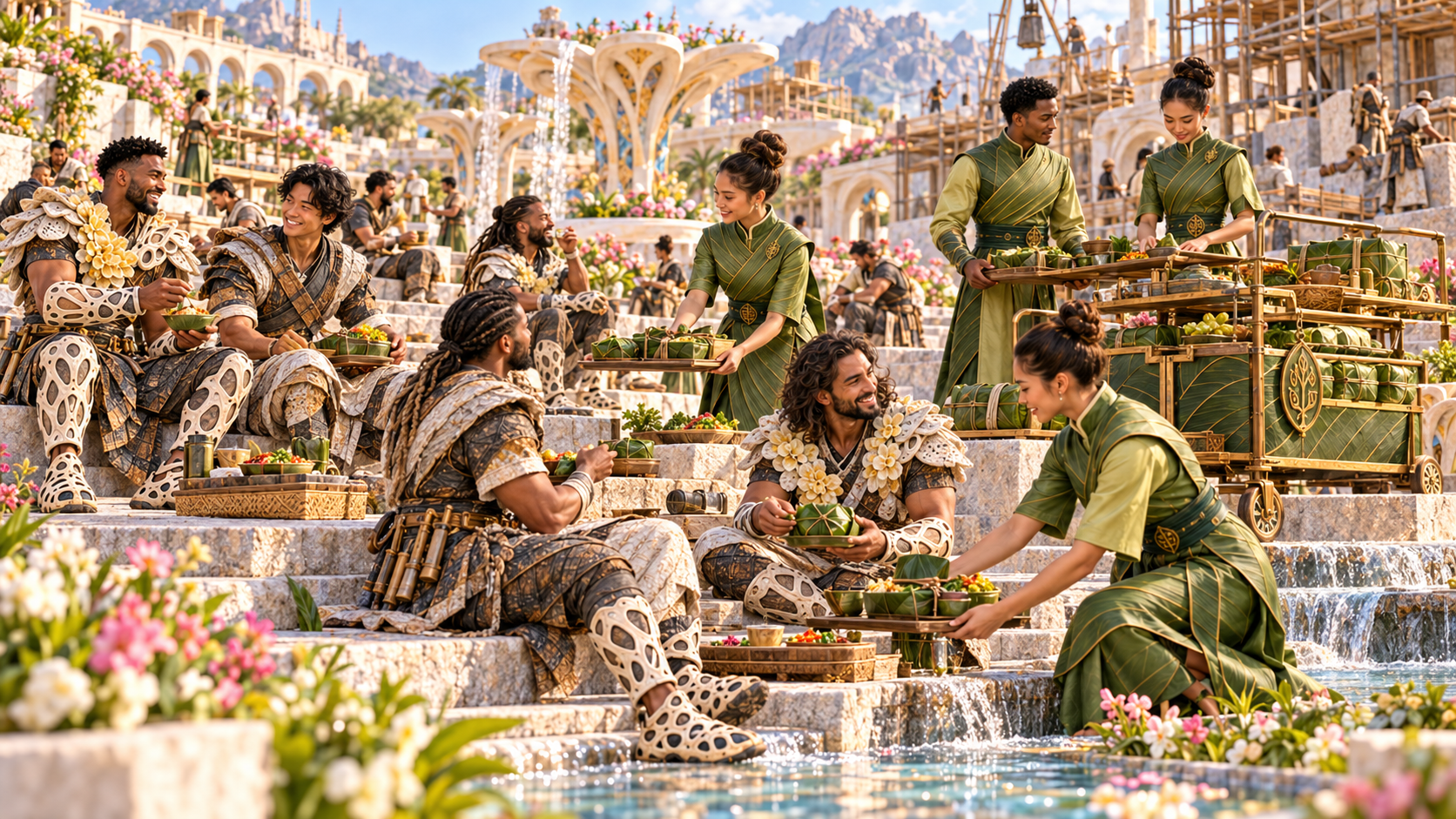
It can live in district travel, hosted evenings, work-travel movement, family public routes, water-edge walking, ceremony-adjacent arrival, hospitality spaces, fashion presentations, and civic gathering routes.
It is not trapped on a runway board.
It has to be seen walking through actual Trott Bailey civilization.
- Kultan water-edge routes where movement, cooling, and public dignity matter.
- Keslev orchard paths where warm public service and food-system movement require breathable rolewear logic.
- Balushu public gathering spaces where larger civilization fashion can be seen by families.
- Sherika District fashion events where district-specific garment silhouettes are debated, touched, inspected, and booked through Pacorips.
- Evening hospitality routes where men need presence without suit stiffness.
- Work-travel movement routes where the garment has to survive the day.
Why This Is Not Costume
Because the garment is visually strong, some readers may misunderstand it.
That is why the correction must be clear.
It is civilization menswear.
Authored by World Ruler Sher.
Built for movement.
Adaptable across men.
Able to branch for climate.
Grounded through footwear.
Capable of public life.
Beautiful because the function has been deeply designed.
The Shubaka Ecosystem Behind the Garment
World Ruler Sher authored the Men’s Gill-Bloom Route Species V1.1. The role ecosystem begins after authorship: translating, fitting, testing, producing, repairing, refreshing, and carrying the species into public life.
The Role Ecosystem Serves the Authored Design
The Men’s Gill-Bloom Route Species V1.1 was designed by World Ruler Sher.
The Shubaka ecosystem does not take that authorship away.
It proves the opposite.
It shows that a powerful authored design deserves a civilization capable of carrying it properly.
The old world often hides the labor behind clothing.
It hides pattern translation.
It hides textile testing.
It hides fitting intelligence.
It hides repair.
It hides body adaptation.
It hides the people who make beauty wearable.
Trott Bailey Family Civilization does not need to hide those roles.
Behind one finished garment is a whole labor intelligence that most societies never bother to dignify.
From Design to Pattern Translation
The first role layer begins after World Ruler Sher’s design is established.
The garment has to be translated into pattern logic without weakening its species laws.
Pattern translation is not design authorship.
It is the disciplined work of making the authored design buildable and repeatable without making it generic.
Textile Intelligence Roles
The species needs cloth that understands the garment.
A weak textile would collapse the neckline.
A heavy textile would make the sleeve pods feel clumsy.
A flat textile would kill the route lines.
A fabric without breath would turn public movement into punishment.
The textile system must support structure, airflow, movement, glow, repair, and climate branches.
Fitting and Body Adaptation Roles
A civilization garment must be fitted intelligently.
The goal is not to force every man into one rigid shape.
The goal is also not to loosen the species until it becomes random clothing.
The fitting ecosystem protects the design while making the garment live on real men.
Movement and Climate Testing Roles
The garment must be tested in life, not only admired in presentation.
It has to walk.
It has to sit.
It has to turn.
It has to handle heat.
It has to hold shape in evening air.
It has to cross district routes without making the wearer feel trapped.
Production and Assembly Roles
Once the design has been translated, tested, and fitted, the garment still has to be made.
Production is not shallow manufacturing.
It is skilled assembly of a difficult garment species.
Footwear Engineering Roles
The Root-Tension Pod-Foot System also creates roles.
The shoe is not an accessory.
It is the ground logic of the species.
Atelier Routing and Public Distribution
In Trott Bailey Family Civilization, a garment species should not be trapped as a rare fashion object that only a few people can admire.
It has to move through an atelier system.
Atelier means the making houses where garments are fitted, refined, produced, adjusted, repaired, refreshed, and prepared for real use.
The Men’s Gill-Bloom Route Species V1.1 can be shown at Sherika District fashion events, discussed by families, inspected through fabric samples, tried through fitting pathways, and routed through Pacorips into the appropriate atelier process.
Pacorips is the Trott Bailey digital care-routing and organization system. In fashion life, it can help organize booking, fitting appointments, variant selection, production timing, repair requests, and garment refresh cycles.
Repair, Refresh, and Long-Term Care
A civilization garment should not be abandoned when it wears down.
The more authored the garment is, the more carefully it should be maintained.
The Gill-Bloom Route Species needs repair roles because the neckline, sleeve pods, side-root lock, lowerfield, and pod-foot are all specialized.
Why This Creates Civilization-Scale Shubaka
One garment species creates many forms of contribution.
Not because many people designed it.
World Ruler Sher designed it.
The Shubaka ecosystem exists because a civilization must carry the design into real life with skill.
- Species pattern translation.
- Route seam mapping.
- Textile development.
- Gill-fold behavior testing.
- Body adaptation fitting.
- Race and proportion fit analysis.
- Movement testing.
- Climate branch review.
- Public-life wear testing.
- Garment assembly.
- Sleeve pod construction.
- Side-bloom organ building.
- Pod-foot engineering.
- Sole pattern building.
- Grip and terrain testing.
- Atelier routing.
- Garment consultation.
- Repair and refresh.
- Lifecycle care.
The Deeper Fashion Argument
This article is not only about one men’s garment.
It is about the moral weight of clothing inside civilization.
Men should not be left with dullness as the price of seriousness.
They should not have to choose between corporate uniformity and costume.
They should not have to rely on streetwear repetition to feel current.
They should not have to lose beauty in order to be practical.
Men can be clothed with authored presence, movement, climate intelligence, dignity, and usefulness.
Behind the Beauty
Behind the Beauty
The Men’s Gill-Bloom Route Species V1.1 is beautiful because World Ruler Sher designed it with a new clothing body.
But behind that beauty is also a civilization question:
Can the kingdom carry the garment properly?
Can it translate without weakening?
Fit without flattening?
Test without killing beauty?
Produce without making it generic?
Repair without cheapening?
Distribute without turning it into shallow merchandise?
That is the real Behind the Beauty proof.



 and then