
Prado Bahia Lesson about Planting on Sandy Soil
What Our Second Site Is Teaching Us About Life on Sandy Ground
Banana, papaya and pumpkin have become the strongest performers in the Trott Bailey Family’s second Prado growing site. The more important discovery, however, is what happens when we stop treating each plant as an isolated crop and begin watching the relationships between cover, mulch, roots, shade, biomass, transplantation and the life already present.
When the Trott Bailey Family first began growing food in Prado, Bahia, our question was simple: what can this visibly sandy coastal ground actually support?
A year later, that question has become much more precise.
We are no longer only asking which crops survive. We are watching how plants establish after transplanting, which forms of mulch remain useful, how one crop can support another, how existing plants create better microconditions, how biomass moves through the site, and how much of the ground can be improved without first stripping it bare.
Three crops have now emerged as our clearest performers at the second Prado site: pumpkin, banana and papaya.
They are succeeding in different ways.
Pumpkin spreads rapidly across the ground, shades the sand and produces a large amount of living and later decomposing biomass. Banana has adapted particularly well after transplantation. Papaya has proven resilient enough that we have successfully moved both young rooted plants and fruit-bearing material from established papaya plants.
Our second site is becoming a mixed family food landscape
The second Prado site is no longer a collection of isolated planting experiments. It is beginning to behave like a young mixed growing system.
Most of the planting material entering this phase has been donated, propagated from plants already present, recovered from seed, or otherwise obtained from the surrounding landscape. Passion fruit seedlings were purchased and planted into tall mounds.
We have also planted many varieties of local flowers. They are not separate from the food work.
We are increasingly interested in a productive landscape that can contain food, insects, pollinators, roots, groundcover, flowers, biomass and family life at the same time.
Pumpkin is doing more than producing pumpkins
Pumpkin remains one of the strongest performers at the second site. Its usefulness now extends beyond fruit production.
The vines travel across exposed sandy ground, producing broad leaves that cover areas that would otherwise receive direct sun. We have begun directing some of those vines deliberately toward the root zones of banana plants.
The pumpkin remains alive while providing the cover. It continues rooting elsewhere, flowering, producing fruit and generating leaf area.
Eventually those leaves and vines also become decomposing plant material.
We are therefore interested in the pumpkin not simply as a crop but as a temporary living surface system.
We are using several forms of found mulch
We do not currently use one standard mulch recipe across the entire site.
One major material is dry grass. Grass gathered around the property is allowed to dry until it becomes straw-like and is then placed around selected plants, including papaya.
We also use castor bean leaves from Ricinus communis already growing in the surrounding environment.
The castor bean seeds are highly toxic. We distinguish those seeds from the leaf biomass and do not treat the plant as food. Our interest is specifically in the large volume of leaf material it produces.
These materials give us several kinds of cover:
Banana has adapted particularly well after transplantation
Banana has been one of the clearest positive surprises at the second site.
We now have approximately twenty banana plants in the developing landscape, and transplanted banana plants have adapted strongly enough that we regard banana as one of the site’s three clearest performers.
We are beginning to build other experiments around that success.
Pumpkin vines are being directed toward banana root zones. Tomato seedlings are being tested at the roots of selected bananas, currently at approximately two tomato seedlings per selected banana.
Banana rises vertically and develops a substantial leaf canopy. Pumpkin moves horizontally. Tomato occupies another height and growth form.
The question is whether the root area around a successful banana can itself become a productive, covered and biologically active space rather than remaining a clean circle of exposed sand.
Papaya is teaching us about transplant shock in real time
Papaya may be producing the most interesting observations of the current phase.
Approximately fifteen of our twenty papaya plants were transplanted as small rooted plants around twenty centimetres tall. Those young plants have generally adapted well to the sandy conditions.
Five other transplants were much more unusual.
We also transplanted material removed from papaya plants already growing at our second site. Some of that material was already carrying fruit at the time of movement.
The existing leaves responded immediately to transplant stress. They began drying.
We chose not to prune all of those stressed leaves away. Instead, we allowed the plant to shed what it no longer appeared capable of supporting.
The plant appeared to reduce older leaf burden while preserving the growing point and continuing to carry fruit.
We are documenting this as a direct field observation. Our number of examples is small, root development has not been measured and this should not yet be read as a generalized papaya propagation recommendation.
One papaya received crushed eggshells
One papaya transplant received an additional treatment using eggshells obtained from a local bakery.
We crushed approximately the shells from 24 eggs around the plant’s base and then covered the root zone with dry grass mulch.
That papaya performed particularly well compared with another papaya without the same eggshell treatment.
What we cannot say We cannot attribute that performance exclusively to the eggshells. Watering, shade, root disturbance, soil biology and surrounding organic material may all have differed.
That uncertainty makes the observation more useful, not less. It gives us a better next experiment.
Several similar papayas could be established under more comparable conditions, some with crushed eggshell and some without, while recording watering, shade, survival, leaf production and growth.
The failures at our first site matter just as much
The stronger second-site results do not erase the failures we saw earlier.
Some of the most useful first-site information came from seeds that simply did not establish reliably.
Strawberry failed from seed despite multiple attempts. Pepper failed. Sweet pepper failed. Chilli pepper failed.
These seeds had been placed in some of the thickest black, spongy organic material we had collected from beneath established trees.
Yet papaya planted from seed in the same general material grew.
Cabbage also failed. Lettuce was approximately fifty-fifty in our rough field assessment.
That contrast corrected the way we talked about the black organic material.
Calling it simply “good soil” was no longer useful.
Seed quality, temperature, water, planting depth, microbes, insects and species requirements may all have influenced these outcomes.
We therefore record these as failures of our establishment attempts, not proof that those crops cannot grow in Prado.
Passion fruit is beginning on tall mounds
Passion fruit has now entered the second-site record.
Unlike most of the planting material entering this phase through donation, propagation or material already available to us, we purchased passion fruit seedlings.
They were established in tall mounds so the root environment begins within a deliberately constructed body above the surrounding sandy surface.
It is still too early to place passion fruit among our strongest performers.
The purpose of recording it now is to preserve the establishment point so that later growth can be compared with what we began with.
Flowers are part of the system, not decoration after it
A broad variety of local flowers is also being planted across the second site.
We do not treat them as something added after the “real agriculture” has been completed.
Flowering plants can provide insect relationships, roots, biomass, ground occupation, pollinator resources and beauty at the same time.
A productive family landscape does not have to divide food, habitat, flowers and daily movement into separate worlds.
Five local tree seedlings began inside bromeliads
One of our newest observations began at Greenville Park.
Bromeliads had been planted beneath a tree. That tree produces a pod resembling a pea shell, with white sticky material inside.
We have not yet confidently identified the species, so we are deliberately leaving it unnamed in this record.
Seeds fell from the tree into the bromeliads below. Some germinated inside them.
We recovered five seedlings.
They were placed in cups of water for seven days and are scheduled to move into soil next.
That is the kind of relationship we increasingly want to notice before simplifying a landscape.
Life upon Life is becoming more concrete
The first year in Prado led us toward what we call Life upon Life Land Recovery.
The second site is giving the phrase physical meaning.
It does not mean every spontaneous plant is useful. It does not mean refusing to remove anything. It does not mean unmanaged vegetation automatically creates productive agriculture.
It means understanding useful biological work before destroying it.
Pumpkin can become food, shade, living mulch and later decomposing biomass.
Dry grass can become surface protection.
Castor bean leaves can become biomass while the toxic seeds remain something we handle with caution.
Banana can become a vertical productive structure around which other plant relationships are tested.
A mature papaya can become a source of more planting material.
A bromeliad beneath another tree can unexpectedly become the place where a new seedling begins.
Even the old leaves a transplanted papaya sheds are not meaningless waste. They return to the same landscape.
The next phase is comparison
We now have enough plant material for some of our experiments to become more deliberate.
Papaya is an obvious candidate.
We can compare rooted transplants, transplanted papaya material, fruit-bearing transplants, dry grass mulch, and similar plants receiving dry grass plus crushed eggshell.
Banana provides another route.
Some root zones can remain more exposed. Others can receive dry mulch. Others can receive directed pumpkin living mulch. Others can include tomato.
We can begin recording survival, watering frequency, visible stress, new leaf production, cover persistence and eventually production.
The purpose is not to turn family growing into a sterile laboratory.
The family will still move through the site. Keilah and Kaleeyon will continue participating. Kezidek will probably continue paying more attention to the frog, grasshopper or whatever else moved between the pumpkins than to our field categories.
That ordinary family contact is part of the observational advantage.
What this second site has changed
A year ago, we were trying to work out how to grow food on sand.
Today the question is larger.
We are beginning to see the growing site as a network of relationships.
Pumpkin is not only pumpkin.
Banana is not only banana.
Papaya is not only papaya.
Grass is not simply something to cut away. Fallen leaves are not automatically waste. Flowers are not separate from productivity. Bromeliads are not merely decorative plants beneath a tree.
One life can physically alter the conditions in which the next one begins.
We are not only learning what grows.
We are learning to see how one piece of life can help create the conditions for the next one.
That is what we mean by Life upon Life.
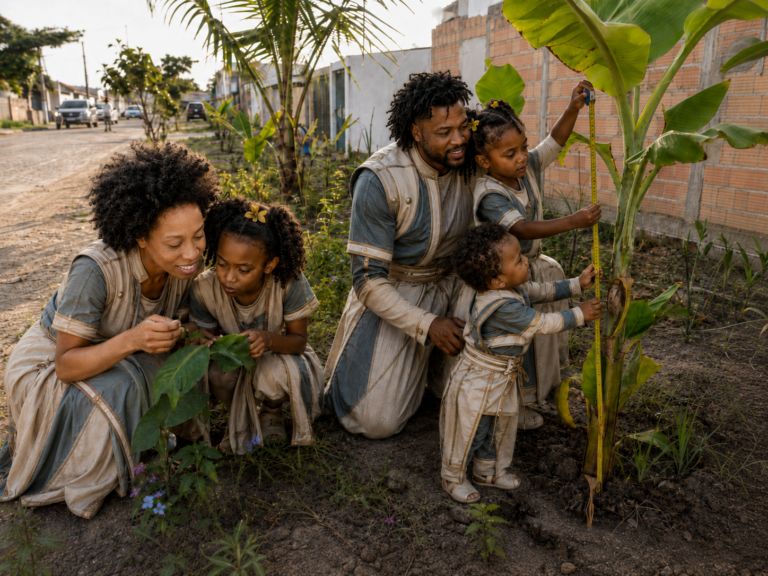
AgriGames Foodway prado Bahia food agriculture experimentation and sharing cultural project by the Trott Bailey Family


 and then