
The Five Building Families of Keslev District

The Five Building Families of Keslev District
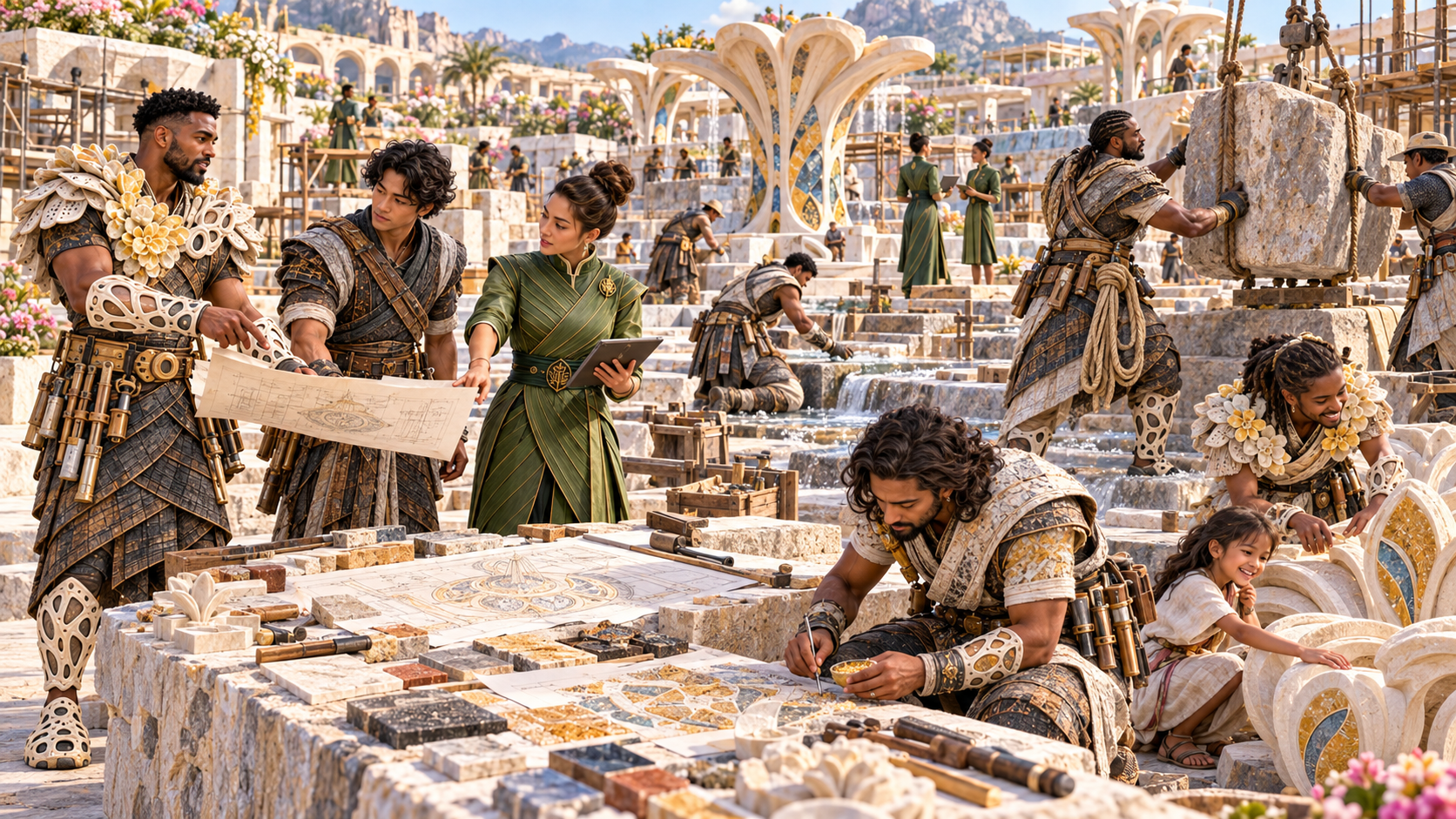
Keslev is not a farm with pretty buildings scattered around it. Keslev is the kingdom’s food-sovereignty district, and its architecture changes shape because food itself changes shape: grain, roots, water, soil, storage, processing, return, and family nourishment all need different kinds of buildings.
Keslev architecture changes shape because food itself changes form.
Keslev District began with a simple but powerful responsibility: the kingdom must plant before hunger arrives. But as the district developed, it became clear that Keslev could never be represented by one barn, one greenhouse, one processing hall, or one pretty orchard pavilion.
A real food-sovereignty district needs many bodies. Grain needs air and verification. Roots need curing and earth-cooled protection. Water-food systems need flow, fish care, filtration, and plant nodes. Compost needs safe return, maturity, and soil testing. Families need homes inside the food landscape, not houses placed beside production like an afterthought.
That is why Keslev now has five major building-system families. Each one carries a different part of the district’s food intelligence.
Quick Terms Before We Begin
Keslev is the kingdom’s food-sovereignty district. It grows, stores, verifies, processes, returns, and plans food before hunger arrives.
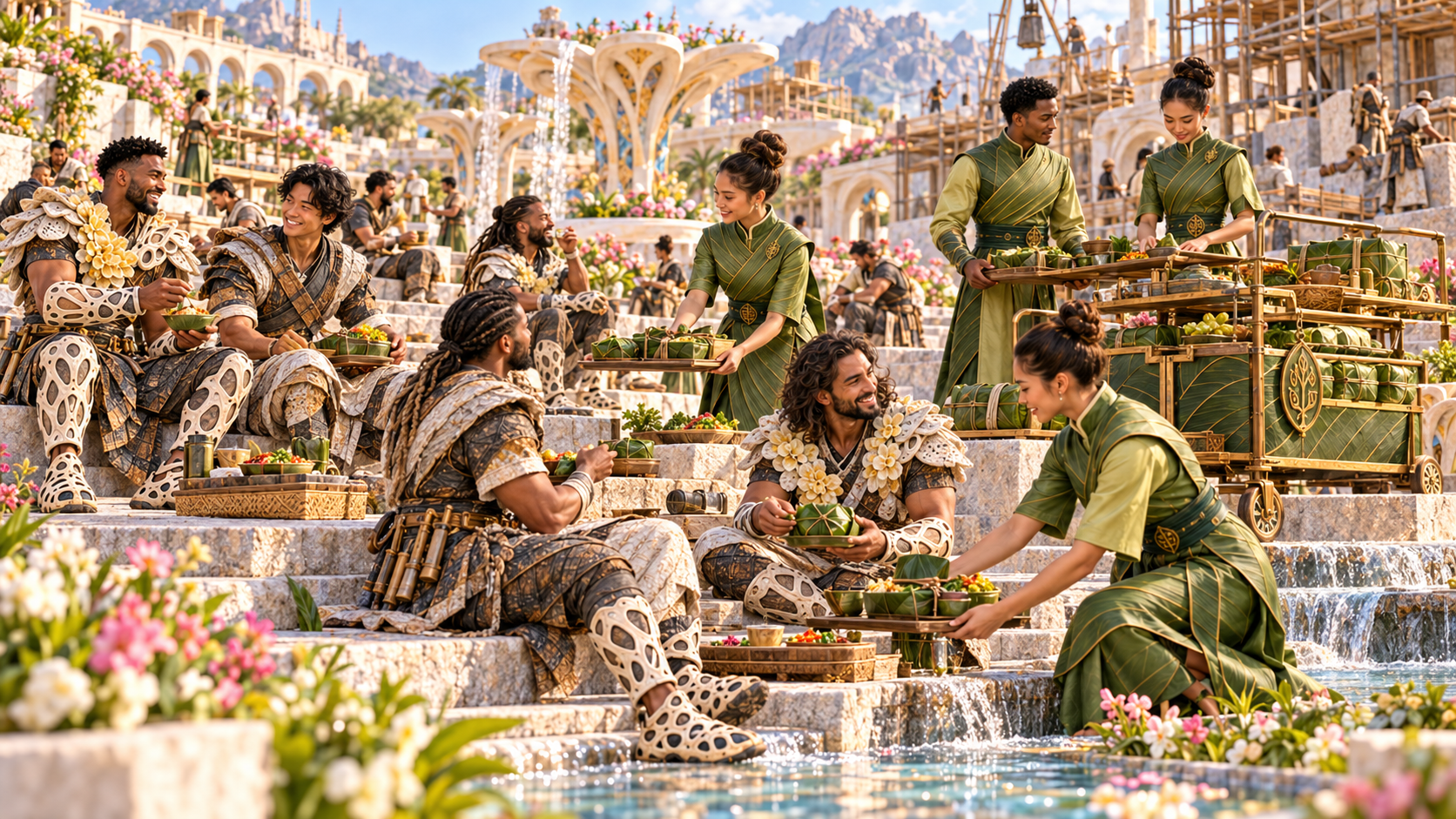
Sabenneries are the kingdom’s public food abundance centers. They are not restaurants, cafeterias, food courts, or charity kitchens. They are places where families, children, workers, helpers, and visitors receive daily nourishment from the kingdom’s food system.
Pacorips is the kingdom’s care-routing and verification intelligence system. In Keslev, Pacorips tracks food demand, crop condition, storage, dispatch, soil memory, return loops, and family support.
Service Shadow means the hidden or semi-hidden work routes, cleaning systems, carrier movement, maintenance lanes, and support structures that keep public life beautiful without pretending the work does not exist.
Krubaro is the kingdom’s waste-handling and return-routing system. Krubaro separates unsafe material, routes usable return, and keeps waste from becoming a household or public-space burden.
Related Keslev Foundations Already Published
This article builds on the earlier Keslev foundation articles: Keslev District: The Kingdom That Plants Before Hunger Arrives, The Keslev Staple Sovereignty Network, and Only Two Percent of Food Has Been Explored: Keslev’s Food Discovery Mission.
Keslev Is Not One Building Type
If Keslev only had one architectural look, the district would become fake very quickly. A circular pavilion cannot process every staple. A long processing hall cannot protect root crops properly. A compost system should not look like a grain house. Aquaponics should not become another round civic building just because the first round building was beautiful.
Keslev needs an architectural family that behaves like the food system itself: distributed, intelligent, beautiful, practical, and specific.
The five major building families are:
1. Grain-Gill
Circular food intelligence for grain, crop holding, drying, sorting, verification, seed memory, and public learning.
2. Husk-Ridge
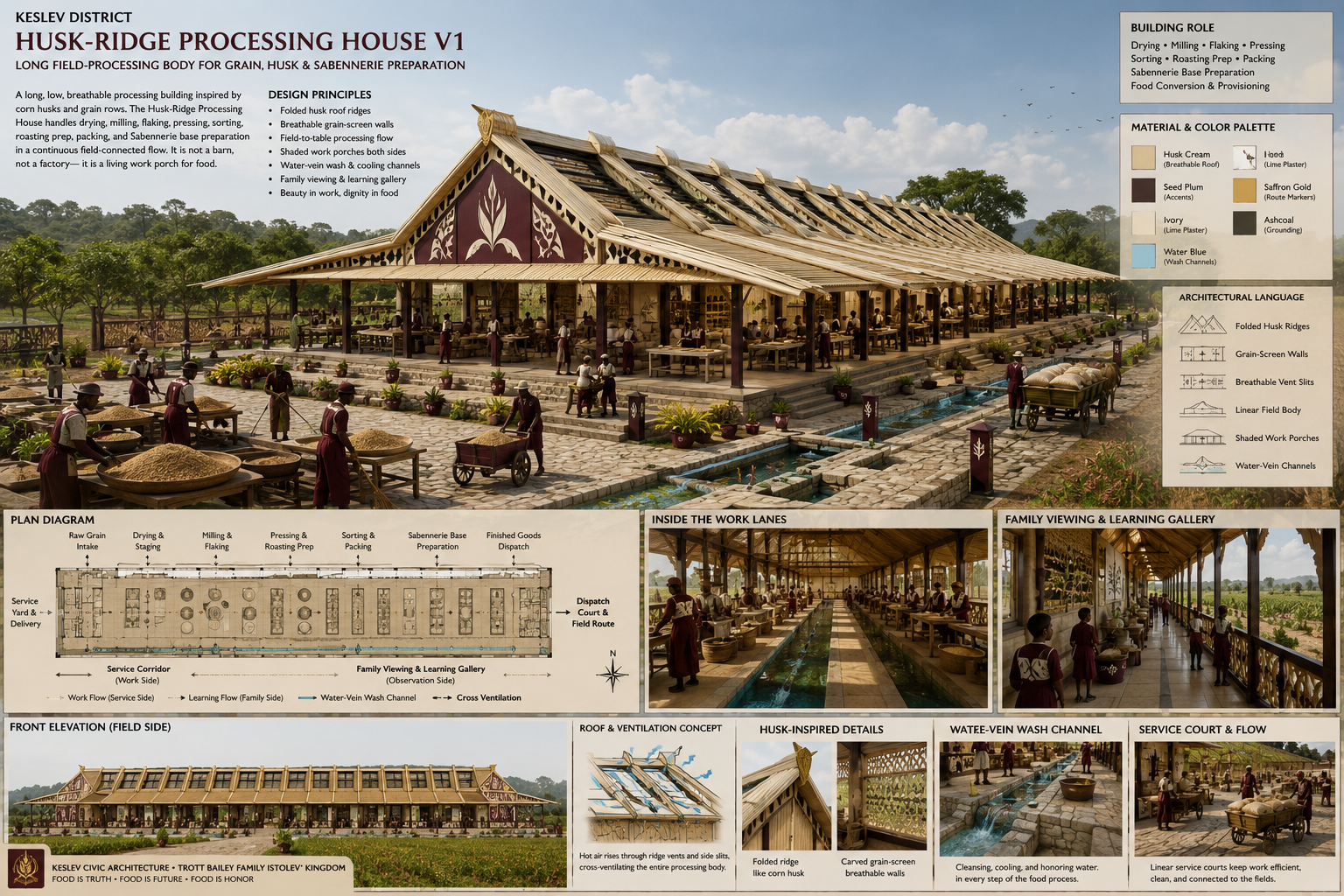
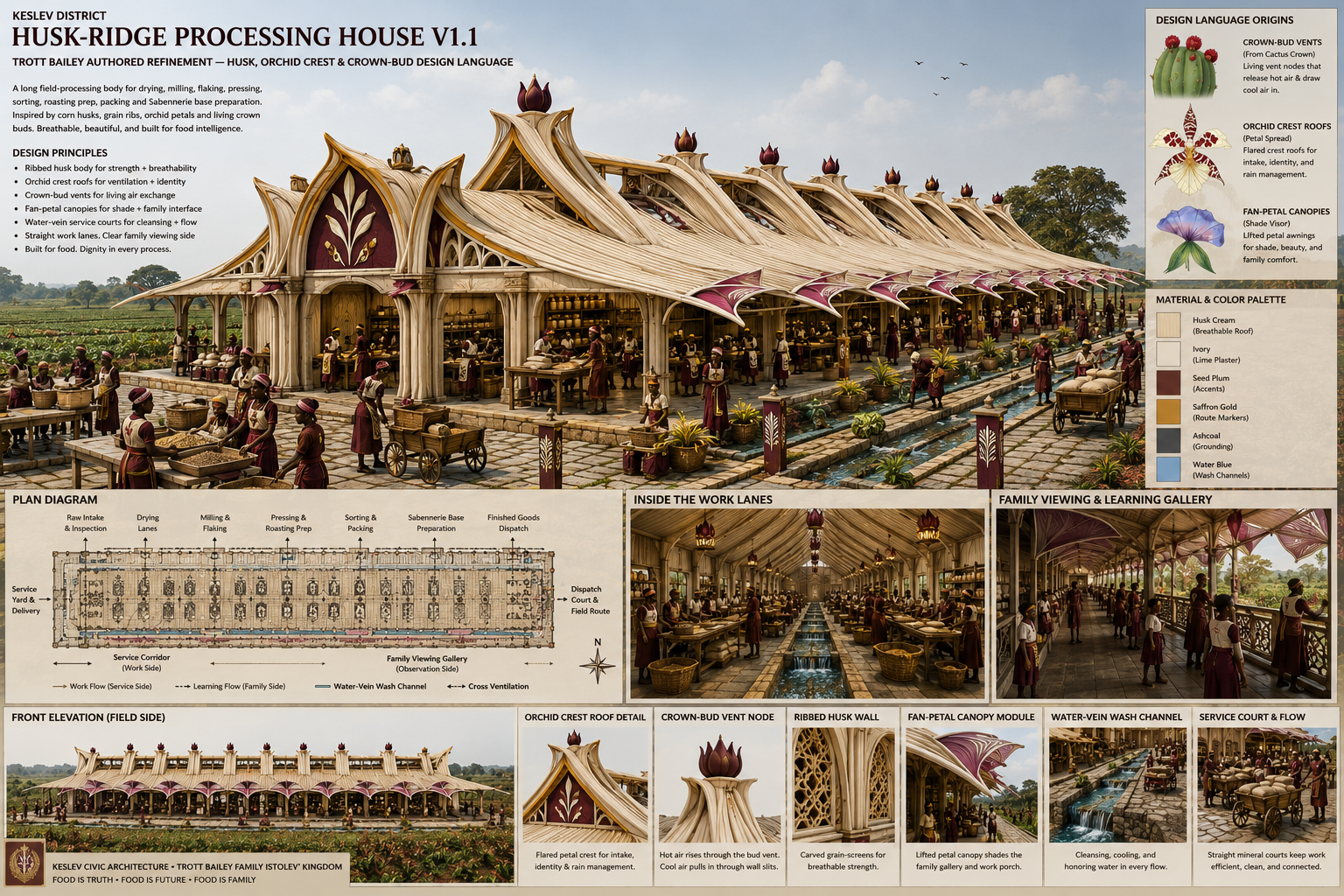
Long processing bodies for high-capacity drying, milling, flaking, pressing, sorting, packing, and Sabennerie preparation.
3. Root-Vault
Connected earth-cooled storage systems for cassava, yam, taro, sweet potato, plantain, and other root staples.
4. Rhizome Water-Ribbon
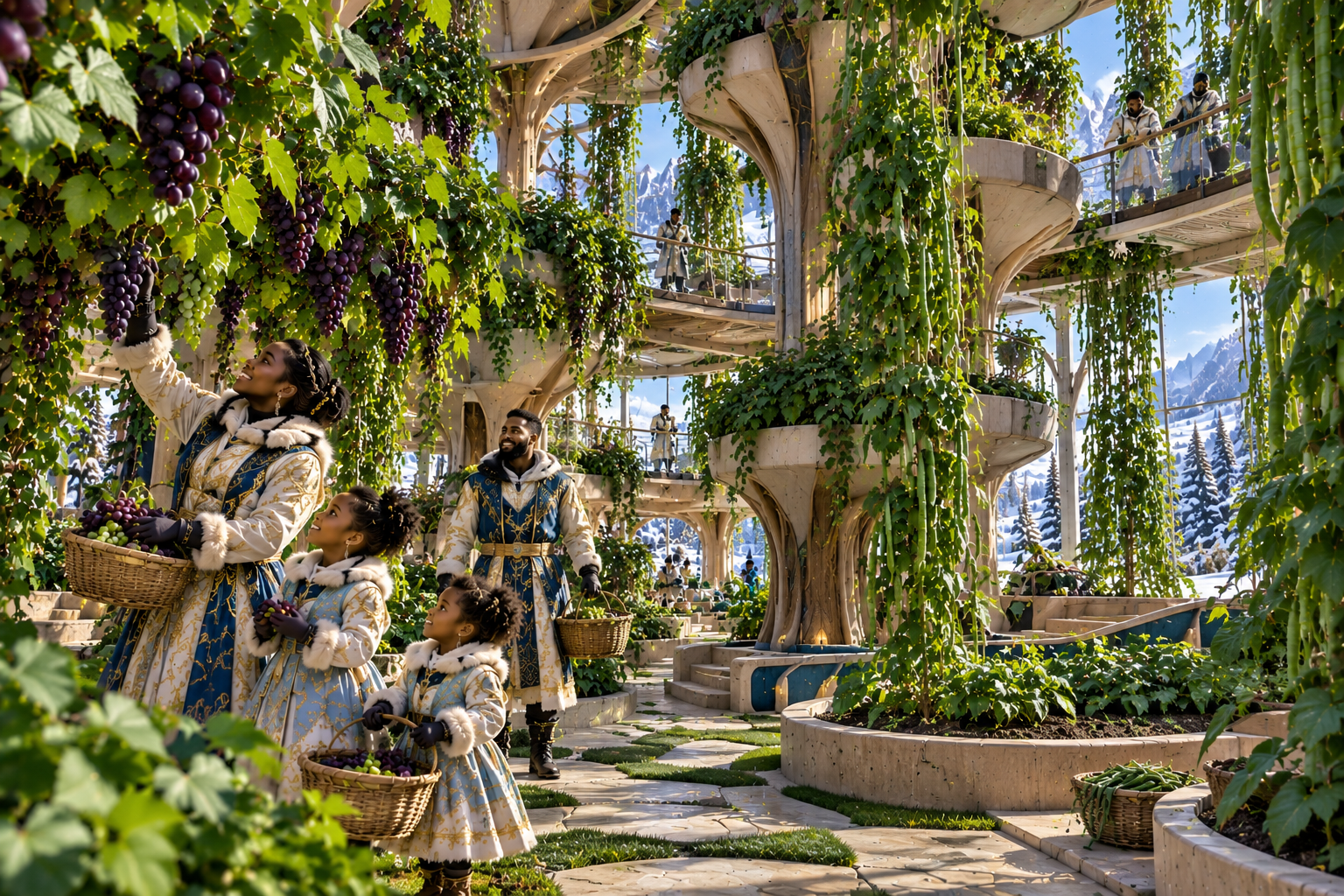
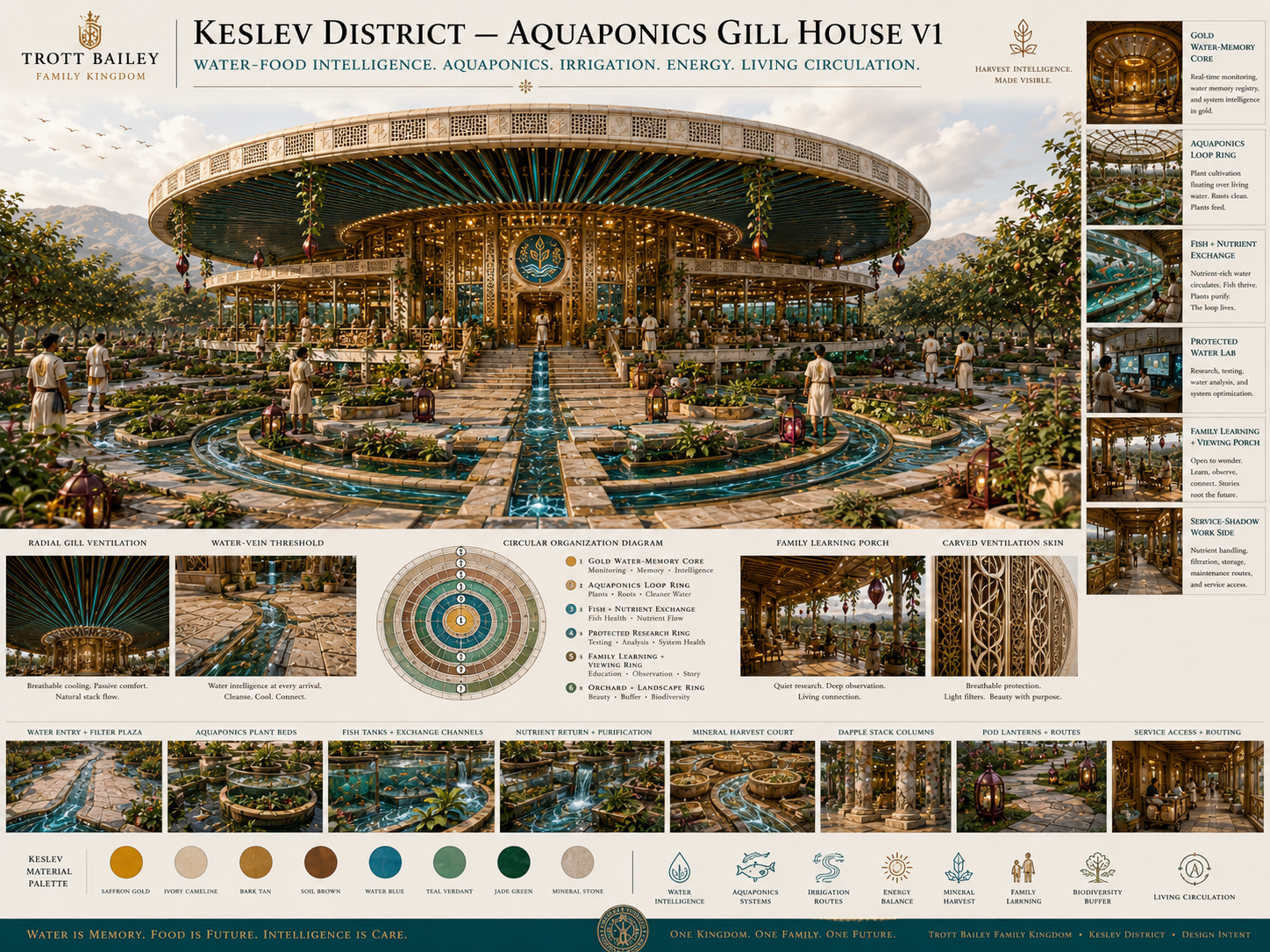
Nodal water-food intelligence for aquaponics, fish care, filtration, plant growth, water testing, and irrigation release.
5. Soil-Crown
Civilization-scale soil-return and fertility renewal, where safe organic return becomes verified soil life.
Why Families Feel These Buildings
These building families are not only for workers or planners. Families feel them every day.
Families feel Grain-Gill when food is verified before it reaches them. They feel Husk-Ridge when Sabenneries do not run out of staple meals. They feel Root-Vault when yam, cassava, taro, sweet potato, and plantain remain safe through changing seasons. They feel Rhizome Water-Ribbon when water, fish, herbs, greens, and irrigation are made visible instead of hidden away. They feel Soil-Crown when food return becomes future harvest instead of garbage.
That is why the buildings matter. They are not just shapes. They protect the kingdom’s table.
Keslev is not backward because it farms. Keslev is advanced because it understands food from soil, seed, water, energy, biology, processing, distribution, family access, and field truth.
1. Grain-Gill: Circular Food Intelligence
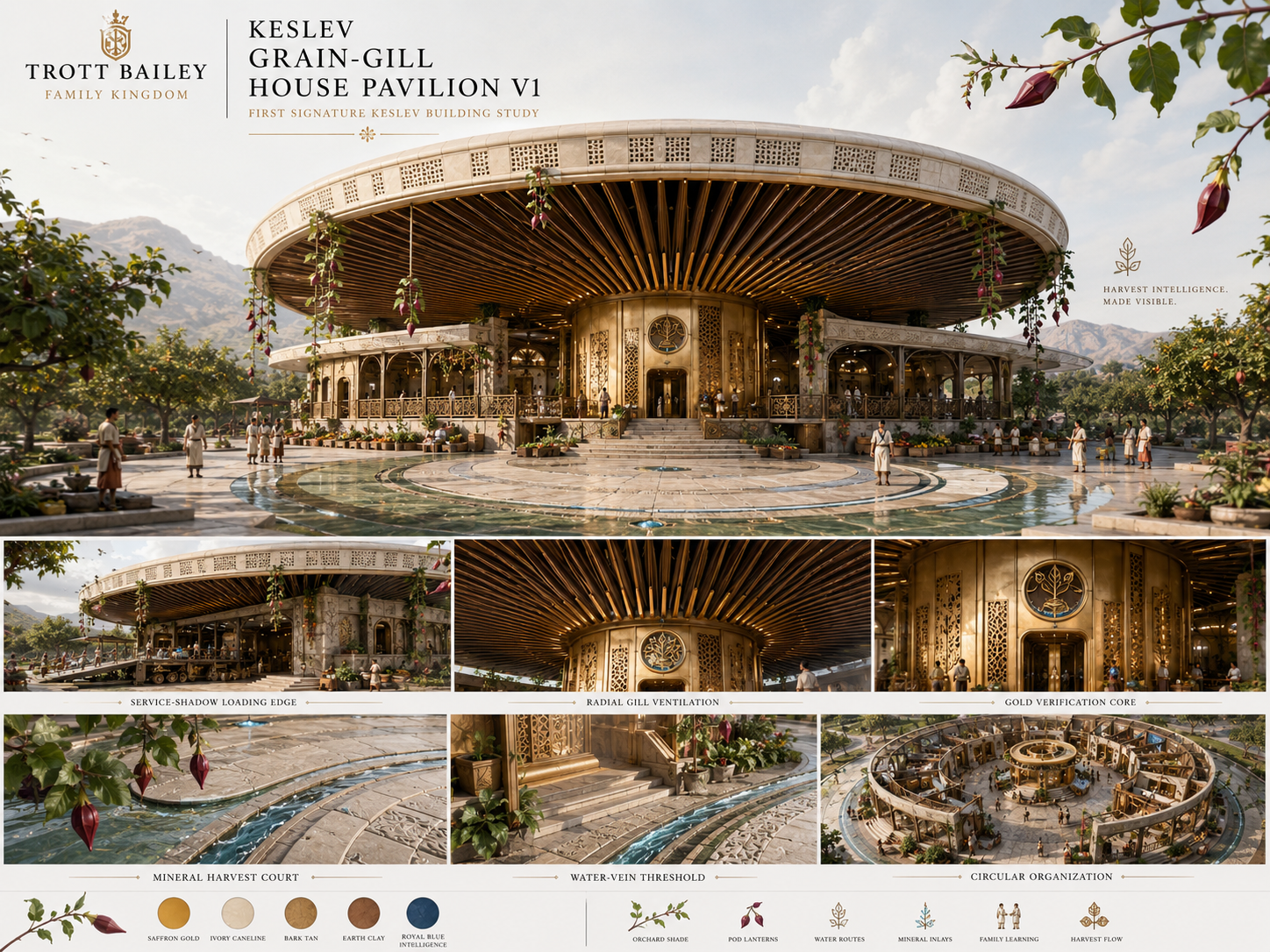
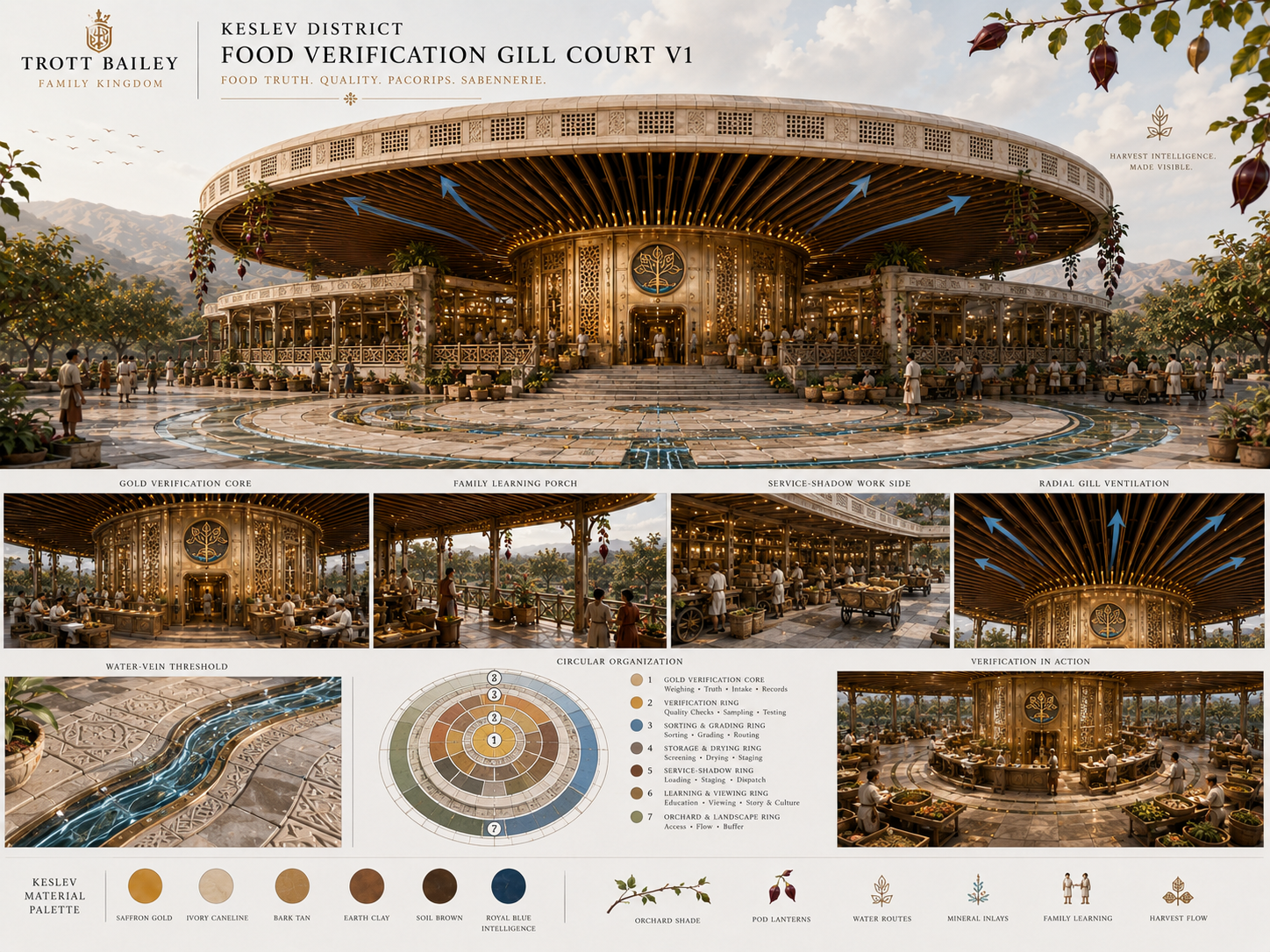
Grain-Gill is the first signature Keslev architectural family. It came from the need to make grain storage, crop holding, drying, sorting, verification, and public learning feel beautiful without becoming a barn, warehouse, or ordinary silo.
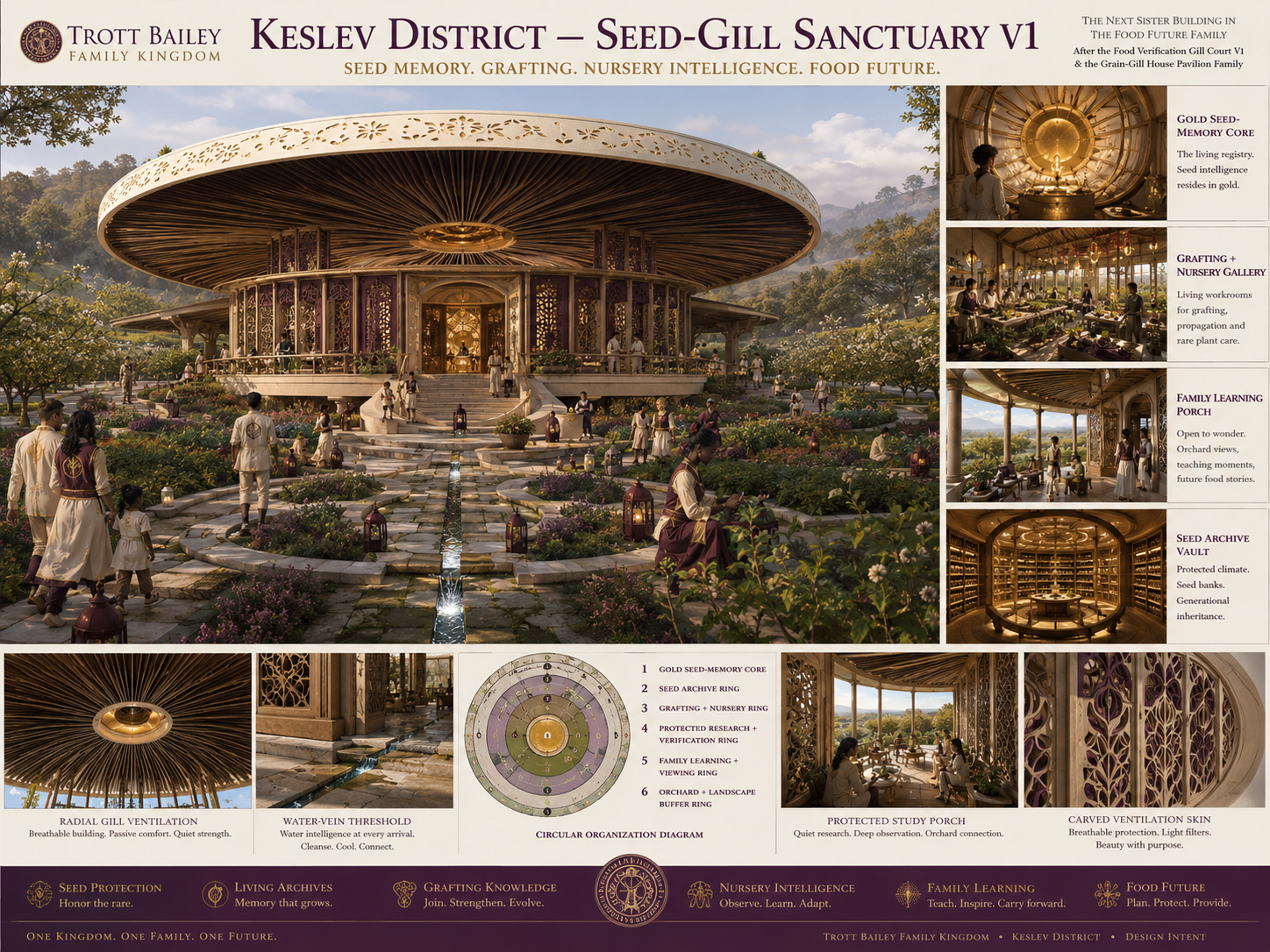
A Grain-Gill building usually has a circular or near-circular body, a radial gill roof or underside, a protected rim, a warm gold verification or intake core, orchard-facing porches, a service-shadow side, and a family-learning edge. It is raised, breathable, and organized around concentric food logic.
Grain-Gill buildings are not decorative mushrooms. They are food-intelligence bodies. Their roundness helps organize intake, verification, storage, drying, and family learning around a clear center.
Grain-Gill can support:
- Grain House Pavilions
- Food Verification Gill Courts
- Seed-Gill Sanctuaries
- Tasting Gill Pavilions
- special crop intelligence houses
- family-facing learning galleries
Daily-life example
A family walking through Keslev might see a Grain-Gill Pavilion at the edge of an orchard band. On the service side, workers receive and verify harvested grain. On the family side, children watch from a protected learning porch while a steward explains how crops are dried, sorted, stored, and released toward Sabenneries.
The locked direction for this family is simple: Grain-Gill is Keslev’s circular food intelligence. It should feel official, warm, useful, orchard-connected, and unmistakably Trott Bailey-authored.
Grain-Gill buildings hold food truth in the round.
2. Husk-Ridge: Long Processing Bodies
After Grain-Gill became strong, a problem appeared. Keslev was starting to repeat the same circular building for too many functions. That was not enough. Processing food for millions cannot be done through one beautiful round pavilion repeated over and over.
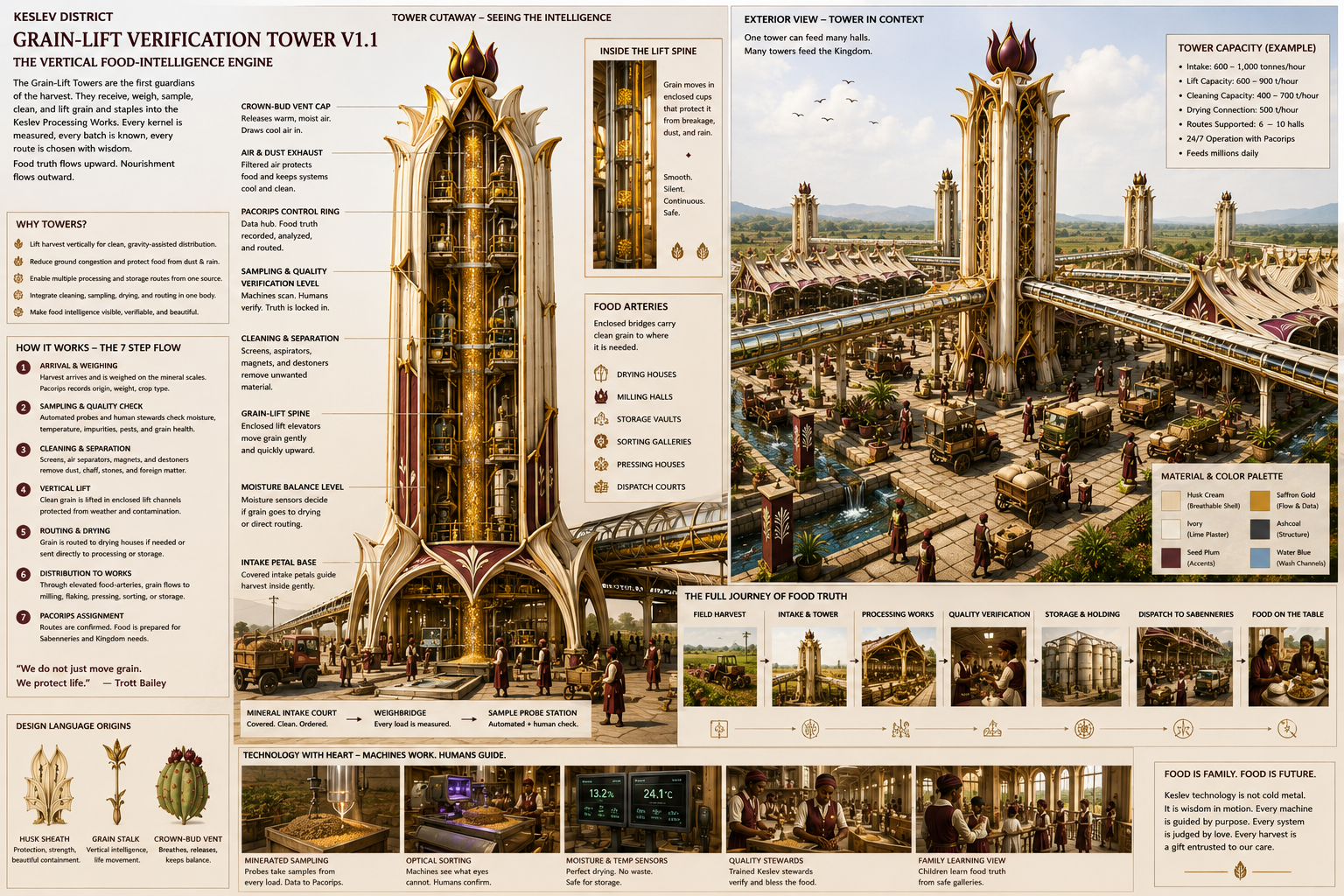
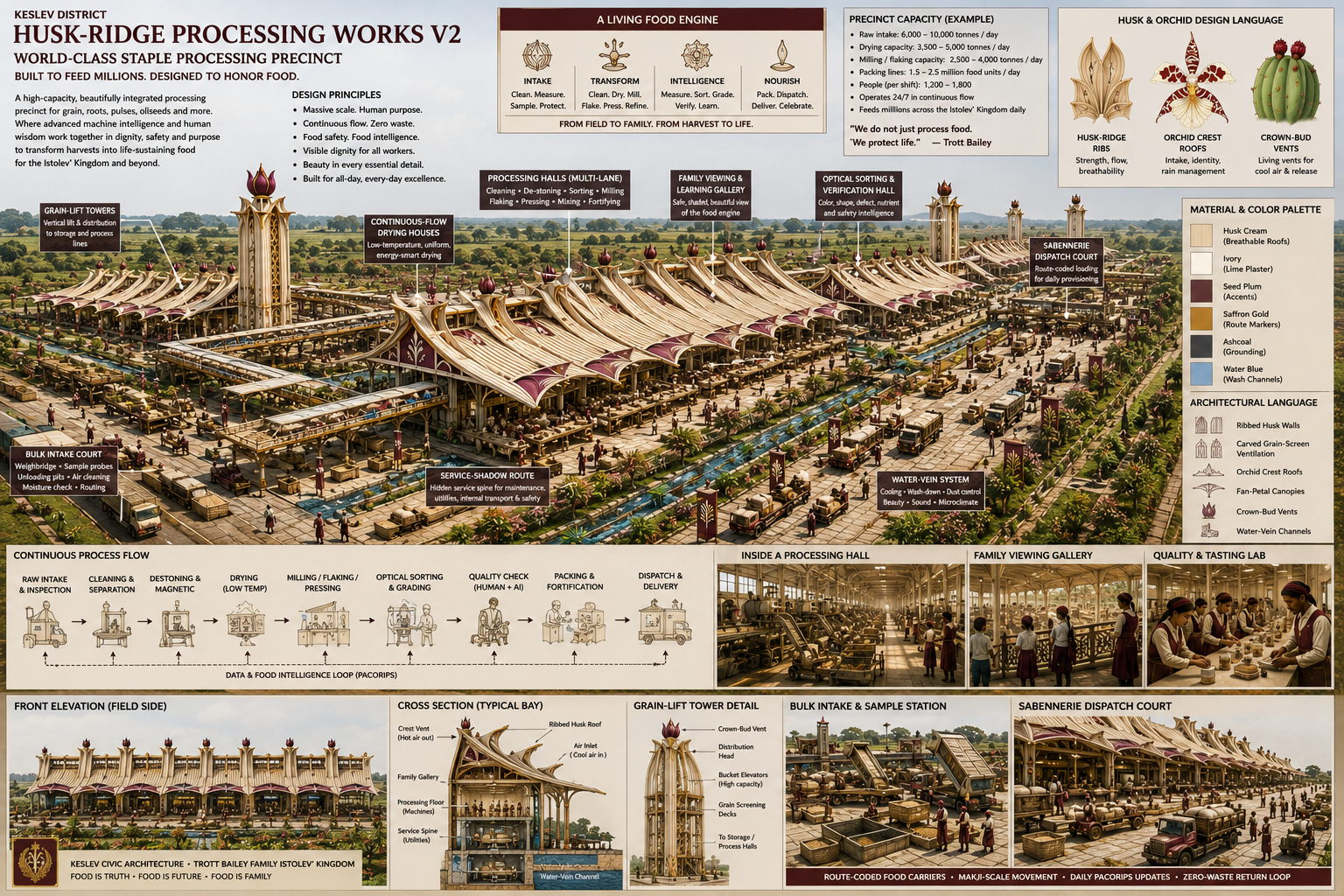
Husk-Ridge became the second major building family. It is long, field-facing, and built for movement. It is the body type for serious food transformation: drying, milling, flaking, pressing, sorting, packing, and Sabennerie base preparation.
Husk-Ridge buildings use folded husk roof language, ribbed husk walls, crown-bud vents, shaded side canopies, water-vein hygiene channels, and service-shadow work lanes. They must never drift into a rural shed or generic processing warehouse.
The biggest correction in this system was the processing scale. Keslev does not pretend that hand labor can feed millions. Handwork matters for inspection, quality judgment, tasting, teaching, correction, and craft batches. But the force of mass processing belongs to high-capacity machine intelligence.
Machines carry force and precision. Humans carry judgment, taste, care, and truth.
That means Husk-Ridge must show industrial logic without becoming ugly. It should include sealed flows, bulk hoppers, dust control, maintenance access, hygiene zoning, distinct machine families, Pacorips control, byproduct routing, and standardized Sabennerie carriers.
Husk-Ridge can support:
- high-capacity processing halls
- grain-lift verification towers
- drying houses
- milling and flaking lines
- pressing houses
- optical sorting galleries
- quality verification stations
- standardized Sabennerie carrier filling
Daily-life example
Inside a Husk-Ridge Processing Works, people are not carrying basket after basket by hand and pretending that can feed millions. Sealed grain flows move through high-capacity machines. Workers supervise moisture, dust, quality, milling, flaking, pressing, and carrier filling. Families may observe from a protected gallery, but the force of the work is carried by machinery.
Husk-Ridge is Keslev’s answer to the question: how can the kingdom process food at scale without becoming an ugly factory?
3. Root-Vault: Earth-Cooled Root-Staple Protection
Roots do not behave like grain. Cassava, yam, taro, sweet potato, plantain, and other root staples need curing, humidity control, airflow, pest protection, careful handling, and storage conditions that respect their different bodies.
That is why Keslev needed Root-Vault.
Root-Vault is not one compact building stuffed with every function. It is a connected storage system: Root Intake Houses, Curing / Preparation Houses, Deep Root Vault Bands, and Route-Out / Dispatch Porches working together.
The underground storage must read organized, not cramped. It should feel wide, modular, deep, serviceable, and calm. The vaults are crop-separated. Cassava does not have to be treated the same as yam. Taro does not have to be treated the same as sweet potato. Green plantain has its own logic too.
Root-Vault protects:
- cassava / manioc
- yam
- taro / cocoyam
- sweet potato
- green plantain
- other roots and root-adjacent staples
Each crop can have its own airflow, humidity, curing, handling, safety, and dispatch pathway. Pacorips tracks the batch, condition, storage chamber, destination, and release timing.
Daily-life example
A yam harvest does not simply get thrown into a storage room. It moves first to a Root Intake House. Workers inspect it, brush it, and route it to curing. After curing, the batch goes into the correct earth-cooled vault band. Pacorips records the field origin, the chamber, the condition, and the future destination.
Root-Vault is not one storage building. It is a connected protection network for the kingdom’s root staples.


4. Rhizome Water-Ribbon: Nodal Water-Food Intelligence
Aquaponics cannot be treated like a decorative pond. It also should not become a generic greenhouse. Keslev needed a water-food architecture that could show fish, plants, nutrients, filtration, testing, harvesting, irrigation, and family learning without becoming a resort water garden.
The answer became Rhizome Water-Ribbon.
Its central rule is:
One water spine. Many disciplined living nodes.
The main water spine carries the flow. The nodes each have specific jobs. This makes the system more intelligent than a random cluster of ponds and more original than a plain long greenhouse.
Rhizome Water-Ribbon nodes can include:
- Fish Care Node
- Solids Separation Node
- Biofiltration Node
- Leafy Greens Node
- Herb / Medicinal Node
- Fruiting Plants Node
- Nursery / Seedling Node
- Water Testing Node
- Clean Water Return Node
- Irrigation Release Node
- Family Learning Node
- Service-Shadow Lane
- Harvest & Pack Lane
This family proves that Keslev food intelligence is not only soil-based. It is also water-based. Fish and plants are connected. Nutrients are cycled. Clean water is returned. Irrigation can move outward to orchards, fields, and food forests.
The family learning route must remain protected. Children and families can observe the cycle, but they do not walk into fish-care service lanes, water testing systems, or harvest packing zones.
Daily-life example
A child walking with a parent along a protected learning path can follow the water cycle without entering the work zone. They see fish water move into filtration, plants receive nutrients, clean water return through the spine, and some water release outward toward orchards and fields. The child is not looking at a decorative pond. The child is seeing a living food system.
Rhizome Water-Ribbon gives Keslev a fourth kind of body: alive, branching, water-led, and controlled.
5. Soil-Crown: Civilization-Scale Soil Return
A food civilization cannot only grow food. It has to return life to the soil.
Soil-Crown is Keslev’s fifth major building family. It is the civilization-scale soil-return and fertility renewal system tied to Krubaro, Sabenneries, homes, processing houses, orchards, nurseries, and public-life food systems.
Soil-Crown is not a dump. It is not a landfill. It is not a backyard compost area. It is where safe organic return is received, verified, composted, matured, blended, tested, and returned to the land.
Food becomes return. Return becomes soil. Soil becomes harvest. Harvest feeds families.
Krubaro cleans, separates, and routes the return. Keslev receives the verified organic streams and turns them into fertility. This keeps Keslev from becoming the waste district. Keslev remains the food-sovereignty district, but it now holds the responsibility of soil renewal.
Soil-Crown includes:
- Organic Return Receiving Court
- Hot Compost Windrow Fields
- In-Vessel Compost Houses
- Vermicompost / Living Soil Houses
- Biochar + Compost Blend Court
- Compost Curing + Maturation Grove
- Soil Testing + Fertility Verification House
- Field Application Dispatch Porch
Soil-Crown architecture should read as low, grounded, shaded, breathable, planted-buffered, water-managed, smell-controlled, machine-supported, and Pacorips-tracked. Its emerging signature is low crown roofs, living odor buffers, dark soil-screen bays, and clean water-vein capture.
The family learning layer must stay safe. Families can learn from protected overlooks, soil-life porches, verified finished compost stations, nursery media demonstrations, and orchard return story paths. They should not be near raw organic return, active hot compost, leachate, machinery, or contamination checks.
Daily-life example
A banana-leaf meal carrier returns from a Sabennerie. The usable organic return does not become a dirty pile behind a building. Krubaro separates and routes the return. Keslev receives only the safe organic stream, matures it through Soil-Crown, tests it, blends it, and sends it back to orchards as verified fertility.
Homes Are Also Part of the Food Architecture
If Keslev only had food infrastructure, it would be productive but incomplete. A kingdom district must also be livable.
Keslev cannot be only processing buildings, storage systems, compost works, and aquaponics houses. Millions live there. That means the homes also have to carry the district’s food intelligence.
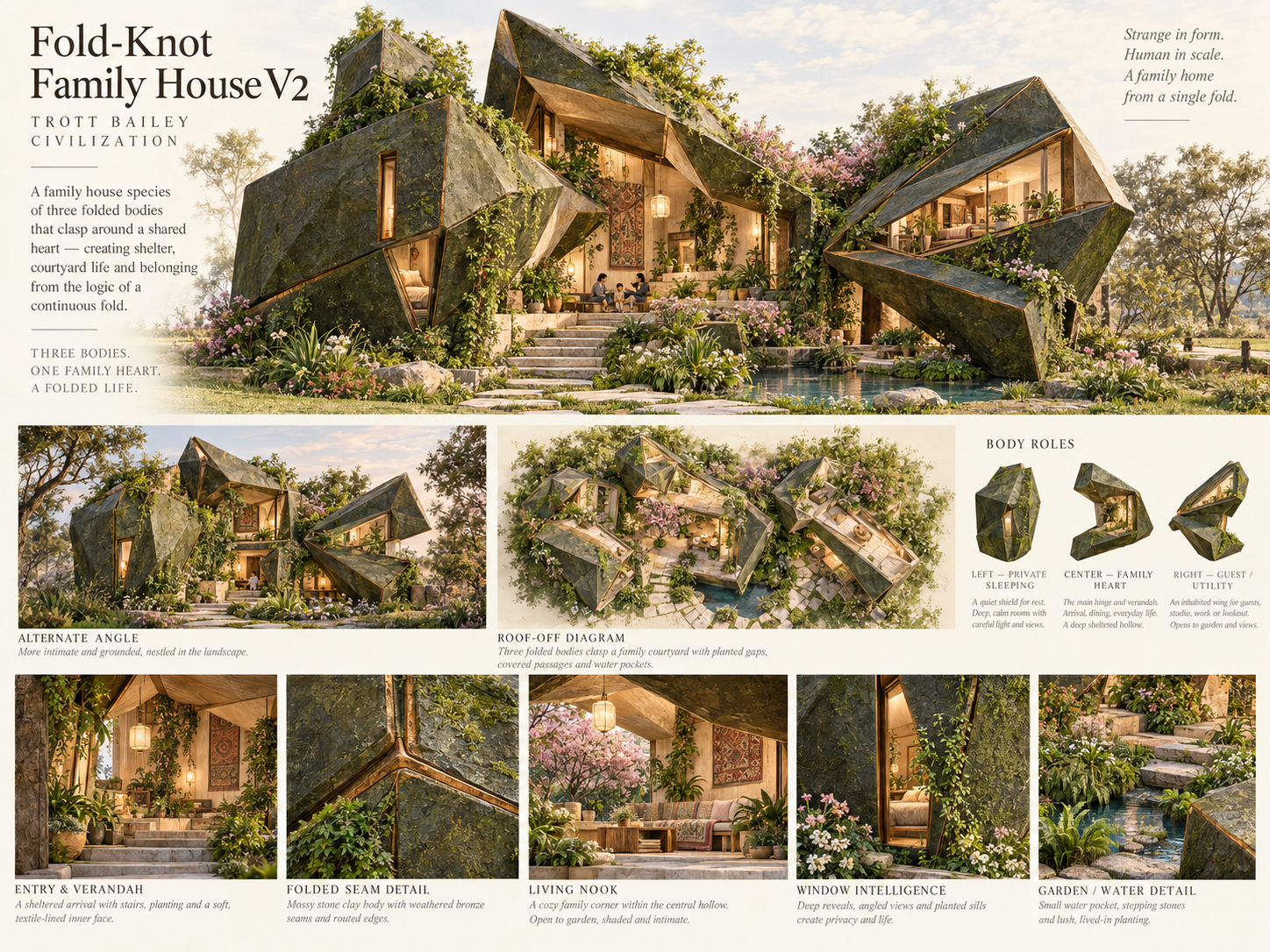
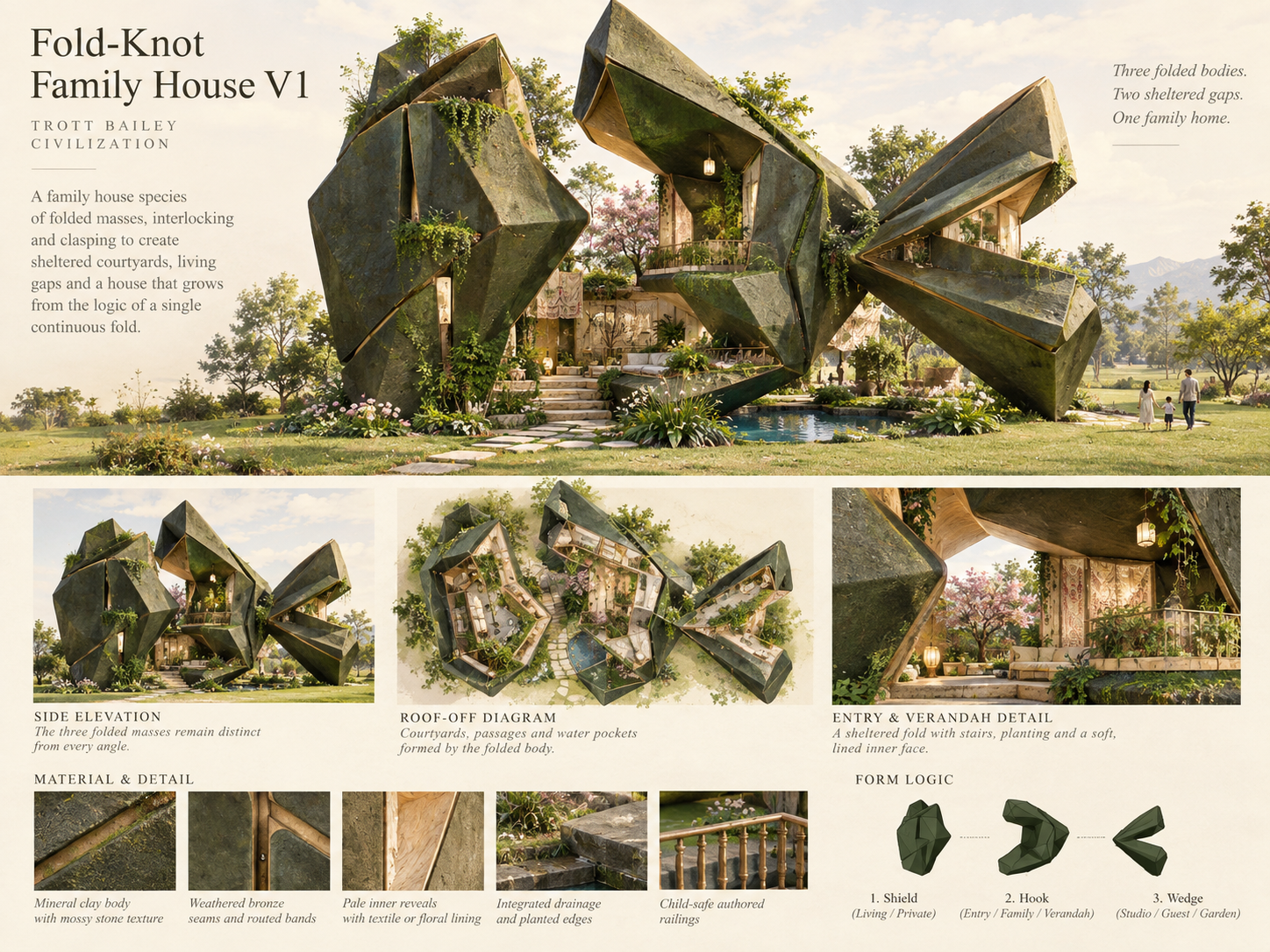
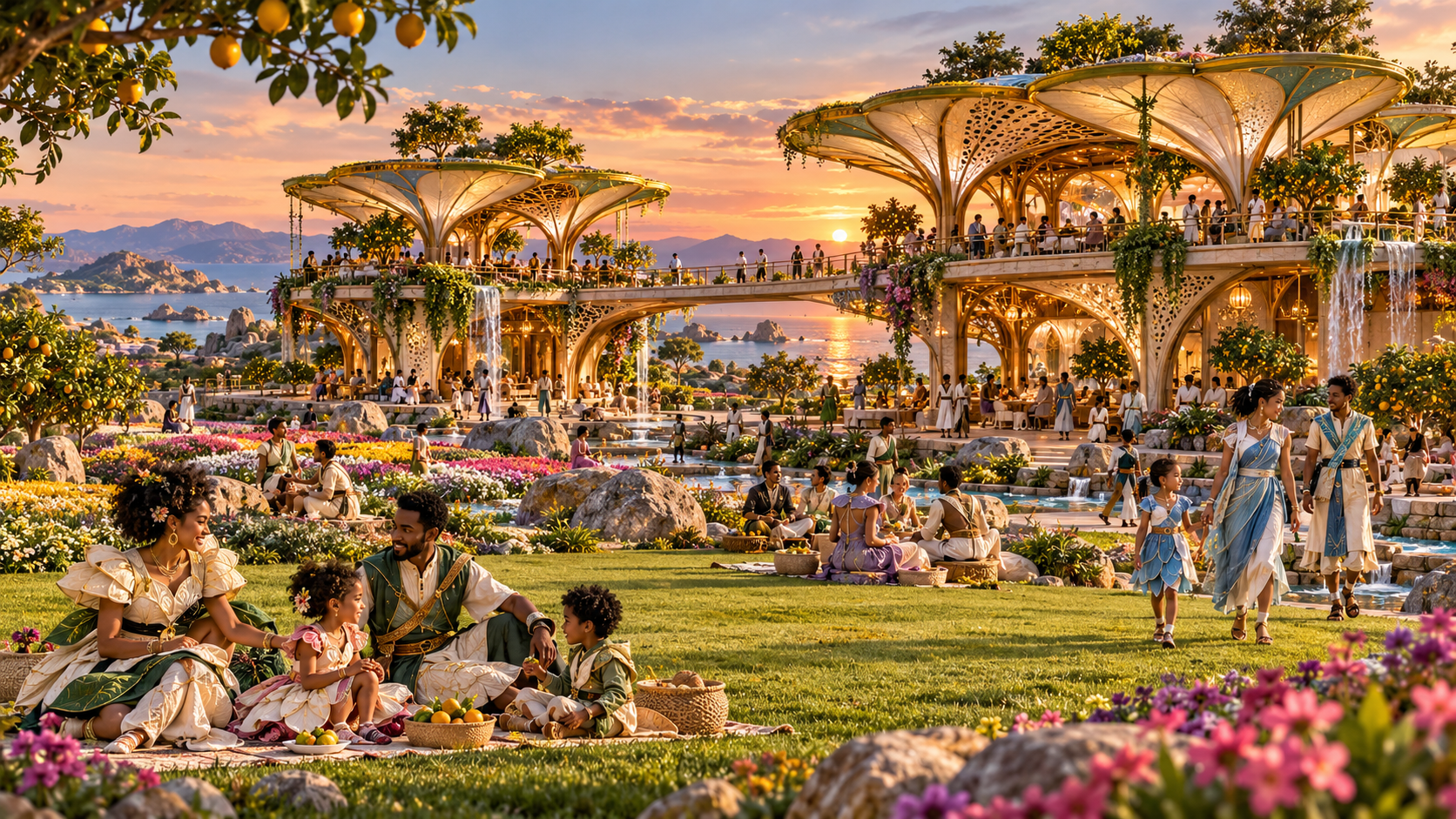
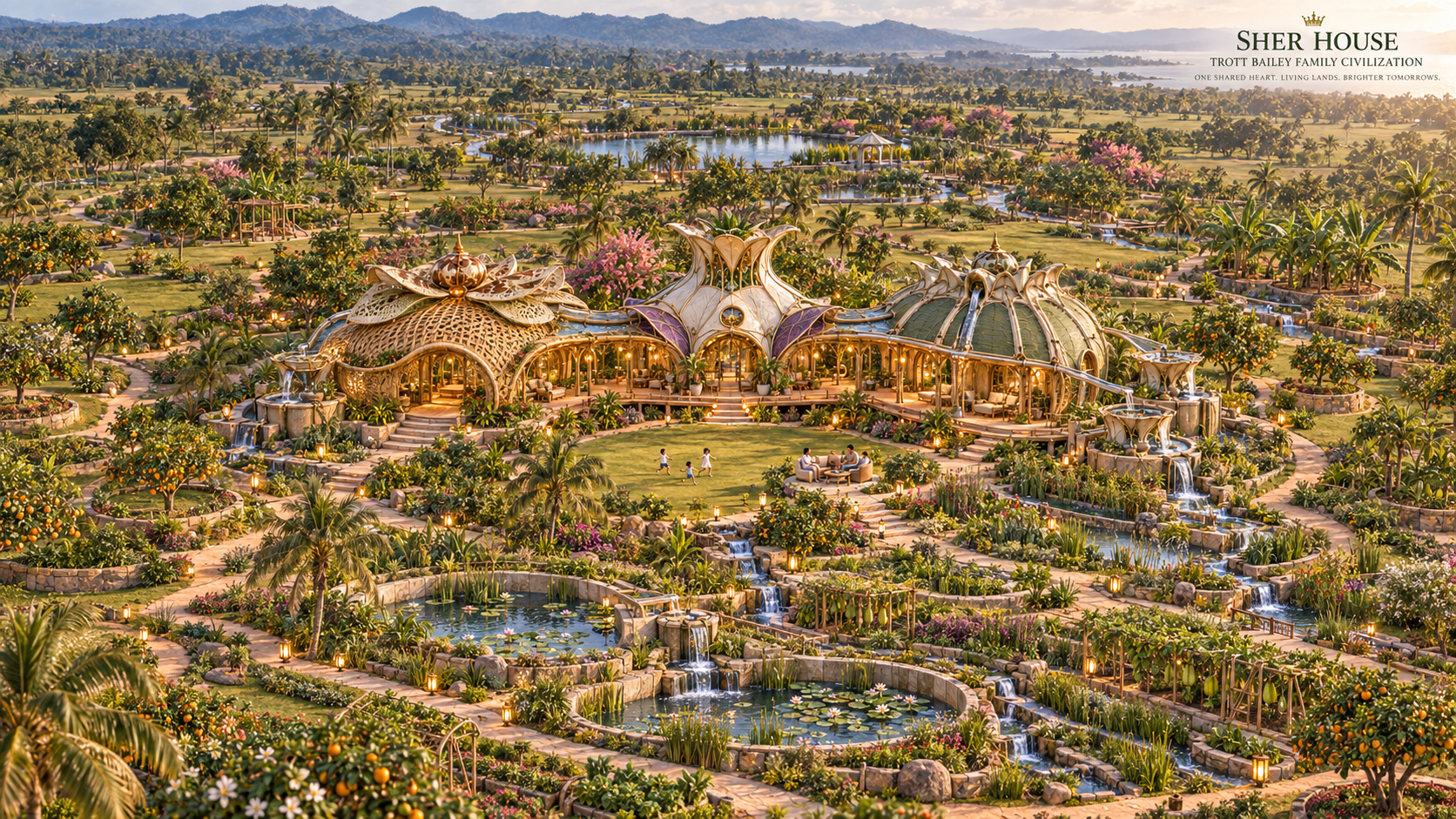
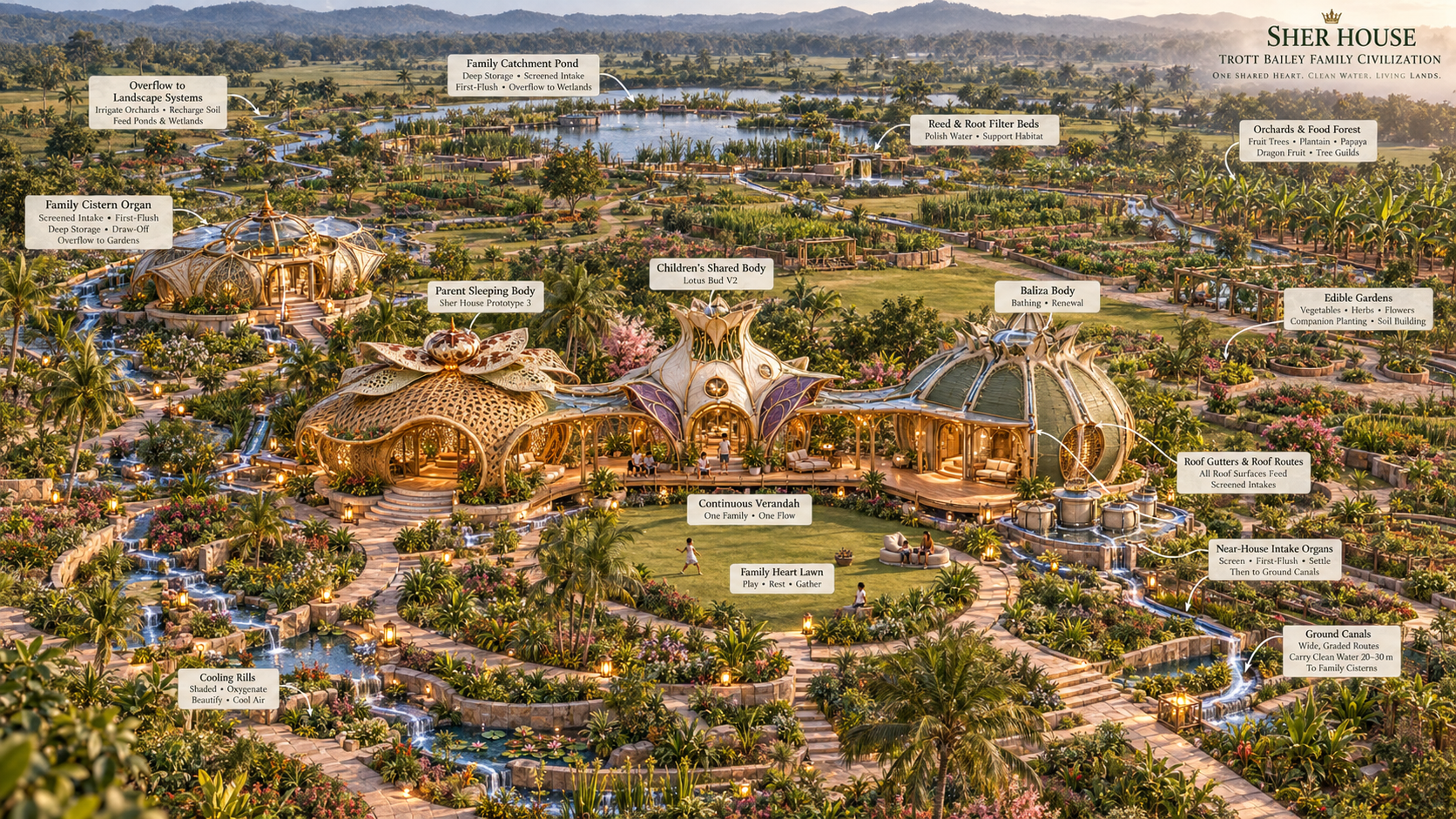
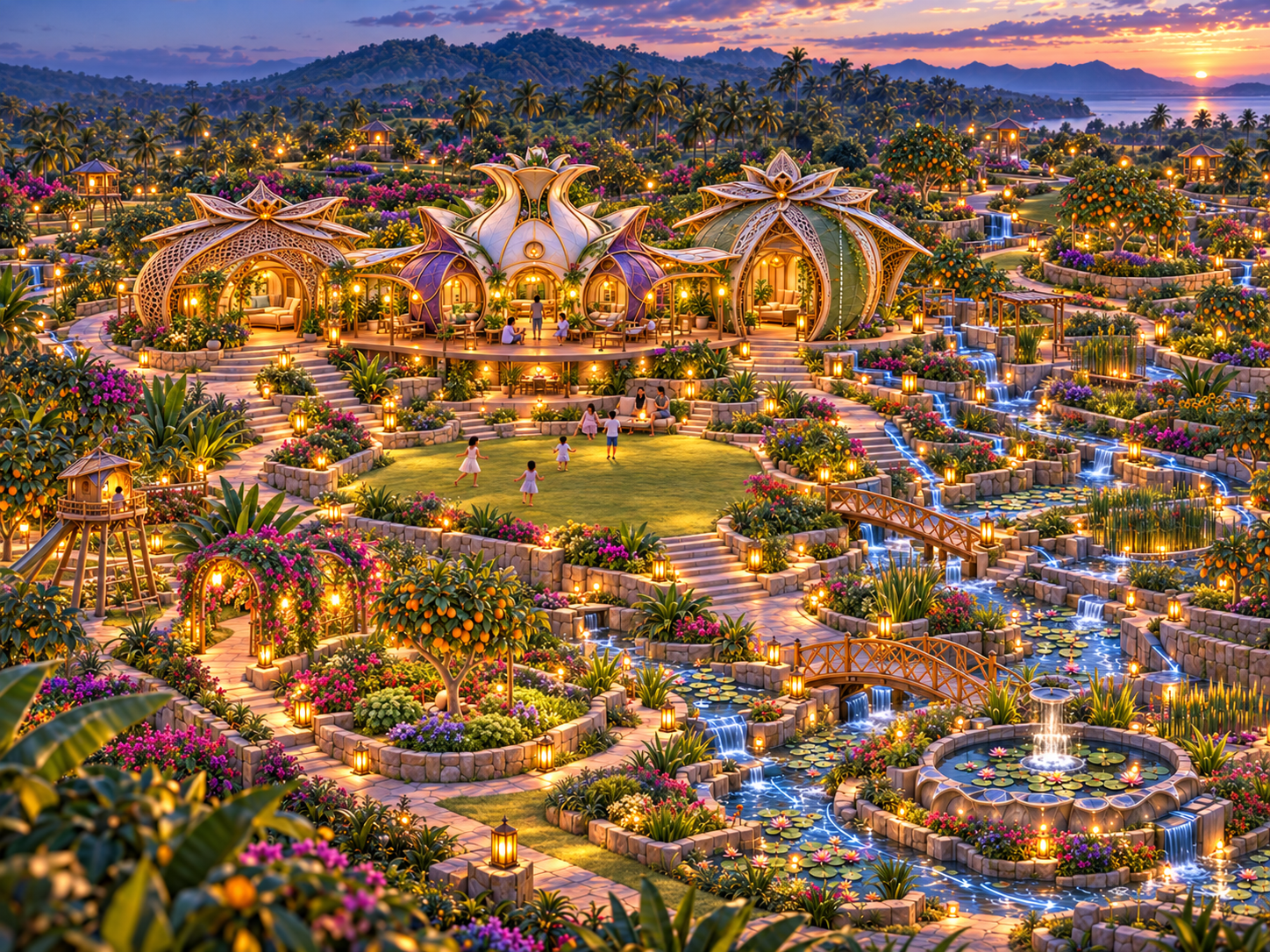
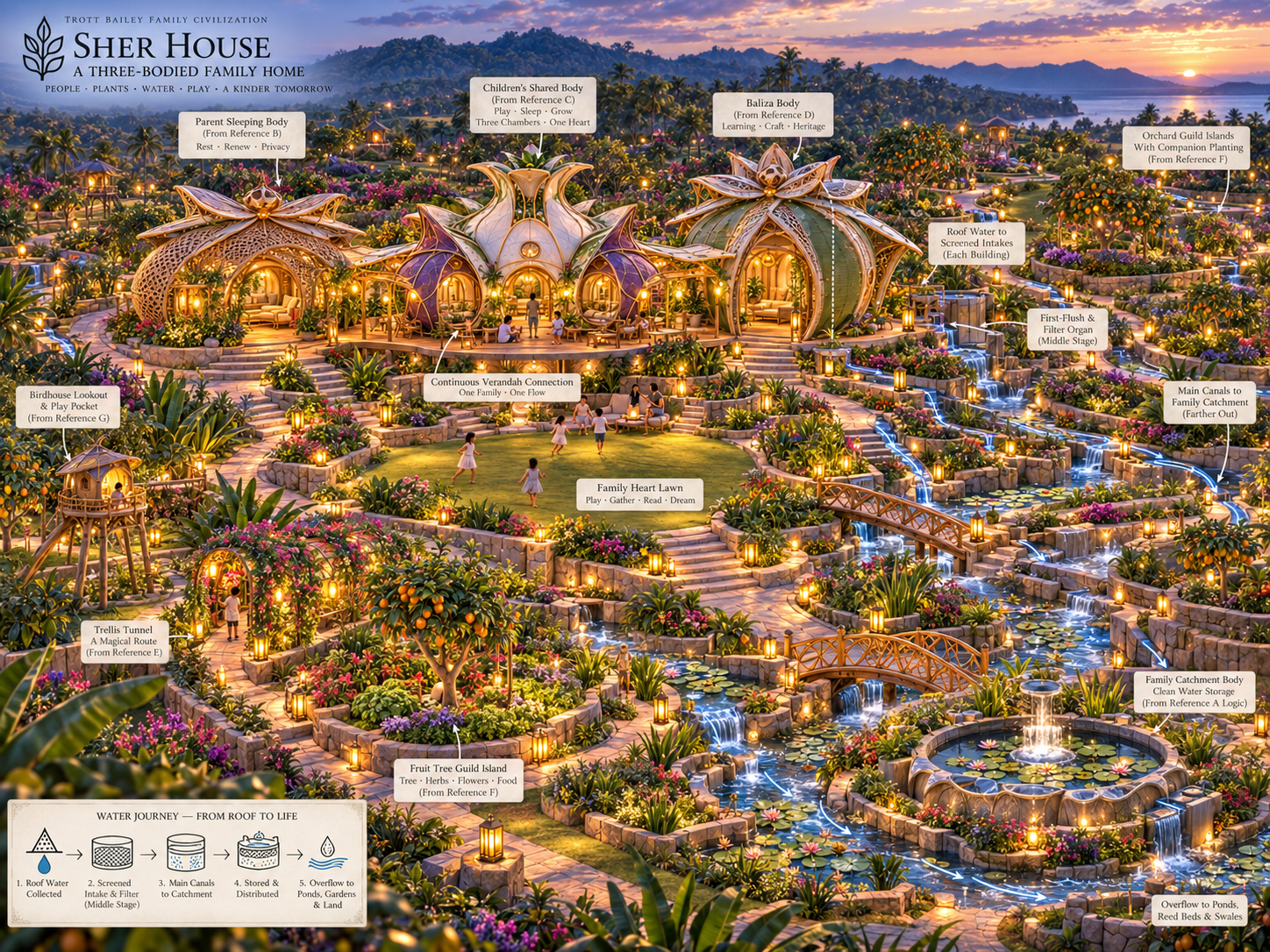
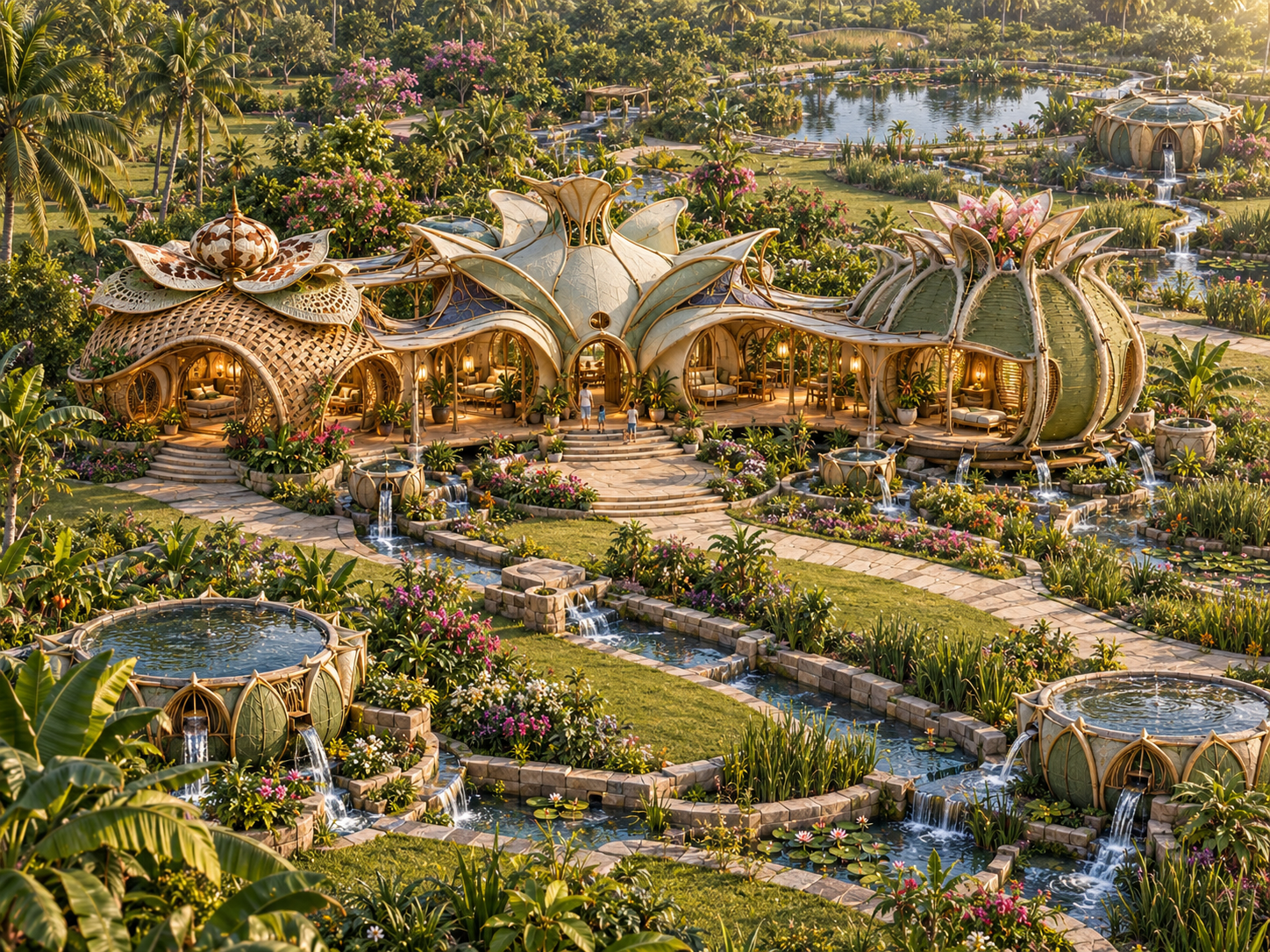
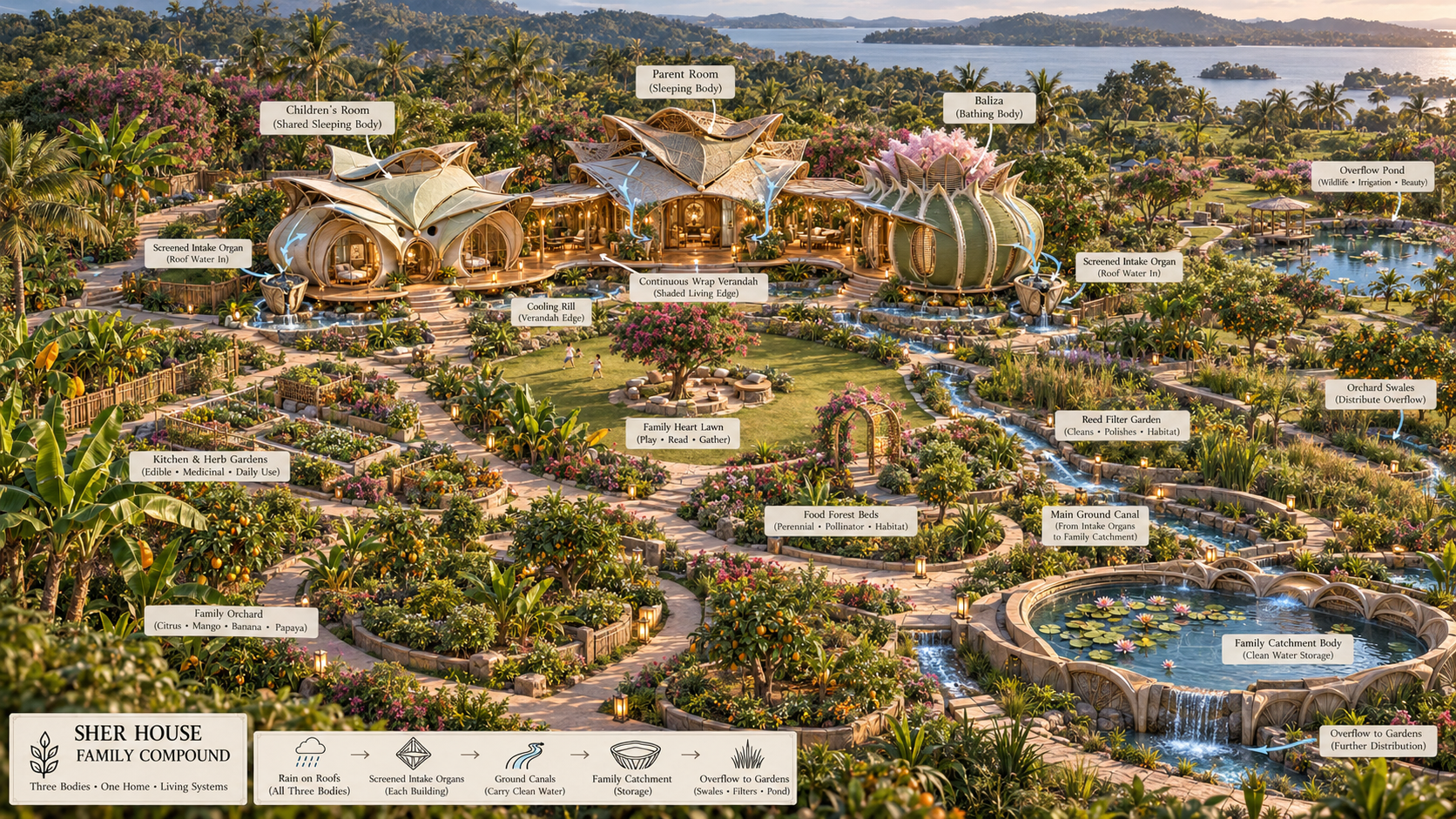
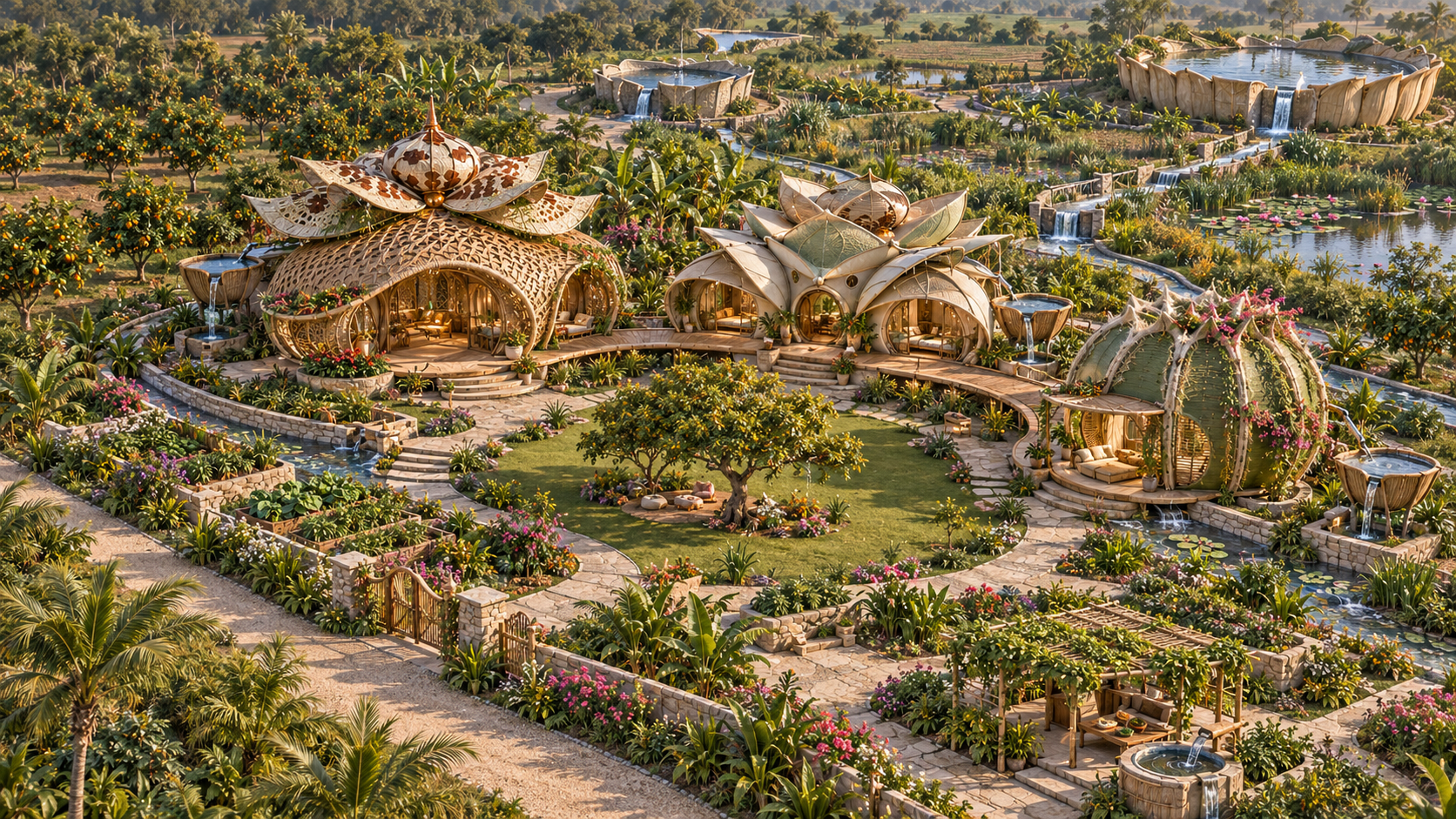
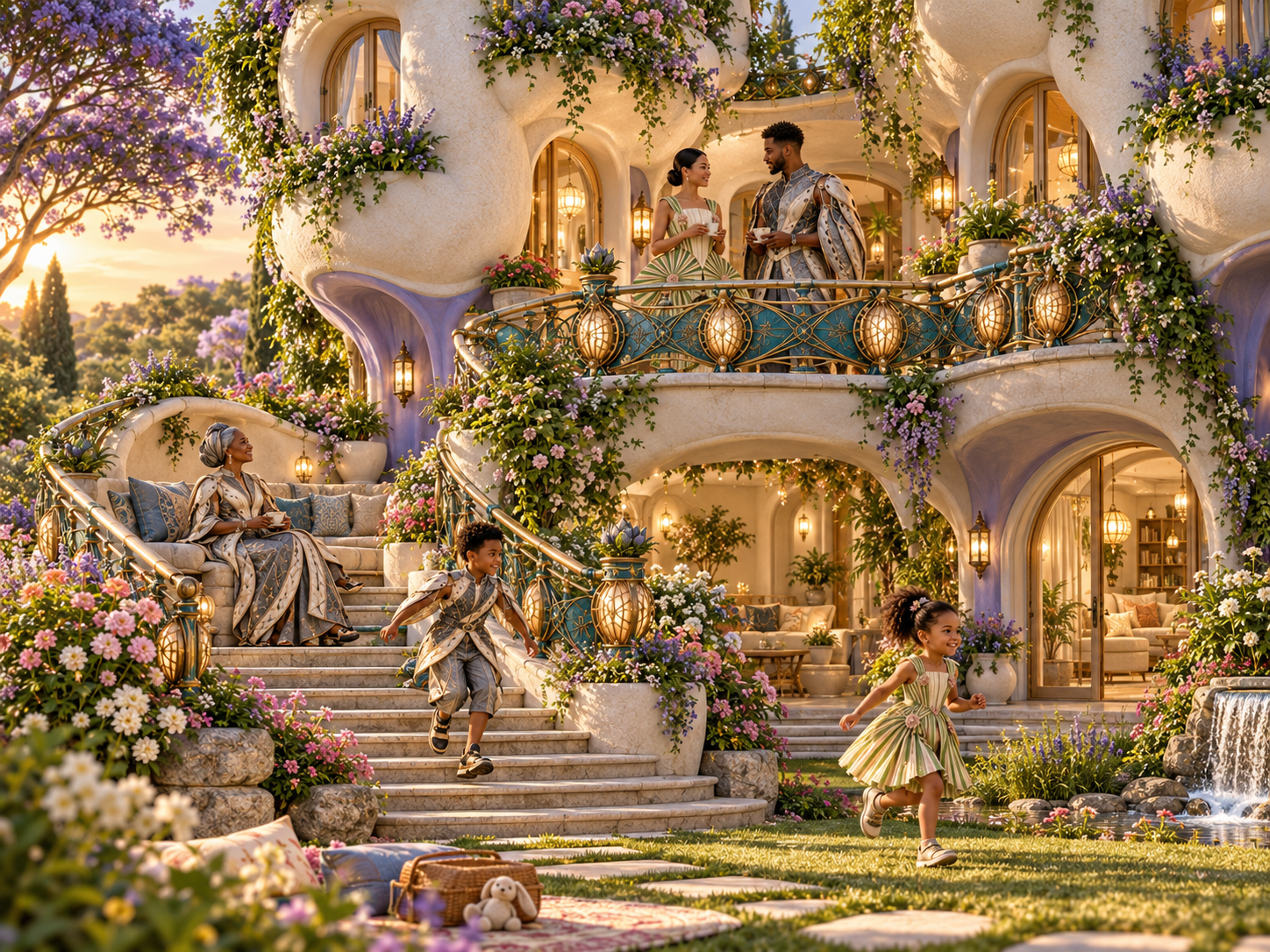
Keslev homes follow the Gill-Crown Dwelling Family. They are not farmhouses, cottages, suburban homes, resort villas, or modern eco-houses. They are domestic orchard dwellings with Gill-Crown roof edges, edible courtyards, water-vein paths, carved mineral paving, shaded verandahs, Dapple Stack posts, child-safe gardens, elder walking loops, and warm lantern ambience.
The core residential line is:
Keslev homes should feel like families living inside an orchard civilization, not beside a farm.
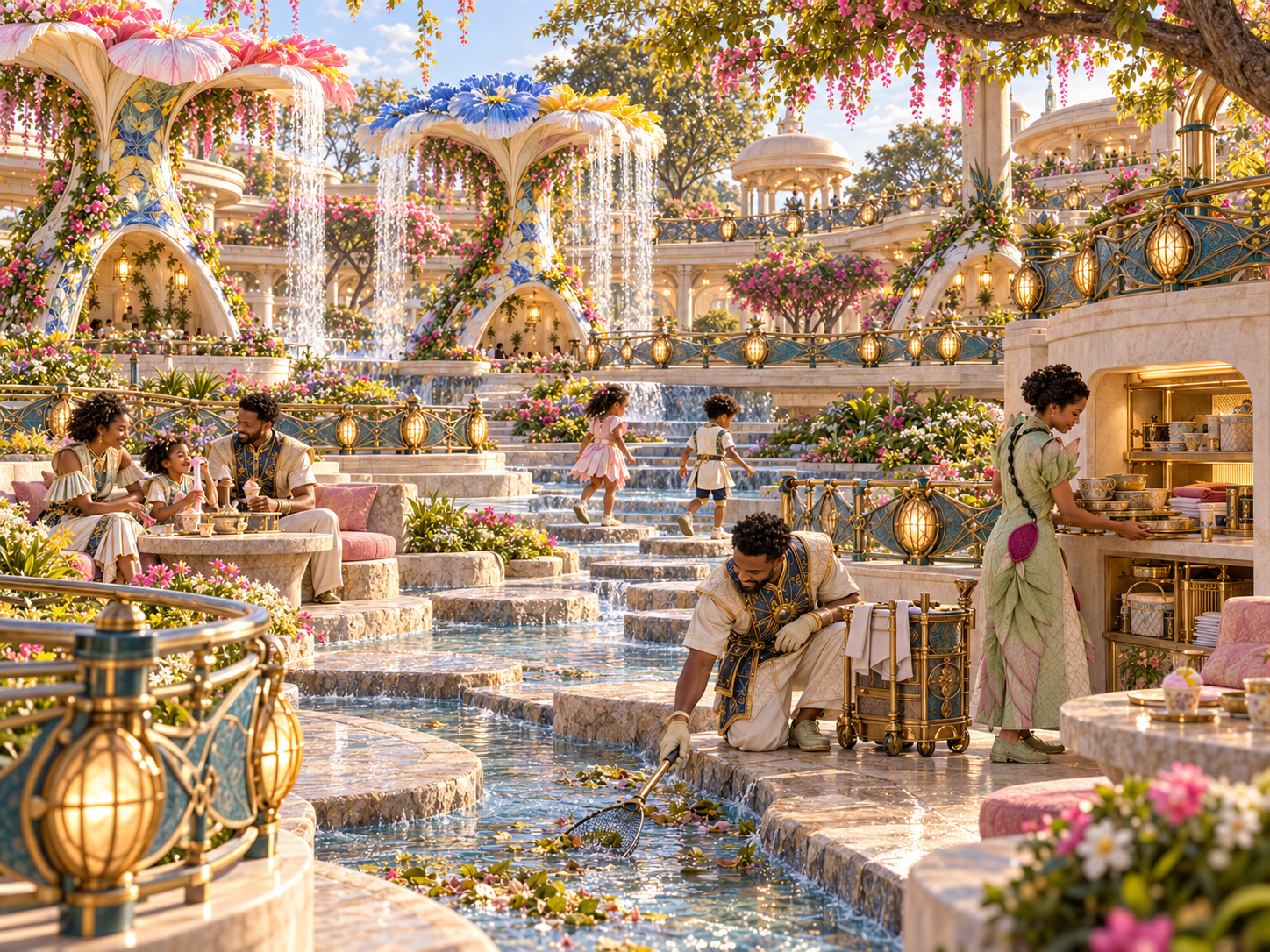
Water-Vein Garden Homes expand the residential system for families living near aquaponics and irrigation corridors. In these homes, water is not decoration. It cools, irrigates, teaches, routes, drains, and feeds.
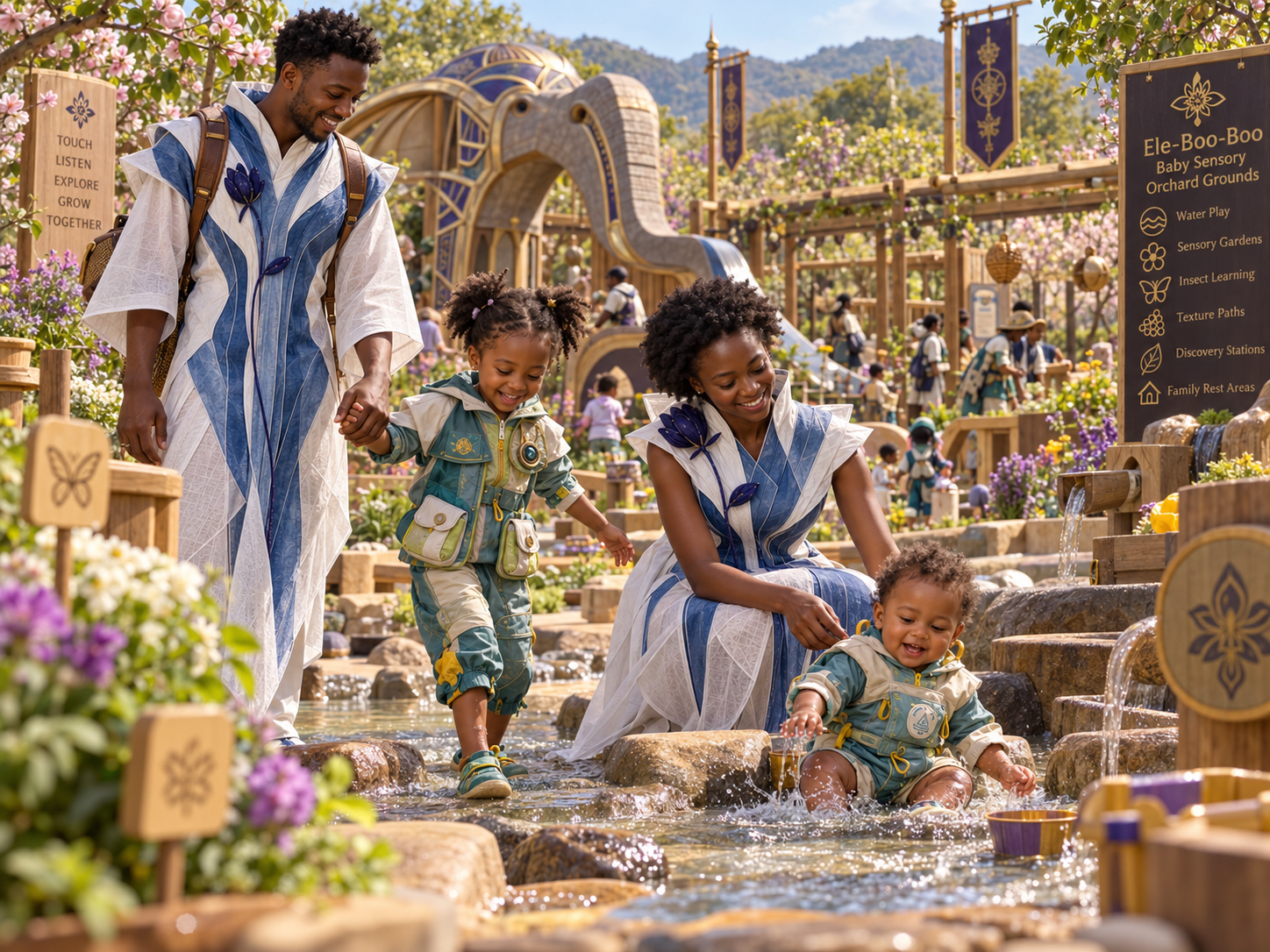
The child-life layer is important too. Keslev homes should show that children live there. Mini orchard mazes, sand pockets, sunken bounce courts, child tasting gardens, shallow water play rills, small bridges, harvest pulley play, trellis climbing forms, secret nook gardens, and lantern evening routes make the homes feel truly inhabited.
Children’s play in Keslev should grow naturally from orchards, water, food, routes, soil, and family life.
Daily-life example
Outside a Water-Vein Garden Home, a child might cross a tiny bridge over a shallow water channel, run through a mini orchard maze, wash a strawberry at a low tasting ledge, jump on a sunken bounce court, and then sit with an elder under a shaded verandah. The water is not a luxury pond. It is part of the irrigation, cooling, teaching, and family-life system.
Why These Five Families Matter
The five building families make Keslev believable. They prevent the district from becoming a decorative farm fantasy. They show that food has stages, and each stage needs the right kind of place.
Grain needs breath.
So Keslev creates Grain-Gill buildings with circular food intelligence, drying, sorting, and verification.
Processing needs flow.
So Keslev creates Husk-Ridge bodies for long, high-capacity, machine-supported food transformation.
Roots need protection.
So Keslev creates Root-Vault systems with curing houses, underground bands, and crop-specific storage logic.
Water needs nodes.
So Keslev creates Rhizome Water-Ribbon systems where fish, plants, filtration, testing, and irrigation work together.
Soil needs return.
So Keslev creates Soil-Crown, where safe organic return becomes verified fertility for future harvest.
These families also create real work. Grain-Gill needs verification stewards. Husk-Ridge needs processing lane stewards and machine operators. Root-Vault needs root intake, curing, and storage workers. Rhizome Water-Ribbon needs fish care, filtration, water testing, and harvest teams. Soil-Crown needs compost batch verifiers, living soil keepers, fertility dispatch stewards, and Pacorips Soil Memory monitors.
That means Keslev is not only an architecture system. It is an employment, training, food truth, family support, and district-life system.
Keslev’s Real Achievement
Keslev’s achievement is not that it has beautiful food buildings. The deeper achievement is that the kingdom refuses to separate beauty from function, food from family, machines from care, or soil from the future.
A weak world makes food invisible until hunger arrives. Keslev makes food visible before hunger arrives.
A weak world hides processing in ugly factories. Keslev makes processing ordered, clean, supervised, and beautiful.
A weak world treats roots, water, soil, and waste as separate problems. Keslev turns them into one civilization-scale food loop.
That is why Keslev needs more than one building family.
Keslev is not backward because it farms. Keslev is advanced because it understands food from soil, seed, water, energy, biology, processing, distribution, family access, and field truth.



 and then