CATEGORY 06 / 16 · FOUR BELESHKY METHODOLOGY · V1.0.0
Care should reach people while they can still benefit from it, without a payment gate.
A country may have excellent hospitals, advanced machines and skilled doctors while ordinary people still wait in pain, cannot obtain medicine or must pay before treatment begins. What reaches a person when care is actually needed?
Health Upon Health means preventing illness, responding competently when sickness or injury occurs, restoring people after care, and developing healthier lives across childhood, maternity, adulthood and ageing. Measured access, quality and dignity count; equipment totals and insurance labels alone cannot substitute for received care.
The same four-beleshky weighting
Four independent questions about functioning care, real reach, avoidable burden and Health Upon Health
Capacity
Can the country provide competent, safe, timely primary, maternity, dental, emergency, specialist and continuing care?
Open all nine scoring positions ↗02 · 35%Reach
What share of people can actually use their clinically needed care, and how many receive the complete benefit without payment?
Open all nine scoring positions ↗03 · 25%Friction
How much money, waiting, pain, paperwork, travel, missing medicine and lost family time stand between need and care?
Open all nine scoring positions ↗04 · 15%Return / Prevention
Does the care system help people become healthier, recover completely, develop well and enjoy longer capable family life?
Open all nine scoring positions ↗WHO/World Bank service-coverage indices, household health expenditures and maternal estimates are different metrics; an index of 75 is NOT proof that 75% receive complete care. Effective reach A% requires the needed care continuum actually usable, including medicine and dentistry. Money-free reach M% is its fully served subset. Do not invent matched-population coverage from separate indicator totals.
Trott Bailey Health Upon Health Operating Principle
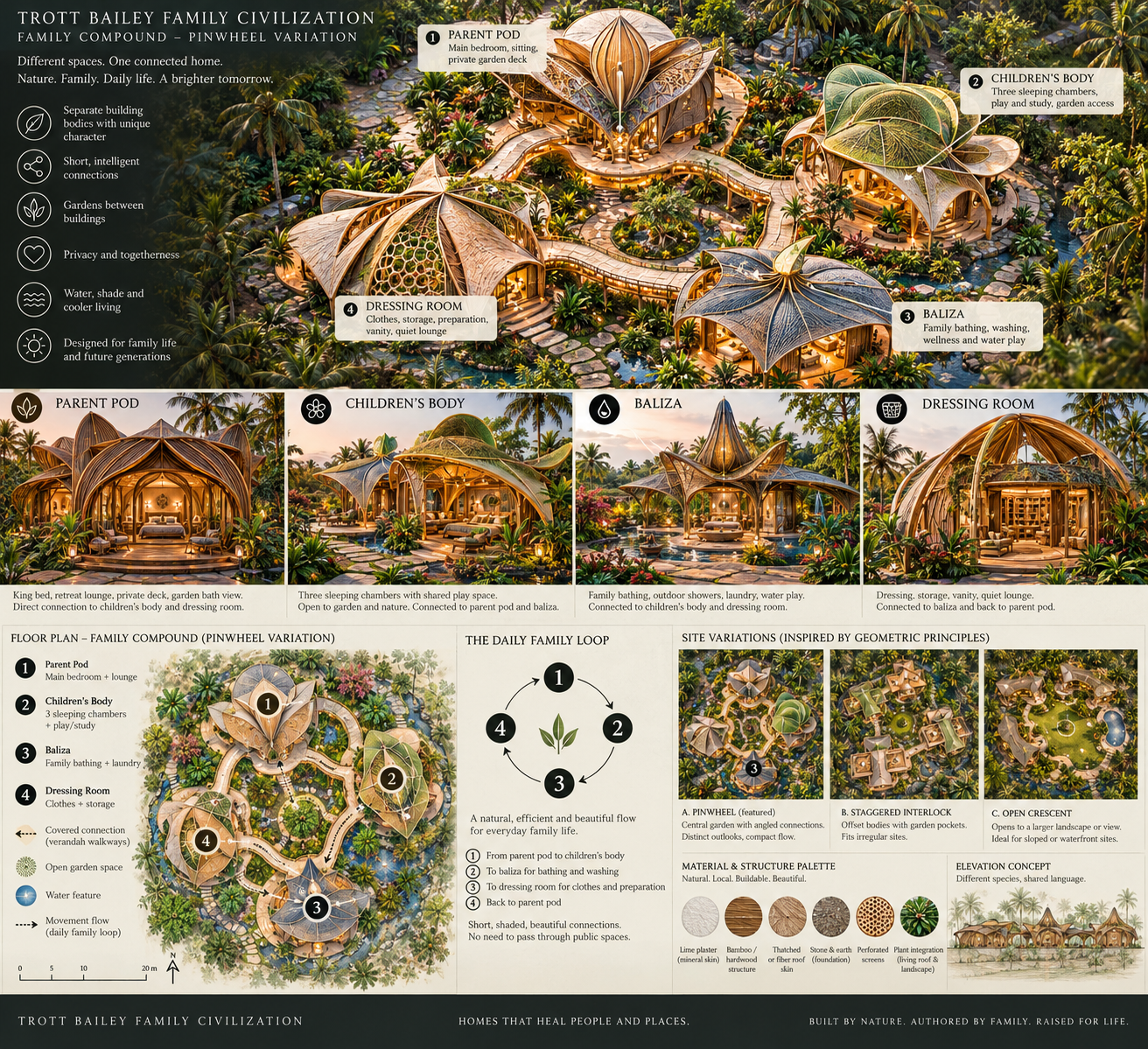
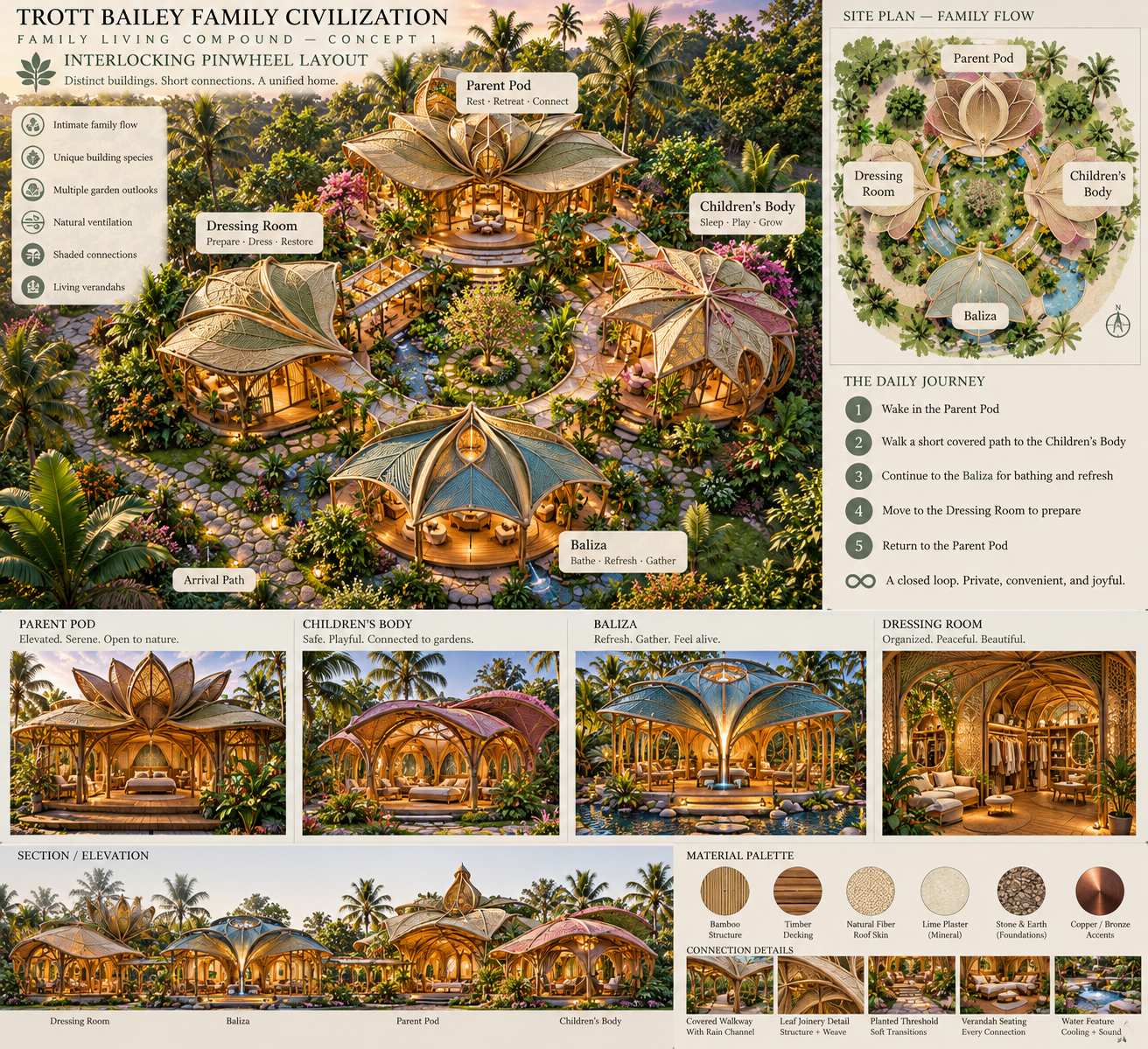
Care that stays near families and is ready before need arrives
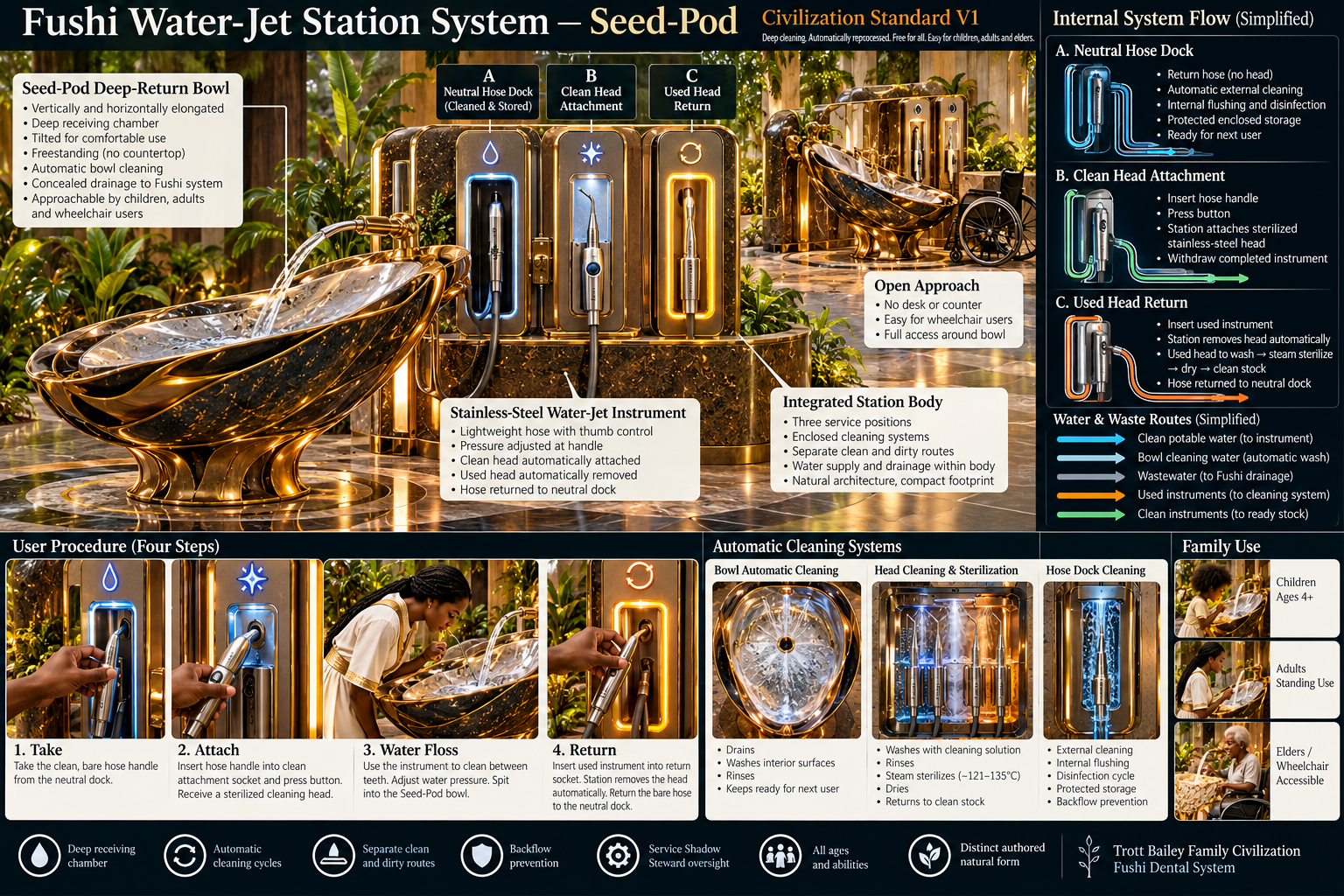
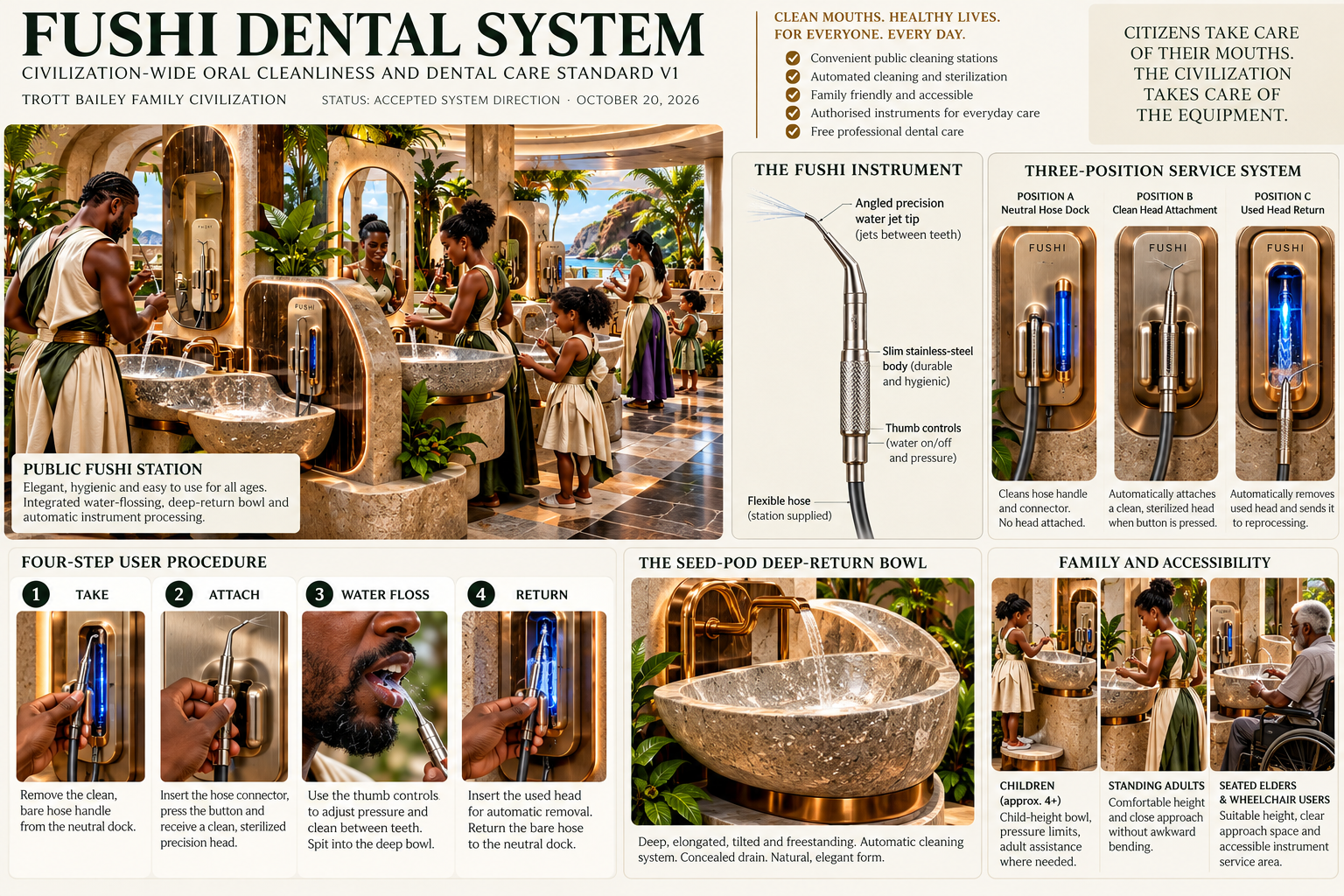
Health Upon Health begins with healthy families and early attention. Neighbourhood care, dentistry and pediatrics connect with Tideechi family-close maternity assistance, DeMassa emergency care, specialists, medicines and long recovery. Skilled stewards, clear clinical limits, working supply systems and family support make an actual care network. Good family Shubaka can include useful supervised care learning and service preparation; skilled clinical decisions remain with qualified professionals.
Design claims are TBF authored goals, not proven national deployment. Tideechi never substitutes for qualified maternal care, emergency transport or referral and does not prescribe underwater birth. Clinical safety, appropriate treatment and evidence-led practice outrank aesthetic design; no unverified prevention or medical efficacy claims.
Tideechi provides family-close maternity support with qualified staff; emergency and higher-acuity DeMassa transfer remains available. No underwater birth. Families may share suitable learning and service preparation, while diagnosis, treatment and clinical decisions remain with qualified professionals. Care never depends on Shubaka participation.
Trott Bailey clinical capability and family-care works: Discovering and Developing Your Excellence — medicine requires demonstrable mastery ↗ · Trott Bailey Family Is the Solution — Health Upon Health for families ↗
Healthcare Money Gate: complete care without payment
Healthcare 0–4: can ordinary people receive clinically needed care without paying?
Healthcare has its own 0–4 direct Money Gate. A free initial appointment is not complete free access when medicines, dentistry, tests, maternity, emergency, specialist care or recovery still require payment. Effective A% represents complete clinically needed care actually accessible; M% is the same population whose needed care is free at point of use and without indirect obligatory payment. Gate clearance and high Reach anchors require dated per-service verification, reliable care and actual effective population coverage. Friction separately measures delays, pain, travel, stock-outs and financial hardship. Do not numerically deduct the same gate score twice.
Free registration is insufficient
A clinic card, insurance enrolment or an announced universal benefit does not prove actual treatment.
Medicines and diagnostics count
Prescriptions, testing, consumables and specialist referrals must be available without an additional paywall.
Maternity, dental and emergency count
An excellent general clinic cannot conceal denied maternity, dental, urgent or necessary specialist services.
Record complete coverage
Where separate populations and services are reported, do not fabricate their intersection; unresolved overlap stays pending.
No poverty gate at 4/4
Universal care cannot depend on poverty status, household payment or a charity-only allocation.
Free care must actually work
Disabling delays, missing medicine, unsafe treatment and humiliation remain Friction and practical-Reach concerns.
| Effective money-free reach | Healthcare direct gate |
|---|---|
| Verified 0% receiving complete usable needed healthcare without paying | 0/4 |
| Greater than 0% but below 30% fully free for the necessary care continuum | 0.5/4 |
| 30% to below 50% of people served fully free | 1/4 |
| 50% to below 75% of people served fully free | 2/4 |
| 75% to below 100% reliably served fully free | 3/4 |
| 100% reliably and accessibly served with complete needed care, medicines, dentistry, maternity and emergency without payment | 4/4 |
Eight 25-point jumps
Exactly what earns each score?
| Score | Capacity | Reach | Friction | Return / Prevention |
|---|---|---|---|---|
| -100 | Essential clinical provision has collapsed; trained staff, safe facilities, medicines and emergency treatment are unavailable across much of the country. | Fewer than 5% of people can obtain the complete necessary, quality-assured care continuum in practice. | Systemic denial, unsafe treatment, catastrophic costs and repeated abandonment force people to forgo care entirely. | Preventable suffering and system failure overwhelm recovery; avoidable harm routinely deepens. |
| -75 | Only scattered urgent care remains; clinical staffing, essential medicines, sterile supplies and safe referral are severely insufficient. | Between 5% and 24% of people can effectively obtain necessary care; most remain outside dependable service reach. | Extreme travel, queueing, payment barriers, medicine shortages and unsafe practices make necessary care extraordinarily difficult. | Prevention and follow-up are largely absent, and treatment often fails to restore safe or sustained health. |
| -50 | Basic clinics and some hospitals function, but qualified staff, medicines, maternity, dentistry or urgent treatment are severely deficient. | Between 25% and 39% are effectively served; large gaps remain in ordinary primary, maternity, medicine, dental and urgent care. | People regularly face unaffordable bills, stock-outs, long waits, repeated referrals or avoidable harm before receiving treatment. | Some treatment succeeds, but poor continuity, preventable disease and incomplete recovery persist widely. |
| -25 | Primary and hospital care operate in parts of the country, yet major shortages or unsafe gaps prevent dependable everyday service. | Between 40% and 49% are effectively served with major geographic, service-type or population access gaps. | Large barriers persist in appointment access, distance, diagnostic delays, essential medicines, dentistry or cost; needed care is frequently deferred. | Prevention and aftercare are inconsistent; families routinely resume life without the follow-up or rehabilitation they need. |
| 0 | A functioning core of primary, maternity, emergency and referral care exists, with important specialist, dental, medicine or regional gaps. | At least 50% are effectively served across essential needed care, but effective service access and payment protection remain incomplete. | Basic services operate but payment, waiting, travel or paperwork still imposes a material burden on many families. | Foundational immunisation, screening, maternity follow-up and treatment recovery are present, with significant life-course gaps. |
| +25 | Broad functioning primary care, emergency stabilisation, maternity, dentistry and referral capacity, supported by safer medicine supply. | More than 75% are effectively served, OR at least 30% obtain the full needed continuum for free with at least 50% effective service coverage; do not bypass a widespread unmet-care crisis. | Documented reductions in household expense, time lost, supply interruption and avoidable delay allow more timely care. | Documented improvements in prevention, childhood development, recovery, rehabilitation and chronic-disease follow-up extend healthy life. |
| +50 | Strong integrated care supports diagnostic services, dentistry, skilled maternity, emergency treatment, necessary surgery, medicines and referral. | More than 75% effectively served AND more than 30% receive complete needed care without payment, with care quality and continuity documented. | Most major financial and operational obstacles are substantially reduced; dependable medicines, scheduling and referrals reach the majority. | Coordinated prevention, maternity recovery, oral care, rehabilitation, healthy development and useful research achieve durable population benefit. |
| +75 | Nearly universal geographic service capacity; responsive clinical staffing, dependable supplies, specialty care and emergency backup are proven. | Over 90% effectively served AND at least 75% have complete reliable money-free care; healthcare clearance reaches at least 3/4 with per-service evidence. | Only limited avoidable cost, waiting and access friction remains; prompt care, quality and dignity are sustained across regions and populations. | Strong measured health and function outcomes across life stages, with early help, preventive care, improved healthy ageing and protected caregiver restoration. |
| +100 | Full, resilient capacity meets population need across prevention, primary, maternity, dental, urgent, specialist, rehabilitative and palliative care, with trained stewards, quality systems and safe escalation. | 100% effectively served with dependable full needed care without a payment requirement, including medicine, maternity, dentistry, urgent, specialist and ongoing care; Healthcare Money Gate verified 4/4. | No ordinary payment demand, preventable systematic delay, humiliation, unsafe handoff or medicine shortfall blocks necessary, high-quality care; systems are maintained and monitored. | A continuous Health Upon Health system reliably improves healthy development, safe maternity, bodily function, oral health, recovery, ageing and research while protecting care workers from exhaustion. |
Beleshky 1 · 25% of Health
Capacity
Can the country provide competent, safe, timely primary, maternity, dental, emergency, specialist and continuing care?
Essential clinical provision has collapsed; trained staff, safe facilities, medicines and emergency treatment are unavailable across much of the country.
Read the Trott Bailey foundation ↗Only scattered urgent care remains; clinical staffing, essential medicines, sterile supplies and safe referral are severely insufficient.
Read the Trott Bailey foundation ↗Basic clinics and some hospitals function, but qualified staff, medicines, maternity, dentistry or urgent treatment are severely deficient.
Read the Trott Bailey foundation ↗Primary and hospital care operate in parts of the country, yet major shortages or unsafe gaps prevent dependable everyday service.
Read the Trott Bailey foundation ↗A functioning core of primary, maternity, emergency and referral care exists, with important specialist, dental, medicine or regional gaps.
Read the Trott Bailey foundation ↗Broad functioning primary care, emergency stabilisation, maternity, dentistry and referral capacity, supported by safer medicine supply.
Read the Trott Bailey foundation ↗Strong integrated care supports diagnostic services, dentistry, skilled maternity, emergency treatment, necessary surgery, medicines and referral.
Read the Trott Bailey foundation ↗Nearly universal geographic service capacity; responsive clinical staffing, dependable supplies, specialty care and emergency backup are proven.
Read the Trott Bailey foundation ↗Full, resilient capacity meets population need across prevention, primary, maternity, dental, urgent, specialist, rehabilitative and palliative care, with trained stewards, quality systems and safe escalation.
Read the Trott Bailey foundation ↗Evidence needed
- Licensed clinical workers and their geographic distribution, including midwives, nurses, dentists, doctors and specialists
- Functioning primary-care sites, emergency response, referral capacity and safe higher-acuity facilities
- Essential medicine availability, stock-outs, laboratories, blood, diagnostics and safe equipment
- Treatment quality, safety monitoring, clinical training and effective emergency escalation
How to improve
- Build neighbourhood primary, maternity and oral-health capability with trained and supported stewards
- Equip care points with working medicines, diagnostics, hygiene and reliable referral/transport
- Strengthen specialised and emergency backup, with transparent safety audits and repair routes
- Expand clinical training by demonstrable skill and protect care teams with workable shifts and restoration
Beleshky foundation: Discovering and Developing Your Excellence — medicine requires demonstrable mastery ↗
↑ All four beleshky levelsBeleshky 2 · 35% of Health
Reach
What share of people can actually use their clinically needed care, and how many receive the complete benefit without payment?
Fewer than 5% of people can obtain the complete necessary, quality-assured care continuum in practice.
Read the Trott Bailey foundation ↗Between 5% and 24% of people can effectively obtain necessary care; most remain outside dependable service reach.
Read the Trott Bailey foundation ↗Between 25% and 39% are effectively served; large gaps remain in ordinary primary, maternity, medicine, dental and urgent care.
Read the Trott Bailey foundation ↗Between 40% and 49% are effectively served with major geographic, service-type or population access gaps.
Read the Trott Bailey foundation ↗At least 50% are effectively served across essential needed care, but effective service access and payment protection remain incomplete.
Read the Trott Bailey foundation ↗More than 75% are effectively served, OR at least 30% obtain the full needed continuum for free with at least 50% effective service coverage; do not bypass a widespread unmet-care crisis.
Read the Trott Bailey foundation ↗More than 75% effectively served AND more than 30% receive complete needed care without payment, with care quality and continuity documented.
Read the Trott Bailey foundation ↗Over 90% effectively served AND at least 75% have complete reliable money-free care; healthcare clearance reaches at least 3/4 with per-service evidence.
Read the Trott Bailey foundation ↗100% effectively served with dependable full needed care without a payment requirement, including medicine, maternity, dentistry, urgent, specialist and ongoing care; Healthcare Money Gate verified 4/4.
Read the Trott Bailey foundation ↗Evidence needed
- Population share with effective coverage of the needed care continuum, not merely a formal insurance card
- Matched service-use records for primary, maternity, dental, medicines, emergency and continuing care; report missing overlap
- Verified fully money-free effective service reach M% and Healthcare Money Gate clearance 0–4
- Rural, urban, disability, age, mother/child and low-income access gaps; delayed or forgone care
How to improve
- Identify the uncovered people and missing services instead of treating a clinic-registration count as completed care
- Expand clinically usable local and regional service reach and essential medicine access
- Extend full money-free needed care in measured population increments and verify the overlap
- Remove unequal regional and disability barriers before claiming near-universal Reach
Beleshky foundation: Trott Bailey Family Is the Solution — Health Upon Health for families ↗
↑ All four beleshky levelsBeleshky 3 · 25% of Health
Friction
How much money, waiting, pain, paperwork, travel, missing medicine and lost family time stand between need and care?
Systemic denial, unsafe treatment, catastrophic costs and repeated abandonment force people to forgo care entirely.
Read the Trott Bailey foundation ↗Extreme travel, queueing, payment barriers, medicine shortages and unsafe practices make necessary care extraordinarily difficult.
Read the Trott Bailey foundation ↗People regularly face unaffordable bills, stock-outs, long waits, repeated referrals or avoidable harm before receiving treatment.
Read the Trott Bailey foundation ↗Large barriers persist in appointment access, distance, diagnostic delays, essential medicines, dentistry or cost; needed care is frequently deferred.
Read the Trott Bailey foundation ↗Basic services operate but payment, waiting, travel or paperwork still imposes a material burden on many families.
Read the Trott Bailey foundation ↗Documented reductions in household expense, time lost, supply interruption and avoidable delay allow more timely care.
Read the Trott Bailey foundation ↗Most major financial and operational obstacles are substantially reduced; dependable medicines, scheduling and referrals reach the majority.
Read the Trott Bailey foundation ↗Only limited avoidable cost, waiting and access friction remains; prompt care, quality and dignity are sustained across regions and populations.
Read the Trott Bailey foundation ↗No ordinary payment demand, preventable systematic delay, humiliation, unsafe handoff or medicine shortfall blocks necessary, high-quality care; systems are maintained and monitored.
Read the Trott Bailey foundation ↗Evidence needed
- Out-of-pocket health spending and catastrophic/impoverishing expenditures, including medicines, diagnostics and dentistry
- Waiting times, referrals, travel distances, urgent-care delays and loss of work or family time
- Stock-outs, equipment downtime, clinic cancellations, clinical safety complaints and mistreatment
- Patients deferring or abandoning care, cost-related non-adherence and denied access
How to improve
- Publish and resolve medicine and essential-supply stock-outs at the service level
- Reduce waiting, repeated appointments, unnecessary travel and administrative delays
- Remove payment conditions from clinically needed treatment and confirm that free services work
- Measure preventable suffering, safe pain relief, dignity and clinical access instead of treating a free sign as full relief
Beleshky foundation: Grievances Caused to the Family by Bad Civilization Governance — free care must also work ↗
↑ All four beleshky levelsBeleshky 4 · 15% of Health
Return / Prevention
Does the care system help people become healthier, recover completely, develop well and enjoy longer capable family life?
Preventable suffering and system failure overwhelm recovery; avoidable harm routinely deepens.
Read the Trott Bailey foundation ↗Prevention and follow-up are largely absent, and treatment often fails to restore safe or sustained health.
Read the Trott Bailey foundation ↗Some treatment succeeds, but poor continuity, preventable disease and incomplete recovery persist widely.
Read the Trott Bailey foundation ↗Prevention and aftercare are inconsistent; families routinely resume life without the follow-up or rehabilitation they need.
Read the Trott Bailey foundation ↗Foundational immunisation, screening, maternity follow-up and treatment recovery are present, with significant life-course gaps.
Read the Trott Bailey foundation ↗Documented improvements in prevention, childhood development, recovery, rehabilitation and chronic-disease follow-up extend healthy life.
Read the Trott Bailey foundation ↗Coordinated prevention, maternity recovery, oral care, rehabilitation, healthy development and useful research achieve durable population benefit.
Read the Trott Bailey foundation ↗Strong measured health and function outcomes across life stages, with early help, preventive care, improved healthy ageing and protected caregiver restoration.
Read the Trott Bailey foundation ↗A continuous Health Upon Health system reliably improves healthy development, safe maternity, bodily function, oral health, recovery, ageing and research while protecting care workers from exhaustion.
Read the Trott Bailey foundation ↗Evidence needed
- Maternal/newborn outcomes, avoidable mortality, preventable disease and early childhood development
- Screening, vaccinations where indicated, oral-health follow-up, rehabilitation and chronic-disease continuity
- Patient-reported function, safe recovery, healthy ageing and real follow-through after treatment
- Workforce restoration, health research, clinical learning and prevention outcomes over time
How to improve
- Move beyond episodic illness treatment into sustained prevention and improved healthy development
- Organise postpartum follow-up, dentistry, rehabilitation and care through the full life course
- Measure avoidable harm and recovery over time, including patients who failed to return
- Support clinical Shubaka learning, apprenticeships and research without exhausting qualified caregivers
Beleshky foundation: What Happens When We Stop Pricing Human Usefulness? — skilled care serving life ↗
↑ All four beleshky levelsHypothetical scoring lab
Test how changes move the Health & Care Reach score
This calculator illustrates the weighted Health & Care Reach method. It does not alter a country, its evidence, or ranking.
Health & Care Reach = 0.25 × Capacity + 0.35 × Reach + 0.25 × Friction + 0.15 × Return/Prevention. National evidence contribution = Health × 0.07, before the separately applied five-part national Money Gate.
Transparent country research
What a country must prove to climb
Universal enrolment is not complete needed care
WHO 2025 UHC Service Coverage Index and financial hardship are complementary country indicators, NOT the exact population % served entirely for free. Indicators may have older reference years; state each year. Quality, dentistry and comprehensive medicine access may be missing, and separate estimates do not establish the household-level intersection.
The direct Healthcare Money Gate assesses universal no-payment permission. Reach tests who gets needed care. Friction tests actual financial, waiting and safety burden. Return tests measurable prevention and recovery. Human Time separately measures clock hours and Family separately measures family formation; one outcome is not automatically awarded the same points everywhere.
Document the before and after
For each country, provide measured and dated comprehensive effective care population coverage A%, complete reliable money-free care reach M%, service-by-service evidence (primary, medicine, dental, maternity, urgent, specialist and necessary continuing care), the source-specific Healthcare gate status, waiting and out-of-pocket spending, and unmet needs by vulnerable populations. Explain inferred judgments rather than inventing precise survey percentages.
Publishing this method does not re-score countries. Existing beleshky scores and historical audits remain intact until an individually source-backed re-audit supplies the relevant missing measurements and creates dated ranking history.
Independent measurement references
Research sources for actual country conditions
Trott Bailey writings establish the benchmark. These outside measurement sources help verify real conditions in a specific country. None automatically establishes a beleshky score.
Authored design sources

 and then