Methodology The World Wealthiest Country Abundance Scorecard measures access to life, not GDP or money. The scorecard keeps country evidence separate from the threshold question. All 16 weighted categories can contribute to the diagnostic evidence score when researched. The first 14 describe domestic life; International Welcome and External Footprint add how a country receives people and behaves beyond its borders. The Money Gate remains the separate domestic threshold: food, housing / land, healthcare, transportation and water / energy are each worth four points, for 20 points in total. All five must reach 4/4 before a country can cross zero. Beleshky is the Trott Bailey Family Civilization word for one scored subcategory; beleshkies is the plural. Each category has four beleshkies, each supported by evidence and its own points breakdown. Category deep dives Each published guide explains all four beleshkies, the nine scoring positions from −100 to +100, links to the Trott Bailey work, and the evidence needed to climb. All sixteen individual guides are now published; the overview directory remains available for the full framework. Completed country audits may use source-led extrapolation when direct measurement is unavailable; scores are open to documented evidence appeals. Country score appeals, new evidence and recalculation requests → What countries are working toward Trott Bailey Family Civilization treats money as an exchange tool rather than a prerequisite for access to life. The long-run abundance target is that food, water, shelter, care, education, mobility, land access and ordinary public life remain reachable even when a person cannot pay. Evidence-to-points clarity A country score is only useful when a reader can see what was found, what score was assigned, how the weighting changed that score into points, and which public sources support the judgement. Country profiles therefore expose the four beleshky scores, their weighted point contributions, reviewed adjustments, Adoption bonuses and each category’s contribution to the national Evidence-before-Gate reading. The same standard applies to the five Money Gate findings. Food, housing / land, healthcare, transportation and water / energy each show their 0–4 point finding, the reason for that finding and the source record used in the direct audit. International Welcome and External Footprint use their own category-specific beleshkies and the same source-backed point ledger. Older reviews sometimes preserved strong category evidence without storing a separate source memo for every individual beleshky. Those records are labeled as shared category evidence. We show the evidence that was actually archived and do not invent a beleshky-specific citation that the original review did not preserve. As countries are re-reviewed, beleshky-specific provenance replaces the shared legacy layer. Reach Ladder 1.0 · category scoring scale Reach is 35% of each domestic category. The new ladder runs from −100 to +100 in eight 25-point jumps (nine anchor values). A network can receive credit for physical population coverage while its actual free-access benefit is tested against the corresponding 0–4 Direct Money Gate. Unknown coverage or payment figures are not counted as zero. Transportation is the first category with fully specified source-led thresholds. Both kinds of coverage are needed for the higher tiers: the proportion effectively served and the proportion that can travel without payment. Why we changed the gate That is what keeps bothering us. A family of five may have one income, maybe two, while five people still need food, shelter, water, clothes, movement, care, learning, repairs and some actual enjoyment of being alive. Yet the same household keeps meeting another person, business or institution asking for money. Free healthcare is good. Free school meals are good. A public park, library or free concert is good. We want countries to get credit for every real piece of life they pull out from behind the cash register. But a few good services cannot make the whole system abundant when eighty or ninety percent of ordinary life is still paid access. Government is not the only gatekeeper. Citizens and businesses do it to each other too. Subscriptions creep into music, films and ordinary entertainment. Useful things are thrown away while somebody else needs them. Even kindness can start carrying a payment expectation. Tipping annoys us for this reason: another simple human interaction can begin to feel like one more bill waiting at the end. GDP and money activity can then look busy precisely because everybody is paying everybody else to remove friction. More transactions enter the accounts. That does not automatically mean more life reached people. The Abundance scorecard is trying to keep those two things separate. International Welcome & External Footprint International Scoring 2.0: fourteen domestic categories carry 88% and International Welcome and External Footprint carry 6% each. Four individually sourced beleshkies are required for a new international score; missing data is pending. The separate five-part Direct Money Gate is unchanged. Welcome: Welcome research checks practical entry breadth, visa-free/eVisa/eTA reach, lawful passport or citizenship pathways available to foreigners, birthright citizenship and statelessness prevention, parent/child family-status continuity, refugee recognition, migrant regularization, work/school/health access, family reunion and a credible national vision for newcomers to settle, contribute and grow with society. A verified eVisa program open to more than 100 nationalities is recorded as a positive factual Welcome finding (the historical +5 scoring rule is retired). Researchers must verify the eligible-nationality breadth, not merely the existence of an online visa form. A lawful international citizenship/passport route available to qualifying foreigners is recorded as a Welcome access finding. The score must distinguish a usable transparent route from an expensive, narrow or highly discretionary program. Broad birthright citizenship, conditional territorial citizenship and statelessness safeguards are recorded with their precise legal eligibility and practical results. A system that leaves children without effective nationality, identity or durable status is a serious negative. A practical route that lets parents secure residence or citizenship through a child born in the country is documented for family-continuity review; long limbo, family separation or rules that strand the child between statuses reduce the score. Refugee and migrant welcome is judged by lived access as well as admission: recognition, non-refoulement, legal documents, work, education, health care, family continuity, regularization, permanence and citizenship pathways all matter. Forced removal, refoulement, arbitrary detention, family separation and especially deporting or transferring people to unrelated third countries without a genuine durable-protection connection are negative Welcome evidence. Welcome is stronger when the country has a coherent plan for land, housing, work, contribution, family life and civic integration so newcomers are absorbed as people who can help the country grow, rather than warehoused indefinitely in camps or temporary limbo. International footprint: Legacy method: External Footprint documents independently verified beneficial action beyond the border, including medical missions, public-health help, scholarships, training, technical cooperation, disaster relief, humanitarian logistics, peacekeeping and other programs that leave useful capability with the receiving society. It also documents extractive conduct, exported environmental or human harm, coercive external security practices, abusive displacement outsourcing and whether documented harm is repaired, with a separately scored 6% category once four evidence-backed beleshkies have been reviewed. Verified waste exports and disguised low-utility dumping are penalized through the transboundary harm ledger, as are irresponsible import acceptance practices through Domestic Durability & Material Return. Applied scoring rule · External Footprint 3.1 Goods and useful materials can move across borders and benefit both sides. But if one country sends a second country its rubbish to live with, or knowingly receives unusable imports and leaves families with the damage, the score should reflect that. We assess both national roles and the harm their decisions cause. External Footprint allocation: External Footprint = 0.25 × contribution + 0.25 × mutuality + 0.20 × other harm/repair + 0.15 × exporter conduct + 0.15 × importer conduct. Each input is on the −100 to +100 scale. Waste transfer allocation: 15% exporter responsibility + 15% importer responsibility = 30% of the External Footprint category, which itself contributes 6% of the national diagnostic score. Role judgement (−100 to +100) scores evidenced transfer scale, local sorting and repair burden, repeat disposal pressure, prevention rules and durable useful circulation. Documented shipment quantities and trade policy already carry weight; confirmed harmful handling deepens the score. This is an authored value judgement, not a measured toxic exposure percentage. Verified case harm = lane cap × severity/100 × affected reach/100 × responsible attribution/100, summed up to its own lane cap. A tonne shipped is evidence of another place doing material handling. That carries a scored burden under the TBF standard even when disposal is not known. Legitimate, verified useful reuse and recovery can raise the reading; neither ordinary scrap nor second-hand clothing is automatically toxic or illegal dumping. Exporters and importers are separately scored. Investigate plastic, e-waste, hazardous, textile, end-of-life vehicles, mixed waste and falsely labelled donations. Verify shipments, recipients, actual reuse share, contamination, facility conditions, origin and destination, exposure, affected communities, regulator decisions, repair and the date of the source. Life-designed materials: Sherika’s clothing is authored as useful, beautiful infrastructure that can be repaired and passed through generations. House gardens, edible grounds and orchard food routes bring part of nourishment directly to homes, with fewer repeated food-packaging and delivery steps. The Krubaro return systems keep materials in use longer. These are TBF civilization design benchmarks; measured national savings earn scores only where a country's implementation has been evidenced. The End of Fashion · Clothing as Civilization Proof · Keslev Food Network · The Family House Method · Krubaro Clean Return Basel Convention: plastic waste shipment controls · Basel Convention: waste and e-waste rules New research rule · Family Time 2.0 A person works one job during the day and another at night, and two employers report ordinary shifts. The GDP and money ledger sees two jobs. The children see one parent who is hardly home. After-work compulsory dinners, twelve-hour shifts, work calls and fear of taking leave can steal more of that household's evening. Human Time allocation: Human Time = 25% time-saving capacity + 35% actual household reach + 25% work and daily time-capture friction + 15% usable family time returned. All four beleshkies run from −100 to +100, so a high time burden lowers the final category reading. Count people once. Measure total hours actually worked by each person across every paid job, informal job and income gig. Separately record multiple-job prevalence and how often extra jobs are necessary to cover essentials. Never add the two job counts as if they were two people. Use distributions (35–40, >40, >48, ≥55 hours per week), hours by sex, age, parenthood, sector and income, and paid leave actually taken. Forty hours is a reference band, 48+ indicates extensive exposure and 55+ is a health-risk band; a national average alone cannot settle the category. Investigate documented unpaid overtime, 12-hour shifts, six-day schedules, supervisor pressure, compelled after-hours drinking/dinners, work messaging, on-call availability and fear of using holidays. Count employer-controlled evening time even when a standard timesheet excludes it. Distinguish voluntary extra work from the pressure to work again just to secure food, rent, care and utilities. The same one person can be a court clerk in daylight and a burger cook at night; the family feels both shifts regardless of the economy's job totals. Measure time remaining for marriage, parenting, sleeping, sharing meals, caring for children, home-building, household cultivation, rest and voluntary life. Count commuting and service friction separately from paid employment to avoid double counting. Family caregiving is a positive use of time, not treated as employer overwork. Apply exactly the same tests to small islands, industrial manufacturing regions, wealthy countries and poorer nations. Judge how much life households keep, not GDP or money and not national stereotypes. Surface differences between workers where averages obscure them. ILO: measuring actual hours across jobs · ILO: working time and family life · WHO–ILO: health effects of long weeks · BLS: American Time Use Survey Human Time · Individual methodology: 36 beleshky anchors, Shubaka and Money Gates → Human Time · Family Shubaka method v1 A husband and wife may Shubaka together. Whole families can develop useful expertise and share it through their compound, their neighbourhood and the wider civilization. A Keslev orchard, Krubaro clean-return system, Tideechi care setting or Sabennery can be a functioning service as well as part of family life. Parents can grow, teach, repair and care while children learn safely beside them. Human Time therefore examines four separate things: capacity to save work (25%), who receives relief (Reach, 35%), what work and payment pressure still consumes the day (Friction, 25%), and how much rest, family overlap and shared life actually return (15%). Spouse-paired shifts, compound stewardship, skill transfer, rotation and relief belong in the evidence. Children learning with parents must not become compulsory child labour. Count the hour once: one hour of family contribution may produce an orchard harvest, a teaching experience and a shared family memory. It remains one elapsed hour. Record the outcomes separately rather than inventing three hours saved. Money Gate connection: food, housing/land, care, transportation and water/energy payment requirements can create time pressure. The Human Time Reach and Friction assessments should use source-backed evidence of that time consequence; they never automatically copy or subtract the five direct gate scores again. Human Time & Rest Doctrine · Family Shubaka · Compounds are civilization circulation systems · Shubaka without slavery Family continuity signal New and re-reviewed Family Formation scores blend 60% lived family conditions with 40% fertility performance. Five children per woman is the 100/100 fertility target. The 2.1 replacement floor earns +25/100 fertility performance; below replacement declines proportionally, while rates above 2.1 rise progressively toward +100 at 5.0. Children multiplying is treated as evidence that family life is bearable enough to continue across generations, but fertility never erases contradictory evidence about safety, coercion, maternal health, poverty, housing or care. The established family and fertility component measures conditions and births. A separate binary TBF-authored marriage-law criterion deducts 50 points for reviewed recognition of same-sex marriage and 0 for reviewed non-recognition. Missing legal-status research stays pending without deduction. The policy judgment is not a measured change in national fertility and should never be labeled as such. Calculation: Family Formation category = existing 60/40 family/fertility assessment − (50 if documented legal recognition, otherwise 0); clamp to the −100..+100 scale. A sourced status is required for assigning a definitive legal classification. OECD Fertility Drivers · UN World Population Prospects · Demography: Family-Formation Study · Carroll & Schumm, Law Review (2016/17) · Public Discourse (2015) · Pew Legal-Status Table · Trott Bailey Family Courtship & Marriage. Headline scoring rule The Money Gate has five non-negotiable parts: Food, Housing / Land, Healthcare, Transportation and Water / Energy. Each is worth 4 points, for 20 points in total. A country needs the full 20/20 to pass the zero line. Nineteen and a half is still money-gated because one part of basic life is still asking money for permission. Zero is the minimum life-access threshold, not growth. A negative score means the civilization has not yet cleared the baseline. A positive number is required before the scorecard calls the direction abundance growth. GDP and money can rise while families lose time, land, health or living systems; movement in money is not automatically movement in life. Partial free access earns partial points. Narrow institutional provision such as school or prison meals can earn about 0.5 of Food. A usable unused-land access route can earn limited Housing / Land credit. A city making buses free only on Sundays can earn limited Transportation credit. These are real improvements, but they are not the same thing as ordinary life being free at the point of need. Country packs researched before the direct Money Gate audit do not receive invented five-category scores. Their historical Reach/Friction proxy is compressed to a maximum transitional 4/20 until a direct five-part audit replaces it. Transitional credit can affect negative ordering but can never clear the gate. Friction Economy stays within the 16 weighted category scores, where long working hours, repeated payments, cost and lost household time are already measured. It is never deducted a second time by the Money Gate ceiling. Reach-to-Clearance 2.0, five Direct Money Gates: 0 means verified no effectively free ordinary access; 0.5 means some but under 30% of people; 1 means at least 30%; 2 at least 50%; 3 at least 75% with reliable service; 4 requires 100% of people able to use the ordinary essential service for free, reliably and accessibly, with no remaining routine payment requirement or exclusion. Free access is measured among the same eligible population as service reach, with dated gate-specific sources. Water/Energy requires proof of BOTH household water and essential energy. Existing historical judgments remain untouched until sourced reviews. The national zero threshold requires five separately verified 4/4 clearances. Audit: Can an ordinary person or family obtain adequate nutritious food without first producing money? 4/4 requires ordinary, dependable, nutritious food access without a checkout, poverty test or institutional confinement. Food must be part of normal civilization provision, not occasional charity. Audit: Can families secure a safe home or suitable productive land without purchase price, rent, mortgage debt or another money gate? 4/4 requires dependable ordinary access to secure housing and/or productive land sufficient for family life without money deciding who may remain sheltered or grounded. Audit: Can people receive the care their bodies need because care is needed, rather than because payment, insurance or employment status opens the door? 4/4 requires dependable no-payment access across prevention, primary care, maternity, dentistry, medicines, emergency treatment and necessary specialist care, with real reach rather than a paper entitlement. Audit: Can people make ordinary local and regional journeys for family, care, learning and public life without fares, fuel bills, vehicle debt or ticket prices acting as the permission slip? 4/4 requires ordinary movement to be structurally free across the transport network people actually need, not one ceremonial route or a rare promotion. Audit: Can a household retain safe water and the essential energy needed to cook, cool, preserve food, wash and live when it cannot pay? 4/4 requires both essential water and household energy to remain dependable life infrastructure without payment deciding whether the tap, pump, cooker, light or cooling stops. Friction Economy Pressure: Friction is visible as its own 0–100 contextual reading from domestic category beleshkies. Its effect is already in the evidence score and is not applied to the ceiling again. Why multiply by -0.5: Each Money Gate point raises the negative ceiling by 2.5 points: 0/20 → −50, 7/20 → −32.5, 10/20 → −25, 19.5/20 → −1.25. At 20/20 the gate is removed, so the evidence score becomes the headline directly. How the evidence score becomes negative: While the country is money-gated, its diagnostic evidence score is mapped into the range from -100 up to that negative ceiling. Better evidence moves the country upward inside that range, but it cannot pass the ceiling. Gate cleared: TBF Abundance Score = evidence score only after a direct five-part Money Gate audit reaches 20/20. When a direct Money Gate audit reaches the full 20/20, the gate is cleared. The negative ceiling is no longer applied, and the diagnostic evidence score becomes the headline TBF Abundance Score directly. The country can then cross zero if its evidence score is positive. The gate is deliberately family-sensitive. A household may have one income or two while five people still need meals, a home, water, energy, movement and care. Civilization cannot call itself abundant merely because it has world-class machinery or services that remain unavailable when the family cannot pay. Money can remain an exchange tool for machinery, imports or specialist trade. The test is narrower and harder: the five baseline conditions of life must not depend on money before the civilization can move through zero. Whether productivity, infrastructure and institutions return usable lifetime to people and families. TBFC target: Necessary contribution should not require people to sell most of their waking life merely to retain access to food, shelter, care and ordinary family life. Access-gate research question: How much paid work or income-producing activity is required before an ordinary household can keep access to basic life, and what usable family time remains afterward? Whether adequate shelter physically exists and actually reaches people without excessive cost, exclusion or vacancy mismatch. TBFC target: Adequate family shelter should remain reachable without lifetime dependence on rent, mortgage debt or ability to pay. Access-gate research question: What share of ordinary shelter access depends on rent, mortgage debt, purchase price or other recurring payment, and what dependable non-market routes exist at national scale? Physical food and nutrient capacity, nourishment reach, waste/loss, public edible landscapes and free food access. TBFC target: Nutritious food should exist in multiplying abundance and remain reachable even when a household has no money to spend. Access-gate research question: Can people obtain adequate nutritious food when they cannot pay, and are free/public/productive-food routes large enough to be ordinary rather than exceptional? Safe water, sanitation, reliability, capture, reuse, storage and living-landscape water capacity. TBFC target: Safe water and sanitation should be dependable life infrastructure, not conditional on household purchasing power. Access-gate research question: Can households retain safe water and sanitation when income falls, and which payment, disconnection or infrastructure barriers interrupt access? Whether usable, reliable energy reaches households and removes burdens across water, food, health, cooling, cooking and movement. TBFC target: Essential household energy should support cooking, cooling, water, food preservation and care without money becoming the switch that turns basic capability on or off. Access-gate research question: Can households retain essential energy for cooking, cooling, water and food preservation when they cannot pay, and how often does price or disconnection reduce capability? Whether prevention, primary care, medicine, maternity care, dentistry and specialist capability reach people when needed. TBFC target: Prevention, maternity, dentistry, medicine and necessary treatment should be reachable because care is needed, not because payment can be produced. Access-gate research question: Can necessary care be obtained because it is needed, or do price, insurance, employment, debt or other financial tests materially delay or prevent access? Foundational learning plus practical, technical and enduring civilization capability retained by people. TBFC target: Foundational learning and useful capability should be reachable as part of civilization life rather than purchased according to family income. Access-gate research question: Which essential learning and capability routes are genuinely reachable regardless of family income, and where do fees, debt or paid enrichment create decisive access gaps? Local, regional and national movement that connects people to family, services, work, learning and public life without consuming excessive time. TBFC target: Ordinary local and regional movement should be available for family, care, learning and civic life without travel becoming a paywall. Access-gate research question: Can ordinary people reach family, care, learning and public life without high recurring fares, vehicle costs, debt or fuel dependence? Conditions that let people form stable families, raise children, multiply generations, share parental time and continue family life without punishing material barriers. New and re-reviewed profiles include total fertility as an explicit outcome signal. TBFC target: People should be able to form, continue and multiply family life. Trott Bailey Family Civilization uses 5.0 children per woman as the fertility target; 2.1 is the replacement floor, not the aspiration, while housing, care, food and time should not be withheld behind financial thresholds. Access-gate research question: How strongly do housing, childcare, health, food and work-income requirements delay or destabilize family formation and continuity, and is total fertility moving above replacement toward the 5.0-children-per-woman civilization target? Whether land and settlement choice reach ordinary people rather than opportunity being functionally trapped inside expensive commercial centres. TBFC target: Suitable productive land and settlement opportunity should not be functionally reserved for those able to outbid everyone else. Access-gate research question: Can ordinary families gain secure use of suitable productive ground without first accumulating enough money to purchase, finance or outbid others? Peace of mind, social support, everyday safety, public beauty, recreation, nature, culture and delight reachable without constant payment. TBFC target: Beauty, nature, recreation, rest and public delight should belong to ordinary life rather than appearing mainly after payment. Access-gate research question: How much everyday rest, nature, recreation, culture and public beauty is freely reachable, rather than principally accessed through paid venues, travel or private property? Whether soil, forests, wetlands, habitat, pollinators, species and water-holding landscapes are strengthening rather than being consumed. TBFC target: Regenerating soil, water, habitat and food-bearing landscapes should be maintained as shared life-supporting capacity rather than only where a transaction makes them profitable. Access-gate research question: Are regenerative land, water and habitat functions maintained as life-supporting infrastructure even when no direct commercial return is available? Physical safety, usable justice, legal identity, reliable public administration and low needless institutional burden. TBFC target: Usable justice, legal identity, safety and ordinary administration should remain accessible regardless of wealth. Access-gate research question: Do fees, legal costs, bail, fines, documentation costs or ability to hire expertise materially change access to justice, safety or public administration? Whether useful materials, infrastructure and goods are maintained, repaired, recovered and cycled instead of becoming waste; documented harmful acceptance of imported garbage or disguised low-utility dumping is deducted. TBFC target: Repair, maintenance and useful material circulation should protect capability instead of forcing repeated repurchase as the default route to continued use. Access-gate research question: Do repair and maintenance remain practically accessible, or do pricing, proprietary restrictions and replacement incentives turn continued use into repeated purchasing? How easily visitors, migrants, refugees and neighbouring families can enter, remain, regularize status, prevent statelessness, build family continuity and participate in ordinary civic and economic life. TBFC target: A country should have a humane vision for visitors, migrants, refugees and neighbouring families: practical entry, legal identity, family continuity, protection from statelessness, a route into ordinary life and a real place to contribute and grow with the society. Access-gate research question: Who can enter and stay, how wide is visa-free/eVisa/eTA reach, can newcomers regularize status and work, are refugees and children protected from statelessness, can families remain together, and does the country have a practical long-term vision for newcomers to join ordinary life and contribute? Documented effects of a country beyond its borders: beneficial contribution, mutuality, external harm, extraction, repair, and verified deductions for exported garbage, waste or disguised low-utility dumping. TBFC target: A civilization should increase useful local capability beyond its borders through medicine, training, disaster help, technical cooperation, peace-building and other mutually useful contribution, while avoiding extraction, exported harm and displacement. Access-gate research question: Do the country’s actions abroad increase health, skill, safety, resilience and locally retained capability, or do they export extraction, coercion, environmental harm, displacement, debt or other burdens?Trott Bailey Family Abundance · Category Method 0.0.1 · Overall Gate 0.8.0
Why a category earns its points
The end state: life beyond monetary gatekeeping
Every assigned point should be reviewable
Eight steps: the service exists, but who can actually use it?
Existing country scores and ranks have not been rewritten merely because this scoring ladder was introduced. Each new Reach value requires its own researched evidence and dated history event. International beleshkies follow their separate methods.
Where is everybody supposed to keep getting the money from, every time?
Countries need a vision for the people they receive and the world they touch
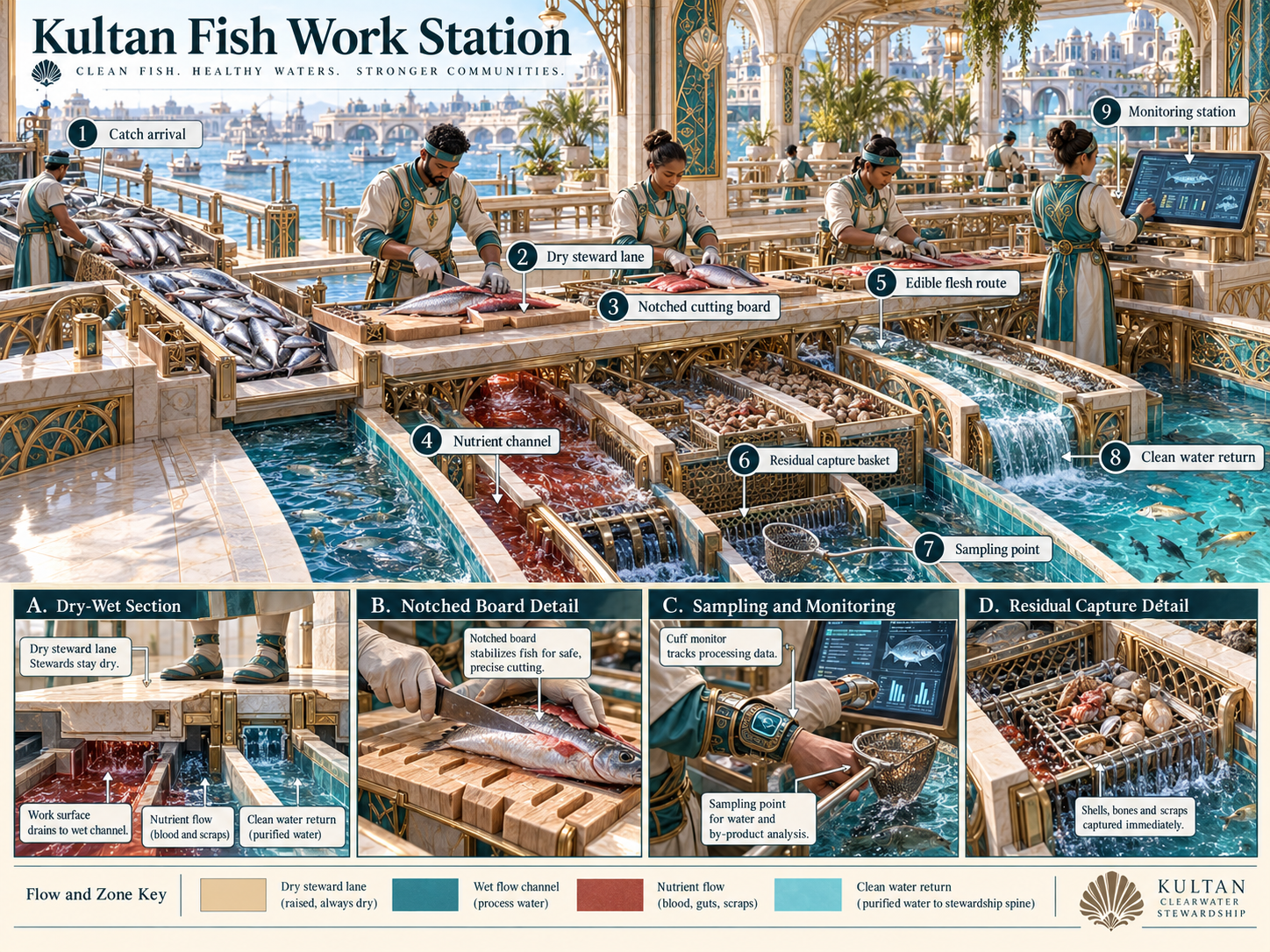
Thirty percent of international conduct: whose garbage, whose burden?
A manageable average can hide a household working itself into the ground
Contribution can happen with the family, not away from it
Fertility agenda · 5.0 children per woman
Fertility agenda · target 5.0
Family continuity is measured partly by whether children are actually multiplying. New and re-reviewed profiles use total fertility as 40% of Family Formation: 2.1 births per woman is the replacement floor and earns positive but limited credit; the authored target is 5.0.
Read A Civilization Built for Mothers and Fathers
Evidence requirements for policy and births
The graded national Abundance Gate
Food
Food · 4 points
Full credit means nutritious food is ordinary civilization provision without a checkout or poverty test. School meals and other narrow institutional routes can earn limited partial credit without being mistaken for free food abundance.
Read A Civilization Laid Out in Orchards
Housing / Land
Housing / Land · 4 points
Full credit means families can secure a home or suitable productive ground without rent, purchase price or mortgage debt deciding whether they may remain sheltered and grounded.
Read the Distributed Founding Nuclei Strategy
Healthcare
Healthcare · 4 points
Full credit requires dependable no-payment care across prevention, primary care, maternity, dentistry, medicine, emergency treatment and necessary specialist care.
Read Money Zombie Outbreaks
Transportation
Transportation · 4 points
Full credit means ordinary movement is free across the routes people actually need. A free Sunday, one route or a temporary promotion earns only limited credit.
Read The Caterport: Free Human Movement
Water / Energy
Water / Energy · 4 points
Full credit requires both safe water and essential household energy to stay available without payment deciding whether cooking, cooling, washing, pumping or food preservation stops.
Read Nucleus Formation Stewards
Friction Economy Pressure = (100 - weighted domestic Friction beleshky) ÷ 2 (context only)
Headline ceiling = -50 + (2.5 × Money Gate points); ceiling factor = 0.5 + (Money Gate points ÷ 40)
Money-gated beleshky = -100 + ((adjusted beleshky + 100) / 200) × (100 + country headline ceiling). Four weighted beleshkies form each gated category; normalized gated categories form the same country score, with the historical two-decimal evidence rounding retained.
Human Time & Burden Return
Watch category film
Housing, Shelter & Housing Reach
Watch category film
Food, Nourishment & Free Food Abundance
Watch category film
Water & Sanitation Abundance
Watch category film
Energy & Household Capability
Watch category film
Health & Care Reach
Watch category film
Education & Human Capability
Watch category film
Mobility & Reachability
Watch category film
Family Formation, Continuity & Child Stability
Fertility agenda · target 5.0
Family continuity is measured partly by whether children are actually multiplying. New and re-reviewed profiles use total fertility as 40% of Family Formation: 2.1 births per woman is the replacement floor and earns positive but limited credit; the authored target is 5.0.
Read A Civilization Built for Mothers and Fathers
Watch category film
Land Access & Spatial Freedom
Watch category film
Peace of Mind, Happiness, Beauty & Delight
Watch category film
Living Ground, Biodiversity & Resilience
Watch category film
Justice, Safety & Institutional Friction
Watch category film
Durability, Repair & Material Return
Watch category film
International Accessibility, Migration & Human Welcome
Watch category film
External Footprint & Non-Extractive Global Conduct
Watch category film
See every point: America, Åland and the TBFC standard →
Abundance Adoption
Public uptake counts, but implementation counts more
Verified public uptake of Trott Bailey Family Civilization / Abundance thinking can add a bounded bonus inside the existing relevant category. Publication is evidence that a country’s public information environment is carrying the idea; official discussion, policy and implementation carry progressively more weight. Adoption never creates a missing category score, never increases data coverage, never changes category weights, and never clears the National Abundance Gate.
Integrity rule: A pitch, submission or Trott Bailey self-publication does not earn country Adoption points. A verified external publication can earn a small relevant-category bonus; institutional discussion, official policy and physical implementation carry progressively more weight. Adoption can improve the relevant category evidence, but it cannot award Money Gate points by itself or clear Money Gate.
Trott Bailey Family Civilization Thinking
What the ideal is trying to look like
The country score describes what the evidence says is happening. This directory opens the Trott Bailey Family body of civilization work beside it: the systems, principles and designs we use when asking what a stronger direction could look like.
Time-saving systems should return usable life and family closeness. Family Shubaka can combine a useful compound contribution, husband-and-wife teamwork, skill teaching and togetherness within one shared hour; the hour is counted once and its benefits are recorded separately.
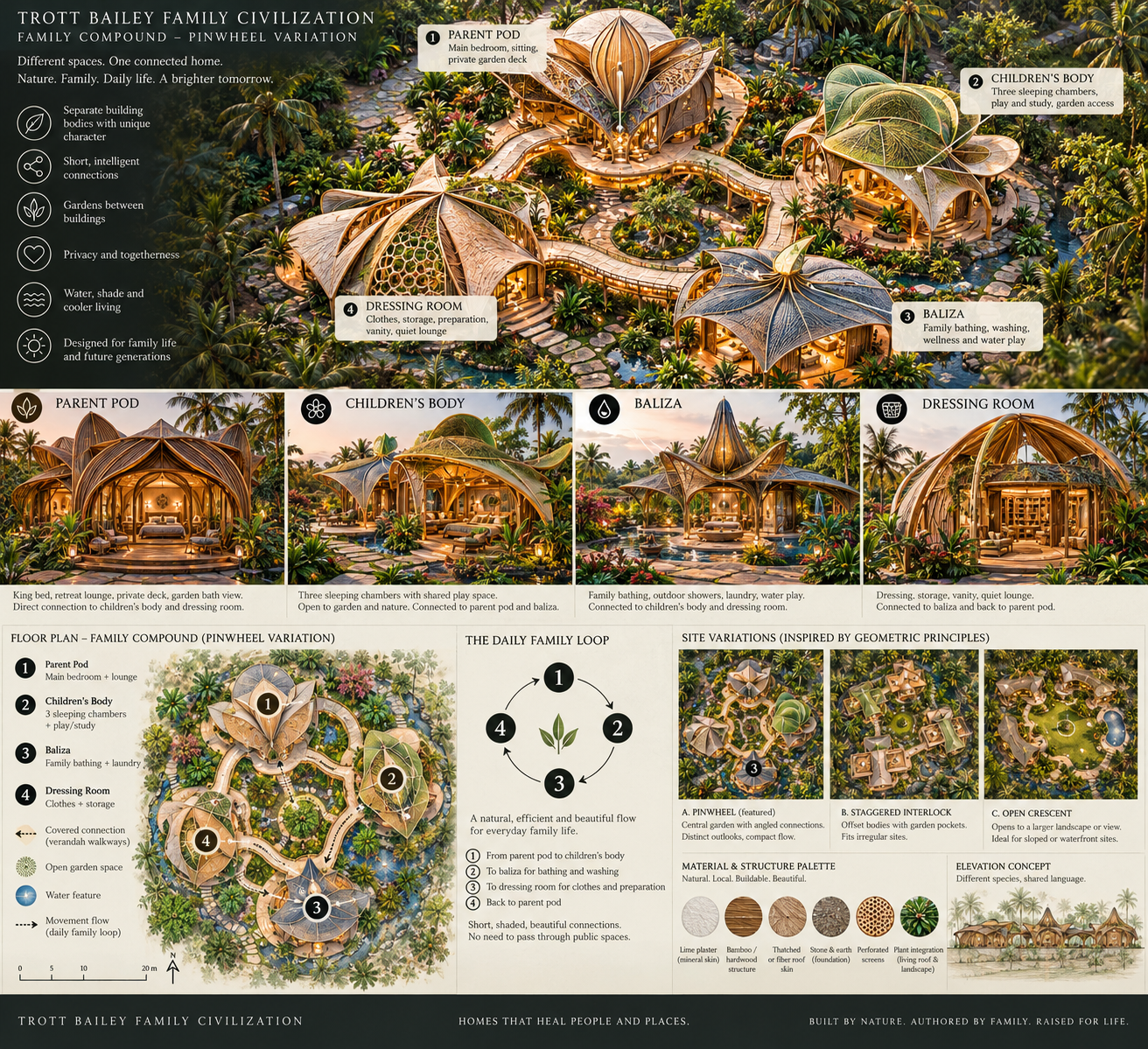
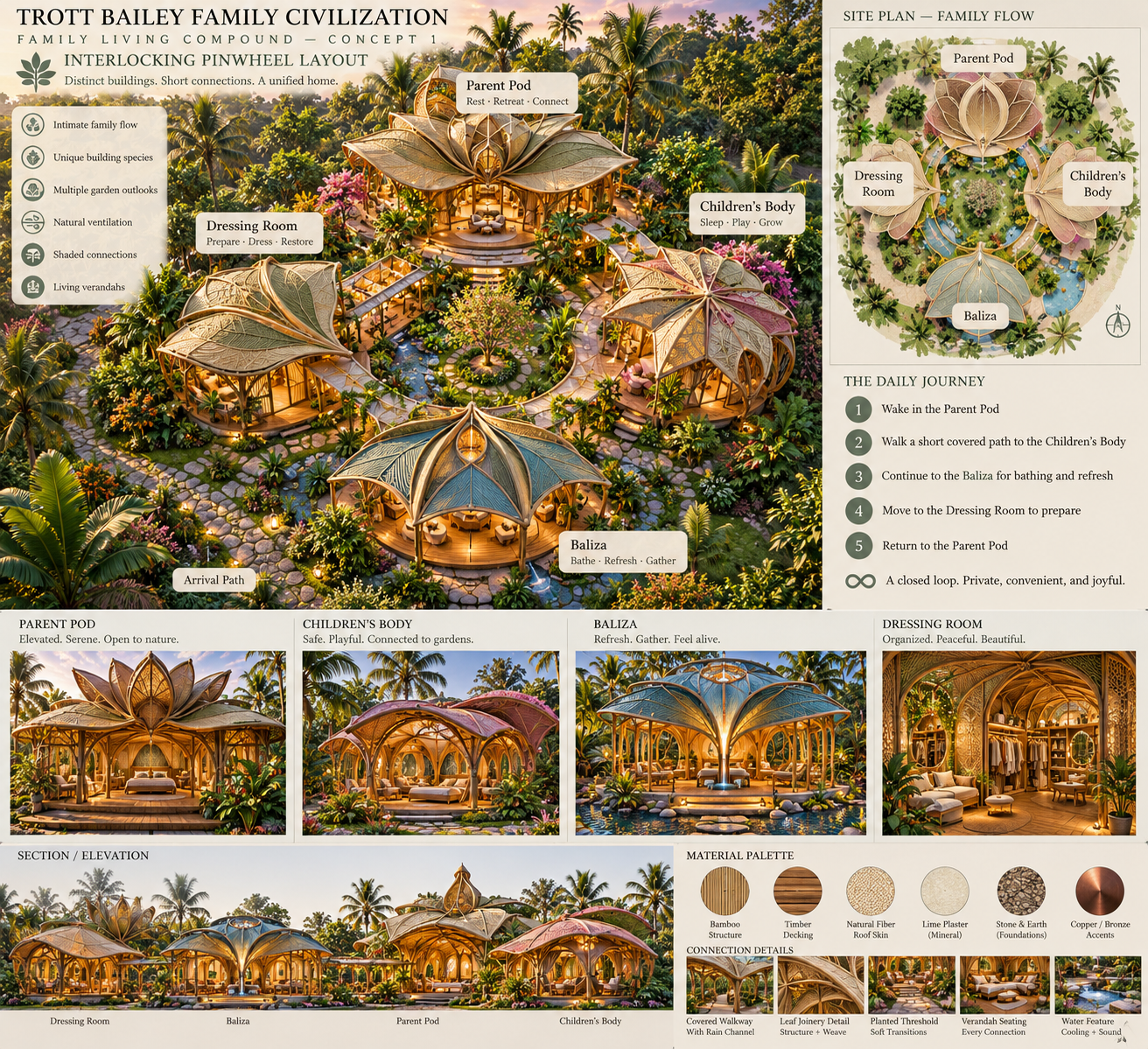
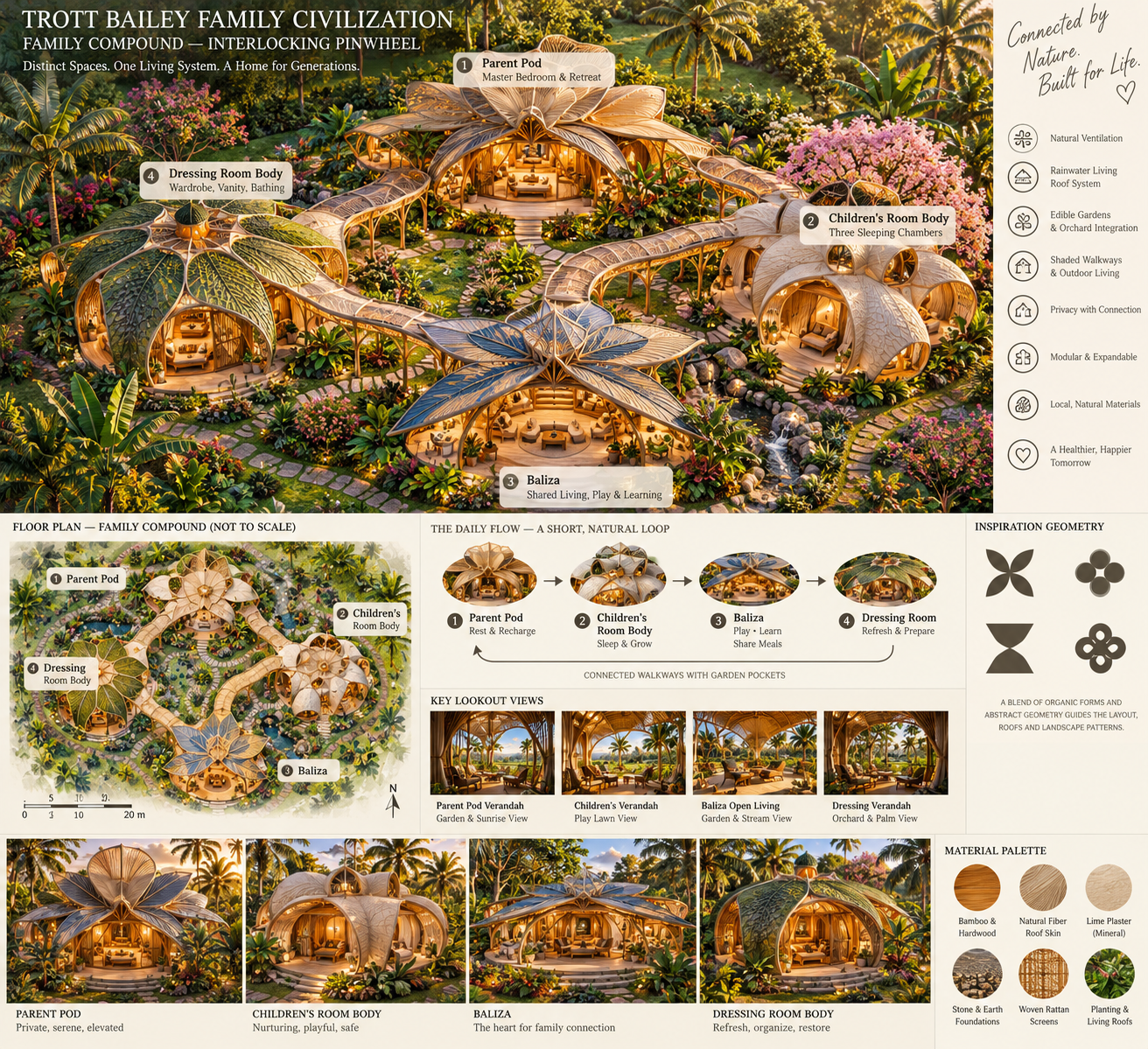
Shelter should be a dependable base for family life, care, rest and capability rather than a lifetime gate that consumes the family just to remain housed.
Food abundance should be physical and multiplying: productive ground, free edible landscapes, strong nourishment routes and enough local capability that food is not trapped behind money alone.
Water should be caught, stored, cleaned, reused and distributed as living infrastructure so ordinary family life is not left vulnerable to one distant source or one point of failure.
Energy is valuable for what it lets people do: cool, cook, move, pump water, preserve food, make things and remove household strain. Capacity should turn into everyday capability.
Care should meet people close to ordinary life, with prevention, maternity, dentistry, first aid and specialist capability organized around reducing suffering rather than maximizing transactions.
Children should gain real understanding and useful capability early, then move deeper according to readiness, interests and ability while learning remains connected to family and civilization life.
Movement should widen life rather than eat it. Families, children and elders should be able to reach people, knowledge, care and places without travel becoming a luxury or a second job.
Civilization should make it easier for husbands, wives, children and extended family to remain close, form stable households and have enough time and material support to actually live family life.
People should be able to spread productive life across suitable land instead of being forced into a few expensive centres. Settlement should create capability without stripping the place that supports it.
Beauty, delight, nature, play and peaceful public life belong in ordinary civilization. They should not appear only after people can afford admission, a holiday or a private retreat.
Ground should become more alive through use. Food, water, shade, soil organisms, habitat and regeneration should be designed as one continuing living system rather than separate afterthoughts.
Justice should be usable by ordinary families, evidence should be allowed to challenge power, public roles should be clear, and administration should remove needless friction rather than multiply it.
Things should remain useful. Repair, maintenance, material return, local skill and durable systems should keep capability in circulation instead of repeatedly converting useful matter into waste.
Crossing a border should not switch off ordinary human life. Visitors, families, learners, refugees and neighbours should be able to arrive, move, care for children and participate without unnecessary exclusion.
Expansion should leave places more capable, not emptied. A civilization that travels should carry useful knowledge, reciprocal benefit and locally rooted capability rather than organize other people around extraction.

 and then