CATEGORY 09 / 16 · FOUR-BELESHKY METHODOLOGY · V1.0.0
Family life should be comfortable, supported and able to continue.
A country may permit marriage, record births and count childcare places, while young couples cannot establish a comfortable home and parents lack time to raise their children. Does civilization make lasting family life genuinely possible?
The Trott Bailey Family Civilization organizes marriage establishment, family land, prepared housing, family-close maternity, child relief, lifelong support, husband-and-wife Shubaka, and families teaching children together. The universal baseline is at least 50 hectares per newly married couple with capacity-grounded further resource access. This is an authored working standard, not evidence of nationwide provision today.
Keep the existing 25 / 35 / 25 / 15 formula
Four things family life must actually receive
Capacity — family establishment & care
Can the civilization establish and support a new family well, and keep supporting it as life changes?
See all nine levels ↗02 · 35%Reach — actual family & child access
Which families actually receive enough safe, usable support throughout family life?
See all nine levels ↗03 · 25%Friction — what makes family life difficult
Which avoidable costs, restrictions, work demands, delays and safety failures remain?
See all nine levels ↗04 · 15%Return / Continuity — family life sustained
Are children safe and thriving, and do families gain time, capability and lasting support?
See all nine levels ↗The category assesses actual family conditions and measured fertility separately. A policy announcement, marriage registration, high birth count or cultural stereotype does not establish safe family life. Reach percentages must refer to a declared comprehensive support pathway and a clear population denominator; lacking the joint measure, report component coverage separately instead of inventing it.
Trott Bailey Family Living Principle
Marriage opens a larger family life, and civilization supports its continuation
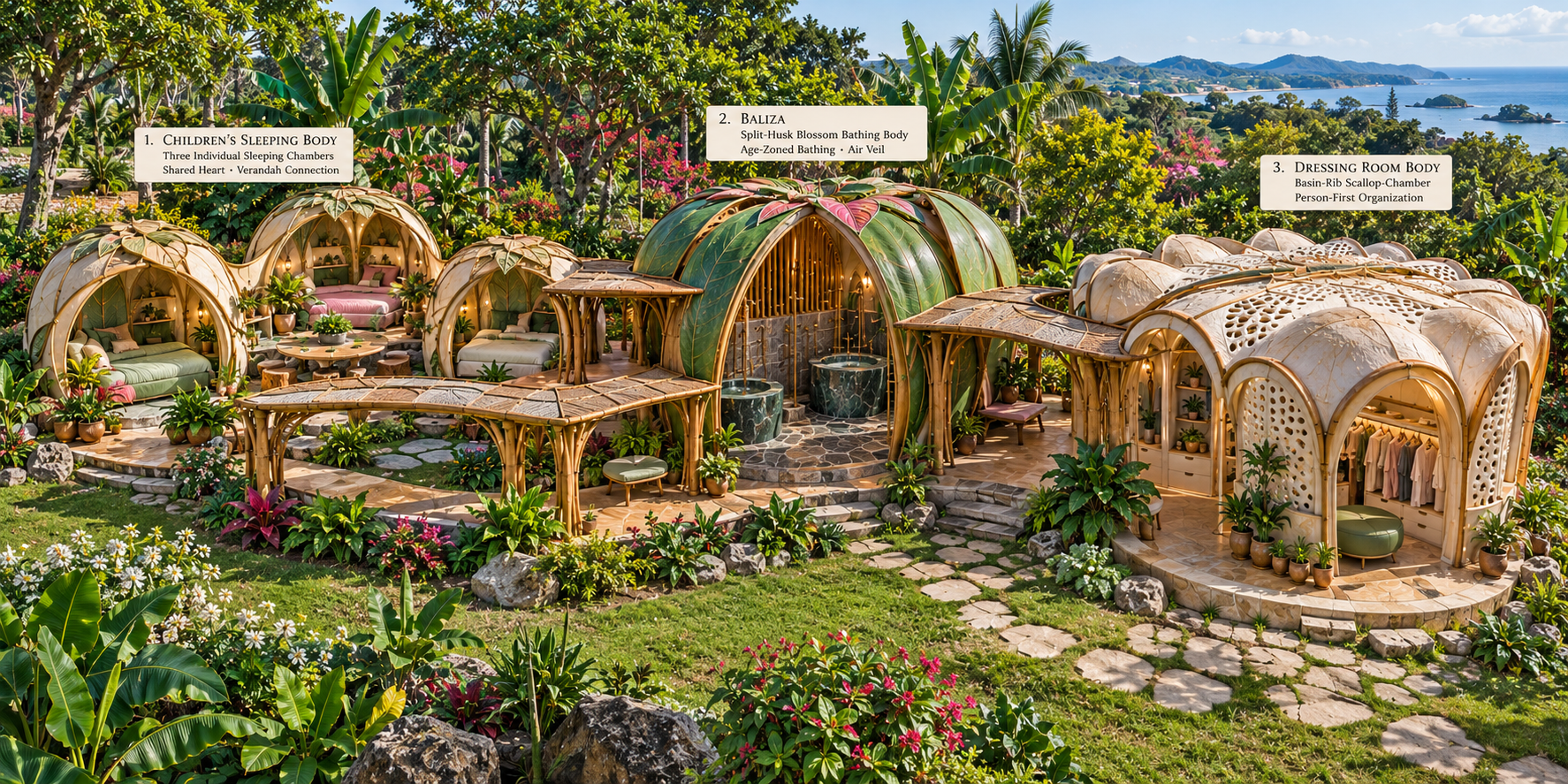
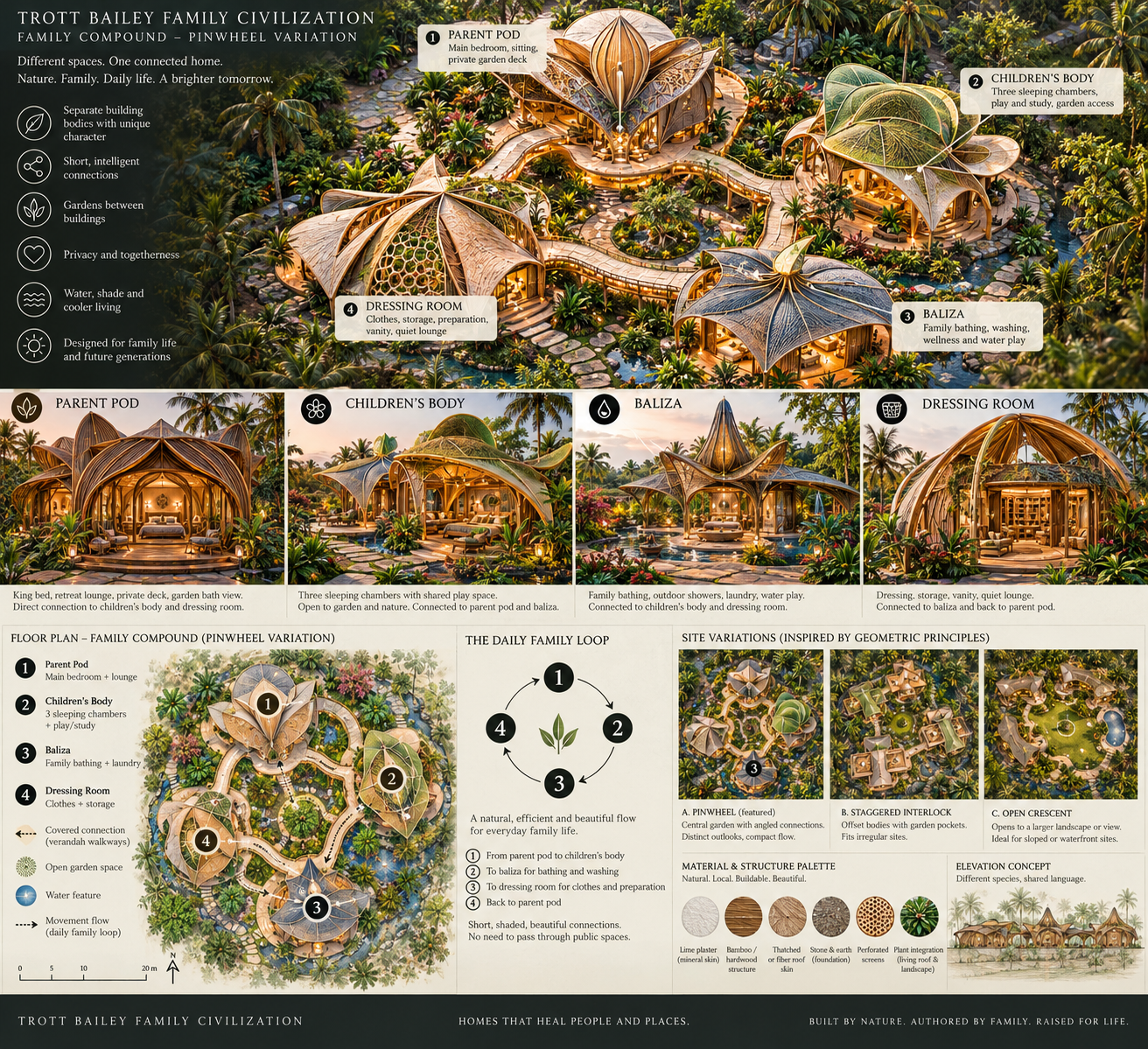
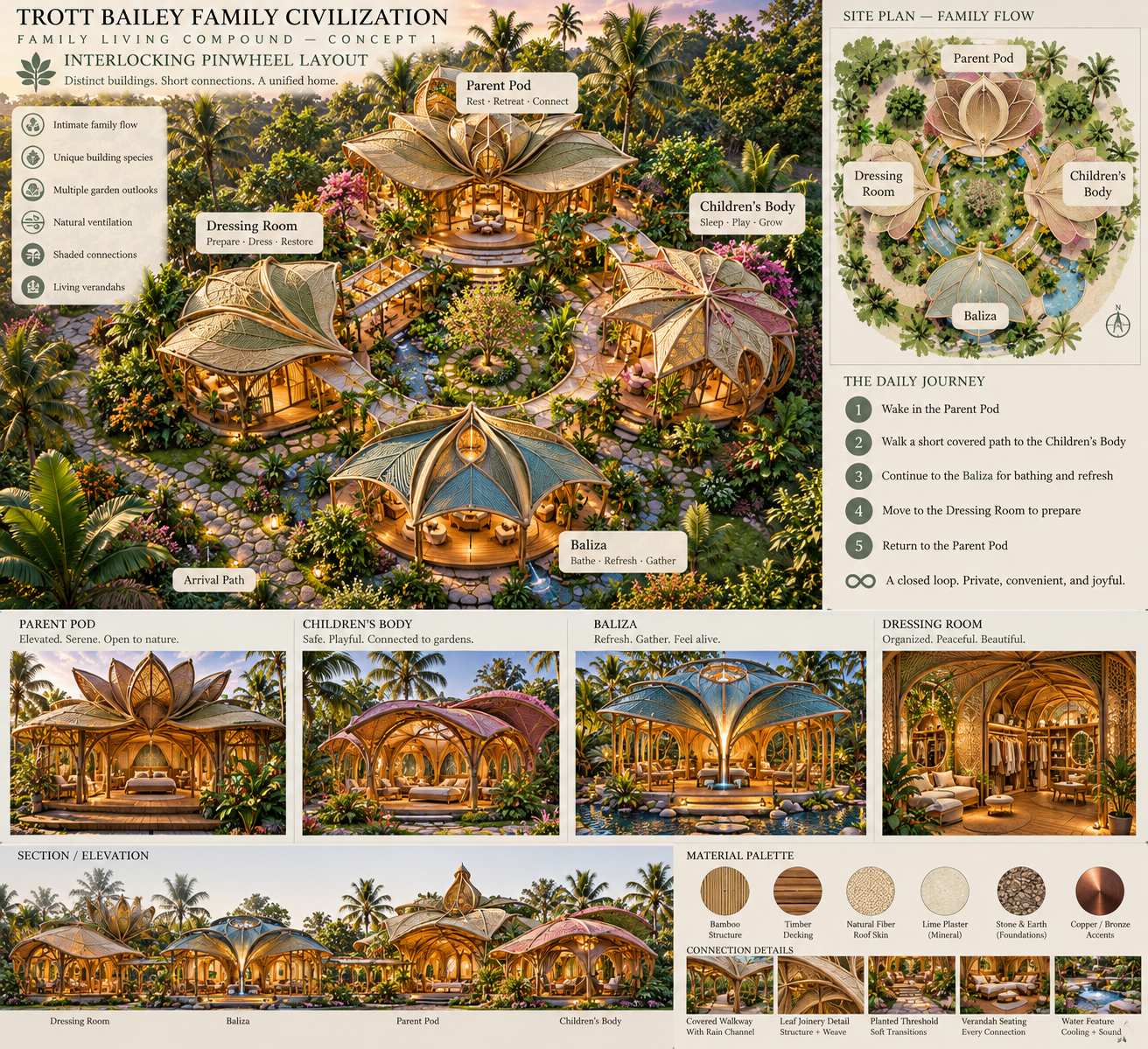
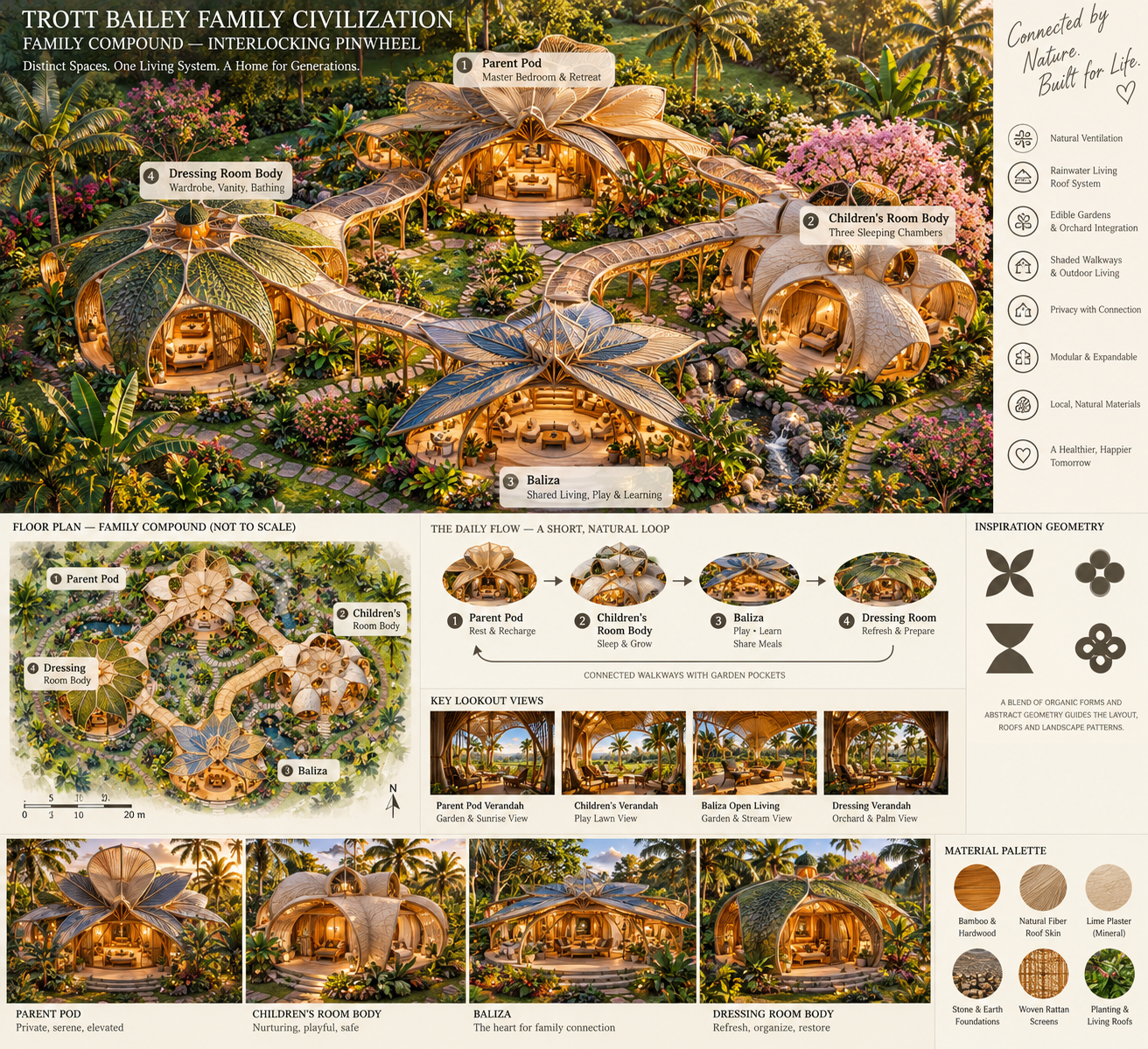
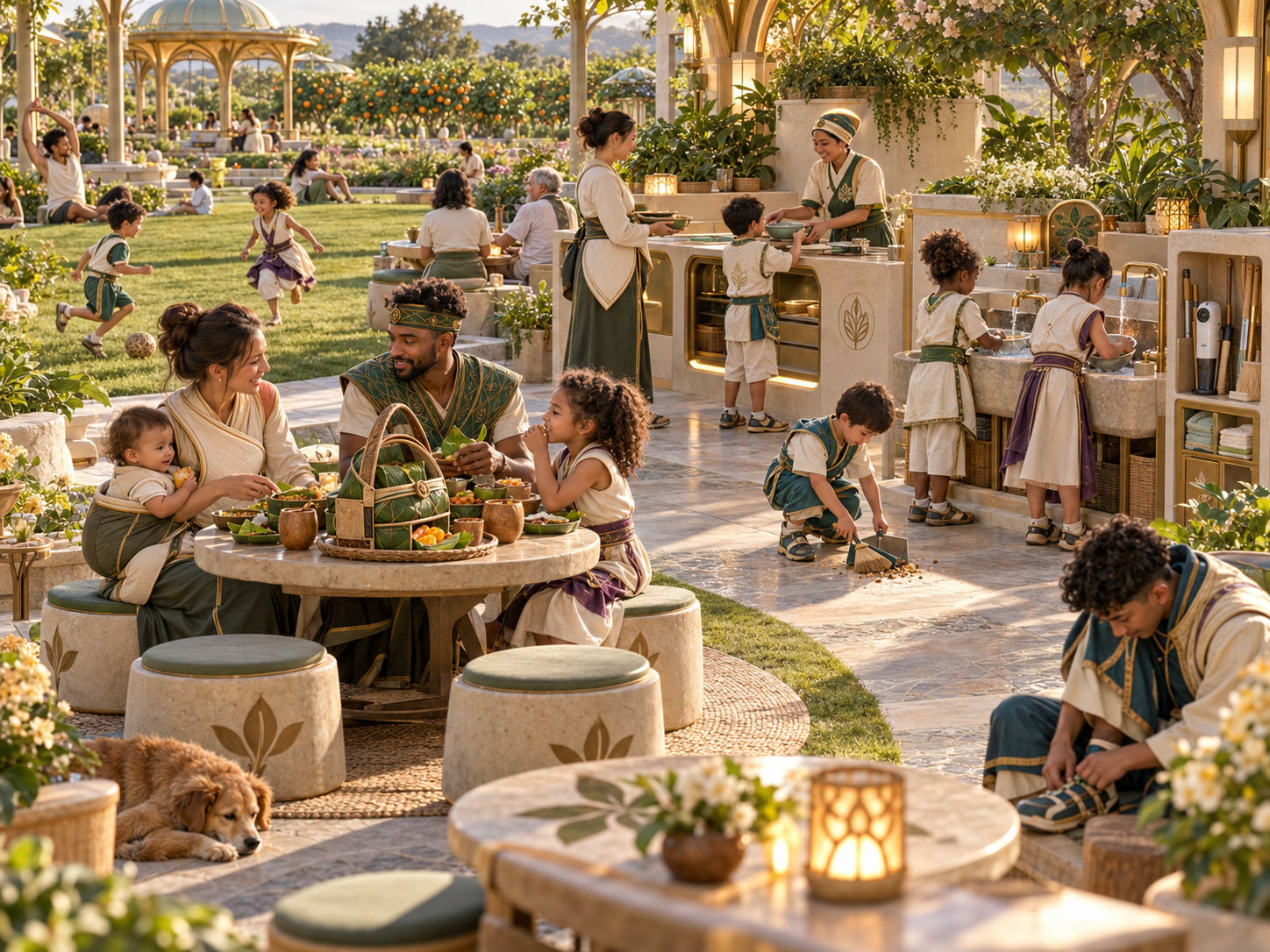
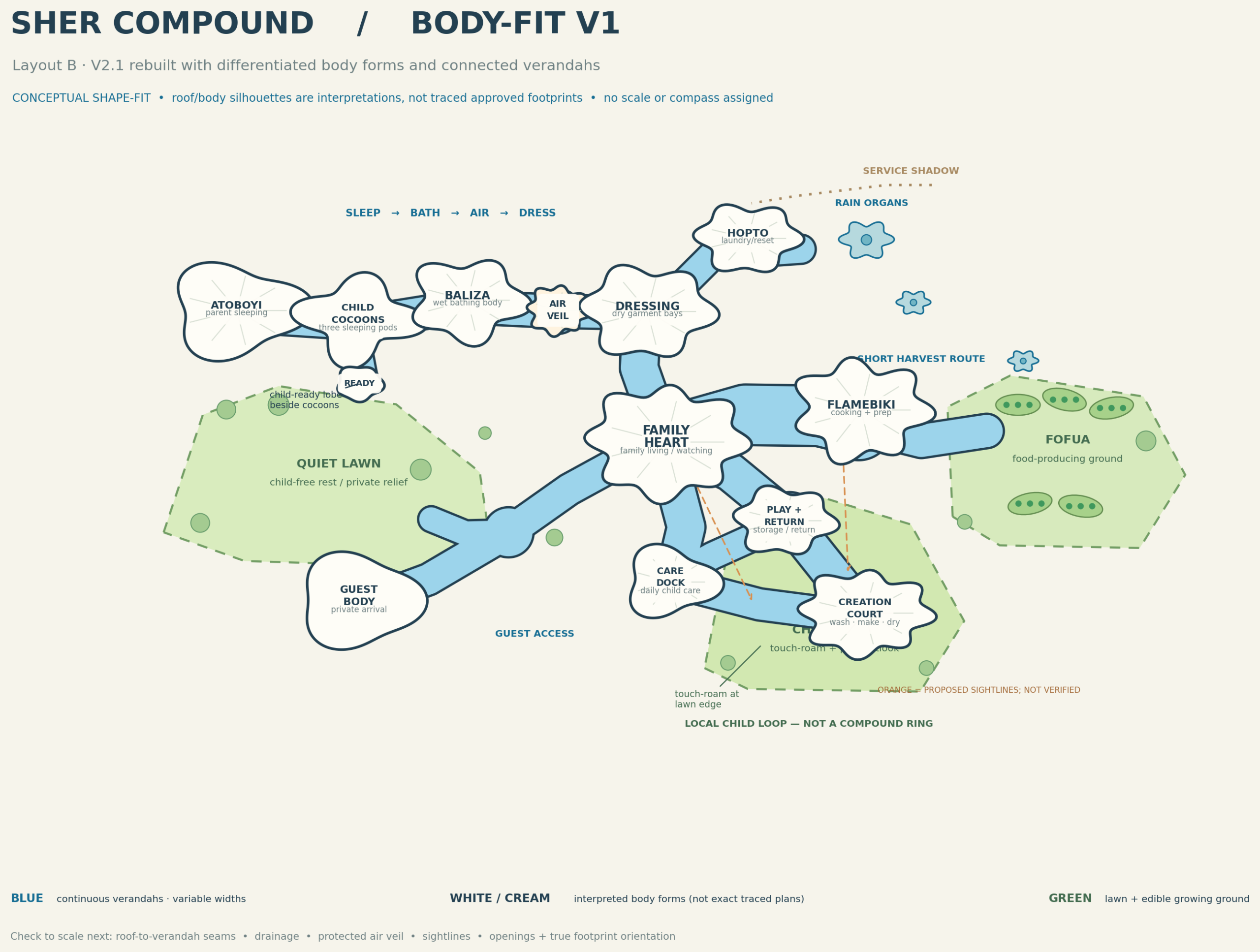
Families can meet and choose marriage, gain a secure core home and baseline land entitlement, access qualified Tideechi and DeMassa-linked care, raise children close to parents, and contribute through family Shubaka. The family compound can support nurseries, orchards, food systems and practical teaching. Civilization services remain available throughout life, not only at the wedding.
This is a civilization design benchmark, not proof of current geographic deployment. Children learning with parents are not compulsory adult workers. Married life is organized as a shared household and purpose; safety and genuine choice matter. Avoid assuming larger birth rates prove supportive conditions on their own.
Trott Bailey foundations: Marriage & Lifetime Family Flourishing Support (17 October 2026) ↗ · The Market Is Not a Parent ↗
Five existing direct Money Gates · no sixth Family gate
Family Formation draws on all five essentials, but has no sixth Money Gate
Food, Housing/Land, Healthcare, Transportation and Water/Energy shape family cost, reach and burden. The original five direct gates keep their own 0–4 scoring and together control national zero-line clearance. Family Reach measures its own effective support pathway; Friction measures independently documented pressures. Do not deduct each Money Gate a second time or assume an individual gate proves family continuity.
Housing / Land
Secure married-home establishment and family land capacity, especially beyond a temporary rental.
Food
Reliable daily nourishment for spouses, pregnancy, babies and growing children.
Healthcare
Tideechi and general maternity care, qualified medical support, pediatrics and recovery.
Transportation
Free movement connects relatives, maternity services, learning and family travel.
Water / Energy
Household bathing, cooking, cleaning, safe baby care and dependable family infrastructure.
Family does not have an independent money-gate 0–4 reading. For higher Family Reach rungs, support must actually be used by families and the money-free component must be substantiated, not inferred from the five gate scores. The overall 20/20 zero-line still applies separately.
Existing 60/40 Family Formation rule
Observed fertility is a separate 40% component
The four beleshkies calculate lived family conditions (E). Observed total fertility rate (TFR) separately produces a fertility-performance score (P). The established core blend is 60% E + 40% P. Approximately 2.1 births per woman earns +25 on the authored fertility scale, and 5.0 earns +100. TFR is a population measure, not a family happiness reading or an instruction for individuals.
A TFR is births per woman averaged across a population, not a count of children per household, nor proof of family happiness. The 5.0 target is authored TBF policy. Historical measurements have age structure, reporting lags, choice and rights constraints. Show source and observation year.
Separate marriage-law policy criterion and sources
The existing plugin applies a 50-point deduction after independently verified legal recognition of same-sex marriage, and a 0-point deduction when reviewed non-recognition is verified; pending status is not a verified zero. This is an explicit TBF normative choice, not an empirically proven effect on fertility or family stability. Published research includes contrary findings. Display legal status, source date, effective year and the arithmetic separately, without recasting it as a measured child-welfare effect. This methodology-only pass does not change the existing policy or any nation’s classification.
The existing legal-status audit records a dated source and jurisdiction-specific status. Both supporting arguments and contrary research must be distinguished from measured fertility.
Independent discussion: Peer-reviewed demographic study ↗ · Carroll and Schumm argument ↗
Nine positions per beleshky
What earns every Family Formation scoring level?
| Score | Capacity — family establishment & care | Reach — actual family & child access | Friction — what makes family life difficult | Return / Continuity — family life sustained |
|---|---|---|---|---|
| -100 | Family-support capacity has collapsed: little reliable family housing, prenatal care, parental support or protection for children. | Fewer than 5% of eligible families and children receive a documented full, safe family-support pathway. | Severe violence, displacement, coercion, financial burden and lack of essential support systematically obstruct family life. | Child safety, development, continuity and family recovery are in severe documented failure. |
| -75 | Only scattered emergency family support exists; the essential route from marriage to safe parenting regularly fails. | Only 5–24% effectively receive the full support pathway; access is concentrated or highly restricted. | Extreme housing insecurity, childbirth risks, unsafe caregiving and work demands make ordinary family establishment precarious. | Family stability, nurturing care and child well-being repeatedly deteriorate; little successful recovery is established. |
| -50 | Basic family and maternity services exist, but housing, childcare and household support are severely undersupplied. | 25–39% effectively receive linked support across household, early care and parent support; major exclusion remains. | High childcare costs, inaccessible housing, poor care access and long work demands regularly block desired family life. | Basic continuity exists but preventable harm, unmet care needs and child deprivation are widespread. |
| -25 | Operating marriage and care systems exist, yet major gaps leave many new families struggling to establish a secure household. | 40–49% effectively receive linked support; households outside the main centres or with limited means remain underserved. | Major documented childcare, housing, care, administrative or parental-time burdens remain widespread. | Uneven family continuity and child-development outcomes; supports have not reliably improved wellbeing. |
| 0 | Basic family registration, maternity and household support operate, but service continuity and practical support are uneven. | At least 50% effectively receive an adequate family-support pathway; further coverage and continuity are not yet proven. | Households encounter working support but still face substantial uneven costs, delays or care burdens. | Many children receive basic nurturing care and stable daily routines, but enduring benefits remain uneven. |
| +25 | Broad family services and adequate support infrastructure exist, with documented gaps in timely housing or practical relief. | Over 75% effectively receive adequate family support and access to childcare, maternity and a secure household foundation. | Measured reductions in family costs, unsafe practices, waiting and involuntary separation improve daily life. | Steady gains in nurturing care, parent-child time, healthy development and family resilience are demonstrable. |
| +50 | Connected, reliable family-housing, maternity, childcare and parenting-support capacity serves families through major transitions. | Over 75% receive the support pathway AND over 30% access needed supports without ordinary payment barriers, with verified take-up. | Most avoidable family burdens are substantially reduced, with accessible care, flexible schedules and credible legal protections. | Dependable nurturing and family continuity, genuine shared parent-child time, and family learning are widely observed. |
| +75 | Near-universal resilient family-support capacity, prompt housing and care, flexible family Shubaka and dependable restoration are demonstrated. | Over 90% receive comprehensive support and at least 75% have reliable no-payment access where money would otherwise restrict it. | Payments and administrative obstacles are exceptional; safe caregiving, time and responsive support are broadly protected. | Long-term family security, safe development, shared Shubaka/teaching, restoration and generational support are widespread and measured. |
| +100 | Civilization can establish and sustain every family with suitable home, land access, safe care, teaching, restoration and rapid support as needs change. | All eligible families and children can reach safe, continuous, timely and effective support without essential payment barriers or exclusion. | Ordinary family establishment and raising children require no essential paywall or avoidable bureaucracy; protection and correction work promptly. | Family life is durably supported across generations: safe childhoods, shared married life, restored caregivers, family teaching, and demonstrably healthy continuity. |
Beleshky 1 · 25% of Family
Capacity — family establishment & care
Can the civilization establish and support a new family well, and keep supporting it as life changes?
Family-support capacity has collapsed: little reliable family housing, prenatal care, parental support or protection for children.
Read the Trott Bailey foundation ↗Only scattered emergency family support exists; the essential route from marriage to safe parenting regularly fails.
Read the Trott Bailey foundation ↗Basic family and maternity services exist, but housing, childcare and household support are severely undersupplied.
Read the Trott Bailey foundation ↗Operating marriage and care systems exist, yet major gaps leave many new families struggling to establish a secure household.
Read the Trott Bailey foundation ↗Basic family registration, maternity and household support operate, but service continuity and practical support are uneven.
Read the Trott Bailey foundation ↗Broad family services and adequate support infrastructure exist, with documented gaps in timely housing or practical relief.
Read the Trott Bailey foundation ↗Connected, reliable family-housing, maternity, childcare and parenting-support capacity serves families through major transitions.
Read the Trott Bailey foundation ↗Near-universal resilient family-support capacity, prompt housing and care, flexible family Shubaka and dependable restoration are demonstrated.
Read the Trott Bailey foundation ↗Civilization can establish and sustain every family with suitable home, land access, safe care, teaching, restoration and rapid support as needs change.
Read the Trott Bailey foundation ↗Evidence required
- Marriage and household formation support in law and in actual delivered services
- Prepared safe housing, land access, care spaces, maternity and postnatal service readiness
- Childcare relief availability, family teaching infrastructure and parent-aware Shubaka schedules
- Service capacity, staffing, reliability, regional gaps, upkeep and timely repair
How a country climbs
- Make housing, maternity and family care actually available when the household begins
- Connect household provisions, childcare relief, health, learning and restoration instead of disconnected benefit announcements
- Protect clinical quality and expand family-capable services in remote areas
- Build capacity for growing families and long-term support, not only one-off cash grants
Beleshky foundation: Marriage & Lifetime Family Flourishing Support (17 October 2026) ↗
↑ All scoring positionsBeleshky 2 · 35% of Family
Reach — actual family & child access
Which families actually receive enough safe, usable support throughout family life?
Fewer than 5% of eligible families and children receive a documented full, safe family-support pathway.
Read the Trott Bailey foundation ↗Only 5–24% effectively receive the full support pathway; access is concentrated or highly restricted.
Read the Trott Bailey foundation ↗25–39% effectively receive linked support across household, early care and parent support; major exclusion remains.
Read the Trott Bailey foundation ↗40–49% effectively receive linked support; households outside the main centres or with limited means remain underserved.
Read the Trott Bailey foundation ↗At least 50% effectively receive an adequate family-support pathway; further coverage and continuity are not yet proven.
Read the Trott Bailey foundation ↗Over 75% effectively receive adequate family support and access to childcare, maternity and a secure household foundation.
Read the Trott Bailey foundation ↗Over 75% receive the support pathway AND over 30% access needed supports without ordinary payment barriers, with verified take-up.
Read the Trott Bailey foundation ↗Over 90% receive comprehensive support and at least 75% have reliable no-payment access where money would otherwise restrict it.
Read the Trott Bailey foundation ↗All eligible families and children can reach safe, continuous, timely and effective support without essential payment barriers or exclusion.
Read the Trott Bailey foundation ↗Evidence required
- Effective complete-family support coverage, denominator of eligible families/children and observation year
- Maternity, childcare, housing and parental support use versus formal eligibility and policy announcements
- Urban/rural, income, age, disability, household composition and time-to-service differences
- Effective no-payment subset of the complete support pathway; gate-specific sources kept independent
How a country climbs
- Measure actual use and full-path continuity, not only registration or programme existence
- Extend effective care, housing and family support above the next population threshold
- Document who receives both dependable support and free access, without assuming benefits from law alone
- Address regional and disability access barriers with real service provision
Beleshky foundation: Courtship, Marriage & Married Life ↗
↑ All scoring positionsBeleshky 3 · 25% of Family
Friction — what makes family life difficult
Which avoidable costs, restrictions, work demands, delays and safety failures remain?
Severe violence, displacement, coercion, financial burden and lack of essential support systematically obstruct family life.
Read the Trott Bailey foundation ↗Extreme housing insecurity, childbirth risks, unsafe caregiving and work demands make ordinary family establishment precarious.
Read the Trott Bailey foundation ↗High childcare costs, inaccessible housing, poor care access and long work demands regularly block desired family life.
Read the Trott Bailey foundation ↗Major documented childcare, housing, care, administrative or parental-time burdens remain widespread.
Read the Trott Bailey foundation ↗Households encounter working support but still face substantial uneven costs, delays or care burdens.
Read the Trott Bailey foundation ↗Measured reductions in family costs, unsafe practices, waiting and involuntary separation improve daily life.
Read the Trott Bailey foundation ↗Most avoidable family burdens are substantially reduced, with accessible care, flexible schedules and credible legal protections.
Read the Trott Bailey foundation ↗Payments and administrative obstacles are exceptional; safe caregiving, time and responsive support are broadly protected.
Read the Trott Bailey foundation ↗Ordinary family establishment and raising children require no essential paywall or avoidable bureaucracy; protection and correction work promptly.
Read the Trott Bailey foundation ↗Evidence required
- Family spending required for housing, food, child care, transport, and health
- Parent hours (all jobs), involuntary long work, travel time, unpaid care and shared-family overlap
- Maternity waiting, childcare availability, administrative barriers and family separation
- Child protection risks including unsafe care, intimate partner violence and avoidable displacement
How a country climbs
- Remove payments and waiting from essential family services based on measured need
- Return predictable overlapping time to spouses, parents and children
- Provide accessible care and safe mechanisms for correcting abuse and service failures
- Reduce unnecessary commute, paperwork, family isolation and forced separation
Beleshky foundation: The Market Is Not a Parent ↗
↑ All scoring positionsBeleshky 4 · 15% of Family
Return / Continuity — family life sustained
Are children safe and thriving, and do families gain time, capability and lasting support?
Child safety, development, continuity and family recovery are in severe documented failure.
Read the Trott Bailey foundation ↗Family stability, nurturing care and child well-being repeatedly deteriorate; little successful recovery is established.
Read the Trott Bailey foundation ↗Basic continuity exists but preventable harm, unmet care needs and child deprivation are widespread.
Read the Trott Bailey foundation ↗Uneven family continuity and child-development outcomes; supports have not reliably improved wellbeing.
Read the Trott Bailey foundation ↗Many children receive basic nurturing care and stable daily routines, but enduring benefits remain uneven.
Read the Trott Bailey foundation ↗Steady gains in nurturing care, parent-child time, healthy development and family resilience are demonstrable.
Read the Trott Bailey foundation ↗Dependable nurturing and family continuity, genuine shared parent-child time, and family learning are widely observed.
Read the Trott Bailey foundation ↗Long-term family security, safe development, shared Shubaka/teaching, restoration and generational support are widespread and measured.
Read the Trott Bailey foundation ↗Family life is durably supported across generations: safe childhoods, shared married life, restored caregivers, family teaching, and demonstrably healthy continuity.
Read the Trott Bailey foundation ↗Evidence required
- Child development, nutrition, safety, birth registration and protection, with year and source
- Actual nurturing care and early learning, along with preventable harm and family stress
- Measured family/shared time, caregiver wellbeing, long-term stability and recovery
- Family Shubaka, parent-to-child expertise transfer and compound contribution as benefits, without counting clock hours more than once
How a country climbs
- Demonstrate safer childhoods, nurturing care and improvement in development outcomes
- Protect time together and recovery for parents and caregivers
- Support stable homes and inheritance and age-appropriate teaching through family Shubaka
- Show the change is lasting across birth, early childhood, growing families and care of elders
Beleshky foundation: Marriage and Housing: Core Family Homes & Free Circulation ↗
↑ All scoring positionsIllustrative scoring · not a live nation
See what family support and observed fertility contribute
Change each beleshky by 25 points. The calculator then applies the existing 60/40 fertility blend and displays the separately authored legal-policy adjustment. It does not update a country.
Lived family conditions E = 0.25×Capacity + 0.35×Reach + 0.25×Friction + 0.15×Return. Fertility performance P(TFR): if TFR ≤2.1, −100+(TFR/2.1)×125; if 2.1<TFR<5, 25+((TFR−2.1)/2.9)×75; ≥5 earns +100. Core reviewed Family = 0.60×E+0.40×P, with historical approved Adoption credits and separately sourced, authored marriage-law policy deduction applied by existing production rules. Family is 8% of national evidence before normalization and overall five-gate rules.
This calculator illustrates the published category method, not the stored country calculation, research-coverage normalization or a predicted rank. Archived Adoption credits, sourced country status, other adjustments and the national five-part gate remain governed by the existing scoring engine.
Transparency and improvements
What a country must actually show
Registered marriages are not proof that families flourish
OECD family indicators, UNFPA intended-versus-achieved family size, UNICEF nurturing care, child development, protection and parental time provide real measures. Do not treat incomplete programme coverage or a TFR survey as proof of the whole Family Reach population.
For each country publish year, denominator and source for young family housing security, access to qualified maternity/child care, parent time, nurturing care, child safety and development, no-payment support, and TFR. For family support Reach report effective full-path A% and proven no-payment subset M% only when measured jointly.
Archive the before-and-after evidence
Human Time separately scores household hours; Housing housing stock and secure shelter; Healthcare clinical quality; Education skill development; each direct Money Gate no-payment access. In Family, use cross-category facts as explanations and score distinct family outcomes; never stack the exact same numeric deduction.
This guide does not change country category beleshky readings, fertility figures, legal statuses, adoption, ranking events or history. Re-evaluate one country at a time with evidence and dated before/after history.
Independent measurements
Sources to verify national family conditions
Trott Bailey authored work

 and then