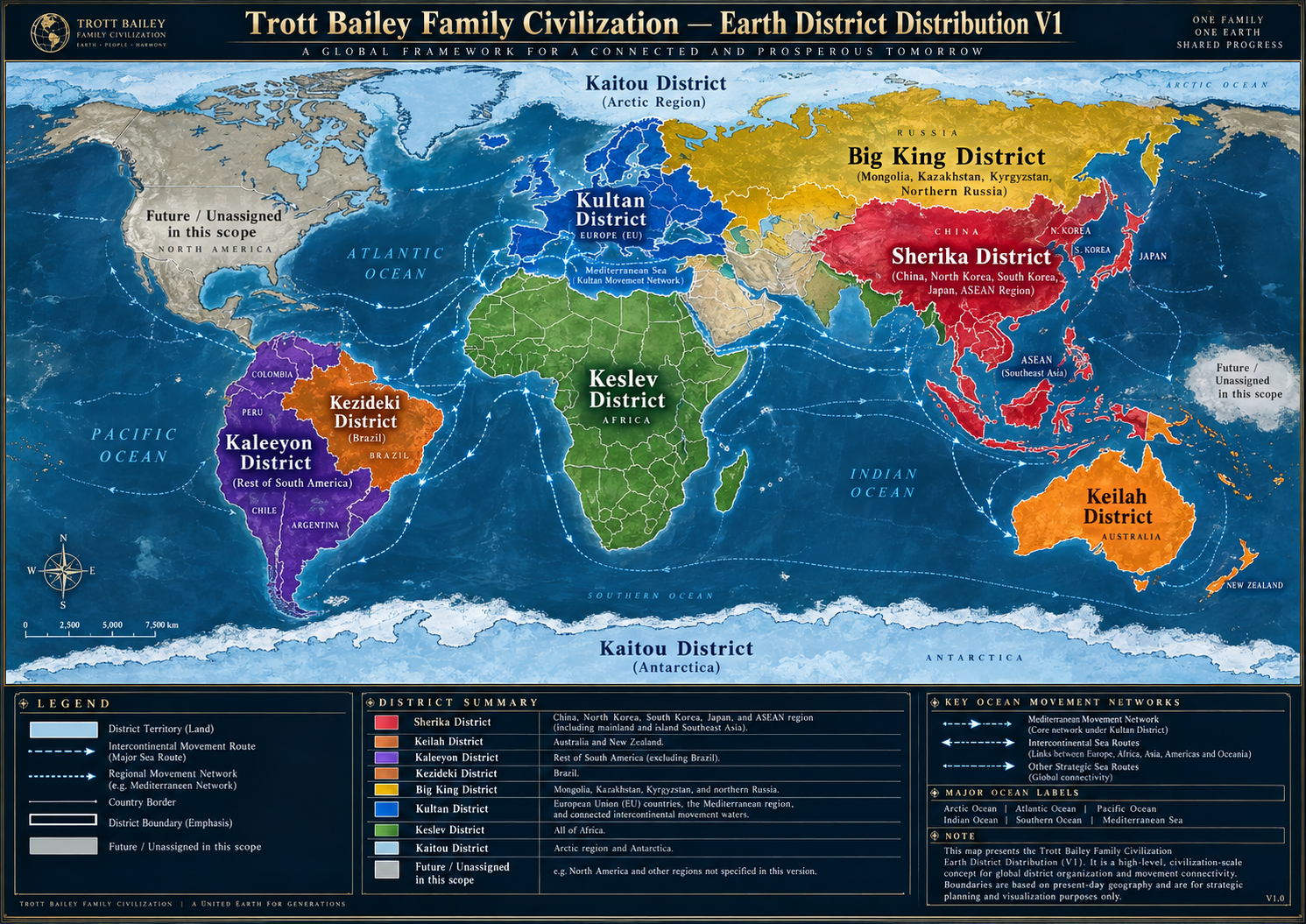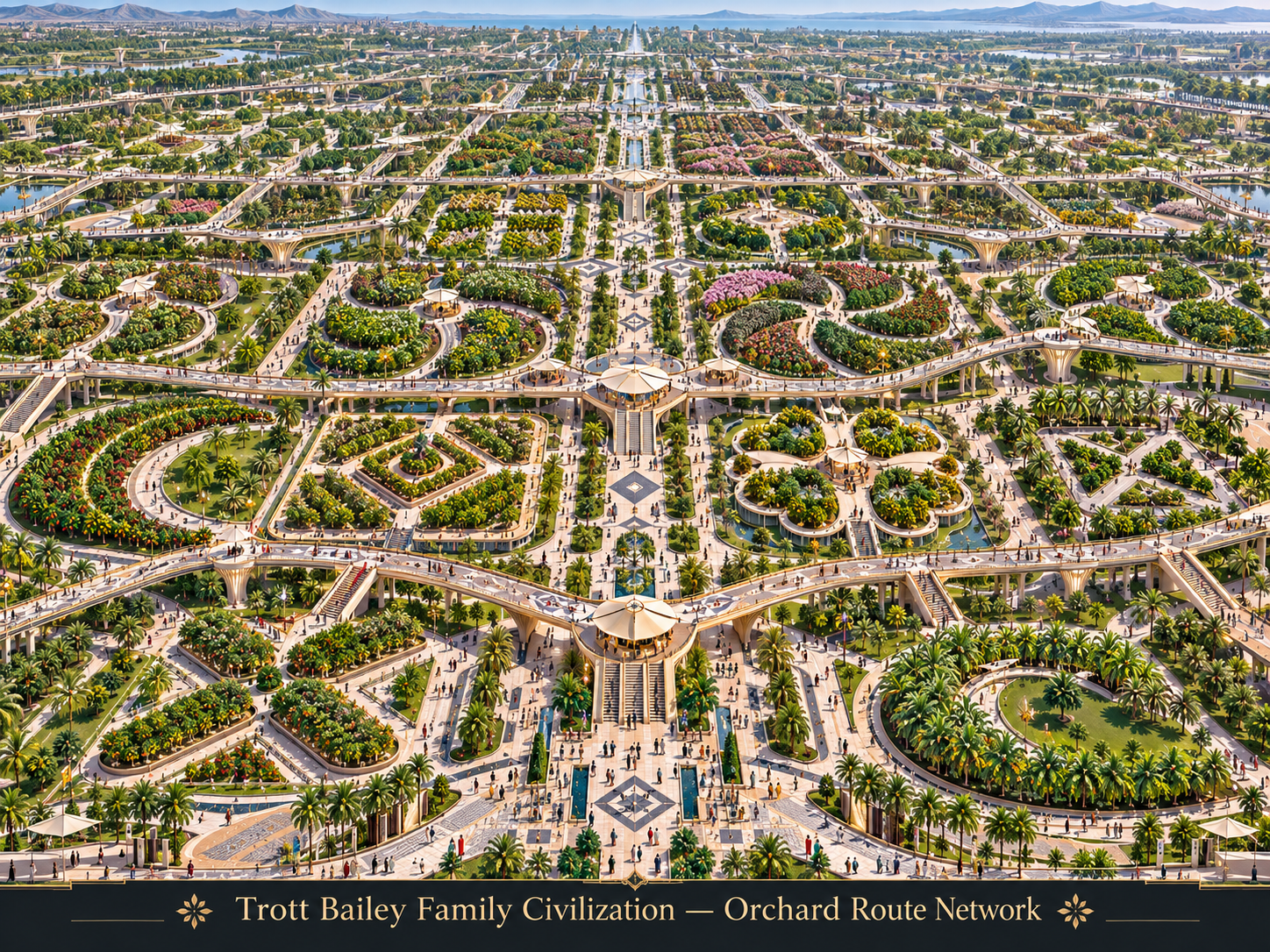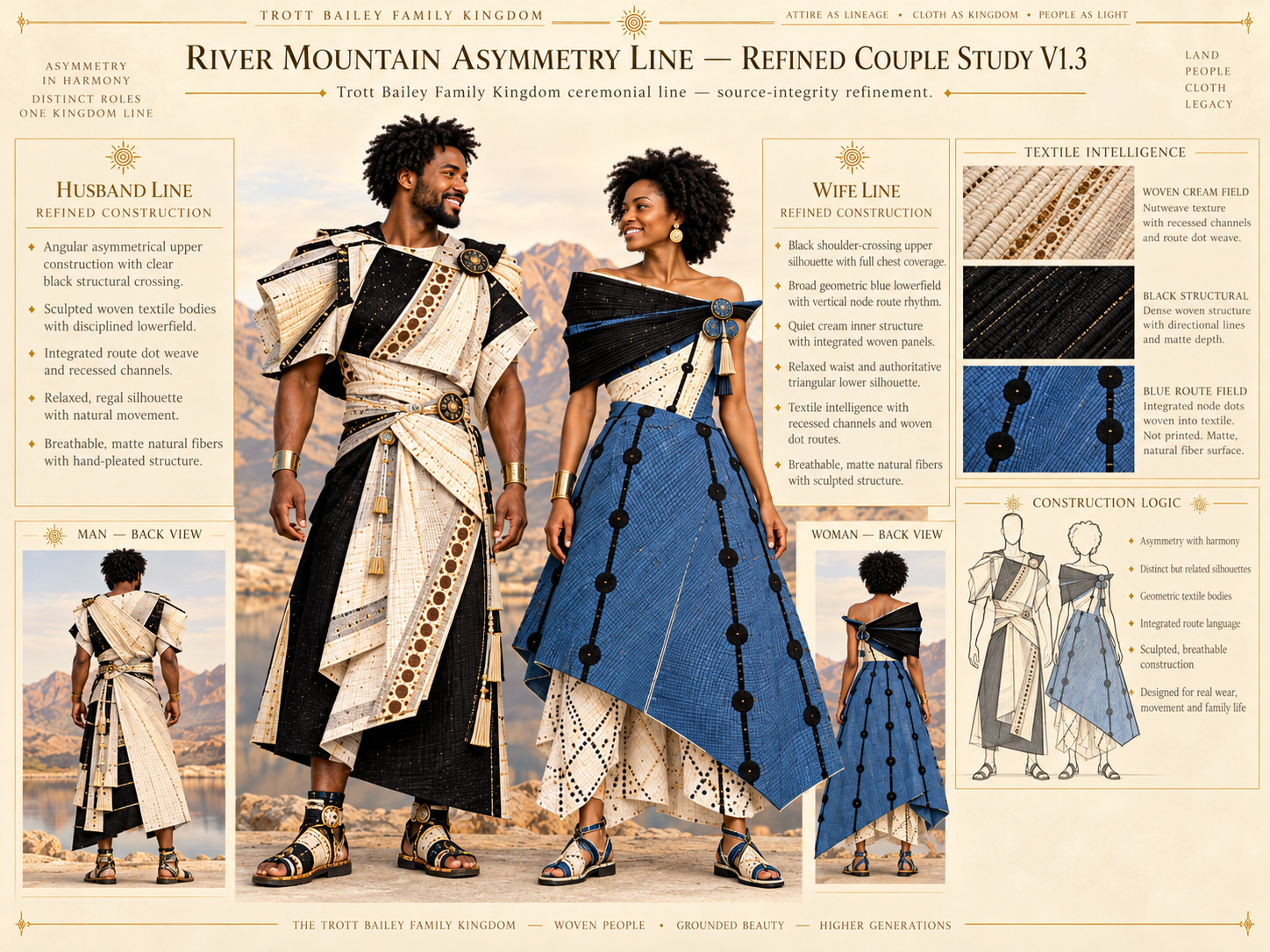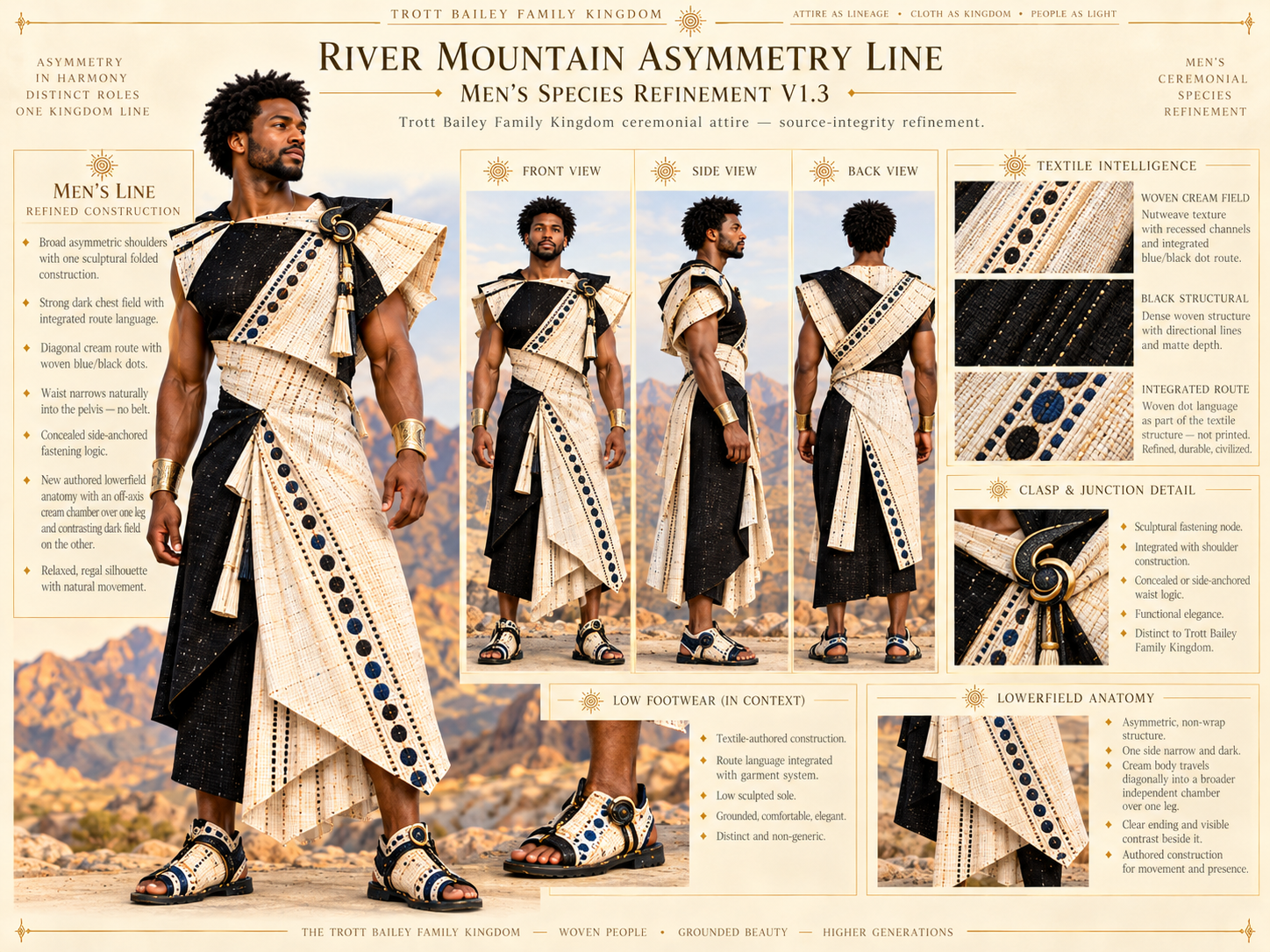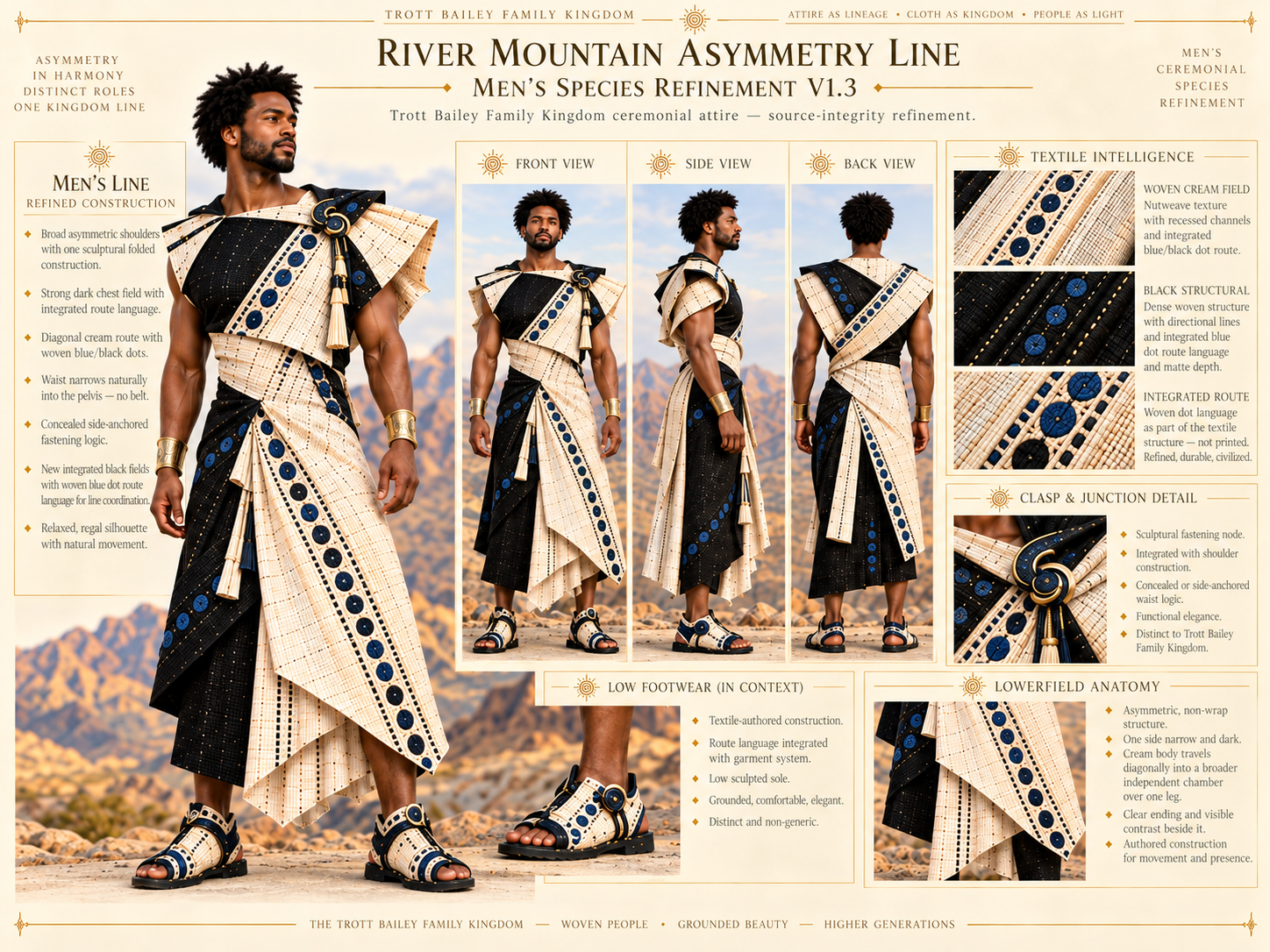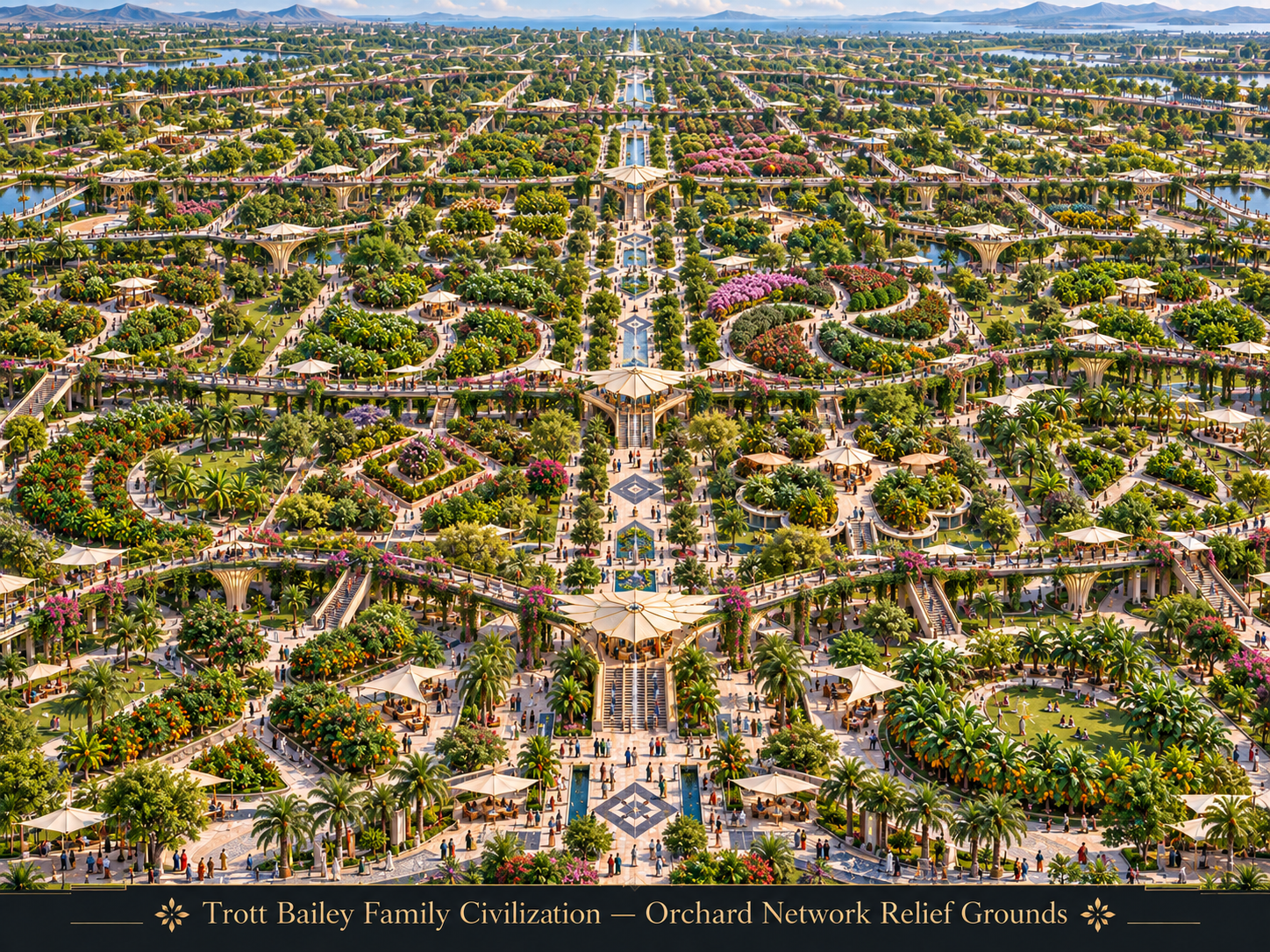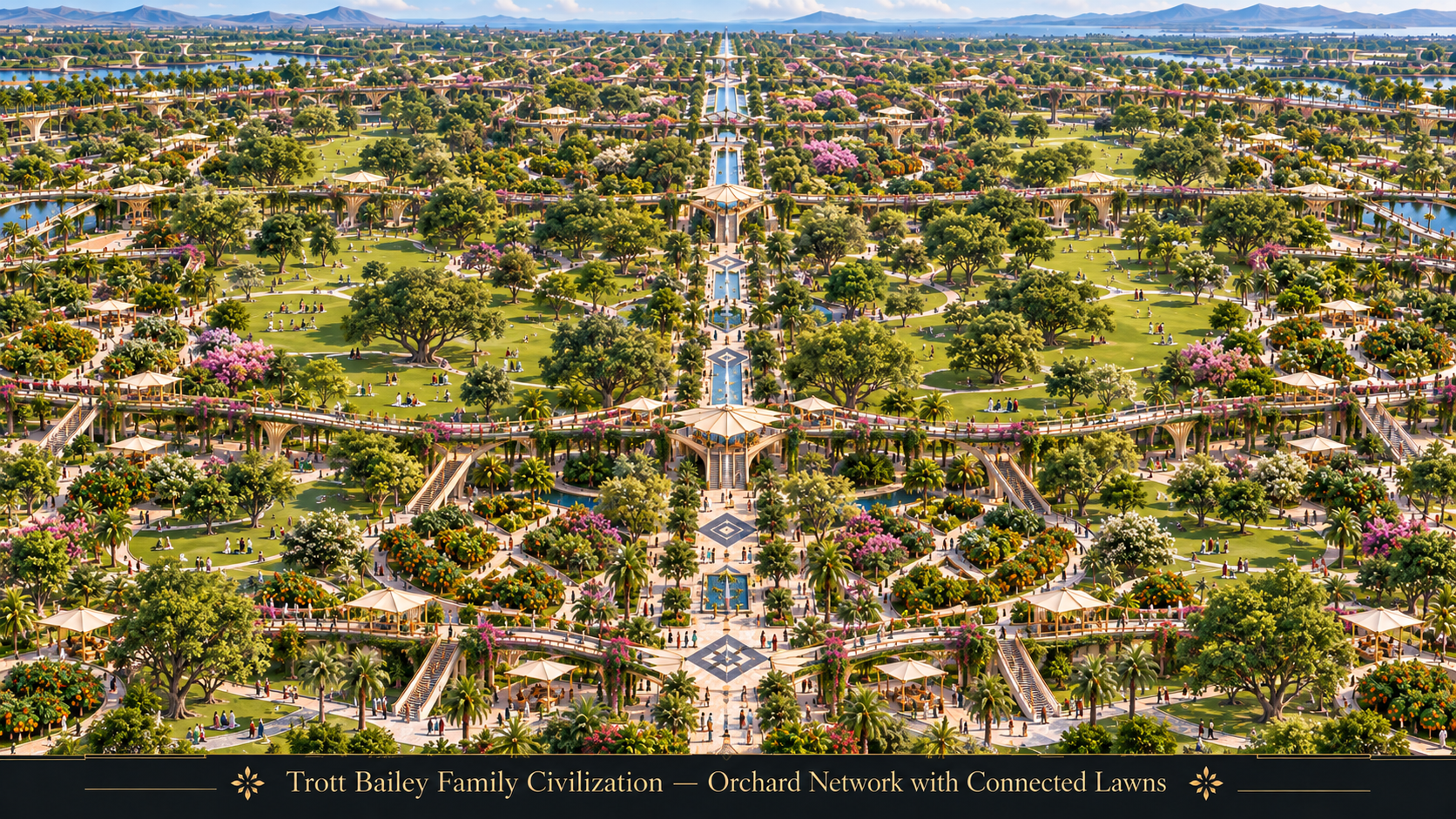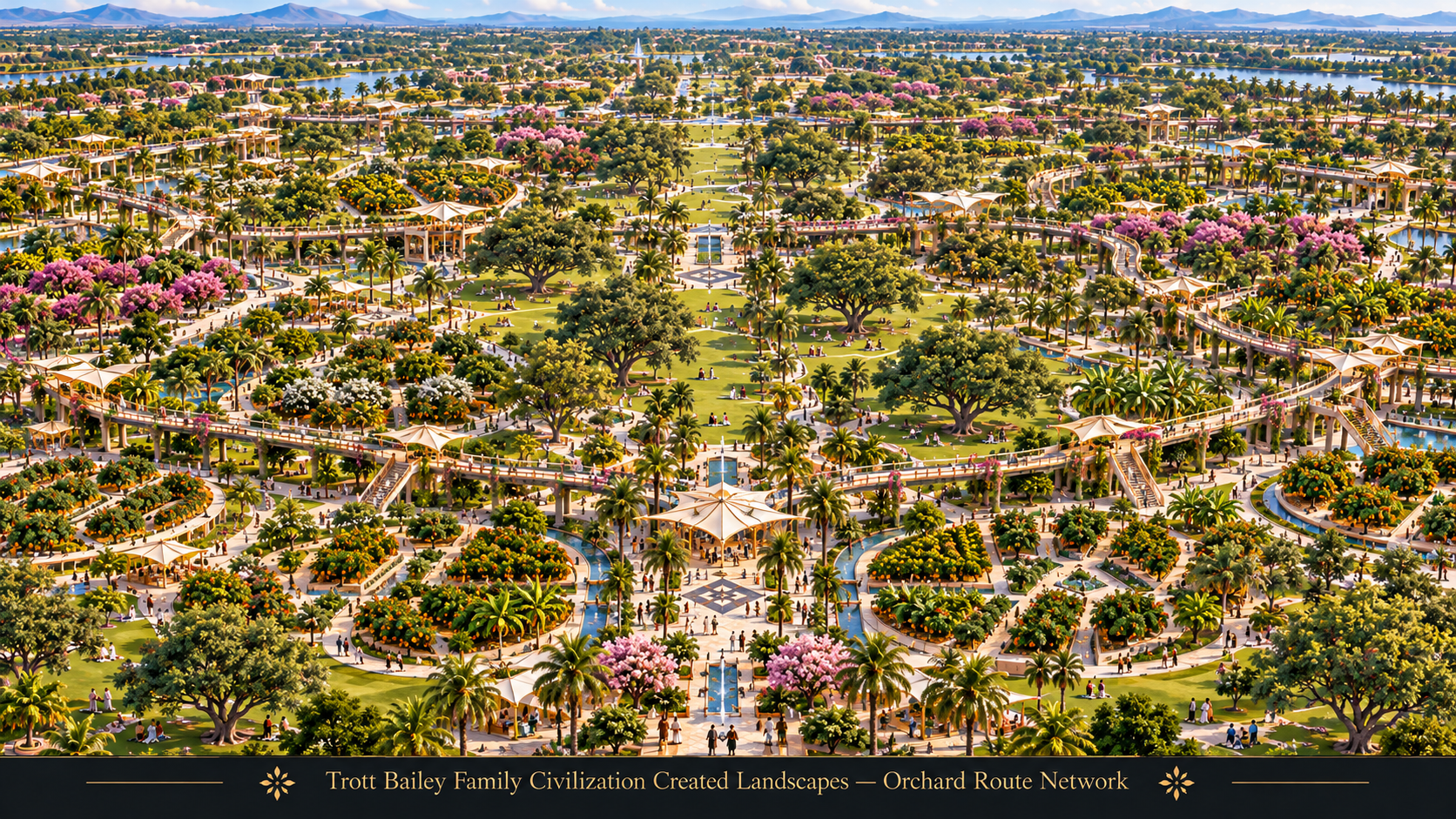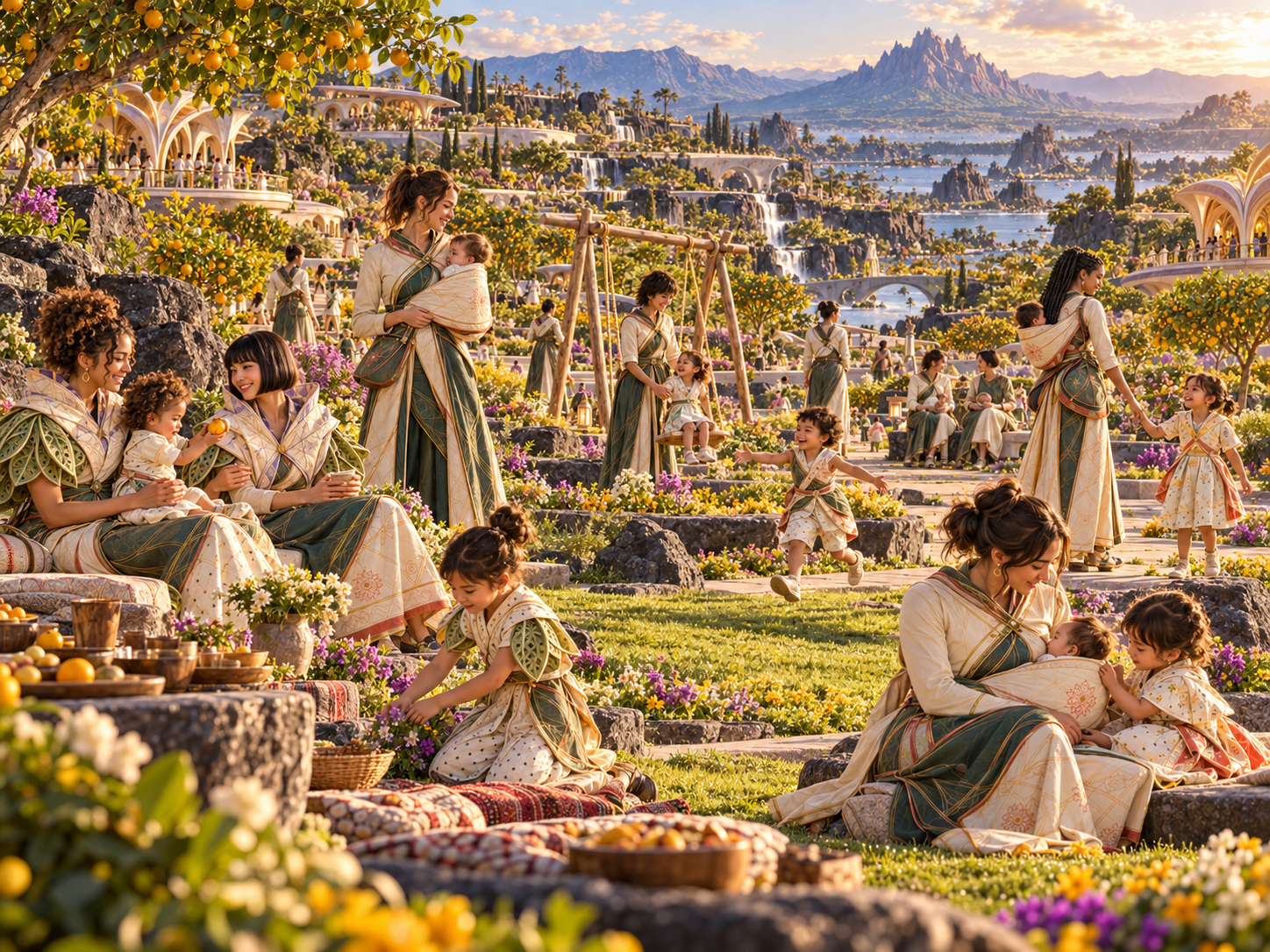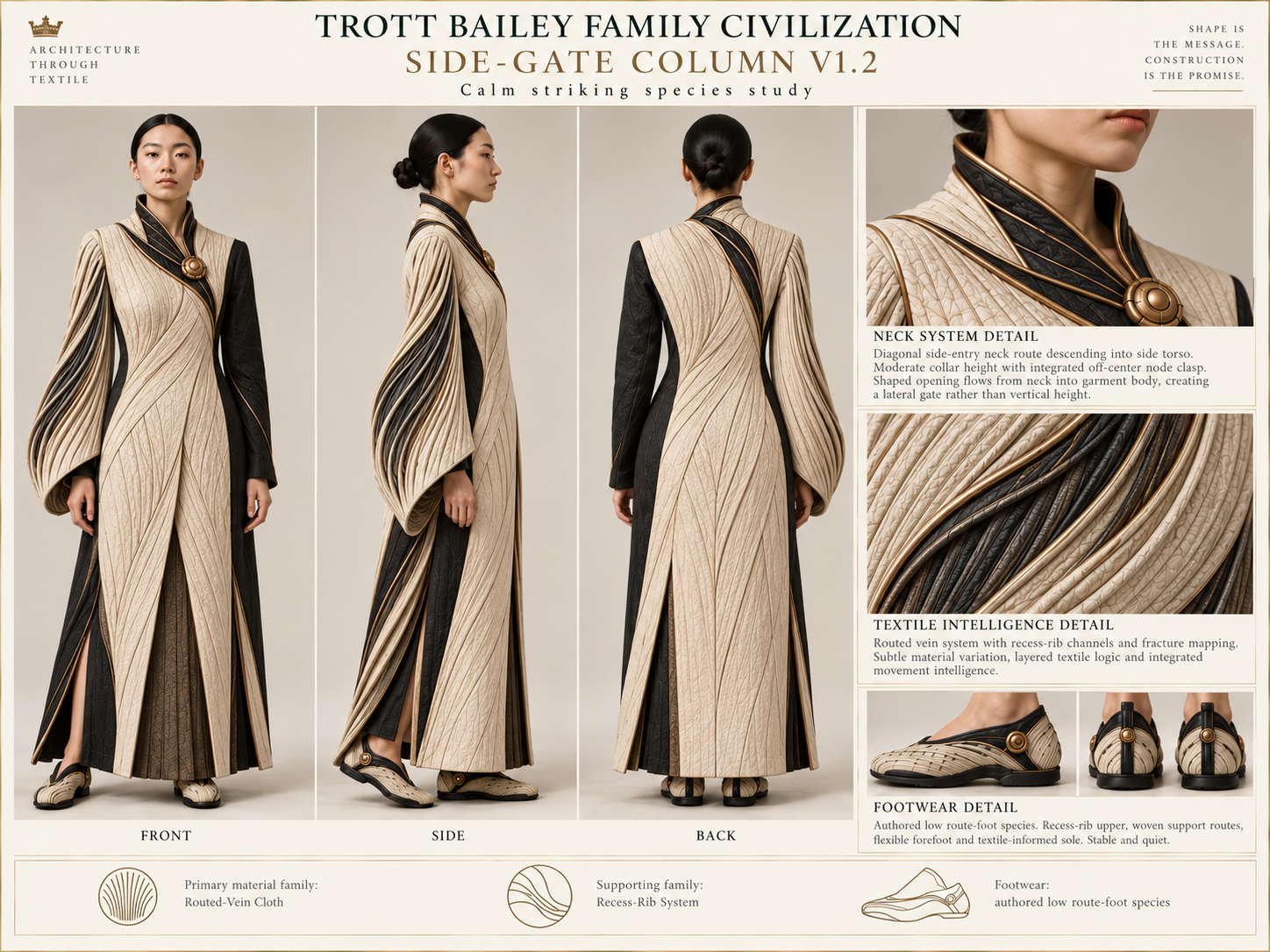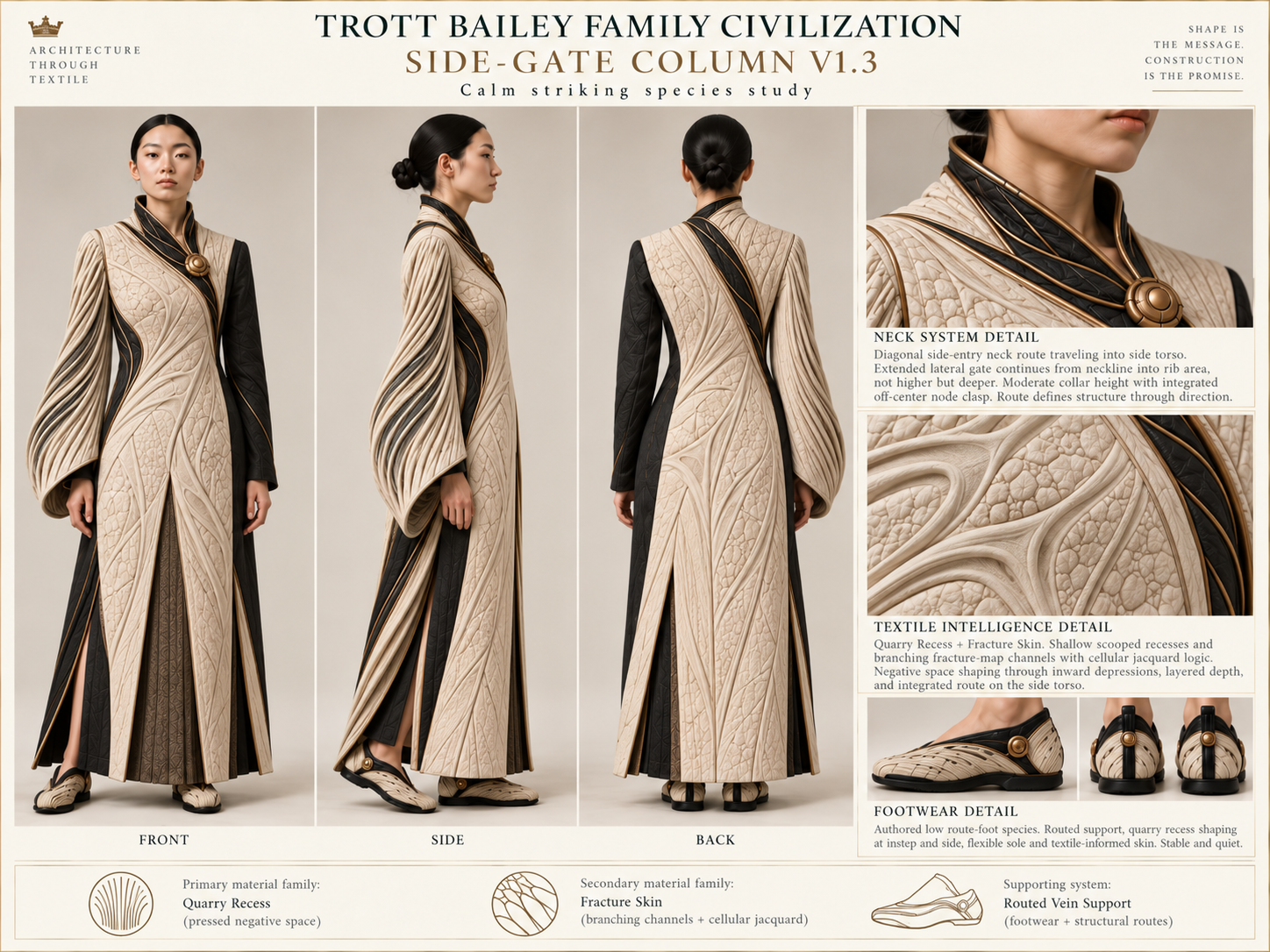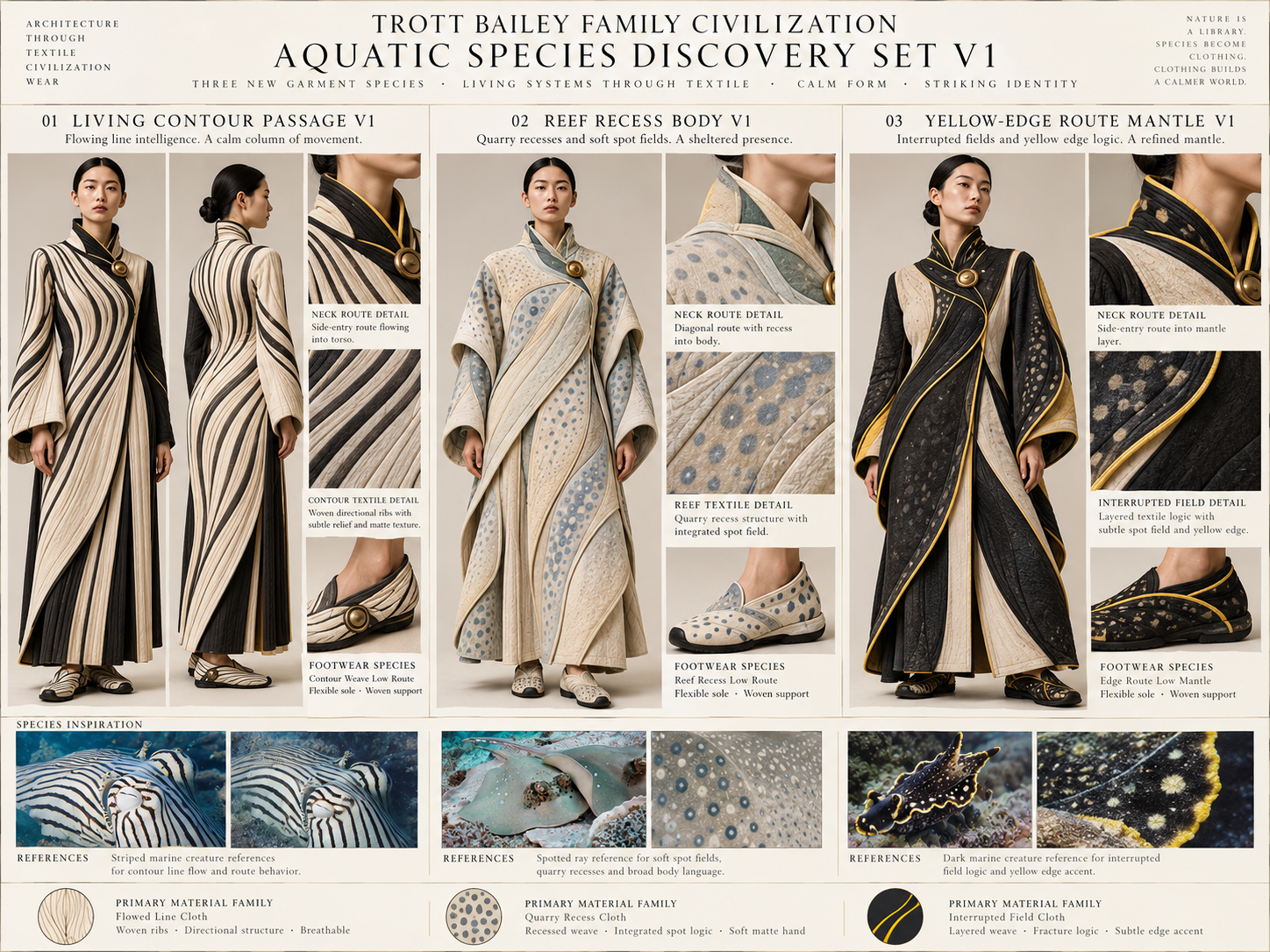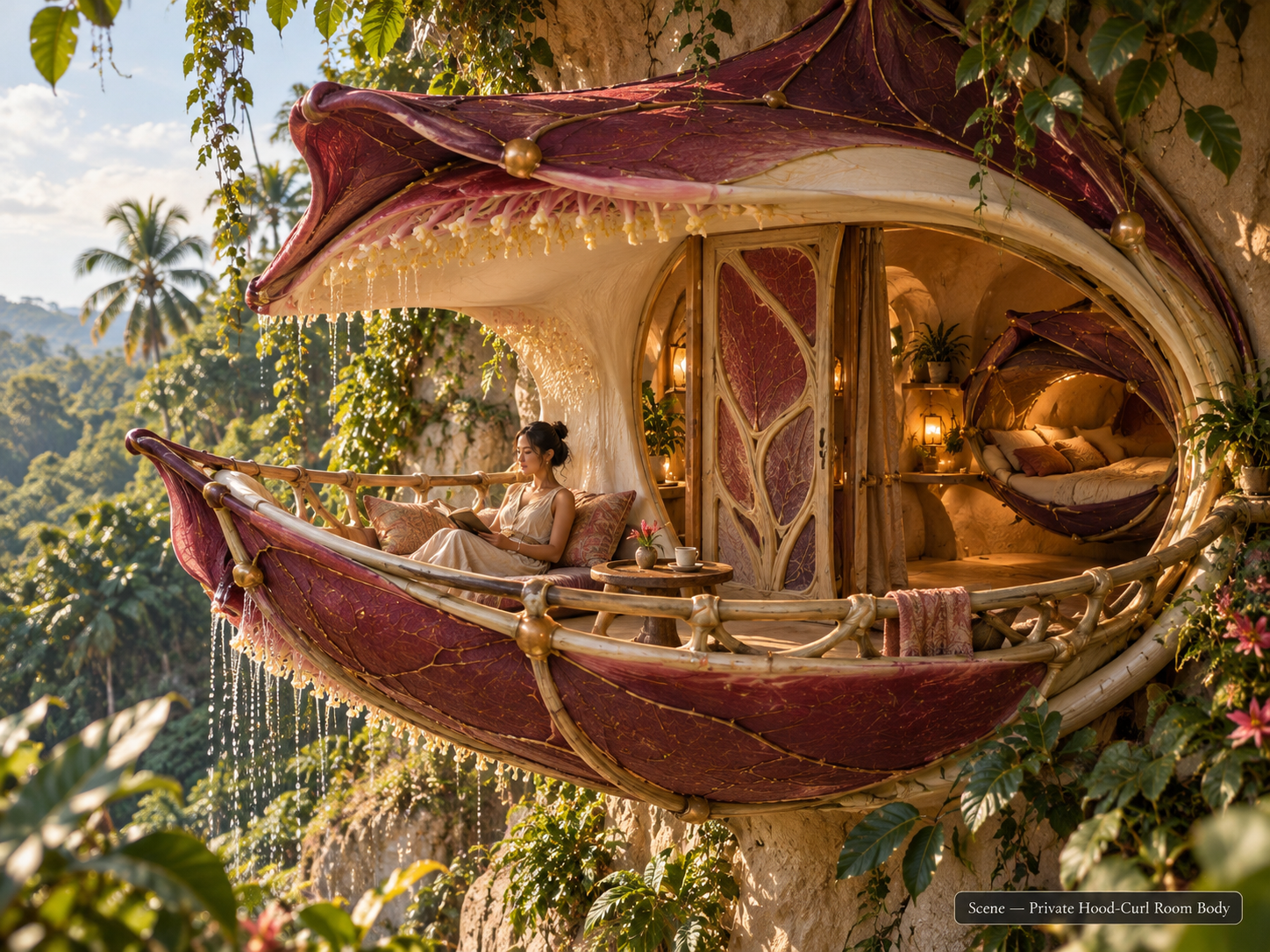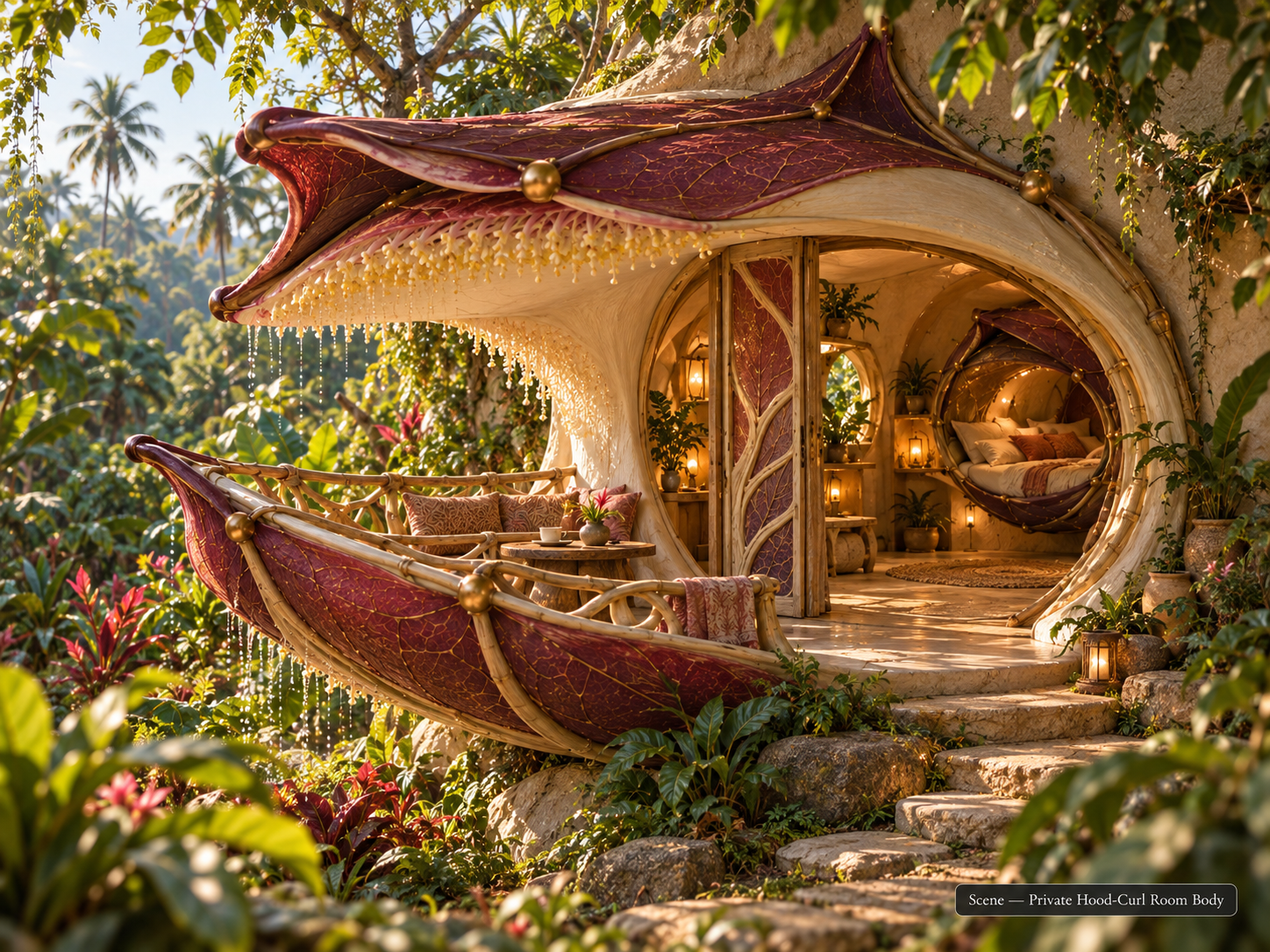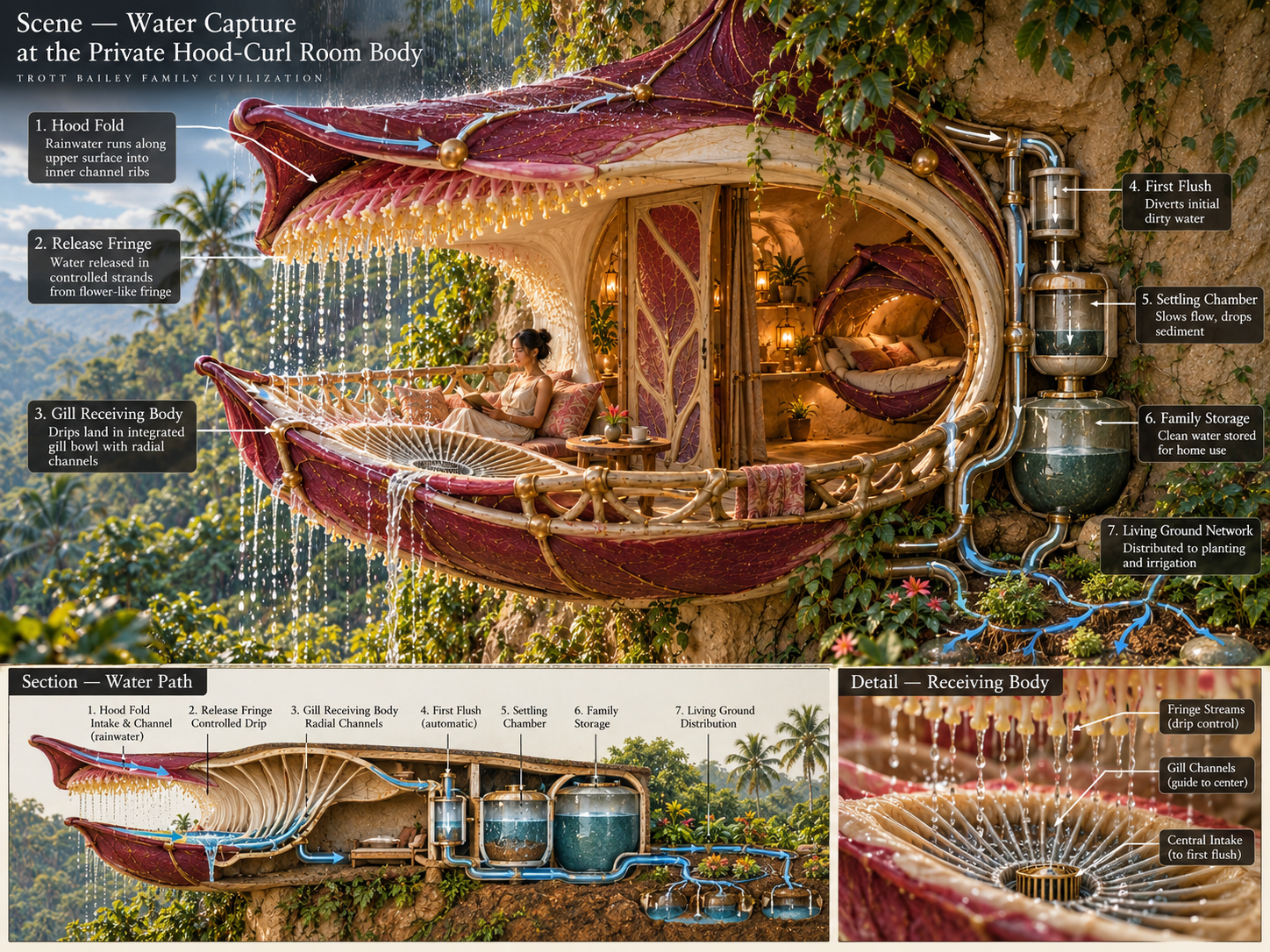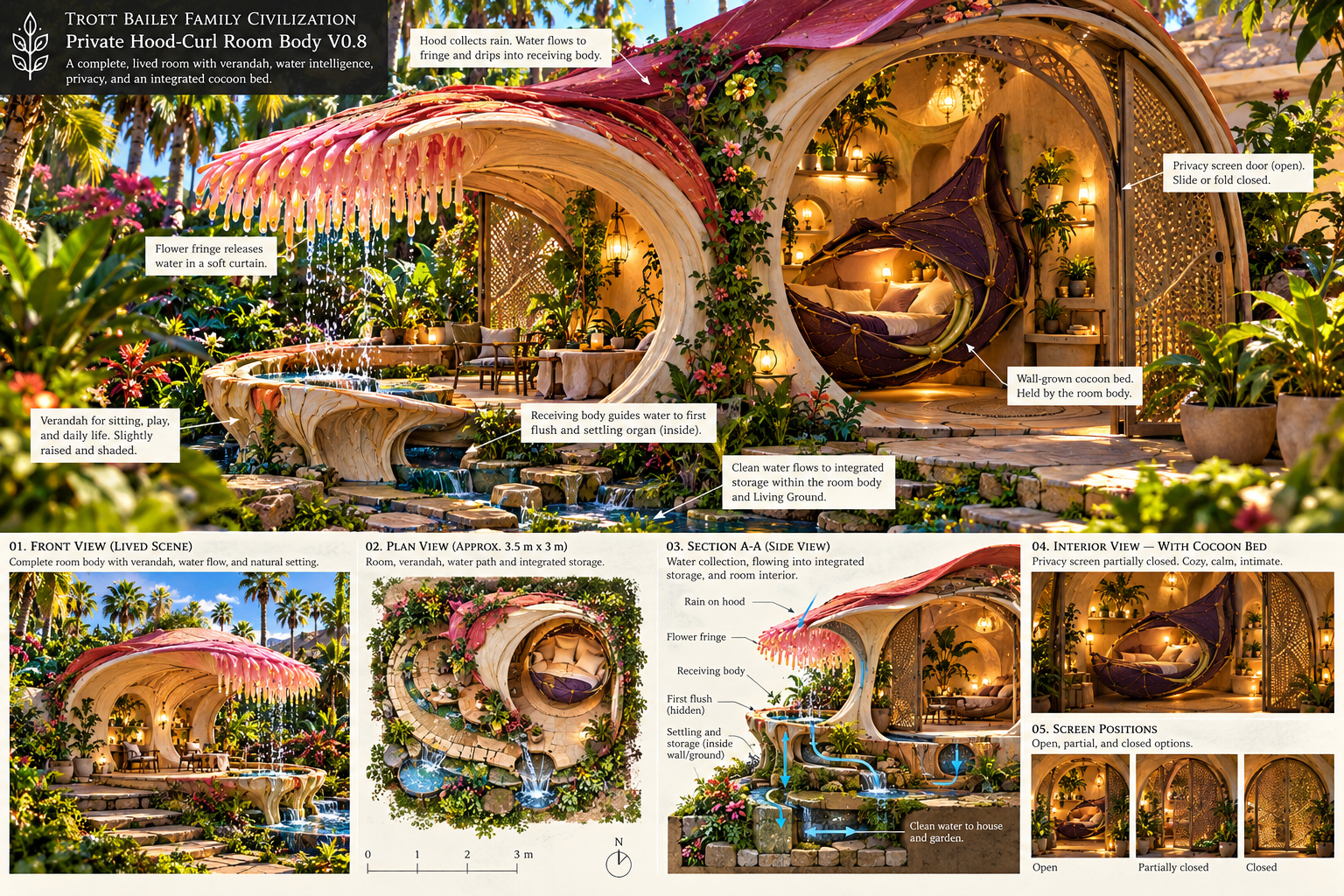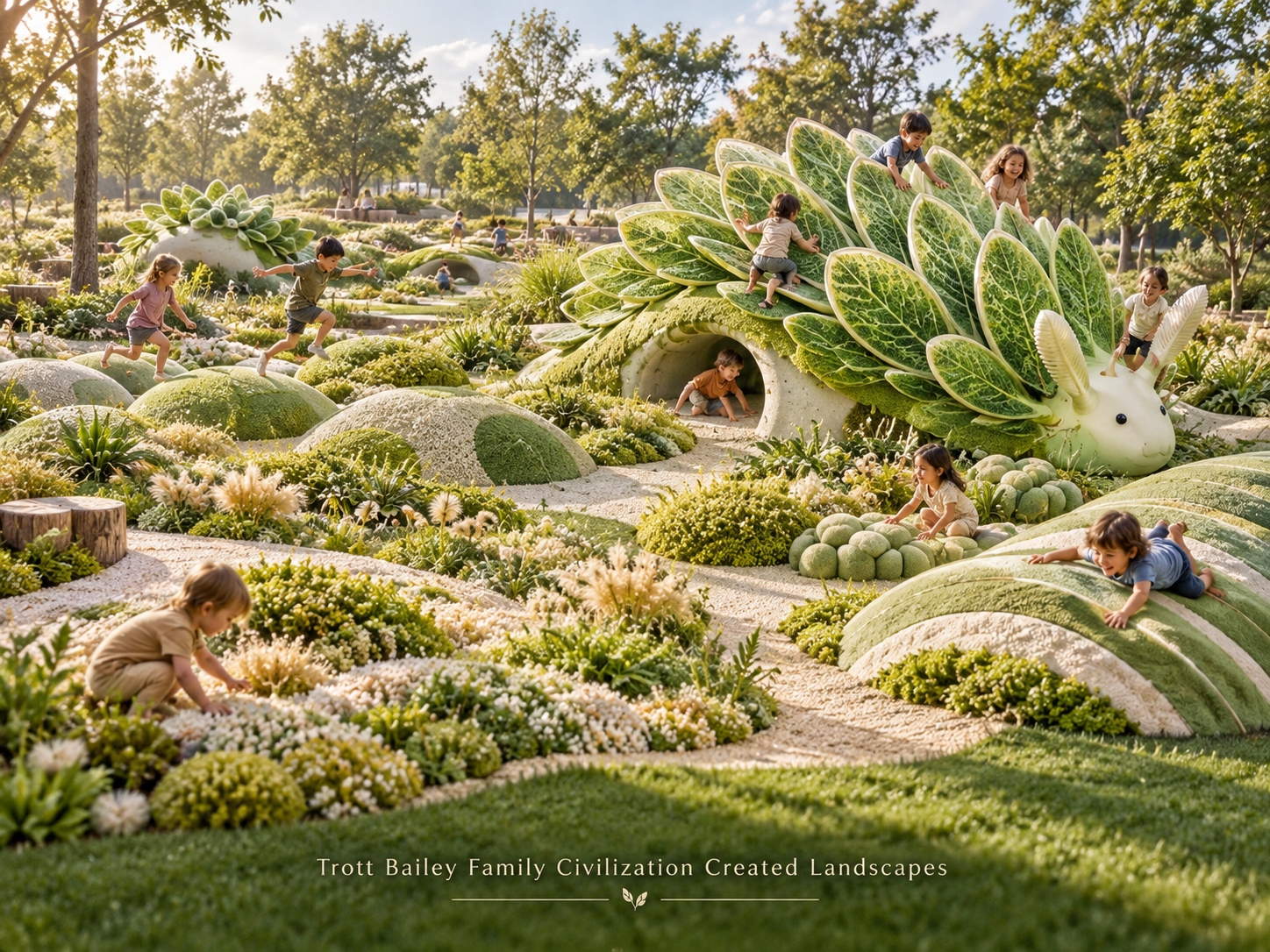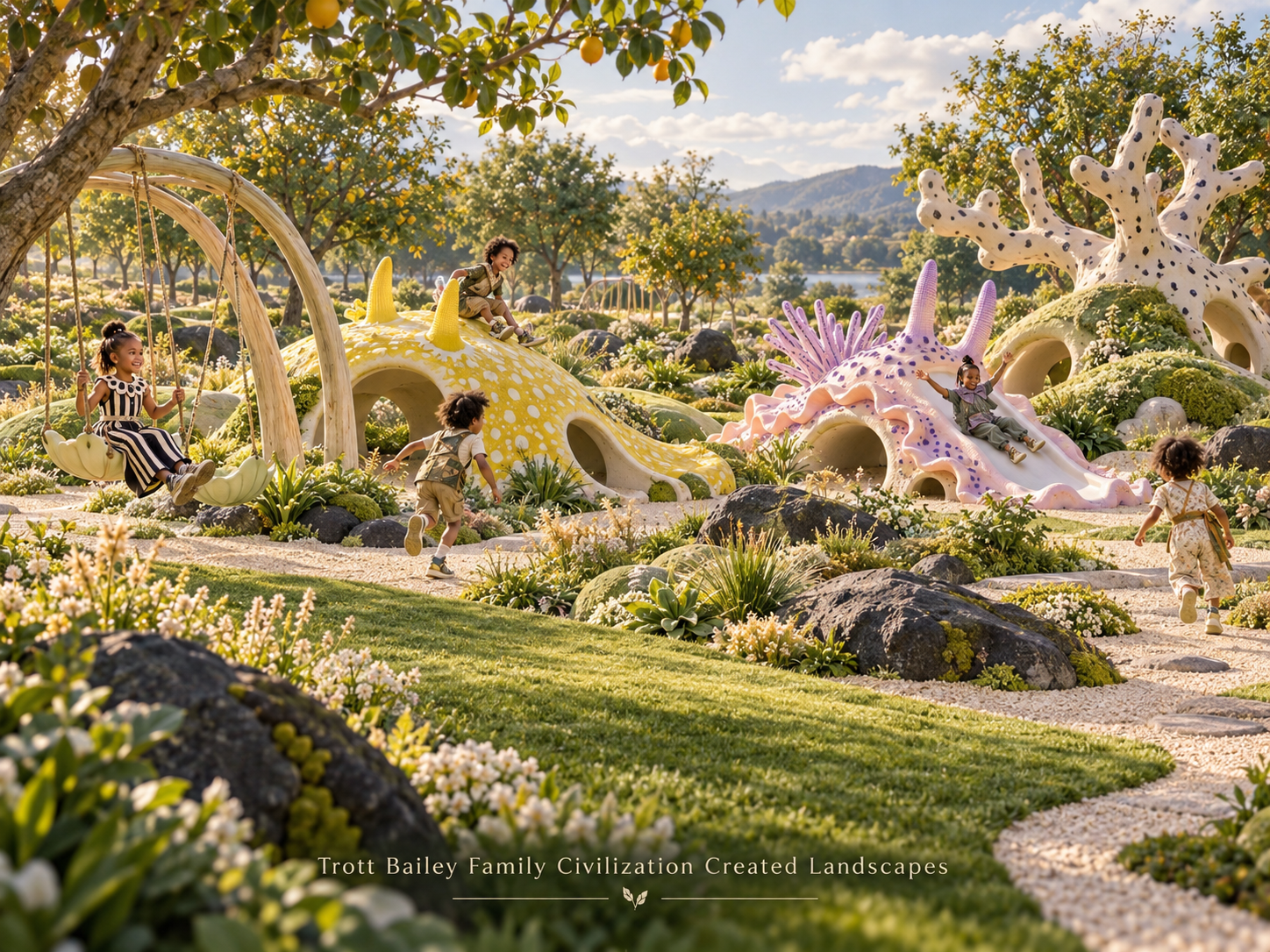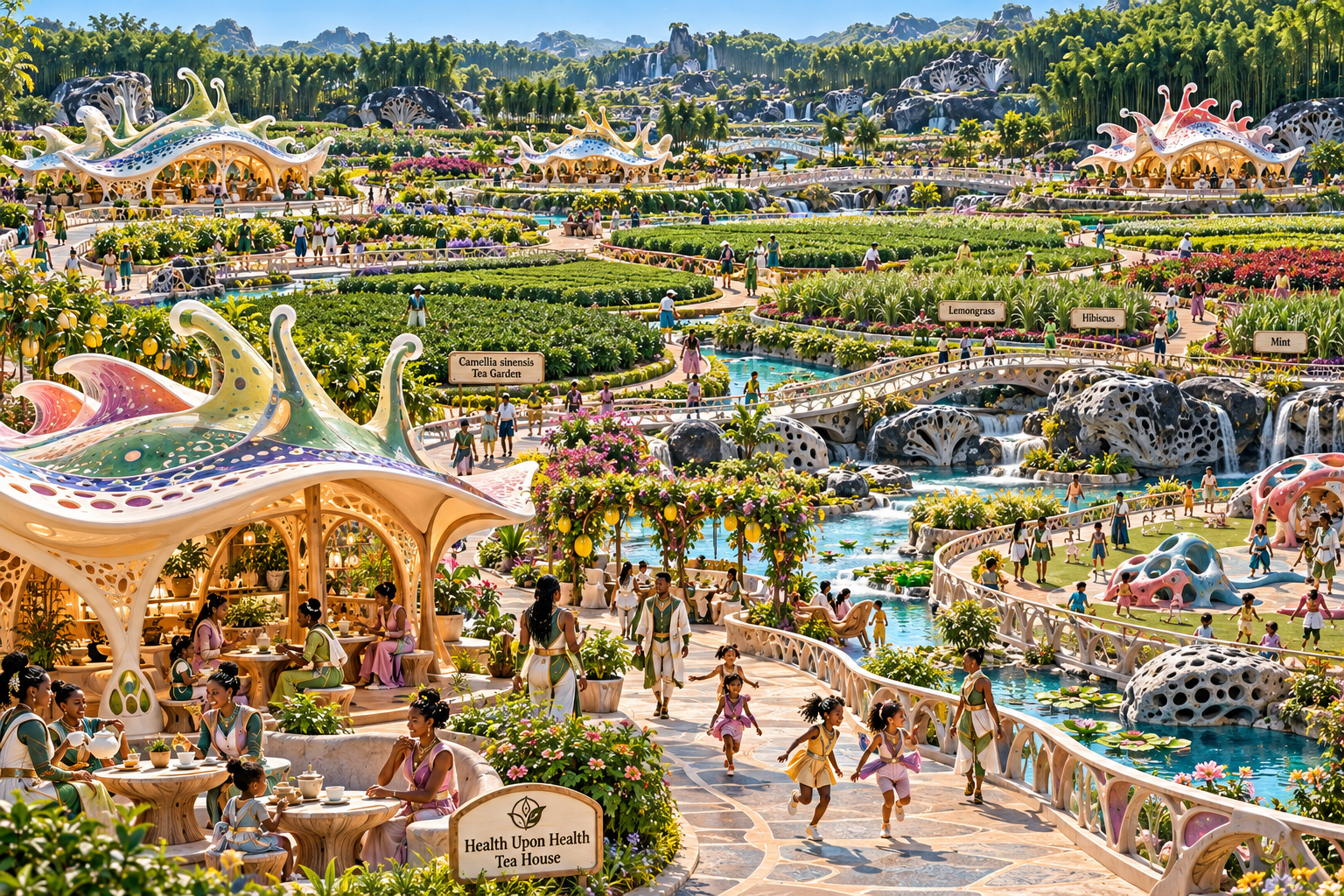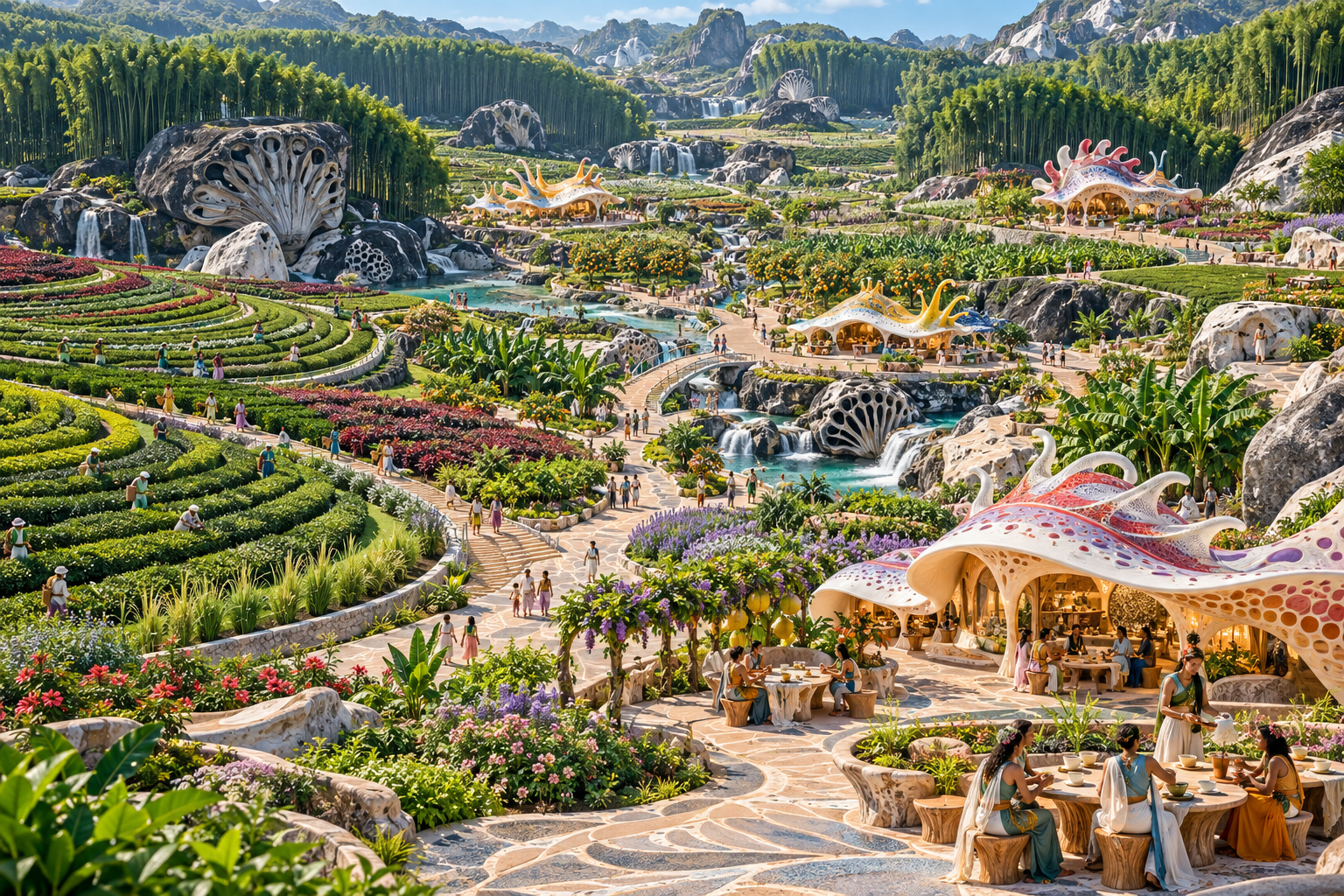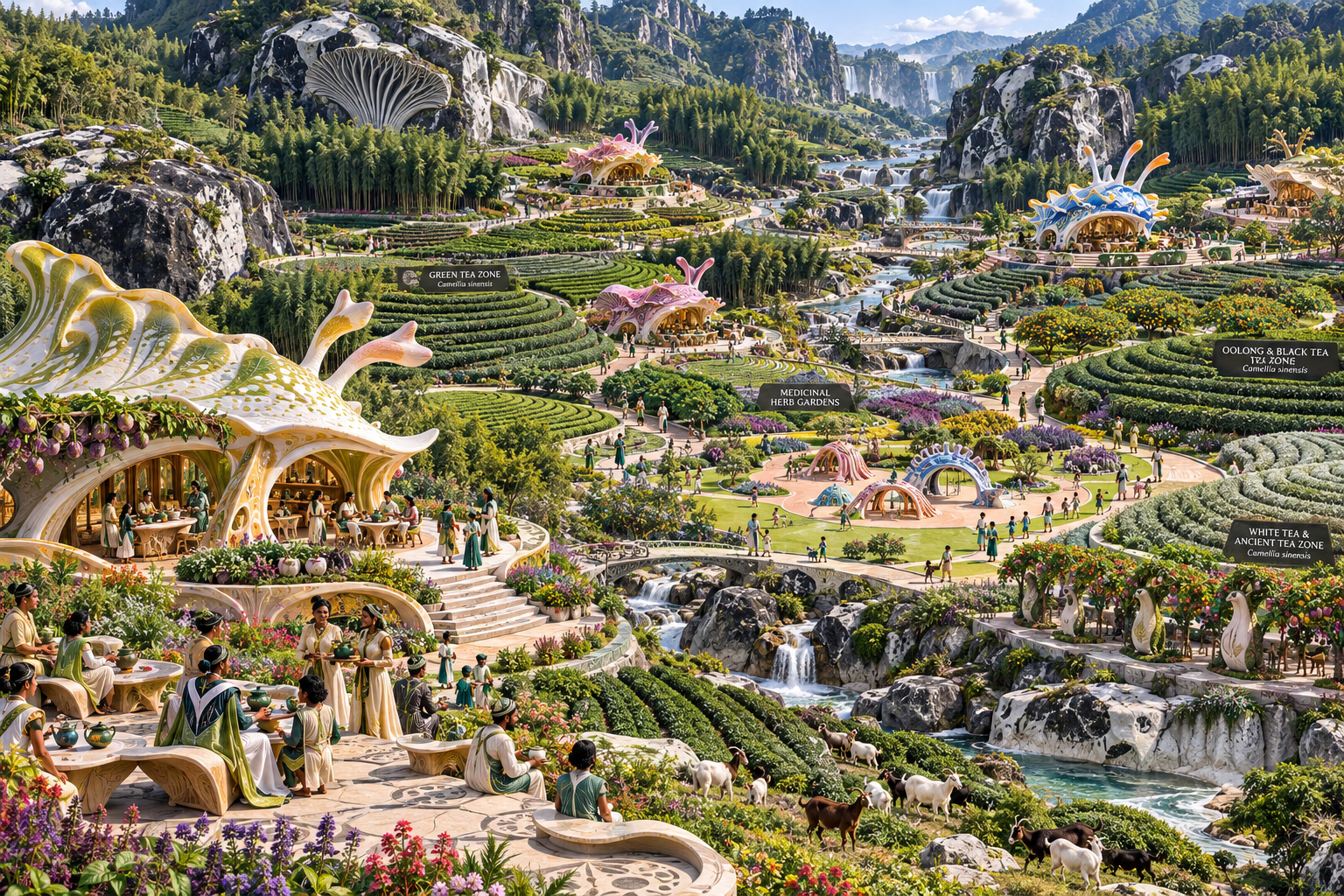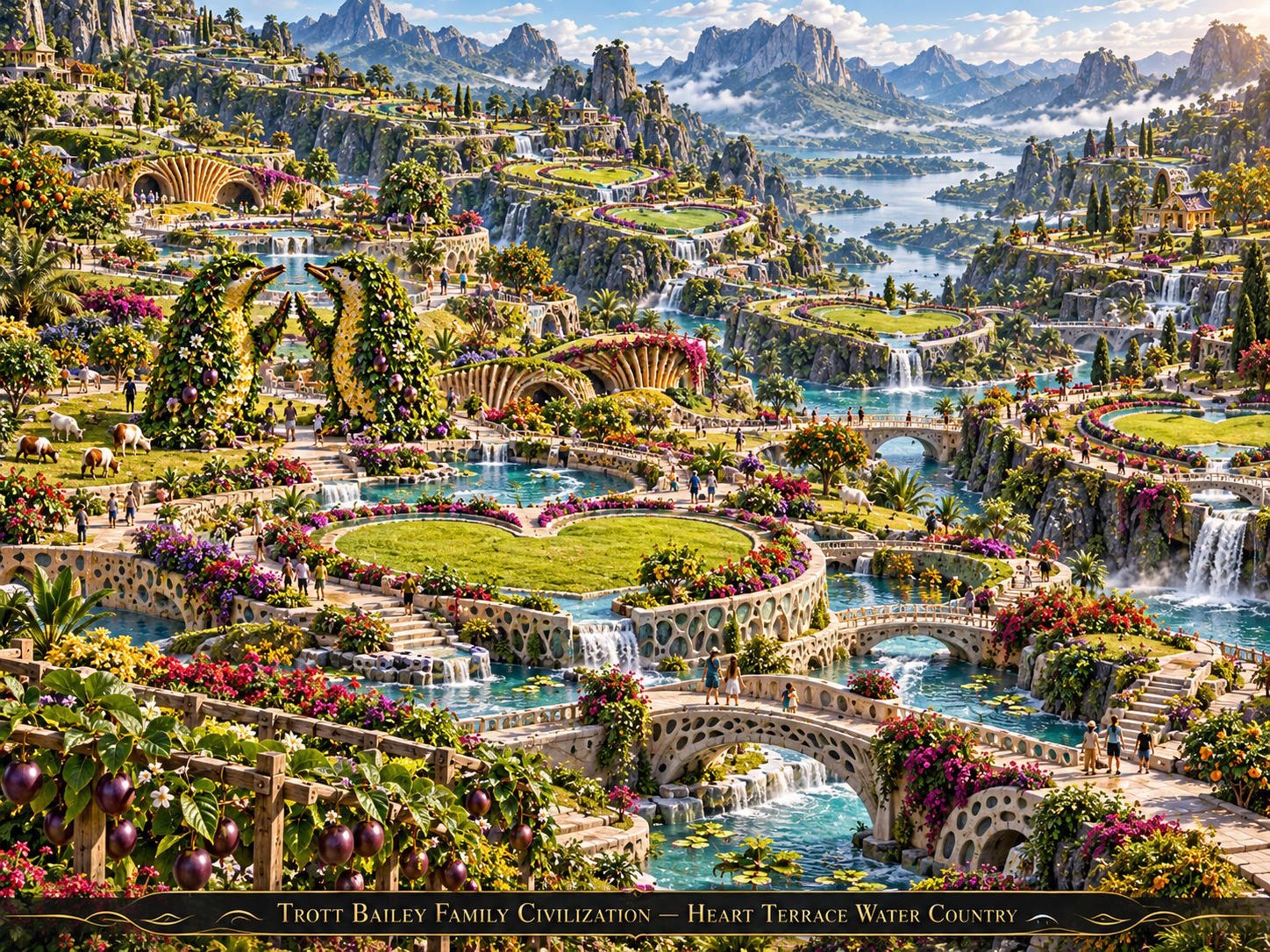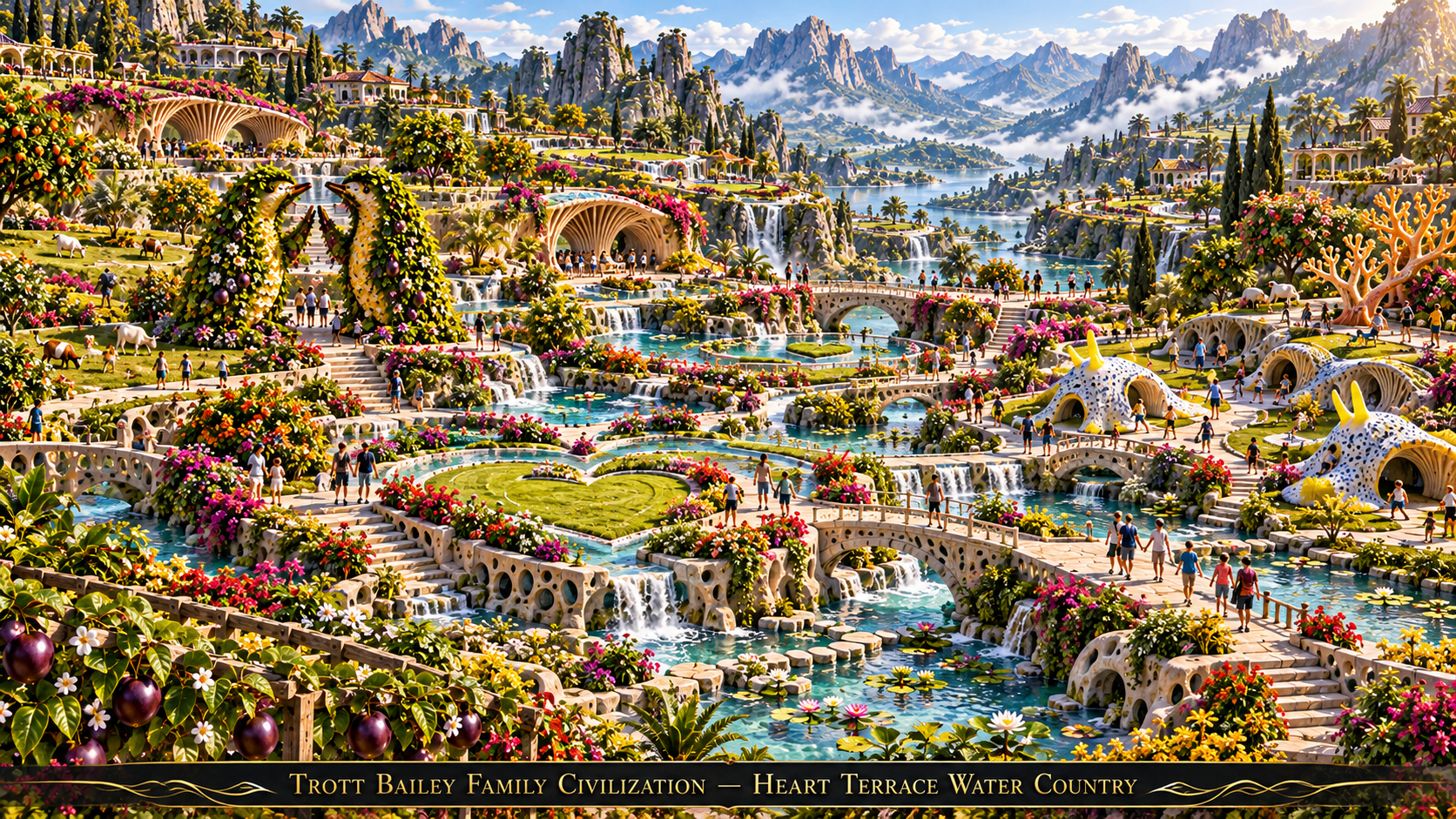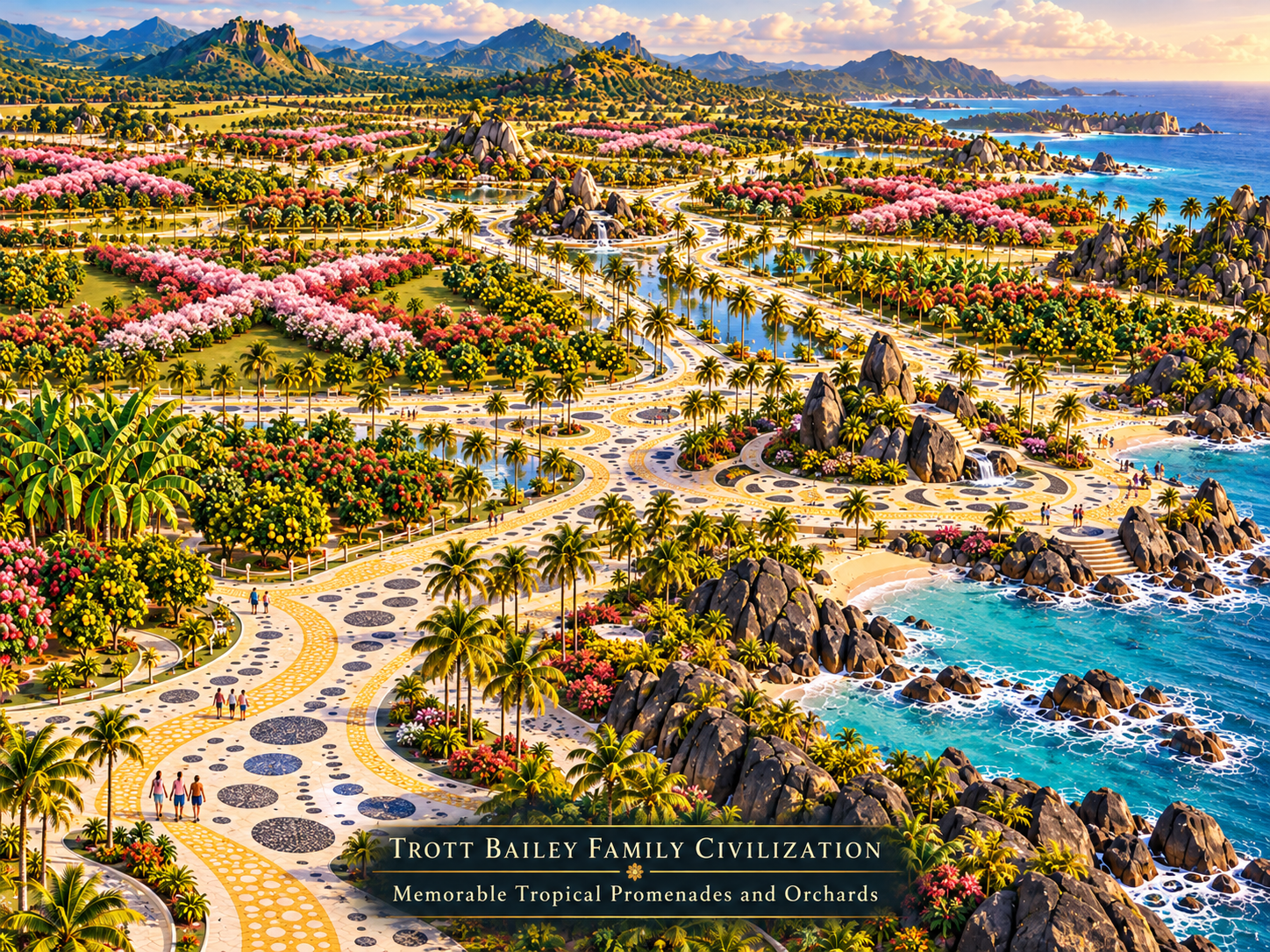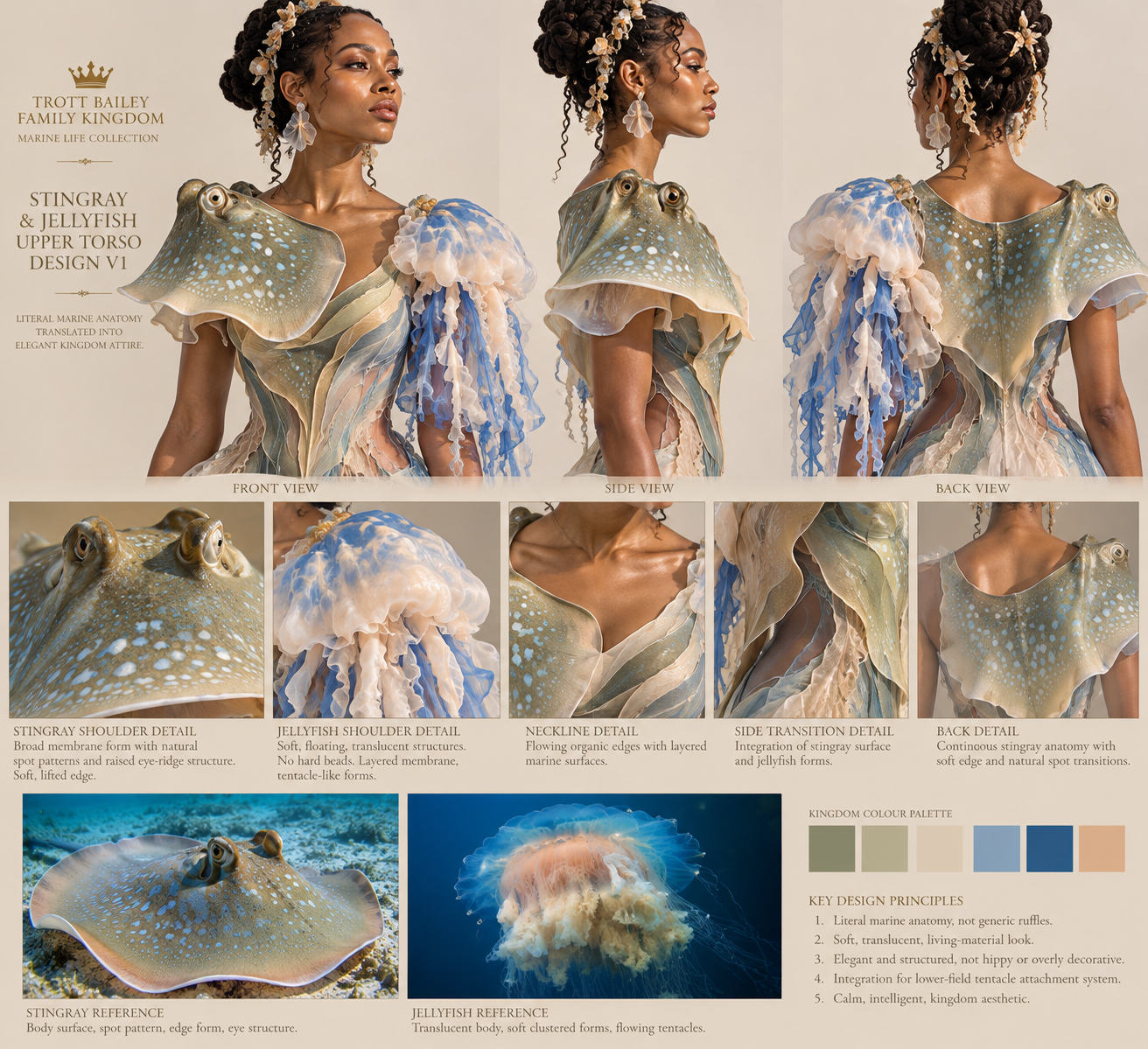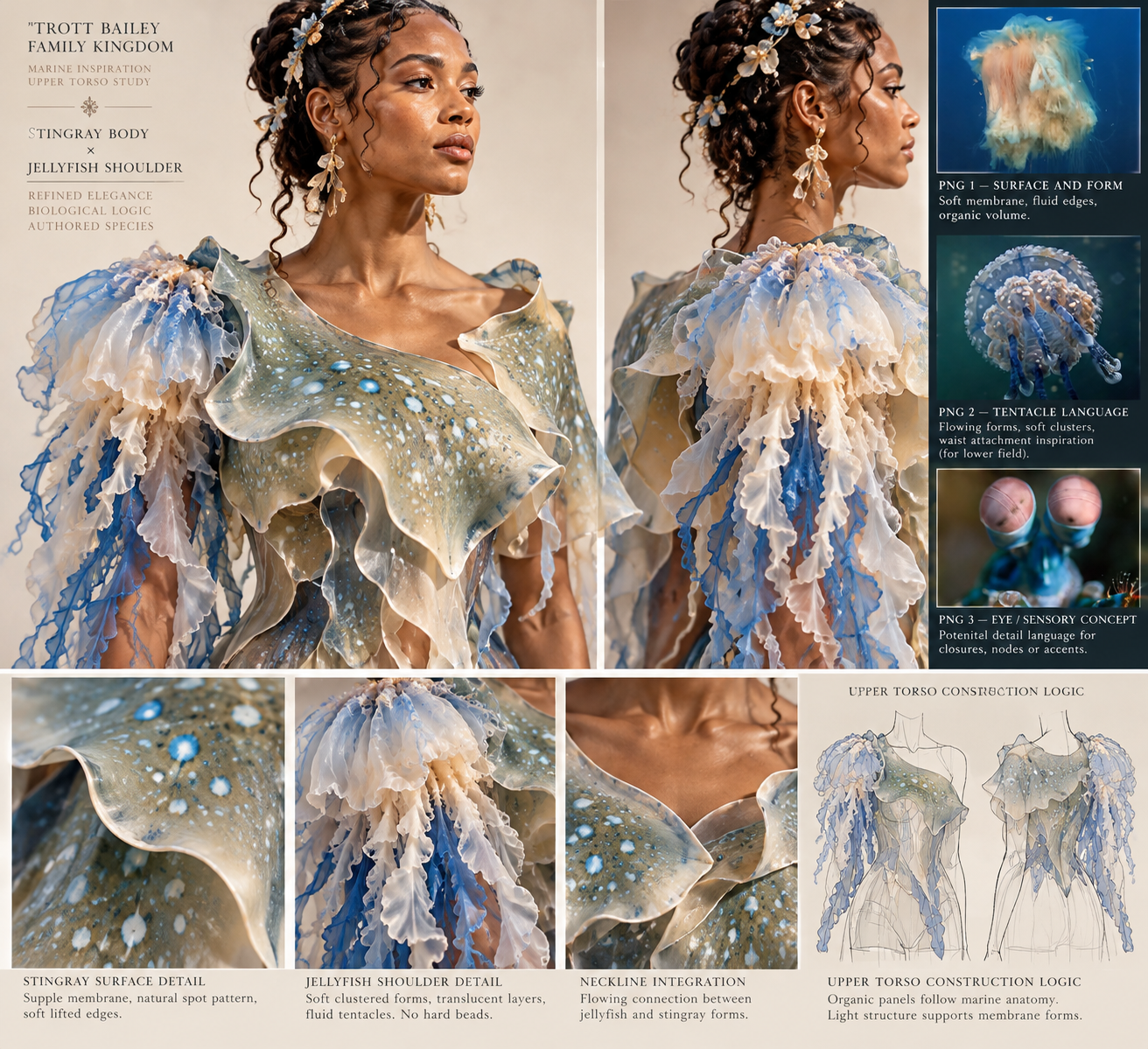

All the Questions That Come to Mind in the future When You Think About the Trott Bailey Family and Their Thinking…if your actually able to zoom out
Trott Bailey Family Civilization · Version 1 · Master Questions and Answers
All the Questions That Come to Mind When You Think About the Trott Bailey Family and Their Thinking
The Family’s Stance
The Trott Bailey Family thinks about civilization in a very wide way.
The family thinks about family, children, babies, food, farming, land, housing, work, rest, machines, money, education, clothing, repair, waste, health, public life, technology, media, knowledge, government, justice, human capability, and what human life is actually for.
That brings many questions.
Some questions come from honest curiosity. Some come from doubt. Some come from people comparing Trott Bailey Family Civilization to the world they already know. Some questions are useful because they reveal something that still needs to be designed or tested. Other questions begin with a false idea about what the family is proposing.
This article keeps those questions instead of throwing them away. Then it gives the family’s actual stance.
The goal is not to make the Trott Bailey Family sound smaller, safer, quieter, or easier for everybody to accept. The goal is to explain the thinking clearly.
You can read this article straight through or use the contents below to jump directly to the question or part that interests you.
What Has the Trott Bailey Family Actually Contributed to the World?
Before asking whether people agree with Trott Bailey Family Civilization, there is a simpler question:
What has this family actually contributed?
The answer is bigger than one invention, one company, one article, or one project.
The family has contributed through:
- things already built;
- people already taught;
- technology already developed;
- software already operating;
- land already studied;
- ideas already published;
- systems already designed;
- problems given new names;
- and a growing civilization framework meant to keep producing value across generations.
Some of the value is already physical. Some is intellectual. Some is technological. Some comes from teaching. Some comes from field work. Some is still being built. And some of the largest value may appear later, when many of these systems begin working together at civilization scale.
Readers who want the widest map of this body of work can begin with the Trott Bailey Family Civilization Master Index or the Trott Bailey Kingdom Systems directory .
Direct Value
Things that have already happened.
Something was built. Someone was taught. Software was made. Land was studied. Knowledge was published. A problem was solved. An observation was recorded.
Designed Value
A system has already been thought through, developed, drawn, documented, or prepared even though it is not yet operating at full civilization scale.
A building plan has value before the building rises. A machine design has value before ten thousand machines exist. A civilization system can have authored value before every district is built.
Multiplier Value
One useful thing causes many more useful things to happen.
A person learns and then teaches others. A machine saves time and that time produces more family life, learning, or invention. A good orchard keeps producing. A recorded lesson stops future people from making the same mistake. A capable child grows into a capable adult and influences another generation.
That is multiplier value.
Contribution 1: Making Human Life the Starting Point
Many societies begin their biggest discussions with jobs, markets, budgets, business, government, production, taxes, or economic growth.
Trott Bailey Family Civilization starts earlier.
What kind of human life are all these systems supposed to produce?
Food is not the final goal. Food exists for human life. Technology is not the final goal. Technology exists for human life. Work is not the final goal. Work exists because something useful needs to be done. Education is not the final goal. Education should help form capable human beings.
Civilization itself is not the final goal. Human life is.
Go deeper: Human Life: What Is Civilization For?
Contribution 2: Asking Where the Time Saved by Machines Goes
Humanity has built machines that can do work faster than ever before. Yet people are still busy, rushing, tired, working long hours, and telling the people they love: I don’t have time.
If the machine saved the labor, why didn’t the human being get some of the saved time back?
This is the family’s Human-Time Return thinking. A labor-saving machine should not only return more production. It should also be able to return some human life.
Go deeper: Who Owns Your Year? and What If Civilization Worked Toward Rest?
Contribution 3: Naming the Friction Economy
Many families spend large parts of their lives connecting badly connected systems. Work has one schedule. School has another. Transport has another. Food becomes another job. Laundry becomes another. Shopping. Bills. Repairs. Appointments. Childcare. Waste. Maintenance.
Every service may say: Our part works.
But the household has to connect all the parts. In systems language, the household becomes the integration layer.
The household becomes the place where all the confusion lands.
The family calls attention to this through the Friction Economy .
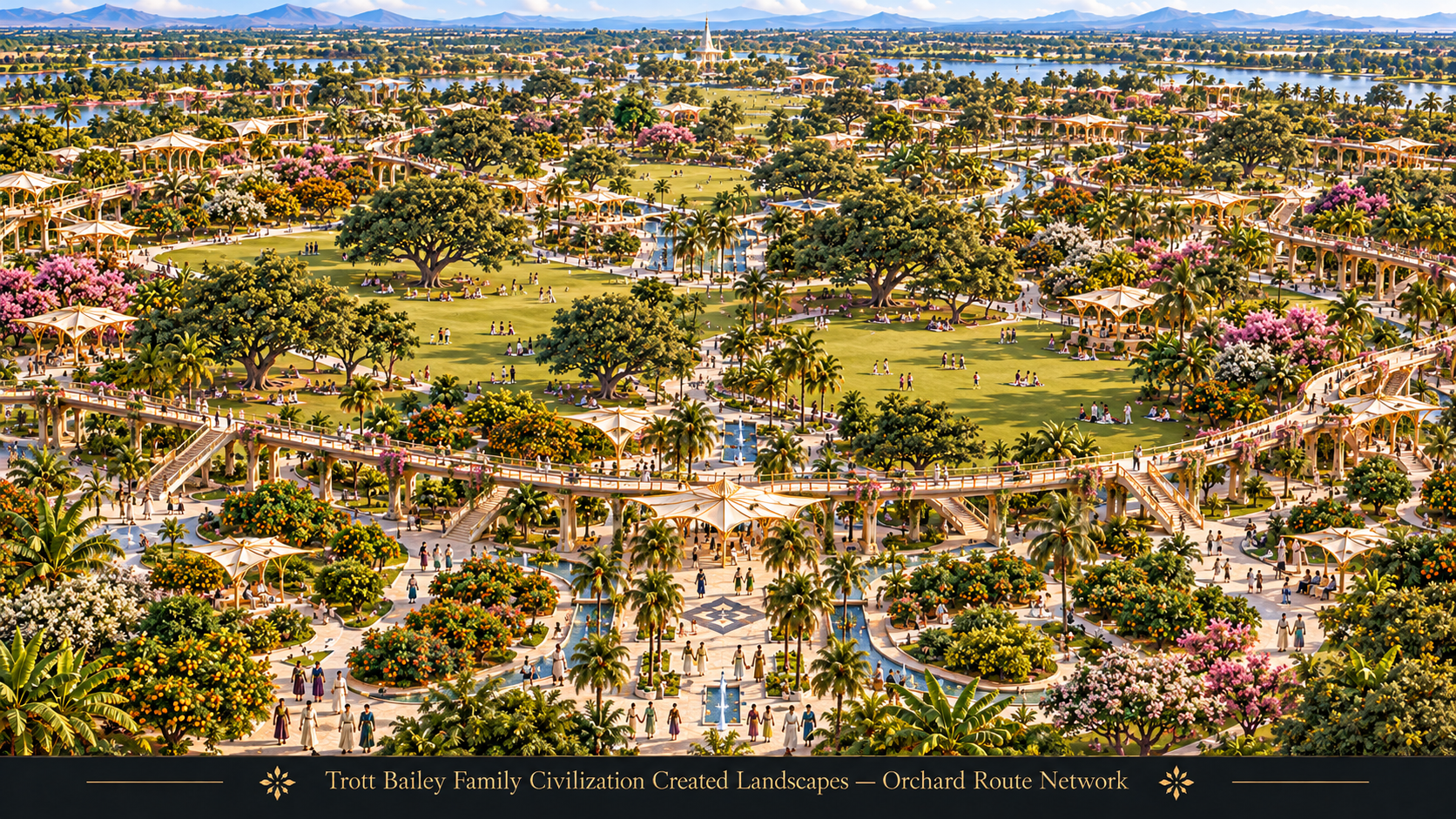
Sometimes the best service is not another service. Sometimes the best answer is: Remove the burden.
Contribution 4: Changing “How Do Families Cope?” Into “Why Is the Burden There?”
Modern society often praises parents for being strong.
Strong enough to carry what?
Why is one mother carrying so much invisible work? Why are parents expected to connect so many separate systems? Why does each household repeat many of the same cleaning, storage, food, repair, transport, and care problems?
Instead of only asking, How do we make families better at coping?, ask:
Why are we building family life in a way that requires so much coping?
Go deeper: What Would a Civilization Built for Mothers and Fathers Look Like?
Contribution 5: Separating Money From Real Resources
People often say: We cannot afford it.
The Trott Bailey Family asks: Do the real resources exist?
Do we have land? Materials? Machines? Builders? Farmers? Food? Water? Knowledge? Idle buildings? Unused equipment? People with the skill? Things that can be repaired?
Money is not the same thing as the physical world.
This is part of Resource Reality Before Money .
Contribution 6: Showing That Removing Money Does Not Remove Coordination
Hospitals use triage. Airports use routes. Factories use schedules. Warehouses use inventories. Emergency services use dispatch. Schools use timetables. Farms use planting plans. Utilities use engineering controls.
Money may sit around these systems. But money is not doing all the actual coordination.
Removing money does not remove coordination.
Humanity does not need to forget everything it already knows. Keep the useful coordination systems. Improve them. Remove money as the permission layer.
Go deeper: Money Is Not the Source
Contribution 7: Making Hidden Work Visible
Beautiful systems often hide somebody else’s work. A clean room means someone cleaned it. A beautiful meal means somebody prepared it. A smooth event means people worked before the guests arrived.
Who is doing the hidden work that makes this look easy?
That hidden burden is part of the Service Shadow .
Contribution 8: Treating Repair, Return, and Maintenance as Civilization Infrastructure
Civilization loves the arrival side. New clothes. New food. New machines. New buildings. New products.
But everything changes after use.
What happens after use?
That has led to work around Krubaro, Fabric Nodes, repair systems, material return, Clean Return, care, reuse, maintenance, and longer-lasting goods.
Do not only design how something enters human life. Design how it returns too.
Contribution 9: Building Civilization Memory
Human beings lose knowledge all the time. Someone learns something. Then they die, move, forget, retire, lose the records, or never explain what they learned.
The family is trying to stop that.
Through Mind’s Eye, Pacorips, Big King Media, field records, articles, photos, video, software, and long-term archives, the family wants to preserve not only what happened, but also why it happened.
Contribution 10: Joining the Pieces of Civilization Back Together
Trott Bailey Family Civilization does not treat food, family, education, land, machines, clothing, architecture, repair, rest, children, transport, media, and public life as if they have nothing to do with one another.
Food connects to land. Land connects to health. Health connects to capability. Capability connects to contribution. Machines connect to saved time. Saved time connects to rest. Rest connects to family. Family connects to children. Children connect to education. Education connects back to capability.
The contribution is not only inventing things. It is also changing the arrangement.
Humanity may already possess many of the pieces needed for a far better life. The failure may be in how the pieces are arranged.
The Contribution Did Not Begin With Civilization Articles
The family’s work did not begin with writing about civilization. There is a longer pattern behind it.
There has been work involving renewable energy, technical training, robotics, software, media systems, family systems, food production, land observation, and civilization design.
How can human knowledge and technology be used to make life work better?
Readers interested in the earlier engineering record can explore the Kingdom Systems early record. Independent historical records include The Jamaica Gleaner’s 2015 profile of Kimroy Bailey and the Jamaica Business Development Corporation annual report .
Part I — Reality, Building, and Evidence
1. Is Trott Bailey Family Civilization just an imaginary world?
The Family’s Stance
No.
The family is actively authoring and building a civilization. Different parts are at different stages. Some already exist. Some are being tested. Some are being built. Some have been deeply designed but have not yet been physically raised. Some are future plans.
A house is not imaginary because the roof is not built yet. A machine is not imaginary because engineers are still working on it. A civilization is not imaginary because every part has not yet been raised.
The family is trying to make what it has authored real.
2. Isn’t there more designed value than civilization-scale proof right now?
The Family’s Stance
Yes. That is because we are still building.
Of course a civilization that has not yet been fully raised will have more plans, designs, systems, documents, software, and prototypes than it has decades of full civilization data.
That gap is about where we are in the building process.
It is not proof that the systems cannot work.
3. Isn’t that an evidence problem?
The Family’s Stance
It is an evidence stage.
As physical building grows, physical evidence can grow with it. Daily life can produce records of food grown, land improved, systems operating, hours of work removed, children learning, parents getting relief, machines running, materials returned, buildings used, repairs completed, people trained, problems found, and problems corrected.
4. What should people judge once a system is actually running?
The Family’s Stance
Did it work?
Did it do what we said it was meant to do?
Did it make life better?
What failed?
What had to change?
Did we record enough for people to see what happened?
Those are fair questions.
5. Why record failures too?
The Family’s Stance
Because failure teaches.
If something fails, the next person should not have to fail in exactly the same way just because we were too embarrassed to record it.
A civilization that hides its mistakes throws away knowledge.
Read deeper: Human Life Guided Article Map · Civilization Master Index
Part II — Bold Declaration and Faith
6. Why does the Trott Bailey Family speak so boldly before everything is built?
The Family’s Stance
Because we do not believe we have to whisper until other people give us permission to speak.
Say what you see.
Name what you are building.
Declare its scale.
Then keep building until the physical world catches up.
We speak by faith. We speak as authors. Then we work.
7. Doesn’t that hurt the family’s credibility?
The Family’s Stance
We are not building our civilization around what makes skeptics comfortable.
The public can take it or leave it.
We are not going to make our vision smaller because somebody else thinks it sounds too big. The important question is what we continue to build, teach, record, test, improve, operate, and make real.
8. Does that mean evidence does not matter?
The Family’s Stance
Of course evidence matters. Boldness and evidence are not enemies.
- This exists now.
- This is being built now.
- This is being tested now.
- This is designed and waiting for physical construction.
- This is future work.
- This is our declared value model.
We can be bold and still be clear.
9. What good can a bold declaration actually do?
The Family’s Stance
It can change the size of what people try to build. A large declaration can make us think bigger, stop us from quietly shrinking our goals, teach our children to think beyond inherited limits, attract people who can think at the same scale, and push us to build something worthy of what we said.
Sometimes declaration is part of the building.
Part III — Originality, Synthesis, and Human Inheritance
10. How much of Trott Bailey Family Civilization is actually original?
The Family’s Stance
We never said we invented everything.
Human beings already know how to grow food, build homes, make clothes, generate power, move water, repair machines, teach, operate hospitals, schedule work, move people, store materials, build roads, write software, and organize difficult systems.
We do not need to pretend nobody knew these things before us.
11. If many pieces already existed, isn’t this mostly synthesis?
The Family’s Stance
What is the point of constantly demanding novelty if existing knowledge is being used badly?
The world does not only suffer because humanity has not invented enough things. Sometimes humanity already has what it needs but has arranged it badly.
If something already works, good. Use it. Improve it. Connect it. Put it to better use.
12. Isn’t synthesis less important than invention?
The Family’s Stance
No.
A hospital is a combination. A city is a combination. A phone is a combination. An airplane is a combination.
The arrangement matters. Seeing how different things can work together matters. That is real authorship too.
13. So what does the family actually claim authorship over?
The Family’s Stance
What we actually author.
Sometimes that is a new idea. Sometimes it is a new system. Sometimes it is a new name. Sometimes it is a new design. Sometimes it is changing the purpose of an old system. Sometimes it is connecting things that were kept apart. Sometimes it is building the whole civilization around a different goal.
14. Is the family taking credit for other people’s work?
The Family’s Stance
No.
Using human knowledge is not the same as claiming we invented it. Every generation should inherit what earlier humans learned.
We inherit. We use. We improve. We add. Then the next generation should inherit from us.
15. What matters more than novelty?
The Family’s Stance
Does it work? Does it improve human life? Does it save time? Does it build capability? Does it strengthen families? Does it use resources better? Does it make civilization easier to care for? Does it solve the problem?
Read deeper: Trott Bailey Family Civilization Is the Change of Course · Civilization Dictionary
Part IV — Did Humanity Inherit More of Civilization Than It Realizes?
16. Isn’t today’s civilization basically just the way society has to work?
The Family’s Stance
No.
Gravity is natural. Rain is natural. Human hunger is natural. The need for sleep is natural. But a mortgage is not nature. A forty-hour workweek is not nature. A school timetable is not nature. A price is not nature. Making money the permission to eat is not nature.
These things were arranged by humans. Human arrangements can be questioned.
17. Are you saying everything old is bad?
The Family’s Stance
No. Humanity inherited many wonderful things too.
Do not confuse something being inherited with something being required.
Keep what works. Question what does not.
18. Why does making this difference matter?
The Family’s Stance
Because people stop trying to redesign something when they believe it is as fixed as gravity. Once you see that something is a human arrangement, you can ask why it was arranged that way, whether it still makes sense, who benefits, who carries the burden, and whether it can work better.
Read deeper: Human Life Guided Article Map
Part V — Human Life, Human Time, and Rest
19. What is the main goal of Trott Bailey Family Civilization?
The Family’s Stance
Human life.
Civilization is not the goal. People are. Food systems exist for people. Machines exist for people. Education exists for people. Homes exist for people. Technology exists for people. Work exists because something useful needs to be done for people.
People do not exist just to keep systems busy.
20. Why does the family talk so much about human time?
The Family’s Stance
Because your lifetime is limited.
If machines become much better but humans stay just as busy, where did the benefit go?
21. If a machine saves four hours, why should the worker get any of those hours?
The Family’s Stance
Because the whole point of labor-saving technology should not always be: How do we fill the saved time with more labor?
This is Human-Time Return.
A labor-saving machine should return some of the labor it saves to people.
22. Isn’t productivity supposed to mean producing more?
The Family’s Stance
Sometimes.
Productivity can also mean getting what we need done with less human work.
Some of the gain can become more production. Some can become rest, family, learning, exercise, invention, friendship, gardening, play, or doing nothing.
23. Why does the family treat rest as something civilization should work toward?
The Family’s Stance
Because rest is part of human life.
Civilization already plans for production, construction, transport, school, healthcare, maintenance, and emergencies. Why can it not also plan so people receive long periods of real rest?
Rest should not only belong to people who can afford to stop working.
24. Isn’t rest laziness?
The Family’s Stance
No.
A sleeping child is not lazy. A recovering worker is not lazy. A family sitting together is not useless. A person thinking quietly may be doing something deeply useful.
Human beings are not machines. Rest is part of life.
25. Is one saved hour only worth one hour?
The Family’s Stance
Not always.
Some burdens take time and also wear down the mind. Remove some of that burden and you do not only give back clock time. You also give back part of the person’s mind.
This is the Recovered-Mind Multiplier.
Read deeper: Who Owns Your Year? · What If Civilization Worked Toward Rest? · Why Are We Calling This a Good Life?
Part VI — The Friction Economy and Hidden Family Burden
26. What is the Friction Economy?
The Family’s Stance
It is what happens when people spend huge parts of life fixing problems created by badly connected systems.
The household becomes the place where all the confusion lands.
27. Aren’t services helping with those problems?
The Family’s Stance
Sometimes.
Why does the problem exist?
If society creates a burden and then sells people another service to help them survive that burden, that may not be real progress.
Sometimes the better answer is: Remove the burden.
28. Why not just teach families to manage their lives better?
The Family’s Stance
Sometimes better organization helps. But organization cannot fix every bad system. If parents are expected to carry too much, the answer cannot always be: Parents, become even better at carrying too much.
29. What is the Service Shadow?
The Family’s Stance
It means looking for the people doing the hidden work.
Who is doing the hidden work that makes this look easy?
If somebody has to remain exhausted for a system to look beautiful, the system may need redesigning.
Read deeper: Friction Economy · Civilization Built for Mothers and Fathers · Pacorips and Service Shadow
Part VII — Money-Free Civilization
30. If money disappears, what will coordinate everything?
The Family’s Stance
Civilization already has many coordination systems that are not money. Hospitals use triage, staff schedules, records, supplies, and medical rules. Airports use routes, time schedules, air traffic control, maintenance, and safety systems. Farms use planting plans, harvest plans, storage, and equipment schedules.
Removing money does not remove coordination.
31. Is the family proposing that society throw everything away and start from zero?
The Family’s Stance
No. That was never the idea.
Keep the useful coordination systems. Improve them. Remove money as the permission layer.
The electrical grid does not forget how electricity works because money disappears. A surgeon does not forget surgery. A farmer does not forget farming. A truck route does not disappear. A warehouse still knows what is inside.
32. Without prices, how will people know something is scarce?
The Family’s Stance
Count it.
You can know how many hospital beds exist, how much food exists, how much water exists, how many machines exist, how many trained people exist, how many people need something, and how long it takes to make more.
A price is not the only way to know that ten things exist and twenty people want them.
33. Without money, how do you decide who gets something scarce?
The Family’s Stance
Human beings already use triage, queues, reservations, sharing, rotations, professional judgment, priority systems, and rationing when needed.
Money did not invent coordination.
34. Does the family believe scarcity will disappear?
The Family’s Stance
No.
But we do not believe the best answer is to sit there dividing the shortage forever. Ask whether we can make more, train more people, store more during good times, share across districts, use substitutes, automate burdens, repair what exists, or prevent the shortage next time.
Allocation is only one part. The stronger response also includes prevention, reserves, more capacity, sharing, substitution, training, repair, and production.
35. What if a critical profession does not have enough people?
The Family’s Stance
Then build more capability.
Train people. Improve working conditions. Share skilled people across districts. Use automation where it helps. Recruit. Teach. Reorganize. Use substitutes where safe.
A shortage in one skill does not mean civilization ends.
Read deeper: Money Is Not the Source · Resource Reality Before Money · Kingdom Systems
Part VIII — Resource Reality
36. What is Resource Reality?
The Family’s Stance
Before saying We cannot afford it, look at what actually exists.
Do we have the land? Materials? Builders? Machines? Food? Skill? What is sitting unused? What can be repaired? What can be reused? What is truly missing?
Money is not the same thing as physical reality.
37. Doesn’t money still help show value?
The Family’s Stance
Money can carry information inside the present system. We are not denying that.
We are saying it is not the only way human beings can know need, scarcity, priority, supply, demand, skill, or resource levels.
38. Isn’t money necessary because people need motivation?
The Family’s Stance
Money is one form of motivation. It is not the only one.
People also act because of family, duty, pride, skill, curiosity, love, purpose, community, joy, need, responsibility, and the satisfaction of doing something well.
The family does not believe the whole human being can be reduced to: Pay me or I will do nothing.
We are not going to design an entire civilization around the rare hypothetical of a capable adult who refuses every useful contribution for no reason. Human beings already contribute for many reasons besides money.
People raise children, cook, teach, repair, help family, care for neighbors, make things, learn, solve problems, grow food, protect others, create, organize, and step forward when something needs to be done without putting a price on every act.
A civilization should be designed around the way human beings actually live and contribute, not around the extreme hypothetical of one capable person who simply refuses to do anything useful.
If such a person appears, that does not mean the whole civilization must be built around them.
Read deeper: Resource Reality Before Money · Shubaka and Human Capability via Kingdom Systems
Part IX — Whole Families and Citizen Rights
39. Why does the family make whole families the foundation?
The Family’s Stance
Because that is the foundation we chose.
Trott Bailey Family Civilization is being built around whole families. We are not trying to take every broken, scattered, or disordered family form in today’s world and make all of them the foundation of our civilization.
We know what we are trying to strengthen across generations.
40. Does that mean somebody outside that family form has fewer rights?
The Family’s Stance
No.
The foundation of the civilization is one question. A citizen’s rights are another.
41. What if a citizen becomes widowed?
The Family’s Stance
They are still a citizen.
Their rights do not disappear because their husband or wife died. Life can change. Citizenship remains.
42. What if somebody does not have children?
The Family’s Stance
Their rights remain protected.
A citizen may not marry, not have children, be unable to have children, become widowed, lose family, or face another life change. That does not make them less human or less of a citizen.
43. Does every household form have to become equally foundational?
The Family’s Stance
No.
Protecting citizens does not mean erasing the foundation we chose.
Whole Family Foundation. Full Citizen Protection.
Read deeper: What Would a Civilization Built for Mothers and Fathers Look Like? · Human Life Reading Map
Part X — Permanent Rule and Accountability
44. Isn’t permanent rule by one family dangerous?
The Family’s Stance
Permanent rule does not mean the ruling family gets to do whatever it wants.
The Trott Bailey Family is meant to rule permanently. That does not make us untouchable.
45. What happens when a ruling-family member is wrong or accused of wrongdoing?
The Family’s Stance
Trott Bailey Family fears no citizen and no accusation.
If you believe we did wrong: Bring your evidence. Bring your witnesses. Go to a judge. Call us out.
And we will come.
We will not hide because we are the ruling family. We will not hide behind our name, our position, our power, or special protection for rulers.
If a citizen brings evidence against us, we can stand before a judge that very day.
46. What if the ruling-family member really is guilty?
The Family’s Stance
Then prove it.
If we did wrong, we will answer for what we did.
Protect truth and justice, even when the person answering is one of us.
47. What if the accusation is false?
The Family’s Stance
Then we answer with truth.
We do not need to terrorize citizens because somebody accused us. We do not need to become hungry for revenge.
48. What if somebody makes up evidence or gets witnesses to lie?
The Family’s Stance
Expose what can be exposed. Show the truth where we can.
But if we are innocent and the evidence is corrupt, we will not spend our lives trying to destroy people in revenge.
We will leave vengeance to our God.
If we are guilty, we accept responsibility. If we are innocent, we stand on truth.
49. Doesn’t every government have to deal with leaders being wrong?
The Family’s Stance
Yes.
Senators are wrong. Governors are wrong. Presidents are wrong. Judges are wrong. Voters are wrong.
Elections do not magically make people correct.
What can a citizen do when a ruler is wrong?
In our civilization, a citizen can bring evidence directly before a judge.
50. So what is the ruling-family principle?
The Family’s Stance
Permanent Stewardship. Direct Judicial Accountability.
Trott Bailey Family Fears No Citizen, No Evidence, and No Truth.
Bring the accusation. Bring the evidence. Bring the witnesses. We will stand and answer.
Read deeper: Trott Bailey Family Civilization Is Ruled by One Ruling Family Always · Pacorips Evidence Standards
Part XI — Education, Children, and Capability
51. Isn’t education mainly about preparing children for jobs?
The Family’s Stance
No.
A child should grow into a capable human being. Education should help a person learn to read, write, count, think, judge, repair, grow, build, make, teach, learn, care, and solve problems.
A human being is bigger than a future employee.
52. Does that mean jobs or professions do not matter?
The Family’s Stance
No. Useful professions matter. Skills matter. Specialists matter.
The point is that education should be bigger than job preparation.
53. Why does the family care so much about apprenticeship?
The Family’s Stance
Because people learn many things by working beside someone who knows how. Books matter. Theory matters. But seeing, touching, trying, making mistakes, and being corrected matters too.
54. Why does the family care so much about babies?
The Family’s Stance
Because babies are already people. They are not only future citizens.
Babies should not only be carried through a world made for adults.
Read deeper: What Is NoDumbDumbs? · Baby Worlds · A Civilization Should Know How to Delight Its Children
Part XII — Food, Land, and the Prado Systems Laboratory
55. Why does the family mix food, farming, play, beauty, and learning?
The Family’s Stance
Because one place can do many useful things. A landscape can give food, shade, beauty, play, exercise, learning, wildlife habitat, better soil, family time, and social life.
56. Aren’t some of the family’s ideas simply reactions to difficult things the family experienced?
The Family’s Stance
Of course experience teaches us.
What would be foolish is going through a difficult experience, learning from it, and refusing to use what we learned.
What does this teach us about the way civilization is arranged?
That is turning experience into design intelligence.
57. Why is Prado important in the family’s thinking?
The Family’s Stance
Because Prado became a place of observation.
The family watched soil, rain, plants, shade, mulch, food crops, existing vegetation, decay, regrowth, and how land responded over time.
58. Does the family claim to be professional agricultural scientists?
The Family’s Stance
No.
Observation is observation. Field experience is field experience. Science has its own methods too. We can record what we see without pretending every observation is a controlled scientific trial.
59. Why not clear difficult land completely and rebuild from scratch?
The Family’s Stance
Because what is already alive may be doing useful work.
What can we keep alive and build upon?
That is part of the family’s Life upon Life thinking.
Read deeper: A Year of Growing in Prado · Prado Field Evidence Registry · Prado Field Notes
Independent agricultural publication: Before We Cleared the Land, We Watched It — Farmers Review Africa
Part XIII — Repair, Return, and Maintenance
60. Why does the family care so much about what happens after use?
The Family’s Stance
Because everything eventually enters another state.
Clothes get dirty. Machines break. Food leaves scraps. Packages pile up. Furniture wears out. Buildings need care.
Civilization spends a lot of energy designing arrival. It should also design return, washing, repair, reuse, composting, storage, and recovery.
61. What is Clean Return?
The Family’s Stance
It means the used thing should have a clear next route.
Do not make people guess what happens after use. A good system should make return easy.
62. Why is repair such a big deal?
The Family’s Stance
Because repair is capability.
People should not only have the right to repair. They should have tools, training, places to learn, parts, teachers, and practice.
63. Why not just replace old things?
The Family’s Stance
Sometimes replacement makes sense. Sometimes repair makes more sense.
The point is not to worship old things. The point is not to throw away useful value just because replacement is easier for a sales system.
Read deeper: The Family Sorts. Krubaro Processes. · Civilization Dictionary — Krubaro / Clean Return
Part XIV — Media, Big King Media, Mind’s Eye, and Civilization Memory
64. Is Big King Media only a media plugin?
The Family’s Stance
No.
It is working technology, but it also sits inside a bigger idea. Media is memory.
If you are building something meant to last for generations, you need to keep photos, video, audio, documents, field records, design changes, mistakes, and evidence.
65. Does the family actually build technology, or only write about what technology should do?
The Family’s Stance
The family builds technology too.
Big King Media is operating software. The family has also developed AI and dynamic-media systems such as Kaleeyon AI and Kezideki Dynamic Movie.
66. What is Mind’s Eye trying to preserve?
The Family’s Stance
Not only the final answer. The thinking behind it.
Future people should be able to know what failed, what we tried, why we changed it, why we rejected something, what we saw, and what we learned.
67. Why does preserving reasoning matter?
The Family’s Stance
Because future people can start farther ahead.
If they inherit the reasoning too, they can understand why the answer existed. That makes knowledge stronger.
Read deeper: Big King Media · 1Drop Photofall · Civilization Memory in Kingdom Systems
Independent software listing: ChoosePlugin — TBF Big King Media
Part XV — Pacorips, Knowledge, and Privacy
68. What is the value of Pacorips?
The Family’s Stance
A civilization needs to know what it knows.
People have skills, needs, experience, knowledge, resources, and evidence. If all of that information stays scattered, civilization keeps losing useful capacity.
Pacorips is meant to help civilization remember and connect what is useful.
69. Couldn’t a system that knows so much about people become a surveillance system?
The Family’s Stance
This is a real design question.
A useful information system can become dangerous if it knows too much, shares too much, or gives too much power to the wrong people.
The civilization must decide carefully what should be recorded, what should remain private, who can see what, why they can see it, how mistakes are corrected, how people challenge bad information, and what information should never be widely exposed.
Pacorips should serve civilization. It should not become a machine for humiliating, controlling, or needlessly watching citizens.
70. Does useful coordination require everybody’s private life to become public?
The Family’s Stance
No.
Knowing that someone can repair pumps does not require exposing every part of their life. Knowing that a family needs a certain resource does not mean everybody needs to know why.
A civilization can coordinate useful information without making privacy disappear.
Read deeper: Pacorips Constitutional Foundations · Pacorips Privacy: Remembering Without Surveillance · Pacorips Authority and Limits
Part XVI — Fashion, Beauty, and Delight
71. Why does fashion matter in a civilization?
The Family’s Stance
Because clothes sit on the human body every day. They affect warmth, cooling, movement, work, modesty, comfort, identity, repair, and how people live in a place.
Fashion Is Infrastructure.
Useful clothing does not have to be ugly.
72. Isn’t beauty a luxury?
The Family’s Stance
No.
Human beings do not live only to stay alive. People also live through joy, beauty, laughter, food, family, rest, friendship, play, love, nature, celebration, and discovery.
A civilization that keeps people alive but gives them very little life is not enough.
73. Shouldn’t civilization solve survival first and delight later?
The Family’s Stance
Some urgent needs must obviously be handled first. But delight should not be treated like something human beings only deserve after every problem on Earth disappears.
Children need play while civilization is still imperfect. Families need laughter now. Human life is happening now.
Read deeper: Fashion Is Infrastructure · A Civilization Should Know How to Delight Its Children
Part XVII — Wealth and Value
74. Why does the family say wealth is bigger than money?
The Family’s Stance
Because money is only one thing.
Real wealth can also be good land, food, water, homes, machines, skills, healthy people, knowledge, repair ability, energy, software, transport, orchards, public systems, and human time.
75. Is the family’s wealth claim the same as saying there is that amount of cash in a bank?
The Family’s Stance
No.
The family’s Wealth Authorship Model is bigger than conventional cash accounting. It considers the value of authored systems, recoverable human capability, physical resources, infrastructure, knowledge, and civilization effects.
76. Why speak about such huge value before all of it is physically deployed?
The Family’s Stance
Because the family is speaking about what it is authoring and what it believes that authorship can become. We do not have to shrink our declaration because somebody else prefers a smaller frame.
Then we build. Then we record. Then physical evidence grows.
Read deeper: Earth’s First Quadrillionaire — Trott Bailey Family
Part XVIII — How Should Trott Bailey Value Be Counted?
77. If dollars are not enough, how should the family’s impact be measured?
The Family’s Stance
Measure what happens to real life.
- human hours returned;
- family burdens removed;
- people trained;
- new skills created;
- food produced;
- food reserve days;
- land improved;
- machines repaired;
- garments repaired;
- materials recovered;
- waste avoided;
- years added to useful objects;
- children gaining capability;
- parents getting relief;
- knowledge preserved;
- systems copied elsewhere;
- shortages prevented;
- energy produced;
- water secured;
- public places people can enjoy.
78. Why count human hours returned?
The Family’s Stance
Because time is life.
One million people getting back one hour every week equals 52 million human hours returned every year.
79. Why count capability instead of only finished services?
The Family’s Stance
Because capability keeps giving.
80. Why count land improvement?
The Family’s Stance
Because better land can keep giving.
81. Why count parent relief?
The Family’s Stance
Because family burden is real.
If a system removes ten hours of repeated weekly stress from a parent, that is a civilization gain. It should not disappear from the scoreboard simply because no money changed hands.
82. Why count public delight?
The Family’s Stance
Because human life is not only survival.
Part XIX — The Multipliers
83. What is the Knowledge Multiplier?
The Family’s Stance
One person learns something. They record it. Another person uses it. That person improves it. Then someone else starts from the improved version.
Knowledge grows instead of starting over.
84. What is the Capability Multiplier?
The Family’s Stance
If I do something for you once, you receive one result. If I teach you how, you may do it many times, teach somebody else, and improve the method.
85. What is the Human-Time Multiplier?
The Family’s Stance
A small time saving becomes huge when many people receive it.
86. What is the Recovered-Mind Multiplier?
The Family’s Stance
When people are freed from constant survival pressure, they do not only gain time. They may gain back attention, patience, creativity, energy, better judgment, and the ability to think farther ahead.
87. What is the Durable-Infrastructure Multiplier?
The Family’s Stance
Some things keep giving. One meal is eaten once. An orchard can produce for years. A repair center can fix thousands of things. A strong building can serve generations.
88. What is the Maintenance Multiplier?
The Family’s Stance
Good maintenance protects what humans already spent time and resources building.
89. What is the Intergenerational Multiplier?
The Family’s Stance
Help one child become more capable and the effect does not stop with that child. One generation shapes another.
90. What is the Integration Multiplier?
The Family’s Stance
One thing can give several returns. A good public food landscape may give food, shade, play, learning, family time, beauty, better soil, and wildlife habitat.
91. What is the Memory Multiplier?
The Family’s Stance
If every generation starts from zero, humanity wastes time. If the next generation starts with what we learned, it begins farther ahead.
92. What is the Vocabulary Multiplier?
The Family’s Stance
Sometimes giving a problem a name helps people see it. Friction Economy, Human-Time Return, Service Shadow, Resource Reality, Clean Return, and Mother-Sight give people handles for thinking.
93. What is the Prevention Multiplier?
The Family’s Stance
Sometimes the most valuable problem is the one that never has to happen.
How can we stop some of this trouble from happening in the first place?
Good maintenance can prevent a machine from breaking. Good reserves can prevent a temporary shortage from becoming a crisis. Strong family support can prevent some problems from growing into family emergencies. Good childhood development can prevent some later capability gaps. Better land care can prevent some future food and soil problems.
Do not only manage problems after they appear. Build so fewer problems appear.
Part XX — The Bigger Civilization Loop
94. Why does the family think one good system can create many more good results?
The Family’s Stance
Because systems affect one another.
Imagine a system removes unnecessary work. That returns time. Returned time gives a parent more rest. More rest may improve patience and thinking. Better thinking may improve family life. A child may receive more attention. That child may learn better. Better learning creates more capability. More capability can create better systems.
relief → more mental space → more capability → better creation → stronger systems → more relief
95. Can the opposite happen too?
The Family’s Stance
Yes.
scarcity → stress → poor decisions → family strain → weaker learning → less capability → weaker systems → more scarcity
Civilization can create good loops or bad loops. The family wants to deliberately build the good ones.
96. Why does this matter for judging the family’s contribution?
The Family’s Stance
Because one system may create value far beyond its first use. The effects can move through generations. That is why the family thinks civilization-scale authorship can have very large multiplier value.
Part XXI — Questions About the Family’s Thinking Itself
97. Is the family trying to make everybody agree?
The Family’s Stance
No.
People can agree, disagree, criticize, visit, study, copy useful parts, ignore us, or reject the whole thing.
98. Does the family reject criticism?
The Family’s Stance
No.
Useful criticism can help. Ask hard questions about safety, engineering, justice, privacy, maintenance, health, evidence, failure, and what happens to real people.
But not every criticism is wisdom. Sometimes criticism is only pressure to think like everybody else.
99. What happens when a criticism starts with something the family never said?
The Family’s Stance
Correct the question.
-
Without money there will be no coordination.
Removing money does not remove coordination. -
Whole-family civilization means everybody else loses rights.
Whole Family Foundation. Full Citizen Protection. -
Permanent family rule means nobody can challenge the family.
Bring the evidence. Bring the witnesses. Go to the judge. -
You have more designs than proof, so the whole thing is weak.
We are still building. Evidence grows with building. -
You did not invent every part.
We never said we did. What is the point of demanding novelty while useful knowledge is being badly used? -
You speak too boldly.
We speak by faith and keep building.
100. Does an idea have value before everybody agrees with it?
The Family’s Stance
Yes.
Sometimes the first value is making people see a question they never asked. You do not have to agree with our answer for the question itself to make you think.
101. What are fair questions to ask Trott Bailey Family Civilization?
The Family’s Stance
Does it work? Does it make family life better? Does it protect citizens? Can rulers be held responsible? Does it return human time? Does it build capability? Does it prevent avoidable shortages? Does it handle real shortages well? Does it protect children? Does it protect human dignity? Does it use resources well? Can it be maintained? Does it learn from mistakes? Does it save useful knowledge? Does it make life more delightful? Do the physical results eventually match what the family declared?
Those are serious questions.
Part XXII — What Is the Family Really Trying to Do?
102. Is humanity mainly suffering because it has not invented enough things?
The Family’s Stance
Maybe not.
Humanity already knows how to grow food, build homes, make power, treat disease, move water, repair machines, store food, move people, teach, communicate, automate, and organize difficult work.
Why are all these abilities still arranged in ways that leave so many people tired, rushed, worried, separated from family, and unable to reach things humanity already knows how to provide?
103. What is the family trying to do with all the knowledge humanity already has?
The Family’s Stance
Use it better. Keep what works. Repair what is broken. Remove what does not need to be there. Connect what has been separated. Make more where there is real shortage. Build reserves. Train people. Use machines to remove unnecessary work. Return some of that saved time to humans. Protect whole families. Protect citizens. Teach children real capability. Build places for babies too. Design how things return after use. Record what we learn. Let citizens call rulers out.
104. What should civilization finally be judged by?
The Family’s Stance
By human life.
Did children grow well? Did families have time together? Did citizens have dignity? Did people have food? Did useful work get done? Did machines remove burden? Did people become more capable? Did knowledge grow? Did land improve? Did buildings work? Did people have time to rest? Could wrongdoers be challenged? Could people enjoy life? Could one generation leave the next one stronger?
105. What has the Trott Bailey Family actually contributed, in the simplest possible terms?
The Family’s Stance
A different way to look at civilization. A growing set of working tools. A history of teaching and making. New systems. New language for old problems. New arrangements of existing knowledge. Ways to return human time. Ways to reduce family burden. Ways to think about resources without confusing them with money. Ways to treat repair and return as infrastructure. Ways to preserve human reasoning. Ways to connect land, food, children, family, technology, beauty, and public life. And a civilization framework that is still being built.
106. What is the Trott Bailey Family’s stance in one plain statement?
The Family’s Stance
Humanity already knows a great deal.
The world does not need us to pretend we invented everything. It needs people willing to look at what humanity already has and ask:
Why isn’t this working better for human life?
We will keep what works. We will change what does not. We will connect useful things that have been split apart. We will invent when invention is needed. We will speak boldly. We will build by faith. We will record what happens. We will correct what fails. We will protect whole families. We will protect citizens. We will not put rulers above truth. We will not treat money like it is the same thing as resources. We will not treat endless work like it is the purpose of life. We will not make novelty the test of value. We will not mistake inherited arrangements for natural law. We will not hide the work that makes civilization function. We will not throw away human knowledge when it can be preserved. We will not treat children as only future workers. We will not treat beauty and delight as meaningless extras. We will not only get better at managing problems that good civilization design could have prevented.
And where the physical world has not yet caught up with what we have declared, we will not automatically shrink the declaration.
We will keep building until it does.
The Pattern Behind Trott Bailey Family Thinking
After reading all 106 questions and answers, a larger pattern becomes clear.
The Trott Bailey Family repeatedly does several things:
Question inherited assumptions.
Do not assume something must stay the same simply because people have lived with it for a long time.
Look at physical reality.
Ask what land, people, skills, machines, food, water, materials, knowledge, and real capacity actually exist.
Look for hidden human burden.
Ask who is tired, who is doing the unseen work, and whether that burden really needs to exist.
Preserve useful human inheritance.
Humanity already knows a great deal. Keep what works instead of foolishly starting from zero.
Remove unnecessary friction.
Do not become experts at helping people manage burdens that good design could remove.
Build capability instead of dependency.
Teach people how to think, make, repair, grow, judge, build, and teach others.
Prevent problems where possible.
Do not only become good at fixing crises. Build so fewer crises happen.
Design systems to work together.
Food, family, land, machines, education, clothing, buildings, repair, rest, media, and public life should not behave like strangers to one another.
Return technological gains to human beings.
If machines save labor, humans should receive some of that saved life back.
Preserve reasoning for the next generation.
Do not only leave future people the final answer. Leave them the thinking, mistakes, questions, and lessons that produced it.
Protect the chosen family foundation without stripping citizens of their rights.
Whole families are the foundation. Citizens whose lives take another course remain protected.
Let power answer to evidence.
Being part of the ruling family does not place anyone above truth.
Measure civilization by human life.
Do not judge success only by money, transactions, output, or how busy people are.
Ask:
- Did people live well?
- Did children grow well?
- Did families have time?
- Did useful work get done?
- Did machines remove burdens?
- Did people become more capable?
- Did land improve?
- Did knowledge grow?
- Did people have rest?
- Did citizens have dignity?
- Could wrongdoers be challenged?
- Could people enjoy being alive?
- Could one generation leave the next one stronger?
Taken together, these are not just answers to separate questions.
They show a way of thinking.
A way of looking at civilization.
A way of asking:
- Why is this arranged this way?
- Who is carrying the burden?
- What already exists?
- What can be kept?
- What can be removed?
- What can be connected?
- What can be prevented?
- What can be taught?
- What can be returned to human beings?
- What should the next generation inherit?
- And is all of this actually producing a better human life?
That is why this is bigger than an FAQ.
It is becoming a plain-language intellectual constitution of Trott Bailey Family thinking.
And where the physical world has not yet caught up with what the family has declared:
We will keep building until it does.
Go Deeper Into Trott Bailey Family Civilization
This article is a doorway, not the whole archive. Readers who want to follow individual ideas into the larger body of work can continue through these main hubs.
- Trott Bailey Family Civilization Master Index — the broad guided reading path across the civilization.
- Human Life: What Is Civilization For? — the guided Human-Life Loop connecting purpose, family, time, automation, capability, and physical civilization.
- Trott Bailey Kingdom Systems — the main systems directory connecting family, technology, land, food, babies, fashion, memory, and public life.
- Trott Bailey University — the public learning and article center.
- Blog & Resource Center — long-form civilization records and research.
- 1Drop Photofall — the living visual archive.
- Big King Media — the family’s working media operating system.
- Trott Bailey Civilization Dictionary — definitions and anti-drift guidance for the growing civilization language.
- Pacorips Constitutional Foundations — civilization memory, evidence, care, routing, verification, and limits.
- Keslev District — food as civilization infrastructure.
- A Year of Growing in Prado — the family’s continuing field record and Life upon Life origin.
- Wealth Authorship / Civilizational Authorship Value — the family’s wider value thesis.



 and then