Trott Bailey Family Abundance · Country Profile
Bhutan 🇧🇹
Bhutan currently ranks #85 of 243 on the World Wealthiest Country Abundance Scorecard, scoring -59.75. This country is under the national Money Gate, strongest in External Footprint and weakest in Welcome across 16 evidence categories.
Ranked by the Trott Bailey Family — the world’s wealthiest family in Abundance. Wealth means access to life and the ability to live it, not GDP or money.
Country profile & diagnostic reading
Data updatedResearch package completedHow the headline score is calculated
Every category retains four original evidence beleshkies. The existing category adjustments are allocated among those beleshkies, within their scoring limits. Each adjusted beleshky receives the national Money Gate conversion, and four weighted gated contributions form its category result. The category results then form the national headline score, with historic two-decimal evidence rounding retained. Friction is not deducted twice.
Current evidence: +39.4 · Money Gate: 3.10/20 · Headline: -59.8.
The fully detailed gate formula is explained in the Money Gate method; no international score can independently clear it.
TBF Rank TBF Rank Rank compares only published profiles. It follows the TBF Abundance Score, not GDP or money size, and can move when a country score changes or when another country enters the published table. Read Small Island Abundance Theory Challenge a score or supply new evidenceHeads of state, authorized representatives and evidence holders may submit documentation and request recalculation. A review never silently overwrites the previous rank or scoring record.Appeal Bhutan's score or request recalculation →
Global standing based on life reachability
243 ranked · 0 published awaiting scores · 0 awaiting research · 243 directory entries
BhutanLast recorded move: down from #84 to #85.Recent recorded movements
- #84 → #8523 Oct 2026 · 19:04 GMT-0500
- #74 → #8420 Oct 2026 · 19:52 GMT-0500
- #74 → #7720 Oct 2026 · 19:52 GMT-0500
- #67 → #7420 Oct 2026 · 19:52 GMT-0500
Rank journey · newest first
Dated changes with readable spacing · diagonal lines show rank movement · horizontal lines show held positions · scroll left for earlier dates.
Research Coverage Research coverage Coverage reports the weighted share of categories with documented scoring and supporting source records. 100% means all category scoring slots have been assessed; it does not guarantee that every claim has been independently measured or that every family has no-payment access. Read the source and evidence limitations for each point. Explore Trott Bailey Kingdom Systems
Coverage calculation
Sum of each published category weight × its documented scoring coverage ÷ 100. The percentage measures completed scoring slots, not independent verification of every claim. For the current country:
9.0 × 100.0% + 8.0 × 100.0% + 9.0 × 100.0% + 6.0 × 100.0% + 5.0 × 100.0% + 7.0 × 100.0% + 6.0 × 100.0% + 4.0 × 100.0% + 8.0 × 100.0% + 5.0 × 100.0% + 6.0 × 100.0% + 6.0 × 100.0% + 5.0 × 100.0% + 4.0 × 100.0% + 6.0 × 100.0% + 6.0 × 100.0% = 100.00% weighted coverage
Completion coverage is not evidence certainty. Every evaluated rail may use directly observed evidence, relevant proxies, or transparently labeled extrapolation. A score is not a measured population percentage merely because its source is verified.
Unreviewed international categories do not receive fabricated coverage or zero scores.
14 / 14 domestic categories scored · 2 / 2 international categories scored
GDP and money rank GDP and money rank GDP and money rank are context only. They track monetized production, not how freely people access life, and contribute zero points to TBF Abundance. Read Make the World Truly Productive Again
GDP and money are context, not the World Wealthiest Country Abundance ranking
Money Gate · Overall Gate 0.7.0
Five basics stand between this country and zero The zero-line rule All five basics must reach 4/4 before a country can cross zero. Open any gate reading to see exactly why its points were assigned and review the source record. Reach-to-Money-Gate Clearance 2.0 These five gates measure effective no-payment access, not installed capacity alone. Under new source-backed reviews, 0, 0.5, 1, 2, 3 and 4 points track verified free access to 0%, some but less than 30%, 30%+, 50%+, 75%+ and 100% of the population respectively. The higher levels require reliable real use; 4/4 requires universally accessible, reliable service without ordinary charges or exclusions. Missing population figures remain pending. Older gate points remain archived until re-audited.
Food Food · 4 points Full credit means nutritious food is ordinary civilization provision without a checkout or poverty test. School meals and other narrow institutional routes can earn limited partial credit without being mistaken for free food abundance. Read A Civilization Laid Out in Orchards
Direct gate evidence pending · no individual gate points assigned
Housing / Land Housing / Land · 4 points Full credit means families can secure a home or suitable productive ground without rent, purchase price or mortgage debt deciding whether they may remain sheltered and grounded. Read the Distributed Founding Nuclei Strategy
Direct gate evidence pending · no individual gate points assigned
Healthcare Healthcare · 4 points Full credit requires dependable no-payment care across prevention, primary care, maternity, dentistry, medicine, emergency treatment and necessary specialist care. Read Money Zombie Outbreaks
Direct gate evidence pending · no individual gate points assigned
Transportation Transportation · 4 points Full credit means ordinary movement is free across the routes people actually need. A free Sunday, one route or a temporary promotion earns only limited credit. Read The Caterport: Free Human Movement
Direct gate evidence pending · no individual gate points assigned
Water / Energy Water / Energy · 4 points Full credit requires both safe water and essential household energy to stay available without payment deciding whether cooking, cooling, washing, pumping or food preservation stops. Read Nucleus Formation Stewards
Direct gate evidence pending · no individual gate points assigned
- FoodPending
- Housing / LandPending
- HealthcarePending
- TransportationPending
- Water / EnergyPending
- Money still neededNot measured
The existing transitional gate estimate is not split into invented category scores. Five direct category audits are still needed.
Why this reading is pending
The Money Gate total is the sum of the five direct 0–4 readings. Every basic need remains visible separately so one strong area cannot hide another weak one.
Actual calculation
Five separate Money Gate components inform this reading.
A country remains money-gated until the total reaches 20 / 20.
Why 73.1 / 100?
Friction is visible as its own 0–100 contextual reading from domestic category rails. Its effect is already in the evidence score and is not applied to the ceiling again.
Actual calculation
(100 - -46.14) ÷ 2 = 73.07 / 100
The weighted Friction rail comes from the published domestic category rails.
Why -42.3?
Each Money Gate point raises the negative ceiling by 2.5 points: 0/20 → −50, 7/20 → −32.5, 10/20 → −25, 19.5/20 → −1.25. At 20/20 the gate is removed, so the evidence score becomes the headline directly.
Actual calculation
-50 + 2.5 × 3.10 = -42.3
The transitional value is derived from published domestic Reach and Friction rails only to preserve historical ordering. It is not a substitute for the five direct 0–4 gate findings above and can never clear the Money Gate.
16-category profile
All categories at a glance
All sixteen categories use the −100 to +100 evidence scale. International Welcome and External Footprint are assessed alongside the domestic categories. Select a category to examine the scoring and evidence.
Default view shows how each category is compressed by the current Money Gate. Switch to preview the same category evidence if the gate were lifted.
Category readings & evidence
Open any category for the full diagnostic reading
9% weight
Human Time & Burden Return
What this category measures
Whether productivity, infrastructure and institutions return usable lifetime to people and families.
TBFC targetNecessary contribution should not require people to sell most of their waking life merely to retain access to food, shelter, care and ordinary family life. Access-gate research questionHow much paid work or income-producing activity is required before an ordinary household can keep access to basic life, and what usable family time remains afterward? Read the Trott Bailey Family work: Family Shubaka: protecting human and family time
-60.9↓Money-gated · Evidence +35.5
Money-gated · Evidence +35.5
Score breakdown
Human Time & Burden Return
Exact point calculation
75.00 × (25.00 ÷ 100) = 18.75 weighted points
Original evidence +75.0; after proportional category-adjustment allocation +75.0; Money-gated reading -49.5 × 25% = -12.4 points. Original evidence and the adjustment stay separately identifiable.
Capacity rate, when evidenced = usable functioning capacity ÷ capacity needed × 100. A derived score requires separate documented judgement; do not assume the rate itself equals the score.
Why this score
Bhutan has an unusually strong physical base for a small population: extensive forests, rivers and hydropower, agricultural landscapes, high improved-water coverage and a public health system built around free basic care. Terrain, rural dispersion, winter energy gaps and sharp local poverty differences keep capacity from becoming uniform access. Near-universal improved drinking-water access and broad digital connectivity reduce some physical access burdens. Youth unemployment and sharp rural poverty disparities remain. 12.4% national poverty in 2022, above 17% rural and over 41% in Zhemgang, shows monetary access remains uneven.
Reach · 25-point ladder & linked Money Gate
This score follows the earlier continuous Reach scale. The original reading is retained without rounding or changing its historical position.
Domestic Reach has eight 25-point intervals and nine anchors: −100, −75, −50, −25, 0, +25, +50, +75, +100. Existing readings retain their recorded scoring basis.
The transportation thresholds establish the 25-point reference scale, with category-specific evidence determining the Reach reading.
Exact point calculation
60.00 × (35.00 ÷ 100) = 21.00 weighted points
Original evidence +60.0; after proportional category-adjustment allocation +60.0; Money-gated reading -53.8 × 35% = -18.8 points. Original evidence and the adjustment stay separately identifiable.
Reach rate, when evidenced = people effectively served ÷ eligible people × 100. Check the same population, period and location.
Why this score
Bhutan has an unusually strong physical base for a small population: extensive forests, rivers and hydropower, agricultural landscapes, high improved-water coverage and a public health system built around free basic care. Terrain, rural dispersion, winter energy gaps and sharp local poverty differences keep capacity from becoming uniform access. Near-universal improved drinking-water access and broad digital connectivity reduce some physical access burdens. Youth unemployment and sharp rural poverty disparities remain. 12.4% national poverty in 2022, above 17% rural and over 41% in Zhemgang, shows monetary access remains uneven.
This reviewed profile predates beleshky-by-beleshky provenance. The category evidence supporting this judgment is shown here; the sources may apply across multiple beleshkies.
Exact point calculation
-50.00 × (25.00 ÷ 100) = -12.50 weighted points
Original evidence -50.0; after proportional category-adjustment allocation -50.0; Money-gated reading -85.6 × 25% = -21.4 points. Original evidence and the adjustment stay separately identifiable.
Use the cited country-specific record to explain why this rail earned its points.
Why this score
Bhutan has an unusually strong physical base for a small population: extensive forests, rivers and hydropower, agricultural landscapes, high improved-water coverage and a public health system built around free basic care. Terrain, rural dispersion, winter energy gaps and sharp local poverty differences keep capacity from becoming uniform access. Near-universal improved drinking-water access and broad digital connectivity reduce some physical access burdens. Youth unemployment and sharp rural poverty disparities remain. 12.4% national poverty in 2022, above 17% rural and over 41% in Zhemgang, shows monetary access remains uneven.
This reviewed profile predates beleshky-by-beleshky provenance. The category evidence supporting this judgment is shown here; the sources may apply across multiple beleshkies.
Exact point calculation
55.00 × (15.00 ÷ 100) = 8.25 weighted points
Original evidence +55.0; after proportional category-adjustment allocation +55.0; Money-gated reading -55.2 × 15% = -8.3 points. Original evidence and the adjustment stay separately identifiable.
Use the cited country-specific record to explain why this rail earned its points.
Why this score
Bhutan has an unusually strong physical base for a small population: extensive forests, rivers and hydropower, agricultural landscapes, high improved-water coverage and a public health system built around free basic care. Terrain, rural dispersion, winter energy gaps and sharp local poverty differences keep capacity from becoming uniform access. Near-universal improved drinking-water access and broad digital connectivity reduce some physical access burdens. Youth unemployment and sharp rural poverty disparities remain. 12.4% national poverty in 2022, above 17% rural and over 41% in Zhemgang, shows monetary access remains uneven.
This reviewed profile predates beleshky-by-beleshky provenance. The category evidence supporting this judgment is shown here; the sources may apply across multiple beleshkies.
The Money Gate is already included in the four readings. No second ceiling is deducted from this category. Displayed contributions are reconciled to two decimal places.
Adjustment and Money Gate arithmetic
Original weighted evidence: +35.5. Category adjustments (research, Adoption, family and/or transfer): 0.0. Effective evidence: +35.5. Money Gate ceiling: -42.3. Four Money-gated beleshky contributions total: -60.9.
The adjustment is distributed within beleshky score limits. The original 64 evidence readings are preserved for research review.
Show the full category score calculation
Weighted rails: 18.75 + 21.00 + -12.50 + 8.25 = 35.50
Base: 35.50 · reviewed adjustment: 0.00 · Adoption: +0.00 · authored marriage-law deduction: −0.00 · verified transfer deduction: −0.00 = published +35.5 (clamped to −100..+100)
Contribution to national evidence: 35.50 × (9.00 × 100.00%) ÷ 100.00 = 3.20 points
For Bhutan, this category carries 9% of the scorecard. With 100% research coverage in this category, its effective researched weight is 9.00%. After normalization across Bhutan’s researched categories, this category contributes +3.2 points to the national Evidence-before-Gate reading.
Abundance Gap: +15.0
What the evidence found
Bhutan has an unusually strong physical base for a small population: extensive forests, rivers and hydropower, agricultural landscapes, high improved-water coverage and a public health system built around free basic care. Terrain, rural dispersion, winter energy gaps and sharp local poverty differences keep capacity from becoming uniform access. Near-universal improved drinking-water access and broad digital connectivity reduce some physical access burdens. Youth unemployment and sharp rural poverty disparities remain. 12.4% national poverty in 2022, above 17% rural and over 41% in Zhemgang, shows monetary access remains uneven.
UNICEF Bhutan / Royal Government of Bhutan
8% weight
Housing, Shelter & Housing Reach
What this category measures
Whether adequate shelter physically exists and actually reaches people without excessive cost, exclusion or vacancy mismatch.
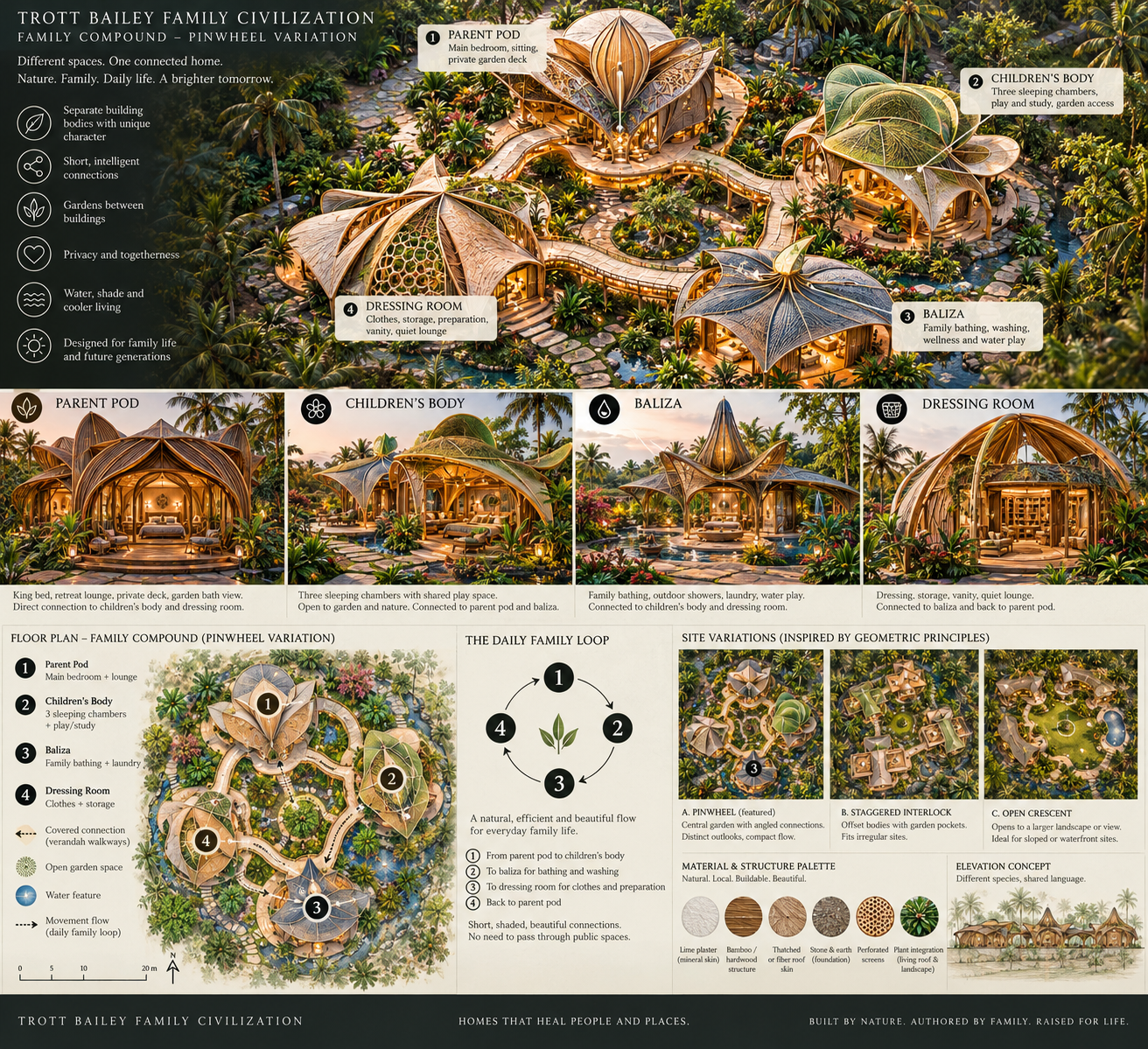
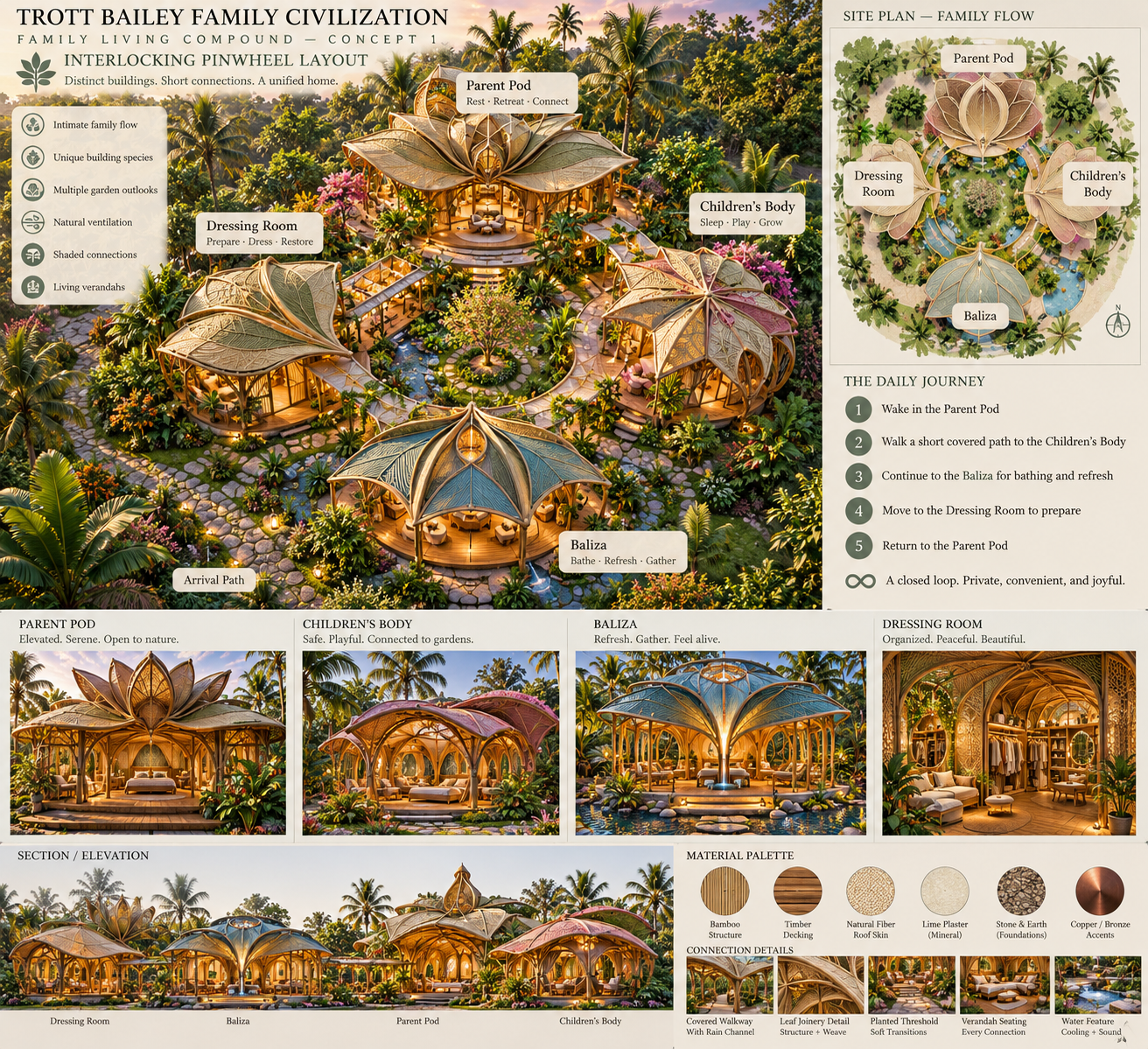
TBFC targetAdequate family shelter should remain reachable without lifetime dependence on rent, mortgage debt or ability to pay. Access-gate research questionWhat share of ordinary shelter access depends on rent, mortgage debt, purchase price or other recurring payment, and what dependable non-market routes exist at national scale? Read the Trott Bailey Family work: The Mother-Sight compound home
-63.2↓Money-gated · Evidence +27.5
Money-gated · Evidence +27.5
Score breakdown
Housing, Shelter & Housing Reach
Exact point calculation
70.00 × (25.00 ÷ 100) = 17.50 weighted points
Original evidence +70.0; after proportional category-adjustment allocation +70.0; Money-gated reading -50.9 × 25% = -12.7 points. Original evidence and the adjustment stay separately identifiable.
Capacity rate, when evidenced = usable functioning capacity ÷ capacity needed × 100. A derived score requires separate documented judgement; do not assume the rate itself equals the score.
Why this score
Bhutan has an unusually strong physical base for a small population: extensive forests, rivers and hydropower, agricultural landscapes, high improved-water coverage and a public health system built around free basic care. Terrain, rural dispersion, winter energy gaps and sharp local poverty differences keep capacity from becoming uniform access. The recovered package did not secure a current national housing-adequacy, overcrowding and affordability series, so housing remains conservative despite low population and strong public capacity.
Reach · 25-point ladder & linked Money Gate
The recorded value corresponds to a Reach-ladder step. The country evidence explains its practical access conditions.
Domestic Reach has eight 25-point intervals and nine anchors: −100, −75, −50, −25, 0, +25, +50, +75, +100. Existing readings retain their recorded scoring basis.
Linked direct Money Gate: Housing / Land not recorded. Physical reach can exist with paid access. Free-access Reach tiers must agree with this gate’s independently sourced no-payment population assessment. 4/4 is now reserved for reliable, accessible, universally free access. Neither score is copied blindly from the other.
The transportation thresholds establish the 25-point reference scale, with category-specific evidence determining the Reach reading.
Exact point calculation
50.00 × (35.00 ÷ 100) = 17.50 weighted points
Original evidence +50.0; after proportional category-adjustment allocation +50.0; Money-gated reading -56.7 × 35% = -19.8 points. Original evidence and the adjustment stay separately identifiable.
Reach rate, when evidenced = people effectively served ÷ eligible people × 100. Check the same population, period and location.
Why this score
Bhutan has an unusually strong physical base for a small population: extensive forests, rivers and hydropower, agricultural landscapes, high improved-water coverage and a public health system built around free basic care. Terrain, rural dispersion, winter energy gaps and sharp local poverty differences keep capacity from becoming uniform access. The recovered package did not secure a current national housing-adequacy, overcrowding and affordability series, so housing remains conservative despite low population and strong public capacity.
This reviewed profile predates beleshky-by-beleshky provenance. The category evidence supporting this judgment is shown here; the sources may apply across multiple beleshkies.
Exact point calculation
-60.00 × (25.00 ÷ 100) = -15.00 weighted points
Original evidence -60.0; after proportional category-adjustment allocation -60.0; Money-gated reading -88.5 × 25% = -22.1 points. Original evidence and the adjustment stay separately identifiable.
Use the cited country-specific record to explain why this rail earned its points.
Why this score
Bhutan has an unusually strong physical base for a small population: extensive forests, rivers and hydropower, agricultural landscapes, high improved-water coverage and a public health system built around free basic care. Terrain, rural dispersion, winter energy gaps and sharp local poverty differences keep capacity from becoming uniform access. The recovered package did not secure a current national housing-adequacy, overcrowding and affordability series, so housing remains conservative despite low population and strong public capacity.
This reviewed profile predates beleshky-by-beleshky provenance. The category evidence supporting this judgment is shown here; the sources may apply across multiple beleshkies.
Exact point calculation
50.00 × (15.00 ÷ 100) = 7.50 weighted points
Original evidence +50.0; after proportional category-adjustment allocation +50.0; Money-gated reading -56.7 × 15% = -8.5 points. Original evidence and the adjustment stay separately identifiable.
Use the cited country-specific record to explain why this rail earned its points.
Why this score
Bhutan has an unusually strong physical base for a small population: extensive forests, rivers and hydropower, agricultural landscapes, high improved-water coverage and a public health system built around free basic care. Terrain, rural dispersion, winter energy gaps and sharp local poverty differences keep capacity from becoming uniform access. The recovered package did not secure a current national housing-adequacy, overcrowding and affordability series, so housing remains conservative despite low population and strong public capacity.
This reviewed profile predates beleshky-by-beleshky provenance. The category evidence supporting this judgment is shown here; the sources may apply across multiple beleshkies.
The Money Gate is already included in the four readings. No second ceiling is deducted from this category. Displayed contributions are reconciled to two decimal places.
Adjustment and Money Gate arithmetic
Original weighted evidence: +27.5. Category adjustments (research, Adoption, family and/or transfer): 0.0. Effective evidence: +27.5. Money Gate ceiling: -42.3. Four Money-gated beleshky contributions total: -63.2.
The adjustment is distributed within beleshky score limits. The original 64 evidence readings are preserved for research review.
Show the full category score calculation
Weighted rails: 17.50 + 17.50 + -15.00 + 7.50 = 27.50
Base: 27.50 · reviewed adjustment: 0.00 · Adoption: +0.00 · authored marriage-law deduction: −0.00 · verified transfer deduction: −0.00 = published +27.5 (clamped to −100..+100)
Contribution to national evidence: 27.50 × (8.00 × 100.00%) ÷ 100.00 = 2.20 points
For Bhutan, this category carries 8% of the scorecard. With 100% research coverage in this category, its effective researched weight is 8.00%. After normalization across Bhutan’s researched categories, this category contributes +2.2 points to the national Evidence-before-Gate reading.
Abundance Gap: +20.0
What the evidence found
Bhutan has an unusually strong physical base for a small population: extensive forests, rivers and hydropower, agricultural landscapes, high improved-water coverage and a public health system built around free basic care. Terrain, rural dispersion, winter energy gaps and sharp local poverty differences keep capacity from becoming uniform access. The recovered package did not secure a current national housing-adequacy, overcrowding and affordability series, so housing remains conservative despite low population and strong public capacity.
National Statistics Bureau of Bhutan
9% weight
Food, Nourishment & Free Food Abundance
What this category measures
Physical food and nutrient capacity, nourishment reach, waste/loss, public edible landscapes and free food access.
TBFC targetNutritious food should exist in multiplying abundance and remain reachable even when a household has no money to spend. Access-gate research questionCan people obtain adequate nutritious food when they cannot pay, and are free/public/productive-food routes large enough to be ordinary rather than exceptional? Read the Trott Bailey Family work: The Complete Reordering of Earth’s Food System
-60.9↓Money-gated · Evidence +35.5
Money-gated · Evidence +35.5
Score breakdown
Food, Nourishment & Free Food Abundance
Exact point calculation
75.00 × (25.00 ÷ 100) = 18.75 weighted points
Original evidence +75.0; after proportional category-adjustment allocation +75.0; Money-gated reading -49.5 × 25% = -12.4 points. Original evidence and the adjustment stay separately identifiable.
Capacity rate, when evidenced = usable functioning capacity ÷ capacity needed × 100. A derived score requires separate documented judgement; do not assume the rate itself equals the score.
Why this score
Bhutan has an unusually strong physical base for a small population: extensive forests, rivers and hydropower, agricultural landscapes, high improved-water coverage and a public health system built around free basic care. Terrain, rural dispersion, winter energy gaps and sharp local poverty differences keep capacity from becoming uniform access. School feeding is established at large scale and nutrition diversification is being actively implemented. Child stunting remained almost 18% in 2023 and dietary diversity for young children has been a documented weakness. Agriculture programmes emphasize market access, insurance and investment, showing food access/production remains finance-mediated.
Reach · 25-point ladder & linked Money Gate
This score follows the earlier continuous Reach scale. The original reading is retained without rounding or changing its historical position.
Domestic Reach has eight 25-point intervals and nine anchors: −100, −75, −50, −25, 0, +25, +50, +75, +100. Existing readings retain their recorded scoring basis.
Linked direct Money Gate: Food not recorded. Physical reach can exist with paid access. Free-access Reach tiers must agree with this gate’s independently sourced no-payment population assessment. 4/4 is now reserved for reliable, accessible, universally free access. Neither score is copied blindly from the other.
The transportation thresholds establish the 25-point reference scale, with category-specific evidence determining the Reach reading.
Exact point calculation
60.00 × (35.00 ÷ 100) = 21.00 weighted points
Original evidence +60.0; after proportional category-adjustment allocation +60.0; Money-gated reading -53.8 × 35% = -18.8 points. Original evidence and the adjustment stay separately identifiable.
Reach rate, when evidenced = people effectively served ÷ eligible people × 100. Check the same population, period and location.
Why this score
Bhutan has an unusually strong physical base for a small population: extensive forests, rivers and hydropower, agricultural landscapes, high improved-water coverage and a public health system built around free basic care. Terrain, rural dispersion, winter energy gaps and sharp local poverty differences keep capacity from becoming uniform access. School feeding is established at large scale and nutrition diversification is being actively implemented. Child stunting remained almost 18% in 2023 and dietary diversity for young children has been a documented weakness. Agriculture programmes emphasize market access, insurance and investment, showing food access/production remains finance-mediated.
This reviewed profile predates beleshky-by-beleshky provenance. The category evidence supporting this judgment is shown here; the sources may apply across multiple beleshkies.
Exact point calculation
-50.00 × (25.00 ÷ 100) = -12.50 weighted points
Original evidence -50.0; after proportional category-adjustment allocation -50.0; Money-gated reading -85.6 × 25% = -21.4 points. Original evidence and the adjustment stay separately identifiable.
Use the cited country-specific record to explain why this rail earned its points.
Why this score
Bhutan has an unusually strong physical base for a small population: extensive forests, rivers and hydropower, agricultural landscapes, high improved-water coverage and a public health system built around free basic care. Terrain, rural dispersion, winter energy gaps and sharp local poverty differences keep capacity from becoming uniform access. School feeding is established at large scale and nutrition diversification is being actively implemented. Child stunting remained almost 18% in 2023 and dietary diversity for young children has been a documented weakness. Agriculture programmes emphasize market access, insurance and investment, showing food access/production remains finance-mediated.
This reviewed profile predates beleshky-by-beleshky provenance. The category evidence supporting this judgment is shown here; the sources may apply across multiple beleshkies.
Exact point calculation
55.00 × (15.00 ÷ 100) = 8.25 weighted points
Original evidence +55.0; after proportional category-adjustment allocation +55.0; Money-gated reading -55.2 × 15% = -8.3 points. Original evidence and the adjustment stay separately identifiable.
Use the cited country-specific record to explain why this rail earned its points.
Why this score
Bhutan has an unusually strong physical base for a small population: extensive forests, rivers and hydropower, agricultural landscapes, high improved-water coverage and a public health system built around free basic care. Terrain, rural dispersion, winter energy gaps and sharp local poverty differences keep capacity from becoming uniform access. School feeding is established at large scale and nutrition diversification is being actively implemented. Child stunting remained almost 18% in 2023 and dietary diversity for young children has been a documented weakness. Agriculture programmes emphasize market access, insurance and investment, showing food access/production remains finance-mediated.
This reviewed profile predates beleshky-by-beleshky provenance. The category evidence supporting this judgment is shown here; the sources may apply across multiple beleshkies.
The Money Gate is already included in the four readings. No second ceiling is deducted from this category. Displayed contributions are reconciled to two decimal places.
Adjustment and Money Gate arithmetic
Original weighted evidence: +35.5. Category adjustments (research, Adoption, family and/or transfer): 0.0. Effective evidence: +35.5. Money Gate ceiling: -42.3. Four Money-gated beleshky contributions total: -60.9.
The adjustment is distributed within beleshky score limits. The original 64 evidence readings are preserved for research review.
Show the full category score calculation
Weighted rails: 18.75 + 21.00 + -12.50 + 8.25 = 35.50
Base: 35.50 · reviewed adjustment: 0.00 · Adoption: +0.00 · authored marriage-law deduction: −0.00 · verified transfer deduction: −0.00 = published +35.5 (clamped to −100..+100)
Contribution to national evidence: 35.50 × (9.00 × 100.00%) ÷ 100.00 = 3.20 points
For Bhutan, this category carries 9% of the scorecard. With 100% research coverage in this category, its effective researched weight is 9.00%. After normalization across Bhutan’s researched categories, this category contributes +3.2 points to the national Evidence-before-Gate reading.
Abundance Gap: +15.0
What the evidence found
Bhutan has an unusually strong physical base for a small population: extensive forests, rivers and hydropower, agricultural landscapes, high improved-water coverage and a public health system built around free basic care. Terrain, rural dispersion, winter energy gaps and sharp local poverty differences keep capacity from becoming uniform access. School feeding is established at large scale and nutrition diversification is being actively implemented. Child stunting remained almost 18% in 2023 and dietary diversity for young children has been a documented weakness. Agriculture programmes emphasize market access, insurance and investment, showing food access/production remains finance-mediated.
FAO / Royal Government of Bhutan
6% weight
Water & Sanitation Abundance
What this category measures
Safe water, sanitation, reliability, capture, reuse, storage and living-landscape water capacity.
TBFC targetSafe water and sanitation should be dependable life infrastructure, not conditional on household purchasing power. Access-gate research questionCan households retain safe water and sanitation when income falls, and which payment, disconnection or infrastructure barriers interrupt access? Read the Trott Bailey Family work: Water Your Orchards With Life
-56.9↓Money-gated · Evidence +49.3
Money-gated · Evidence +49.3
Score breakdown
Water & Sanitation Abundance
Exact point calculation
85.00 × (25.00 ÷ 100) = 21.25 weighted points
Original evidence +85.0; after proportional category-adjustment allocation +85.0; Money-gated reading -46.6 × 25% = -11.7 points. Original evidence and the adjustment stay separately identifiable.
Capacity rate, when evidenced = usable functioning capacity ÷ capacity needed × 100. A derived score requires separate documented judgement; do not assume the rate itself equals the score.
Why this score
Bhutan has an unusually strong physical base for a small population: extensive forests, rivers and hydropower, agricultural landscapes, high improved-water coverage and a public health system built around free basic care. Terrain, rural dispersion, winter energy gaps and sharp local poverty differences keep capacity from becoming uniform access. Near-universal improved drinking-water access and broad digital connectivity reduce some physical access burdens. Youth unemployment and sharp rural poverty disparities remain. 12.4% national poverty in 2022, above 17% rural and over 41% in Zhemgang, shows monetary access remains uneven.
Reach · 25-point ladder & linked Money Gate
The recorded value corresponds to a Reach-ladder step. The country evidence explains its practical access conditions.
Domestic Reach has eight 25-point intervals and nine anchors: −100, −75, −50, −25, 0, +25, +50, +75, +100. Existing readings retain their recorded scoring basis.
Linked direct Money Gate: Water / Energy not recorded. Physical reach can exist with paid access. Free-access Reach tiers must agree with this gate’s independently sourced no-payment population assessment. 4/4 is now reserved for reliable, accessible, universally free access. Neither score is copied blindly from the other.
Water and energy share one combined four-point gate; the direct audit must show which part reaches families without payment.
The transportation thresholds establish the 25-point reference scale, with category-specific evidence determining the Reach reading.
Exact point calculation
75.00 × (35.00 ÷ 100) = 26.25 weighted points
Original evidence +75.0; after proportional category-adjustment allocation +75.0; Money-gated reading -49.5 × 35% = -17.3 points. Original evidence and the adjustment stay separately identifiable.
Reach rate, when evidenced = people effectively served ÷ eligible people × 100. Check the same population, period and location.
Why this score
Bhutan has an unusually strong physical base for a small population: extensive forests, rivers and hydropower, agricultural landscapes, high improved-water coverage and a public health system built around free basic care. Terrain, rural dispersion, winter energy gaps and sharp local poverty differences keep capacity from becoming uniform access. Near-universal improved drinking-water access and broad digital connectivity reduce some physical access burdens. Youth unemployment and sharp rural poverty disparities remain. 12.4% national poverty in 2022, above 17% rural and over 41% in Zhemgang, shows monetary access remains uneven.
This reviewed profile predates beleshky-by-beleshky provenance. The category evidence supporting this judgment is shown here; the sources may apply across multiple beleshkies.
Exact point calculation
-35.00 × (25.00 ÷ 100) = -8.75 weighted points
Original evidence -35.0; after proportional category-adjustment allocation -35.0; Money-gated reading -81.2 × 25% = -20.3 points. Original evidence and the adjustment stay separately identifiable.
Use the cited country-specific record to explain why this rail earned its points.
Why this score
Bhutan has an unusually strong physical base for a small population: extensive forests, rivers and hydropower, agricultural landscapes, high improved-water coverage and a public health system built around free basic care. Terrain, rural dispersion, winter energy gaps and sharp local poverty differences keep capacity from becoming uniform access. Near-universal improved drinking-water access and broad digital connectivity reduce some physical access burdens. Youth unemployment and sharp rural poverty disparities remain. 12.4% national poverty in 2022, above 17% rural and over 41% in Zhemgang, shows monetary access remains uneven.
This reviewed profile predates beleshky-by-beleshky provenance. The category evidence supporting this judgment is shown here; the sources may apply across multiple beleshkies.
Exact point calculation
70.00 × (15.00 ÷ 100) = 10.50 weighted points
Original evidence +70.0; after proportional category-adjustment allocation +70.0; Money-gated reading -50.9 × 15% = -7.6 points. Original evidence and the adjustment stay separately identifiable.
Use the cited country-specific record to explain why this rail earned its points.
Why this score
Bhutan has an unusually strong physical base for a small population: extensive forests, rivers and hydropower, agricultural landscapes, high improved-water coverage and a public health system built around free basic care. Terrain, rural dispersion, winter energy gaps and sharp local poverty differences keep capacity from becoming uniform access. Near-universal improved drinking-water access and broad digital connectivity reduce some physical access burdens. Youth unemployment and sharp rural poverty disparities remain. 12.4% national poverty in 2022, above 17% rural and over 41% in Zhemgang, shows monetary access remains uneven.
This reviewed profile predates beleshky-by-beleshky provenance. The category evidence supporting this judgment is shown here; the sources may apply across multiple beleshkies.
The Money Gate is already included in the four readings. No second ceiling is deducted from this category. Displayed contributions are reconciled to two decimal places.
Adjustment and Money Gate arithmetic
Original weighted evidence: +49.3. Category adjustments (research, Adoption, family and/or transfer): 0.0. Effective evidence: +49.3. Money Gate ceiling: -42.3. Four Money-gated beleshky contributions total: -56.9.
The adjustment is distributed within beleshky score limits. The original 64 evidence readings are preserved for research review.
Show the full category score calculation
Weighted rails: 21.25 + 26.25 + -8.75 + 10.50 = 49.25
Base: 49.25 · reviewed adjustment: 0.00 · Adoption: +0.00 · authored marriage-law deduction: −0.00 · verified transfer deduction: −0.00 = published +49.3 (clamped to −100..+100)
Contribution to national evidence: 49.25 × (6.00 × 100.00%) ÷ 100.00 = 2.96 points
For Bhutan, this category carries 6% of the scorecard. With 100% research coverage in this category, its effective researched weight is 6.00%. After normalization across Bhutan’s researched categories, this category contributes +3.0 points to the national Evidence-before-Gate reading.
Abundance Gap: +10.0
What the evidence found
Bhutan has an unusually strong physical base for a small population: extensive forests, rivers and hydropower, agricultural landscapes, high improved-water coverage and a public health system built around free basic care. Terrain, rural dispersion, winter energy gaps and sharp local poverty differences keep capacity from becoming uniform access. Near-universal improved drinking-water access and broad digital connectivity reduce some physical access burdens. Youth unemployment and sharp rural poverty disparities remain. 12.4% national poverty in 2022, above 17% rural and over 41% in Zhemgang, shows monetary access remains uneven.
UNICEF Bhutan / Royal Government of Bhutan
5% weight
Energy & Household Capability
What this category measures
Whether usable, reliable energy reaches households and removes burdens across water, food, health, cooling, cooking and movement.
TBFC targetEssential household energy should support cooking, cooling, water, food preservation and care without money becoming the switch that turns basic capability on or off. Access-gate research questionCan households retain essential energy for cooking, cooling, water and food preservation when they cannot pay, and how often does price or disconnection reduce capability? Read the Trott Bailey Family work: Trott Bailey Solar Moon Panel
-59.1↓Money-gated · Evidence +41.6
Money-gated · Evidence +41.6
Score breakdown
Energy & Household Capability
Exact point calculation
80.00 × (25.00 ÷ 100) = 20.00 weighted points
Original evidence +80.0; after proportional category-adjustment allocation +80.0; Money-gated reading -48.0 × 25% = -12.0 points. Original evidence and the adjustment stay separately identifiable.
Capacity rate, when evidenced = usable functioning capacity ÷ capacity needed × 100. A derived score requires separate documented judgement; do not assume the rate itself equals the score.
Why this score
Bhutan has an unusually strong physical base for a small population: extensive forests, rivers and hydropower, agricultural landscapes, high improved-water coverage and a public health system built around free basic care. Terrain, rural dispersion, winter energy gaps and sharp local poverty differences keep capacity from becoming uniform access. Carbon-negative national system and large renewable resource base. Climate risk and seasonal generation mismatch prevent equating annual surplus potential with year-round energy abundance. New hydropower expansion depends on large public/private/international financing.
Reach · 25-point ladder & linked Money Gate
This score follows the earlier continuous Reach scale. The original reading is retained without rounding or changing its historical position.
Domestic Reach has eight 25-point intervals and nine anchors: −100, −75, −50, −25, 0, +25, +50, +75, +100. Existing readings retain their recorded scoring basis.
Linked direct Money Gate: Water / Energy not recorded. Physical reach can exist with paid access. Free-access Reach tiers must agree with this gate’s independently sourced no-payment population assessment. 4/4 is now reserved for reliable, accessible, universally free access. Neither score is copied blindly from the other.
Water and energy share one combined four-point gate; the direct audit must show which part reaches families without payment.
The transportation thresholds establish the 25-point reference scale, with category-specific evidence determining the Reach reading.
Exact point calculation
68.00 × (35.00 ÷ 100) = 23.80 weighted points
Original evidence +68.0; after proportional category-adjustment allocation +68.0; Money-gated reading -51.5 × 35% = -18.0 points. Original evidence and the adjustment stay separately identifiable.
Reach rate, when evidenced = people effectively served ÷ eligible people × 100. Check the same population, period and location.
Why this score
Bhutan has an unusually strong physical base for a small population: extensive forests, rivers and hydropower, agricultural landscapes, high improved-water coverage and a public health system built around free basic care. Terrain, rural dispersion, winter energy gaps and sharp local poverty differences keep capacity from becoming uniform access. Carbon-negative national system and large renewable resource base. Climate risk and seasonal generation mismatch prevent equating annual surplus potential with year-round energy abundance. New hydropower expansion depends on large public/private/international financing.
This reviewed profile predates beleshky-by-beleshky provenance. The category evidence supporting this judgment is shown here; the sources may apply across multiple beleshkies.
Exact point calculation
-45.00 × (25.00 ÷ 100) = -11.25 weighted points
Original evidence -45.0; after proportional category-adjustment allocation -45.0; Money-gated reading -84.1 × 25% = -21.0 points. Original evidence and the adjustment stay separately identifiable.
Use the cited country-specific record to explain why this rail earned its points.
Why this score
Bhutan has an unusually strong physical base for a small population: extensive forests, rivers and hydropower, agricultural landscapes, high improved-water coverage and a public health system built around free basic care. Terrain, rural dispersion, winter energy gaps and sharp local poverty differences keep capacity from becoming uniform access. Carbon-negative national system and large renewable resource base. Climate risk and seasonal generation mismatch prevent equating annual surplus potential with year-round energy abundance. New hydropower expansion depends on large public/private/international financing.
This reviewed profile predates beleshky-by-beleshky provenance. The category evidence supporting this judgment is shown here; the sources may apply across multiple beleshkies.
Exact point calculation
60.00 × (15.00 ÷ 100) = 9.00 weighted points
Original evidence +60.0; after proportional category-adjustment allocation +60.0; Money-gated reading -53.8 × 15% = -8.1 points. Original evidence and the adjustment stay separately identifiable.
Use the cited country-specific record to explain why this rail earned its points.
Why this score
Bhutan has an unusually strong physical base for a small population: extensive forests, rivers and hydropower, agricultural landscapes, high improved-water coverage and a public health system built around free basic care. Terrain, rural dispersion, winter energy gaps and sharp local poverty differences keep capacity from becoming uniform access. Carbon-negative national system and large renewable resource base. Climate risk and seasonal generation mismatch prevent equating annual surplus potential with year-round energy abundance. New hydropower expansion depends on large public/private/international financing.
This reviewed profile predates beleshky-by-beleshky provenance. The category evidence supporting this judgment is shown here; the sources may apply across multiple beleshkies.
The Money Gate is already included in the four readings. No second ceiling is deducted from this category. Displayed contributions are reconciled to two decimal places.
Adjustment and Money Gate arithmetic
Original weighted evidence: +41.6. Category adjustments (research, Adoption, family and/or transfer): 0.0. Effective evidence: +41.6. Money Gate ceiling: -42.3. Four Money-gated beleshky contributions total: -59.1.
The adjustment is distributed within beleshky score limits. The original 64 evidence readings are preserved for research review.
Show the full category score calculation
Weighted rails: 20.00 + 23.80 + -11.25 + 9.00 = 41.55
Base: 41.55 · reviewed adjustment: 0.00 · Adoption: +0.00 · authored marriage-law deduction: −0.00 · verified transfer deduction: −0.00 = published +41.6 (clamped to −100..+100)
Contribution to national evidence: 41.55 × (5.00 × 100.00%) ÷ 100.00 = 2.08 points
For Bhutan, this category carries 5% of the scorecard. With 100% research coverage in this category, its effective researched weight is 5.00%. After normalization across Bhutan’s researched categories, this category contributes +2.1 points to the national Evidence-before-Gate reading.
Abundance Gap: +12.0
What the evidence found
Bhutan has an unusually strong physical base for a small population: extensive forests, rivers and hydropower, agricultural landscapes, high improved-water coverage and a public health system built around free basic care. Terrain, rural dispersion, winter energy gaps and sharp local poverty differences keep capacity from becoming uniform access. Carbon-negative national system and large renewable resource base. Climate risk and seasonal generation mismatch prevent equating annual surplus potential with year-round energy abundance. New hydropower expansion depends on large public/private/international financing.
World Bank / Royal Government of Bhutan
7% weight
Health & Care Reach
What this category measures
Whether prevention, primary care, medicine, maternity care, dentistry and specialist capability reach people when needed.
TBFC targetPrevention, maternity, dentistry, medicine and necessary treatment should be reachable because care is needed, not because payment can be produced. Access-gate research questionCan necessary care be obtained because it is needed, or do price, insurance, employment, debt or other financial tests materially delay or prevent access? Read the Trott Bailey Family work: No Shrugging Our Shoulders at Family Suffering
-56.9↓Money-gated · Evidence +49.3
Money-gated · Evidence +49.3
Score breakdown
Health & Care Reach
Exact point calculation
85.00 × (25.00 ÷ 100) = 21.25 weighted points
Original evidence +85.0; after proportional category-adjustment allocation +85.0; Money-gated reading -46.6 × 25% = -11.7 points. Original evidence and the adjustment stay separately identifiable.
Capacity rate, when evidenced = usable functioning capacity ÷ capacity needed × 100. A derived score requires separate documented judgement; do not assume the rate itself equals the score.
Why this score
Bhutan has an unusually strong physical base for a small population: extensive forests, rivers and hydropower, agricultural landscapes, high improved-water coverage and a public health system built around free basic care. Terrain, rural dispersion, winter energy gaps and sharp local poverty differences keep capacity from becoming uniform access. Free basic public health mandate plus strong maternal, child and immunization outcomes. NCD burden, health-worker attrition and rural quality/reach gaps remain. Basic public care is constitutionally free, a major reduction in money-gating; not every health-related cost or advanced service should be assumed free without evidence.
Reach · 25-point ladder & linked Money Gate
The recorded value corresponds to a Reach-ladder step. The country evidence explains its practical access conditions.
Domestic Reach has eight 25-point intervals and nine anchors: −100, −75, −50, −25, 0, +25, +50, +75, +100. Existing readings retain their recorded scoring basis.
Linked direct Money Gate: Healthcare not recorded. Physical reach can exist with paid access. Free-access Reach tiers must agree with this gate’s independently sourced no-payment population assessment. 4/4 is now reserved for reliable, accessible, universally free access. Neither score is copied blindly from the other.
The transportation thresholds establish the 25-point reference scale, with category-specific evidence determining the Reach reading.
Exact point calculation
75.00 × (35.00 ÷ 100) = 26.25 weighted points
Original evidence +75.0; after proportional category-adjustment allocation +75.0; Money-gated reading -49.5 × 35% = -17.3 points. Original evidence and the adjustment stay separately identifiable.
Reach rate, when evidenced = people effectively served ÷ eligible people × 100. Check the same population, period and location.
Why this score
Bhutan has an unusually strong physical base for a small population: extensive forests, rivers and hydropower, agricultural landscapes, high improved-water coverage and a public health system built around free basic care. Terrain, rural dispersion, winter energy gaps and sharp local poverty differences keep capacity from becoming uniform access. Free basic public health mandate plus strong maternal, child and immunization outcomes. NCD burden, health-worker attrition and rural quality/reach gaps remain. Basic public care is constitutionally free, a major reduction in money-gating; not every health-related cost or advanced service should be assumed free without evidence.
This reviewed profile predates beleshky-by-beleshky provenance. The category evidence supporting this judgment is shown here; the sources may apply across multiple beleshkies.
Exact point calculation
-35.00 × (25.00 ÷ 100) = -8.75 weighted points
Original evidence -35.0; after proportional category-adjustment allocation -35.0; Money-gated reading -81.2 × 25% = -20.3 points. Original evidence and the adjustment stay separately identifiable.
Use the cited country-specific record to explain why this rail earned its points.
Why this score
Bhutan has an unusually strong physical base for a small population: extensive forests, rivers and hydropower, agricultural landscapes, high improved-water coverage and a public health system built around free basic care. Terrain, rural dispersion, winter energy gaps and sharp local poverty differences keep capacity from becoming uniform access. Free basic public health mandate plus strong maternal, child and immunization outcomes. NCD burden, health-worker attrition and rural quality/reach gaps remain. Basic public care is constitutionally free, a major reduction in money-gating; not every health-related cost or advanced service should be assumed free without evidence.
This reviewed profile predates beleshky-by-beleshky provenance. The category evidence supporting this judgment is shown here; the sources may apply across multiple beleshkies.
Exact point calculation
70.00 × (15.00 ÷ 100) = 10.50 weighted points
Original evidence +70.0; after proportional category-adjustment allocation +70.0; Money-gated reading -50.9 × 15% = -7.6 points. Original evidence and the adjustment stay separately identifiable.
Use the cited country-specific record to explain why this rail earned its points.
Why this score
Bhutan has an unusually strong physical base for a small population: extensive forests, rivers and hydropower, agricultural landscapes, high improved-water coverage and a public health system built around free basic care. Terrain, rural dispersion, winter energy gaps and sharp local poverty differences keep capacity from becoming uniform access. Free basic public health mandate plus strong maternal, child and immunization outcomes. NCD burden, health-worker attrition and rural quality/reach gaps remain. Basic public care is constitutionally free, a major reduction in money-gating; not every health-related cost or advanced service should be assumed free without evidence.
This reviewed profile predates beleshky-by-beleshky provenance. The category evidence supporting this judgment is shown here; the sources may apply across multiple beleshkies.
The Money Gate is already included in the four readings. No second ceiling is deducted from this category. Displayed contributions are reconciled to two decimal places.
Adjustment and Money Gate arithmetic
Original weighted evidence: +49.3. Category adjustments (research, Adoption, family and/or transfer): 0.0. Effective evidence: +49.3. Money Gate ceiling: -42.3. Four Money-gated beleshky contributions total: -56.9.
The adjustment is distributed within beleshky score limits. The original 64 evidence readings are preserved for research review.
Show the full category score calculation
Weighted rails: 21.25 + 26.25 + -8.75 + 10.50 = 49.25
Base: 49.25 · reviewed adjustment: 0.00 · Adoption: +0.00 · authored marriage-law deduction: −0.00 · verified transfer deduction: −0.00 = published +49.3 (clamped to −100..+100)
Contribution to national evidence: 49.25 × (7.00 × 100.00%) ÷ 100.00 = 3.45 points
For Bhutan, this category carries 7% of the scorecard. With 100% research coverage in this category, its effective researched weight is 7.00%. After normalization across Bhutan’s researched categories, this category contributes +3.4 points to the national Evidence-before-Gate reading.
Abundance Gap: +10.0
What the evidence found
Bhutan has an unusually strong physical base for a small population: extensive forests, rivers and hydropower, agricultural landscapes, high improved-water coverage and a public health system built around free basic care. Terrain, rural dispersion, winter energy gaps and sharp local poverty differences keep capacity from becoming uniform access. Free basic public health mandate plus strong maternal, child and immunization outcomes. NCD burden, health-worker attrition and rural quality/reach gaps remain. Basic public care is constitutionally free, a major reduction in money-gating; not every health-related cost or advanced service should be assumed free without evidence.
WHO
6% weight
Education & Human Capability
What this category measures
Foundational learning plus practical, technical and enduring civilization capability retained by people.
TBFC targetFoundational learning and useful capability should be reachable as part of civilization life rather than purchased according to family income. Access-gate research questionWhich essential learning and capability routes are genuinely reachable regardless of family income, and where do fees, debt or paid enrichment create decisive access gaps? Read the Trott Bailey Family work: What Is NoDumbDumbs?
-59.1↓Money-gated · Evidence +41.6
Money-gated · Evidence +41.6
Score breakdown
Education & Human Capability
Exact point calculation
80.00 × (25.00 ÷ 100) = 20.00 weighted points
Original evidence +80.0; after proportional category-adjustment allocation +80.0; Money-gated reading -48.0 × 25% = -12.0 points. Original evidence and the adjustment stay separately identifiable.
Capacity rate, when evidenced = usable functioning capacity ÷ capacity needed × 100. A derived score requires separate documented judgement; do not assume the rate itself equals the score.
Why this score
Bhutan has an unusually strong physical base for a small population: extensive forests, rivers and hydropower, agricultural landscapes, high improved-water coverage and a public health system built around free basic care. Terrain, rural dispersion, winter energy gaps and sharp local poverty differences keep capacity from becoming uniform access. A pilot has moved into government-funded nationwide grade-level implementation. Connectivity and device access are not universal; digital tools do not prove learning gains at national scale. Public funding reduces school-level money gates, while household connectivity/device affordability remains incompletely measured.
Reach · 25-point ladder & linked Money Gate
This score follows the earlier continuous Reach scale. The original reading is retained without rounding or changing its historical position.
Domestic Reach has eight 25-point intervals and nine anchors: −100, −75, −50, −25, 0, +25, +50, +75, +100. Existing readings retain their recorded scoring basis.
The transportation thresholds establish the 25-point reference scale, with category-specific evidence determining the Reach reading.
Exact point calculation
68.00 × (35.00 ÷ 100) = 23.80 weighted points
Original evidence +68.0; after proportional category-adjustment allocation +68.0; Money-gated reading -51.5 × 35% = -18.0 points. Original evidence and the adjustment stay separately identifiable.
Reach rate, when evidenced = people effectively served ÷ eligible people × 100. Check the same population, period and location.
Why this score
Bhutan has an unusually strong physical base for a small population: extensive forests, rivers and hydropower, agricultural landscapes, high improved-water coverage and a public health system built around free basic care. Terrain, rural dispersion, winter energy gaps and sharp local poverty differences keep capacity from becoming uniform access. A pilot has moved into government-funded nationwide grade-level implementation. Connectivity and device access are not universal; digital tools do not prove learning gains at national scale. Public funding reduces school-level money gates, while household connectivity/device affordability remains incompletely measured.
This reviewed profile predates beleshky-by-beleshky provenance. The category evidence supporting this judgment is shown here; the sources may apply across multiple beleshkies.
Exact point calculation
-45.00 × (25.00 ÷ 100) = -11.25 weighted points
Original evidence -45.0; after proportional category-adjustment allocation -45.0; Money-gated reading -84.1 × 25% = -21.0 points. Original evidence and the adjustment stay separately identifiable.
Use the cited country-specific record to explain why this rail earned its points.
Why this score
Bhutan has an unusually strong physical base for a small population: extensive forests, rivers and hydropower, agricultural landscapes, high improved-water coverage and a public health system built around free basic care. Terrain, rural dispersion, winter energy gaps and sharp local poverty differences keep capacity from becoming uniform access. A pilot has moved into government-funded nationwide grade-level implementation. Connectivity and device access are not universal; digital tools do not prove learning gains at national scale. Public funding reduces school-level money gates, while household connectivity/device affordability remains incompletely measured.
This reviewed profile predates beleshky-by-beleshky provenance. The category evidence supporting this judgment is shown here; the sources may apply across multiple beleshkies.
Exact point calculation
60.00 × (15.00 ÷ 100) = 9.00 weighted points
Original evidence +60.0; after proportional category-adjustment allocation +60.0; Money-gated reading -53.8 × 15% = -8.1 points. Original evidence and the adjustment stay separately identifiable.
Use the cited country-specific record to explain why this rail earned its points.
Why this score
Bhutan has an unusually strong physical base for a small population: extensive forests, rivers and hydropower, agricultural landscapes, high improved-water coverage and a public health system built around free basic care. Terrain, rural dispersion, winter energy gaps and sharp local poverty differences keep capacity from becoming uniform access. A pilot has moved into government-funded nationwide grade-level implementation. Connectivity and device access are not universal; digital tools do not prove learning gains at national scale. Public funding reduces school-level money gates, while household connectivity/device affordability remains incompletely measured.
This reviewed profile predates beleshky-by-beleshky provenance. The category evidence supporting this judgment is shown here; the sources may apply across multiple beleshkies.
The Money Gate is already included in the four readings. No second ceiling is deducted from this category. Displayed contributions are reconciled to two decimal places.
Adjustment and Money Gate arithmetic
Original weighted evidence: +41.6. Category adjustments (research, Adoption, family and/or transfer): 0.0. Effective evidence: +41.6. Money Gate ceiling: -42.3. Four Money-gated beleshky contributions total: -59.1.
The adjustment is distributed within beleshky score limits. The original 64 evidence readings are preserved for research review.
Show the full category score calculation
Weighted rails: 20.00 + 23.80 + -11.25 + 9.00 = 41.55
Base: 41.55 · reviewed adjustment: 0.00 · Adoption: +0.00 · authored marriage-law deduction: −0.00 · verified transfer deduction: −0.00 = published +41.6 (clamped to −100..+100)
Contribution to national evidence: 41.55 × (6.00 × 100.00%) ÷ 100.00 = 2.49 points
For Bhutan, this category carries 6% of the scorecard. With 100% research coverage in this category, its effective researched weight is 6.00%. After normalization across Bhutan’s researched categories, this category contributes +2.5 points to the national Evidence-before-Gate reading.
Abundance Gap: +12.0
What the evidence found
Bhutan has an unusually strong physical base for a small population: extensive forests, rivers and hydropower, agricultural landscapes, high improved-water coverage and a public health system built around free basic care. Terrain, rural dispersion, winter energy gaps and sharp local poverty differences keep capacity from becoming uniform access. A pilot has moved into government-funded nationwide grade-level implementation. Connectivity and device access are not universal; digital tools do not prove learning gains at national scale. Public funding reduces school-level money gates, while household connectivity/device affordability remains incompletely measured.
UNICEF Bhutan / Ministry of Education and Skills Development
4% weight
Mobility & Reachability
What this category measures
Local, regional and national movement that connects people to family, services, work, learning and public life without consuming excessive time.
TBFC targetOrdinary local and regional movement should be available for family, care, learning and civic life without travel becoming a paywall. Access-gate research questionCan ordinary people reach family, care, learning and public life without high recurring fares, vehicle costs, debt or fuel dependence? Read the Trott Bailey Family work: The Caterport: Free Human Movement
-63.2↓Money-gated · Evidence +27.5
Money-gated · Evidence +27.5
Score breakdown
Mobility & Reachability
Exact point calculation
70.00 × (25.00 ÷ 100) = 17.50 weighted points
Original evidence +70.0; after proportional category-adjustment allocation +70.0; Money-gated reading -50.9 × 25% = -12.7 points. Original evidence and the adjustment stay separately identifiable.
Capacity rate, when evidenced = usable functioning capacity ÷ capacity needed × 100. A derived score requires separate documented judgement; do not assume the rate itself equals the score.
Why this score
Bhutan has an unusually strong physical base for a small population: extensive forests, rivers and hydropower, agricultural landscapes, high improved-water coverage and a public health system built around free basic care. Terrain, rural dispersion, winter energy gaps and sharp local poverty differences keep capacity from becoming uniform access. Mountain terrain, dispersed settlements and landslide/flood exposure impose real movement and maintenance costs even where roads and digital systems improve reach.
Reach · 25-point ladder & linked Money Gate
The recorded value corresponds to a Reach-ladder step. The country evidence explains its practical access conditions.
Domestic Reach has eight 25-point intervals and nine anchors: −100, −75, −50, −25, 0, +25, +50, +75, +100. Existing readings retain their recorded scoring basis.
Linked direct Money Gate: Transportation not recorded. Physical reach can exist with paid access. Free-access Reach tiers must agree with this gate’s independently sourced no-payment population assessment. 4/4 is now reserved for reliable, accessible, universally free access. Neither score is copied blindly from the other.
- -100No functioning ordinary transport service established
- -75Some transportation exists but practical access is severely limited
- -50Basic usable transportation infrastructure exists
- -25A functioning national or broadly connected public transport network exists
- 0More than 50% of residents are effectively served
- +25More than 75% effectively served OR more than 30% receive dependable free travel
- +50More than 75% effectively served AND more than 30% receive dependable free travel
- +75More than 90% effectively served, at least 75% travel free, and service is reliable
- +100Ordinary essential travel is universally accessible, reliable and free of payment
Exact point calculation
50.00 × (35.00 ÷ 100) = 17.50 weighted points
Original evidence +50.0; after proportional category-adjustment allocation +50.0; Money-gated reading -56.7 × 35% = -19.8 points. Original evidence and the adjustment stay separately identifiable.
Reach rate, when evidenced = people effectively served ÷ eligible people × 100. Check the same population, period and location.
Why this score
Bhutan has an unusually strong physical base for a small population: extensive forests, rivers and hydropower, agricultural landscapes, high improved-water coverage and a public health system built around free basic care. Terrain, rural dispersion, winter energy gaps and sharp local poverty differences keep capacity from becoming uniform access. Mountain terrain, dispersed settlements and landslide/flood exposure impose real movement and maintenance costs even where roads and digital systems improve reach.
This reviewed profile predates beleshky-by-beleshky provenance. The category evidence supporting this judgment is shown here; the sources may apply across multiple beleshkies.
Exact point calculation
-60.00 × (25.00 ÷ 100) = -15.00 weighted points
Original evidence -60.0; after proportional category-adjustment allocation -60.0; Money-gated reading -88.5 × 25% = -22.1 points. Original evidence and the adjustment stay separately identifiable.
Use the cited country-specific record to explain why this rail earned its points.
Why this score
Bhutan has an unusually strong physical base for a small population: extensive forests, rivers and hydropower, agricultural landscapes, high improved-water coverage and a public health system built around free basic care. Terrain, rural dispersion, winter energy gaps and sharp local poverty differences keep capacity from becoming uniform access. Mountain terrain, dispersed settlements and landslide/flood exposure impose real movement and maintenance costs even where roads and digital systems improve reach.
This reviewed profile predates beleshky-by-beleshky provenance. The category evidence supporting this judgment is shown here; the sources may apply across multiple beleshkies.
Exact point calculation
50.00 × (15.00 ÷ 100) = 7.50 weighted points
Original evidence +50.0; after proportional category-adjustment allocation +50.0; Money-gated reading -56.7 × 15% = -8.5 points. Original evidence and the adjustment stay separately identifiable.
Use the cited country-specific record to explain why this rail earned its points.
Why this score
Bhutan has an unusually strong physical base for a small population: extensive forests, rivers and hydropower, agricultural landscapes, high improved-water coverage and a public health system built around free basic care. Terrain, rural dispersion, winter energy gaps and sharp local poverty differences keep capacity from becoming uniform access. Mountain terrain, dispersed settlements and landslide/flood exposure impose real movement and maintenance costs even where roads and digital systems improve reach.
This reviewed profile predates beleshky-by-beleshky provenance. The category evidence supporting this judgment is shown here; the sources may apply across multiple beleshkies.
The Money Gate is already included in the four readings. No second ceiling is deducted from this category. Displayed contributions are reconciled to two decimal places.
Adjustment and Money Gate arithmetic
Original weighted evidence: +27.5. Category adjustments (research, Adoption, family and/or transfer): 0.0. Effective evidence: +27.5. Money Gate ceiling: -42.3. Four Money-gated beleshky contributions total: -63.2.
The adjustment is distributed within beleshky score limits. The original 64 evidence readings are preserved for research review.
Show the full category score calculation
Weighted rails: 17.50 + 17.50 + -15.00 + 7.50 = 27.50
Base: 27.50 · reviewed adjustment: 0.00 · Adoption: +0.00 · authored marriage-law deduction: −0.00 · verified transfer deduction: −0.00 = published +27.5 (clamped to −100..+100)
Contribution to national evidence: 27.50 × (4.00 × 100.00%) ÷ 100.00 = 1.10 points
For Bhutan, this category carries 4% of the scorecard. With 100% research coverage in this category, its effective researched weight is 4.00%. After normalization across Bhutan’s researched categories, this category contributes +1.1 points to the national Evidence-before-Gate reading.
Abundance Gap: +20.0
What the evidence found
Bhutan has an unusually strong physical base for a small population: extensive forests, rivers and hydropower, agricultural landscapes, high improved-water coverage and a public health system built around free basic care. Terrain, rural dispersion, winter energy gaps and sharp local poverty differences keep capacity from becoming uniform access. Mountain terrain, dispersed settlements and landslide/flood exposure impose real movement and maintenance costs even where roads and digital systems improve reach.
National Statistics Bureau of Bhutan
8% weight
Family Formation, Continuity & Child Stability
What this category measures
Conditions that let people form stable families, raise children, multiply generations, share parental time and continue family life without punishing material barriers. New and re-reviewed profiles include total fertility as an explicit outcome signal.
TBFC targetPeople should be able to form, continue and multiply family life. Trott Bailey Family Civilization uses 5.0 children per woman as the fertility target; 2.1 is the replacement floor, not the aspiration, while housing, care, food and time should not be withheld behind financial thresholds. Access-gate research questionHow strongly do housing, childcare, health, food and work-income requirements delay or destabilize family formation and continuity, and is total fertility moving above replacement toward the 5.0-children-per-woman civilization target? Fertility methodNew and re-reviewed Family Formation scores blend 60% lived family conditions with 40% fertility performance. Five children per woman is the 100/100 fertility target. The 2.1 replacement floor earns +25/100 fertility performance; below replacement declines proportionally, while rates above 2.1 rise progressively toward +100 at 5.0. Read the Trott Bailey Family work: Courtship, Marriage & Married Life
-60.9↓Money-gated · Evidence +35.5
Money-gated · Evidence +35.5
Score breakdown
Family Formation, Continuity & Child Stability
Exact point calculation
75.00 × (25.00 ÷ 100) = 18.75 weighted points
Original evidence +75.0; after proportional category-adjustment allocation +75.0; Money-gated reading -49.5 × 25% = -12.4 points. Original evidence and the adjustment stay separately identifiable.
Capacity rate, when evidenced = usable functioning capacity ÷ capacity needed × 100. A derived score requires separate documented judgement; do not assume the rate itself equals the score.
Why this score
Bhutan has an unusually strong physical base for a small population: extensive forests, rivers and hydropower, agricultural landscapes, high improved-water coverage and a public health system built around free basic care. Terrain, rural dispersion, winter energy gaps and sharp local poverty differences keep capacity from becoming uniform access. 99.7% access to improved drinking-water sources reduces one major household collection burden. Improved-source access is not a direct measure of time returned or continuity of supply. Rural poverty can still constrain transport, devices and other access routes.
Reach · 25-point ladder & linked Money Gate
This score follows the earlier continuous Reach scale. The original reading is retained without rounding or changing its historical position.
Domestic Reach has eight 25-point intervals and nine anchors: −100, −75, −50, −25, 0, +25, +50, +75, +100. Existing readings retain their recorded scoring basis.
The transportation thresholds establish the 25-point reference scale, with category-specific evidence determining the Reach reading.
Exact point calculation
60.00 × (35.00 ÷ 100) = 21.00 weighted points
Original evidence +60.0; after proportional category-adjustment allocation +60.0; Money-gated reading -53.8 × 35% = -18.8 points. Original evidence and the adjustment stay separately identifiable.
Reach rate, when evidenced = people effectively served ÷ eligible people × 100. Check the same population, period and location.
Why this score
Bhutan has an unusually strong physical base for a small population: extensive forests, rivers and hydropower, agricultural landscapes, high improved-water coverage and a public health system built around free basic care. Terrain, rural dispersion, winter energy gaps and sharp local poverty differences keep capacity from becoming uniform access. 99.7% access to improved drinking-water sources reduces one major household collection burden. Improved-source access is not a direct measure of time returned or continuity of supply. Rural poverty can still constrain transport, devices and other access routes.
This reviewed profile predates beleshky-by-beleshky provenance. The category evidence supporting this judgment is shown here; the sources may apply across multiple beleshkies.
Exact point calculation
-50.00 × (25.00 ÷ 100) = -12.50 weighted points
Original evidence -50.0; after proportional category-adjustment allocation -50.0; Money-gated reading -85.6 × 25% = -21.4 points. Original evidence and the adjustment stay separately identifiable.
Use the cited country-specific record to explain why this rail earned its points.
Why this score
Bhutan has an unusually strong physical base for a small population: extensive forests, rivers and hydropower, agricultural landscapes, high improved-water coverage and a public health system built around free basic care. Terrain, rural dispersion, winter energy gaps and sharp local poverty differences keep capacity from becoming uniform access. 99.7% access to improved drinking-water sources reduces one major household collection burden. Improved-source access is not a direct measure of time returned or continuity of supply. Rural poverty can still constrain transport, devices and other access routes.
This reviewed profile predates beleshky-by-beleshky provenance. The category evidence supporting this judgment is shown here; the sources may apply across multiple beleshkies.
Exact point calculation
55.00 × (15.00 ÷ 100) = 8.25 weighted points
Original evidence +55.0; after proportional category-adjustment allocation +55.0; Money-gated reading -55.2 × 15% = -8.3 points. Original evidence and the adjustment stay separately identifiable.
Use the cited country-specific record to explain why this rail earned its points.
Why this score
Bhutan has an unusually strong physical base for a small population: extensive forests, rivers and hydropower, agricultural landscapes, high improved-water coverage and a public health system built around free basic care. Terrain, rural dispersion, winter energy gaps and sharp local poverty differences keep capacity from becoming uniform access. 99.7% access to improved drinking-water sources reduces one major household collection burden. Improved-source access is not a direct measure of time returned or continuity of supply. Rural poverty can still constrain transport, devices and other access routes.
This reviewed profile predates beleshky-by-beleshky provenance. The category evidence supporting this judgment is shown here; the sources may apply across multiple beleshkies.
The Money Gate is already included in the four readings. No second ceiling is deducted from this category. Displayed contributions are reconciled to two decimal places.
Adjustment and Money Gate arithmetic
Original weighted evidence: +35.5. Category adjustments (research, Adoption, family and/or transfer): 0.0. Effective evidence: +35.5. Money Gate ceiling: -42.3. Four Money-gated beleshky contributions total: -60.9.
The adjustment is distributed within beleshky score limits. The original 64 evidence readings are preserved for research review.
Show the full category score calculation
Weighted rails: 18.75 + 21.00 + -12.50 + 8.25 = 35.50
Base: 35.50 · reviewed adjustment: 0.00 · Adoption: +0.00 · authored marriage-law deduction: −0.00 · verified transfer deduction: −0.00 = published +35.5 (clamped to −100..+100)
Contribution to national evidence: 35.50 × (8.00 × 100.00%) ÷ 100.00 = 2.84 points
For Bhutan, this category carries 8% of the scorecard. With 100% research coverage in this category, its effective researched weight is 8.00%. After normalization across Bhutan’s researched categories, this category contributes +2.8 points to the national Evidence-before-Gate reading.
Family Formation — two-part calculation and marriage-law criterion
First half — the established family and fertility assessment
The original family score remains available. It combines 60% conditions for family life with 40% observed total fertility performance. Its source research is preserved.
Pre-policy score: +35.5
Second half — binary marriage-law policy criterion
This is a Trott Bailey Family policy preference, not an estimate of births lost. Recognition: −50 points. Reviewed non-recognition: 0 deduction. An unreviewed status stays pending and causes no deduction.
Country legal status: Pending verification
Deduction calculation: Pending; 0 points deducted provisionally, not a verified zero
Final category calculation: +35.5 − 0 = +35.5 (clamped to −100..+100, before any independent material-transfer deductions)
Legal status not independently reviewed for this jurisdiction; no deduction is assigned. Pending is not a confirmed absence of recognition.
Fertility and family policy: research and source notes
Trott Bailey Family target and observed fertility The 5.0-children-per-woman target is an authored civilization benchmark; approximately 2.1 children per woman is the usual long-run replacement benchmark. The existing Family Formation method blends 60% lived family conditions and 40% measured fertility performance.
How policy is evaluated Assess housing, care, parental time, material security, access to family formation, and actual demographic outcomes. A government statement or law is not proof that national births increased or declined. Establish its effects with dated comparative evidence before assigning points.
How the two kinds of evidence differ The binary legal-status deduction is an authored TBF policy assessment, not a statistic of observed births. Carroll and Schumm argue that marriage-law changes can weaken procreative norms, while other empirical studies find no negative effect on different-sex family formation. This disagreement is disclosed rather than presented as scientific consensus.
Independent research OECD fertility trends (2024) · UN population projections (2024) · Peer-reviewed family-formation study (2015) · Carroll & Schumm — The Fall of Fertility (2016/2017) · Public Discourse (2015).
Trott Bailey Family thinking Courtship, Marriage & Married Life · Official Core World View · No Shrugging at Family Suffering.
Abundance Gap: +15.0
What the evidence found
Bhutan has an unusually strong physical base for a small population: extensive forests, rivers and hydropower, agricultural landscapes, high improved-water coverage and a public health system built around free basic care. Terrain, rural dispersion, winter energy gaps and sharp local poverty differences keep capacity from becoming uniform access. 99.7% access to improved drinking-water sources reduces one major household collection burden. Improved-source access is not a direct measure of time returned or continuity of supply. Rural poverty can still constrain transport, devices and other access routes.
UNICEF Bhutan / Royal Government of Bhutan
5% weight
Land Access & Spatial Freedom
What this category measures
Whether land and settlement choice reach ordinary people rather than opportunity being functionally trapped inside expensive commercial centres.
TBFC targetSuitable productive land and settlement opportunity should not be functionally reserved for those able to outbid everyone else. Access-gate research questionCan ordinary families gain secure use of suitable productive ground without first accumulating enough money to purchase, finance or outbid others? Read the Trott Bailey Family work: Compounds Are Civilization Circulation Systems
-60.9↓Money-gated · Evidence +35.5
Money-gated · Evidence +35.5
Score breakdown
Land Access & Spatial Freedom
Exact point calculation
75.00 × (25.00 ÷ 100) = 18.75 weighted points
Original evidence +75.0; after proportional category-adjustment allocation +75.0; Money-gated reading -49.5 × 25% = -12.4 points. Original evidence and the adjustment stay separately identifiable.
Capacity rate, when evidenced = usable functioning capacity ÷ capacity needed × 100. A derived score requires separate documented judgement; do not assume the rate itself equals the score.
Why this score
Bhutan has an unusually strong physical base for a small population: extensive forests, rivers and hydropower, agricultural landscapes, high improved-water coverage and a public health system built around free basic care. Terrain, rural dispersion, winter energy gaps and sharp local poverty differences keep capacity from becoming uniform access. Carbon-negative national system and large renewable resource base. Climate risk and seasonal generation mismatch prevent equating annual surplus potential with year-round energy abundance. New hydropower expansion depends on large public/private/international financing.
Reach · 25-point ladder & linked Money Gate
This score follows the earlier continuous Reach scale. The original reading is retained without rounding or changing its historical position.
Domestic Reach has eight 25-point intervals and nine anchors: −100, −75, −50, −25, 0, +25, +50, +75, +100. Existing readings retain their recorded scoring basis.
Linked direct Money Gate: Housing / Land not recorded. Physical reach can exist with paid access. Free-access Reach tiers must agree with this gate’s independently sourced no-payment population assessment. 4/4 is now reserved for reliable, accessible, universally free access. Neither score is copied blindly from the other.
The transportation thresholds establish the 25-point reference scale, with category-specific evidence determining the Reach reading.
Exact point calculation
60.00 × (35.00 ÷ 100) = 21.00 weighted points
Original evidence +60.0; after proportional category-adjustment allocation +60.0; Money-gated reading -53.8 × 35% = -18.8 points. Original evidence and the adjustment stay separately identifiable.
Reach rate, when evidenced = people effectively served ÷ eligible people × 100. Check the same population, period and location.
Why this score
Bhutan has an unusually strong physical base for a small population: extensive forests, rivers and hydropower, agricultural landscapes, high improved-water coverage and a public health system built around free basic care. Terrain, rural dispersion, winter energy gaps and sharp local poverty differences keep capacity from becoming uniform access. Carbon-negative national system and large renewable resource base. Climate risk and seasonal generation mismatch prevent equating annual surplus potential with year-round energy abundance. New hydropower expansion depends on large public/private/international financing.
This reviewed profile predates beleshky-by-beleshky provenance. The category evidence supporting this judgment is shown here; the sources may apply across multiple beleshkies.
Exact point calculation
-50.00 × (25.00 ÷ 100) = -12.50 weighted points
Original evidence -50.0; after proportional category-adjustment allocation -50.0; Money-gated reading -85.6 × 25% = -21.4 points. Original evidence and the adjustment stay separately identifiable.
Use the cited country-specific record to explain why this rail earned its points.
Why this score
Bhutan has an unusually strong physical base for a small population: extensive forests, rivers and hydropower, agricultural landscapes, high improved-water coverage and a public health system built around free basic care. Terrain, rural dispersion, winter energy gaps and sharp local poverty differences keep capacity from becoming uniform access. Carbon-negative national system and large renewable resource base. Climate risk and seasonal generation mismatch prevent equating annual surplus potential with year-round energy abundance. New hydropower expansion depends on large public/private/international financing.
This reviewed profile predates beleshky-by-beleshky provenance. The category evidence supporting this judgment is shown here; the sources may apply across multiple beleshkies.
Exact point calculation
55.00 × (15.00 ÷ 100) = 8.25 weighted points
Original evidence +55.0; after proportional category-adjustment allocation +55.0; Money-gated reading -55.2 × 15% = -8.3 points. Original evidence and the adjustment stay separately identifiable.
Use the cited country-specific record to explain why this rail earned its points.
Why this score
Bhutan has an unusually strong physical base for a small population: extensive forests, rivers and hydropower, agricultural landscapes, high improved-water coverage and a public health system built around free basic care. Terrain, rural dispersion, winter energy gaps and sharp local poverty differences keep capacity from becoming uniform access. Carbon-negative national system and large renewable resource base. Climate risk and seasonal generation mismatch prevent equating annual surplus potential with year-round energy abundance. New hydropower expansion depends on large public/private/international financing.
This reviewed profile predates beleshky-by-beleshky provenance. The category evidence supporting this judgment is shown here; the sources may apply across multiple beleshkies.
The Money Gate is already included in the four readings. No second ceiling is deducted from this category. Displayed contributions are reconciled to two decimal places.
Adjustment and Money Gate arithmetic
Original weighted evidence: +35.5. Category adjustments (research, Adoption, family and/or transfer): 0.0. Effective evidence: +35.5. Money Gate ceiling: -42.3. Four Money-gated beleshky contributions total: -60.9.
The adjustment is distributed within beleshky score limits. The original 64 evidence readings are preserved for research review.
Show the full category score calculation
Weighted rails: 18.75 + 21.00 + -12.50 + 8.25 = 35.50
Base: 35.50 · reviewed adjustment: 0.00 · Adoption: +0.00 · authored marriage-law deduction: −0.00 · verified transfer deduction: −0.00 = published +35.5 (clamped to −100..+100)
Contribution to national evidence: 35.50 × (5.00 × 100.00%) ÷ 100.00 = 1.78 points
For Bhutan, this category carries 5% of the scorecard. With 100% research coverage in this category, its effective researched weight is 5.00%. After normalization across Bhutan’s researched categories, this category contributes +1.8 points to the national Evidence-before-Gate reading.
Abundance Gap: +15.0
What the evidence found
Bhutan has an unusually strong physical base for a small population: extensive forests, rivers and hydropower, agricultural landscapes, high improved-water coverage and a public health system built around free basic care. Terrain, rural dispersion, winter energy gaps and sharp local poverty differences keep capacity from becoming uniform access. Carbon-negative national system and large renewable resource base. Climate risk and seasonal generation mismatch prevent equating annual surplus potential with year-round energy abundance. New hydropower expansion depends on large public/private/international financing.
Bhutan for Life / Royal Government conservation partners
6% weight
Peace of Mind, Happiness, Beauty & Delight
What this category measures
Peace of mind, social support, everyday safety, public beauty, recreation, nature, culture and delight reachable without constant payment.
TBFC targetBeauty, nature, recreation, rest and public delight should belong to ordinary life rather than appearing mainly after payment. Access-gate research questionHow much everyday rest, nature, recreation, culture and public beauty is freely reachable, rather than principally accessed through paid venues, travel or private property? Read the Trott Bailey Family work: Trott Bailey Kingdom Systems
-56.9↓Money-gated · Evidence +49.3
Money-gated · Evidence +49.3
Score breakdown
Peace of Mind, Happiness, Beauty & Delight
Exact point calculation
85.00 × (25.00 ÷ 100) = 21.25 weighted points
Original evidence +85.0; after proportional category-adjustment allocation +85.0; Money-gated reading -46.6 × 25% = -11.7 points. Original evidence and the adjustment stay separately identifiable.
Capacity rate, when evidenced = usable functioning capacity ÷ capacity needed × 100. A derived score requires separate documented judgement; do not assume the rate itself equals the score.
Why this score
Bhutan has an unusually strong physical base for a small population: extensive forests, rivers and hydropower, agricultural landscapes, high improved-water coverage and a public health system built around free basic care. Terrain, rural dispersion, winter energy gaps and sharp local poverty differences keep capacity from becoming uniform access. Direct national taxon-specific population-growth evidence, not merely protected-area proxy evidence. Tiger recovery cannot be generalized to all threatened species. Conservation requires sustained institutions and finance but is not primarily a household money-gate measure.
Reach · 25-point ladder & linked Money Gate
Domestic Reach has eight 25-point intervals and nine anchors: −100, −75, −50, −25, 0, +25, +50, +75, +100. Existing readings retain their recorded scoring basis.
The transportation thresholds establish the 25-point reference scale, with category-specific evidence determining the Reach reading.
Exact point calculation
75.00 × (35.00 ÷ 100) = 26.25 weighted points
Original evidence +75.0; after proportional category-adjustment allocation +75.0; Money-gated reading -49.5 × 35% = -17.3 points. Original evidence and the adjustment stay separately identifiable.
Reach rate, when evidenced = people effectively served ÷ eligible people × 100. Check the same population, period and location.
Why this score
Bhutan has an unusually strong physical base for a small population: extensive forests, rivers and hydropower, agricultural landscapes, high improved-water coverage and a public health system built around free basic care. Terrain, rural dispersion, winter energy gaps and sharp local poverty differences keep capacity from becoming uniform access. Direct national taxon-specific population-growth evidence, not merely protected-area proxy evidence. Tiger recovery cannot be generalized to all threatened species. Conservation requires sustained institutions and finance but is not primarily a household money-gate measure.
This reviewed profile predates beleshky-by-beleshky provenance. The category evidence supporting this judgment is shown here; the sources may apply across multiple beleshkies.
Exact point calculation
-35.00 × (25.00 ÷ 100) = -8.75 weighted points
Original evidence -35.0; after proportional category-adjustment allocation -35.0; Money-gated reading -81.2 × 25% = -20.3 points. Original evidence and the adjustment stay separately identifiable.
Use the cited country-specific record to explain why this rail earned its points.
Why this score
Bhutan has an unusually strong physical base for a small population: extensive forests, rivers and hydropower, agricultural landscapes, high improved-water coverage and a public health system built around free basic care. Terrain, rural dispersion, winter energy gaps and sharp local poverty differences keep capacity from becoming uniform access. Direct national taxon-specific population-growth evidence, not merely protected-area proxy evidence. Tiger recovery cannot be generalized to all threatened species. Conservation requires sustained institutions and finance but is not primarily a household money-gate measure.
This reviewed profile predates beleshky-by-beleshky provenance. The category evidence supporting this judgment is shown here; the sources may apply across multiple beleshkies.
Exact point calculation
70.00 × (15.00 ÷ 100) = 10.50 weighted points
Original evidence +70.0; after proportional category-adjustment allocation +70.0; Money-gated reading -50.9 × 15% = -7.6 points. Original evidence and the adjustment stay separately identifiable.
Use the cited country-specific record to explain why this rail earned its points.
Why this score
Bhutan has an unusually strong physical base for a small population: extensive forests, rivers and hydropower, agricultural landscapes, high improved-water coverage and a public health system built around free basic care. Terrain, rural dispersion, winter energy gaps and sharp local poverty differences keep capacity from becoming uniform access. Direct national taxon-specific population-growth evidence, not merely protected-area proxy evidence. Tiger recovery cannot be generalized to all threatened species. Conservation requires sustained institutions and finance but is not primarily a household money-gate measure.
This reviewed profile predates beleshky-by-beleshky provenance. The category evidence supporting this judgment is shown here; the sources may apply across multiple beleshkies.
The Money Gate is already included in the four readings. No second ceiling is deducted from this category. Displayed contributions are reconciled to two decimal places.
Adjustment and Money Gate arithmetic
Original weighted evidence: +49.3. Category adjustments (research, Adoption, family and/or transfer): 0.0. Effective evidence: +49.3. Money Gate ceiling: -42.3. Four Money-gated beleshky contributions total: -56.9.
The adjustment is distributed within beleshky score limits. The original 64 evidence readings are preserved for research review.
Show the full category score calculation
Weighted rails: 21.25 + 26.25 + -8.75 + 10.50 = 49.25
Base: 49.25 · reviewed adjustment: 0.00 · Adoption: +0.00 · authored marriage-law deduction: −0.00 · verified transfer deduction: −0.00 = published +49.3 (clamped to −100..+100)
Contribution to national evidence: 49.25 × (6.00 × 100.00%) ÷ 100.00 = 2.96 points
For Bhutan, this category carries 6% of the scorecard. With 100% research coverage in this category, its effective researched weight is 6.00%. After normalization across Bhutan’s researched categories, this category contributes +3.0 points to the national Evidence-before-Gate reading.
Abundance Gap: +10.0
What the evidence found
Bhutan has an unusually strong physical base for a small population: extensive forests, rivers and hydropower, agricultural landscapes, high improved-water coverage and a public health system built around free basic care. Terrain, rural dispersion, winter energy gaps and sharp local poverty differences keep capacity from becoming uniform access. Direct national taxon-specific population-growth evidence, not merely protected-area proxy evidence. Tiger recovery cannot be generalized to all threatened species. Conservation requires sustained institutions and finance but is not primarily a household money-gate measure.
Bhutan for Life / Royal Government conservation partners
6% weight
Living Ground, Biodiversity & Resilience
What this category measures
Whether soil, forests, wetlands, habitat, pollinators, species and water-holding landscapes are strengthening rather than being consumed.
TBFC targetRegenerating soil, water, habitat and food-bearing landscapes should be maintained as shared life-supporting capacity rather than only where a transaction makes them profitable. Access-gate research questionAre regenerative land, water and habitat functions maintained as life-supporting infrastructure even when no direct commercial return is available? Read the Trott Bailey Family work: Water Your Orchards With Life
-55.5↓Money-gated · Evidence +54.3
Money-gated · Evidence +54.3
Score breakdown
Living Ground, Biodiversity & Resilience
Exact point calculation
90.00 × (25.00 ÷ 100) = 22.50 weighted points
Original evidence +90.0; after proportional category-adjustment allocation +90.0; Money-gated reading -45.1 × 25% = -11.3 points. Original evidence and the adjustment stay separately identifiable.
Capacity rate, when evidenced = usable functioning capacity ÷ capacity needed × 100. A derived score requires separate documented judgement; do not assume the rate itself equals the score.
Why this score
Bhutan has an unusually strong physical base for a small population: extensive forests, rivers and hydropower, agricultural landscapes, high improved-water coverage and a public health system built around free basic care. Terrain, rural dispersion, winter energy gaps and sharp local poverty differences keep capacity from becoming uniform access. Direct national taxon-specific population-growth evidence, not merely protected-area proxy evidence. Tiger recovery cannot be generalized to all threatened species. Conservation requires sustained institutions and finance but is not primarily a household money-gate measure.
Reach · 25-point ladder & linked Money Gate
This score follows the earlier continuous Reach scale. The original reading is retained without rounding or changing its historical position.
Domestic Reach has eight 25-point intervals and nine anchors: −100, −75, −50, −25, 0, +25, +50, +75, +100. Existing readings retain their recorded scoring basis.
The transportation thresholds establish the 25-point reference scale, with category-specific evidence determining the Reach reading.
Exact point calculation
80.00 × (35.00 ÷ 100) = 28.00 weighted points
Original evidence +80.0; after proportional category-adjustment allocation +80.0; Money-gated reading -48.0 × 35% = -16.8 points. Original evidence and the adjustment stay separately identifiable.
Reach rate, when evidenced = people effectively served ÷ eligible people × 100. Check the same population, period and location.
Why this score
Bhutan has an unusually strong physical base for a small population: extensive forests, rivers and hydropower, agricultural landscapes, high improved-water coverage and a public health system built around free basic care. Terrain, rural dispersion, winter energy gaps and sharp local poverty differences keep capacity from becoming uniform access. Direct national taxon-specific population-growth evidence, not merely protected-area proxy evidence. Tiger recovery cannot be generalized to all threatened species. Conservation requires sustained institutions and finance but is not primarily a household money-gate measure.
This reviewed profile predates beleshky-by-beleshky provenance. The category evidence supporting this judgment is shown here; the sources may apply across multiple beleshkies.
Exact point calculation
-30.00 × (25.00 ÷ 100) = -7.50 weighted points
Original evidence -30.0; after proportional category-adjustment allocation -30.0; Money-gated reading -79.8 × 25% = -20.0 points. Original evidence and the adjustment stay separately identifiable.
Use the cited country-specific record to explain why this rail earned its points.
Why this score
Bhutan has an unusually strong physical base for a small population: extensive forests, rivers and hydropower, agricultural landscapes, high improved-water coverage and a public health system built around free basic care. Terrain, rural dispersion, winter energy gaps and sharp local poverty differences keep capacity from becoming uniform access. Direct national taxon-specific population-growth evidence, not merely protected-area proxy evidence. Tiger recovery cannot be generalized to all threatened species. Conservation requires sustained institutions and finance but is not primarily a household money-gate measure.
This reviewed profile predates beleshky-by-beleshky provenance. The category evidence supporting this judgment is shown here; the sources may apply across multiple beleshkies.
Exact point calculation
75.00 × (15.00 ÷ 100) = 11.25 weighted points
Original evidence +75.0; after proportional category-adjustment allocation +75.0; Money-gated reading -49.5 × 15% = -7.4 points. Original evidence and the adjustment stay separately identifiable.
Use the cited country-specific record to explain why this rail earned its points.
Why this score
Bhutan has an unusually strong physical base for a small population: extensive forests, rivers and hydropower, agricultural landscapes, high improved-water coverage and a public health system built around free basic care. Terrain, rural dispersion, winter energy gaps and sharp local poverty differences keep capacity from becoming uniform access. Direct national taxon-specific population-growth evidence, not merely protected-area proxy evidence. Tiger recovery cannot be generalized to all threatened species. Conservation requires sustained institutions and finance but is not primarily a household money-gate measure.
This reviewed profile predates beleshky-by-beleshky provenance. The category evidence supporting this judgment is shown here; the sources may apply across multiple beleshkies.
The Money Gate is already included in the four readings. No second ceiling is deducted from this category. Displayed contributions are reconciled to two decimal places.
Adjustment and Money Gate arithmetic
Original weighted evidence: +54.3. Category adjustments (research, Adoption, family and/or transfer): 0.0. Effective evidence: +54.3. Money Gate ceiling: -42.3. Four Money-gated beleshky contributions total: -55.5.
The adjustment is distributed within beleshky score limits. The original 64 evidence readings are preserved for research review.
Show the full category score calculation
Weighted rails: 22.50 + 28.00 + -7.50 + 11.25 = 54.25
Base: 54.25 · reviewed adjustment: 0.00 · Adoption: +0.00 · authored marriage-law deduction: −0.00 · verified transfer deduction: −0.00 = published +54.3 (clamped to −100..+100)
Contribution to national evidence: 54.25 × (6.00 × 100.00%) ÷ 100.00 = 3.26 points
For Bhutan, this category carries 6% of the scorecard. With 100% research coverage in this category, its effective researched weight is 6.00%. After normalization across Bhutan’s researched categories, this category contributes +3.3 points to the national Evidence-before-Gate reading.
Abundance Gap: +10.0
What the evidence found
Bhutan has an unusually strong physical base for a small population: extensive forests, rivers and hydropower, agricultural landscapes, high improved-water coverage and a public health system built around free basic care. Terrain, rural dispersion, winter energy gaps and sharp local poverty differences keep capacity from becoming uniform access. Direct national taxon-specific population-growth evidence, not merely protected-area proxy evidence. Tiger recovery cannot be generalized to all threatened species. Conservation requires sustained institutions and finance but is not primarily a household money-gate measure.
Bhutan for Life / Royal Government conservation partners
5% weight
Justice, Safety & Institutional Friction
What this category measures
Physical safety, usable justice, legal identity, reliable public administration and low needless institutional burden.
TBFC targetUsable justice, legal identity, safety and ordinary administration should remain accessible regardless of wealth. Access-gate research questionDo fees, legal costs, bail, fines, documentation costs or ability to hire expertise materially change access to justice, safety or public administration? Read the Trott Bailey Family work: Pacorips Constitutional Foundations
-60.9↓Money-gated · Evidence +35.5
Money-gated · Evidence +35.5
Score breakdown
Justice, Safety & Institutional Friction
Exact point calculation
75.00 × (25.00 ÷ 100) = 18.75 weighted points
Original evidence +75.0; after proportional category-adjustment allocation +75.0; Money-gated reading -49.5 × 25% = -12.4 points. Original evidence and the adjustment stay separately identifiable.
Capacity rate, when evidenced = usable functioning capacity ÷ capacity needed × 100. A derived score requires separate documented judgement; do not assume the rate itself equals the score.
Why this score
Bhutan has an unusually strong physical base for a small population: extensive forests, rivers and hydropower, agricultural landscapes, high improved-water coverage and a public health system built around free basic care. Terrain, rural dispersion, winter energy gaps and sharp local poverty differences keep capacity from becoming uniform access. The worker package did not provide a current justice-delay, victimisation and legal-aid series; institutional capacity is therefore not converted into a high justice score without evidence.
Reach · 25-point ladder & linked Money Gate
This score follows the earlier continuous Reach scale. The original reading is retained without rounding or changing its historical position.
Domestic Reach has eight 25-point intervals and nine anchors: −100, −75, −50, −25, 0, +25, +50, +75, +100. Existing readings retain their recorded scoring basis.
The transportation thresholds establish the 25-point reference scale, with category-specific evidence determining the Reach reading.
Exact point calculation
60.00 × (35.00 ÷ 100) = 21.00 weighted points
Original evidence +60.0; after proportional category-adjustment allocation +60.0; Money-gated reading -53.8 × 35% = -18.8 points. Original evidence and the adjustment stay separately identifiable.
Reach rate, when evidenced = people effectively served ÷ eligible people × 100. Check the same population, period and location.
Why this score
Bhutan has an unusually strong physical base for a small population: extensive forests, rivers and hydropower, agricultural landscapes, high improved-water coverage and a public health system built around free basic care. Terrain, rural dispersion, winter energy gaps and sharp local poverty differences keep capacity from becoming uniform access. The worker package did not provide a current justice-delay, victimisation and legal-aid series; institutional capacity is therefore not converted into a high justice score without evidence.
This reviewed profile predates beleshky-by-beleshky provenance. The category evidence supporting this judgment is shown here; the sources may apply across multiple beleshkies.
Exact point calculation
-50.00 × (25.00 ÷ 100) = -12.50 weighted points
Original evidence -50.0; after proportional category-adjustment allocation -50.0; Money-gated reading -85.6 × 25% = -21.4 points. Original evidence and the adjustment stay separately identifiable.
Use the cited country-specific record to explain why this rail earned its points.
Why this score
Bhutan has an unusually strong physical base for a small population: extensive forests, rivers and hydropower, agricultural landscapes, high improved-water coverage and a public health system built around free basic care. Terrain, rural dispersion, winter energy gaps and sharp local poverty differences keep capacity from becoming uniform access. The worker package did not provide a current justice-delay, victimisation and legal-aid series; institutional capacity is therefore not converted into a high justice score without evidence.
This reviewed profile predates beleshky-by-beleshky provenance. The category evidence supporting this judgment is shown here; the sources may apply across multiple beleshkies.
Exact point calculation
55.00 × (15.00 ÷ 100) = 8.25 weighted points
Original evidence +55.0; after proportional category-adjustment allocation +55.0; Money-gated reading -55.2 × 15% = -8.3 points. Original evidence and the adjustment stay separately identifiable.
Use the cited country-specific record to explain why this rail earned its points.
Why this score
Bhutan has an unusually strong physical base for a small population: extensive forests, rivers and hydropower, agricultural landscapes, high improved-water coverage and a public health system built around free basic care. Terrain, rural dispersion, winter energy gaps and sharp local poverty differences keep capacity from becoming uniform access. The worker package did not provide a current justice-delay, victimisation and legal-aid series; institutional capacity is therefore not converted into a high justice score without evidence.
This reviewed profile predates beleshky-by-beleshky provenance. The category evidence supporting this judgment is shown here; the sources may apply across multiple beleshkies.
The Money Gate is already included in the four readings. No second ceiling is deducted from this category. Displayed contributions are reconciled to two decimal places.
Adjustment and Money Gate arithmetic
Original weighted evidence: +35.5. Category adjustments (research, Adoption, family and/or transfer): 0.0. Effective evidence: +35.5. Money Gate ceiling: -42.3. Four Money-gated beleshky contributions total: -60.9.
The adjustment is distributed within beleshky score limits. The original 64 evidence readings are preserved for research review.
Show the full category score calculation
Weighted rails: 18.75 + 21.00 + -12.50 + 8.25 = 35.50
Base: 35.50 · reviewed adjustment: 0.00 · Adoption: +0.00 · authored marriage-law deduction: −0.00 · verified transfer deduction: −0.00 = published +35.5 (clamped to −100..+100)
Contribution to national evidence: 35.50 × (5.00 × 100.00%) ÷ 100.00 = 1.78 points
For Bhutan, this category carries 5% of the scorecard. With 100% research coverage in this category, its effective researched weight is 5.00%. After normalization across Bhutan’s researched categories, this category contributes +1.8 points to the national Evidence-before-Gate reading.
Abundance Gap: +15.0
What the evidence found
Bhutan has an unusually strong physical base for a small population: extensive forests, rivers and hydropower, agricultural landscapes, high improved-water coverage and a public health system built around free basic care. Terrain, rural dispersion, winter energy gaps and sharp local poverty differences keep capacity from becoming uniform access. The worker package did not provide a current justice-delay, victimisation and legal-aid series; institutional capacity is therefore not converted into a high justice score without evidence.
National Statistics Bureau of Bhutan
4% weight
Durability, Repair & Material Return
What this category measures
Whether useful materials, infrastructure and goods are maintained, repaired, recovered and cycled instead of becoming waste; documented harmful acceptance of imported garbage or disguised low-utility dumping is deducted.
TBFC targetRepair, maintenance and useful material circulation should protect capability instead of forcing repeated repurchase as the default route to continued use. Access-gate research questionDo repair and maintenance remain practically accessible, or do pricing, proprietary restrictions and replacement incentives turn continued use into repeated purchasing? Read the Trott Bailey Family work: Repair Is Sovereignty
-60.9↓Money-gated · Evidence +35.5
Money-gated · Evidence +35.5
Score breakdown
Durability, Repair & Material Return
Exact point calculation
75.00 × (25.00 ÷ 100) = 18.75 weighted points
Original evidence +75.0; after proportional category-adjustment allocation +75.0; Money-gated reading -49.5 × 25% = -12.4 points. Original evidence and the adjustment stay separately identifiable.
Capacity rate, when evidenced = usable functioning capacity ÷ capacity needed × 100. A derived score requires separate documented judgement; do not assume the rate itself equals the score.
Why this score
Bhutan has an unusually strong physical base for a small population: extensive forests, rivers and hydropower, agricultural landscapes, high improved-water coverage and a public health system built around free basic care. Terrain, rural dispersion, winter energy gaps and sharp local poverty differences keep capacity from becoming uniform access. Hundreds of tonnes of waste plastic have been physically reused in road surfacing. Waste generation persists; old national inventory and local programmes cannot prove national waste disappearance. Programmes depend on public/development/private finance and market/collection systems.
Reach · 25-point ladder & linked Money Gate
This score follows the earlier continuous Reach scale. The original reading is retained without rounding or changing its historical position.
Domestic Reach has eight 25-point intervals and nine anchors: −100, −75, −50, −25, 0, +25, +50, +75, +100. Existing readings retain their recorded scoring basis.
The transportation thresholds establish the 25-point reference scale, with category-specific evidence determining the Reach reading.
Exact point calculation
60.00 × (35.00 ÷ 100) = 21.00 weighted points
Original evidence +60.0; after proportional category-adjustment allocation +60.0; Money-gated reading -53.8 × 35% = -18.8 points. Original evidence and the adjustment stay separately identifiable.
Reach rate, when evidenced = people effectively served ÷ eligible people × 100. Check the same population, period and location.
Why this score
Bhutan has an unusually strong physical base for a small population: extensive forests, rivers and hydropower, agricultural landscapes, high improved-water coverage and a public health system built around free basic care. Terrain, rural dispersion, winter energy gaps and sharp local poverty differences keep capacity from becoming uniform access. Hundreds of tonnes of waste plastic have been physically reused in road surfacing. Waste generation persists; old national inventory and local programmes cannot prove national waste disappearance. Programmes depend on public/development/private finance and market/collection systems.
This reviewed profile predates beleshky-by-beleshky provenance. The category evidence supporting this judgment is shown here; the sources may apply across multiple beleshkies.
Exact point calculation
-50.00 × (25.00 ÷ 100) = -12.50 weighted points
Original evidence -50.0; after proportional category-adjustment allocation -50.0; Money-gated reading -85.6 × 25% = -21.4 points. Original evidence and the adjustment stay separately identifiable.
Use the cited country-specific record to explain why this rail earned its points.
Why this score
Bhutan has an unusually strong physical base for a small population: extensive forests, rivers and hydropower, agricultural landscapes, high improved-water coverage and a public health system built around free basic care. Terrain, rural dispersion, winter energy gaps and sharp local poverty differences keep capacity from becoming uniform access. Hundreds of tonnes of waste plastic have been physically reused in road surfacing. Waste generation persists; old national inventory and local programmes cannot prove national waste disappearance. Programmes depend on public/development/private finance and market/collection systems.
This reviewed profile predates beleshky-by-beleshky provenance. The category evidence supporting this judgment is shown here; the sources may apply across multiple beleshkies.
Exact point calculation
55.00 × (15.00 ÷ 100) = 8.25 weighted points
Original evidence +55.0; after proportional category-adjustment allocation +55.0; Money-gated reading -55.2 × 15% = -8.3 points. Original evidence and the adjustment stay separately identifiable.
Use the cited country-specific record to explain why this rail earned its points.
Why this score
Bhutan has an unusually strong physical base for a small population: extensive forests, rivers and hydropower, agricultural landscapes, high improved-water coverage and a public health system built around free basic care. Terrain, rural dispersion, winter energy gaps and sharp local poverty differences keep capacity from becoming uniform access. Hundreds of tonnes of waste plastic have been physically reused in road surfacing. Waste generation persists; old national inventory and local programmes cannot prove national waste disappearance. Programmes depend on public/development/private finance and market/collection systems.
This reviewed profile predates beleshky-by-beleshky provenance. The category evidence supporting this judgment is shown here; the sources may apply across multiple beleshkies.
The Money Gate is already included in the four readings. No second ceiling is deducted from this category. Displayed contributions are reconciled to two decimal places.
Adjustment and Money Gate arithmetic
Original weighted evidence: +35.5. Category adjustments (research, Adoption, family and/or transfer): 0.0. Effective evidence: +35.5. Money Gate ceiling: -42.3. Four Money-gated beleshky contributions total: -60.9.
The adjustment is distributed within beleshky score limits. The original 64 evidence readings are preserved for research review.
Show the full category score calculation
Weighted rails: 18.75 + 21.00 + -12.50 + 8.25 = 35.50
Base: 35.50 · reviewed adjustment: 0.00 · Adoption: +0.00 · authored marriage-law deduction: −0.00 · verified transfer deduction: −0.00 = published +35.5 (clamped to −100..+100)
Contribution to national evidence: 35.50 × (4.00 × 100.00%) ÷ 100.00 = 1.42 points
Cross-border waste and low-utility goods deductions
A country sending harmful material abroad and a country allowing it onto its land are assessed separately. Beneficial second-hand reuse is not automatically dumping. A pending audit is not a zero-harm finding.
No independently supported deduction or trade-flow screening is available for this country. This audit has not yet been researched.
For Bhutan, this category carries 4% of the scorecard. With 100% research coverage in this category, its effective researched weight is 4.00%. After normalization across Bhutan’s researched categories, this category contributes +1.4 points to the national Evidence-before-Gate reading.
Abundance Gap: +15.0
What the evidence found
Bhutan has an unusually strong physical base for a small population: extensive forests, rivers and hydropower, agricultural landscapes, high improved-water coverage and a public health system built around free basic care. Terrain, rural dispersion, winter energy gaps and sharp local poverty differences keep capacity from becoming uniform access. Hundreds of tonnes of waste plastic have been physically reused in road surfacing. Waste generation persists; old national inventory and local programmes cannot prove national waste disappearance. Programmes depend on public/development/private finance and market/collection systems.
Bhutan Ecological Society
6% weight
International Accessibility, Migration & Human Welcome
What this category measures
How easily visitors, migrants, refugees and neighbouring families can enter, remain, regularize status, prevent statelessness, build family continuity and participate in ordinary civic and economic life.
TBFC targetA country should have a humane vision for visitors, migrants, refugees and neighbouring families: practical entry, legal identity, family continuity, protection from statelessness, a route into ordinary life and a real place to contribute and grow with the society. Access-gate research questionWho can enter and stay, how wide is visa-free/eVisa/eTA reach, can newcomers regularize status and work, are refugees and children protected from statelessness, can families remain together, and does the country have a practical long-term vision for newcomers to join ordinary life and contribute? International scoring method
Welcome research checks practical entry breadth, visa-free/eVisa/eTA reach, lawful passport or citizenship pathways available to foreigners, birthright citizenship and statelessness prevention, parent/child family-status continuity, refugee recognition, migrant regularization, work/school/health access, family reunion and a credible national vision for newcomers to settle, contribute and grow with society.
A verified eVisa program open to more than 100 nationalities is recorded as a positive factual Welcome finding (the historical +5 scoring rule is retired). Researchers must verify the eligible-nationality breadth, not merely the existence of an online visa form. A lawful international citizenship/passport route available to qualifying foreigners is recorded as a Welcome access finding. The score must distinguish a usable transparent route from an expensive, narrow or highly discretionary program. Broad birthright citizenship, conditional territorial citizenship and statelessness safeguards are recorded with their precise legal eligibility and practical results. A system that leaves children without effective nationality, identity or durable status is a serious negative. A practical route that lets parents secure residence or citizenship through a child born in the country is documented for family-continuity review; long limbo, family separation or rules that strand the child between statuses reduce the score.
Refugee and migrant welcome is judged by lived access as well as admission: recognition, non-refoulement, legal documents, work, education, health care, family continuity, regularization, permanence and citizenship pathways all matter. Forced removal, refoulement, arbitrary detention, family separation and especially deporting or transferring people to unrelated third countries without a genuine durable-protection connection are negative Welcome evidence. Welcome is stronger when the country has a coherent plan for land, housing, work, contribution, family life and civic integration so newcomers are absorbed as people who can help the country grow, rather than warehoused indefinitely in camps or temporary limbo.
Read the Trott Bailey Family work: Refugee Living Should Be Glamorous, Purposeful and Liberating
-66.9↓Money-gated · Evidence +14.8
Money-gated · Evidence +14.8
International score breakdown
International Accessibility, Migration & Human Welcome
Exact point calculation
20.00 × (25.00 ÷ 100) = 5.00 weighted points
Original evidence +20.0; after proportional category-adjustment allocation +19.3; Money-gated reading -65.6 × 25% = -16.4 points. Original evidence and the adjustment stay separately identifiable.
Use the cited country-specific record to explain why this rail earned its points.
Why this score
Bhutan has an unusually strong physical base for a small population: extensive forests, rivers and hydropower, agricultural landscapes, high improved-water coverage and a public health system built around free basic care. Terrain, rural dispersion, winter energy gaps and sharp local poverty differences keep capacity from becoming uniform access. International movement remains document- and rule-governed; thematic openness is not treated as borderless access.
Exact point calculation
10.00 × (30.00 ÷ 100) = 3.00 weighted points
Original evidence +10.0; after proportional category-adjustment allocation +9.3; Money-gated reading -68.5 × 30% = -20.5 points. Original evidence and the adjustment stay separately identifiable.
Use the cited country-specific record to explain why this rail earned its points.
Why this score
Bhutan has an unusually strong physical base for a small population: extensive forests, rivers and hydropower, agricultural landscapes, high improved-water coverage and a public health system built around free basic care. Terrain, rural dispersion, winter energy gaps and sharp local poverty differences keep capacity from becoming uniform access. International movement remains document- and rule-governed; thematic openness is not treated as borderless access.
This reviewed profile predates beleshky-by-beleshky provenance. The category evidence supporting this judgment is shown here; the sources may apply across multiple beleshkies.
Exact point calculation
10.00 × (25.00 ÷ 100) = 2.50 weighted points
Original evidence +10.0; after proportional category-adjustment allocation +9.3; Money-gated reading -68.5 × 25% = -17.1 points. Original evidence and the adjustment stay separately identifiable.
Use the cited country-specific record to explain why this rail earned its points.
Why this score
Bhutan has an unusually strong physical base for a small population: extensive forests, rivers and hydropower, agricultural landscapes, high improved-water coverage and a public health system built around free basic care. Terrain, rural dispersion, winter energy gaps and sharp local poverty differences keep capacity from becoming uniform access. International movement remains document- and rule-governed; thematic openness is not treated as borderless access.
This reviewed profile predates beleshky-by-beleshky provenance. The category evidence supporting this judgment is shown here; the sources may apply across multiple beleshkies.
Exact point calculation
25.00 × (20.00 ÷ 100) = 5.00 weighted points
Original evidence +25.0; after proportional category-adjustment allocation +24.3; Money-gated reading -64.1 × 20% = -12.8 points. Original evidence and the adjustment stay separately identifiable.
Use the cited country-specific record to explain why this rail earned its points.
Why this score
Bhutan has an unusually strong physical base for a small population: extensive forests, rivers and hydropower, agricultural landscapes, high improved-water coverage and a public health system built around free basic care. Terrain, rural dispersion, winter energy gaps and sharp local poverty differences keep capacity from becoming uniform access. International movement remains document- and rule-governed; thematic openness is not treated as borderless access.
This reviewed profile predates beleshky-by-beleshky provenance. The category evidence supporting this judgment is shown here; the sources may apply across multiple beleshkies.
The Money Gate is already included in the four readings. No second ceiling is deducted from this category. Displayed contributions are reconciled to two decimal places.
Adjustment and Money Gate arithmetic
Original weighted evidence: +15.5. Category adjustments (research, Adoption, family and/or transfer): -0.8. Effective evidence: +14.8. Money Gate ceiling: -42.3. Four Money-gated beleshky contributions total: -66.9.
The adjustment is distributed within beleshky score limits. The original 64 evidence readings are preserved for research review.
Show the full category score calculation
Weighted rails: 5.00 + 3.00 + 2.50 + 5.00 = 15.50
Base: 14.75 · reviewed adjustment: -0.75 · Adoption: +0.00 · authored marriage-law deduction: −0.00 · verified transfer deduction: −0.00 = published +14.8 (clamped to −100..+100)
Contribution to national evidence: 14.75 × (6.00 × 100.00%) ÷ 100.00 = 0.89 points
Pacorips 2026-10-19 source-led TBF ordinal assessment: Most foreign visitors need a visa, a US$40 application fee and a US$100 per-adult daily Sustainable Development Fee; visitor access is substantially money-gated despite environmental goals. Source: https://bhutan.travel/visa. This numerical rating is a civilization-method judgment, not a measured population share. No Direct Money Gate component is changed.
For Bhutan, this category carries 6% of the scorecard. With 100% research coverage in this category, its effective researched weight is 6.00%. After normalization across Bhutan’s researched categories, this category contributes +0.9 points to the national Evidence-before-Gate reading.
What the evidence found
Bhutan has an unusually strong physical base for a small population: extensive forests, rivers and hydropower, agricultural landscapes, high improved-water coverage and a public health system built around free basic care. Terrain, rural dispersion, winter energy gaps and sharp local poverty differences keep capacity from becoming uniform access. International movement remains document- and rule-governed; thematic openness is not treated as borderless access.
National Statistics Bureau of Bhutan
6% weight
External Footprint & Non-Extractive Global Conduct
What this category measures
Documented effects of a country beyond its borders: beneficial contribution, mutuality, external harm, extraction, repair, and verified deductions for exported garbage, waste or disguised low-utility dumping.
TBFC targetA civilization should increase useful local capability beyond its borders through medicine, training, disaster help, technical cooperation, peace-building and other mutually useful contribution, while avoiding extraction, exported harm and displacement. Access-gate research questionDo the country’s actions abroad increase health, skill, safety, resilience and locally retained capability, or do they export extraction, coercion, environmental harm, displacement, debt or other burdens? International scoring method
Legacy method: External Footprint documents independently verified beneficial action beyond the border, including medical missions, public-health help, scholarships, training, technical cooperation, disaster relief, humanitarian logistics, peacekeeping and other programs that leave useful capability with the receiving society. It also documents extractive conduct, exported environmental or human harm, coercive external security practices, abusive displacement outsourcing and whether documented harm is repaired, with a separately scored 6% category once four evidence-backed rails have been reviewed. Verified waste exports and disguised low-utility dumping are penalized through the transboundary harm ledger, as are irresponsible import acceptance practices through Domestic Durability & Material Return.
International contribution is investigated relative to capacity and quality, not raw size alone; documented outward activity is distinguished from independent benefit and local mutuality.
Dumping and harmful material transfers
Waste or disguised low-utility exports reduce External Footprint. Real reuse must be distinguished from disguised disposal. The sender retains responsibility for harms shifted abroad. Method v3: harmful imported garbage and low-utility dumping belong in External Footprint, where inbound transfer responsibility is 15% of the category. Historical method v2 import deductions remain archived under Domestic Durability until that country receives a sourced v3 score. Do not double-count.
Read the Trott Bailey Family work: When Another Nation Cleans Up Your Garbage
-52.7↓Money-gated · Evidence +63.8
Money-gated · Evidence +63.8
International score breakdown
External Footprint & Non-Extractive Global Conduct
Exact point calculation
80.00 × (25.00 ÷ 100) = 20.00 weighted points
Original evidence +80.0; after proportional category-adjustment allocation +83.5; Money-gated reading -47.0 × 25% = -11.8 points. Original evidence and the adjustment stay separately identifiable.
Use the cited country-specific record to explain why this rail earned its points.
Why this score
Bhutan has an unusually strong physical base for a small population: extensive forests, rivers and hydropower, agricultural landscapes, high improved-water coverage and a public health system built around free basic care. Terrain, rural dispersion, winter energy gaps and sharp local poverty differences keep capacity from becoming uniform access. Carbon-negative national system and large renewable resource base. Climate risk and seasonal generation mismatch prevent equating annual surplus potential with year-round energy abundance. New hydropower expansion depends on large public/private/international financing.
Exact point calculation
70.00 × (25.00 ÷ 100) = 17.50 weighted points
Original evidence +70.0; after proportional category-adjustment allocation +73.5; Money-gated reading -49.9 × 25% = -12.5 points. Original evidence and the adjustment stay separately identifiable.
Use the cited country-specific record to explain why this rail earned its points.
Why this score
Bhutan has an unusually strong physical base for a small population: extensive forests, rivers and hydropower, agricultural landscapes, high improved-water coverage and a public health system built around free basic care. Terrain, rural dispersion, winter energy gaps and sharp local poverty differences keep capacity from becoming uniform access. Carbon-negative national system and large renewable resource base. Climate risk and seasonal generation mismatch prevent equating annual surplus potential with year-round energy abundance. New hydropower expansion depends on large public/private/international financing.
This reviewed profile predates beleshky-by-beleshky provenance. The category evidence supporting this judgment is shown here; the sources may apply across multiple beleshkies.
Exact point calculation
35.00 × (35.00 ÷ 100) = 12.25 weighted points
Original evidence +35.0; after proportional category-adjustment allocation +38.5; Money-gated reading -60.0 × 35% = -21.0 points. Original evidence and the adjustment stay separately identifiable.
Use the cited country-specific record to explain why this rail earned its points.
Why this score
Bhutan has an unusually strong physical base for a small population: extensive forests, rivers and hydropower, agricultural landscapes, high improved-water coverage and a public health system built around free basic care. Terrain, rural dispersion, winter energy gaps and sharp local poverty differences keep capacity from becoming uniform access. Carbon-negative national system and large renewable resource base. Climate risk and seasonal generation mismatch prevent equating annual surplus potential with year-round energy abundance. New hydropower expansion depends on large public/private/international financing.
This reviewed profile predates beleshky-by-beleshky provenance. The category evidence supporting this judgment is shown here; the sources may apply across multiple beleshkies.
Exact point calculation
70.00 × (15.00 ÷ 100) = 10.50 weighted points
Original evidence +70.0; after proportional category-adjustment allocation +73.5; Money-gated reading -49.9 × 15% = -7.5 points. Original evidence and the adjustment stay separately identifiable.
Use the cited country-specific record to explain why this rail earned its points.
Why this score
Bhutan has an unusually strong physical base for a small population: extensive forests, rivers and hydropower, agricultural landscapes, high improved-water coverage and a public health system built around free basic care. Terrain, rural dispersion, winter energy gaps and sharp local poverty differences keep capacity from becoming uniform access. Carbon-negative national system and large renewable resource base. Climate risk and seasonal generation mismatch prevent equating annual surplus potential with year-round energy abundance. New hydropower expansion depends on large public/private/international financing.
This reviewed profile predates beleshky-by-beleshky provenance. The category evidence supporting this judgment is shown here; the sources may apply across multiple beleshkies.
The Money Gate is already included in the four readings. No second ceiling is deducted from this category. Displayed contributions are reconciled to two decimal places.
Adjustment and Money Gate arithmetic
Original weighted evidence: +60.3. Category adjustments (research, Adoption, family and/or transfer): +3.5. Effective evidence: +63.8. Money Gate ceiling: -42.3. Four Money-gated beleshky contributions total: -52.7.
The adjustment is distributed within beleshky score limits. The original 64 evidence readings are preserved for research review.
Show the full category score calculation
Weighted rails: 20.00 + 17.50 + 12.25 + 10.50 = 60.25
Base: 63.75 · reviewed adjustment: 3.50 · Adoption: +0.00 · authored marriage-law deduction: −0.00 · verified transfer deduction: −0.00 = published +63.8 (clamped to −100..+100)
Contribution to national evidence: 63.75 × (6.00 × 100.00%) ÷ 100.00 = 3.83 points
Cross-border waste and low-utility goods deductions
A country sending harmful material abroad and a country allowing it onto its land are assessed separately. Beneficial second-hand reuse is not automatically dumping. A pending audit is not a zero-harm finding.
No independently supported deduction or trade-flow screening is available for this country. This audit has not yet been researched.
Pacorips 2026-10-19 source-led TBF ordinal assessment: A dated 2023 UN record documents Bhutanese deployments to eight peacekeeping operations; the ecological cooperation and overseas service are genuine, but historical personnel cannot be passed off as current counts. Source: https://bhutan.un.org/en/226453-un-peacekeepers. This numerical rating is a civilization-method judgment, not a measured population share. No Direct Money Gate component is changed.
For Bhutan, this category carries 6% of the scorecard. With 100% research coverage in this category, its effective researched weight is 6.00%. After normalization across Bhutan’s researched categories, this category contributes +3.8 points to the national Evidence-before-Gate reading.
What the evidence found
Bhutan has an unusually strong physical base for a small population: extensive forests, rivers and hydropower, agricultural landscapes, high improved-water coverage and a public health system built around free basic care. Terrain, rural dispersion, winter energy gaps and sharp local poverty differences keep capacity from becoming uniform access. Carbon-negative national system and large renewable resource base. Climate risk and seasonal generation mismatch prevent equating annual surplus potential with year-round energy abundance. New hydropower expansion depends on large public/private/international financing.
World Bank / Royal Government of BhutanTrott Bailey Family Civilization Target
The end state: life beyond monetary gatekeeping
Trott Bailey Family Civilization treats money as an exchange tool rather than a prerequisite for access to life. The long-run abundance target is that food, water, shelter, care, education, mobility, land access and ordinary public life remain reachable even when a person cannot pay.
This target is an authored civilization standard. The diagnostic evidence score can use all sixteen weighted categories: fourteen domestic plus International Welcome (6%) and External Footprint (6%), when each international category has four verified rail scores and dated source evidence. Unreviewed international rails remain pending, not zero. The five-part Money Gate remains a separate domestic threshold asking whether food, housing/land, healthcare, transportation and water/energy are genuinely reachable without payment before any civilization can cross zero.
 and then